Why do certain AMM tasks require equipment resets?
Source: Airbus Safety First URL: https://safetyfirst.airbus.com/why-do-certain-amm-tasks-require-equipment-resets/ Published: 2008-07-29 Magazine Issue: 2008-07 Category: Archive PDF: Original PDF
By: Duncan HARRIS Flight Guidance and Navigation Systems Engineer Customer Services
1 Introduction
Section titled “1 Introduction”While Line Replaceable Unit (LRU) replacement is often performed under significant pressure to maintain a timely aircraft departure, the relevant Aircraft Maintenance Manual (AMM) should not be forgotten. This article looks at one aspect of those AMM procedures whose importance may not always be entirely understood.
While the AMM may not always explicitly require a reset, this can be accomplished by an OFF/ON action request. For example, when starting a task, it may simply require switching OFF certain LRUs. This is accomplished either by pulling the relevant Circuit Breaker or by Cockpit Push Button. At the end of the task, when returning the aircraft to original configuration, the operator is required to switch the LRU back ON. A reset is effectively performed by the OFF/ON action. The LRU may also be switched OFF to avoid electrical or data disturbances in the affected system.
2 Why do certain AMM tasks require equipment resets?
Section titled “2 Why do certain AMM tasks require equipment resets?”The reset is often necessary to clear faults recor - ded by systems before or even possibly during maintenance. Some systems (the example below illustrates this) use fault latching mechanisms. That is to say that once a fault has been detected, the input system will be considered unavailable until the user system is next reset.
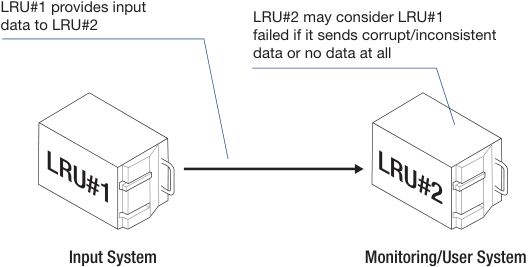
3 An example of Air Data/Inertial Reference Unit (ADIRU) replacement
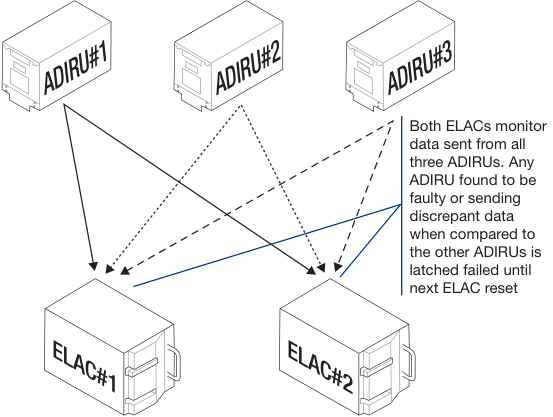
Section titled “3 An example of Air Data/Inertial Reference Unit (ADIRU) replacement”Airbus recently investigated an event in which it was found that an aircraft departed in Alternate Flight control law following maintenance actions not performed fully according to AMM procedure. The circumstances of this event were as follows: During flight an ADR#1 (Air Data Reference) fault was detected. The ELAC (Elevator and Aileron Computer) on detecting this fault, latched the ADR#1 as failed until its next reset. The ELAC subsequently used only ADR#2 and #3 data for calculations.
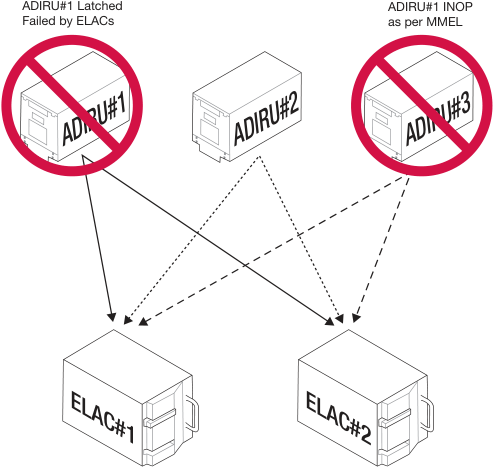
previous flight. In addition it detected that the ADR#3 was INOP. Without ADR#1 or #3, only ADR#2 was considered available. Under these conditions the Electronic Flight Control system is only capable of operating in Alternate Law.
5 Conclusion
Section titled “5 Conclusion”-
Remember to always follow the relevant AMM task, even if each step may not always appear necessary.
-
If in any doubt:
-
Contact Airbus customer support to task for assistance.
-
Perform an electrical reset of the aircraft: cut all aircraft electrical power, wait 5 minutes, and then power up again.
Safety First
Section titled “Safety First”The Airbus Safety Magazine For the enhancement of safe flight through increased knowledge and communications.
Safety First is published by the Flight Safety Department of Airbus. It is a source of specialist safety information for the restricted use of flight and ground crew members who fly and maintain Airbus aircraft. It is also distributed to other selected organisations.
requirements or technical orders. The contents do not supersede any requirements mandated by the State of Registry of the Operator’s aircraft or supersede or amend any Airbus type-specific AFM, AMM, FCOM, MEL documentation or any other approved documentation.
Material for publication is obtained from multiple sources and includes selected information from the Airbus Flight Safety Confidential Reporting System, incident and accident investigation reports, system tests and flight tests. Material is also obtained from sources within the airline industry, studies and reports from government agencies and other aviation sources.
来源: Airbus Safety First 网址: https://safetyfirst.airbus.com/why-do-certain-amm-tasks-require-equipment-resets/ 发布日期: 2008-07-29 杂志期号: 2008-07 类别: 档案 PDF: 原始 PDF
作者:Duncan HARRIS 飞行指引与导航系统工程师 客户服务部
航线可更换件(LRU)更换通常在保持飞机及时起飞的压力下进行,但不应忽视相关的飞机维护手册(AMM)。本文探讨这些 AMM 程序的一个方面,其重要性可能并非总是被完全理解。
虽然 AMM 可能并不总是明确要求复位,但这可以通过 OFF/ON(关/开)操作请求来实现。例如,启动任务时,可能只需要关闭某些 LRU。这可以通过拔出相关跳开关或通过驾驶舱按钮来实现。在任务结束时,当将飞机恢复到原始构型时,操作员需要将 LRU 重新打开。OFF/ON 操作实际上执行了复位。LRU 也可能被关闭,以避免对受影响系统造成电气或数据干扰。
2 为什么某些 AMM 任务需要设备复位?
Section titled “2 为什么某些 AMM 任务需要设备复位?”复位通常是清除系统在维护前或甚至维护期间记录的故障所必需的。一些系统(下面的示例说明了这一点)使用故障锁存机制。也就是说,一旦检测到故障,输入系统将被视为不可用,直到用户系统下次复位。
3 大气数据/惯性参考组件(ADIRU)更换示例
Section titled “3 大气数据/惯性参考组件(ADIRU)更换示例”空中客车公司最近调查了一起事件,发现一架飞机在未完全按照 AMM 程序进行维护操作后以备用飞行控制法则起飞。该事件的情况如下:在飞行过程中检测到 ADR#1(大气数据参考)故障。升降舵和副翼计算机(ELAC)检测到此故障后,将 ADR#1 锁存为失效状态,直到其下次复位。ELAC 随后仅使用 ADR#2 和 #3 的数据进行计算。
前次飞行。此外,它还检测到 ADR#3 失效(INOP)。没有 ADR#1 或 #3,只有 ADR#2 被视为可用。在此条件下,电子飞行控制系统只能以备用法则运行。
-
切记始终遵循相关 AMM 任务,即使每个步骤可能并不总是看起来必要。
-
如有任何疑问:
-
联系空中客车客户支持部门寻求协助。
-
对飞机进行电气复位:切断所有飞机电源,等待 5 分钟,然后重新通电。
空中客车安全杂志 通过增加知识和沟通提高安全飞行水平。
《安全优先》由空中客车飞行安全部出版。它是飞行和地面机组人员(他们驾驶和维护空中客车飞机)的专业安全信息来源。也分发给其他选定机构。
要求或技术指令。本内容不取代注册国对运营人飞机规定的任何要求,也不取代或修改任何空中客车特定机型 AFM、AMM、FCOM、MEL 文件或任何其他批准文件。
发表的材料来自多个来源,包括从空中客车飞行安全保密报告系统、事件和事故调查报告、系统测试和飞行测试中选定的信息。也从航空公司行业、政府机构的研究和报告以及其他航空来源获取材料。