Engine Relight After an All-engine Flameout
Source: Airbus Safety First URL: https://safetyfirst.airbus.com/engine-relight-after-an-all-engine-flameout/ Published: 2024-12-17 Category: Flight Ops, APU, APU Bleed, EMER ELEC, engine failure, restart, start PDF: Original PDF

An all-engine flameout is one of the most stressful situations where flight crews need to urgently relight the aircraft engines. Incorrect application of the engine relight sequence can lead to delayed or unsuccessful engine restarts.
This article describes an in-service event in which such a situation was encountered. It recalls the various steps of the in the ALL ENG FAIL of the engine relight sequence procedure QRH and highlights the improvements that have been made on the operational procedure of A300, A310, A320 family, A330, A340, A350 and A380 aircraft.
Check the latest version of this article on safetyfirst.airbus.com and on the Safety first app for iOS and Android devices.
CASE STUDY
Section titled “CASE STUDY”Event Description
Section titled “Event Description”Diversion to alternate airport
Section titled “Diversion to alternate airport”An A320 aircraft equipped with CFM56-5B engines was approaching its destination airport. Due to adverse weather conditions, the flight crew decided to divert to an alternate airport, where they performed a safe landing at 18:40 local time. After a three-hour stopover, the aircraft departed the diversion airport at 21:51 local time, heading towards its initial destination.
Weather avoidance and storm encounter
Section titled “Weather avoidance and storm encounter”During the night flight, persistent adverse weather remained along their route. ① The flight crew requested a northward deviation to avoid storm cells that they detected on their weather radar. ② The aircraft was cruising at FL 240 with autopilot and autothrust ON when the flight crew executed a 90° left turn toward their final destination.
Severe storm and dual engine flameout
Section titled “Severe storm and dual engine flameout”③ Shortly after the turn, the aircraft encountered severe turbulence and hail. Loud impact noises were heard, and both the left and right windscreen sustained damage. Several ECAM alerts were triggered, including ANTI ICE R WINDSHIELD, ANTI ICE L WINDSHIELD, ENG 1 STALL, NAV RA 2 FAULT.
④ The autopilot and autothrust disconnected, and within one second, the cockpit went dark. Flight recorder data is not available for the following 2 min and 46 s due to an EMER ELEC configuration. ⑤ During this time, the thrust levers were moved to TOGA position.
Both engines had flamed out combined with an unreliable airspeed indication. The flight crew switched the APU to ON. ⑥ When the APU came online, electrical power was restored. The aircraft pitch was -3.5°, corresponding to the pitch provided in the QRH to reach the optimum windmill relight speed. The speed, which was unreliable, was 232 kt indicated on the captain PFD and the aircraft altitude was 18 100 ft (5 900 ft lost from cruise altitude). The aircraft was in ALTERNATE flight control law and thrust levers remained in the TOGA position.
⑦ One windmilling relight attempt of ENG 2 was recorded, then ⑧ the flight crew switched APU BLEED ON and performed several simultaneous attempts (both ENG Master switches ON at the same time) of starter-assisted engine relight with the thrust levers still in the TOGA position. ⑨ The flight crew eventually set the thrust levers to IDLE and both master levers OFF before performing a successful ENG1 starter-assisted relight with ENG 2 master switch left to the OFF position. The altitude was 9 100 ft, representing a loss of 14 900 ft from the cruise altitude. The flight crew then tried to relight engine #2 twice, but both attempts were unsuccessful.
Safe landing with single engine, unreliable airspeed and ALTERNATE law
Section titled “Safe landing with single engine, unreliable airspeed and ALTERNATE law”The aircraft emerged from the storm and continued to the destination airport. ⑩ The flight crew performed a safe landing with a single engine operative, ALTERNATE flight control law, unreliable airspeed indication, and significantly damaged windshields impairing visibility.
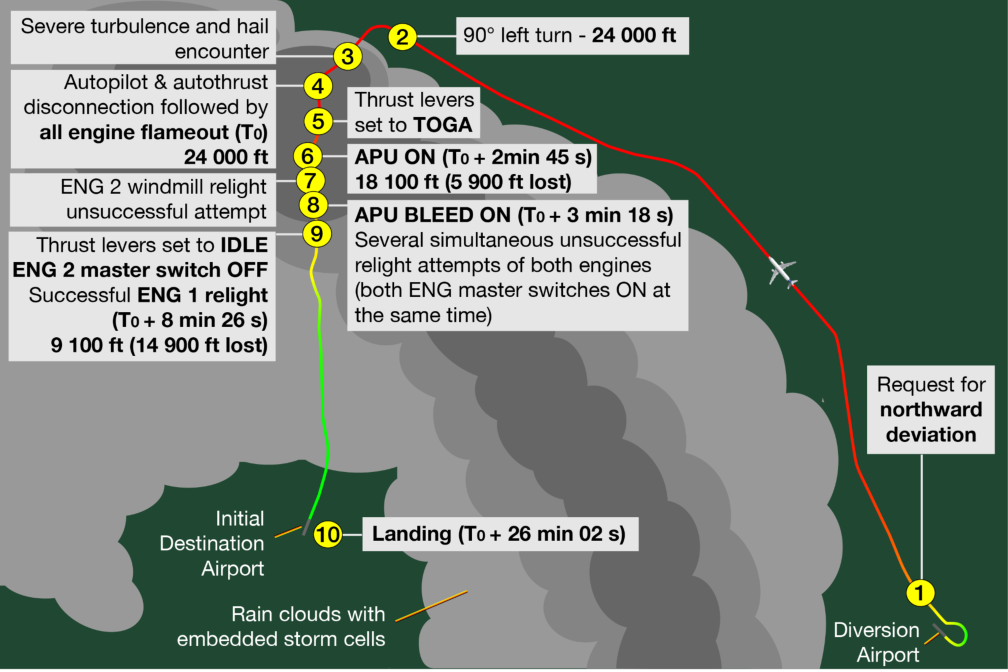
(fg.1) Lateral trajectory of the aircraft during the event
Severely damaged aircraft
Section titled “Severely damaged aircraft”When the aircraft came to a stop, the crew assessed the aircraftʼs damage, including a destroyed radome.
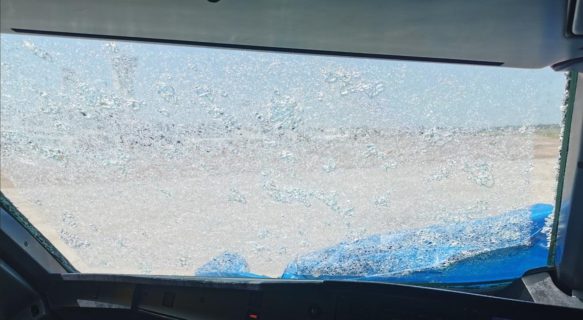
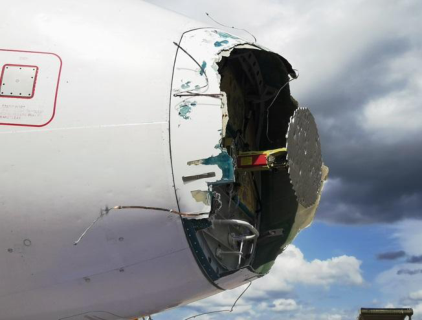
(fig.2) View of the damaged windshield and radome after the event (photos: Investigation Board)
Event Analysis
Section titled “Event Analysis”Unsuccessful weather avoidance
Section titled “Unsuccessful weather avoidance”Night conditions and numerous storms in the area made effective weather avoidance challenging. Despite having an automatic radar and performing both automatic and manual scanning, the flight crew entered a severe hailstorm.
For more information on the use of weather radar for weather avoidance, refer to: - the FCTM “Aircraft Systems - Weather Radar” chapter, - the “Optimum use of weather radar” article published in July 2016, - the “Operational use of the weather radar” WIN video.
- the Pilotʼs guide of the weather radar manufacturer.
Extreme weather conditions
Section titled “Extreme weather conditions”The hailstorm significantly exceeded the engine design and certification criteria. The water/ice content was approximately twice the level for which engines are designed and certified. This explains the observed engine damage and flameout.
Radome damage impact
Section titled “Radome damage impact”Radome damage disrupted airflow around the air data probes, causing unreliable airspeed indications and reversion to the ALTERNATE flight control law.
Thrust lever positioning
Section titled “Thrust lever positioning”The thrust levers remained in the TOGA position during seven relight attempts. The ALL ENG FAIL QRH procedure requires setting the thrust levers to IDLE before attempting to relight the engines.
Unsuccessful engine relight attempts
Section titled “Unsuccessful engine relight attempts”Recorder’s data enabled analysis of the sequence of the various engine relight attempts.
① The flight crew cycled the ENG 2 master switch OFF then ON 2 s later. ② They switched the ENG 1 master switch to OFF. APU BLEED was set to ON shortly after. The ENG 1 master switch was then set back to ON 6s after being switched OFF. 10 s later, ③ the ENG 1 master switch was cycled OFF then ON. 25 s later, both ④ ENG 1 and ⑤ ENG 2 master switches were cycled OFF then ON. The flight crew then ⑥ cycled ENG 1 master switch again shortly followed by ⑦ ENG 2 master switch. All relight attempts were unsuccessful. The thrust levers remained in the TOGA position.
(fig.3) Sequence of unsuccessful relight attempts during the event
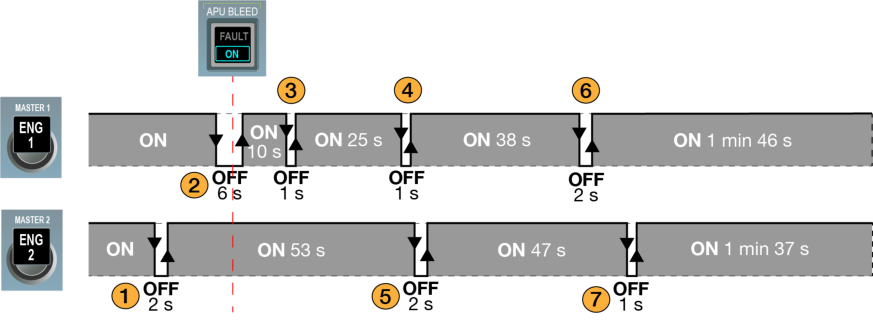
These Simultaneous starter-assisted relight attempts failed due to the fact that APU bleed provides sufficient air pressure to restart only one engine at a time. It was observed that no ventilation of 30s was performed between each relight attempt.
Successful ENG 1 relight
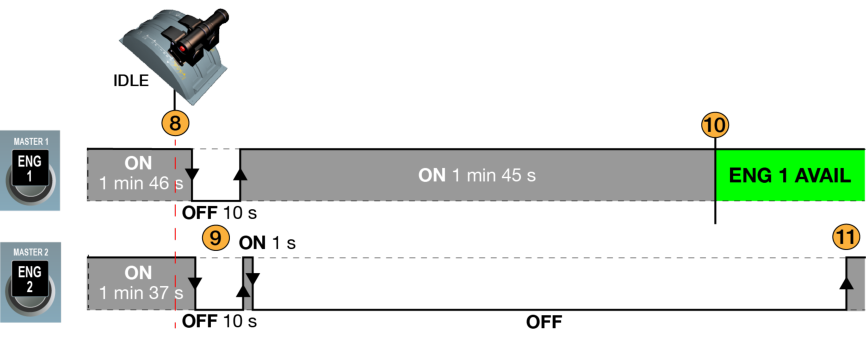
Section titled “Successful ENG 1 relight”⑧ The crew then set the thrust levers to IDLE and ⑨ set both engine master switches to OFF. The ENG 1 master switch was set back to ON, while the ENG 2 master switch was briefly set to ON then back to OFF. Within 1 minute and 45 seconds, ENG1 N2 and EGT increased and ⑩ ENG1 successfully restarted.
The ENG 2 master switch being OFF enabled sufficient bleed pressure to be delivered to ENG 1 starter for a successful relight.
(fig.4) Successful ENG 1 relight
Damaged ENG2
Section titled “Damaged ENG2”⑪ The flight crew then tried two ENG 2 relights, but both attempts remained unsuccessful. Detailed inspection revealed sufficient damage to ENG 2 preventing successful inflight restart.
Significant relight time and altitude loss
Section titled “Significant relight time and altitude loss”ENG 1 became available 8 min 26 s after the all-engine flameout. The aircraft altitude was 9 100 ft, representing a loss of 14 900 ft from the 24 000 ft initial cruise altitude.
OPERATIONAL CONSIDERATIONS
Section titled “OPERATIONAL CONSIDERATIONS”Careful application of the windmill and starter-assisted relight procedures in the ALL ENG FAIL QRH procedure (A300, A310, A320 family, A330 and A340 aircraft) and in the ENG ALL ENGINES FAILURE ECAM alert (A350 and A380 aircraft) is critical for successful in-flight engine restart.
Windmill Relight
Section titled “Windmill Relight”In the case of an all-engine flameout, the windmill relight is possible at higher altitudes while the starter assisted relight is only available below FL200. In addition, a windmill relight enables the flight crew to perform simultaneous engine restart attempts.
①Maintain optimum relight speed
Section titled “①Maintain optimum relight speed”Maintaining aircraft optimum relight speed provides sufficient airflow for the engines to reach a rotation speed that produces sufficient compression of the air in the compressor and combustion chamber necessary for a successful engine relight.
The optimum relight speed is provided:
| ● | in the | ENG ALL ENGINES FAILURE | ENG ALL ENGINES FAILURE | ENG ALL ENGINES FAILURE | ECAM alert and in the QRH | ALL |
|---|---|---|---|---|---|---|
| ENG FAIL | procedure of A320 family, A330 and A340 aircraft | |||||
| ● | in the | ENG ALL ENGINES FAILURE ECAM alert of A350 and A380 | ||||
| aircraft | ||||||
| ● | in the | ALL ENG FAILFCOM/QRH memory item of A300 and A310 aircraft. |
②Thrust levers set to IDLE
Section titled “②Thrust levers set to IDLE”Positioning the thrust levers to idle will enable stable idle restart, and a reduced risk of stall that may be caused by immediate acceleration to high thrust if the thrust levers remained above the idle position.
③ENG mode selector set to IGN
Section titled “③ENG mode selector set to IGN”Set ENG mode selector to IGN to activate combustion chamber ignitors.
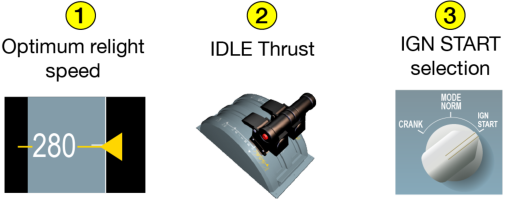
(fig.5) First steps of the windmill relight sequence
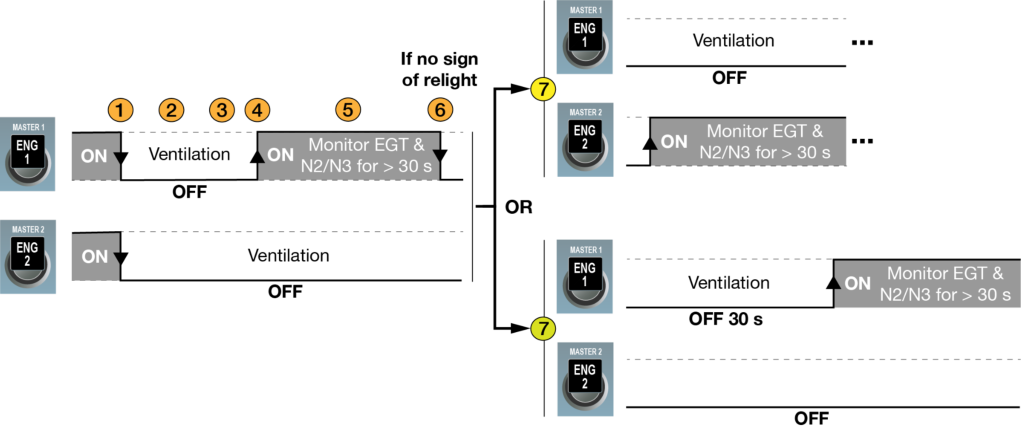
④ALL ENG MASTER switches to OFF for 30 s
Section titled “④ALL ENG MASTER switches to OFF for 30 s”This step will ventilate the combustion chamber to remove any residual fuel before the first relight attempt, and between relight attempts. Failure to ventilate the engine may result in an engine stall, an EGT overlimit, a tailpipe fire, or an unsuccessful relight attempt.
⑤ALL ENG Master switches to ON
Section titled “⑤ALL ENG Master switches to ON”All ENG MASTER switches can be simultaneously set to ON for windmill relight attempts.
⑥Monitor Engine parameters for at least 30 s
Section titled “⑥Monitor Engine parameters for at least 30 s”Monitor the EGT and N2 (N3 for Rolls Royce engines) for signs of relight for at least 30 s. If increase in N2/N3 and EGT is observed, continue with the relight attempt.
A successful in-flight windmill relight can take up to 2 minutes.
⑦Repeat attempts if no restart occurs
Section titled “⑦Repeat attempts if no restart occurs”If no sign of relight appears within 30 s, switch both engine master levers to OFF for 30 s to ventilate the engines and repeat the relight attempts until successful, or until reaching FL 200 where a starter-assisted relight can be attempted.
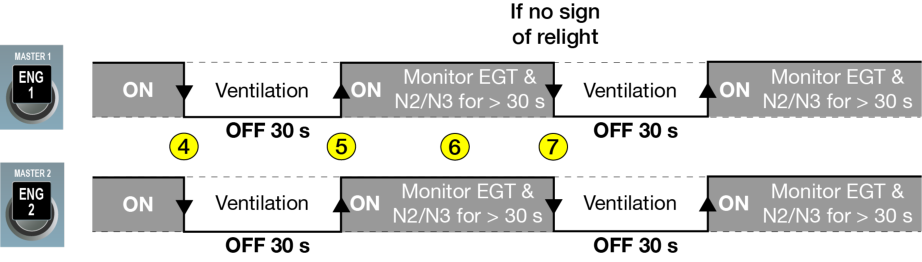
(fig.6) Windmill relight sequence (simultaneous relight attempts)
Starter-Assisted Relight (Below FL 200)
Section titled “Starter-Assisted Relight (Below FL 200)”The ALL ENG FAIL QRH procedure requests to start the APU when below the upper limit of the APU battery restart envelope, enabling recovery of the electrical power and the use of APU bleed. Below FL 200, if the windmill relight was unsuccessful and if the APU is available, the flight crew can attempt a starter-assisted relight. Only one engine (two on A380 aircraft) can be restarted at a time when attempting a starter-assisted engine relight.
Thrust levers set to IDLE
Section titled “Thrust levers set to IDLE”The thrust levers should already be set to IDLE in the first part of the procedure.
ENG mode selector set to IGN
Section titled “ENG mode selector set to IGN”The ENG mode selector should also already be in the IGN position to activate combustion chamber ignitors.
①ENG MASTER switches to OFF Each engine must first be switched off for ventilation to remove residual fuel from the combustion chamber before any engine relight attempt. The time to perform the next two steps ensure a sufficient ventilation close to 30 s.
②Reduce speed to green dot speed
Section titled “②Reduce speed to green dot speed”Reducing the speed down to green dot speed reduces the aircraft rate of descent. ③APU BLEED ON (fig.7) First steps of the starter-assisted relight APU BLEED should be set to ON. sequence
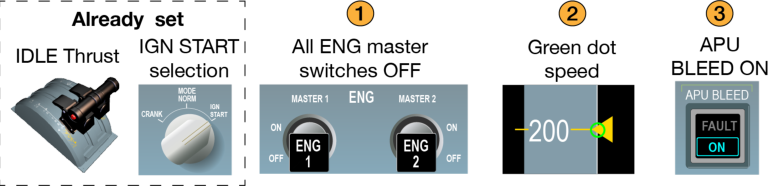
|---|---|
PRODUCT ENHANCEMENTS
Section titled “PRODUCT ENHANCEMENTS”Operational Documentation Improvement
Section titled “Operational Documentation Improvement”The event described previously led Airbus to improve the operational documentation to prevent misinterpretation of the starter-assisted relight procedure included in the ALL ENG FAIL procedure of A300, A300-600, A310, A320 family, A330, A340, A350 and A380 aircraft. The update of the ALL ENG FAIL procedure in QRH/FCOM (for A300/A310/A320/A330/A340) and ECAM/FCOM (for A350/A380) is also associated to an update of the All Engines Failure procedure in the FCTM. This improvement is available in the following documentation revisions:
-
A320 family, A330 and A340 aircraft: November 2024
-
A300, A300-600 and A310 aircraft: March 2025
-
A350 aircraft: mid 2025
-
A380 aircraft: 2026
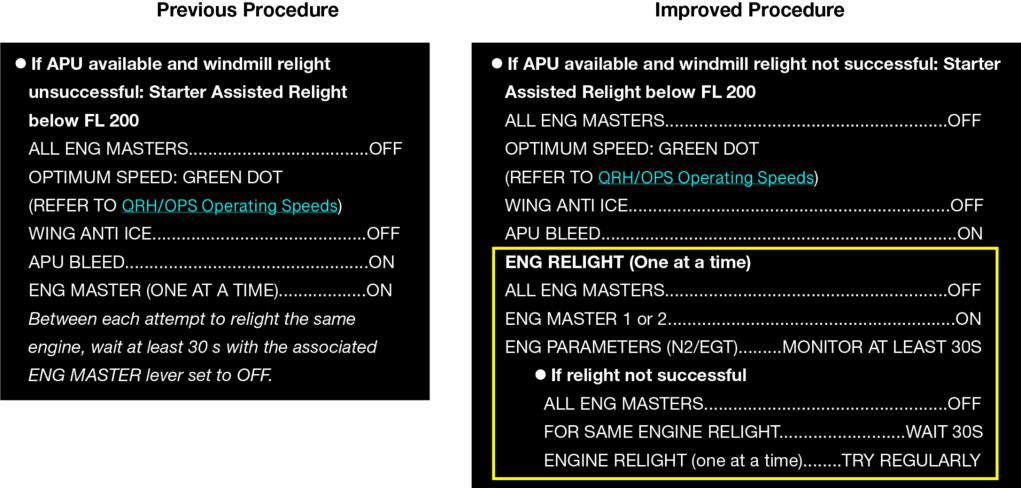
(fig.9) Example of the procedure update on A320 family aircraft
Flight Warning System Enhancements (A350 and A380 aircraft)
Section titled “Flight Warning System Enhancements (A350 and A380 aircraft)”A Flight Warning System update is under study on A350 and A380 aircraft to improve the ECAM procedure.
Contributors:
Section titled “Contributors:”Céline BELLOCQ
Section titled “Céline BELLOCQ”Flight Ops Engineering & Support Specialist Customer Support
David BOYER
Section titled “David BOYER”Expert Engine Control Technology & Development Design Office
Tuan DO
Section titled “Tuan DO”HO Overall System Flight Tests Flight tests department
Sunny GUPTA
Section titled “Sunny GUPTA”Accident/Incident Investigator Aviation Safety
An all-engine flameout is a high-stress situation that requires immediate and precise crew action. Successful engine relight depends on meticulous execution of the procedure.
The 30 seconds engine ventilation removes any residual fuel from the engineʼs combustion chamber before the first relight attempt, and between relight attempts if unsuccessful. It prevents risks of engine stall, EGT overlimit, tailpipe fire or unsuccessful relight.
Windmill relights enable attempts to restart all engines at the same time at higher altitude.
Starter-assisted relights enable restart of only one engine at a time (two engines at a time on A380 aircraft only) due to APU bleed air limitations and can only be performed below FL200.
Flight crew should monitor the EGT and N2 (N3 for Rolls Royce engines) for signs of relight for at least 30 s. If there are signs of relight within 30 sec, continue with the current engine restart attempt. A successful in-flight relight may take up to 2 minutes. If there are no signs of relight within 30 s, set all ENG MASTER switches to OFF and initiate a new relight attempt.
Maxime LANSONNEUR
Section titled “Maxime LANSONNEUR”Director Safety - Training and Flight Operations Customer Support
The event described in this article also illustrates the importance of maintaining situational awareness during emergencies, and correctly applying QRH procedures during an extremely high stress situation.
Antoine PILON
Section titled “Antoine PILON”Expert UERF Prevention & Protection Design Office
Safety first, 2024. Safety first is published by Airbus S.A.S. 1, rond point Maurice Bellonte - 31707 Blagnac Cedex/France.
Editor: Yannick Malinge, SVP AViation Safety.
Editorial team: Guillaume Estragnat, Vanessa Sadi, Gwyneth Duggan, Javier Martinez Marina, Tim Roach.
Photos by Airbus.
双发熄火后的发动机重新点火
Section titled “双发熄火后的发动机重新点火”来源:Airbus Safety First 网址:https://safetyfirst.airbus.com/engine-relight-after-an-all-engine-flameout/ 发布日期:2024-12-17 类别:飞行运营、APU、APU引气、EMER ELEC、发动机失效、重启、启动 PDF:原始PDF
双发熄火是飞行机组需要紧急重新点燃飞机发动机的最具压力的情境之一。错误执行发动机重新点火程序可能导致发动机重启延迟或失败。
本文描述了一起实际发生的事件,飞行机组遇到了此类情况。文章回顾了QRH中ALL ENG FAIL发动机重新点火程序的各种步骤,并重点介绍了A300、A310、A320系列、A330、A340、A350和A380飞机操作程序的改进。
请在safetyfirst.airbus.com网站和安全第一APP(iOS和Android设备)上查看本文的最新版本。
一架配备CFM56-5B发动机的A320飞机正在接近目的地机场。由于天气条件不利,机组决定备降至备降机场,于当地时间18:40安全落地。经过三小时的停留后,飞机于当地时间21:51从备降机场起飞,前往原定目的地。
天气绕飞与遭遇风暴
Section titled “天气绕飞与遭遇风暴”夜间飞行期间,不利天气持续分布在航线上。① 机组通过气象雷达探测到雷暴单体,申请向北偏航以避开风暴。② 飞机在FL 240高度层巡航,自动驾驶和自动推力接通,机组执行了90°左转飞向目的地。
强烈风暴与双发熄火
Section titled “强烈风暴与双发熄火”③ 转弯后不久,飞机遭遇强烈颠簸和冰雹。听到了巨大的撞击声,左、右风挡均受损。触发了多个ECAM警告,包括ANTI ICE R WINDSHIELD(右侧风挡防冰)、ANTI ICE L WINDSHIELD(左侧风挡防冰)、ENG 1 STALL(发动机1失速)、NAV RA 2 FAULT(导航无线电高度表2故障)。
④ 自动驾驶和自动推力断开,一秒钟后,驾驶舱陷入黑暗。由于EMER ELEC构型,飞行记录仪数据在随后的2分46秒内不可用。⑤ 在此期间,推力手柄被移动至TOGA位置。
两台发动机同时熄火,空速指示不可靠。机组将APU开关置于ON。⑥ 当APU上线后,恢复了电力供应。飞机俯仰角为-3.5°,对应QRH中提供的最佳风车重新点火速度。不可靠的空速在机长PFD上显示为232节,飞机高度为18,100英尺(从巡航高度下降了5,900英尺)。飞机处于ALTERNATE(备份)飞行控制法则,推力手柄保持在TOGA位置。
⑦ 记录到一次ENG 2风车重新点火尝试,随后⑧ 机组将APU BLEED接通,并进行了多次同时尝试(两个ENG Master开关同时接通),使用推力手柄仍在TOGA位置的起动机辅助发动机重新点火。⑨ 机组最终将推力手柄设置为IDLE,两个主电门关闭,随后成功完成ENG 1起动机辅助重新点火,ENG 2主电门保持在OFF位置。当时高度为9,100英尺,比巡航高度下降了14,900英尺。机组随后两次尝试重新点燃2号发动机,但均未成功。
单发、不可靠空速与ALTERNATE法则的安全落地
Section titled “单发、不可靠空速与ALTERNATE法则的安全落地”飞机脱离风暴,继续飞往目的地机场。⑩ 机组在单发运转、ALTERNATE飞行控制法则、不可靠空速指示以及风挡严重受损影响视界的情况下安全落地。
(图1) 事件期间飞机的横向轨迹
严重受损的飞机
Section titled “严重受损的飞机”飞机停稳后,机组评估了飞机损伤,包括被摧毁的雷达罩。
(图2) 事件后受损风挡和雷达罩的照片(照片来源:调查委员会)
不成功的天气绕飞
Section titled “不成功的天气绕飞”夜间条件和该区域大量风暴使得有效的天气绕飞面临挑战。尽管使用了自动气象雷达并进行了自动和手动扫描,机组仍然进入了一个强烈的冰雹区。
有关使用气象雷达进行天气绕飞的更多信息,请参阅:
-
FCTM“飞机系统 - 气象雷达”章节,
-
2016年7月发布的“最佳使用气象雷达”文章,
-
“气象雷达的操作使用”WIN视频。
-
气象雷达制造商的飞行员指南。
Extreme weather conditions
Section titled “Extreme weather conditions”冰雹严重超出发动机设计和认证标准。水/冰含量大约是发动机设计和认证标准的两倍。这解释了所观察到的发动机损伤和熄火现象。
Radome damage impact
Section titled “Radome damage impact”天线罩损坏扰乱了空速传感器周围的气流,导致空速指示不可靠,并触发备用飞控法则。
Thrust lever positioning
Section titled “Thrust lever positioning”在七次重新点火尝试期间,推力手柄一直保持在 TOGA 位置。ALL ENG FAIL QRH 程序要求在尝试重新点火发动机前,将推力手柄设置为 IDLE。
Unsuccessful engine relight attempts
Section titled “Unsuccessful engine relight attempts”记录器数据使各发动机重新点火尝试的顺序分析成为可能。
① 机组将 ENG 2 主电门切换至 OFF,2 秒后再切换至 ON。② 他们将 ENG 1 主电门切换至 OFF。此后不久将 APU BLEED 设置为 ON。ENG 1 主电门在切换至 OFF 后 6 秒再切换回 ON。10 秒后,③ 将 ENG 1 主电门循环切换 OFF 再 ON。25 秒后,④ ENG 1 和 ⑤ ENG 2 主电门均循环切换 OFF 再 ON。随后机组 ⑥ 再次循环切换 ENG 1 主电门,随后 ⑦ 循环切换 ENG 2 主电门。所有重新点火尝试均未成功。推力手柄保持在 TOGA 位置。
(图 3) 事件期间不成功的重新点火尝试顺序
这些同时起动机辅助重新点火尝试失败,原因是 APU 引气提供的压力仅足以一次重新启动一台发动机。据观察,各重新点火尝试之间未进行 30 秒的通风。
Successful ENG 1 relight
Section titled “Successful ENG 1 relight”⑧ 机组随后将推力手柄设置为 IDLE,⑨ 并将两个发动机主电门设置为 OFF。ENG 1 主电门切换回 ON,同时 ENG 2 主电门短暂切换至 ON 后再切回 OFF。在 1 分 45 秒内,ENG1 的 N2 和 EGT 上升,⑩ ENG1 成功重新启动。
ENG 2 主电门处于 OFF 位置使得足够的引气压力能够输送至 ENG 1 起动机,从而成功重新点火。
(图 4) 成功的 ENG 1 重新点火
Damaged ENG2
Section titled “Damaged ENG2”⑪ 机组随后尝试两次 ENG 2 重新点火,但两次尝试均未成功。详细检查发现 ENG 2 受损严重,无法进行空中重新启动。
Significant relight time and altitude loss
Section titled “Significant relight time and altitude loss”ALL ENG FAIL 发生后 8 分 26 秒 ENG 1 恢复可用。当时飞机高度为 9 100 ft,相较于 24 000 ft 的初始巡航高度下降了 14 900 ft。
OPERATIONAL CONSIDERATIONS
Section titled “OPERATIONAL CONSIDERATIONS”仔细执行 ALL ENG FAIL QRH 程序(A300、A310、A320 系列、A330 和 A340 飞机)和 ENG ALL ENGINES FAILURE ECAM 警告(A350 和 A380 飞机)中的风车和起动机辅助重新点火程序,对于成功进行空中发动机重新启动至关重要。
Windmill Relight
Section titled “Windmill Relight”在双发熄火的情况下,风车重新点火可在较高高度进行,而起动机辅助重新点火仅在 FL200 以下可用。此外,风车重新点火使机组能够同时尝试重新启动两台发动机。
①Maintain optimum relight speed
Section titled “①Maintain optimum relight speed”①保持最佳重新点火速度
保持飞机最佳重新点火速度可为发动机提供足够的气流,使其达到产生足够压缩所需的转速,从而压缩压气机和燃烧室中的空气,实现成功的发动机重新点火。
最佳重新点火速度提供位置:
| ● | 在 | ENG ALL ENGINES FAILURE | ENG ALL ENGINES FAILURE | ENG ALL ENGINES FAILURE | ECAM 警告及 QRH | ALL |
|---|---|---|---|---|---|---|
| ENG FAIL | A320 系列、A330 和 A340 飞机 | |||||
| ● | 在 | ENG ALL ENGINES FAILURE A350 和 A380 | ||||
| 飞机 | ||||||
| ● | 在 | ALL ENG FAILFCOM/QRH 记忆项目 A300 和 A310 飞机。 |
②Thrust levers set to IDLE
Section titled “②Thrust levers set to IDLE”②推力手柄置于 IDLE
将推力手柄置于怠速位置将实现稳定的怠速启动,并降低因推力手柄保持在怠速以上位置而可能导致的立即加速至高推力所带来的失速风险。
③ENG mode selector set to IGN
Section titled “③ENG mode selector set to IGN”③发动机模式选择器置于 IGN
将 ENG 模式选择器置于 IGN 以激活燃烧室点火器。
(图 5) 风车重新点火程序的第一步
④ALL ENG MASTER switches to OFF for 30 s
Section titled “④ALL ENG MASTER switches to OFF for 30 s”④两个 ENG 主电门置于 OFF 30 秒
此步骤将对燃烧室进行通风,以清除任何残余燃油,然后进行首次重新点火尝试,并在各次重新点火尝试之间进行通风。未对发动机进行通风可能导致发动机失速、EGT 超限、尾喷管着火或重新点火尝试失败。
⑤ALL ENG Master switches to ON
Section titled “⑤ALL ENG Master switches to ON”⑤两个 ENG 主电门置于 ON
两个 ENG 主电门可同时置于 ON 以进行风车重新点火尝试。
⑥Monitor Engine parameters for at least 30 s
Section titled “⑥Monitor Engine parameters for at least 30 s”⑥监控发动机参数至少 30 秒
监控 EGT 和 N2(罗尔斯·罗伊斯发动机为 N3)至少 30 秒,观察重新点火的迹象。如果观察到 N2/N3 和 EGT 上升,继续进行重新点火尝试。
成功的空中风车重新点火最多可能需要 2 分钟。
⑦Repeat attempts if no restart occurs
Section titled “⑦Repeat attempts if no restart occurs”⑦如果未重新启动则重复尝试
如果在 30 秒内未出现重新点火迹象,将两个发动机主电门切换至 OFF 30 秒以通风发动机,并重复重新点火尝试,直至成功,或到达 FL200,在该高度可尝试起动机辅助重新点火。
(图 6) 风车重新点火程序(同时重新点火尝试)
起动机辅助重启(低于 FL 200)
Section titled “起动机辅助重启(低于 FL 200)”ALL ENG FAIL QRH 程序要求在低于 APU 电瓶重启包线上限的高度启动 APU,以便恢复电力并使用 APU 引气。低于 FL 200 时,如果风车重启不成功且 APU 可用,飞行机组可以尝试起动机辅助重启。尝试起动机辅助发动机重启时,一次只能重启一台发动机(A380 飞机一次可重启两台)。
推力手柄设置为 IDLE
Section titled “推力手柄设置为 IDLE”推力手柄在程序的第一部分应已设置为 IDLE。
发动机模式选择器设置为 IGN
Section titled “发动机模式选择器设置为 IGN”发动机模式选择器也应已置于 IGN 位以激活燃烧室点火器。
① 发动机主电门设置为 OFF 在任何发动机重启尝试之前,必须先将每台发动机关闭,以通风方式清除燃烧室内的残余燃油。执行以下两个步骤的时间确保约 30 秒的充分通风。
② 减速至绿点速度
Section titled “② 减速至绿点速度”将速度减至绿点速度可降低飞机下降率。③ APU 引气 ON(图 7) 起动机辅助重启程序的第一步 APU 引气应设置为 ON。序列
|---|---|
运行文件改进
Section titled “运行文件改进”此前描述的事件促使空客改进了运行文件,以防止对 A300、A300-600、A310、A320 系列、A330、A340、A350 和 A380 飞机 ALL ENG FAIL 程序中包含的起动机辅助重启程序的误解。QRH/FCOM(A300/A310/A320/A330/A340)和 ECAM/FCOM(A350/A380)中 ALL ENG FAIL 程序的更新也与 FCTM 中双发停车程序的更新相关联。此项改进已在以下文件修订中提供:
-
A320 系列、A330 和 A340 飞机:2024 年 11 月
-
A300、A300-600 和 A310 飞机:2025 年 3 月
-
A350 飞机:2025 年中
-
A380 飞机:2026 年
(图 9) A320 系列飞机程序更新示例
飞行警告系统增强(A350 和 A380 飞机)
Section titled “飞行警告系统增强(A350 和 A380 飞机)”A350 和 A380 飞机的飞行警告系统正在研究中,以改进 ECAM 程序。
Céline BELLOCQ
Section titled “Céline BELLOCQ”飞行运营工程与支援专家 客户支援
David BOYER
Section titled “David BOYER”发动机控制技术与开发专家 设计办公室
Tuan DO
Section titled “Tuan DO”系统总体飞行试验负责人 飞行试验部门
Sunny GUPTA
Section titled “Sunny GUPTA”事故/事故调查员 航空安全
双发停车是高应激情况,需要立即采取精确的机组行动。成功重启发动机取决于对程序的细致执行。
30 秒的发动机通风可在首次重启尝试前清除发动机燃烧室内的残余燃油,并在重启不成功时在重启尝试之间进行清除。它可防止发动机喘振、排气温度超限、尾喷管着火或重启不成功的风险。
风车重启可在较高高度同时尝试重启所有发动机。
起动机辅助重启由于 APU 引气量的限制,一次只能重启一台发动机(A380 飞机一次可重启两台),且只能在 FL 200 以下执行。
飞行机组应监控排气温度和 N2(罗尔斯·罗伊斯发动机为 N3)至少 30 秒,以观察重启迹象。如果在 30 秒内出现重启迹象,继续当前的发动机重启尝试。成功的空中重启可能需要长达 2 分钟。如果在 30 秒内没有重启迹象,将所有发动机主电门设置为 OFF,并开始新的重启尝试。
Maxime LANSONNEUR
Section titled “Maxime LANSONNEUR”安全总监——培训与飞行运营 客户支援
本文所述的事件也说明,在紧急情况下保持态势意识的重要性,以及在极端高应激情况下正确应用 QRH 程序的重要性。
Antoine PILON
Section titled “Antoine PILON”不安全事件预防与保护专家 设计办公室
Safety first,2024 年。Safety first 由空中客车股份有限公司出版。地址:1, rond point Maurice Bellonte - 31707 Blagnac Cedex/法国。
编辑:Yannick Malinge,航空安全高级副总裁。
编辑团队:Guillaume Estragnat、Vanessa Sadi、Gwyneth Duggan、Javier Martinez Marina、Tim Roach。
照片由空客提供。