High-altitude manual flying
Source: Airbus Safety First URL: https://safetyfirst.airbus.com/high-altitude-manual-flying/ Published: 2015-06-29 Magazine Issue: 2015-07 Category: Flight Ops, alternate, altitude, AoA, ap, athr, attack, buffet, ceiling, compressibility, flying, laws, mach, manual, md, mmo, normal, pitch, stall, test, vd, vmo PDF: Original PDF
036 Safety First #20 | July 2015
Section titled “036 Safety First #20 | July 2015”“Had I not known this, understood that or paid attention to that, I wouldn’t be here with you today” was a sentence Jacques often repeated when he referred to some of the thousands of fl ights he performed either as a fi ghter pilot or as an experimental test pilot. Sadly, Jacques is no longer with us today. He was a genius pilot, a humble man, a great man. Aviation was his passion, safety his quest. He was always ready to share his knowledge, experience and wisdom to improve safety, as he did with the following article.
HE WILL BE MISSED…
GENERAL TOPIC
Section titled “GENERAL TOPIC”High-altitude manual fl ying
High-altitude manual fl ying
Section titled “High-altitude manual fl ying”Flying an aircraft manually at high altitudes, and therefore necessarily at high Mach number, is a completely different discipline to what it may be like at low altitudes. As it turns out, opportunities to experience manual fl ying at high altitudes are rare in a pilot’s career. Yet, regulations do require it in certain circumstances, such as when the Auto Pilot is unavailable.
JACQUES ROSAY Experimental Test Pilot Former Airbus Chief Test Pilot

Most of the time, commercial aircraft fly at high altitudes, above FL 290. In other words, they fly within the RVSM (Reduced Vertical Separation Minima) space that extends from FL 290 to 410 included, and which now covers a very large part of the world’s airspace. As it turns out, use of the Auto Pilot (AP) within this airspace is mandatory, meaning that the regulations actually prevent the pilots from acquiring practical manual flying experience of their aircraft within the part of the envelope where they most often fly.
Pushing this paradox further, in certain cases, especially if the AP is unavailable, these same regulations require that the pilots manually fly the aircraft to rapidly leave this airspace in coordination with air traffic control. In other words, pilots are requested to do maneuvers for which practicing in flight is prohibited.
However, the behaviour of an aircraft at high altitude is significantly different from that of an aircraft at low and medium altitudes.
The aim of this article is to recall some qualitative aerodynamic, flight mechanics and handling qualities notions specific to the high Mach numbers and to high altitudes, to share practical experiences lived by Airbus test pilots in these domains and to make suggestions for training. Lastly, note that, apart from passages specifically dedicated to the normal and alternate electrical flight control laws, the whole of this article applies to all types of commercial aircraft whether equipped with electrical flight controls or not.
AERODYNAMIC ESSENTIALS
Section titled “AERODYNAMIC ESSENTIALS”The effects of Mach number
Section titled “The effects of Mach number”The air flow around the wings accelerates on the upper surface creating a negative pressure and it is this negative pressure which mainly keeps the aircraft up (fig.1).
When the altitude increases and the air density falls, more aerodynamic speed is required to create the lift required for a given lift configuration. This reduction in the density and this increase in the aerodynamic speed is accompanied by an increase in the Mach number required for flight. We have seen that by passing over the wings, the
air flow accelerates on the upper surface. Therefore, the local Mach number around the wings is much higher than the aircraft flight Mach number and in certain locations reaches transonic values. In high-altitude stabilised flight, shock waves can be seen at certain locations by looking at the upper surface through the cabin windows.
This sonic phenomenon around the wings leads to a degradation of their aerodynamic properties. This, in turn, leads mainly to a reduction in the maximum lift angle of attack as the
(fig.1) Air flow around an airfoil
Mach number increases, which significantly reduces the stall margin. Thus, at a high-altitude normal cruise Mach number value, when the angle of attack is increased to produce the load factor required to make a turn or a pull-out, the angle-of-attack limit is more easily approached than when the same maneuver is done at low altitude and at a low Mach number. Also, on most aircraft with sweepback
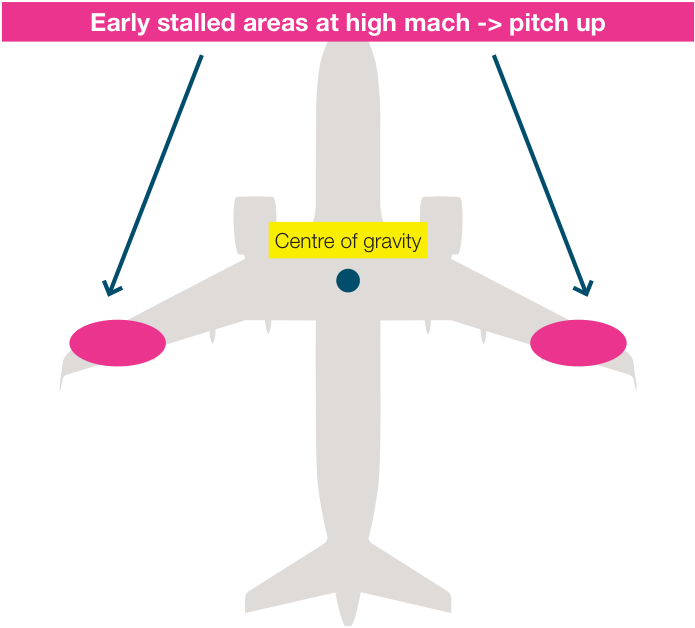
wings, another well-known phenomenon is added to the previous one. As the local Mach numbers along the span are not identical, the distribution of the lift does not vary uniformly with the angle of attack. This creates nonlinearities in the longitudinal balance of the aircraft most classically leading to spontaneous pitch-up tendencies or to self-tightening of the turn when the angle of attack increases (fig.2).
in manual flying, the aerodynamic speed is 260 kt. When flying at FL350 at M 0.85, at standard temperature, the aerodynamic speed is 490 kt. If the temperature is ISA + 12°, the aerodynamic speed is then 500 kt. That is practically twice as fast as the highest speeds usually seen at low altitude.
This difference is not without consequences on flying. For example, for a maneuver at identical load factor, the radius of curvature of an altitude capture is multiplied by four and therefore, starting from a given slope, anticipation for this maneuver must be multiplied by four in order not to exceed the target altitude.
(fig.2)
Section titled “(fig.2)”Early stalled areas along the wings
If a Pilot has to fly manually at high altitude, he/she will not find the characteristics he/ she is familiar with at low altitude.
High-altitude manual fl ying
GENERAL TOPIC
Section titled “GENERAL TOPIC”Compressibility stall
Section titled “Compressibility stall”(fi g.3) General tendency in the evolution of the maximum angle-of-attack ( α ) versus the Mach number
α Stall
Section titled “α Stall”for fl ight at supersonic speeds. Pilots who have fl own on the T33 or the Alpha Jet may perhaps remember having reached subsonic Mach numbers beyond which the wings were incapable of providing a load factor of 1 g. Level fl ight could not be maintained: compressibility stall was reached. The Mach number had to be reduced to regain the load factor authority required for straight level fl ight. On the Alpha Jet in particular, with a little patience and a very small amount of fuel on-board, it is even possible to climb to an altitude where it was neither possible to decelerate due to low Mach number stall nor to accelerate due to compressibility stall. There was only one single practicable fl ight point: the aerodynamic ceiling was reached.
We have seen that when the Mach number increases, the maximum lift angle-of-attack is reduced (fi g.3).
We can imagine that at a certain point in the increase of the Mach, the angleof-attack can theoretically be so limited that the maximum lift the wings are capable of producing becomes insuffi cient to sustain the weight of the aircraft. In certain aerodynamic manuals, this theoretical point is called the “compressibility stall”.
It depends on the evolution of the curve lift versus Mach. This change depends on many aerodynamic characteristics of the aircraft, such as the wing profi le, the chord, the sweep, the span, etc. Remember that this phenomenon does not exist on an aircraft where the wings are designed

Mach
Aerodynamic ceiling and buffeting margin
Section titled “Aerodynamic ceiling and buffeting margin”In practice, even if the compressibility stall and the aerodynamic ceiling can theoretically exist in aerodynamics in certain cases, they cannot be reached by a certifi ed commercial aircraft and this for several reasons. Let us see why.
- The certifi cation regulations require that throughout the fl ight envelope, up to MMO, irrespective of the weight, the aircraft must have a buffeting margin of 0.3 g.
This means that a load factor of 1.3 g must be attainable before “buffet onset” is encountered. “Buffet onset”
is defi ned such that when an accelerometer located under the pilot’s seat measures peak-to-peak accelerations higher than 0.1 g. Therefore, the aircraft MMO value and the lift ceiling (which depends on the weight) are by defi nition such that there is always a buffeting margin of at least 0.3 g and therefore, a margin well above the compressibility stall is ensured.
- The certifi cation regulations also require that the fl ight tests check that the aircraft can fl y above MMO up to MD.
MD is the highest Mach number at
which the aircraft must be able to fl y without structural anomalies (this is the fl utter margin) and without substantial degradation in the handling qualities allowing the aircraft to be always easily controlled. It is determined by calibrated maneuvers (FAA dive, JAA dive) defi ned by the certifi cation regulations. In practice, typically MD = MMO + 0.06.
DETERMINING MD IN FLIGHT TESTS
Section titled “DETERMINING MD IN FLIGHT TESTS”During the fl ight test, MD must be reached fairly quickly by an accentuated dive before encountering another limit: the absolute speed limit VD (typically VD = VMO + 35 kt), which is approached as the altitude drops. For this, Airbus test pilots start from the aircraft ceiling, in direct law, at a Mach as close to MMO as possible. Then they accelerate by a dive with an attitude of around -15° at the start of the maneuver with engines at full throttle. When MD is reached, this Mach is maintained by adjusting the
To conclude, the regulatory criteria related to the buffeting margin at MMO and to the fl ight characteristics up to MD imply that the “compressibility stall” and “aerodynamic ceiling” phe-
pitch attitude and then, the structure is excited by programmed impulses into the fl ight controls. The purpose of this is to check that there are no divergent structure oscillations (fl utter). Then, test pilots do a positive pull-out, engines idling, to return to the normal fl ight envelope. This pullout requires an important increase in the load factor and demonstrates that compressibility stall is still far from being reached. However, the buffeting margin of 0.3 g is no longer observed beyond MMO and approach of MD at n = 1 is in reality
nomena cannot be physically encountered due to the design of the aircraft. “Compressibility stall” does not exist on current commercial aircraft.
done with moderate buffeting, but the aircraft can still be controlled and maneuvered. Beyond MD, the structural integrity of the aircraft is no longer ensured! Based on the experience accumulated at Airbus and seeing how many aircraft still respond very well at MD load factor, very serious structural problems will be encountered before fi nding a possible compressibility stall which, if it exists, can be found only at Mach numbers well above MD, probably above Mach 1.
FLYING MANUALLY
Section titled “FLYING MANUALLY”Defi nition
Section titled “Defi nition”It would be interesting to survey pilots as to what they understand by the terms “fl ying manually”. Personally, I have often heard during test, demonstration, acceptance or airline fl ights, colleagues, young or older, airline pilots or test pilots, proudly say that they would do such or such a part of the fl ight - in general a complete approach followed by a landing - “in manual control mode”. I would then observe how they performed and saw that all they did was actually disconnect the AP and servilely follow the Flight Director, leaving the Auto Thrust engaged. And this until start of the fl are. This
obviously allows an accurate trajectory to be followed, with correct captures, and good control of the speed. These functions are provided for this purpose.
However, within the scope of this article, which concerns manual fl ying, fl ying in this manner can in no way be considered as “fl ying manually”. Indeed, the orders given to the fl ight controls by the pilot consist in setting the Flight Director (FD) bars to zero, which corresponds to the orders generated by the guidance function. These stick inputs are actions done mechanically by the pilot but are in no way elaborated by him/her. These
GENERAL TOPIC
Section titled “GENERAL TOPIC”The pilot must anticipate to a greater extent the changes in the trajectories both vertically and horizontally.
flight control orders are the same as those which the AP would give if it was engaged. Thus, the added value provided by the pilot is rather negative, as the cognitive resources that he/she uses to follow the FD bars are no longer available for the most elaborate flight monitoring and control functions. In other words, this exercise provides strictly nothing towards the manual flying training for the cases where the pilot would truly have to fly the aircraft manually.
able to correctly perform, at any altitude, all the maneuvers required to manually control the aircraft and land it under satisfactory safety conditions. These safety conditions would not be met if a pilot is not at ease when performing, under all flight control conditions which may be encountered following failures, manual flying without the FD, without the ATHR and without speed vector, from the cruise ceiling of the aircraft to instrument landing under CAT1 weather conditions. The type certifications of all the commercial aircraft in the world are established by the Authorities on the fundamental hypothesis that any qualified pilot is capable of meeting this requirement.
The terms “flying manually” in this article imply that the guidance functions have become unavailable, possibly with the flight control laws in a degraded mode. In this configuration, pilots must be
Specificities of flight control laws
Section titled “Specificities of flight control laws”We have seen that the rules applicable for RVSM mean that the situations where the aircraft must be flown manually at high altitude are limited to degraded cases, especially cases where the AP is lost and, possibly, where the normal law is also lost. As the aim of this article is to get a better knowledge of these situations, let us look at the specificities of the high-altitude flight control laws.
the pilot must anticipate to a greater extent the changes in the trajectories both vertically and horizontally. This is valid whatever the flight control law used, including the normal law.
The behaviour of the normal law differs from its behaviour at low altitude by the effect of the speed on the trajectory. This is sufficient to make it worth the effort to become familiar with the situation in the simulator. For degraded laws, or for aircraft with conventional flight controls, the characteristics specific to high altitude are more affected and must be known.
As said earlier, compared to low altitude, the high aerodynamic speeds used at high altitude radically change the trajectories followed for given load factor applications. This means that
Normal and alternate laws
Section titled “Normal and alternate laws”The normal law and the alternate law - so-called C* laws, or load factor flight control laws - function practically identically on the longitudinal axis as long as we remain within the operational flight envelope and we do not perform dynamic maneuvers leading the angle-of-attack to approach maximum values (which depend on the Mach number). Beyond these limits, the alternate law no longer ensures the protections and this is recalled by the “protection lost” message on the ECAM. The pull-out and turn
maneuvers, for a given longitudinal stick order, give the same load factor excursion. As the alternate law is not protected against excessive angles of attack, awareness of an approach to limiting angle-of-attack is ensured by the Stall Warning (SW) or, in certain cases, by the deterrent buffeting, to which the pilot must react immediately by releasing control. The SW directly alerts the crew of stall proximity but it also indirectly alerts it by indicating, during dynamic maneuvers, that it is approaching angles of attack
where the pitch-up phenomenon may start to develop; this phenomenon itself can lead to stall if the pilot does not immediately counter it by reacting to the SW. In practice, maneuvers a little too dynamic can fairly easily lead to the SW, especially if they are done close to the maximum cruise altitude (REC MAX) calculated by the FMS. For this reason and to make flying more comfortable, even outside of the RVSM space, when flying in degraded laws, it is recommended to maintain some margin in
altitude (around 4000 ft) below the REC MAX altitude.
According to the type of aircraft and type of failure, the alternate law may lead to lateral control being in direct law, i.e. a deflection of the ailerons according to the stick input and not according to a roll rate law, as is normally the case in normal law. This difference can be fairly significant, generally leading to roll responses a little more sharp than in normal law, but still easy to control.
Direct law
Section titled “Direct law”In direct law, as its name implies, the controls give direct orders to the control surfaces. In direct law, the aircraft becomes an “old aircraft” where no assistance is given to the pilot. The longitudinal trim must be used to zero forces on the stick and to balance the longitudinal effects of the engines. The ECAM and the Primary Flight Display (PFD) remind us of this by the “USE MAN PITCH TRIM” message. However, depending on the aircraft, very basic yaw or roll dynamic stabilisation functions may be included in the direct law. At high altitude, the trim law versus speed variations, and therefore the Mach number, is very “flat”. Pilots should therefore not be surprised that there is much
less need to use the trim than at low altitude.
During flight tests, Airbus test pilots try to adjust the kinematics of the direct law to make it as “placid” as possible at high altitude in all the weight and CG ranges. The aim is to have enough authority to efficiently do the basic maneuvers in the vertical and horizontal planes, but without trying to do specifically dynamic maneuvers. Here also, as with alternate law, the deterrent buffeting and/or the SW warn against excess angles of attack taking into account, if applicable, a pitch-up tendency. The same recommendations also apply concerning the flight altitude.
To make flying more comfortable, even outside of the RVSM space, when flying in degraded laws, it is recommended to maintain some margin in altitude (around 4000 ft) below the REC MAX altitude.
TRAINING FOR HIGH-ALTITUDE MANUAL FLYING
Section titled “TRAINING FOR HIGH-ALTITUDE MANUAL FLYING”Representativeness of simulators at high altitude
Section titled “Representativeness of simulators at high altitude”The flight mechanics models used on the training simulators are established based on specific tests conducted during real flights. They generate what is called the “data package. These tests are long and many to obtain a model very close to reality. As I have done several thousands of hours of tests of all sorts on simulators before doing them in flight, I can confidently say that
the models supplied by the simulators are very close to reality. However, two important limits exist and must be known, which are the very high angles of attack and the representativeness of the cabin movements.
- During flight tests, for each type of aircraft, hundreds of stalls are performed, beyond the SW and a little
GENERAL TOPIC
Section titled “GENERAL TOPIC”Over the normal operating domain of commercial flying, simulators are perfectly representative of reality and utmost confidence can be placed in them, for both low and high altitude manual flight.
beyond the maximum lift coefficient (Cl) to clearly identify the loss of lift. In practice, the maximum Cl is exceeded by several angle-of-attack degrees, let us say four or five, but not more. This means that all maneuvers on the simulator that go beyond these known values enter a domain where the representativeness of the model becomes erroneous. Therefore, the exercises on the simulator must not go further than the excursions leading to the reactions to the SW which, according to regulations, are expected by the pilot. In practice, not more than 3 seconds after the appearance of the SW during a dynamic maneuver in cruise. This obviously concerns only the unprotected laws.
- The movements of mobile simulator cockpits are intended to trick the sensory channels of the pilots to make them believe that what they perceive corresponds to a real flight. This operates fairly well when the simulated movements remain low. Simply, let us say that the feelings are not too false whilst the movements of the aircraft are those that the Auto Pilot would command. Whenever significant dynamic movements are done, the feelings become very false and
can clearly have counterproductive training effects as the pilots then perceive sensations contrary to what they would experience in reality. This can be asserted based on a comparison between the basic rotation speed and acceleration parameters on the three aircraft axis (i.e. p, q, r, nx, ny, nz of the flight mechanics) with the same parameters measured in the cockpit of a mobile simulator during somewhat dynamic maneuvers. For this reason, during the flight tests, cockpit movements are never used to fine tune the flight controls knowing that the sensations experienced are, essentially false, and can therefore seriously alter test pilots assessment of these.
Clearly these two limits can be considered as such only when certification flight tests maneuvers are performed very close to – if not beyond – the limits of the aircraft flight envelope. Over the normal operating domain of commercial flying, simulators are perfectly representative of reality and utmost confidence can be placed in them, for both low and high altitudes. For this reason, flying in a simulator is the best option for pilots to experience and train for manual flying at any altitude.
Some ideas for high-altitude manual flying training
Section titled “Some ideas for high-altitude manual flying training”Simulation training exercises must show pilots that at high altitudes and high Mach numbers, it is very important to adopt an especially calm, flexible flying attitude without aggressiveness. At the same time, the exercises suggested here will allow pilots to reinforce the necessary confidence in themselves. To gain this competence, it is important that they do maneuvers which go a little beyond those that they may have to do in flight. Here are several personal ideas of exercises to reach this objective. Within the same frame of mind, others can of course be proposed.
- Normal law, AP engaged, weight = MLW + 2 hours of fuel consumption, REC MAX altitude and cruise Mach according to airline Cost Index. Loss
of AP, FD and ATHR, return to alternate law. Keep level flight. Reduce Mach to alternate law limit (if applicable). Do a turn with a bank angle of 30° (that is 1.15 g) in level flight at constant Mach. Resume straight line flight. Descent with engines at idle to first level outside of the RVSM space, still at constant Mach. Temporarily stabilise at REC MAX – 4000 ft, maintaining the Mach. Observe the response of the aircraft, resume descent.
- Normal law, AP engaged, weight = MLW + 2 hours of fuel consumption, REC MAX altitude. Loss of AP, FD and ATHR, return to direct law. Use the trim. Keep level flight. Reduce Mach to direct law limit (if applicable). Make a turn with a bank angle
045
of 25° (that is 1.1 g) in level flight at constant Mach. Resume straight line flight. Descent with engines at idle to first level outside RVSM space, still at constant Mach. Temporarily stabilise at REC MAX – 4000 ft, maintaining the Mach. Observe the response of the aircraft, resume descent.
As a passenger, I would be very happy to fly with an airline which gives its pilots the instruction to place themselves in the easiest situation at all times. Pilots should be instructed to use all the piloting aids placed at their disposal to facilitate their tasks as far as possible. In practice, this perfectly respectable policy leads the pilots to almost never manually fly the aircraft, except on take-off for a short period and for certain landings between the minima and the ground when automatic landing is impossible. This means that the pilots of such an airline acquire or maintain almost no
manual flying training. But, again as a passenger, I at the same time require that these same pilots have all the manual flying skills that we have discussed and which they require to face up to failure cases where the piloting aids are no longer available, whether at high or low altitude.
These two requirements are contradictory only in appearance. Indeed, even as is the case in many airlines, the pilots are authorised to manually fly aircraft under certain conditions. During commercial flights, they could never fly manually at high altitude due to the RVSM rules, or under degraded flight control laws for obvious reasons, which deprives them of all knowledge of the reactions of their aircraft under these conditions.
The only solution to cover this need is therefore the intensive use of training simulators and this in perfect compliance with the limits of their representativeness.
At high altitudes and high Mach numbers, it is very important to adopt an especially calm, flexible flying attitude without aggressiveness.
036 Safety First #20 | July 2015
Section titled “036 Safety First #20 | July 2015”“如果我不知道这些、不理解这些或不注意这些,我今天就不会站在这里和你们在一起了”——雅克经常在提到他作为战斗机飞行员或试飞员执行的数千次飞行时重复这句话。不幸的是,雅克今天已经不在我们身边了。他是一位天才的飞行员、一位谦虚的人、一位伟大的人。航空是他的热情,安全是他的追求。他总是乐于分享他的知识、经验和智慧来提高安全性,就像他在下文中的分享。
我们将永远怀念他……
高空手动飞行
高空手动飞行
Section titled “高空手动飞行”在高海拔地区手动驾驶飞机,因此必然在高马赫数下飞行,与低海拔地区的情况完全不同。事实上,在飞行员的职业生涯中,获得高空手动飞行经验的机会很少。然而,在某些情况下,如自动驾驶仪不可用时,法规确实要求这样做。
JACQUES ROSAY 实验试飞员 前空中客车首席试飞员
大多数时候,商业飞机在 FL 290 以上的高空飞行。换句话说,它们在 RVSM(缩小垂直最小间隔)空域内飞行,该空域从 FL 290 延伸至 410,包含了一个覆盖全球大部分空域的区域。然而,在这整个空域内使用自动驾驶仪(AP)是强制性的,这意味着法规实际上阻止了飞行员在他们最常飞行的包线范围内获得实际的飞机手动飞行经验。
进一步推动这种矛盾的是,在某些情况下,特别是当 AP 不可用时,这些相同的法规要求飞行员手动驾驶飞机迅速离开该空域,并与空中交通管制协调。换句话说,飞行员被要求执行在飞行中禁止练习的机动动作。
然而,飞机在高海拔的飞行特性与低空和中海拔的飞行特性明显不同。
本文旨在回顾一些与高马赫数和高海拔相关的定性空气动力学、飞行力学和操纵品质概念,分享空中客车试飞员在这些领域的实际经验,并提出训练建议。最后请注意,除专门讨论正常和备用电气飞行控制法则的段落外,本文的全部内容适用于所有类型的商业飞机,无论是否配备电气飞行控制。
空气动力学要点
Section titled “空气动力学要点”马赫数的影响
Section titled “马赫数的影响”机翼上表面的气流加速,产生负压,正是这种负压主要维持着飞机的升力**(图1)**。
当高度增加、空气密度降低时,需要更高的气动速度来产生给定升力构型所需的升力。这种密度的降低和气动速度的增加伴随着飞行所需马赫数的增加。我们已经看到,气流在通过机翼时在上表面加速。因此,机翼周围的局部马赫数远高于飞机飞行马赫数,在某些位置可达到跨音速值。在高空稳定飞行中,透过客舱窗户观察机翼上表面可以看到某些位置的激波。
这种围绕机翼的声学现象导致其气动性能的下降。这反过来主要导致最大升力迎角随马赫数增加而减小,从而显著减小失速裕度。因此,在高海拔正常巡航马赫数下,当增加迎角以产生转弯或改出所需的载荷因子时,比在低空和低马赫数下执行相同机动时更容易接近迎角限制。此外,在大多数后掠翼飞机上,另一种众所周知的现象会叠加到上述现象上。由于沿展向的局部马赫数不相同,升力分布不随迎角均匀变化。这在飞机的纵向平衡中产生非线性,最典型的是导致自发抬头趋势,或当迎角增加时转弯自动收紧**(图2)**。
在手动飞行中,气动速度为 260 节。当在 FL 350 以 M 0.85 飞行时,在标准温度下气动速度为 490 节。如果温度为 ISA + 12°,则气动速度为 500 节。这几乎是在低空通常看到的最高速度的两倍。
这种差异对飞行有直接影响。例如,对于相同载荷因子的机动,捕获高度的曲率半径乘以四,因此,从给定的航迹开始,为了不超过目标高度,对该机动的预判必须乘以四。
(fig.2)
Section titled “(fig.2)”翼展早期失速区域
如果飞行员必须在高海拔手动飞行,他将不会发现与低海拔时相同的特性。
高海拔手动飞行
(fig.3) 最大迎角(α)随马赫数变化的一般趋势
适用于超音速飞行。曾经飞过 T33 或 Alpha Jet 的飞行员可能记得曾达到过某个跨音速马赫数,超过该马赫数后机翼将无法提供 1g 的载荷因数。无法维持平飞:此时即达到压缩性失速。必须降低马赫数以恢复直线平飞所需的载荷因数权限。特别是 Alpha Jet,在机载燃油较少的情况下,甚至可以爬升至一个高度,在该高度上既无法因低速失速而减速,也无法因压缩性失速而加速。当时只有一个唯一可行的飞行点:达到了气动升限。
我们已看到,当马赫数增加时,最大升力迎角会减小 (fig.3)。
我们可以想象,在马赫数增加到一定程度时,迎角在理论上可能会受到如此大的限制,以至于机翼能够产生的最大升力变得不足以支撑飞机重量。在某些气动手册中,这一理论临界点被称为“压缩性失速”。
它取决于升力曲线随马赫数的变化趋势。这种变化取决于飞机的许多气动特性,如翼型、弦长、后掠角、翼展等。请记住,这一现象不会出现在以下设计的飞机上。
马赫数
气动升限与抖振裕度
Section titled “气动升限与抖振裕度”实际上,即使压缩性失速和气动升限在某些情况下理论上可能存在于气动学中,但认证商用飞机出于多种原因无法达到这些状态。让我们看看原因。
- 认证规章要求在整个飞行包线内,直至 MMO,不论重量如何,飞机必须具有 0.3g 的抖振裕度。
这意味着在遇到“抖振开始”之前必须能够达到 1.3g 的载荷因数。“抖振开始”的定义是:当位于飞行员座椅下方的加速度计测量到峰值间加速度超过 0.1g 时。因此,飞机 MMO 值和升力升限(取决于重量)根据定义总是确保至少 0.3g 的抖振裕度,从而确保远高于压缩性失速的裕度。
- 认证规章还要求飞行试验验证飞机能够在 MMO 以上飞行至 MD。
MD 是飞机必须能够飞行而不出现结构异常(这是颤振裕度)的最高马赫数,且不会出现处理品质的实质性下降,使飞机始终易于控制。MD 通过认证规章定义的校准机动动作(FAA 俯冲、JAA 俯冲)确定。实际上,通常 MD = MMO + 0.06。
飞行试验中确定 MD
Section titled “飞行试验中确定 MD”在飞行试验中,必须在遇到另一个限制(绝对速度限制 VD,典型值为 VMO + 35 kt,随高度下降而接近)之前相当快地达到 MD。为此,空客试飞员从飞机升限开始,在直接法则下,以尽可能接近 MMO 的马赫数起飞。然后他们以约 -15° 的姿态开始俯冲,发动机全油门,通过俯冲加速。当达到 MD 时,通过调整俯仰姿态保持该马赫数,然后通过飞行控制装置的程序化脉冲激励结构。其目的是检查是否存在发散的结构振荡(颤振)。随后,试飞员进行正向拉起,发动机怠速,返回正常飞行包线。这一拉起需要载荷因数的大幅增加,并证明压缩性失速仍然远未达到。然而,超过 MMO 后不再遵守 0.3g 的抖振裕度,在 n = 1 时接近 MD 实际上
完成的是中等抖振,但飞机仍可控制和机动。超过 MD 后,飞机结构完整性不再得到保证!基于空客积累的经验,以及看到许多飞机在 MD 载荷因数下仍表现良好,在发现可能的压缩性失速之前会遇到非常严重的结构问题——如果压缩性失速存在的话,它只能出现在远高于 MD 的马赫数,可能超过马赫 1。
对”手动飞行”这一术语的理解,对飞行员进行问卷调查将是一件有趣的事。就个人而言,在测试、演示、接收或航空公司飞行过程中,我曾多次听到同事们——无论是年轻飞行员还是资深飞行员、航空公司飞行员或试飞员——自豪地说,他们将这样或那样的一部分飞行——通常是完整的进近随后着陆——“以手动控制模式”完成。随后我会观察他们的实际操作,发现他们所做的不过是断开自动驾驶仪(AP),然后机械地跟随飞行指引仪(Flight Director),同时保持自动推力(Auto Thrust)接通。直至开始拉平都是如此。显然,这种方式能够沿着精确的轨迹飞行,正确的捕获,以及良好的速度控制。这些功能正是为此目的而设计的。
然而,在本文所涉及的手动飞行范畴内,以这种方式飞行无论如何都不能被视为”手动飞行”。事实上,飞行员向飞行控制面发出的指令是使飞行指引仪(FD)指令杆归零,这对应于引导功能产生的指令。这些杆量输入是由飞行员机械完成的,但绝非由其本人精心规划产生的。这些飞行控制指令与自动驾驶仪(AP)接通时会给出的指令相同。因此,飞行员所提供的附加值实际上是负面的,因为他在跟随飞行指引仪(FD)指令杆时所消耗的认知资源,已无法再用于更高层次的飞行监控与控制功能。换言之,这种练习对于飞行员在真正需要手动驾驶飞机时的手动飞行训练毫无助益。
“手动飞行”一词在本文中的含义是指引导功能已变得不可用,可能同时伴随飞行控制律处于降级模式。在此配置下,飞行员必须能够在任何高度上,正确执行手动控制飞机所需的所有机动动作,并在令人满意的安全条件下完成着陆。如果飞行员在以下所有飞行控制条件下无法自如操作——即在发生故障后可能遇到的情况下,不使用飞行指引仪、不使用自动推力(ATHR)且不使用速度矢量,完全手动飞行——从飞机的巡航升限直至仪表着陆系统一类(CAT1)气象条件下的仪表着陆,则这些安全条件将无法满足。全球所有商用飞机的型号认证,都是由局方基于一个基本假设建立的,即任何合格的飞行员都有能力满足这一要求。
飞行员必须在更大程度上预判垂直和水平轨迹的变化。这一点适用于所采用的任何飞行控制律,包括正常法则。
飞行控制律的特殊性
Section titled “飞行控制律的特殊性”我们已经了解到,适用于缩小垂直最小间隔(RVSM)的规则意味着,飞机必须在高空手动飞行的情况仅限于降级情况,尤其是自动驾驶仪(AP)失效的情况,可能还包括正常法则也失效的情况。由于本文的目的是更好地了解这些情况,让我们来看看高空飞行控制律的特殊性。
与低空相比,高空使用的高气动速度从根本上改变了在给定载荷因子施加下所遵循的轨迹。这意味着,飞行员必须在更大程度上预判垂直和水平轨迹的变化。这一点适用于所采用的任何飞行控制律,包括正常法则。
正常法则的行为与低空行为的不同之处在于速度对轨迹的影响。这足以说明在飞行模拟机中熟悉这种情况是值得的。对于降级法则,或对于采用常规飞行控制的飞机,高空特有的性能特点受到的影响更大,必须加以了解。
正常法则与备用法则
Section titled “正常法则与备用法则”正常法则和备用法则——即所谓的 C* 法则,或载荷因子飞行控制律——只要保持在运营飞行包线内且不执行导致迎角接近最大值的动态机动(在纵向轴上的操作实际上是相同的。最大迎角取决于马赫数)。超出这些限制后,备用法则不再提供保护,ECAM 上的”保护失效”(protection lost)信息会提醒这一点。对于给定的纵向杆量输入,拉起和转弯机动产生相同的载荷因子变化范围。由于备用法则没有对过大迎角的保护,当接近限制迎角时,通过失速警告(SW)或在某些情况下通过警示性抖振来确保感知,飞行员必须立即对此作出反应并松杆。失速警告直接警告机组即将接近失速,但在动态机动中,它也间接警告正在接近可能开始发生自动抬头现象的迎角;如果飞行员不通过响应失速警告立即抵消,自动抬头现象本身可能导致失速。实际上,稍具动态性的机动相当容易触发失速警告,尤其是在接近 FMS 计算的最大巡航高度(REC MAX)时。出于这个原因,也为了使飞行更加舒适,即使在 RVSM 空域之外,当以降级法则飞行时,建议在 REC MAX 高度以下保持一定的垂直裕度(约 4000 英尺)。
根据飞机型号和故障类型,备用法则可能导致横向控制处于直接法则,即副翼偏转遵循杆量输入,而非遵循正常法则中通常采用的滚转率法则。这种差异可能相当显著,通常导致滚转响应比正常法则稍显敏锐,但仍易于控制。
在直接法则中,顾名思义,操纵装置直接向操纵面发送指令。在直接法则中,飞机变成了一架”老式飞机”,不向飞行员提供任何辅助。必须使用俯仰配平来消除杆上的力,并平衡发动机产生的纵向影响。ECAM 和主飞行显示器(PFD)通过”USE MAN PITCH TRIM”(使用人工俯仰配平)信息提醒我们这一点。但是,根据飞机型号,直接法则中可能包含非常基本的偏航或滚转动稳定性功能。在高空,配平法则相对于速度变化(因此也相对于马赫数)非常”平坦”。因此,飞行员不应惊讶地发现,与低空相比,需要使用配平的次数要少得多。
在飞行测试期间,空客试飞员尝试调整直接法则的运动学特性,使其在所有重量和重心范围内的高空尽可能”平缓”。目的是提供足够的权限来有效地完成垂直和水平平面内的基本机动,但不尝试特定的动力学机动。这里与备用法则一样,警告抖振和/或失速警告(SW)可防止超过允许的迎角(如果适用,还包括抬头趋势)。关于飞行高度的建议同样适用。
为了使飞行更加舒适,即使在 RVSM 空域之外,当使用降级法则飞行时,建议在 REC MAX 高度以下保持一定的高度余量(约 4000 ft)。
高海拔手动飞行训练
Section titled “高海拔手动飞行训练”高海拔飞行模拟机的代表性
Section titled “高海拔飞行模拟机的代表性”训练模拟机所使用的飞行动力学模型是基于真实飞行中进行的特定测试建立的。它们生成所谓的”数据包”。这些测试耗时很长且数量众多,以获得非常接近真实情况的模型。由于我在飞行前已在模拟机上进行了数千小时的各种测试,我可以自信地说
模拟机提供的模型非常接近真实情况。然而,存在两个重要的限制必须了解,即非常大的迎角和客舱运动的代表性。
- 在飞行测试中,对于每种机型,都会进行数百次失速测试,超越失速警告并略微
超过最大升力系数(Cl)以清楚地识别失速。实际上,最大 Cl 会超出几个迎角度数,比如说四到五度,但不会再多。这意味着模拟机上超过这些已知值的所有机动动作都进入了模型代表性变得不准确的领域。因此,模拟机上的练习不应超出导致失速警告反应的范围,根据法规,这是飞行员应该能够响应的。实际上,在巡航中的动态机动中,不应超过失速警告出现后 3 秒。这显然只涉及无保护的法则。
- 移动式模拟机座舱的运动旨在欺骗飞行员的感知通道,使他们相信所感知到的与真实飞行相对应。当模拟的运动保持在较低水平时,这种方式运作得相当好。简单地说,当飞机的运动是自动驾驶仪会发出指令的那种时,感觉不会太失真。每当进行显著的动力学时,感觉会变得非常失真,
可能会产生适得其反的训练效果,因为飞行员此时感知到的感觉与他们实际会体验到的相反。这可以通过比较三个飞机轴上的基本旋转速度和加速度参数(即飞行动力学中的 p、q、r、nx、ny、nz)与在动态机动过程中在移动式模拟机座舱中测量的相同参数来证实。出于这个原因,在飞行测试期间,座舱运动从不用于微调飞行控制,因为所体验到的感觉本质上是虚假的,因此可能会严重改变测试飞行员对这些的评估。
显然,这两个限制只有在进行认证飞行测试且机动动作非常接近——如果不是超出——飞机飞行包线的限制时才能被这样考虑。在商业飞行的正常运行范围内,模拟机对于现实具有完美的代表性,无论低空还是高空飞行都可以给予最大的信任。出于这个原因,在模拟机中飞行是飞行员在任何高度体验和训练手动飞行的最佳选择。
Some ideas for high-altitude manual flying training
Section titled “Some ideas for high-altitude manual flying training”模拟训练必须让飞行员明白,在高空和高马赫数下,采用特别冷静、灵活而非激进的飞行姿态至关重要。同时,这些建议的练习将帮助飞行员增强必要的自信心。为了获得这种能力,重要的是让他们做一些略超出实际飞行中可能遇到的机动动作。以下是实现这一目标的几项个人练习建议。秉承同样的思路,当然还可以提出其他练习。
-
正常法则,AP(自动驾驶仪)接通,重量 = MLW(最大着陆重量)+ 2小时燃油消耗量,按照航空公司成本指数确定 REC MAX 高度和巡航马赫数。失去 AP、FD(飞行指引仪)和 ATHR(自动推力),返回备用法则。保持平飞。将马赫数降低至备用法则限制值(如适用)。在恒定马赫数的平飞中做30°坡度(即1.15g)的转弯。恢复直线飞行。在发动机慢车状态下以恒定马赫数下降至 RVSM(缩小垂直间隔)空间外的第一个高度层。在 REC MAX – 4000 ft 处暂时稳定,保持马赫数不变。观察飞机的响应,然后恢复下降。
-
正常法则,AP 接通,重量 = MLW + 2小时燃油消耗量,REC MAX 高度。失去 AP、FD 和 ATHR,返回直接法则。使用配平。保持平飞。将马赫数降低至直接法则限制值(如适用)。在恒定马赫数的平飞中做25°坡度
045
(即1.1g)的转弯。恢复直线飞行。在发动机慢车状态下以恒定马赫数下降至 RVSM 空间外的第一个高度层。在 REC MAX – 4000 ft 处暂时稳定,保持马赫数不变。观察飞机的响应,然后恢复下降。
作为一名乘客,如果一家航空公司指示其飞行员始终让自己处于最简单的情况下飞行,我会非常高兴。应该指示飞行员使用所有可用的飞行辅助工具来尽可能简化其任务。在实践中,这种完全值得推崇的做法导致飞行员几乎从不手动驾驶飞机,除了起飞时的短暂时间,以及在最低高度和地面之间自动着陆不可能时的某些着陆。这意味着此类航空公司的飞行员几乎无法获得或维持
手动飞行训练。但是,作为一名乘客,我同时要求这些相同的飞行员具备我们讨论过的所有手动飞行技能,以便应对飞行辅助工具不再可用的故障情况,无论是在高空还是低空。
这两个要求仅在表面上相互矛盾。事实上,即使在许多航空公司中,飞行员在某些条件下被授权手动驾驶飞机。在商业飞行中,由于 RVSM 规则,他们可能永远无法在高空手动飞行,或者由于明显的降级飞行控制法则原因,这剥夺了他们对这些条件下飞机反应的全部了解。
因此,唯一的解决方案是 intensive use of training simulators(密集使用训练模拟器),并在完全符合其代表性的限制范围内进行。
At high altitudes and high Mach numbers, it is very important to adopt an especially calm, flexible flying attitude without aggressiveness.