Is it a Loss of Braking?
Source: Airbus Safety First URL: https://safetyfirst.airbus.com/is-it-a-loss-of-braking/ Published: 2024-06-10 Category: Flight Ops, anti-skid, autobrake, Brakes, decel, excursion, landing, overrun, runway excursion, runway overrun, skid PDF: Original PDF

The LOSS OF BRAKING procedure memory items have to be applied in the extremely remote case of a failure of the braking system. In-service experience shows that inappropriate application of the LOSS OF BRAKING procedure may contribute to a risk of runway excursion.
This article recalls the conditions to apply the LOSS OF BRAKING procedure and highlights the risk of confusion by the flight crew when monitoring the aircraft deceleration during landing on contaminated runway.
Check the latest version of this article on safetyfrst.airbus.com and on the Safety first app for iOS and Android devices.
CASE STUDY 1
Section titled “CASE STUDY 1”Event Description
Section titled “Event Description”An A320 aircraft was stabilized in final approach in CONF FULL. Autobrake MED was selected. The runway length was 3700 m. Autopilot and autothrust were both engaged. External conditions were combining snow showers and left crosswinds between 16 kt and 22 kt. The runway was reported as contaminated with snow.
Normal touchdown
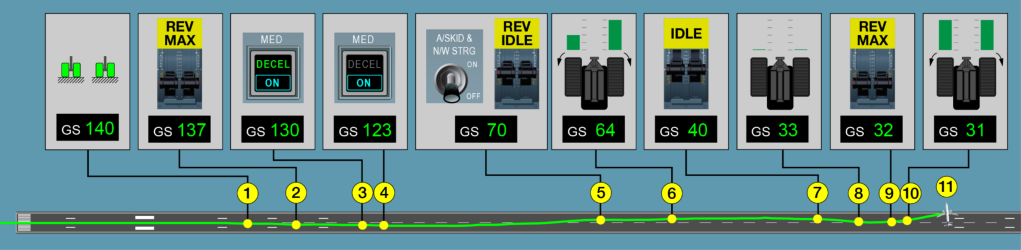
Section titled “Normal touchdown”① The touchdown was performed nominally at 140 kt ground speed (GS). The spoilers extended, ② MAX REV was applied, and the MED autobrake mode activated. ③ The DECEL light on the MED pushbutton switch transiently turned on and ④ then went OFF shortly after. The ON light remained ON.
Application of the LOSS OF BRAKING procedure
Section titled “Application of the LOSS OF BRAKING procedure”⑤ At around 70 kt, the flight crew set the A/SKID & N/W STRG switch to OFF. The PF selected REV IDLE almost simultaneously. The aircraft was slightly diverging from the centerline toward the left edge of the runway.
Lateral runway excursion
Section titled “Lateral runway excursion”⑥ The PF applied differential braking and rudder inputs to the right to try to recover the runway centerline. ⑦ The flight crew set the engine thrust levers to IDLE and ⑧ the PF released the brake pedals for some seconds. ⑨ They selected REV MAX again and ⑩ applied maximum pedal braking. The aircraft skidded, deviated from the centerline and ⑪ came to a stop at 90° from the centerline with the nose landing gear out of the runway.
(fig.1) Description of the first event (rudder inputs not illustrated)
Event Analysis
Section titled “Event Analysis”Autobrake and anti-skid correct activation
Section titled “Autobrake and anti-skid correct activation”Analysis of the flight recorder data showed that the autobrake activated correctly and that the anti-skid function released the brake pressure several times to prevent wheel blockage due to the snow on the runway surface. This resulted in an average deceleration of 0.2 g, below the autobrake MED target of 0.3 g. As a consequence, the DECEL light briefly illuminated at the beginning of the landing roll.
Inappropriate application of the LOSS OF BRAKING procedure
Section titled “Inappropriate application of the LOSS OF BRAKING procedure”The pilot report confirmed that the LOSS OF BRAKING procedure was applied with no further details provided. Airbus could not identify the reason for application of the LOSS OF BRAKING procedure because analysis of the flight recorder data showed the brake system functioned normally in autobrake normal braking mode until the flight crew switched the A/SKID & N/W STRG switch to OFF. A possible explanation is that the limited deceleration, due to the runway contamination with snow, may have been interpreted as a loss of braking function by the flight crew.
CASE STUDY 2
Section titled “CASE STUDY 2”Event Description
Section titled “Event Description”An A321 was stabilized in final approach in CONF FULL. The runway length was 2400 m. The Captain was PF, autobrake MED was selected, autopilot was OFF and autothrust engaged. The airport was subject to heavy rainfall. The ATIS and tower reported WET runway condition. The ENG 2 thrust reverser was inhibited as per MEL item 78-30-01A. The flight crew planned to select REV IDLE during the landing roll.
Nominal touchdown and autobrake activation
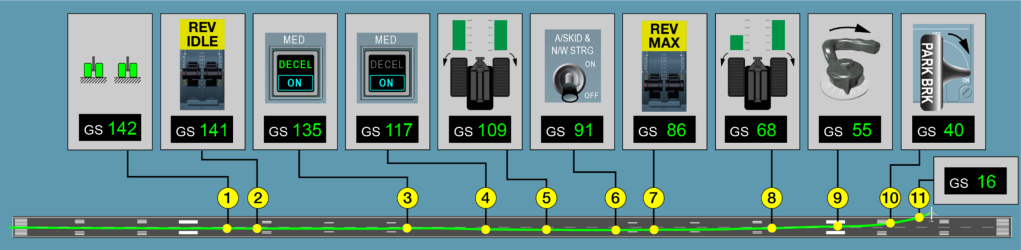
Section titled “Nominal touchdown and autobrake activation”① The touchdown was performed nominally at 142 kt ground speed, with a 2 kt tailwind. The spoilers extended, ② REV IDLE was selected as planned, and the MED autobrake mode activated. The aircraft began to decelerate and ③ the DECEL light of the MED pushbutton switch illuminated.
Sudden deceleration drop followed by manual braking application
Section titled “Sudden deceleration drop followed by manual braking application”The flight crew then felt a sudden deceleration drop. ④ The PM observed that the ON light of the autobrake MED pushbutton switch was illuminated but the DECEL light had extinguished. He announced that the autobrake was lost. ⑤ The PF took over from the autobrake by applying full manual braking.
(fig.2) Description of the second event (rudder inputs not illustrated)
Application of the LOSS OF BRAKING procedure
Section titled “Application of the LOSS OF BRAKING procedure”The flight crew could not feel an increase in deceleration and decided five seconds later to apply the LOSS OF BRAKING procedure, ⑥ by setting the A/SKID & N/W STRG switch to OFF while the brake pedals were still fully deflected. This resulted in the instantaneous blocking of the four main landing gear wheels.
Aircraft skidding and REV MAX application
Section titled “Aircraft skidding and REV MAX application”The aircraft skidded for 10 seconds and the PF applied right rudder input to maintain the aircraft’s alignment with the runway. The PF then ⑦ set both reversers to REV MAX, whilst maintaining right rudder inputs.
Application of differential braking and nose wheel steering tiller inputs
Section titled “Application of differential braking and nose wheel steering tiller inputs”⑧ While maintaining right rudder input, the PF started to apply differential braking by transiently releasing the left hand brake pedal. The aircraft veered to the left. ⑨ The PF applied full right inputs on the nose wheel steering tiller whilst differential braking was maintained. The aircraft quickly deviated toward the left hand edge of the runway.
Parking brake application and runway excursion
Section titled “Parking brake application and runway excursion”⑩ The flight crew applied the parking brake and ⑪ the aircraft exited the runway at 16kt before coming to a stop with the aircraft nose positioned at around 90° from the runway axis and 200 m from the end of the runway.
The flight crew set the thrust lever to IDLE and switched off both engines.
Event Analysis
Section titled “Event Analysis”Autobrake correct activation
Section titled “Autobrake correct activation”Analysis of the flight recorder data showed the autobrake MED activated correctly.
Sudden change in deceleration
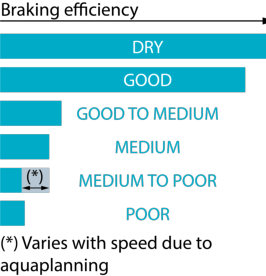
Section titled “Sudden change in deceleration”The sudden change in deceleration felt by the flight crew, and confirmed by the analysis of the flight recorder data, was due to the fact that the aircraft entered a portion of the runway with a very degraded runway friction performance, which is probably due to a significant layer of standing water. Performance computation based on the actual aircraft deceleration showed that the runway condition dropped abruptly from an equivalent of GOOD to POOR and remained POOR until the end of the landing roll. This runway condition was below the MED TO POOR condition that would be expected in the case of a runway contamination by standing water and used for landing distance computation (fig.3).
(fig.3) Braking efficiency per reported braking action for landing distance computation (data from the FAA AC-25-32)
Significant anti-skid activation
Section titled “Significant anti-skid activation”The POOR runway friction caused the anti-skid function to be very active as it released the brakes several times to prevent wheel skidding. This reduced the deceleration rate below 80% of the target rate of the MED autobrake mode. This caused the DECEL light of the MED pushbutton switch to extinguish.
Inappropriate application of the LOSS OF BRAKING procedure
Section titled “Inappropriate application of the LOSS OF BRAKING procedure”The sudden change in deceleration due to the uneven runway contamination, combined with the significant activation of the anti-skid function when manual braking was applied, led the flight crew to interpret the situation as a loss of braking and inappropriately apply the LOSS OF BRAKING.
A/SKID & N/W STRG switch set to OFF with pedals fully pressed
Section titled “A/SKID & N/W STRG switch set to OFF with pedals fully pressed”The flight crew set the A/SKID & N/W STRG switch to OFF while the PF was pressing the brake pedals. This caused the wheels to lock instantly due to full application of the alternate brake pressure without anti-skid modulation.
Use of the nose wheel steering tiller
Section titled “Use of the nose wheel steering tiller”The attempt to use the steering tiller during the final seconds of the landing roll was ineffective because the nose wheel steering was unavailable due to the application of the LOSS OF BRAKING procedure.
OPERATIONAL CONSIDERATIONS
Section titled “OPERATIONAL CONSIDERATIONS”The LOSS OF BRAKING procedure was introduced to cover an extremely rare failure of the automatic switching to the alternate/emergency braking mode, in cases where the normal braking mode failed. This may happen after a takeover from automatic to manual braking during landing or rejected takeoff. It may also happen during taxi. In-service experience has shown that the application of this procedure has been also efficient to cope with other kinds of braking system malfunction.
The LOSS OF BRAKING procedure consists in a manual activation of the alternate braking mode without anti-skid (emergency braking mode on A350 and A380 aircraft) using the A/SKID & N/W STRG switch on A320 family, A330 and A340-200/300 aircraft, or the A-SKID switch on A340-500/600, A350 and A380 aircraft, or the BRK/ANTI SKID switch on A300-600 and A310 aircraft. Ultimately, the procedure requests the application of the PARK BRK if the alternate/emergency braking also fails.
There is no equivalent LOSS OF BRAKING procedure on A220 aircraft because it has a different braking system design.
When to apply the procedure
Section titled “When to apply the procedure”The procedure must only be applied during manual braking , and only if the flight crew does not feel any effect on the deceleration while pressing on the brake pedals.
Consequences of the application of the LOSS OF BRAKING procedure
Section titled “Consequences of the application of the LOSS OF BRAKING procedure”Applying the LOSS OF BRAKING procedure has non negligeable consequences which depends on the aircraft type:
-
Loss of anti-skid function only on A300, A300-600, A310, A340-500/600, A350 and A380 aircraft. This may reduce the braking performance of the aircraft, increase the risk of tyre burst, and potentially lead to runway excursion.
-
Loss of both the anti-skid function and the Nose Wheel Steering (NWS) on A320 family, A330 and A340-200/300 aircraft. The braking performance may be reduced as well as the ground handling capabilities. The flight crew has to use the rudder at high speed and differential braking at lower speed for lateral control.
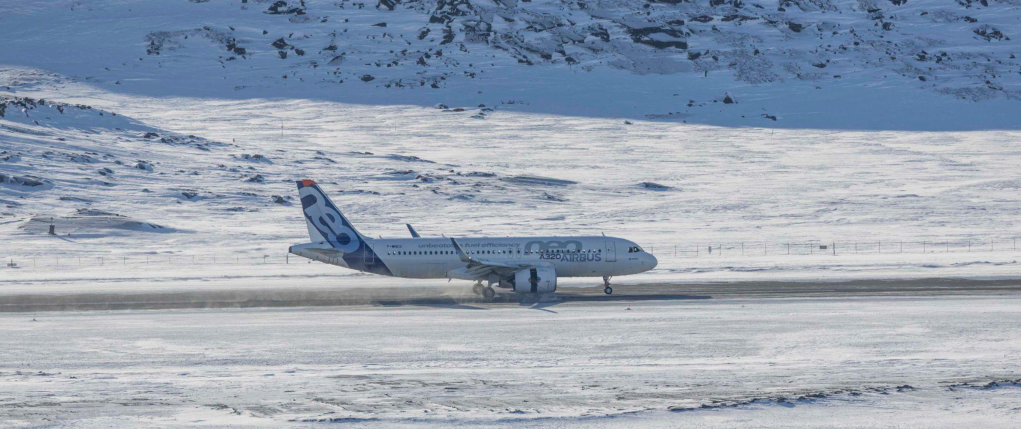
Wet and Contaminated Runway: Is it a Loss of Braking?
Section titled “Wet and Contaminated Runway: Is it a Loss of Braking?”The two case studies described previously highlight the need to pay particular attention when landing on wet or contaminated runways in order to prevent inappropriate application of the LOSS OF BRAKING procedure. It is important that flight crews are aware of the behavior of the aircraft and its braking system when landing on wet or contaminated runways. This will prevent them from interpreting some normal phenomena linked to the conditions of the runway as loss of braking.
Lower deceleration in the case of a high anti-skid activity
Section titled “Lower deceleration in the case of a high anti-skid activity”The rate of deceleration perceived by the flight crew may be less on a contaminated runway than on a dry runway, particularly in the case of standing water or presence of other contaminants. There is a high probability that the anti-skid function will activate, reducing the perceived rate of deceleration. Even if it is the case, flight crew should be aware that the anti-skid is designed to ensure the optimum deceleration rate adapted for the runway condition.
Sudden deceleration change due to inconsistent contamination
Section titled “Sudden deceleration change due to inconsistent contamination”The second case study showed the level of contamination of a runway, and therefore the runway condition, may vary along its length. This can lead to sudden changes in the rate of deceleration perceived by the flight crew, which may cause them to incorrectly determine they have a loss of braking.
Change in deceleration during transition from REV MAX to REV idle
Section titled “Change in deceleration during transition from REV MAX to REV idle”Flight crews should also be aware that a sudden deceleration drop may be felt during the transition from REV MAX to REV IDLE, especially on wet or contaminated runways since the braking efficiency is reduced. This does not mean that the braking capability is lost.
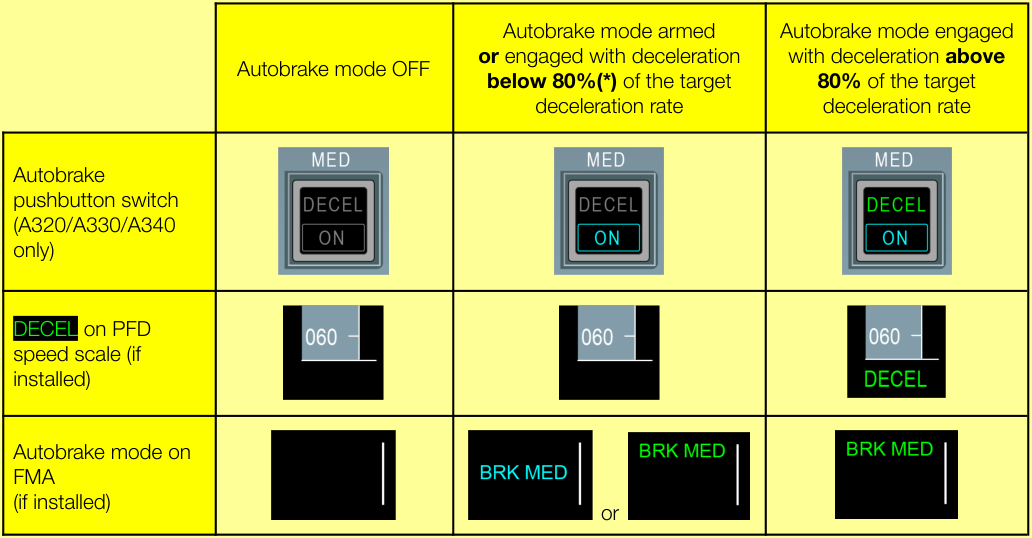
Autobrake** DECEL light (A320/A330/A340) and DECEL **message on the PFD (A320/A330/A340/A380)
Section titled “Autobrake** DECEL light (A320/A330/A340) and DECEL **message on the PFD (A320/A330/A340/A380)”On A320, A330 and A340 aircraft, if the DECEL light of the autobrake pushbutton switch is not illuminated, or extinguishes during the landing roll, this does not mean that the autobrake mode has failed. As explained in the FCOM description chapter, the DECEL light of the autobrake pushbutton switches is an indication that the deceleration is above 80% of the target deceleration of the selected braking mode. As a consequence, the DECEL light may not illuminate or extinguish during the landing roll, or during RTO, if the deceleration is reduced due to the runway condition and anti-skid activation. The use of the MED mode on wet or contaminated runways increases the probability of an extinction of the DECEL light. The illumination threshold of the DECEL light may not be reached or only temporarily reached. A display of a DECEL message below the PFD speedscale as well as a display of the autobrake mode on the FMA is available on A350 and A380 aircraft as well as on A320 aircraft equipped with EIS 2 standard S14 combined with BSCU L4-10 (MOD 157491) and SDAC H2E3 (MOD 151314), and subsequent standards. It is also available on A330/A340 aircraft equipped with EIS 2 standard L10 (MOD 205162) combined with BSCU S9D (MOD 205183), and SDAC C11 (MOD 203928), and subsequent standards.
“DECEL” standard callout
Section titled ““DECEL” standard callout”As per SOP, the PM should make the “DECEL” standard callout when they feel the deceleration and confirm it with the speed trend on the PFD. It is not based on the display of the DECEL light of the autobrake pushbutton switch.
If no deceleration is felt, and it is confirmed on the PFD speed trend, the PF should call “NO DECEL”
Importance of the Arrival Briefing
Section titled “Importance of the Arrival Briefing”Being prepared to manage the effects of a wet or contaminated runway on the aircraft deceleration prevents any surprise effects during landing that could lead to the flight crew inappropriately applying the LOSS OF BRAKING procedure.
During the arrival briefing:
-
Discuss the runway conditions based on the available information
-
● Discuss the stop margin and the available deceleration means. A drop in deceleration may be felt during the landing roll if the anti-skid activates, and when reversers are selected from REV MAX to REV IDLE, and
-
● If the weather conditions are expected to change or in the case of significant precipitation at the airport, the flight crew should be prepared for a reduction of the braking performance. The case study n°2 showed us that a reported WET runway can quickly be contaminated with standing water, degrading the braking action from an expected MEDIUM to a MEDIUM TO POOR. The flight crew should therefore consider making a second computation of the landing distance with the worst condition possible.
TRAINING CONSIDERATIONS
Section titled “TRAINING CONSIDERATIONS”The Flight Crew Training Standard (FCTS) manual recommends training the LOSS OF BRAKING procedure in the simulator in order to recall and apply the memory items with the associated callouts.
Train LOSS OF BRAKING at low speed and at high speed
Section titled “Train LOSS OF BRAKING at low speed and at high speed”This can be performed at low speed such as during taxi, and also at high speed during landing. It is recommended to perform one of these scenarios with a startle effect situation.
Simulator limitation
Section titled “Simulator limitation”Due to the limitation of the simulator ground model, instructors must not mix a LOSS OF BRAKING with contaminated runway conditions. Combining both situations would not be representative of the real aircraft behavior and would therefore give a negative training scenario. However, the specific behavior of the aircraft on wet and contaminated runways and possible confusion with a loss of braking should be reviewed during the briefing of the simulator session using the LOSS OF BRAKING section of the Flight Crew Techniques Manual (FCTM).
A video dedicated to the LOSS OF BRAKING procedure is also available on the Airbus Worldwide Instructor News (WIN) website.
Contributors :
Section titled “Contributors :”Livier BEN
Section titled “Livier BEN”Braking & Steering Expert
Flight Tests
The LOSS OF BRAKING procedure was introduced to cover an extremely rare failure of the automatic switching to the alternate/emergency braking mode, in cases where the normal braking mode failed. It must only be applied during manual braking, and only if the flight crew does not feel any effect on the deceleration while pressing on the brake pedals.
Denis CADOUX
Section titled “Denis CADOUX”Accident/Incident Investigator
Aviation Safety
To prevent inappropriate application of the LOSS OF BRAKING PROCEDURE, flight crew should be aware that, on contaminated runways, the perceived rate of deceleration may be lower than the rate of deceleration felt on dry runways. It is likely when there is activation of the anti-skid function.
Philippe CASTAIGNS
Section titled “Philippe CASTAIGNS”Experimental Test Pilot
Flight Tests
Maxime LANSONNEUR
Section titled “Maxime LANSONNEUR”Director Safety - Training and Flight Operations
Customer Support
Albert URDIROZ
Section titled “Albert URDIROZ”Accident/Incident Investigator
Aviation Safety
With thanks to Cesar GARCIA CASTILLA from Aviation Safety and Thomas GOBEAUT from the A300/A310 Flight Operations Support.
Section titled “With thanks to Cesar GARCIA CASTILLA from Aviation Safety and Thomas GOBEAUT from the A300/A310 Flight Operations Support.”Flight crew should also be aware that an uneven contamination of the runway, or the presence of standing water in some areas of the runway after a heavy rainfall, may cause sudden changes in the deceleration rate. This could cause the crew to flight incorrectly determine they have a total loss of braking. Flight crew should also be prepared for the sudden change in the perceived rate of deceleration when they transition from REV MAX to REV IDLE, especially on wet or contaminated runways, since the braking efficiency is reduced.
It is essential to discuss these effects during the arrival briefing so that the flight crew will not be surprised should they perceive a sudden change in the rate of deceleration during the landing roll. This will prevent inappropriate application of the LOSS OF BRAKING procedure.
Training of the LOSS OF BRAKING PROCEDURE should be performed according to the Flight Crew Training Standard (FCTS) manual requirements and taking into account the limitations of the simulator ground simulation model.
Safety first, 2024. Safety first is published by Airbus S.A.S. 1, rond point Maurice Bellonte - 31707 Blagnac Cedex/France.
Editor: Yannick Malinge, SVP AViation Safety.
Editorial team: Guillaume Estragnat, Vanessa Sadi, Gwyneth Duggan, Javier Martinez Marina, Tim Roach.
Photos by Airbus, H. Gousse, P. Masclet, S. Ramadier.
真的是刹车失效吗?
Section titled “真的是刹车失效吗?”来源:Airbus Safety First 网址:https://safetyfirst.airbus.com/is-it-a-loss-of-braking/ 发布日期:2024-06-10 类别:飞行运营、防滞、自动刹车、刹车、减速、冲出、落地、超限、跑道冲出、跑道超限、打滑 PDF:原始 PDF
在极少数刹车系统发生故障的情况下,必须执行 LOSS OF BRAKING(刹车失效) 程序的记忆项目。实际运营经验表明,不恰当地执行 LOSS OF BRAKING 程序可能导致跑道冲出的风险。
本文回顾了执行 LOSS OF BRAKING 程序的条件,并强调了在污染跑道上落地时,机组监控飞机减速过程中可能出现的混淆风险。
请访问 safetyfirst.airbus.com 或下载 Safety first 应用(iOS 和 Android)查看本文最新版本。
案例研究 1
Section titled “案例研究 1”一架 A320 飞机在最终进近中保持稳定,构型为 CONF FULL,选择了自动刹车 MED 模式。跑道长度为 3700 米。自动驾驶仪和自动推力均已衔接。外部条件为阵雪,左侧侧风 16 节至 22 节。跑道据报被积雪污染。
① 飞机以 140 节地速(GS)正常接地。扰流板伸出,② 最大反推(MAX REV)已使用,MED 自动刹车模式启动。③ MED 按钮开关上的 DECEL(减速)灯短暂亮起,④ 随即熄灭。ON(接通)灯保持亮起。
执行 LOSS OF BRAKING 程序
Section titled “执行 LOSS OF BRAKING 程序”⑤ 约 70 节时,机组将 A/SKID & N/W STRG(防滞与前轮转向)电门置于 OFF 位。PF 几乎同时将反推推力手柄置于 IDLE(慢车)位。飞机轻微偏离跑道中心线,向左侧边缘滑行。
横向跑道冲出
Section titled “横向跑道冲出”⑥ PF 施加差动刹车并向右使用方向舵修正,试图恢复跑道中心线。⑦ 机组将发动机推力手柄置于 IDLE 位,⑧ PF 松开刹车脚蹬数秒。⑨ 他们再次选择 MAX REV,⑩ 并施加最大脚蹬刹车。飞机打滑、偏离中心线,⑪ 最终以 90° 偏转角停在跑道外,主起落架外侧。
(图 1) 第一次事件描述(未显示方向舵输入)
自动刹车和防滞功能正常启动
Section titled “自动刹车和防滞功能正常启动”飞行数据记录器数据分析表明,自动刹车正常启动,防滞功能多次释放刹车压力,以防止由于跑道表面积雪导致的轮子抱死。这导致平均减速度为 0.2 g,低于 MED 自动刹车的目标值 0.3 g。因此,减速灯在着陆滑跑开始时短暂亮起。
不恰当地执行 LOSS OF BRAKING 程序
Section titled “不恰当地执行 LOSS OF BRAKING 程序”飞行员报告确认执行了 LOSS OF BRAKING 程序,但未提供更多细节。空中客车公司无法确定执行该程序的原因,因为飞行数据记录器数据分析表明,在机组将 A/SKID & N/W STRG 电门置于 OFF 位之前,刹车系统在自动刹车正常刹车模式下工作正常。一种可能的解释是,由于跑道被积雪污染导致的减速不足,可能被机组误判为刹车功能失效。
案例研究 2
Section titled “案例研究 2”一架 A321 飞机在最终进近中保持稳定,构型为 CONF FULL。跑道长度为 2400 米。机长担任 PF,选择了 MED 自动刹车,自动驾驶仪未衔接,自动推力已衔接。机场区域大雨倾盆。ATIS 和塔台报告跑道湿滑。由于 MEL 项目 78-30-01A,2 号发动机反推被抑制。机组计划在着陆滑跑时选择 REV IDLE(反推慢车)。
正常接地和自动刹车启动
Section titled “正常接地和自动刹车启动”① 飞机以 142 节地速正常接地,有 2 节顺风。扰流板伸出,② 按计划选择 REV IDLE,MED 自动刹车模式启动。飞机开始减速,③ MED 按钮开关上的 DECEL 灯亮起。
突然减速下降,随后施加人工刹车
Section titled “突然减速下降,随后施加人工刹车”机组随即感到突然的减速下降。④ PM 注意到自动刹车 MED 按钮开关的 ON 灯亮起,但 DECEL 灯已熄灭。他宣布自动刹车失效。⑤ PF 通过施加全人工刹车来接替自动刹车。
(图 2) 第二次事件描述(未显示方向舵输入)
执行 LOSS OF BRAKING 程序
Section titled “执行 LOSS OF BRAKING 程序”机组感觉不到减速的增加,5 秒后决定执行 LOSS OF BRAKING 程序,⑥ 在刹车脚蹬仍处于全偏转状态的情况下,将 A/SKID & N/W STRG 电门置于 OFF 位。这导致四个主起落架轮子瞬间抱死。
飞机打滑和 REV MAX 的使用
Section titled “飞机打滑和 REV MAX 的使用”飞机打滑 10 秒,PF 施加右方向舵输入以保持飞机沿跑道方向对齐。随后 PF ⑦ 将两个反推均置于 REV MAX 位,同时保持右方向舵输入。
差动刹车和前轮转向控制手柄的使用
Section titled “差动刹车和前轮转向控制手柄的使用”⑧ 在保持右方向舵输入的同时,PF 开始施加差动刹车,短暂松开左侧刹车脚蹬。飞机向左偏转。⑨ PF 在保持差动刹车的同时,向右全量使用前轮转向控制手柄。飞机迅速向左侧跑道边缘偏离。
停机刹车应用与跑道滑出
Section titled “停机刹车应用与跑道滑出”⑩ 机组实施了停机刹车,⑪ 飞机以16节的速度滑出跑道,随后停止,飞机机头相对于跑道轴线约呈90°,距离跑道端部约200米。
机组将推力手柄设置为慢车(IDLE)并关闭了两台发动机。
自动刹车正确启动
Section titled “自动刹车正确启动”飞行记录器数据分析表明,自动刹车中等着陆(MED)模式已正确启动。
机组感受到的减速度突变经飞行记录器数据分析确认,原因是飞机进入了跑道摩擦性能严重恶化的区域,这可能是由于存在大量积水。基于实际飞机减速度的性能计算表明,跑道状况从良好(GOOD)突然下降至差(POOR),并在整个着陆滑跑过程中保持差(POOR)状态。该跑道状况低于积水污染跑道用于着陆距离计算的预期中等到差(MED TO POOR)状况**(图3)**。
(图3) 用于着陆距离计算的报告制动动作对应的制动效率(数据来源:FAA AC-25-32)
防滑系统频繁激活
Section titled “防滑系统频繁激活”跑道摩擦性能差导致防滑功能高度活跃,多次释放刹车以防止机轮打滑。这使得减速率降至中等自动刹车模式目标减速率的80%以下,导致中等自动刹车(MED)按压开关上的减速(DECEL)灯熄灭。
不当执行失去制动程序
Section titled “不当执行失去制动程序”跑道污染不均匀导致的减速度突变,加上实施人工刹车时防滑系统的频繁激活,使机组将此情况误解为失去制动,从而不当执行了失去制动(LOSS OF BRAKING)程序。
A/SKID & N/W STRG 开关设置为关且脚蹬完全踩下
Section titled “A/SKID & N/W STRG 开关设置为关且脚蹬完全踩下”机组在飞行员PF踩下刹车脚蹬的同时将A/SKID & N/W STRG开关设置为关。这导致机轮因备用刹车压力全量施加且无防滑调制而瞬间锁死。
使用前轮转弯手轮
Section titled “使用前轮转弯手轮”在着陆滑跑最后几秒尝试使用转弯手轮是无效的,因为由于执行了失去制动程序,前轮转弯不可用。
运营注意事项
Section titled “运营注意事项”失去制动程序的设计初衷是应对正常刹车模式失效后自动切换至备用/应急刹车模式失败这一极为罕见的情况。这种情况可能发生在着陆或中断起飞过程中从自动刹车至人工刹车的接管之后,也可能发生在滑行期间。实际运营经验表明,执行该程序对于处理其他类型的刹车系统故障同样有效。
失去制动程序包括手动启动无防滑功能的备用刹车模式(A350和A380飞机上的应急刹车模式),在A320系列、A330和A340-200/300飞机上使用A/SKID & N/W STRG开关,在A340-500/600、A350和A380飞机上使用A-SKID开关,在A300-600和A310飞机上使用BRK/ANTI SKID开关。最终,如果备用/应急刹车也失效,该程序要求实施停机刹车(PARK BRK)。
A220飞机没有等效的失去制动程序,因为其刹车系统设计不同。
何时执行该程序
Section titled “何时执行该程序”该程序仅在人工刹车期间执行,且仅在机组踩下刹车脚蹬时未感受到任何减速效果的情况下执行。
执行失去制动程序的后果
Section titled “执行失去制动程序的后果”执行失去制动程序会产生不可忽视的后果,且因飞机类型而异:
-
仅在A300、A300-600、A310、A340-500/600、A350和A380飞机上失去防滑功能。这可能降低飞机的制动性能,增加轮胎爆破风险,并可能导致跑道滑出。
-
在A320系列、A330和A340-200/300飞机上同时失去防滑功能和前轮转弯(NWS)。制动性能和地面操纵能力均可能降低。机组须在高速时使用方向舵,在低速时使用差动刹车进行侧向控制。
湿滑和污染跑道:这是失去制动吗?
Section titled “湿滑和污染跑道:这是失去制动吗?”前文描述的两个案例研究凸显了在湿滑或污染跑道上着陆时需特别关注,以防止不当执行失去制动程序的必要性。重要的是,机组必须了解飞机及其刹车系统在湿滑或污染跑道上着陆时的行为表现。这将防止他们将跑道状况相关的正常现象误判为失去制动。
高防滑活动情况下的较低减速
Section titled “高防滑活动情况下的较低减速”飞行机组在污染跑道上感受到的减速率可能低于干燥跑道,特别是在存在积水或其他污染物的情况下。防滑功能极有可能启动,从而降低飞行机组感受到的减速率。即使出现这种情况,飞行机组也应了解,防滑系统的设计目的是确保适应跑道条件的最佳减速率。
因污染不均匀导致的减速突变
Section titled “因污染不均匀导致的减速突变”第二个案例研究表明,跑道的污染程度(进而跑道条件)可能沿长度方向存在变化。这可能导致飞行机组感受到的减速率突然改变,从而可能使他们错误地判断为刹车失效。
从 REV MAX 过渡到 REV IDLE 过程中的减速变化
Section titled “从 REV MAX 过渡到 REV IDLE 过程中的减速变化”飞行机组还应注意,在从 REV MAX 过渡到 REV IDLE 时可能会感受到减速突然下降,尤其是在潮湿或受污染的跑道上,因为制动效率会降低。这并不意味着制动能力丧失。
自动刹车 DECEL 灯(A320/A330/A340)和 PFD 上的 DECEL 信息(A320/A330/A340/A380)
Section titled “自动刹车 DECEL 灯(A320/A330/A340)和 PFD 上的 DECEL 信息(A320/A330/A340/A380)”在 A320、A330 和 A340 飞机上,如果自动刹车电门上的 DECEL 灯未点亮,或在着陆滑跑过程中熄灭,这并不意味着自动刹车模式失效。正如 FCOM 描述章节中所解释的,自动刹车电门上的 DECEL 灯是对当前减速率超过所选制动模式目标减速率 80% 的指示。因此,如果由于跑道条件和防滑系统启动导致减速率降低,DECEL 灯可能在着陆滑跑或 RTO(中断起飞)过程中不亮或熄灭。在潮湿或受污染的跑道上使用 MED 模式会增加 DECEL 灯熄灭的可能性。DECEL 灯的点亮阈值可能无法达到或仅暂时达到。PFD 速度刻度下方显示 DECEL 信息以及 FMA 上显示自动刹车模式的功能适用于 A350 和 A380 飞机,以及配备 EIS 2 S14 标准(结合 BSCU L4-10(MOD 157491)和 SDAC H2E3(MOD 151314))及后续标准的 A320 飞机。该功能也适用于配备 EIS 2 L10 标准(结合 BSCU S9D(MOD 205183)和 SDAC C11(MOD 203928))及后续标准的 A330/A340 飞机。
“DECEL” 标准喊话
Section titled ““DECEL” 标准喊话”根据 SOP,PM 应在感受到减速并通过 PFD 上的速度趋势确认后进行 “DECEL” 标准喊话。该喊话并非基于自动刹车电门上 DECEL 灯的显示。
如果未感受到减速,且经 PFD 速度趋势确认,PF 应喊话 “NO DECEL”。
进近简述的重要性
Section titled “进近简述的重要性”做好准备应对潮湿或受污染跑道对飞机减速的影响,可以防止着陆过程中出现意外效应,从而避免飞行机组不当执行 LOSS OF BRAKING(刹车失效)程序。
在进近简述中:
-
根据可用信息讨论跑道条件
-
● 讨论停止裕度和可用的减速手段。如果在防滑系统启动时以及反推从 REV MAX 选择到 REV IDLE 时感受到减速下降属正常现象,
-
● 如果预期天气条件会发生变化,或机场出现显著降水,飞行机组应为制动性能的降低做好准备。案例研究 2 表明,报告为 WET(湿)的跑道可能很快被积水污染,使制动效果从预期的 MEDIUM(中等)降至 MEDIUM TO POOR(中等到差)。因此,飞行机组应考虑使用最差条件进行第二次着陆距离计算。
培训注意事项
Section titled “培训注意事项”飞行机组培训标准(FCTS)手册建议在模拟机中培训 LOSS OF BRAKING(刹车失效)程序,以回忆和应用相关记忆项目及配套喊话。
在低速和高速下练习 LOSS OF BRAKING(刹车失效)
Section titled “在低速和高速下练习 LOSS OF BRAKING(刹车失效)”可以在低速(如滑行期间)进行,也可以在高速(如着陆期间)进行。建议其中一个场景使用惊吓效应情况。
模拟机局限性
Section titled “模拟机局限性”由于模拟机地面模型的局限性,教员不得将 LOSS OF BRAKING(刹车失效)与受污染跑道条件相结合。将两种情况结合将无法代表真实飞机行为,因此会造成负面培训效果。然而,应在模拟机课程简述中使用飞行机组技术手册(FCTM)的 LOSS OF BRAKING 部分,回顾飞机在潮湿和受污染跑道上的特定行为以及可能与刹车失效混淆的情况。
飞行机组技术手册(FCTM)中也提供了关于 LOSS OF BRAKING(刹车失效)程序的视频,可在 Airbus Worldwide Instructor News(WIN)网站上获取。
Livier BEN
Section titled “Livier BEN”刹车与转弯专家
飞行试验
失去刹车(LOSS OF BRAKING)程序是针对自动转换为备用/应急刹车模式这一极其罕见失效情况而引入的,仅在正常刹车模式失效时适用。该程序仅适用于人工刹车,且仅在飞行机组在踩下刹车踏板时未感受到减速效果的情况下方可执行。
Denis CADOUX
Section titled “Denis CADOUX”事故/事件调查员
航空安全
为防止不当使用失去刹车程序,飞行机组应了解:在污染跑道上,感知到的减速率可能低于干燥跑道上的减速率。防滑(anti-skid)功能激活时尤其如此。
Philippe CASTAIGNS
Section titled “Philippe CASTAIGNS”试飞员
飞行试验
Maxime LANSONNEUR
Section titled “Maxime LANSONNEUR”安全总监——培训与飞行运行
客户支援
Albert URDIROZ
Section titled “Albert URDIROZ”事故/事件调查员
航空安全
特别感谢Aviation Safety的Cesar GARCIA CASTILLA以及A300/A310飞行运行支援部门的Thomas GOBEAUT。
Section titled “特别感谢Aviation Safety的Cesar GARCIA CASTILLA以及A300/A310飞行运行支援部门的Thomas GOBEAUT。”飞行机组还应了解,跑道污染不均匀,或大雨后跑道某些区域存在积水,可能导致减速率突然变化。这可能使机组错误地判断发生了完全失去刹车。飞行机组还应为从最大反推(REV MAX)转换到慢车反推(REV IDLE)时感知到的减速率突变做好准备,特别是在潮湿或污染的跑道上,因为刹车效率会有所降低。
在进近简令(arrival briefing)中讨论这些影响至关重要,以便机组在滑跑过程中感受到减速率突然变化时不会感到意外。这将防止不当使用失去刹车程序。
失去刹车程序的培训应按照飞行机组培训标准(FCTS)手册的要求进行,并应考虑模拟机地面仿真模型的局限性。
Safety first,2024年。Safety first由空中客车公司出版。地址:法国布拉尼亚克,31707,Maurice Bellonte环形路1号。
编辑:Yannick Malinge,航空安全高级副总裁。
编辑团队:Guillaume Estragnat、Vanessa Sadi、Gwyneth Duggan、Javier Martinez Marina、Tim Roach。
照片由空中客车公司、H. Gousse、P. Masclet、S. Ramadier提供。