Transient Loss of Communication due to Jammed Push-To-Talk
Source: Airbus Safety First URL: https://safetyfirst.airbus.com/transient-loss-of-communication-due-to-jammed-push-to-talk/ Published: 2012-07-14 Magazine Issue: 2012-06 Category: Archive PDF: Original PDF
Safety
Benoît duVAL
Section titled “Benoît duVAL”Safety enhancement Manager Aircraft Architecture and Integration
Transient Loss of Communication due to Jammed Push-To-Talk A320 and A330/A340 Families
Section titled “Transient Loss of Communication due to Jammed Push-To-Talk A320 and A330/A340 Families”1. Introduction
Section titled “1. Introduction”At the end of 2011, the crew of a cruising A320 was unable to transmit on any radio, but reported that it was still possible to receive ATC communications. A few months before, on another A320, the crew reported after landing that it was not possible to contact the tower via either VHF system. Investigations attributed both events to Push-To-Talk (PTT) selectors jammed in the transmit position. As illustrated by these examples, jammed PTT selectors generate events of transient loss of communication with ATC every year.
This kind of failure might be difficult to identify for the crew, and might lead to the feeling that all communications have been lost with ATC. In reality, a correct identification of the situation and the implementation of a few simple steps will, in most cases, allow the crew to recover full communications.
This article will outline the effects of a jammed PTT and will explain how to restore communications. It will also describe a new ECAM caution and procedure that will be introduced in the next Flight Warning Computer (FWC) standards.
2. Transmitting with VHF or HF
Section titled “2. Transmitting with VHF or HF”In order to transmit on VHF or HF radio, the flight crew uses one of the Audio Control Panels (ACP) (fig.1).
devices: side stick radio selector, hand mike PTT, or INT/RAD switch on the ACP (fig.2).
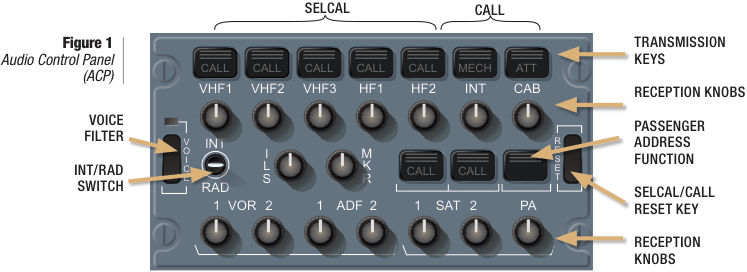
In the normal configuration, three ACP are available. They are located on the Captain side (ACP1), on the F/O side (ACP2), and on the overhead panel (ACP3). The ACP3 allows reconfiguration in case of failure of ACP1 or ACP2.
3.1 VHF
Section titled “3.1 VHF”When a Push-To-Talk device is jammed in the transmit position, the VHF transceiver transmits continuously as soon as it is selected, and no reception is possible on the tuned frequency.
Initially, the pilot has to press one of the ACP transmission keys in order to select a VHF or HF transceiver. Then, in order to actually transmit on the selected radio, he uses one of the Push-To-Talk
In order to limit such a continuous and unintentional transmission
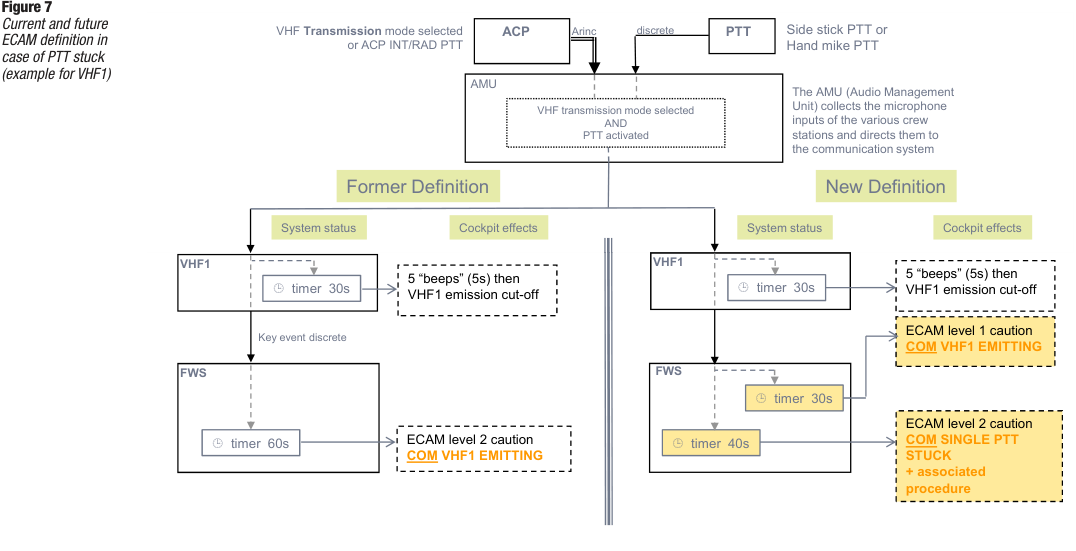
that could disturb the ATC frequency, an internal protection is implemented inside each VHF, limiting the transmission time to 35s. After 30s of transmission, the crew is warned of this imminent automatic transmission cut-off through an interrupted tone that sounds for 5 seconds (5 audio “beeps”, one per second).
In normal operation, on hearing the 5 audio “beeps” the crew has to release and press again the PTT selector/button to continue the transmission. But if the Push-ToTalk device is jammed the transmission may not be resumed on the selected radio, which will be limited to reception only. In this case, an ECAM COM VHF (1 or 2 or 3) EMITTING caution is also triggered after 60s.
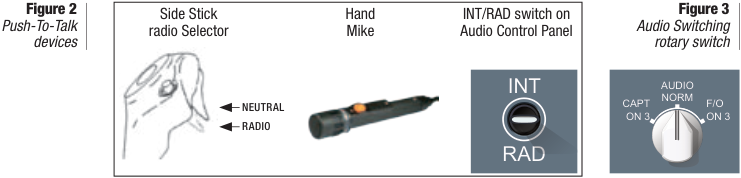
Figure 4
Section titled “Figure 4”3.2 HF
Section titled “3.2 HF”There is no automatic transmission cut-off after 35s on the HF transceivers, but an ECAM COM HF (1 or 2) EMITTING caution is triggered as well if the HF transmission duration exceeds 60s.
4. VHF/HF Communication Recovery In Case of a Jammed Push-To-Talk
Section titled “4. VHF/HF Communication Recovery In Case of a Jammed Push-To-Talk”4.1 Typical scenario
Section titled “4.1 Typical scenario”Consider, for example, an attempt of VHF1 communication with a side-stick PTT jammed on the Capt side. As soon as the VHF1 transmission key is selected on the Audio Control Panel located on the Capt side (ACP1), a continuous VHF1 transmission is initiated.
The VHF1 transmission will be automatically interrupted after 35s (VHF internal protection). 25s later, the Flight Warning System (FWS) will trigger the ECAM COM VHF1 EMITTING caution.
A320 Family FCOM information associated to the COM VHF/HF EMITTING caution
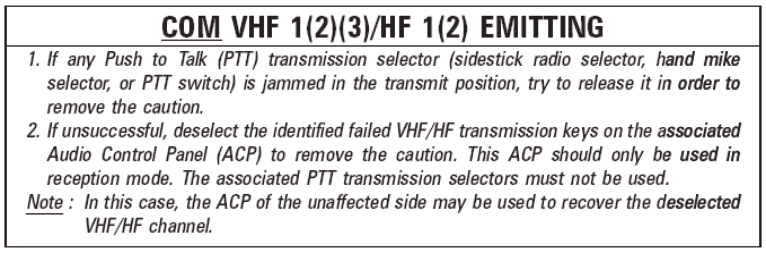
Figure 5
Section titled “Figure 5”A330/A340 FCOM information associated to the COM VHF/HF EMITTING caution
4.2 Recovery
Section titled “4.2 Recovery”The way to handle the situation in this case, is to first check the PTT transmission selector and try to release it. Then, if this does not work, isolate the jammed PTT and the associated Audio Control Panel by deselecting all the VHF transmission keys on the ACP1. It is then possible to use the ACP2 and the associated PTT devices, on the F/O side, to establish a new VHF transmission.
If the crew tries to select another VHF on the same ACP, for example VHF2, the same scenario will occur as the side-stick PTT is still jammed: the VHF2 will be automatically interrupted after 35s and the COM VHF2 EMITTING alert will trigger 25s later.
Selection of “CAPT ON 3” by means of the Audio Switching rotary switch (fig. 3) , to use the ACP3 (overhead panel) on the Captain side, will not solve the problem as the jammed PTT will request a permanent transmission through the ACP3.
Such a procedure is available today in the FCOM, as expanded information associated to the COM VHF/HF EMITTING caution (fig.4 & 5).
Safety
COM SINGLE PTT STUCK
-
ACP1 VHF1 TX..DESELECT
-
ACP2 VHF1 TX..DESELECT
-
ACP3 VHF1 TX..DESELECT
Configuration: one PTT jammed, VHF1 transmission, and Audio Switching rotary switch on NORMAL position.
1[st] part of the procedure: identification of the affected side These 5 procedure lines disappear as soon as the VHF1 transmission key has been deselected on the affected side (the side where the PTT is jammed).
For example, if the F/O side stick PTT is jammed, these lines will disappear as soon as the VHF1 transmission key has been deselected on the ACP2.
COM SINGLE PTT STUCK
Section titled “COM SINGLE PTT STUCK”-
AUDIO SWTG…DO NOT USE -
ALL TX KEYS.DO NOT USE
-
VHF1 TX…RESELECT
2[nd] part o f the procedure: reconfiguration on the other side Once the VHF1 has been deselected on all ACPs, the procedure requests the crew to not use the audio switching, nor any transmission keys on the affected ACP. Then, the procedure requests to reselect the VHF1 transmission key on the other ACP.
Figure 6 New ECAM COM SINGLE PTT STUCK caution with associated procedure
5. New ECAM Caution and Procedure in Case of a Jammed Push-To-Talk
Section titled “5. New ECAM Caution and Procedure in Case of a Jammed Push-To-Talk”5.1 VHF
Section titled “5.1 VHF”To assist the crew to recover correct communication in case of a jammed PTT, a new amber COM SINGLE PTT STUCK caution has been developed. This alert will trigger when a PTT is detected continuously activated during 40s and will provide a new procedure to guide the crew through the two following steps :
q Identification of the side affected by the jammed Push-To-Talk.
q Reconfiguration on the non affected side.
An illustration of this procedure for a jammed PTT using a VHF1 radio is given in fig. 6.
In association with the introduction of this new alert, the COM VHF 1 (2) (3) EMITTING alert will be
triggered simultaneously with the audio “beeps”, i.e. 30s after the start of the transmission, to reinforce the awareness that the transmission will be cut-off.
The introduction of the COM SINGLe PTT STUCK caution will lead to the downgrading of the COM VHF 1 (2) (3) eMITTING alert from a level 2 to a level 1 caution, which implies that there will be no associated Single Chime nor Master Caution light.
The differences between the present and future ECAM definitions for the VHF radios are summarized in fig. 7.
5.2 HF
Section titled “5.2 HF”The COM SINGLE PTT STUCK caution described above will trigger as well for HF communication. The only difference will lie in the delay of activation: to take into account the longer average length of messages of HF transmissions, the caution will trigger only when a
PTT is detected continuously activated during 180s.
As for the VHF associated alert, the COM HF (1 or 2) eMITTING caution (level 2) will likewise be downgraded to a level 1 caution.
The differences between the present and future ECAM definitions for the HF transceivers are summarized in fig. 8.
5.3 Calender
Section titled “5.3 Calender”On the A320 Family, these improvements will be implemented on the Flight Warning Computer (FWC) H2-F7 standard (availability planned in December 2012).
On the A330/A340, these improvements will be implemented on the FWC T5 standard (planned in January 2013) for the A330 and A340-500/600, and from the L13 standard (planned in August 2013) for the A340-200/300.
On the A320 and A330/A340 families, when a transient loss of VHF communication is experienced in association with the triggering of the alert COM VHF EMITTING, the root cause can almost always be attributed to a jammed PTT device.
In this case, it is necessary to isolate the jammed Push-To-Talk device by deselecting all the transmission keys of the Audio Control Panel on the affected side, then to use a Push-To-Talk device and Audio Control Panel on the other side to recover the transmission.
A new ECAM COM SINGLE PTT STUCK caution and associated procedure will be introduced in the next standards of FWC to assist the crew to recover both ways communications.
Safety
Safety
Benoît duVAL
Section titled “Benoît duVAL”Safety enhancement Manager Aircraft Architecture and Integration
由于按下通话(PTT)卡阻导致的短暂通讯中断 A320 和 A330/A340 系列
Section titled “由于按下通话(PTT)卡阻导致的短暂通讯中断 A320 和 A330/A340 系列”2011 年年底,一架巡航中的 A320 机组无法通过任何无线电发射信号,但报告称仍可接收 ATC 通讯。几个月前,另一架 A320 的机组在落地后报告称无法通过任一 VHF 系统联系塔台。调查结果表明,两起事件均由按下通话(PTT)电门卡阻在发射位置所致。正如这些案例所示,PTT 电门卡阻每年都会造成与 ATC 的短暂通讯中断事件。
此类故障可能难以被机组识别,并可能导致一种所有与 ATC 的通讯都已中断的感觉。事实上,正确识别状况并实施几个简单步骤,在大多数情况下就能使机组恢复完整通讯。
本文将概述 PTT 卡阻的影响,并说明如何恢复通讯。此外还将介绍将在下一版飞行警告计算机(FWC)标准中引入的新 ECAM 警戒和程序。
2. 通过 VHF 或 HF 发射
Section titled “2. 通过 VHF 或 HF 发射”为了通过 VHF 或 HF 无线电发射,飞行机组使用其中一个音频控制面板(ACP)(图 1)。
设备:侧杆无线电选择器、手持话筒 PTT,或 ACP 上的 INT/RAD 开关**(图 2)**。
在正常构型中,有三个 ACP 可用。它们分别位于机长侧(ACP1)、副驾驶侧(ACP2)和头顶面板(ACP3)。ACP3 允许在 ACP1 或 ACP2 故障时进行重新配置。
3.1 VHF
Section titled “3.1 VHF”当按下通话(PTT)设备卡阻在发射位置时,VHF 收发机一旦被选中就会连续发射,在调谐频率上无法接收。
最初,飞行员必须按下其中一个 ACP 发射键以选择 VHF 或 HF 收发机。然后,为了在所选无线电上实际发射,他使用以下其中一个按下通话设备:
- 侧杆无线电选择器
- 手持话筒 PTT
- 或 ACP 上的 INT/RAD 开关**(图 2)**
为了限制这种可能干扰 ATC 频率的连续非故意发射,每个 VHF 内部都实施了保护措施,将发射时间限制为 35 秒。发射 30 秒后,机组会通过 5 秒的断续音调收到即将自动切断发射的警告(5 个音频”哔”声,每秒一个)。
在正常操作中,机组听到 5 个音频”哔”声后必须松开并再次按下 PTT 选择器/按钮以继续发射。但如果按下通话设备卡阻,发射可能无法在所选无线电上恢复,该无线电将被限制为仅接收。在这种情况下,60 秒后也会触发 ECAM COM VHF(1 或 2 或 3)EMITTING 警戒。
Figure 4
Section titled “Figure 4”3.2 HF
Section titled “3.2 HF”HF收发机在传输超过60秒后不会自动切断传输,但也会触发ECAM COM HF(1或2)EMITTING警告。
4. VHF/HF通信恢复——PTT卡住的情况
Section titled “4. VHF/HF通信恢复——PTT卡住的情况”4.1 典型场景
Section titled “4.1 典型场景”以尝试使用VHF1通信时右侧驾驶杆PTT卡住为例。一旦在右侧驾驶舱的音频控制面板(ACP1)上选择了VHF1传输键,就会启动连续的VHF1传输。
VHF1传输将在35秒后自动中断(VHF内部保护)。25秒后,飞行警告系统(FWS)将触发ECAM COM VHF1 EMITTING警告。
A320系列 FCOM中与COM VHF/HF EMITTING警告相关的信息
Figure 5
Section titled “Figure 5”A330/A340 FCOM中与COM VHF/HF EMITTING警告相关的信息
4.2 恢复方法
Section titled “4.2 恢复方法”处理这种情况的方法是:首先检查PTT传输选择器并尝试释放。如果不起作用,则通过取消选择ACP1上所有VHF传输键来隔离卡住的PTT及相关音频控制面板。然后,可以使用ACP2及副驾驶侧的PTT设备建立新的VHF传输。
如果机组试图在同一ACP上选择另一个VHF(例如VHF2),由于驾驶杆PTT仍然卡住,相同的情况将再次发生:VHF2将在35秒后自动中断,COM VHF2 EMITTING警告将在25秒后触发。
通过音频切换旋钮(图3)选择”CAPT ON 3”,使用右侧驾驶舱的ACP3(顶板)将无法解决问题,因为卡住的PTT将通过ACP3请求持续传输。
此类程序现已收录在FCOM中,作为COM VHF/HF EMITTING警告的扩展信息(图4和图5)。
Safety
COM SINGLE PTT STUCK
-
ACP1 VHF1 TX..取消选择
-
ACP2 VHF1 TX..取消选择
-
ACP3 VHF1 TX..取消选择
配置: 一个PTT卡住,VHF1传输,且音频切换旋钮在NORMAL位置。
程序第一部分: 识别受影响侧 一旦受影响侧( PTT卡住的一侧)的VHF1传输键被取消选择,这5行程序文字即会消失。
例如,如果副驾驶侧驾驶杆PTT卡住,一旦ACP2上的VHF1传输键被取消选择,这些文字就会消失。
COM SINGLE PTT STUCK
Section titled “COM SINGLE PTT STUCK”-
音频切换…不使用 -
所有TX键..不使用
-
VHF1 TX…重新选择
程序第二部 分:对侧重新配置 一旦所有ACP上的VHF1被取消选择,程序要求机组不使用音频切换,也不使用受影响ACP上的任何传输键。然后要求机组在对侧ACP上重新选择VHF1传输键。
图6 新的ECAM COM SINGLE PTT STUCK警告及相应程序
5. PTT卡住时的新ECAM警告和程序
Section titled “5. PTT卡住时的新ECAM警告和程序”5.1 VHF
Section titled “5.1 VHF”为协助机组在PTT卡住时恢复正常的通信,已开发了一个新的琥珀色COM SINGLE PTT STUCK警告。当检测到PTT持续激活40秒时,该警告将被触发,并将提供新的程序引导机组完成以下两个步骤:
q 识别PTT卡住受影响的一侧。
q 在未受影响的一侧重新配置。
图6给出了PTT卡住使用VHF1无线电台时该程序的图示。
与此新警告的引入相关联,COM VHF 1(2)(3)EMITTING警告将与音频”蜂鸣”同时触发,即传输开始30秒后,以增强对传输将被切断的意识。
COM SINGLE PTT STUCK(通讯单通道发射按钮卡住)警告的引入将导致COM VHF 1(2)(3)EMITTING(发射中)警戒从2级降级为1级警告,这意味着将不会触发相关的单声谐音或主警戒灯。
当前与未来ECAM对VHF无线电通讯的定义差异汇总于图7中。
5.2 HF(高频)
Section titled “5.2 HF(高频)”上述描述的COM SINGLE PTT STUCK警告也将在HF通讯中触发。唯一的区别在于激活延迟:为考虑HF传输较长的平均信息长度,该警告仅在发射按钮被持续激活180秒后才会触发。
与VHF相关警戒一样,COM HF(1或2)EMITTING警告(2级)也将降级为1级警告。
当前与未来ECAM对HF收发机的定义差异汇总于图8中。
5.3 时间表
Section titled “5.3 时间表”在A320系列上,这些改进将在飞行警告计算机(FWC)H2-F7标准中实施(计划于2012年12月可用)。
在A330/A340上,这些改进将在FWC T5标准中实施(计划于2013年1月)用于A330和A340-500/600,以及从L13标准开始(计划于2013年8月)用于A340-200/300。
在A320和A330/A340系列中,当在与COM VHF EMITTING警告触发相关联的情况下经历VHF通讯的短暂中断时,根源几乎总是可以归因于发射按钮卡住。
在这种情况下,需要通过取消选择受影响一侧音频控制面板上的所有发射键来隔离卡住的发射按钮,然后使用另一侧的发射按钮和音频控制面板来恢复通讯。
新的ECAM COM SINGLE PTT STUCK警告及相关程序将在FWC的后续标准中引入,以协助机组人员恢复双向通讯。