Operational Landing Distances
Source: Airbus Safety First URL: https://safetyfirst.airbus.com/operational-landing-distances/ Published: 2010-08-14 Magazine Issue: 2010-08 Category: Archive PDF: Original PDF
Safety
Lars KORNSTAEdT Group Manager A380 Operational Performance
Robert LIGNEE
Section titled “Robert LIGNEE”Experimental Flight Test Engineer
A new standard for in-flight landing distance assessment
Section titled “A new standard for in-flight landing distance assessment”2. Current situation
Section titled “2. Current situation”1. Introduction
Section titled “1. Introduction”A third of major accidents of large commercial transport aircraft are runway excursions. Many involve difficulties by the crew to realistically assess the available landing distance margins at time of arrival.
This is to some extent explained by three contributing factors:
q The multitude of methods and formats for assessing and reporting the runway surface condition
q The lack of explicit regulation regarding the in-flight landing distance assessment
q The variety of landing performance data formats published by manufacturers or operators for inflight use.
Following a runway overrun in winter conditions, the FAA launched a full review of American operators landing distance assessment policies. This review led the FAA to recommend guidelines and best practices to the airlines by the Safety Alert for Operators
(SAFO) 06012, followed up by Advisory Circular (AC) 91-79. It then created the Takeoff and Landing Performance Assessment Aviation Rulemaking Committee (TALPA ARC). This group of representatives from the FAA and other regulators, airlines, airport operators, pilot associations and most manufacturers, including Airbus, finalized its proposal for new regulation of in-flight landing distance assessment in July 2009.
This article briefly describes the current regulations covering the landing distance assessment, restricted to the FAA and EASA for simplification purposes, and the options Airbus has chosen to follow. It will then outline the main concepts of the proposed TALPA ARC rules for landing.
2.1. Runway condition assessment and reporting
Section titled “2.1. Runway condition assessment and reporting”There is currently not a unique standard for runway condition assessment and reporting:
q Most frequently the contaminant type and depth is reported, with variation in the measurement means and terminology
q When runway friction measurement vehicles are available, friction values may be reported, although there is no correlation available for a runway friction measured by a vehicle with aircraft performance on the same surface
q After landing, it is common practice for North American pilots used to winter conditions to report their assessment of braking action to the tower, and thus to following aircraft. The assessment is based on a scale ranging from GOOD to POOR.
2.2. In-flight assessment operational rules
Section titled “2.2. In-flight assessment operational rules”Current FAA and EASA rules make a generic statement regarding the need to assess landing performance
in flight: “The commander must satisfy himself/herself that, according to the information available to him/her, the weather at the aerodrome and the condition of the runway intended to be used should not prevent a safe approach and landing”. No guidance is given on the criteria and factors to be taken into account for the determination of a safe landing distance.
2.3. Landing performance computation and publication
Section titled “2.3. Landing performance computation and publication”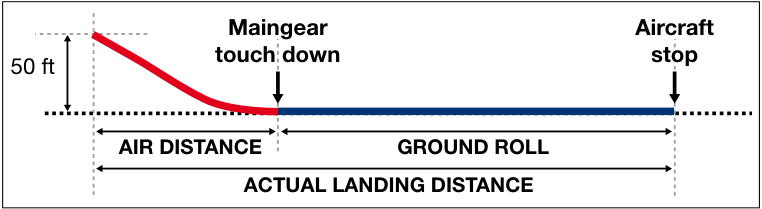
2.3.1. Actual Landing distances (ALd)
Section titled “2.3.1. Actual Landing distances (ALd)”The data published in the Airbus operational documentation for inflight reference are labeled as Actual Landing Distance (ALD). They are defined by regulations for publication in the Flight Manual for dry (FAA and EASA) and contaminated (EASA only) runways. There is no such a regulation for wet runways.
The ALD are the basis upon which margins are added for the regulatory dispatch requirements.
They are not a valid reference data for making in-flight performance assessments when used as published, with no additional margin (fig. 1 & 2).
The ALD are published for sea level, a reference temperature and no wind. Corrections for pressure altitude, longitudinal wind, reverse thrust use, planned approach speed, automatic landing and auto brake use are provided, but not for runway slope or temperature. A runway down slope or higher than reference temperature will thus make the achievable landing distance longer than the published one.
Airbus ALd computation method Air distance:
Section titled “Airbus ALd computation method Air distance:”-
For dry and wet runways, it is derived from flight tests conditions.
-
For contaminated runways, EASA has defined the air distance as 7 seconds at the equivalent ground speed of Vref, with a 7% speed decay between threshold and touchdown.
Ground roll wheel to ground frictions: - For dry runways, it is derived from flight tests.
- For wet runways, Airbus uses the regulatory smooth runway friction approved for rejected take-off. - For contaminated runways, they are defined by EASA regulations.
| Runway condition | Airbus ALd computation | Airbus ALd computation | Regulatory basis |
|---|---|---|---|
| Air distance | Ground roll wheel to ground frictions | ||
| DRY | Flight tests | Flight tests | FAA and EASA |
| CONTAMINATED | 7 sec with 7% speed decay | EASA CS25.1591 | EASA only |
Figure 2 Main characteristics of the ALD published by Airbus
2.3.2. Landing distance requirements for dispatch
Section titled “2.3.2. Landing distance requirements for dispatch”No RLD corrections are published for runway slopes or temperatures above the reference temperature:
The Required Landing Distances for dispatch are defined by regulations as factored ALD and are labeled as RLD (fig. 3). They must be shorter than the declared Landing Distance Available (LDA) of the intended runway, and vary with:
q For dry runways, the effects of slope and temperature are covered by the large regulatory margin.
q For wet and contaminated runways the margins are comparatively small, particularly when taking into account that the recommended approach speed is Vref+5, which increases the landing distance significantly.
q Runway condition, and
q The approach type (for EASA only: dispatch requirement with AUTOLAND planned at arrival).
Figure 3 Main characteristics of the RLD
|---|---|---|---| |Runway condition|RLd computation|Regulatory basis|Reverse credit| |DRY|1,67 x ALD DRY|FAA and EASA|No| |CONTAMINATED|1,15 x ALD CONTAMINATED|EASA only|Allowed|
Safety
q Provisions of specific landing and rejected take-off performance credit for wet grooved or PFC runways have been made. However no specific runway code was assigned to such runways.
q Airbus has elected to take no credit for this fluid contaminant drag at landing, enabling one unique aircraft landing performance level associated with each code.
3. FAA TALpA ARC proposals
Section titled “3. FAA TALpA ARC proposals”The TALPA ARC proposals consist of three intensely related packages of:
q Airports standards for runway condition reporting (FAR139)
The following reports are used as entry points:
The “Matrix” has been already extensively tested in Alaska and other US airports in real conditions during the 2008-2009 and 2009-2010 winters. The runway condition classification made in the “Matrix” will also be the basis of the digital NOTAM system currently being developed in the US.
q Aircraft operational landing performance computation (FAR25/26)
q Contaminant type and depth
q Pilot braking action (PiREP)
q Operators operational rules (FAR121) and training.
q Runway friction measurement (Mu (μ)).
The latter two report types should be used exclusively to downgrade a runway assessed by means of contaminant type and depth (primary columns).
3.1. Runway condition assessment and reporting
Section titled “3.1. Runway condition assessment and reporting”The centerpiece of the proposals is the runway condition “Matrix” hereafter, that associates:
The information to be transmitted to the flight crew includes:
q 7 runway condition codes, built on the existing ICAO runway friction codes, to
q The runway code for each third of the runway
Fluid contaminants (snow, water, slush) generate an extra drag, function of their depth:
q The type and depth of the contaminant and percentage of coverage in 25% increments
q 6 aircraft performance levels defined in § 3.2.1. No performance level is provided for the code 0 as operations in these conditions are prohibited.
q TALPA ARC proposals limit this credit at landing (to half of the reported depth)
q The PiREPS when available.
|---|---|---|---|---| |6|• Dry|||Dry|
Code 2 - Water depth greater than 1/8” (3 mm) - may not be detected by airports, and may therefore not be reported.
Primary columns
Downgrade columns
TALpA ARC main rules associated to the “Matrix”
Section titled “TALpA ARC main rules associated to the “Matrix””-
Pilot reports (PIREPs) of braking action might provide insight that the friction level fell since the last airport evaluation. With existing technology, these reports reflect a purely subjective pilot evaluation, presently only in North America and from pilots used to such a difficult evaluation. They rarely apply to the full length of the runway. The airport should exercise prudent judgment, prompt a new evaluation, and if warranted, report a lower runway condition code than the “Matrix” would indicate for the contaminant type.
-
Friction values from measurement vehicles in winter conditions will no longer be transmitted to pilots, but restricted for the airport authorities use in consolidating or downgrading a runway code. The “Matrix” area shown in blue above is therefore meant for airport use only. - All ambiguous airport reporting terms will be eliminated (such as “patchy”, “thin”, etc).
-
A damp runway must be considered wet. - Wet runways failing maintenance friction survey as defined in AC 150-5320 (e.g., heavy rubber deposits) will be reported as “Slippery” until brought back into required friction standards.
3.2. Landing performance computation and publication
Section titled “3.2. Landing performance computation and publication”3.2.1. Operational Landing distance (OLd)
Section titled “3.2.1. Operational Landing distance (OLd)”The TALPA proposal defines the Operational Landing Distance (OLD) as the maximum landing performance realistically achievable by a line pilot adhering to standard techniques (fig. 4).
OLd computation method
Section titled “OLd computation method”Air distance:
The length of the air distance is the distance covered in 7 seconds at the ground speed corresponding to the approach speed (including temperature and conventional wind effect), with speed decay during the flare set at 4%.
Ground roll wheel to ground frictions: Deceleration means are considered as per their prescribed use in the Standard Operating Procedures (SOP): - For landing in manual braking, maximum pedal braking is assumed to be initiated, if allowed by SOP, at main gear touchdown with reversers deployed shortly after. -For landing with auto brake, the automatic sequence is followed.
|---|---|---|---|---|---|---| ||||Air distance|Ground roll wheel to ground frictions||| |3|MEDIUM|Loose Snow||||| |1|POOR|ICE|||||
Figure 4 (*) The over-conservative ICE value built for dispatch requirements is changed to a more
Main characteristics realistic friction coefficient. of the OLD
3.2.2. Landing distance requirements for dispatch
Section titled “3.2.2. Landing distance requirements for dispatch”Old computation from reported runway condition code and aircraft landing configuration FOLD = 1.15 x OLD if FOLD longer than LDA, no landing on that runway in reported conditions Except in-flight failure affecting landing performance: no landing if OLD adjusted for failure penalty longer than LDA
TALPA ARC was not mandated to review current dispatch rules, therefore the existing rules continue to apply. However for the long term, the need to review dispatch landing distances for consistency with the time of arrival requirements, was acknowledged by TALPA ARC in its submission to the FAA.
Figure 5 In-flight assessment prior to initiating an approach
4. Conclusion
Section titled “4. Conclusion”The FAA TALPA ARC proposal for regulatory changes is made up of three intensely related packages of: q Airport runway condition reporting standards q Aircraft performance computation and publication standards q Operators operational rules and training.
3.3. In-flight assessment operational rules
Section titled “3.3. In-flight assessment operational rules”The FAR 121 operational rules will mandate an in-flight landing distance assessment based on 115% of the Operational Landing Distance published for prevailing conditions (FOLD or Factored OLD) (fig. 5).
With the current dispatch requirements, it will be permitted to omit the in-flight assessment for landing on the runway planned at dispatch only if:
The resulting FAA regulation will become applicable to all new aircraft, and be made retroactive for all existing aircraft.
Airbus supports the new methods for assessing Operational Landing Distances as part of the Industry efforts to help further reducing the runway overruns at landing.
q Dispatch was performed for DRY and if, at the time of the approach preparation, a dry runway and no worse conditions than the standard ones considered for dispatch are reported
Airbus will provide The Runway Overrun Prevention Operational LandSystem (ROPS), described in Safety ing Distance data in First Issue 8 dated July 2009, is the documentation consistent with the TALPA ARC by mid-2011, and proposals. The system was certified has anticipated by in October 2009 on the A380. issuing recommenA future article will detail how the dations for interim ROPS integrates the new in-flight measures since May landing distance assessment rules. 2009.
q Dispatch was performed for WET and if, at the time of the approach preparation, a wet runway and no worse conditions than those considered for the dispatch are reported and the runway is maintained to the standards defining grooved or PFC runways in AC 150-5320.
Safety
Safety
Lars KORNSTAedt A380 运行性能集团经理
Robert Lignee
Section titled “Robert Lignee”试飞工程师
飞行中着陆距离评估的新标准
Section titled “飞行中着陆距离评估的新标准”大型商用运输机重大事故中有三分之一是跑道偏离事故。许多事故涉及机组在抵达时难以现实评估可用着陆距离余度。
这在一定程度上可由以下三个因素解释:
- 评估和报告跑道表面状况的方法和格式多种多样
- 缺乏关于飞行中着陆距离评估的明确法规
- 制造商或运营商发布的飞行中使用着陆性能数据格式各异
在冬季条件下发生一起跑道冲出事故后,FAA 对美国运营商的着陆距离评估政策进行了全面审查。审查结果促使 FAA 通过《运营者安全警报》(SAFO)06012 向航空公司推荐了指南和最佳实践,随后发布了咨询通告(AC)91-79。随后,FAA 成立了起飞和着陆性能评估航空规则制定委员会(TALPA ARC)。该委员会由 FAA 和其他监管机构、航空公司、机场运营商、飞行员协会以及包括空客在内的大多数制造商代表组成,于 2009 年 7 月完成了关于飞行中着陆距离评估新规则的提案。
本文简要介绍了当前管理着陆距离评估的法规(为简化起见,仅涉及 FAA 和 EASA),以及空客选择遵循的方案。然后将概述 TALPA ARC 提议的着陆规则的主要概念。
2.1. 跑道状况评估和报告
Section titled “2.1. 跑道状况评估和报告”目前没有统一的跑道状况评估和报告标准:
- 最常见的是报告污染物类型和深度,测量手段和术语各异
- 当有跑道摩擦力测量车可用时,可能会报告摩擦力值,但测量车测得的跑道摩擦力与同一表面上的飞机性能之间没有相关性
- 着陆后,北美飞行员在冬季条件下通常会向塔台报告其对制动效果的评估,以便通报给后续飞机。评估基于从“好”到“差”的等级划分。
2.2. 飞行中评估操作规则
Section titled “2.2. 飞行中评估操作规则”当前 FAA 和 EASA 规则对飞行中评估着陆性能的必要性做了笼统声明:“机长必须根据其掌握的信息确信,目的地机场的天气和计划使用跑道的状况不应妨碍安全进近和着陆。”但对于确定安全着陆距离应考虑的标准和因素未提供任何指导。
2.3. 着陆性能计算和发布
Section titled “2.3. 着陆性能计算和发布”
2.3.1. 实际着陆距离(ALd)
Section titled “2.3.1. 实际着陆距离(ALd)”空客操作文件中发布的飞行中参考数据被称为实际着陆距离(ALD)。它们是法规为飞行手册中干跑道(FAA 和 EASA)和污染跑道(仅 EASA)公布的依据。湿跑道没有此类规定。
ALD 是添加余度的基础,以满足法规放行要求。
如果按发布形式使用,不添加额外余度,则它们不是进行飞行中性能评估的有效参考数据**(图 1 和 2)**。
ALD 按海平面、标准气温和无风条件发布。提供了气压高度、顺逆风、反推使用、计划进近速度、自动着陆和自动刹车使用的修正,但不提供跑道坡度或温度的修正。因此,下坡跑道或高于标准气温将使可达到的着陆距离比公布值更长。
空客 ALD 计算方法 空中滑翔距离:
Section titled “空客 ALD 计算方法 空中滑翔距离:”- 对于干跑道和湿跑道,来源于飞行试验条件。
- 对于污染跑道,EASA 将空中滑翔距离定义为以 Vref 的等效地速飞行 7 秒,阈速与接地之间速度衰减 7%。
接地后滑跑轮地摩擦系数:
- 对于干跑道,来源于飞行试验。
- 对于湿跑道,空客使用经批准用于中断起飞的规则光滑跑道摩擦系数。
- 对于污染跑道,由 EASA 法规定义。
| 跑道状况 | 空客 ALD 计算 | 空客 ALD 计算 | 法规依据 |
|---|---|---|---|
| 空中滑翔距离 | 接地后滑跑轮地摩擦系数 | ||
| 干 | 飞行试验 | 飞行试验 | FAA 和 EASA |
| 污染 | 7 秒,7% 速度衰减 | EASA CS25.1591 | 仅 EASA |
图 2 空客发布的 ALD 主要特征
2.3.2. 放行着陆距离要求
Section titled “2.3.2. 放行着陆距离要求”对于跑道坡度或高于基准温度的温度,未发布任何 RLD 修正值:
放行所需着陆距离由法规定义为经因数修正的 ALD,并标记为 RLD(图 3)。其必须短于预定跑道公布的着陆可用距离(LDA),且随以下因素变化:
q 对于干燥跑道,坡度和温度的影响已包含在较大的法规余量中。
q 对于湿和污染跑道,余量相对较小,特别是考虑到推荐进近速度为 Vref+5,这会显著增加着陆距离。
q 跑道状况,以及
q 进近类型(仅适用于 EASA:计划到达时使用 AUTOLAND 的放行要求)。
图 3 RLD 的主要特征
|---|---|---|---| |跑道状况|RLd 计算|法规依据|反推 credit| |干燥|1.67 × ALD 干燥|FAA 和 EASA|无| |污染|1.15 × ALD 污染|仅 EASA|允许|
安全
q 已制定了针对湿滑刻槽或 PFC 跑道的特定着陆和中断起飞性能 credit。然而,此类跑道未分配特定跑道代码。
q 空中客车选择不在着陆时考虑该流体污染物的阻力,从而为每个代码关联一个唯一的飞机着陆性能水平。
3. FAA TALPA ARC 提案
Section titled “3. FAA TALPA ARC 提案”TALPA ARC 提案由三个密切相关的方案组成:
q 机场 跑道状况报告标准(FAR139)
以下报告用作切入点:
“矩阵”已在 2008-2009 和 2009-2010 年冬季在阿拉斯加和其他美国机场的真实条件下进行了广泛测试。“矩阵”中的跑道状况分类也将成为美国目前正在开发的数字 NOTAM 系统的基础。
q 飞机 运营着陆性能计算(FAR25/26)
q 污染物类型和深度
q 飞行员制动动作报告(PiREP)
q 运营人 运营规则(FAR121)和培训。
q 跑道摩擦力测量(Mu (μ))。
后两种报告类型应仅用于根据污染物类型和深度(主列)对跑道进行降级。
3.1. 跑道状况评估与报告
Section titled “3.1. 跑道状况评估与报告”提案的核心是以下跑道状况”矩阵”:
传输给飞行机组的信息包括:
q 7 个跑道状况代码,基于现有 ICAO 跑道摩擦代码构建,用于
q 每段跑道三分之一处的跑道代码
流体污染物(雪、水、泥浆)产生额外阻力,其大小取决于深度:
q 污染物类型和深度,以及以 25% 为增量递增的覆盖率
q 第 3.2.1 节定义的 6 个飞机性能等级。代码 0 未提供性能等级,因为此类条件下的运行被禁止。
q TALPA ARC 提案将此 credit 限制在着陆时(报告深度的一半)
q 可用的 PiREP。
|---|---|---|---|---| |6|• 干燥|||干燥|
代码 2 - 水深大于 1/8”(3 mm)- 机场可能无法检测,因此可能不会被报告。
主列
降级列
与”矩阵”相关的 TALPA ARC 主要规则
Section titled “与”矩阵”相关的 TALPA ARC 主要规则”-
飞行员报告(PIREPs)中的制动动作可能表明摩擦力自上次机场评估以来已下降。使用现有技术,这些报告反映的是完全主观的飞行员评估,目前仅在北美地区且仅来自习惯这种困难评估的飞行员。它们很少适用于整条跑道长度。机场应谨慎判断,启动新的评估,如有正当理由,报告比”矩阵”根据污染物类型所示更低的跑道状况代码。
-
冬季条件下测量车辆的摩擦系数值将不再传输给飞行员使用,仅限机场当局用于整合或降级跑道代码。因此,上面蓝色显示的”矩阵”区域仅供机场使用。- 所有模糊的机场报告术语将被消除(如”斑驳”、“薄”等)。
-
潮湿跑道必须视为湿跑道。未能通过 AC 150-5320 定义的维护摩擦力调查的湿跑道(如重橡胶沉积物)将被报告为”湿滑”,直至恢复所需摩擦力标准。
3.2. 着陆性能计算与公布
Section titled “3.2. 着陆性能计算与公布”3.2.1. 运营着陆距离(OLd)
Section titled “3.2.1. 运营着陆距离(OLd)”TALPA 提案将运营着陆距离(OLD)定义为航线飞行员在遵守标准技术的情况下可实际实现的最大着陆性能(图 4)。
OLd 计算方法
Section titled “OLd 计算方法”空中距离:
空中距离长度对应于在进近速度地速(包含温度和常规风效应)下 7 秒内经过的距离,拉平期间速度衰减设定为 4%。
着陆滑跑接地摩擦: 减速方式按标准操作程序(SOP)中规定的使用方式考虑:
- 手动制动着陆时,如 SOP 允许,假设主起落架接地后即开始最大脚蹬制动,反推随后不久展开。
- 使用自动刹车着陆时,遵循自动序列。
|---|---|---|---|---|---|---| ||||空中距离|接地滑跑摩擦||| |3|中等|松散雪地||||| |1|差|冰面|||||
图 4 (*) 为放行要求建立的过度保守的冰面数值被更改为更
主要特征 现实的摩擦系数。 OLD
OLd 的主要特征
3.2.2. 放行时的着陆距离要求
Section titled “3.2.2. 放行时的着陆距离要求”旧版计算方法(基于报告的跑道状况代码和飞机着陆构型): FOLD = 1.15 × OLD
如果 FOLD 长于 LDA,则在所报告的条件下不得在该跑道着陆 除非发生影响着陆性能的飞行中故障:如果 OLD 经故障惩罚调整后长于 LDA,则不得着陆
TALPA ARC 未被授权审查现行的放行规则,因此现有规则继续适用。然而,从长远来看,TALPA ARC 在其提交给 FAA 的报告中承认,需要审查放行着陆距离以与到达时间要求保持一致。
Figure 5 进近前飞行中评估
FAA TALPA ARC 提出的法规修订提案由三个密切相关的部分组成:
- 机场跑道状况报告标准
- 飞机性能计算与公布标准
- 运营人运营规则和培训
即将出台的 FAA 法规将适用于所有新飞机,并对所有现有飞机具有追溯效力。
空客支持评估运营着陆距离的新方法,这是行业为进一步减少着陆时跑道偏出所作努力的一部分。
3.3. 飞行中评估运营规则
Section titled “3.3. 飞行中评估运营规则”FAR 121 运营规则将强制要求基于所报告条件下的已公布运营着陆距离的 115% 进行飞行中着陆距离评估(FOLD 或因数化 OLD)(图 5)。
根据现行放行要求,在以下条件下,可以省略对计划放行跑道进行飞行中评估:
将要出台的 FAA 法规将适用于所有新飞机,并追溯适用于所有现有飞机。
q 放行是针对干跑道进行的,且在进近准备时,报告的跑道为干跑道且状况不差于放行时考虑的标准条件
q 放行是针对湿跑道进行的,且在进近准备时,报告的跑道为湿跑道且状况不差于放行时考虑的条件,且跑道维护符合 AC 150-5320 中定义的开槽或 PFC 跑道标准
空客将在 2011 年中期前按 TALPA ARC 提案提供一致的跑道冲出防护运营着陆距离系统文件,如 2009 年 7 月《Safety First》第 8 期中所述的跑道冲出防护系统(ROPS),该系统已于 2009 年 10 月在 A380 上获得认证。未来的文章将详细介绍 ROPS 如何整合自 2009 年 5 月以来的新型飞行中着陆距离评估规则。