Thrust Reverser Selection is a Decision to Stop
Source: Airbus Safety First URL: https://safetyfirst.airbus.com/thrust-reverser-selection-is-a-decision-to-stop/ Published: 2023-06-10 Category: Flight Ops, go around, landing, rejected landing, reverse PDF: Original PDF

The SOP for landing requests that the flight crew perform a full stop landing after thrust reversers selection. However, in-service data revealed that the of one flight analysis equivalent month is after selection of thrust go-around per performed reversers. This article describes an event where the crew flight performed a go-around after they had selected thrust reversers on an A320 aircraft. The reverser on one engine remained deployed until the end of the flight.
The article explains how adherence to SOPs will prevent recurrence of this kind of event and describes the product enhancements that Airbus developed as additional safety barriers.
Check the latest version of this article on safetyfrst.airbus.com and on the Safety first app for iOS and Android devices.
CASE STUDY
Section titled “CASE STUDY”Event Description
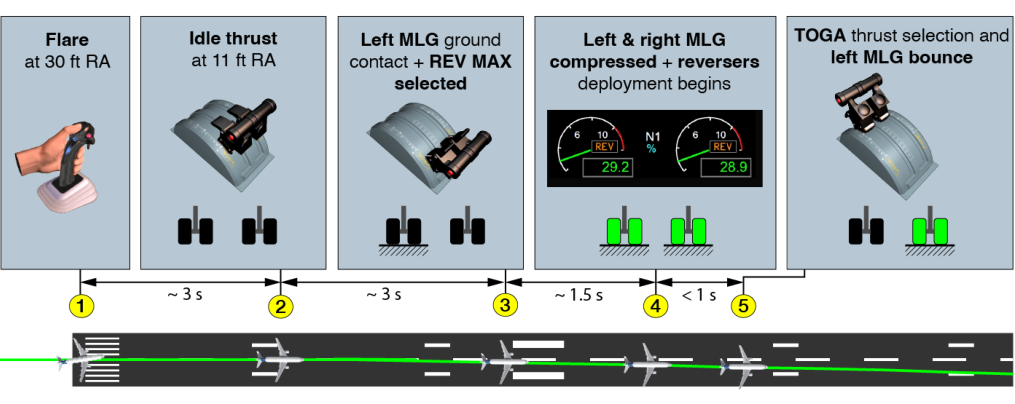
Section titled “Event Description”An A320 aircraft fitted with CFM56 engines was on an ILS approach in FLAP 3 configuration with good visibility conditions. There was a 25 kt crosswind and wind gusts from the left side (fig.1).
① The PF initiated the flare slightly above 30 ft RA, started the decrab maneuver at 24 ft RA, and ② set the thrust levers to idle at 11 ft RA. ③ The left Main Landing Gear (MLG) briefly touched the runway, but was not fully compressed when the flight crew set the thrust lever to maximum reverse.
④ When both the left and right MLG touched the runway and were compressed, the thrust reversers began to deploy. ⑤ The flight crew then decided to perform a go-around. The left MLG was briefly uncompressed when the PF applied TOGA thrust. They selected CONF2 and applied nose-up inputs.
(fig.1) Sequences of the event from landing flare to the application of TOGA thrust for go-around
⑥ ENG 2 spooled up to reach TOGA thrust, but ENG 1 remained at idle with the REV indication still displayed on the Engine Warning Display (EWD) (fig.2). The aircraft began to veer to the left. The PF reacted and applied a half of maximum right rudder input. Both the left and right MLG were briefly compressed again. ⑦ The aircraft continued to veer to the left and the ENG 1 REVERSE UNLOCKED ECAM alert triggered when the left and right MLG were uncompressed. The beta target symbol on the PFD was flagged. ⑧ The aircraft overflew the left runway edge by 1 ft.
⑨ The flight crew commanded the landing gear up and the aircraft started to climb on a trajectory that was shifted by approximately 20° to the left of the runway axis. When the landing gear was retracted and the pitch was set close to 12.5°, corresponding to the target for go-around with one engine inoperative, ⑩ the vertical speed reached 1 000 ft/min.
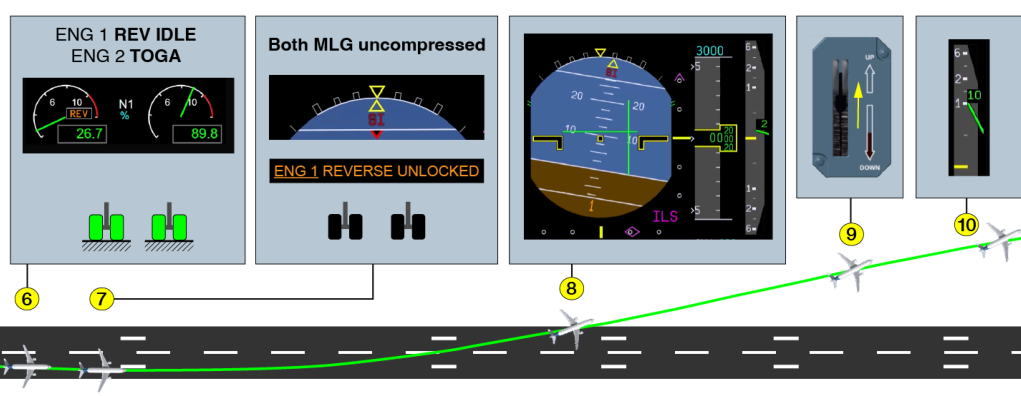
The flight crew then set the ENG1 thrust lever to IDLE at 360 ft and shut down ENG 1, as per the ECAM procedure at 1 260 ft QNH. The beta target symbol appeared again on the PFD, which enabled the PF to correctly trim the rudder, and the autopilot was engaged.
(fig.2) Sequences of the event after TOGA thrust selection
The flight crew performed a second ILS approach and manually landed the aircraft with its ENG 1 inoperative.
The aircraft arrived at the gate with three of the four ENG 1 thrust reverser blocker doors deployed and not locked (fig.3). The fourth door was not deployed, but was unlocked.
Event Analysis
Section titled “Event Analysis”Thrust Reverser Deployment Sequence
Section titled “Thrust Reverser Deployment Sequence”The thrust reversers unlocked when both the left and right MLG were compressed. When the PF applied TOGA thrust, the thrust reversers of the left and right engines were not fully deployed (the amber REV indication was still displayed on the EWD).
Thrust Reverser Stowage Logic (on CFM56 Engines)
Section titled “Thrust Reverser Stowage Logic (on CFM56 Engines)”When the thrust levers are moved from the REV sector to idle or forward thrust sector, the Electronic Control Unit (ECU) of each engine computes a “ground” or “flight” status using the “compressed” or “uncompressed” status for the left and right MLG. This is provided by the Landing Gear Control and Interface Unit (LGCIU).
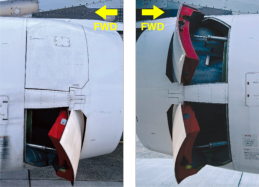
(fig.3) Aircraft at gate after the event with three out of four thrust reverser blocker doors deployed on ENG 1 (photos: Accident Investigation Board)
If the computed status is “ground” when the thrust levers are moved out of the REV sector, then the ECU will send a “stow” command until the thrust reversers are stowed. If the computed status is “flight”, then the ECU does not send a signal to initiate the stow sequence.
Why ENG 2 thrust reverser stowed and locked
Section titled “Why ENG 2 thrust reverser stowed and locked”When the PF set TOGA thrust, ECU 2 computed the “ground” status using information from LGCIU 2. This sent the “stow” command to the ENG 2 thrust reverser. The ENG 2 thrust reverser stowed and locked correctly and ENG 2 spooled up to reach TOGA thrust.
Why ENG 1 thrust reverser did not stow and lock
Section titled “Why ENG 1 thrust reverser did not stow and lock”When the PF set TOGA thrust, ECU 1 computed the “flight” status using information from LGCIU 1. ECU 1 did not send a stow command to the ENG 1 reverser and its
blocker doors remained deployed. The automatic idle protection activated and sent a signal to prevent ENG 1 increasing thrust. What caused the difference between ENG 1 and ENG 2
A short asynchronism between the computation of the ground/flight status by both ECUs, combined with a bounce of the left landing gear, explains the different behaviors of the ECUs. This timing difference can be explained by the fact that thrust levers may not be closely aligned when the flight crew moves them from the REV sector to idle or forward thrust sector. In addition, a very slight delay may appear between the signals and computation chain of LGCIU-EIU-ECU, which are independent for the left and right sides (fig.4).
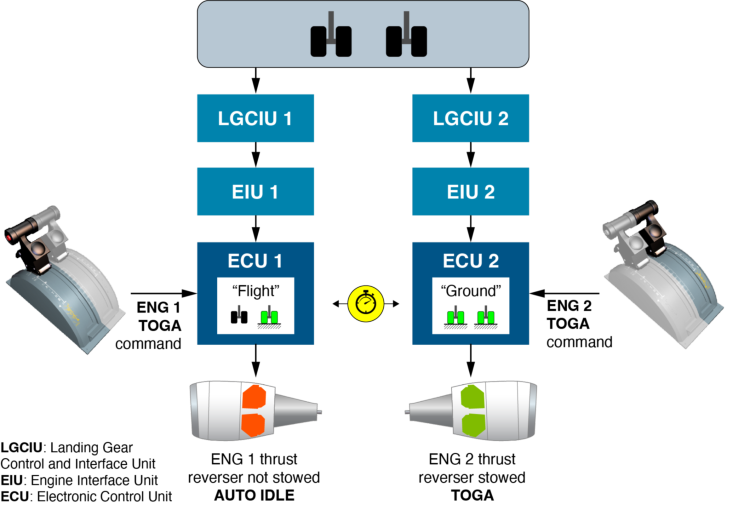
(fig.4) A short delay between the computation of the “ground” or “flight” status by ECU 1 and ECU 2, combined with a left MLG “bounce” condition caused the ENG 1 thrust reverser blocker doors to remain deployed and ENG 1 set at AUTO IDLE
Limited to aircraft with CFM56 engines
Section titled “Limited to aircraft with CFM56 engines”A study of the reverser stowing logic was performed on A320 aircraft equipped with all other types of engine, as well as on other Airbus aircraft types including the A220. It confirmed that only A320 and A340 aircraft equipped with CFM56 engines can be affected by this potential for the thrust reversers to not retract if the crew decides to perform a go-around after the thrust reversers are selected.
Beta target not displayed due to EIS logic
Section titled “Beta target not displayed due to EIS logic”The current EIS logic flags the beta target symbol on the PFD if the reversers are not stowed and the auto-idle protection is active. This explains why the beta target symbol was flagged in the early stage of the go-around and before ENG 1 was shut down. As soon as ENG 1 was shut down, the beta target reappeared on the PFD.
Impact on aircraft control and performance
Section titled “Impact on aircraft control and performance”The flight crew had to cope with a fast lateral trajectory deviation, together with a significant degradation of climb performance, during an already demanding maneuver.
Significant pitch and roll values reached closed to the ground
Section titled “Significant pitch and roll values reached closed to the ground”In the initial phase of the go-around, the aircraft attitude went close to wing tip and tailstrike conditions (fig.5) but remained within the ground clearance limits.
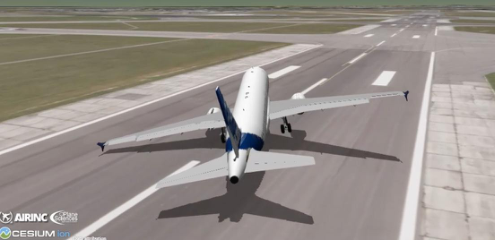
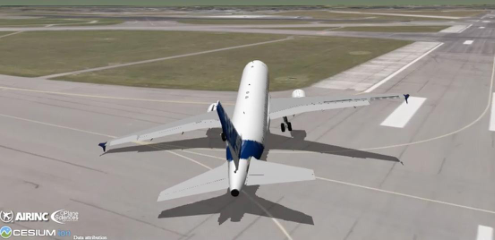
(fig.5) Screen captures from the video reconstruction of the event showing the aircraft attitude in the early stage of the go-around phase (Flight Animation System from APS Aerospace)
OPERATIONAL CONSIDERATIONS
Section titled “OPERATIONAL CONSIDERATIONS”Adherence to the SOP for landing will prevent recurrence of a similar event and ensure optimum and safe use of the thrust reversers, regardless of the engine type, and on any aircraft.
Select reversers immediately after touchdown
Section titled “Select reversers immediately after touchdown”The SOP for landing requests that the flight crew select thrust reversers immediately after landing gear touchdown, but not before, to ensure timely deployment of the thrust reversers for optimum aircraft deceleration on landing.
Thrust reverser selection means full stop
Section titled “Thrust reverser selection means full stop”The SOP for landing also states that as soon as the flight crew selects reverse thrust, they must perform a full-stop landing. This is also highlighted for a go-around near the ground in the FCTM, which states, “ the PF must not initiate a go-around after the selection of the thrust reversers .” Adherence to this SOP will avoid any repeat of the event described in this article. The A220 FCOM limitation chapter also states that “ Go-around maneuver and touch-and-go are prohibited after deployment of the thrust reversers. ”
A similar event, described in a previous Safety first article, occurred on an A300-600 with a different reverser system architecture. The root cause was different, but it also highlighted how adherence to the SOP for landing would have prevented the incident.
Refer to the “Thrust reverser selection means full-stop” article published in June 2012.

PRODUCT ENHANCEMENTS
Section titled “PRODUCT ENHANCEMENTS”Airbus performed flight data analysis with inputs from 31 operators for 3.4 million flights of A320 family aircraft. The results showed that the equivalent of one go-around per month is performed with the thrust reversers already selected, which represents significant exposure. Consequently, Airbus decided to address this issue with updates to the ECU software, the EIS software, and the relevant documentation.
ECU software update for CFM56 engines
Section titled “ECU software update for CFM56 engines”An update of the ECU software for CFM56 engines is under development. It includes an enhanced stow logic in the case of a rejected landing with reversers already selected, which will prevent recurrence of the event described in this article. The ECU software update is planned to be available in 2025 for CFM56-5B engines and is under review for CFM56-5A and -5C.
EIS update
Section titled “EIS update”A320 family EIS 2 software will be modified to enable the display of the beta target on the PFD when REV doors are unlocked. This enhancement will be implemented in the next EIS 2 standard.
Enhancement of the SOP for landing
Section titled “Enhancement of the SOP for landing”The SOP for landing will be updated to move the following text from the FCOM layer 2 (L2) to a note in the FCOM layer 1 (L1), making it more visible to the flight crew: “ The flight crew must select reverse thrust immediately after landing gear touchdown ” and “ As soon as the flight crew selects reverse thrust, they must perform a full-stop landing ”
Contributors:
Section titled “Contributors:”David BOYER
Section titled “David BOYER”Expert Engine Control Technology & Development Design Office
Denis CADOUX Accident/incident Investigator Product Safety
Dirk DE-WINTER
Section titled “Dirk DE-WINTER”Flight Ops & Training Pilot Expert Customer Support
Maxime LANSONNEUR Director Safety - Training and Flight Operations Customer Support
The SOP for landing states that as soon as the flight crew selects reverse thrust, they must perform a full-stop landing. Analysis of in-service data shows that there is still a risk exposure with flight crews deciding to perform a go-around after the thrust reversers were selected.
An incident that happened on an A320 aircraft highlighted a risk of having one of the engines with the reversers still deployed in the case of a go-around initiated after reverser deployment on aircraft equipped with CFM56 engines. Application of the SOP should prevent this kind of event from happening. However, Airbus decided to introduce aircraft modifications to further prevent this scenario from happening and enhance the documentation by making the recommendation to perform a full-stop landing after selection of thrust reversers more visible to the flight crew.
With thanks to Matthias MAEDER from Airbus Canada
Section titled “With thanks to Matthias MAEDER from Airbus Canada”Safety first, 2023. Safety first is published by Airbus S.A.S. 1, rond point Maurice Bellonte - 31707 Blagnac Cedex/France.
Editor: Yannick Malinge, Chief Product Safety Officer.
Editorial team: Guillaume Estragnat, Vanessa Sadi, Gwyneth Duggan, Javier Martinez Marina, Tim Roach.
Photos by Airbus.
来源: Airbus Safety First 网址: https://safetyfirst.airbus.com/thrust-reverser-selection-is-a-decision-to-stop/ 发布日期: 2023-06-10 类别: 飞行操作,复飞,着陆,中止着陆,反推 PDF: 原始 PDF
着陆标准操作程序要求飞行机组在选择反推后执行全停着陆。然而,服役数据表明,大约每飞行当量月就会发生一起在选择反推后执行复飞的事件。本文描述了一个事件,飞行机组在一架 A320 飞机上选择反推后执行了复飞。一台发动机的反推在飞行结束前一直处于展开状态。
本文解释了遵守标准操作程序将如何防止此类事件的再次发生,并描述了空中客车公司作为额外安全屏障而开发的产品改进。
请在 safetyfirst.airbus.com 和 iOS 及 Android 设备的 Safety first 应用程序上查看本文的最新版本。
一架装有 CFM56 发动机的 A320 飞机在 FLAP 3 形态下进行 ILS 进近,能见度良好。存在 25 节侧风且伴有来自左侧的阵风 (图 1)。
① PF 在 30 ft RA 以上略微开始拉平,在 24 ft RA 开始修正偏流,② 在 11 ft RA 将推力手柄设置到慢车。③ 左侧主起落架(MLG)短暂接触跑道,但在飞行机组将推力手柄设置到最大反推时未完全压缩。④ 当左、右 MLG 均接触跑道并被压缩后,反推开始展开。⑤ 然后飞行机组决定执行复飞。当 PF 应用 TOGA 推力时,左侧 MLG 短暂未压缩。他们选择了 CONF 2 并施加了抬头输入。
(图 1) 从着陆拉平到复飞应用 TOGA 推力的事件顺序
⑥ ENG 2 加速达到 TOGA 推力,但 ENG 1 保持在慢车状态,EWD 上仍显示 REV 指示 (图 2)。飞机开始向左偏移。PF 作出反应,应用了最大右舵输入量的一半。左、右 MLG 均再次短暂压缩。⑦ 当左、右 MLG 未压缩时,飞机继续向左偏移,触发了 ENG 1 REVERSE UNLOCKED ECAM 警告。PFD 上的 beta 目标符号被标牌遮挡。⑧ 飞机从左侧跑道边伸出 1 ft。
⑨ 飞行机组指令收起起落架,飞机开始以偏离跑道轴线约 20° 的轨迹爬升。当起落架收起且俯仰角接近 12.5°(对应单发失效复飞的目标俯仰角)时,⑩ 垂直速度达到 1000 ft/min。
飞行机组随后在 360 ft 将 ENG 1 推力手柄设置到 IDLE,并根据 ECAM 程序在 1260 ft QNH 关闭了 ENG 1。PFD 上再次出现 beta 目标符号,这使 PF 能够正确调整方向舵配平,并接入了自动驾驶仪。
(图 2) 选择 TOGA 推力后的事件顺序
飞行机组执行了第二次 ILS 进近,并用 ENG 1 不工作状态手动着陆了飞机。
飞机停靠廊桥时,ENG 1 的四个反推挡板门中有三个处于展开且未锁定状态 (图 3)。第四个挡板门未展开,但处于未锁定状态。
反推展开顺序
Section titled “反推展开顺序”当左、右 MLG 均被压缩时,反推解锁。当 PF 应用 TOGA 推力时,左、右发动机的反推未完全展开(EWD 上仍显示琥珀色 REV 指示)。
反推收存逻辑(CFM56 发动机)
Section titled “反推收存逻辑(CFM56 发动机)”当推力手柄从反推区移动到慢车或前推力区时,每台发动机的 ECU 根据左、右 MLG 的“压缩”或“未压缩”状态计算“地面”或“飞行”状态。这由 LGCIU 提供。
(图 3) 事件后停在廊桥的飞机,ENG 1 上四个反推挡板门中有三个展开(照片:事故调查委员会)
如果当推力手柄移出反推区时计算状态为“地面”,则 ECU 将发送“收存”指令直到反推收存完毕。如果计算状态为“飞行”,则 ECU 不发送信号启动收存顺序。
Why ENG 2 thrust reverser stowed and locked
Section titled “Why ENG 2 thrust reverser stowed and locked”当 PF 设置 TOGA 推力时,ECU 2 使用 LGCIU 2 的信息计算”地面”状态。这向 ENG 2 反推发送了”收上”指令。ENG 2 反推正确收上并锁定,ENG 2 加速达到 TOGA 推力。
Why ENG 1 thrust reverser did not stow and lock
Section titled “Why ENG 1 thrust reverser did not stow and lock”当 PF 设置 TOGA 推力时,ECU 1 使用 LGCIU 1 的信息计算”飞行”状态。ECU 1 没有向 ENG 1 反推发送收上指令,其阻挡门保持展开状态。自动怠速保护启动并发送信号阻止 ENG 1 增加推力。
What caused the difference between ENG 1 and ENG 2
Section titled “What caused the difference between ENG 1 and ENG 2”两个 ECU 计算地面/飞行状态之间的短暂不同步,加上左侧主起落架(MLG)的弹跳,解释了 ECU 的不同行为。这种时序差异可归因于飞行机组将推力手柄从反推区移动到怠速或前推力区时,推力手柄可能未紧密对齐。此外,LGCIU-EIU-ECU 的信号和计算链之间可能出现轻微延迟,这些对于左侧和右侧是独立的**(图4)**。
(图4) ECU 1 和 ECU 2 计算”地面”或”飞行”状态之间的短暂延迟,加上左侧 MLG”弹跳”状况,导致 ENG 1 反推阻挡门保持展开状态,ENG 1 处于自动怠速
Limited to aircraft with CFM56 engines
Section titled “Limited to aircraft with CFM56 engines”对配备其他类型发动机的 A320 飞机以及包括 A220 在内的其他空客飞机型号进行了反推收上逻辑研究。研究确认,只有配备 CFM56 发动机的 A320 和 A340 飞机可能在机组决定在选择反推后执行复飞时受到影响,导致反推无法收回。
Beta target not displayed due to EIS logic
Section titled “Beta target not displayed due to EIS logic”当前 EIS 逻辑会在反推未收上且自动怠速保护激活时在 PFD 上标记 Beta 目标符号。这解释了为什么 Beta 目标符号在复飞初期被标记,以及在 ENG 1 关闭前出现的原因。一旦 ENG 1 关闭,Beta 目标符号重新出现在 PFD 上。
Impact on aircraft control and performance
Section titled “Impact on aircraft control and performance”飞行机组不得不在本已要求苛刻的机动中,应对快速的侧向轨迹偏离以及爬升性能的显著下降。
Significant pitch and roll values reached closed to the ground
Section titled “Significant pitch and roll values reached closed to the ground”在复飞初期,飞机的姿态接近翼尖擦地和尾橇擦地的条件**(图5)**,但保持在地面间隙限制范围内。
(图5) 事件视频重建的屏幕截图,显示复飞初期阶段的飞机姿态(Flight Animation System from APS Aerospace)
OPERATIONAL CONSIDERATIONS
Section titled “OPERATIONAL CONSIDERATIONS”遵守着陆 SOP 将防止类似事件再次发生,并确保在任何飞机上安全使用反推(无论发动机类型)。
Select reversers immediately after touchdown
Section titled “Select reversers immediately after touchdown”着陆 SOP 要求飞行机组在主起落架触地后立即选择反推,但不得在此之前,以确保反推及时展开,在着陆时实现最佳飞机减速。
Thrust reverser selection means full stop
Section titled “Thrust reverser selection means full stop”着陆 SOP 还规定,飞行机组一旦选择反推,必须执行全停着陆。FCTM 也在近地面复飞部分强调了这一要求,指出” PF 不得在选择反推后启动复飞 “。遵守此 SOP 将避免本文所述事件的再次发生。A220 FCOM 限制章节也规定” 在反推展开后禁止执行复飞机动和连续起飞 ”。
此前 Safety First 文章中描述的类似事件发生在 A300-600 上,其反推系统架构不同。根本原因不同,但也同样强调遵守着陆 SOP 可以防止该事件。
请参阅 2012 年 6 月发表的”Thrust reverser selection means full-stop”文章。
空客对A320系列飞机3.4百万次航班的数据进行了分析,并收集了31家航空公司的意见。结果显示,平均每月发生一次反推已选择后的复飞,这意味着存在重大风险敞口。因此,空客决定通过更新ECU软件、EIS软件及相关文档来解决此问题。
CFM56发动机ECU软件更新
Section titled “CFM56发动机ECU软件更新”CFM56发动机ECU软件更新正在开发中。该更新包含在反推已选择情况下中断着陆时的增强收起逻辑,将防止本文所述事件的再次发生。ECU软件更新计划于2025年面向CFM56-5B发动机提供,目前正在审核是否适用于CFM56-5A和-5C发动机。
A320系列EIS 2软件将进行修改,在反推舱门解除锁定时在PFD上显示beta目标值。该增强功能将在下一个EIS 2标准中实施。
着陆SOP增强
Section titled “着陆SOP增强”着陆SOP将进行更新,将以下内容从FCOM第2层(L2)移至FCOM第1层(L1)的注释中,以提高对飞行机组的可见性:“飞行机组必须在主轮接地后立即选择反推”以及“飞行机组一旦选择反推,必须执行全停着陆”
David BOYER
发动机控制技术与发展设计办公室专家
Denis CADOUX
事故/事故征候调查员产品安全
Dirk DE-WINTER
飞行运营与训练飞行员客户支持专家
Maxime LANSONNEUR
客户支持飞行运营与训练安全总监
着陆SOP规定,飞行机组一旦选择反推,必须执行全停着陆。运营数据分析表明,飞行机组在选择反推后决定执行复飞仍存在风险敞口。
一起发生在A320飞机上的事件凸显了在配备CFM56发动机的飞机上,复飞启动后一台发动机反推仍处于展开状态的风险。SOP的应用应能防止此类事件发生。然而,空客决定引入飞机改装以进一步防止此类情况发生,并通过使关于选择反推后执行全停着陆的建议对飞行机组更加可见来增强文档。
特别感谢来自空中客车加拿大的Matthias MAEDER
Section titled “特别感谢来自空中客车加拿大的Matthias MAEDER”Safety first,2023年。Safety first由空中客车S.A.S.出版。1, rond point Maurice Bellonte - 31707 Blagnac Cedex/法国。
编辑:Yannick Malinge,产品安全总监。
编辑团队:Guillaume Estragnat、Vanessa Sadi、Gwyneth Duggan、Javier Martinez Marina、Tim Roach。
照片由空中客车提供。