Correct Escape Slides Maintenance for Successful Slides Deployment
Source: Airbus Safety First URL: https://safetyfirst.airbus.com/correct-escape-slides-maintenance-for-successful-slides-deployment/ Published: 2019-02-26 Magazine Issue: 2019-03 Category: Maintenance, door, doors, Emergency escape slide, emergency exit, escape slide/raft, evacuation, raft PDF: Original PDF
OPERATIONS Correct Escape Slides Maintenance for Successful Slides Deployment
Correct Escape Slides Maintenance for Successful Slides Deployment
It is of the outmost importance to make sure that escape slides’ maintenance is properly done so that they can deploy correctly when they are the most needed.
This article recalls the importance of reporting scheduled and unscheduled slide deployment results to Airbus. It highlights the most common causes of unsuccessful slide deployments and provide recommendations to prevent them.

In the early nineties, an A300-600 aircraft overran the runway threshold and came to rest leaning to its left side. This meant that evacuation from the right hand side of the aircraft was impossible. The cabin crew also observed fire on the aft fuselage of the aircraft and decided to evacuate the passengers using only one escape slide from the forward left side door. The escape slide deployed correctly to allow all 160 passengers and crew to escape the wreckage and move to a safe distance away from the aircaft before it burst into flames.
This event highlights the importance of reliable escape slide deployment and how following correct maintenance procedures, and reporting slide deployment test results to Airbus, is essential for ensuring that escape slides will properly deploy when they are most needed.
REPORTING SLIDE DEPLOYMENTS TO AIRBUS
Section titled “REPORTING SLIDE DEPLOYMENTS TO AIRBUS”Reporting all slide deployments enables continuous improvement of slide reliability
Section titled “Reporting all slide deployments enables continuous improvement of slide reliability”Operators have to perform a certain number of slide deployment tests on a regular basis. Comprehensively reporting any slide deployment gives an overview of the slide’s reliability, and this can help to identify areas of improvement. The AMM/MP provides the slide deployment report form template (fig.1). The operator should use this form to describe the result of each slide deployment and then send it to Airbus. This form is for reporting both successful and unsuccessful slide deployments for analysis.
Comprehensively reporting any slide deployment gives an overview of the slide’s reliability, and this can help to identify areas of improvement.
A detailed report facilitates failure identification
Section titled “A detailed report facilitates failure identification”The AMM/MP procedure for operational check of slide deployment also requests the operator to record the test with video cameras from different angles. Should the deployment be unsuccessful, this video recording enables detailed analysis of the deployment sequence and providing the videos and any photos to Airbus, in addition to the deployment report, will assist in the investigation to find the root cause of the failed deployment.
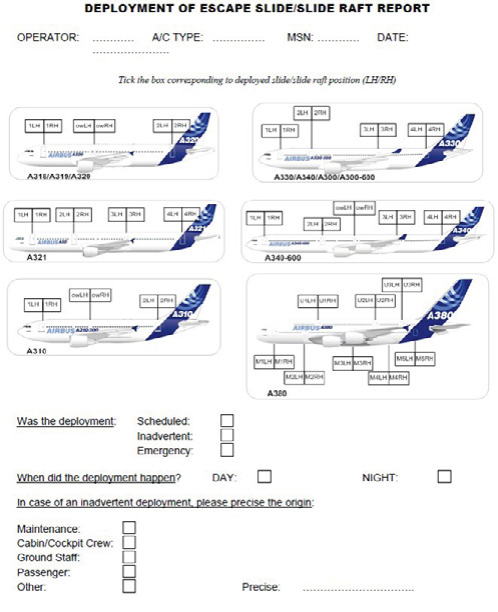
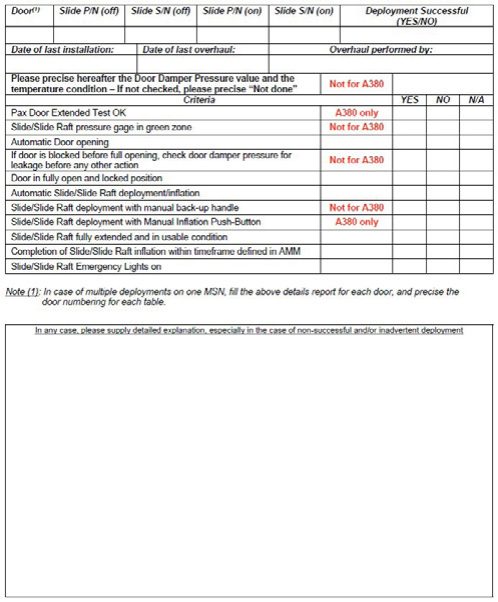
(fi g.1)
Section titled “(fi g.1)”Escape slide deployment report template in the AMM/MP.
SAFETY PRECAUTIONS IN THE CASE OF AN UNSUCCESSFUL DEPLOYMENT DURING A TEST
Section titled “SAFETY PRECAUTIONS IN THE CASE OF AN UNSUCCESSFUL DEPLOYMENT DURING A TEST”If the slide does not deploy during a test, the deployment area must remain clear of any personnel as there is the risk that the slide can suddenly infl ate until the slide is correctly secured. Sudden slide raft infl ation may cause injuries or damage to equipment.
It is recommended to carefully take photos from the inside and from the outside of the aircraft in addition to recording details of the position of the slide during a failed test. When it is confi rmed that the slide is not obstructed by the doorframe or its compartment the operator can then pull the manual infl ation handle. This will ensure that the slide infl ation gas cylinder is empty and that the slide is in a safe condition to handle.
COMMON CAUSES OF INCORRECT SLIDE DEPLOYMENTS
Section titled “COMMON CAUSES OF INCORRECT SLIDE DEPLOYMENTS”Reported slide deployments enabled Airbus to identify several common causes of unsuccessful deployments. A majority of these can be avoided by following these recommendations.
Checking for correct electrical harness routing during door slide installation
Section titled “Checking for correct electrical harness routing during door slide installation”The slide’s electrical harness routing is different depending if it is installed on the left or right side of the aircraft. Several reported cases showed that the slide harness routing was not correct for the side where the side was installed. A door slide with an incorrect routing of the electrical harness can impede the evacuation of the passengers (fi g.2), or block door opening sequence and prevent the slide deployment.
Operators must carefully follow AMM instructions for slide installation and ensure that the electrical harness routing is correct for the position of the slide installed on the left, or on the right of the aircraft.
A door slide with an incorrect routing of the electrical harness can impede the evacuation of the passengers, or block door opening sequence and prevent the slide deployment.
TIP: As a general rule, the electrical harness route should exit the slide assembly on the forward side of the door.
Incorrect packing during slide overhaul
Section titled “Incorrect packing during slide overhaul”Many incorrect slide deployments are due to incorrect packing of the slide during shop maintenance.
Slide overhaul should only be performed by certifi ed maintenance organizations. The maintenance organizations in charge of the slide overhaul must refer to latest revision of the Component Maintenance Manual (CMM) or the folding procedure for packing slides.
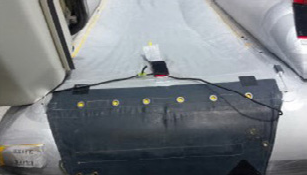
(fi g.2)
Example of a deployed slide with an electrical harness incorrectly routed. In this case, the harness could impede the evacuation.
SYSTEM IMPROVEMENT: THE A320 SLIDE WRAPPER
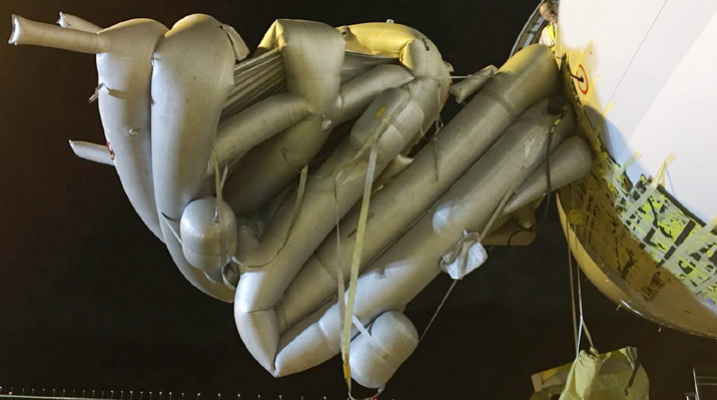
Section titled “SYSTEM IMPROVEMENT: THE A320 SLIDE WRAPPER”A modifi cation of the A320 slides called the “Slide Wrapper” provides more reliable deployment. The modifi cation is a device that is installed to hold both the infl atable part of the slide and its reservoir together, which prevents early activation of the reservoir when a slide has not cleared the door (fi g.3).
This modifi cation is known as the slide wrapper and it is installed via the following Service Bulletins (SB): SB A320-25-1B81, SB A320-25-1B82, SB A320-25-1B83, or SB A320-25-1B84. Embodiment of this modifi cation is mandated by the EASA AD 16-0043 (March 2019 compliance)
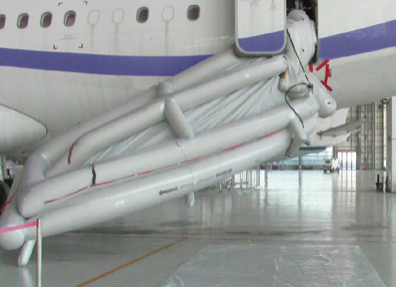
(fi g.3)
Section titled “(fi g.3)”Showing an incorrect slide deployment where the reservoir was activated and began to infl ate the slide before the it had cleared the door. The slide wrapper modifi cation is desiged to prevent this kind of occurence.
It is important to check the external dimensions of the slide after packing
“Fat packing”
Section titled ““Fat packing””The outer dimensions of a packed slide can exceed the normal envelope if the slide is not packed as per the vendor’s folding instructions. This can effect the dropping kinematics of the slide and prevent the slide from being inflated automatically.
It is mandatory to carefully follow the packing process, including the oven cycle to set the material folds, to achieve the correct packing density inside the vendor defined outer dimensions envelope.
Check the external dimensions of the slide after packing using the three dimensional check tool described in the packing documentation, and by confirming the packed slide can be inserted with sufficient clearance into its cover.
Use of incorrect restraints during packing
Section titled “Use of incorrect restraints during packing”Calibrated restraints are used to control the slide deployment sequence in various environmental conditions. They are designed to break with a pre-determined load when pulled during the slide inflation sequence. If an incorrect restraint is used, it may not release the slide during inflation and prevent the slide extending (fig.4).
To avoid this kind of event, a color code on restraints is a visual indicator of the the correct restraints load calibration and the slide folding instructions must be carefully followed.
(fig.4)
Section titled “(fig.4)”Consequence of the use of an incorrect restraint during packing. The slide extension is blocked.
Inoperative door emergency actuator
Section titled “Inoperative door emergency actuator”The door emergency actuator provides a dynamic momentum to rapidly open the door and and enable the release of the slide from its stowage to launch its deployment sequence. In some reported cases, the emergency actuator failed to open the door and it prevented the slide from deploying correctly. The actuator did not operate because of incorrect rigging of the door actuator percussion mechanism or the actuator was deactivated for maintenance but not reactivated at the end of the procedure.
Carefully following the AMM/MP during emergency actuator maintenance will ensure that the actuator percussion mechanism is correctly rigged and that a deactivated actuator is reactivated following the maintenance task.
Foreign object ingested by the inflation aspirator
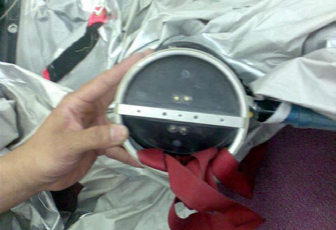
Section titled “Foreign object ingested by the inflation aspirator”A a foreign object can either obstruct the aspirator inlet or block the flapper valve of the aspirator in the open position and cause incorrect slide deployment.
The obstruction of the inlet blocks the air intake to the aspirator, and prevents slide inflation or it may cause an incomplete slide deployment. The blockage of the flapper valve in the open position (fig.5) can cause an inflated slide to deflate.
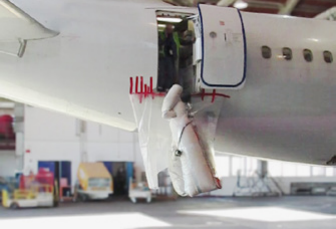
Some operational deployment tests were reported as unsuccessful due to ingestion of the fuselage protection material (fig.6). Fuselage protection must be done according to AMM/MP procedure to avoid ingestion of any protection materials into the aspirator during any operational test of a slide. Operators must not use protection materials other than those recommended by the AMM/MP.
(fig.5)
Section titled “(fig.5)”(fig.6)
Section titled “(fig.6)”Aspirator flapper valve blocked in the open position due to a foreign object ingestion.
Incomplete inflation due to obstructed aspirator inlet caused by non-standard fuselage protection during a slide deployment test.
Non-operational conditions during an operational deployment test
Section titled “Non-operational conditions during an operational deployment test”During a slide deployment test, the aircraft must be in a condition that is representative of real operations. The emergency actuator must be activated so that the test is performed in real conditions.
Analysis of previous unsuccessful deployments showed that to avoid maintenance on the emergency cylinder further to a slide deployment test, some operators de-activated it before the deployment test. As explained earlier, the emergency actuator actuation is part of the slide deployment kinematics, therefore, a de-activated emergency actuator during a test may lead to an unsuccessful deployment.
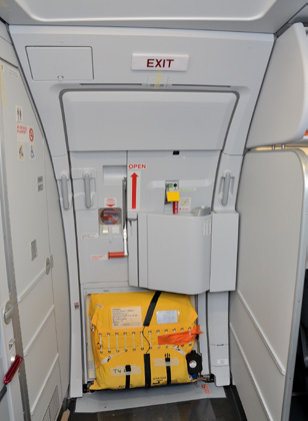
To be representative of the operational conditions, a deployment test should be done with the slide decorative cover installed (fig.7).
During a slide deployment test, the aircraft must be in a condition that is representative of real operations.
(fig.7)
Section titled “(fig.7)”Removal of the decorative cover of a slide for a depoloyment test does not provide a realistic operational configuration.
Escape slides can save lives in emergency situations.
CONTRIBUTORS:
Section titled “CONTRIBUTORS:”Mohammed ALAHYANE
Section titled “Mohammed ALAHYANE”Product Leader Emergency Equipment Customer Support
Uwe EGGERLING
Section titled “Uwe EGGERLING”Senior Director of Safety, Maintenance & Engineering Customer Support
Sven MACHTANS
Section titled “Sven MACHTANS”HO Cabin Safety Equipment Design Office
Slide overhaul should only be done by certified maintenance organizations. Particular care should be taken to pack the slide using the latest folding instructions provided in the CMM or in the folding document. AMM procedures and recommendations must be carefully followed during installation and servicing of the slides to ensure the correct deployment of the slide.
Periodical slide deployment tests should be done on aircraft in an operational configuration and with approved fuselage protection in accordance with the AMM/MP recommendations. This will mean that the test is representative of the slide deployment in operational conditions.
A thorough reporting of both unsuccessful and successful slide deployments during scheduled tests, an inadvertent deployment or in any emergency situation is essential for Airbus and its suppliers to assess slide reliability. In case of an unsuccessful slide deployment, providing videos and photos of the event in addition to a detailed report facilitates identification of root causes and enables the continuous improvement of slide deployment reliability.
Safety fi rst, #28 February, 2019. Safety fi rst is published by Airbus S.A.S. - 1, rond point Maurice Bellonte - 31707 Blagnac Cedex/France. Publisher and Editor: Yannick Malinge, Chief Product Safety Offi cer. Concept Design by Airbus Multi Media Support 20190588. Reference: X00D16031905 Issue 28. Photos by Airbus, C. Brinkmann, Sonovision Deutschland GmbH.
Safety fi rst
Section titled “Safety fi rst”The Airbus magazine contributing to the enhancement of the safety of aircraft operations by increasing knowledge and communication on safety related topics.
Safety fi rst is published by the Product Safety department. It is a source of specialist safety information for the use of airlines who fl y and maintain Airbus aircraft. It is also distributed to other selected organizations and is available on digital devices.
Material for publication is obtained from multiple sources and includes selected information from the Airbus Flight Safety Confi dential Reporting System, incident and accident investigation reports, system tests and fl ight tests. Material is also obtained from sources within the airline industry, studies and reports from government agencies and other aviation sources.
All articles in Safety fi rst are presented for information only and are not intended to replace ICAO guidelines, standards or recommended practices, operator-mandated requirements or technical orders. The contents do not supersede any requirements mand ated by the State of Registry of the Operator’s aircraft or supersede or amend any Airbus type-specific AFM, AMM, FCOM, MMEL documentation or any other approved documentation.
来源:Airbus Safety First URL:https://safetyfirst.airbus.com/correct-escape-slides-maintenance-for-successful-slides-deployment/ 发布日期:2019-02-26 期刊期号:2019-03 类别:维护,舱门,舱门,应急逃生滑梯,应急出口,逃生滑梯/救生筏,疏散,救生筏 PDF:原始 PDF
运营 正确的逃生滑梯维护确保滑梯成功展开
正确的逃生滑梯维护确保滑梯成功展开
确保逃生滑梯的维护工作正确执行至关重要,这样才能在最需要时正常展开。
本文回顾了向空客报告计划内和计划外滑梯展开结果的重要性。文中重点介绍了滑梯展开失败的最常见原因,并提供了预防建议。
九十年代初,一架 A300-600 飞机冲出跑道入口,以左侧倾斜的姿态停住。这意味着从飞机右侧疏散乘客是不可能的。客舱乘务员还观察到飞机后段机身起火,于是决定仅使用左前侧舱门的逃生滑梯疏散乘客。该逃生滑梯正常展开,使机上全部 160 名乘客和机组人员得以逃离残骸,并在飞机起火前撤离到安全距离。
此事件凸显了可靠逃生滑梯展开的重要性,以及遵循正确的维护程序并向空客报告滑梯展开测试结果对于确保逃生滑梯在最需要时能够正常展开至关重要。
向空客报告滑梯展开情况
Section titled “向空客报告滑梯展开情况”报告所有滑梯展开情况有助于持续提高滑梯可靠性
Section titled “报告所有滑梯展开情况有助于持续提高滑梯可靠性”运营商必须定期执行一定数量的滑梯展开测试。全面报告任何滑梯展开情况可以了解滑梯的可靠性概貌,有助于识别改进领域。AMM/MP 提供了滑梯展开报告表模板**(图 1)**。运营商应使用此表格记录每次滑梯展开的结果,然后将其发送给空客。此表格用于报告成功和失败的滑梯展开,以供分析。
全面报告任何滑梯展开情况可以了解滑梯的可靠性概貌,有助于识别改进领域。
详细报告有助于故障识别
Section titled “详细报告有助于故障识别”AMM/MP 中关于滑梯展开操作检查的程序还要求运营商使用摄像机从不同角度录制测试过程。如果展开失败,此录像能够对展开过程进行详细分析。除了提供展开报告外,将视频和任何照片提供给空客,将有助于调查,以找出展开失败的根本原因。
AMM/MP 中的逃生滑梯展开报告表模板。
测试中滑梯展开失败时的安全注意事项
Section titled “测试中滑梯展开失败时的安全注意事项”如果滑梯在测试期间未能展开,在滑梯被正确固定之前,展开区域必须保持无人员状态,因为存在滑梯可能突然充气的风险。突然的滑梯救生筏充气可能造成人员伤害或设备损坏。
建议除记录详细信息外,还应从飞机内部和外部仔细拍摄照片,记录失败测试中滑梯的位置。确认滑梯未被门框或其舱室卡阻后,运营商可拉动手动充气手柄。这将确保滑梯充气气瓶已排空,滑梯处于可安全操作的状态。
滑梯展开不正确的常见原因
Section titled “滑梯展开不正确的常见原因”已报告的滑梯展开案例使空客能够识别出几个导致展开失败的常见原因。遵循以下建议可以避免大多数此类问题。
舱门滑梯安装时检查线束走向是否正确
Section titled “舱门滑梯安装时检查线束走向是否正确”滑梯线束走向因安装在飞机左侧还是右侧而异。多起报告案例显示,滑梯线束走向与安装侧不匹配。线束走向不正确的舱门滑梯可能会阻碍乘客疏散**(图 2)**,或阻止舱门打开程序并防止滑梯展开。
运营商必须严格遵循 AMM 中关于滑梯安装的说明,并确保线束走向与安装在飞机左侧或右侧的滑梯位置相匹配。
线束走向不正确的舱门滑梯可能会阻碍乘客疏散,或阻止舱门打开程序并防止滑梯展开。
提示:作为一般原则,线束走向应从滑梯组件的舱门前端侧引出。
滑梯检修期间的错误包装
Section titled “滑梯检修期间的错误包装”许多错误的滑梯展开是由于车间维护期间滑梯包装错误造成的。
滑梯检修只能由认证的维修机构执行。负责滑梯检修的维修机构必须参考最新版的部件维修手册(CMM)或滑梯包装折叠程序。
(图 2)
充气滑梯电气线束错误布线的示例。在这种情况下,线束可能会阻碍疏散。
系统改进:A320 滑梯护套
Section titled “系统改进:A320 滑梯护套”A320 滑梯的一项名为“滑梯护套”的改装可提供更可靠的展开。该改装是一种安装装置,用于将滑梯的充气部分与其储气瓶固定在一起,防止滑梯未离开舱门时储气瓶提前激活 (图 3)。
此改装称为滑梯护套,通过以下服务通告(SB)安装:SB A320-25-1B81、SB A320-25-1B82、SB A320-25-1B83 或 SB A320-25-1B84。此改装的实施由 EASA AD 16-0043(2019 年 3 月符合性)强制要求。
展示了滑梯在未离开舱门时储气瓶已激活并开始充气的错误展开。滑梯护套改装旨在防止此类事件发生。
重要的是在包装后检查滑梯的外部尺寸
“过满包装”
Section titled ““过满包装””如果滑梯未按照供应商的折叠说明进行包装,包装后滑梯的外部尺寸可能会超出正常包络范围。这可能会影响滑梯的下摆运动学特性,并阻止滑梯自动充气。
必须仔细遵循包装流程,包括烘箱循环以设定材料折叠位置,以在供应商定义的外部尺寸包络范围内实现正确的包装密度。
使用包装文档中描述的三维检查工具检查包装后滑梯的外部尺寸,并通过确认包装后的滑梯能够以足够的间隙插入其外罩中进行验证。
包装期间使用错误的约束装置
Section titled “包装期间使用错误的约束装置”校准的约束装置用于在各种环境条件下控制滑梯展开顺序。它们设计为在滑梯充气过程中被拉动时以预定的负载断裂。如果使用了错误的约束装置,约束装置可能不会在充气过程中释放滑梯,从而阻止滑梯伸展 (图 4)。
为避免此类事件,约束装置上的颜色代码是正确约束装置负载校准的视觉指示,并且必须仔细遵循滑梯折叠说明。
包装期间使用错误约束装置的后果。滑梯伸展被阻挡。
舱门应急作动器失效
Section titled “舱门应急作动器失效”舱门应急作动器提供动态动量以快速打开舱门,并使滑梯从存放位置释放以启动其展开顺序。在一些报告的案例中,应急作动器未能打开舱门,导致滑梯无法正确展开。该作动器未动作的原因是舱门作动器击发机构装配不正确,或者作动器在维护期间被停用但在程序结束时未重新启用。
仔细遵循 AMM/MP 进行应急作动器维护,将确保作动器击发机构正确装配,并且在维护任务完成后重新启用被停用的作动器。
异物被充气吸气器吸入
Section titled “异物被充气吸气器吸入”异物可能阻塞吸气器入口或将吸气器的瓣阀阻塞在打开位置,从而导致滑梯展开不正确。
入口阻塞会阻止空气进入吸气器,并阻止滑梯充气或可能导致滑梯充气不完全。瓣阀阻塞在打开位置 (图 5) 可能导致已充气的滑梯放气。
一些操作展开测试报告为不成功,原因是吸入了机身保护材料 (图 6)。机身保护必须按照 AMM/MP 程序进行,以避免在任何滑梯操作测试期间将任何保护材料吸入吸气器。运营人不得使用 AMM/MP 建议以外的保护材料。
(fig.5)
Section titled “(fig.5)”(fig.6)
Section titled “(fig.6)”吸气单向活门因异物吸入而卡阻在打开位置。
充气不完全,原因是滑梯展开测试期间非标准机身防护导致充气口堵塞。
操作展开测试期间的非操作条件
Section titled “操作展开测试期间的非操作条件”在滑梯展开测试期间,飞机必须处于符合实际运行状况的状态。必须激活紧急作动器,以便在真实条件下进行测试。
对之前不成功展开的分析表明,为避免在滑梯展开测试后对紧急气瓶进行维护,一些运营商在展开测试前将其解除激活。如前所述,紧急作动器作动是滑梯展开运动学的一部分,因此,测试期间解除激活的紧急作动器可能导致展开不成功。
为符合操作条件代表性和真实性,展开测试应使用已安装的滑梯装饰罩进行 (fig.7)。
在滑梯展开测试期间,飞机必须处于符合实际运行状况的状态。
(fig.7)
Section titled “(fig.7)”为进行展开测试而拆除滑梯装饰罩无法提供真实的操作配置。
逃生滑梯可在紧急情况下挽救生命。
Mohammed ALAHYANE
Section titled “Mohammed ALAHYANE”客户支持紧急设备产品负责人
Uwe EGGERLING
Section titled “Uwe EGGERLING”客户支持维护与工程安全高级总监
Sven MACHTANS
Section titled “Sven MACHTANS”客舱安全设备设计办公室负责人
滑梯检修只能由认证的维修机构进行。打包滑梯时应特别注意使用 CMM 或折叠文件中提供的最新折叠说明。安装和维护滑梯时必须严格遵守 AMM 程序和建议,以确保滑梯正确展开。
定期滑梯展开测试应在操作配置下进行,并按照 AMM/MP 建议使用经批准的机身防护措施。这意味着测试将代表操作条件下的滑梯展开情况。
对计划测试、不意展开或任何紧急情况下不成功和成功的滑梯展开进行详细报告,对于空客及其供应商评估滑梯可靠性至关重要。如果滑梯展开不成功,除详细报告外提供事件视频和照片有助于识别根本原因,并能够持续改进滑梯展开可靠性。
Safety first, #28 February, 2019. Safety first 由空客 S.A.S. 出版 - 1, rond point Maurice Bellonte - 31707 Blagnac Cedex/France。出版商和编辑:Yannick Malinge,首席产品安全官。概念设计:空客多媒体支持 20190588。参考编号:X00D16031905 第 28 期。照片来源:空客、C. Brinkmann、Sonovision Deutschland GmbH。
Safety first
Section titled “Safety first”空客杂志致力于通过增进安全相关主题的知识和交流,提升飞机运行安全。
Safety first 由产品安全部门出版。作为专业安全信息来源,供运营和维护空客飞机的航空公司使用。同时也分发给其他选定的机构,并可在数字设备上获取。
出版材料来源于多个渠道,包括从空客飞行安全保密报告系统精选的信息、事故和事故调查报告、系统测试和飞行测试。材料还来源于航空公司行业、政府机构的研究和报告以及其他航空来源。
Safety first 中的所有文章仅供参考,无意取代 ICAO 指南、标准或推荐做法、运营商强制要求或技术指令。内容不取代运营商飞机注册国的任何强制要求,也不取代或修改任何空客特定机型的 AFM、AMM、FCOM、MMEL 文件或其他批准文件。