Low Speed Rejected Take-Off upon Engine Failure
Source: Airbus Safety First URL: https://safetyfirst.airbus.com/low-speed-rejected-take-off-upon-engine-failure/ Published: 2013-07-14 Magazine Issue: 2013-07 Category: Archive PDF: Original PDF
Albert uRdIROZ
Section titled “Albert uRdIROZ”Director, Flight Safety
1. Introduction
Section titled “1. Introduction”Rejected Take-Off’s (RTO) are often considered in the context of V1, the Decision Speed, otherwise called the Critical Engine Failure Speed. However, there are situations, at speeds much lower than V1, when RTO’s can be quite challenging. These are sudden engine failures at speeds when the rudder has not yet become effective for maintaining directional control. Consequently, establishing safe lateral control relies on the following: immediate cancellation of the forward thrust asymmetry, selecting both thrust reversers so as to take advantage of the “live” engine reverse thrust, steering with rudder pedals and asymmetric braking as appropriate.
2. In-Service Event
Section titled “2. In-Service Event”2.1 Engine Failure at low Speed
Section titled “2.1 Engine Failure at low Speed”Off mode. both engines spooled up symmetrically.
The daylight incident involved an A300-600 taking off from a uniformly wet runway, with patches of ice.
Within 12 seconds, engine one stalled. The thrust asymmetry caused the aircraft to deviate to the left of the runway. Ground speed was less than 60 kt (fig. 1).
As the aircraft was being aligned, the go-levers were triggered and the Auto-Throttle was engaged in Take-
This article reviews the pertinent Flight Crew Operating Manual (FCOM) Standard Operating procedures (SOPs) and Flight Crew Training Manual (FCTM) recommendations, and also reflects on the documentation relevant to other Airbus models.
Safety
2.2 Runway Excursion Sequence
Section titled “2.2 Runway Excursion Sequence”The crew aborted the take-off within one second by simultaneously:
q Setting both thrust levers to IDLE, without applying reverse thrust.
q Applying right rudder pedals, thus counteracting the thrust asymmetry.
- The rudder pedal inputs acted both on the nose wheel steering and the rudder deflection. On the A300-600, the maximum achievable nose wheel steering angle, when using rudder pedals, is 6°. This does not depend on the air speed. The rudder deflected fully, but had limited aerodynamic effect at that speed.
q Applying manual brake inputs as follows: nearly full left and limited right pedal braking.
- This resulted in a significant asymmetric braking in the wrong direction.
(fig. 2) illustrates the individual effects and the overall resulting momentum. The directional balance was still to the left, so the aircraft continued deviating towards the edge of the runway.
In an ultimate attempt to remain on the runway, an additional nose wheel steering demand was applied with the tiller. The aircraft went off the runway and stopped on uneven ground. Seven seconds elapsed between the engine failure and the runway excursion. There were no injuries and the aircraft sustained only limited damage.
3. Review of relevant Procedures
Section titled “3. Review of relevant Procedures”3.1 Seating/Pedal Position Adjustments
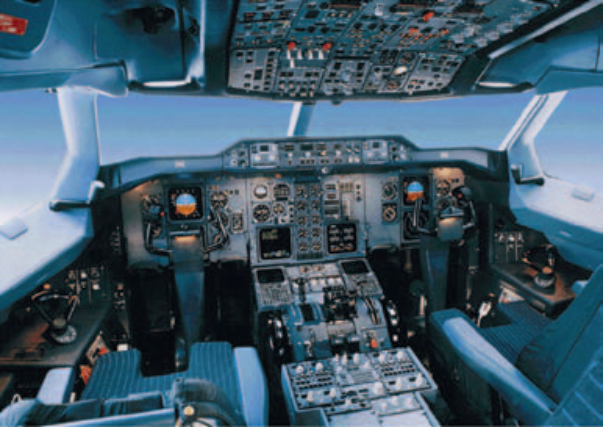
Section titled “3.1 Seating/Pedal Position Adjustments”The final report documents that the likely key to the asymmetric braking in the wrong direction was the pilot’s seating and pedal position adjustments.
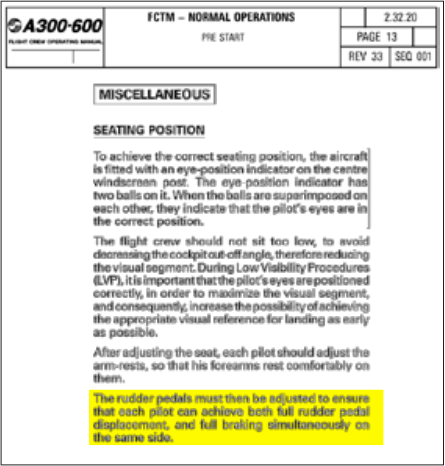
eye-indicator, then the arm-rest, and finally the rudder pedals such as to be in a position to simultaneously apply full rudder and full brakes on the same side (fig. 4). Similar recommendation is reflected in other Airbus FCTM.
The A300-600 FCTM, Normal Operations, Pre-Start recommends to first adjust the seat by means of the
3.2 directional Control during Take-Off
Section titled “3.2 directional Control during Take-Off”Use rudder pedals for directional control during take-off. As written earlier, the tiller was ultimately used to try and counteract the lateral deviation by increasing the nose wheel deflection. This was not effective. As ground speed builds up, the nose wheel skids if too much deflection is applied. When using the tiller, the nose wheel was deflected beyond its operational limit and skidded without directional effectiveness.
All Airbus FCOM SOP’s applicable to take-off read:
DIRECTIONAL CONTROL_____
________________USE RUDDER
Figure 4 A300-600 FCTM rudder pedals adjustment recommendation
Additional information is available in the A300-600 FCTM (fig. 5). The same information is also reflected in the documentation relevant to other Airbus models.
3.3 use Manual Braking at low Speeds
Section titled “3.3 use Manual Braking at low Speeds”The Auto-brake activation is associated to the automatic deployment of the ground spoilers, which occurs when the ground speed is above 85 kt on the A300/A310 (fig. 6) and 72 kt on other Airbus models.
As a result, the Auto-brake may not activate in case of low speed RTO and braking must be performed manually.
3.4 Lessons learnt from Simulator Sessions
Section titled “3.4 Lessons learnt from Simulator Sessions”An A300-600 simulator session was run in order to experiment with different scenarios of engine failure at low speed during the take-off roll and determine the most appropriate course of actions. These involved different runway status (dry, wet and patchy icy).
Upon an engine failure at 60 kt ground speed, the crew would immediately select IDLE thrust on both engines. The session showed that:
Figure 5 A300-600 FCTM on rudder pedal steering during take-off
Figure 6 Auto-Brake is associated to the ground spoilers
Safety
q Keeping directional control with rudder pedals upon the initial trajectory deviation, as instructed by SOP’s, was effective in all cases.
q When full symmetric braking was applied, both brake pedals on stops, no runway excursion was experienced. However, given the runway length available in such early RTO scenarios, it appeared that braking performance was much less an issue than directional control. Smoother recoveries were achieved with less pronounced braking inputs.
q Asymmetric braking may contribute to maintaining directional control, provided that it is applied towards the operative engine. When applied towards the failed engine during the simulator session, the aircraft unavoidably deviated towards the edges of the runway.
q When maximum reverse thrust is applied on the operative engine, the trajectory deviation is reduced by a small amount given the limited efficiency of reverse thrust at low speed but still in a helpful recovery sense.
VMCG Minimum Control Speed on the Ground
Section titled “VMCG Minimum Control Speed on the Ground”EASA CS 25.149 (e) definition of VMCG:
Section titled “EASA CS 25.149 (e) definition of VMCG:”“VMCG, the minimum control speed on the ground, is the calibrated airspeed during the take-off run at which, when the critical engine is suddenly made inoperative, it is possible to maintain control of the aeroplane using the rudder control alone (without the use of nose-wheel steering), as limited by 667 N of force (150 lbf), and the lateral control to the extent of keeping the wings level to enable the take-off to be safely continued using nor-mal piloting skill. In the determination of VMCG, assuming that the path of the aeroplane accelerating with all engines operating is along the centreline of the runway, its path from the point at which the critical engine is made inoperative to the point at which recovery to a direction parallel to the centreline is completed, may not deviate more than 9.1 m (30 ft) laterally from the centreline at any point.
VMCG must be established, with –
Section titled “VMCG must be established, with –”(1) The aeroplane in each take-off configuration or, at the option of the applicant, in the most critical take-off configuration; (2) Maximum available take-off power or thrust on the operating engines; (3) The most unfavourable centre of gravity; (4) The aeroplane trimmed for take-off; and
(5) The most unfavourable weight in the range of take-off weights.”
For the A300-600, VMCG is documented 2 -SPEEDS in the Airbus FCOM within section Aircraft A - VMCA - VMCG General - Operational Limitations, FCOM 2.01.20.
training includes mandatory rejected take-off exercises that cover events of a sudden loss of engine thrust below VMCG.”
4.2 Airbus Position
Section titled “4.2 Airbus Position”Training plays a vital role in emphasising the importance of applying correct SOP and techniques.
Airbus encourages operators to include low speed RTO’s in their recurrent training program if not already implemented. This should include unexpected RTO’s well below V1 to ensure both pilots are seated in a position where full rudder with full manual symmetric braking can be achieved.
Additionally, yearly line checks (or the equivalent of) should include an observation of the correct seating position for all relevant phases of flight by the Line-Check Captain.
| kt CAS | kt IAS |
|---|
3.5 Operational Advice
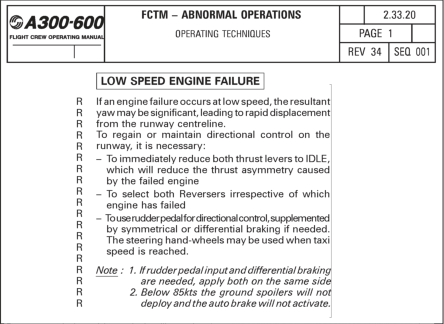
Section titled “3.5 Operational Advice”The observations made during this simulator session support the operational advice included in the FCTM, Operating Techniques, Low Speed Engine Failure on low speed RTO. (fig. 7).
These recommendations are reflected in the FCTM for the whole Airbus fleet.
4. Training Recommendations
Section titled “4. Training Recommendations”4.1 Safety Recommendation by the final Investigation Report
Section titled “4.1 Safety Recommendation by the final Investigation Report”In the operational summary, the final report highlights:
“…deficiencies in pilot training with regard to training for sudden losses of engine thrust in the speed range below VMCG.”
The following safety recommendation is associated to this finding:
5. Conclusion
Section titled “5. Conclusion”This in-service incident illustrates the challenges associated with containing the sudden asymmetry resulting from engine failure during the first seconds of a take-off acceleration. However it is possible to maintain directional control by reacting immediately and in a coordinated manner:
q Thrust levers are closed
q All reversers are selected (even if designated as an MMEL item)
q Apply up to full opposite rudder pedals until directional control is regained
q Braking may be symmetrical or differential as needed to complement steering
q Steering hand-wheels may be used when taxi speed is reached.
Being in a position to effectively respond implies that both pilots have adjusted their seat such as to be in a position to simultaneously apply full rudder and full brakes on the same side if required.
Effective response also relies on crew training. Therefore Airbus supports Operators including RTO’s scenarios in the recurrent training. The engine failure should be unexpected and introduced at speed well below V1. Such scenarios would address simultaneously the seat adjustment and the coordinated response to the sudden asymmetry.
“EASA is recommended to ensure that initial and recurrent pilot
Safety
低速发动机失效时的中断起飞
Section titled “低速发动机失效时的中断起飞”Albert Urdiroz
Section titled “Albert Urdiroz”飞行安全总监
中断起飞 (RTO) 通常在 V1(决策速度,又称关键发动机失效速度)的语境下加以讨论。然而,在远低于 V1 的速度下,同样存在极具挑战性的中断起飞情形。这些情况是指在方向舵尚未有效发挥方向控制作用的速度下发生的突发发动机失效。因此,建立安全的横向控制依赖于以下要素:立即消除向前推力的不对称、选择两个反推装置以利用”正常”发动机的反推力、蹬舵以及适当时的不对称制动。
2. 实际案例
Section titled “2. 实际案例”2.1 低速发动机失效
Section titled “2.1 低速发动机失效”自动油门在关闭模式,两个发动机对称加速。
该起白天事故涉及一架从均匀湿滑、局部结冰的跑道上起飞的 A300-600。
在 12 秒内,1 号发动机熄火。推力不对称导致飞机偏离跑道向左。地速小于 60 节(图 1)。
当飞机正在进行方向修正时,复飞手柄被触发,自动油门切入起飞模式。
本文回顾了相关《飞行机组操作手册》(FCOM) 标准操作程序 (SOP) 及《飞行机组训练手册》(FCTM) 的建议,并涉及其他空客机型的相关文件。
安全
2.2 冲出跑道过程
Section titled “2.2 冲出跑道过程”机组在 1 秒内通过以下方式中断起飞:
- 将两个推力杆设置到慢车位,未使用反推。
- 蹬右方向舵脚蹬,从而抵消推力不对称。
- 方向舵脚蹬输入同时作用于前轮转向和方向舵偏转。在 A300-600 上,使用方向舵脚蹬时前轮最大可达转向角度为 6°。此值与空速无关。方向舵完全偏转,但在该速度下气动效应有限。
- 施加人工制动输入:左脚蹬接近全量,右脚蹬有限量。
- 这导致了明显的方向错误的不对称制动。
(图 2) 说明了各单项效应及总体合成动量。方向平衡仍偏向左侧,因此飞机继续向跑道边缘偏移。
作为保持在跑道上的最后尝试,使用转向手轮施加了额外的前轮转向需求。飞机冲出跑道,停在了不平坦的地面上。从发动机失效到冲出跑道共历时 7 秒。无人员伤亡,飞机仅受到轻微损伤。
3. 相关程序回顾
Section titled “3. 相关程序回顾”3.1 座椅/脚蹬位置调整
Section titled “3.1 座椅/脚蹬位置调整”最终报告指出,不对称制动方向错误的可能关键原因是飞行员的座椅和脚蹬位置调整。
A300-600 FCTM,正常操作,启动前建议首先通过眼点指示器调整座椅,然后调节扶手,最后调整方向舵脚蹬,以使能够同时在同侧施加全量方向舵和全量制动(图 4)。其他空客机型的 FCTM 中也有类似的建议。
3.2 起飞时的方向控制
Section titled “3.2 起飞时的方向控制”使用方向舵脚蹬进行起飞时的方向控制。如前所述,机组最终使用转向手轮试图通过增加前轮偏转来抵消侧向偏移。此举无效。随着地速增加,前轮在偏转过大时会发生侧滑。使用转向手轮时,前轮偏转超出了其工作限制并发生侧滑,失去方向效能。
所有适用于起飞的空客 FCOM SOP 规定:
方向控制_____
________________使用方向舵
图 4 A300-600 FCTM 方向舵脚蹬调整建议
A300-600 FCTM 中有更多相关信息(图 5)。其他空客机型的相关文件中也反映了同样的信息。
3.3 低速时使用人工制动
Section titled “3.3 低速时使用人工制动”自动刹车启动与地面扰流板的自动展开相关联,当地面速度在 A300/A310 上高于 85 节 (图 6),在其他空客机型上高于 72 节时,地面扰流板自动展开。
因此,在低速中断起飞的情况下,自动刹车可能不会启动,必须进行人工制动。
3.4 模拟机练习的经验教训
Section titled “3.4 模拟机练习的经验教训”为验证起飞滑跑阶段低速发动机失效的不同场景并确定最适当的处置方法,进行了 A300-600 模拟机练习。练习涵盖了不同的跑道状况(干燥、潮湿和部分结冰)。
当飞机在地面速度 60 节时发生发动机失效,机组应立即将两个发动机的推力手柄收至慢车位。练习结果表明:
图 5 A300-600 FCTM 关于起飞时方向舵脚蹬操纵
图 6 自动刹车与地面扰流板的关联
安全
q 依据标准操作程序(SOP)指令,在初始航迹偏离时使用方向舵脚蹬保持方向控制,在所有情况下均有效。
q 当施加完全对称制动时,两个刹车脚蹬踩到底,未发生跑道偏出。然而,鉴于这种早期中断起飞场景可用的跑道长度,方向控制问题远比制动性能更为关键。采用不那么急促的制动输入可以实现更平稳的改出。
q 不对称制动有助于保持方向控制,前提是向工作发动机侧施加制动。在模拟机练习中,当向失效发动机侧施加制动时,飞机不可避免地向跑道边缘偏出。
q 在工作发动机上使用最大反推时,由于低速时反推效率有限,航迹偏离仅能减小少量,但仍有助于改出。
VMCG 地面最小控制速度
Section titled “VMCG 地面最小控制速度”EASA CS 25.149 (e) VMCG 定义:
Section titled “EASA CS 25.149 (e) VMCG 定义:”“VMCG,即地面最小控制速度,是指在起飞滑跑过程中,当关键发动机突然失效时的较准空速,在此空速下,仅使用方向舵控制(不使用前轮转向),受力限于 667 N(150 磅力),并使用横向控制使机翼保持水平,即有可能保持对飞机的控制,从而使起飞能够使用正常驾驶技术安全继续。在确定 VMCG 时,假设飞机在所有发动机工作时的滑跑轨迹沿跑道中心线,从关键发动机失效点到完成改出至与中心线平行的方向,其轨迹在任何一点不得偏离中心线超过 9.1 米(30 英尺)。
VMCG 必须在以下条件下确定:
Section titled “VMCG 必须在以下条件下确定:”(1) 飞机处于每一起飞形态,或按申请人的选择,处于最不利的起飞形态;(2) 工作发动机使用最大可用起飞功率或推力;(3) 最不利的重心位置;(4) 飞机已配平至起飞状态;以及
(5) 起飞重量范围内最不利的重量。”
对于 A300-600,VMCG 记录在空客 FCOM 的 2 -SPEEDS 部分 Aircraft A - VMCA - VMCG General - Operational Limitations(总体 - 操作限制),FCOM 2.01.20。
培训内容包括强制性的中断起飞练习,涵盖在 VMCG 以下速度范围内突然失去发动机推力的情况。”
4.2 空客立场
Section titled “4.2 空客立场”培训在强调正确应用标准操作程序和技术的重要性方面起着至关重要的作用。
空客鼓励运营商在其复训项目中纳入低速中断起飞内容(如尚未实施)。这应包括在远低于 V1 的速度下进行意外中断起飞,以确保两名飞行员坐在能够实施满舵配合满人工对称制动的位置。
此外,年度航线检查(或同等检查)应包括由航线检查机长观察所有相关飞行阶段正确的座位位置。
| 节 CAS | 节 IAS |
|---|
3.5 操作建议
Section titled “3.5 操作建议”模拟机练习中得出的观察结果支持 FCTM 操作技术部分关于低速中断起飞低速发动机失效的操作建议。(图 7)。
这些建议已反映在整个空客机队的 FCTM 中。
4. 培训建议
Section titled “4. 培训建议”4.1 最终调查报告中的安全建议
Section titled “4.1 最终调查报告中的安全建议”在操作总结中,最终报告强调:
“…飞行员在 VMCG 以下速度范围内突然失去发动机推力的培训方面存在不足。”
以下安全建议与该发现相关:
这起实际运行事件说明了在起飞加速最初几秒内因发动机失效而导致突然不对称所带来的挑战。然而,通过立即、协调地采取行动,仍然可以保持方向控制:
q 推力手柄收回
q 所有反推装置选择打开(即使被列为主最低设备清单项目)
q 施加直至完全反向的蹬舵直至恢复方向控制
q 刹车可对称或差动使用,根据需要配合方向控制
q 当达到滑行速度时可使用转弯手轮
能够有效响应意味着两名飞行员都需调整座椅位置,以便在需要时能够同时在同侧施加最大蹬舵和最大刹车。
有效的响应还依赖于机组培训。因此,空客支持运营商在复训中纳入中断起飞场景。发动机失效应设置为意外情况,且引入时机应远低于 V1 速度。此类场景将同时训练座椅调整及对突然不对称情况的协调响应。
“建议 EASA 确保初始和复训飞行员 [Safety”