Atlantic Airways Introduction of RNP AR 0.1 Operations
Source: Airbus Safety First URL: https://safetyfirst.airbus.com/atlantic-airways-introduction-of-rnp-ar-0-1-operations/ Published: 2013-07-14 Magazine Issue: 2013-07 Category: Archive PDF: Original PDF
Joen REMMER
Section titled “Joen REMMER”Vice President Operations Atlantic Airways
Stan ABBOTT
Section titled “Stan ABBOTT”Consultant UK & Ireland
Atlantic Airways: Introduction of RNP AR 0.1 Operations
Section titled “Atlantic Airways: Introduction of RNP AR 0.1 Operations”Atlantic Airways, the national carrier of the remote Faroe Islands, last year became the first airline in Europe to introduce RNP AR 0.1 (Required Navigation Performance – Authorisation Required) satellite-based approach and take-off operations. Joen Remmer and Stan Abbott look at the implementation of the system and its impact on safety, crew workload and regularity.
RNP AR operations arrived at Atlantic Airways with the delivery of the airline’s first Airbus A319 in March 2012, following a period of close cooperation and intensive development in partnership with Airbus subsidiary, QuoVadis (fig. 1).
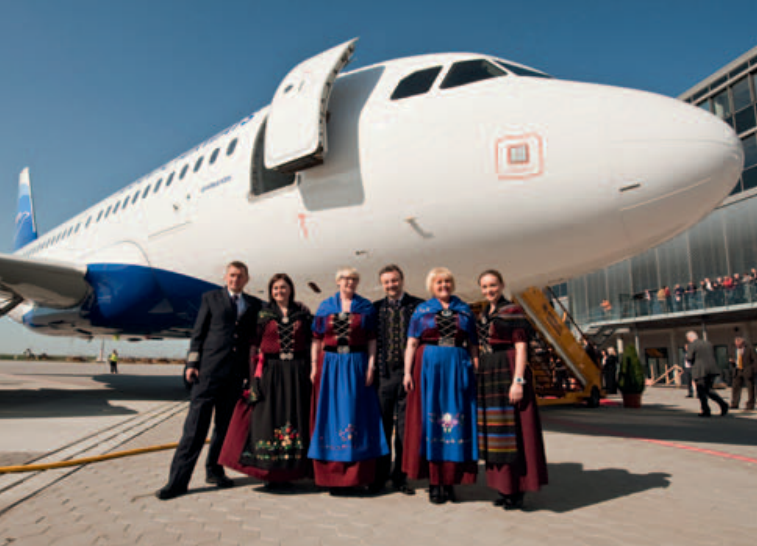
Figure 1 Atlantic Airways took delivery of its first A319 on March 22[nd] 2012. CEO Magni Arge, centre, and (far left) Captain Jóhan í Niðristovu.
RNP AR 0.1 operations were permitted from Day One of Atlantic Airways’ Airbus operation by the Danish Aviation authorities, which went on to grant full unrestricted approval, including significantly reduced operating minima, after a period of detailed monitoring.
RNP AR 0.1 has, since its introduction, achieved significant savings for the airline — both in day-to-day operating costs (due to more fuelefficient approach and take-off patterns) and through very significantly reducing the incidence of weatherrelated diversions to Vágar’s nearest alternates, all which are an hour’s flying time away in Norway, Iceland or Scotland.
Perhaps even more important (though harder to measure in cash terms) is the very real improvement in operational safety. This is not to say that the airline’s operations prior to RNP AR 0.1 were “unsafe”: simply that, in the highly safety-conscious environment of commercial aviation, the system makes Atlantic Airways’ operations in an area of challenging weather and terrain even safer still.
by applying RNP AR 0.1 procedures, Atlantic Airways has been able to convert the implicit skills and knowledge of its pilots, built up over years of operation in their chal-
Safety
lenging environment, into explicit procedures programmed in the aircraft FMS. Automated flight is more often used where manual flight was required previously, leaving the pilots with more mental capacity to monitor the safe progress of the flight, and with more alertness to intervene, if unacceptable deviations develop.
To understand the very particular challenges that Atlantic Airways faces in its day-to-day operations demands first of all a short history lesson.
The Faroe Islands comprise an archipelago of 18 individual islands, 17 of them inhabited. Originally volcanic, the islands meet the full fury of the North Atlantic with precipitous cliffs, including one that rises more than 800 metres sheer and is claimed to be the highest in all of Europe.
In this mountainous landscape, the occupying british forces built a short airstrip during the last war, in the very west of the islands, on a saddle between areas of high land. The strip was in close proximity to both Sörvagur, which was a good harbour for vessels to operate to and from all year round, as well as to the lake on which Catalina flying boat operations were based (fig. 2).
After the war, the strip remained unused until the 1960s, when it reopened to commercial traffic. However, its location and runway alignment have posed significant challenges ever since.
Pilots have required above-average skills and handling capabilities, thanks to the combination of the
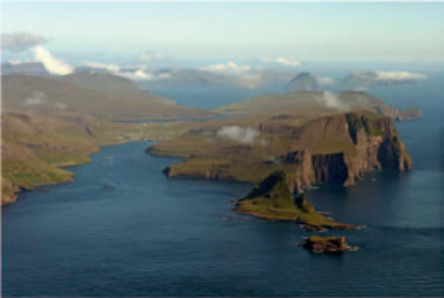
Figure 2 A view of the Sørvágsfjord, which leads to runway 12 at Vágar.
short runway (just 1,250 metres), only having non-precision approach aids, fairly high minima, surrounding topography allowing only narrow and offset approach paths, and the prevailing weather conditions that are typified by strong winds, violent wind shears, rotors, and much cloud and precipitation.
this. Not only would a longer runway (now 1,799 metres) cater for a larger and more modern aircraft type than the then fleet of bAe 146 and AVRO RJs, but any opportunity to improve the safety and regularity level had to be examined. The choice was for the Airbus A319 (fig. 3).
“We had investigated various conventional means of improving the accessibility of the airport in adverse weather conditions, but none proved successful,” explains A319 Captain Jóhan í Niðristovu. “but we had learned an interesting lesson when we introduced the AVRO RJ fleet on top of our existing bAe 146 fleet: that new technology, such as improvements to the autopilot, could also reduce workload, raise safety levels and have a positive effect on regularity. So when we first learned about RNP, we realised that new technology, rather than conventional, would be the right focus.”
Indeed, the airport has, since its reopening seen two fatal accidents, both of which occurred during approaches in difficult meteorological conditions. Neither incident involved Atlantic Airways, which began its operations in 1988. As a consequence of findings that were published some time after the most recent incident (a turbulence-related fatal accident involving a Danish Air Force Gulfstream III in 1996), the Danish authorities imposed new safety rules that now include closure of the airport in certain wind strengths and directions.
Atlantic Airways soon learned that, even though RNP AR had been successfully implemented around the world, there was no previous application of RNP AR with low RNP value (below 0.3nm) in Europe. The first challenge was therefore to bring together the various stakeholders, that is Vágar Airport, the Danish aviation authorities and Airbus. There are very few RNP AR design providers and Atlantic Airways decided to team up with QuoVadis for obvious reasons: its close relationship with the manufacturer of the A319 that the airline had procured, and its record of very successful RNP design projects around the world.
As a consequence of the various challenges, Atlantic Airways’ regularity has often been poor, especially in winter. In 2011 alone Atlantic Airways had more than 50 weatherrelated cancellations or diversions. Needless to say, this is a financial burden for the airline, and an inconvenience for Faroese industry and the public, who are so dependent on the life-line air service to and from mainland Europe.
When the Faroese Government launched a runway extension programme some years ago, Atlantic Airways immediately started to investigate what operational improvements could be achieved through
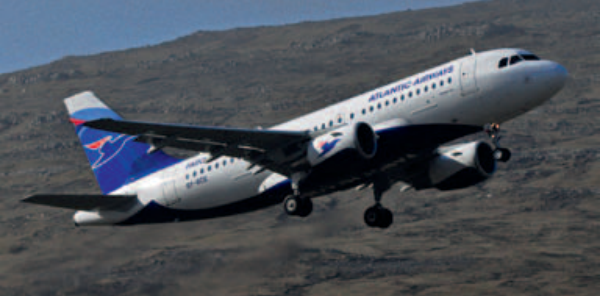
Figure 3 Airbus on take-off from Vágar.
Early studies revealed that RNP 0.3 (which is the “basic” precision used in public procedures) would not offer any advantage over the localiser approaches in terms of minima. Atlantic Airways therefore decided to construct and get authorisation for RNP AR procedures at the highest possible precision, 0.1, so as to take the best possible advantage of this technology. The 0.1 value means that the aircraft’s position is accurate to a variation of no more than 0.1 nautical miles.
The roadmap was agreed with the Danish authorities in the spring of 2011, the kick-off meeting for the implementation project followed in June, and the authorisation to start the RNP AR operation was obtained the day before the first commercial flight with the new A319 on March 28 last year.
The development period of about eight months was a challenging time of intense collaboration between all parties. On the one hand, Atlantic Airways had to ensure that what was designed would truly be beneficial for the airline, in terms of increasing safety levels and regularity, and on the other that the project would be in perfect compliance with relevant ICAO guidelines and EASA regulations.
As for the design work, Captain í Niðristovu, continues: “To meet our primary objectives – enhanced safety and improved regularity and a secondary objective of reduced fuel burn – it was crucial for the airline that its implicit knowledge of operating on Vágar was carefully combined with the explicit knowledge of QuoVadis on the A319 and RNP AR capability, so as to achieve the best result.”
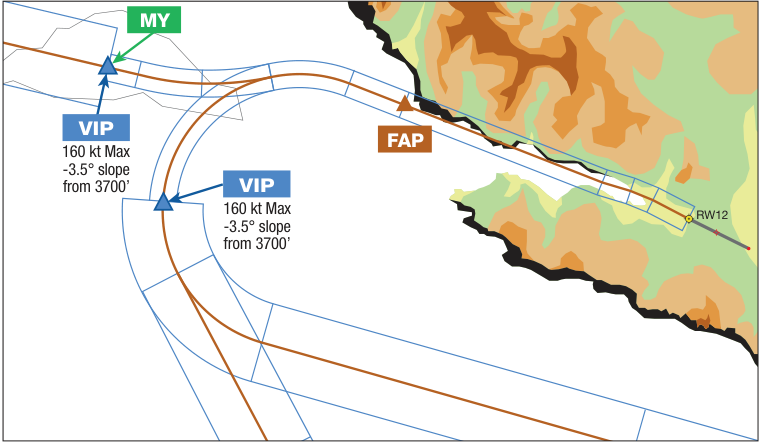
Several design meetings took place, at which experienced Atlantic Airways captains worked closely with procedure designers from QuoVadis to define the most desirable trajectories for various weather conditions. Exploiting a technology that offers so much flexibility (like turns after the Final Approach Fix) required careful attention to the key valuemakers: avoiding known areas of
strong turbulence and shears (generally associated with strong winds in certain directions that give rise to significant turbulence in the lee of sea cliffs and mountains), getting a better alignment with the runway on a short final and obtaining the lowest possible Obstacle Clearance Height (fig. 4).
correct track-keeping capability of the autopilot in dimensioning wind conditions. The design and testing activities were ongoing from August 2011 right up to January 2012. The formal validation was demonstrated in front of the Danish CAA. All procedures were validated in
When the principal trajectories were sketched, QuoVadis started to detail and fine-tune the design, and conduct thorough simulator testing of each procedure. One aim was to ensure that no false Ground Proximity Warning System (GPWS) alerts would occur when flying the procedures, another to verify the
both an A319 engineering simulator (that uses real aircraft systems) and a full flight training simulator with realistic Vágar scenery. And finally, a demonstration flight without passengers was performed at Vágar, flying all the RNP procedures in good weather conditions (fig. 5).
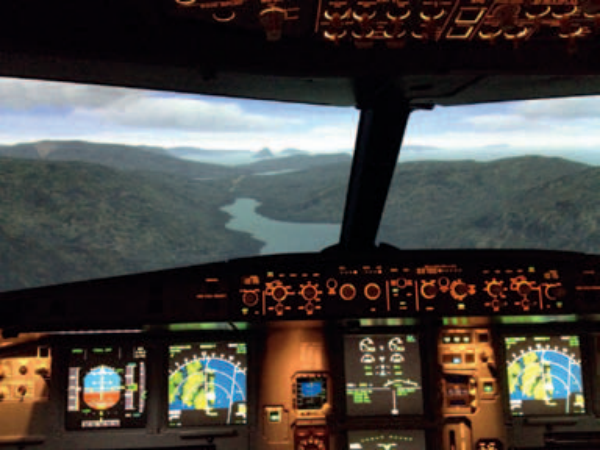
Figure 5 Vágar simulator scenery. The RNP AR training was given in a full flight simulator with very detailed scenery of Vágar.
Safety
Already, after a month of operation, Atlantic Airways was seeing its vision realised, with crews confident that RNP AR was giving them precision approach-like capabilities and advantages in a place where precision approach by conventional means was impossible to implement for both runways. And, in that short time, it was already clear that diversions had been avoided. “The increase in safety level is tangible, because the peak workload is over when the final approach starts and so, much more attention is given to monitoring the approach parameters,” said Captain í Niðristovu at the time. “And the avoidance of conventional procedure turns is saving us precious litres of fuel on almost every flight.”
One other key element in the successful introduction of RNP AR was crew training. In November 2011, three captains from Atlantic Airways joined an intensive threemonth line training programme with Air New Zealand, which operates the A320 family and has RNP AR procedures at several destinations. All four crews in the first round of Atlantic Airways Airbus training, as well as additional line training instructors, received tailored Vágar RNP AR training at the Airbus training academy in Toulouse shortly before entry into service.
Atlantic Airways’ unusual choice of the 27,000lb thrust-rated CFM565b7/P engines for the A319, was also linked to the RNP AR capability. The very powerful engines ensure the best possible one-engineinoperative missed approach climb gradient, an important factor in obtaining the lowest possible Obstacle Clearance Height of 250 feet AGL. And the airline installed a Head-Up Display on its first A319, in anticipation of its upgrade for use during RNP AR operations, to further reduce the workload of the pilot in poor visibility.
One year on, Atlantic Airways can instance more than a dozen diversions avoided and is confident that the investment in RNP AR capability will provide a long-lasting im-
provement in its operation to and from the Faroe Islands, securing the return on investment, thanks to the high impact on safety levels and regularity.
Full and unrestricted approval for the RNP AR system followed soon afterwards from the Danish CAA and Sámal P Danielsen, Director Flight Operations, said: “We are delighted to receive full and unrestricted approval for our proprietary RNP operating system after a successful trial period of operating at higher minima, during which every procedure flown was post-analysed for accuracy and integrity.” (fig. 6)
The airline’s work in pioneering RNP-AR 0.1 in Europe was recognised by industry peers when the airline received the European Regions Airline Association’s Airline of the Year (bronze) Award in September 2012.
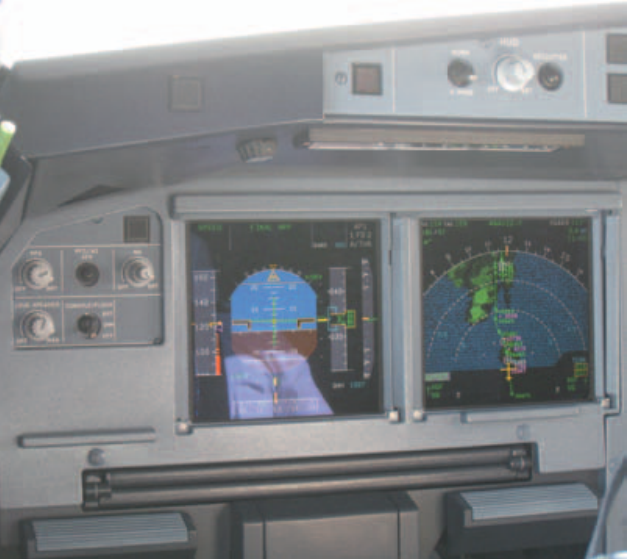
Figure 6 The RNP trajectory on the A319 Navigation Display leading to runway 12 at Vágar. Notice the lateral and vertical deviation indicators (L/DEV and V/DEV) on the Primary Flight Display.
The approval is proprietary to Atlantic Airways and therefore the operating minima are not published or publicised, although they are significantly below those achievable by using Vágar Airport’s own recently commissioned ILS system.
Magni Arge, Chief Executive, added: “Atlantic Airways may not be the largest airline in Europe but we are very proud to be the first airline in Europe to introduce this Performance-based Navigation System. I am delighted too that the Danish aviation authorities have been ready to work with Atlantic Airways and QuoVadis. Their final approval of our proprietary system has been great news for our customers and for everyone who has worked hard to achieve this.”
Safety
Joen REMMER
Section titled “Joen REMMER”大西洋航空公司运行副总裁
Stan ABBOTT
Section titled “Stan ABBOTT”英国及爱尔兰顾问
大西洋航空公司:RNP AR 0.1 运行的引入
Section titled “大西洋航空公司:RNP AR 0.1 运行的引入”大西洋航空公司是法罗群岛的国有航空公司,去年成为欧洲首家引入 RNP AR 0.1(要求授权的所需导航性能)卫星进近和起飞运行的航空公司。Joen Remmer 与 Stan Abbott 探讨了该系统的实施情况及其对安全、机组工作负荷和正常性的影响。
RNP AR 运行随大西洋航空公司首架空客 A319 于 2012 年 3 月交付而到来,此前双方经历了与空客子公司 QuoVadis 的密切合作和密集开发阶段 (图 1)。
图 1 大西洋航空公司于 2012 年 3 月 22 日接收其首架 A319。图中为首席执行官 Magni Arge(居中)及(最左侧)机长 Jóhan í Niðristovu。
自第一天起,丹麦航空当局即批准大西洋航空公司使用空客机型实施 RNP AR 0.1 运行,随后在详细监控期后授予完全无限制批准,包括显著降低的运行最低标准。
RNP AR 0.1 自引入以来,为航空公司带来了显著节约——既有日常运行成本节约(由于更燃油高效的进近和起飞轨迹),也大幅减少了因天气原因飞往瓦格最近备降场(均为距挪威、冰岛或苏格兰一小时飞行距离)的备降次数。
也许更为重要的是(虽然以现金衡量较为困难)运行安全的实质性改善。这并非说该航空公司在 RNP AR 0.1 之前的运行“不安全”:只是在商业航空这一高度注重安全的环境中,该系统使大西洋航空公司本就具有挑战性的天气和地形条件下的运行更加安全。
通过应用 RNP AR 0.1 程序,大西洋航空公司能够将其飞行员在多年恶劣环境运行中积累的隐含技能和知识,转化为明确编入飞机 FMS 的程序。自动飞行在以往需要手动飞行的更多场景得到应用,使飞行员有更多精力监控飞行安全进程,并在出现不可接受的偏差时更有警觉性地进行干预。
要理解大西洋航空公司日常运行面临的特殊挑战,首先需要简要回顾一段历史。
法罗群岛由 18 个独立岛屿组成,其中 17 个有人居住。岛屿原为火山形成,充分承受着北大西洋的狂烈冲击,拥有险峻的悬崖,其中包括一处拔地而起超过 800 米的绝壁,据称为欧洲之最。
在这片多山的地形中,占领的英军在二战期间于群岛最西端在高地区域之间的山脊上修建了一条短跑道。该跑道紧邻索瓦古尔(Sörvagur),该地是可全年运营船舶的优良港口,同时也靠近水上Catalina飞机运营所在的湖泊 (图 2)。
图 2 索尔瓦戈湾(Sørvágsfjord)景观,通往瓦格的 12 号跑道。
战后,该跑道一直闲置至 1960 年代才重新向商业航班开放。然而,其位置和跑道方向此后一直构成重大挑战。
飞行员需要具备高于平均水平的技能和处置能力,这源于以下因素的组合:
跑道较短(仅 1,250 米)、仅有非精密进近辅助设备、最低标准相对较高、周围地形仅允许狭窄且偏置的进近路径,以及典型的强风、剧烈风切变、转子气流以及大量云层和降水的盛行天气条件。
出于多种挑战,大西洋航空公司的正常性常常较差,尤其是冬季。仅 2011 年一年,大西洋航空公司就因天气原因取消或备降超过 50 次。不言而喻,这对航空公司而言是经济负担,对法罗群岛的工业和公众也是如此——他们完全依赖这条往返欧洲大陆的生命线航线服务。
当法罗政府多年前启动跑道延长工程时,大西洋航空公司立即开始研究通过此举可实现哪些运行改进。这样做不仅是因为更长的跑道(现为 1,799 米)可容纳比当时的 BAe 146 和 AVRO RJ 机队更大、更现代化的机型,而且任何提升安全性和正常性水平的机会都必须加以考察。最终选择是空客 A319 (图 3)。
“我们曾研究过各种传统方法来提高机场在恶劣天气条件下的可达性,但均未成功,”A319 机长 Jóhan í Niðristovu 解释道。“但我们在引入 AVRO RJ 机队取代现有 BAe 146 机队时获得了一个有趣的教训:新技术,如自动驾驶仪的改进,也可以降低工作负荷、提高安全水平并对正常性产生积极影响。因此,当我们首次了解 RNP 时,我们意识到新技术而非传统方法才是正确的关注点。”
事实上,该机场自重新开放以来已发生两起致命事故,均发生在恶劣气象条件下的进近过程中。两起事故均不涉及大西洋航空公司,该公司于 1988 年开始运营。最近一次事故(1996 年丹麦空军湾流III飞机发生与颠簸相关的致命事故)发生一段时间后公布调查结论,丹麦当局据此颁布了新的安全规则,现包括在特定风向和风速条件下关闭机场。
大西洋航空公司很快了解到,尽管 RNP AR 在世界各地已成功实施,但在欧洲此前尚无低 RNP 值(低于 0.3 海里)的 RNP AR 应用实例。因此,首要挑战是召集各方相关方,即瓦格机场、丹麦航空当局和空客。可提供 RNP AR 设计的供应商极少,大西洋航空公司决定与 QuoVadis 合作,原因显而易见:该公司与其采购的 A319 制造商关系密切,且在全球范围内有非常成功的 RNP 设计项目记录。
当法罗政府多年前启动跑道延长工程时,大西洋航空公司立即开始研究通过此举可实现哪些运行改进。这样做不仅是因为更长的跑道(现为 1,799 米)可容纳比当时的 BAe 146 和 AVRO RJ 机队更大、更现代化的机型,而且任何提升安全性和正常性水平的机会都必须加以考察。最终选择是空客 A319 (图 3)。
图 3 空客从瓦格起飞。
早期研究表明,RNP 0.3(即公共程序使用的“基础”精度)在最低标准方面相对于本地化器进近并无优势。因此,大西洋航空公司决定构建并获得尽可能最高精度的 RNP AR 程序授权,即 0.1,以便充分利用该技术的优势。0.1 值意味着飞机位置精确度偏差不超过 0.1 海里。
路线图于 2011 年春季与丹麦当局达成一致,执行项目启动会议于 6 月举行,首次商业新 A319 航班于去年 3 月 28 日的前一天获得了启动 RNP AR 运行的授权。
约八个月的开发期是各方紧密协作的挑战时期。一方面,大西洋航空公司必须确保所设计的内容在提高安全水平和正常性方面真正有利于航空公司,另一方面项目必须完全符合相关 ICAO 指南和 EASA 法规。
至于设计工作,í Niðristovu 机长继续说道:“为实现我们的主要目标——增强安全性和改善正常性,以及次要目标——减少燃油消耗,航空公司的隐含知识(即对瓦格运行的了解)必须与 QuoVadis 在 A319 和 RNP AR 能力方面的显含知识精心结合,以取得最佳结果,这一点至关重要。”
举行了多次设计会议,大西洋航空公司经验丰富的机长与 QuoVadis 的程序设计人员密切合作,定义各种天气条件下最理想的轨迹。利用一项提供如此灵活性的技术(如最后进近定位点后的转弯)需要密切关注以下关键价值因素:避开已知强湍流和风切变区域(通常与特定方向强风有关,在海崖和山脉背风侧产生显著颠簸)、在短五边与跑道更好地对齐,以及获得尽可能低的障碍物清除高度 (图 4)。
当主要轨迹初步确定后,QuoVadis 开始详细设计和微调设计,并对每个程序进行彻底的模拟机测试。目的之一是确保飞行该程序时不会产生虚假的近地警告系统(GPWS)告警,另一个是验证自动驾驶仪在设计风条件下的正确保持航迹能力。设计和测试活动从 2011 年 8 月持续至 2012 年 1 月。正式验证在丹麦 CAA 面前进行了演示。所有程序均在 A319 工程模拟机(使用真实飞机系统)和配备逼真瓦格场景的全动飞行训练模拟机中进行了验证。最后,在瓦格进行了无旅客演示飞行,在良好天气条件下飞行了所有 RNP 程序 (图 5)。
图 5 瓦格模拟机场景。RNP AR 培训在配备非常详细瓦格场景的全动飞行模拟机中进行。
运行仅一个月后,大西洋航空公司就已看到其愿景成为现实,机组确信 RNP AR 在精密进近传统手段无法为两条跑道实施的地点为他们提供了类似精密进近的能力和优势。而且,在如此短的时间内,备降已被避免这一点已非常明显。“安全水平的提高是可感知的,因为最高工作负荷在最后进近开始时已经过去,因此更多注意力用于监控进近参数,”í Niðristovu 机长当时表示。“避开传统程序转弯几乎为每次飞行节省了宝贵的燃油。”
RNP AR 成功引入的另一个关键要素是机组培训。2011 年 11 月,大西洋航空公司三名机长加入了与新西兰航空的密集三个月航线训练项目,后者运营 A320 系列飞机并在多个目的地拥有 RNP AR 程序。大西洋航空公司空客培训首批四组全体乘务组以及额外的航线训练教员,在投入运营前不久在图卢兹空客培训学院接受了定制的瓦格 RNP AR 培训。
大西洋航空公司为其 A319 选择 27,000 磅推力级别的 CFM56-5B7/P 发动机也与其 RNP AR 能力相关。强劲的发动机确保了最佳的单发失效复飞爬升梯度,这对于获得尽可能低的 250 英尺 AGL 障碍物清除高度是一个重要因素。航空公司还在其首架 A319 上安装了平视显示器,预为其在 RNP AR 运行期间升级使用做准备,以进一步降低飞行员在低能见度时的工作负荷。
一年过去了,大西洋航空公司可以举出十多起避免的备降实例,并确信对 RNP AR 能力的投资将为其往返法罗群岛的运营提供持久的改善,确保投资回报,得益于对安全水平和正常性的高影响力。
丹麦 CAA 不久后授予该 RNP AR 系统完全无限制批准,分管飞行的 Sámal P Danielsen 主任表示:“经过成功试运行期后,我们很高兴获得完全无限制的专有 RNP 运行系统批准。试运行期间在较高最低标准下运行,每个飞行的程序都进行了事后分析以验证准确性和完整性。” (图 6)
该航空公司作为欧洲 RNP AR 0.1 先驱的工作获得了行业同行的认可,于 2012 年 9 月荣获欧洲地区航空公司协会年度航空公司(铜奖)。
图 6 A319 导航显示器上的 RNP 轨迹,通往瓦格的 12 号跑道。注意主飞行显示器上的横向和垂直偏差指示器(L/DEV 和 V/DEV)。
该批准为大为西洋航空公司专有,因此运行最低标准未予公布或宣传,尽管显著低于使用瓦格机场自身近期投入使用的 ILS 系统所能达到的标准。
Magni Arge 首席执行官补充道:“大西洋航空公司可能不是欧洲最大的航空公司,但我们非常自豪能成为欧洲首家引入这一基于性能导航系统的航空公司。我同样高兴丹麦航空当局已准备好与大西洋航空公司和 QuoVadis 合作。他们对我们专有系统的最终批准对我们的客户和所有为实现这一目标而努力工作的人们来说都是好消息。”