Wake Vortices
Source: Airbus Safety First URL: https://safetyfirst.airbus.com/wake-vortices/ Published: 2024-08-14 Magazine Issue: 2016-01 Category: Flight Ops, separation, test, turbulence, vortex, vortices, wake PDF: Original PDF
All aircraft generate wake vortices, also known as wake turbulence, which continue to be evident far behind the generating aircraft. Another aircraft crossing this wake may feel a sharp and brief turbulence which can be strong under some circumstances. Let’s review the specific characteristics of wake vortices’ and how pilots should react in case of an encounter to ensure the safety of the flight.
CLAUDE LELAIE Former Head of Flight Test
Where do Wake Vortices come from?
Section titled “Where do Wake Vortices come from?”All aircraft generate wake vortices, also known as wake turbulence. When an aircraft is flying, there is an increase in pressure below the wing and a depression on the top of the aerofoil. Therefore, at the tip of the wing, there is a differential pressure that triggers the roll up of the airflow aft of the wing.
Limited swirls exist also for the same reason at the tips of the flaps. Behind the aircraft all these small vortices mix together and roll up into two main vortices turning in opposite directions, clockwise behind the left wing (seen from behind) and anti-clockwise behind the right one (fig.1).
(fig.1) Development of wingtip vortices
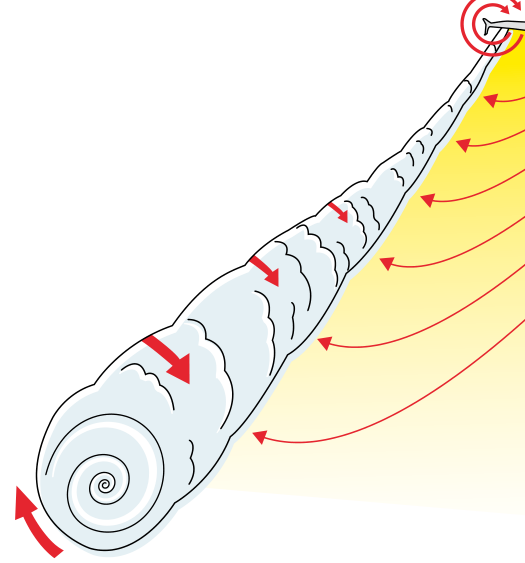
Size: The active part of a vortex has a very small radius, not more than a few meters. However, there is a lot of energy due to the high rotation speed of the air.
Descent rate: In calm air, a wake vortex descends slowly. As an order of
magnitude, in cruise, it could be 1000 ft below and behind the generating aircraft at a range of around 15 NM. Then, when far away from the generator, the rate of descent becomes very small. In approach, the descent is usually limited to around 700 ft.
The decay is much faster in ground effect.
However, depending on weather conditions the descent rate may vary signifi cantly and may even be very small. One of the key factors affecting this descent is the variation of the temperature with the altitude. A temperature inversion limits the rate of descent.
Decay rate: One important parameter of a wake vortex is the decay of its strength with time. The decay rate varies slightly from one aircraft type to another. Unfortunately, in calm air, due to low external interference, it is rather low and this is why the separation
between aircraft needs to be so large.
Ground effect: When the aircraft is close to the ground, less than a wingspan, the two vortices tend to drift out from the centre line, each towards its own side, at a speed of around 2 to 3 kt. It is this phenomenon, when associated with a light crosswind component that tends to “hold” the “into wind” vortex roughly on the centreline, whilst the “downwind” vortex moves away.
Due to this phenomenon, the decay is much faster in ground effect.
Parameters affecting the wake vortex
Section titled “Parameters affecting the wake vortex”Calm weather creates the most critical situation as the strength decreases slowly and the vortex effect may be felt far behind the vortex generating aircraft.
Aircraft weight: Wake vortex strength increases with the weight of the aircraft. This is why today the ICAO aircraft classifi cation is based on the MTOW. However, such an approach is a simplifi cation as other parameters also affect the strength at the separation distance.
Wing characteristics: The wing shape and the load distribution affect the wake vortex characteristics, mainly through the decay rate.
A smaller wing span increases the decay rate. Therefore, for a given “vortex generator” or “leader” aircraft weight and at the same distance, vortex encounters are less severe behind an aircraft having a smaller wingspan.
It has also been demonstrated that aircraft having a high inboard loading (higher defl ection of the fl aps close to the fuselage as an example) have a faster decay of their vortices.
Weather conditions: The weather conditions play a major role in wake vortex development and decay. In the case of heavy turbulence, a vortex will dissipate very quickly and there is no risk for the “follower” aircraft. Strong winds are associated with turbulence and will also contribute to a rapid dissipation.
Calm weather creates the most critical situation as the strength decreases slowly and the vortex effect may be felt far behind the vortex generating aircraft. Today, in order to be safe, all separations assume that the aircraft are flying in perfectly calm conditions.
Encountering a wake vortex
Section titled “Encountering a wake vortex”DEFINITIONS
Section titled “DEFINITIONS”When an aircraft enters in the vortex of another aircraft, the “manoeuvre” is called an encounter. The aircraft emitting the vortex is called the generator and the one experiencing it, the follower.
How likely is an encounter?
Section titled “How likely is an encounter?”It is not possible to implement navigation procedures such that the probability of an encounter is zero. To give an example, during the Airbus wake vortex fl ight tests,
in cruise, A319 vortices were identifi ed at a range of 42 NM, thanks to the contrails. An encounter with such a vortex is obviously very weak but it exists and it
significant separations and dramatically limit the traffic on all airports and airways without significantly improving safety. It is also to be noted that statistics show that the probability of injury to passengers and crew is about five times greater in turbulence due to weather, than with a wake vortex encounter.
would have been a bit stronger behind a Heavy. It is also common to have, in the initial approach phase, encounters at distances well above the ICAO minimum separations. The ICAO separations have not been set to avoid all encounters but to prevent unsafe encounters. Avoiding all encounters would require very
How does it feel to encounter a wake vortex?
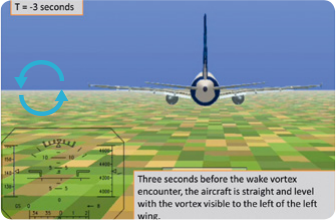
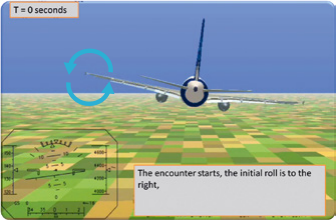
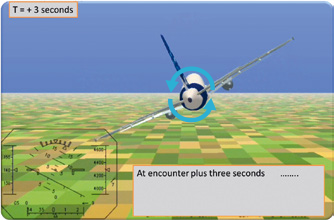
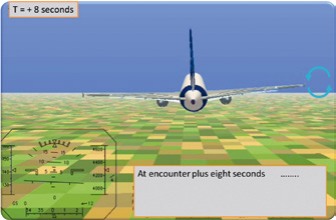
Section titled “How does it feel to encounter a wake vortex?”In most cases the effect of the vortex is mainly felt in roll. We will consider here the case of an aircraft entering laterally in a vortex, which is the most frequent situation. Let’s assume that a follower aircraft is entering the right vortex of the leader aircraft from its right side. Seen from behind, this vortex is rotating anticlockwise. When the left wing of the follower first enters the vortex, there is on this wing a local angle of attack increase and therefore the lift becomes higher than on the right wing. The initial roll motion is therefore to the right. Then, when the aircraft is in the middle
of the vortex, it will be subjected to the full strength of the vortex and roll in the same direction as the vortex, to the left (fig.2). This is the main rolling motion that creates the strongest roll acceleration.
As a conclusion, the typical signature of a severe encounter is an initial small roll in one direction followed by a much more significant roll in the other sense.
When in cruise, this roll motion may be associated with significant load factor variations.
The ICAO separations have not been set to avoid all encounters but to prevent unsafe encounters.
(fig.2)
Section titled “(fig.2)”Aircraft behaviour in a wake vortex encounter (The aircraft bank angle is voluntarily exagerated on the figure)
The typical signature of a severe encounter is an initial small roll in one direction followed by a much more significant roll in the other sense.
Effect on the trajectory of the follower
Section titled “Effect on the trajectory of the follower”To experience a severe roll encounter, it is necessary for the follower to have a trajectory with a small closing angle with the vortex. However, if this angle is too small, the aircraft will be smoothly “ejected” from the vortex (due to the initial roll in the example above).
When perpendicular, there will be no rotation, and any encounter will be a very brief but sharp turbulence effect. To experience a severe encounter, the most critical angle between the trajectory of the follower and the vortex is around 10 degrees.
Severity of the encounters
Section titled “Severity of the encounters”The authorized separations are such that the severity of the encounters does not create an unsafe control situation. When the aircraft is not in ground effect, the order of magnitude of the bank angle for a severe encounter on the approach is around 20°. But
when in ground effect, as explained above, the decay is much faster and the worldwide experience during many years shows that the bank angle achieved is much lower and does not lead to a risk of touching the ground with the wingtip.
Duration of an encounter
Section titled “Duration of an encounter”A severe encounter, as described above, where the trajectories of both aircraft have an angle around 10 degrees, typically lasts around 4 to 6 seconds.
It is not possible to remain for a long time in a severe vortex as the rotating airflow on the wing and on the fin, eject the aircraft from the vortex. In line
with the fl ight mechanics equations, it has been demonstrated during Airbus fl ight tests that the stabilization of a large aircraft inside a vortex can only be obtained by voluntarily establishing a large sideslip angle. As airliners do not and should not fl y with large sideslip angles, they cannot remain in a vortex. Therefore, a vortex cannot be the cause of long duration turbulence.
Operational procedures
Section titled “Operational procedures”General procedure increases
Section titled “General procedure increases”Considering the way the vortex is acting on the aircraft as explained previously, if the pilot reacts at the fi rst roll motion, to the right in the example given, he will correct by rolling to the left. When in the core of the vortex, the main roll motion to the left will then be amplifi ed by this initial piloting action. The result will be a fi nal bank angle greater than if the pilot would not have moved the controls.
clearly show that pilot action does not improve the situation.
In addition, in-flight incidents have demonstrated that the pilot inputs may exacerbate the unusual attitude situation with rapid roll control reversals carried out in an “out of phase” manner.
In the case of a severe encounter the autopilot may disconnect automatically, but in all other cases, it will be able to counter properly the roll and pitch motions generated by the vortex.
This has also been demonstrated during the Airbus fl ight tests. Most of the encounters have been performed stick free, but several hundred were carried out with the pilot trying to minimize the bank angle. The results
For these reasons, the best procedure in case of encounter is:
RELEASE THE CONTROLS
Section titled “RELEASE THE CONTROLS”Do not voluntarily disconnect the autopilot
Section titled “Do not voluntarily disconnect the autopilot”If the autopilot is disconnected, before any reaction, wait for a reasonable stabilization of the aircraft, then:
-
Roll wings level.
-
Re-establish the initial cruise level or the standard climb or descent trajectory.
Use of rudder warning
Section titled “Use of rudder warning”A large defl ection of the rudder creates a very important lateral acceleration that may well surprise the pilot. It could lead to a reaction with a defl ection to the other side. This could then give rise to very large forces on the fi n that may exceed the structural resistance. An
accident has already occurred for this reason. Some recent aircraft types are protected thanks to their fly-by-wire systems, but anyway, any use of the rudder does not reduce the severity of the encounter nor does it improve the ease of recovery. Therefore:
DO NOT USE THE RUDDER
Section titled “DO NOT USE THE RUDDER”Lateral offset
Section titled “Lateral offset”If two aircraft are fl ying exactly on the same track, one being 1000 ft below the other, in the same or opposite direction, and if there is no cross wind, there is a risk of encounter with a vortex for the lower aircraft. In this case, it is possible to reduce the risk by using a lateral offset.
However, most of the time, it is diffi cult to know whether the other aircraft is fl ying with or without a small relative offset due to the lack of angular precision of the TCAS. Therefore, this offset is
not a guarantee that an encounter will be avoided (except if the vortices are clearly visible by contrails).
In case of cross wind, if the two aircraft are fl ying exactly on the same track, the wind will move the vortices out of the track of the lower aircraft whilst they are descending. In this situation, if a lateral offset is decided for other reasons than wake vortex avoidance, an offset upwind by the follower is to be preferred, since a downwind one may potentially create an encounter.
Final approach
Section titled “Final approach”During the final approach, it has sometimes been suggested to maintain a trajectory slightly above the glide slope. This is not a satisfactory procedure for transport aircraft for several reasons:
-
When established in descent on the standard approach slope, as the vortex is descending, there is little risk of encountering the vortices of the previous aircraft, except possibly when reaching the area of the ground effect. However, this possibility has not led to an unsafe situation (no accident in ground effect recorded on transport aircraft with standard separations).
-
If the aircraft is fl own too high above the threshold to avoid a possible encounter, it will lead to a long landing and therefore signifi cantly increase the risk of runway excursion. It is well known that runway excursion
is already, today, the main cause of accidents and such a technique would only increase that risk.
As a conclusion, a transport aircraft should not deviate from the standard approach slope to avoid a risk of encounter. However, for light aircraft, with low approach speed, approaching on a long runway, it is an acceptable procedure to perform a high approach and a long landing, targeting a touch down point after that of the previous aircraft.
It is to be noted that, when on an approach, there is no risk of encounter with the vortices of an aircraft taking-off on the same runway as a vortex will only move backward due to the wind effect. Such a vortex will have a very limited strength, and in the case of a strong headwind may even be dissipated completely. However, with crossing runways, depending on their geometry,
and with inappropriate procedures, it may be possible that, very close to the ground, a landing aircraft enters the vortex of an aircraft which took-off on
another runway. Pilots on the approach need to maintain a general vigilance and awareness, especially with calm wind conditions.
Departure
Section titled “Departure”During the take-off phase, other than time separation, no avoidance procedure is applicable as the manoeuvre is dictated by characteristic speeds V1, Vr, V2, determined by the weight, the weather conditions and the runway. The time separations given for some aircraft types ensure that possible encounters after takeoff remain controllable. When no time separation is given by ICAO rules, the separation is decided by the ATC to
obtain a minimum radar separation, depending on the departure trajectory and long experience has demonstrated an acceptable level of safety.
For a light aircraft taking-off from a long runway behind a transport aircraft, it is recommended to choose the departure point in order to achieve a trajectory well above the preceding aircraft.
Separations
Section titled “Separations”ICAO rules
Section titled “ICAO rules”Almost everywhere in the world the separations comply with the ICAO rules.
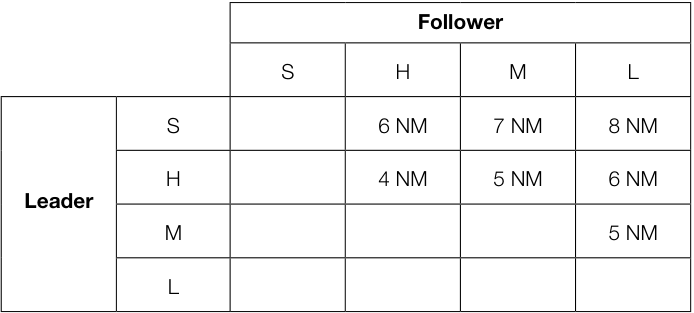
Classifications: Three categories of aircraft are defined according to the MTOW: Heavy (H): above 136 tons. Medium (M): between 7 and 136 tons. Light (L): below 7 tons.
In addition, despite being classified as Heavy, the A380 is known as Super (S), and subjected to increased separations in approach, behind.
Approach: On approach, the separations depend on the leader and the follower classification. The table below gives the separations for the various pairs on the same runway. They apply also to operations on different parallel runways if they are separated laterally by less than 760 m. To be noted that the A380 separations are not in the ICAO recommendations (PANS-ATM), but in a provisional State Letter published by ICAO in 2008.
Cruise: In cruise, the separations are identical for all aircraft types: Horizontally: 5 NM. Vertically: 1000 ft.
Other rules: The ICAO rules are used worldwide except in two Countries, USA and UK. These two Countries apply a different classification with different weight limits and separations.
RECAT (Re-categorization).
Section titled “RECAT (Re-categorization).”Principles of the re-categorization: The target of the re-categorization is to reduce the separations on approach and for departure between some aircraft pairs, without degradation of the safety levels, in order to improve the landing capacity of a given runway or runway couple.
The fi rst step is called RECAT 1. All the aircraft are placed in 6 categories
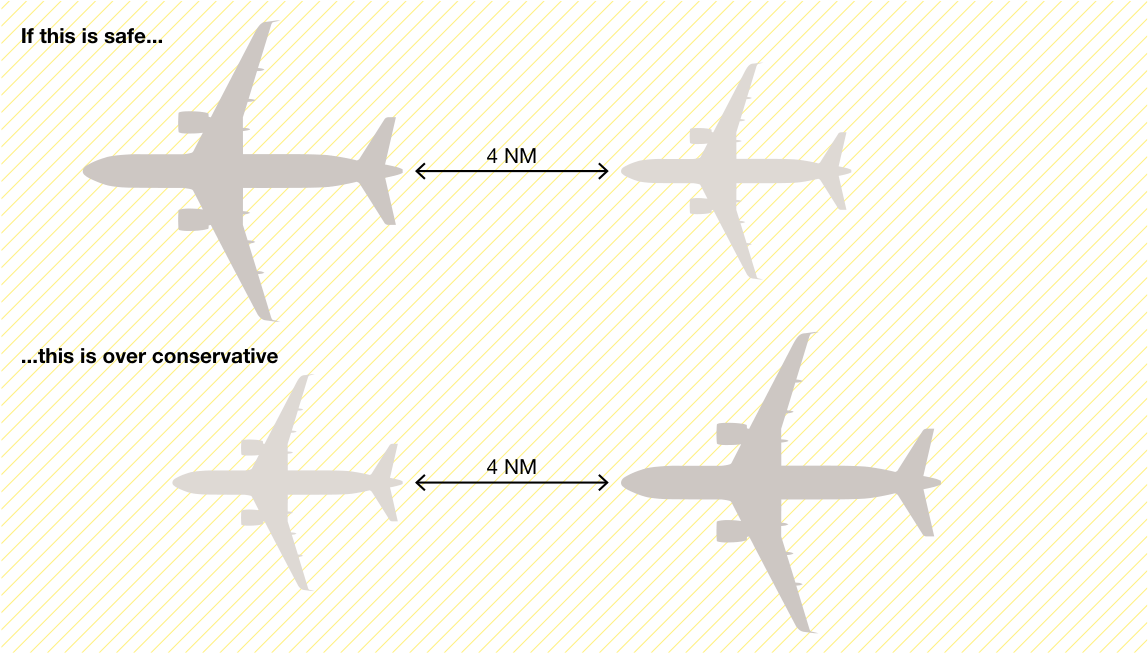
from A to F, A being the larger aircraft category. The principle is to divide the Heavies and the Medium each in 2 categories. As an example, today, the separations between Heavies are established for the worst case that is the smaller Heavy behind the bigger. However, if this bigger Heavy follows the smallest, common sense indicates that a reduction of separation is possible without any impact on the safety level (fi g.3). Similarly, the separation may be reduced between two big Heavies or two small Heavies. The same principles apply to the Medium category. The target is that no situation should be worse than that which exists today with ICAO separations.
(fi g.3)
Section titled “(fi g.3)”Toward a reduction of aircraft separation minima to aircraft categories
RECAT 1 EU: It appeared that the RECAT FAA approach was giving few benefi ts to the European airports due to the differences in the airlines fl eets on both sides of the Atlantic. A RECAT EU was therefore developed. It takes into consideration not only the strength of the wake vortex of the leader aircraft, but also the resistance of the follower. The encounter tests performed by Airbus allowed validating some models used for the computations.
The RECAT 1 EU has also 6 categories:
-
A - Super Heavy: Including A380 and An124.
-
B - Upper Heavy: MTOW above 100 tons and wingspan between 52 m and 72 m.
-
C - Lower Heavy: MTOW above 100 tons and wingspan below 52 m
-
D - Upper Medium: MTOW between 15 and 100 tons and wingspan above 32 m.
-
E - Lower Medium: MTOW between 15 and 100 tons and wing span below 32 m
-
F - Light: MTOW below 15 tons.
The separations are as follows:
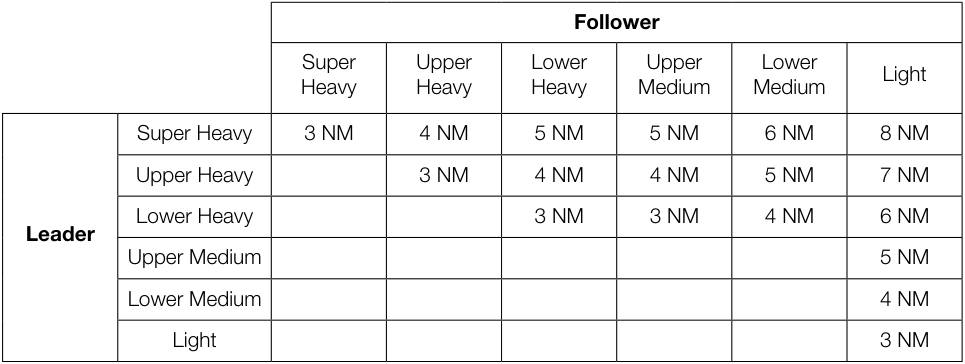
It is to be noted that this implementation is not intended to be mandatory and only the most important European airports will use it, the other ones will keep the ICAO separations.
RECAT 2 and RECAT 3: The RECAT 2 is also called “pair-wise”, with a separation that takes into consideration the leader and the follower types, possibly by groups of aircraft. It will be implemented in the coming years.
The separations are not meant to avoid all encounters but to prevent unsafe ones. In very calm air, wake vortices encounters may lead to strong turbulence with significant bank angle and possibly some load factor when at high altitude.
Remember: Release the Controls and DO NOT use Rudder.
所有航空器都会产生尾涡,也称为尾流湍流,这些涡流在产生航空器后方相当远的距离仍然存在。另一架穿越该尾流的航空器可能会感受到剧烈而短暂的颠簸,在某些情况下可能相当强烈。让我们回顾尾涡的特殊性质,以及飞行员在遭遇尾涡时应如何反应,以确保飞行安全。
CLAUDE LELAIE 试飞部前负责人
尾涡从何而来?
Section titled “尾涡从何而来?”所有航空器都会产生尾涡,也称为尾流湍流。当航空器飞行时,机翼下方压力增大,而翼型上方压力降低。因此,在翼尖处存在压力差,导致翼后方的气流卷起。
由于同样的原因,襟翼翼尖处也存在有限的气流旋涡。在航空器后方,所有这些小涡旋混合在一起并卷起形成两个主要涡旋,以相反方向旋转:从后方看,左翼后方为顺时针,右翼后方为逆时针**(图1)**。
(图1) 翼尖涡旋的形成
尺寸:涡旋的活动部分半径很小,只有几米。然而,由于空气高速旋转,其中蕴含着大量能量。
下沉率:在平静空气中,尾涡缓慢下沉。作为数量级估算,在巡航时,它可能在约15海里距离处位于产生航空器下方1000英尺处。然后,当远离产生源时,下沉率变得非常小。在进近时,下沉通常限制在约700英尺左右。
在地效中,衰减速度要快得多。
然而,根据天气条件,下沉率可能会有显著变化,甚至可能非常小。影响下沉率的关键因素之一是温度随高度的变化。温度逆变会限制下沉率。
衰减率:尾涡的一个重要参数是其强度随时间的衰减。衰减率因航空器类型不同而略有差异。不幸的是,在平静空气中,由于外部干扰较少,衰减率相当低,这就是为什么航空器之间需要如此大的间隔。
地效:当航空器接近地面、距离小于一个翼展时,两个涡旋往往会从中心线向外漂移,各自朝向自己一侧,速度约为2至3节。正是这种现象,当与轻微侧风分量相结合时,会倾向于将”迎风”涡旋大致”固定”在中心线上,而”背风”涡旋则向外移动。
由于这种现象,在地效中衰减速度要快得多。
影响尾涡的参数
Section titled “影响尾涡的参数”平静天气会造成最危险的情况,因为强度下降缓慢,涡旋效应可能在涡旋产生航空器后方相当远处被感受到。
航空器重量:尾涡强度随航空器重量增加而增大。这就是为什么目前ICAO航空器分类基于MTOW。然而,这种方法是一种简化,因为在间隔距离处还有其他参数也会影响强度。
机翼特性:机翼形状和载荷分布影响尾涡特性,主要通过衰减率体现。
较小的翼展会增加衰减率。因此,对于给定的”涡旋产生源”或”引领”航空器重量,在相同距离处,在翼展较小的航空器后方遭遇涡旋会较轻。
也已证明具有较高内侧载荷(以襟翼靠近机身处偏转较大为例)的航空器,其涡旋衰减较快。
天气条件:天气条件在尾涡的产生和衰减中起着重要作用。在强颠簸情况下,涡旋会迅速消散,对”跟随”航空器没有风险。强风伴随颠簸,也会促进快速消散。
平静天气会造成最危险的情况,因为强度下降缓慢,涡旋效应可能在涡旋产生航空器后方相当远处被感受到。今天,为了安全起见,所有间隔都是假设航空器在完全平静的条件下飞行。
当航空器进入另一架航空器的涡旋时,这种”机动”称为遭遇。发射涡旋的航空器称为产生源,经历涡旋的航空器称为跟随者。
遭遇的可能性有多大?
Section titled “遭遇的可能性有多大?”不可能实施使遭遇概率为零的导航程序。举个例子,在空客尾涡飞行测试期间,在巡航时借助凝结尾迹,在42海里的距离处识别到了A319的涡旋。与这样的涡旋遭遇显然非常微弱,但确实存在,而且在一架重型航空器后方会稍强一些。在初始进近阶段,在远超ICAO最小间隔的距离处发生遭遇也很常见。ICAO间隔的设定并非为了避免所有遭遇,而是为了防止不安全遭遇。避免所有遭遇需要非常大的间隔,并将显著限制所有机场和航路的流量,而不会显著提高安全性。还需要注意的是,统计数据显示,乘客和机组人员因天气颠簸受伤的概率约为尾涡遭遇受伤概率的五倍。
遭遇尾涡是什么感觉?
Section titled “遭遇尾涡是什么感觉?”在大多数情况下,涡流的影响主要表现为横滚。我们这里考虑的是航空器从侧面进入涡流的情况,这是最常见的情形。假设后机从其右侧进入前机的右侧涡流。从后视角度看,该涡流呈逆时针旋转。当后机的左翼首先进入涡流时,该翼面出现局部迎角增大,因此升力大于右翼。初始横滚运动因此向右。然后,当航空器处于涡流中心时,它将受到涡流全强度的作用,向左横滚,方向与涡流旋转方向相同 (图2)。这是产生最强横滚加速度的主要横滚运动。
总之,严重遭遇的典型特征是:先向一个方向出现小幅横滚,随后向相反方向出现幅度大得多的横滚。
在巡航阶段,这种横滚运动可能伴随着显著的载荷因子变化。
ICAO 间隔标准的设定并非为了避免所有遭遇,而是为了防止不安全的遭遇。
尾涡遭遇中航空器的行为(图中的航空器坡度角经夸大处理以便于说明)
严重遭遇的典型特征是:先向一个方向出现小幅横滚,随后向相反方向出现幅度大得多的横滚。
对后机轨迹的影响
Section titled “对后机轨迹的影响”要经历严重的横滚遭遇,后机必须具有与涡流夹角很小的接近轨迹。然而,如果这个夹角过小,航空器将被平缓地“弹出”涡流(由于上例中的初始横滚)。
当轨迹与涡流垂直时,将不会产生旋转,任何遭遇都只是非常短暂但剧烈的颠簸效应。要经历严重遭遇,后机轨迹与涡流之间的最危险夹角约为 10 度。
遭遇的严重程度
Section titled “遭遇的严重程度”授权的间隔标准确保遭遇的严重程度不会造成不安全的控制状态。当航空器不在地效范围内时,在进近阶段严重遭遇的坡度角数量级约为 20°。但如前所述,在地效范围内时,涡流衰减快得多,多年来的全球经验表明,实际达到的坡度角要低得多,不会导致翼尖触地的风险。
遭遇持续时间
Section titled “遭遇持续时间”严重的遭遇——即双方航空器轨迹夹角约为 10 度的情况——通常持续约 4 至 6 秒。
不可能在严重涡流中长期停留,因为作用在机翼和垂直安定面上的旋转气流会将航空器推出涡流。根据飞行动力学方程,空客飞行试验已证明,大中型航空器在涡流中要获得稳定,只能通过主动建立大侧滑角来实现。由于民航客机不会、也不应该以大侧滑角飞行,因此它们无法保持在涡流中。所以,涡流不可能是长时间颠簸的原因。
通用程序的增加
Section titled “通用程序的增加”根据前文所述的涡流对航空器的作用方式,如果飞行员在第一次横滚运动时(以上例中向右横滚)做出反应,他会通过向左横滚来进行修正。而当处于涡流核心时,向左的主要横滚运动将因这一初始驾驶动作而加剧。结果是最终的坡度角大于飞行员不动操纵面的情况。
空客飞行试验的结果清楚地表明,飞行员动作并不能改善状况。
此外,飞行中事故表明,飞行员输入可能会以“不同步”的方式快速进行横滚操纵反效,加剧异常姿态情况。
在严重遭遇的情况下,自动驾驶可能自动断开,但在所有其他情况下,它能够正确地抵消涡流产生的横滚和俯仰运动。
空客飞行试验也验证了这一点。大多数遭遇是在飞行员松杆的情况下进行的,但也有数百次是飞行员尝试将坡度角减至最小的飞行试验。结果表明,对于这些原因,在遭遇情况下最佳程序是:
不要主动断开自动驾驶仪
Section titled “不要主动断开自动驾驶仪”如果自动驾驶仪断开,在任何反应之前,等待飞机合理稳定后:
-
副翼改平。
-
重新建立初始巡航高度层或标准上升/下降轨迹。
侧滑舵使用警告
Section titled “侧滑舵使用警告”大面积的侧滑舵偏转会产生非常大的侧向加速度,这可能会让飞行员感到惊讶。这可能导致向另一侧偏转的反作用力,进而在安定面上产生非常大的力,可能超过结构极限。曾有因此引发的事故。部分新型飞机凭借其电传操纵系统得到了保护,但无论如何,使用侧滑舵既不会减轻遭遇的严重程度,也不会改善改出难度。因此:
不要使用侧滑舵
Section titled “不要使用侧滑舵”如果两架飞机沿完全相同的航迹飞行,其中一架在另一架下方 1000 ft,无论同向还是反向飞行,在无侧风的情况下,低高度飞机存在遭遇尾涡的风险。在这种情况下,可通过横向偏转来降低风险。
然而,大多数情况下,由于 TCAS 缺乏角度精度,很难判断其他飞机是否已因相对较小的偏移而偏离航迹。因此,这种偏转并不能保证避免遭遇(除非涡流可通过凝结尾迹清晰可见)。
在有侧风的情况下,如果两架飞机沿完全相同的航迹飞行,风会使涡流在下沉过程中偏离低高度飞机的航迹。在这种情况下,如果出于尾涡避让以外的原因决定采用横向偏转,后机应选择向迎风方向偏转,因为向背风方向偏转可能会反而产生遭遇风险。
在最后进近阶段,有时建议保持略高于下滑道的轨迹。对于运输类飞机而言,这并非令人满意的程序,原因如下:
-
当沿标准进近坡度下降时,由于涡流正在下沉,遭遇前机涡流的风险很小,但在进入地效区域时可能除外。然而,这种情况尚未导致不安全状态(在标准间隔条件下,运输类飞机在地效区域未记录到事故)。
-
如果飞机为了避免可能的遭遇而飞得过高,将导致长距离着陆,从而显著增加冲出跑道的风险。众所周知,冲出跑道已是当前事故的主要原因,这种技术只会增加该风险。
综上所述,运输类飞机不应为了避免遭遇风险而偏离标准进近坡度。然而,对于轻型飞机,以较低的进近速度在长跑道上进近时,采用高进近和长距离着陆、瞄准在前机之后的位置接地,是一种可接受的程序。
值得注意的是,在进近时,不存在与同跑道起飞飞机涡流遭遇的风险,因为涡流只会因风的作用向后移动,强度非常有限。在强顶风的情况下甚至可能完全消散。然而,对于交叉跑道,根据其几何关系及不适当的程序,在非常接近地面时,着陆飞机有可能进入从另一条跑道起飞的飞机涡流中。进近中的飞行员需要保持总体警惕和意识,特别是在静风条件下。
在起飞阶段,除了时间间隔外,不适用任何规避程序,因为机动动作由特征速度 V1、Vr、V2 决定,这些速度由重量、天气条件和跑道决定。某些机型给出的时间间隔确保起飞后可能的遭遇仍可控制。当 ICAO 规则未给出时间间隔时,间隔由 ATC 决定,以获得最小雷达间隔,这取决于起飞轨迹。长期经验已证明可接受的安全水平。
对于轻型飞机在长跑道上跟随运输类飞机起飞,建议选择起飞点以获得明显高于前机的轨迹。
ICAO 规则
Section titled “ICAO 规则”几乎全球所有地区的间隔都遵循 ICAO 规则。
分类:根据最大起飞重量(MTOW)将飞机分为三类:重型(H):136 吨以上。中型(M):7 吨至 136 吨之间。轻型(L):7 吨以下。
此外,尽管 A380 被归类为重型,但其被标识为超级(S),在进近时需遵守增加的间隔。
进近:进近时的间隔取决于前机和后机的分类。下表给出了同跑道各配对的间隔。这些间隔也适用于横向间距小于 760 m 的不同平行跑道上的运行。需要注意的是,A380 的间隔不在 ICAO 建议(PANS-ATM)中,而是在 ICAO 于 2008 年发布的临时State Letter 中。
巡航:巡航时的间隔对所有机型相同:水平间隔:5 NM。垂直间隔:1000 ft。
其他规则:ICAO 规则在全球范围内使用,但有两个国家例外:美国和英国。这两个国家采用不同的分类、重量限制和间隔。
RECAT(重新分类)。
Section titled “RECAT(重新分类)。”重新分类的原则:重新分类的目标是在不影响安全水平的前提下,减少某些飞机对在进近和起飞时的间隔,从而提高给定跑道或跑道组合的着陆容量。
第一步称为 RECAT 1。所有飞机被分为 A 到 F 共 6 个类别,A 为最大的飞机类别。原则是将重型机和中型机各分为 2 个子类别。例如,目前重型机之间的间隔是以最不利情况——即较小的重型机跟在大重型机后面——为基准设定的。然而,如果较大的重型机跟在最小的重型机后面,常识表明在不影响安全水平的情况下可以减小间隔(图 3)。同样,两个大重型机之间或两个小重型机之间的间隔也可以减小。中型机类别适用相同原则。目标是确保任何情况都不应比目前 ICAO 间隔的情况更差。
朝着减小飞机类别间最小间隔的方向发展
RECAT 1 EU:鉴于大西洋两岸航空公司机队的差异,RECAT FAA 方案对欧洲机场的益处有限。因此开发了 RECAT EU。它不仅考虑前机的尾涡强度,还考虑后机的抗扰能力。空客进行的遭遇测试验证了用于计算的某些模型。
RECAT 1 EU 同样分为 6 个类别:
- A - 超重型:包括 A380 和 An124。
- B - 上重型:最大起飞重量(MTOW)超过 100 吨,翼展在 52 米至 72 米之间。
- C - 下重型:最大起飞重量(MTOW)超过 100 吨,翼展小于 52 米。
- D - 上中型:最大起飞重量(MTOW)在 15 至 100 吨之间,翼展大于 32 米。
- E - 下中型:最大起飞重量(MTOW)在 15 至 100 吨之间,翼展小于 32 米。
- F - 轻型:最大起飞重量(MTOW)小于 15 吨。
间隔如下:
值得注意的是,此实施并非强制要求,只有最重要的欧洲机场会使用,其他机场将保持 ICAO 间隔。
RECAT 2 和 RECAT 3:RECAT 2 也称为“逐对”方法,其间隔考虑了前机和后机的类型,可能按飞机分组。它将在未来几年内实施。
间隔的目的不是避免所有遭遇,而是防止不安全的情况。在非常平静的空气中,尾涡遭遇可能导致强烈颠簸,产生显著的滚转角,在高空时可能产生一定的载荷因子。
记住:松开操纵杆,不要使用方向舵。