180° turns on runway
Source: Airbus Safety First URL: https://safetyfirst.airbus.com/180-turns-on-runway/ Published: 2016-07-29 Magazine Issue: 2016-07 Category: Flight Ops, 180°steering,, excursion, runway,runway excursion, taxi, taxiway, turn, u-turn PDF: Original PDF
PROCEDURES
Performing a 180° turn or U-turn on a runway may seem an ordinary maneuver compared to other phases of the fl ight. However, operational experience over the past 10 years shows that unintentionally leaving the runway while completing a U-turn can happen, even to experienced pilots, in any conditions, even on dry runway, on any aircraft type including the A320 family aircraft. A specifi c technique exists for such U-turns to avoid runway excursions.
STÉPHANE BRIZAY Flight Operations Engineer
XAVIER JOLIVET Director Flight Safety Enhancement
U-TURNS ON RUNWAY: A SIGNIFICANT CONTRIBUTOR TO RUNWAY EXCURSIONS
Section titled “U-TURNS ON RUNWAY: A SIGNIFICANT CONTRIBUTOR TO RUNWAY EXCURSIONS”Who would naturally think about U-turns on runways when referring to aviation accidents? Although not intuitive, this relationship does exist. Indeed, operational experience shows that a number of runway excursions resulted from a failure to manage such a maneuver correctly. In less than 10 years, more than 20 runway excursions with some incidents leading to an ICAO Annex 13 investigation have been reported to Airbus.
Beyond the potential for significant aircraft damage or time for inspection and repairs, the consequences of such events translate mainly into operational disturbance. They lead to flight cancellation, the need to off-
load and defuel the aircraft when it has to be returned to the pavement, not to mention the impact on airport operations with the potential closure of the runway and its associated safety implications. The airline involved is often put in an embarrassing position from a brand point of view due to the speed of modern visual communications.
The number of recent events may be growing due to a reporting bias, but the issue has now drawn attention from a safety vantage point.
Thanks to the reported events, Airbus was able to analyze and understand the conditions of occurrence.
Lessons from in-service events
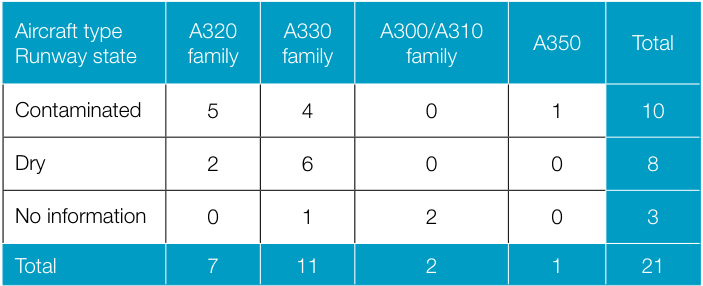
Section titled “Lessons from in-service events”Some possible preconceived ideas are experience or the type of aircraft. Let’s dismissed by facts especially concerning review the 21 events reported to Airbus the runway contamination, the pilot’s over the past 10 years in figures:
PROCEDURES
Section titled “PROCEDURES”Any runway excursion, as smooth as it may seem, requires the aircraft to be checked prior to the next flight.
Beyond these two dimensions, a thorough analysis of the events shows that the runway surface quality is also an important parameter. Indeed, a degraded or damaged runway surface may have as much influence on the performance of a U-turn as a contaminated runway.
As for the pilot’s background, it turns out that it was extremely variable from one event to the other. In other words, a runway excursion when performing a U-turn on a runway is not the preserve of the least experienced pilots…
Reporting: the most precious input to enhancing safety
Section titled “Reporting: the most precious input to enhancing safety”To ensure the aircraft integrity for the next flight, to allow safety lessons to be learnt and to be able to take appropriate mitigation measures from analyzing all events of similar nature, all runway excursion events need to be reported.
In one surprising event, although the crew had experienced a runway excursion, they realigned the aircraft and took off. Damage on the gear was observed at arrival. Even at low speed, a runway excursion can damage the aircraft in a way that can affect the safety of the following flights. Any runway excursion, as smooth as it may seem, requires the aircraft to be checked prior to the next flight in accordance with the AMM guidelines.
Moreover, to ensure the aircraft integrity for the next flight, to allow safety lessons to be learnt and to be able to take appropriate mitigation measures from analyzing all events of similar nature, all runway excursion events need to be reported.
As of today, the analysis of the events made available to Airbus through reporting allowed us to dismiss possible preconceived ideas, such as: it only occurs to the least experienced pilots or only on contaminated runways or with large aircraft. It also allows us to highlight the key points or parameters that need to be checked before initiating the turn and executing the maneuver, as well as to emphasize the best technique and tips to perform such turns safely.
Eventually, thanks to airlines reporting, the technique available today in the FCOM is going to be revisited and improved as part of the FCTM. Key values relating to the recommended runway width will be kept in the FCOM. These updates will be available by the end of 2016.
TECHNIQUE AND TIPS TO PERFORM A SAFE U-TURN ON THE RUNWAY
Section titled “TECHNIQUE AND TIPS TO PERFORM A SAFE U-TURN ON THE RUNWAY”The analysis of in-service events allowed the technique for U-turns in the FCOM to be revisited. The philosophy of the new revision will align with the existing content and emphasize the key steps of the technique for performing successful and safe U-turns. The technique was initially developed for U-turns on a runway, where there are standard markings at the borders of the runway.
As far as possible, a U-turn on the runway needs to be prepared before arriving on the runway. The preparation includes a discussion on who will be PF and in which direction should the turn be performed in accordance with the airline policy.
Performing a safe U-turn on a runway is not just a matter of managing the turn itself. It starts before initiating the turn…
Performing a safe U-turn on a runway is not just a matter of managing the turn itself. It starts before initiating the turn…
Before initiating the turn
Section titled “Before initiating the turn”Initiating the turn in good conditions relies on a number of complementary
aspects beyond the ones mentioned before.
Suitability of runway width with the conditions of the day
Section titled “Suitability of runway width with the conditions of the day”Performing a safe U-turn on a runway requires anticipating the space required for the safe completion of the maneuver. The minimum runway width for a given aircraft type is provided in the FCOM. However, it is important to keep in mind that this value is based on the following assumptions: the runway is dry, the runway surface quality is good and the technique recommended by Airbus is
used. Therefore, it may be necessary to add some margins if these conditions are not met (e.g. contaminated runway).
In summary, before considering a U-turn on a runway, check that the runway width is sufficient with respect to the minimum published in the FCOM possibly adjusted to the anticipated conditions of the day.
Consider the actual runway surface quality
Section titled “Consider the actual runway surface quality”As previously mentioned, the state of the runway may require the margins provided by the FCOM to be adapted. The maneuver is to be performed with the maximum available steering of the nose wheels and in such a configuration, a poor surface may make the wheels slip and increase the turn radius.
surface. In other instances, pieces of multiple layers of painted surface became detached over time, thus generating depressions likely to retain rain water even though the remainder of the runway had already dried up.
As a consequence, special care must be taken when the trajectory requires taxiing the aircraft over a painted surface. A good friction coefficient experienced while still on the unpainted area is not necessarily representative of the one when on the painted marks. The crew must be ready to reassess the situation if any unexpected skidding during the turn is experienced.
It is important to keep in mind that painted areas such as runway threshold markings can be significantly more slippery than the rest of the runway. Indeed, some investigations highlighted that the repainting of the white strips tended to fill the runway’s textured
The minimum required runway width to carry out a U-turn is based on the following assumptions: a dry runway, a good runway surface and the application of the correct technique.
PROCEDURES
Section titled “PROCEDURES”Control the ground speed and adapt it to the conditions of the day
Section titled “Control the ground speed and adapt it to the conditions of the day”Remaining on the runway while performing a U-turn requires control of the trajectory at all times. This involves before initiating the turn:
Stabilizing the trajectory
Stabilizing the initial trajectory before the turn is key in many respects. It allows for:
-
optimization of the point of initiation of the turn
-
compliancy with the assumptions used to determine the minimum runway width required, i.e. the maneuver is properly performed (initial recommended divergence angle)
-
reduction of the number of parameters to be managed during the turn itself.
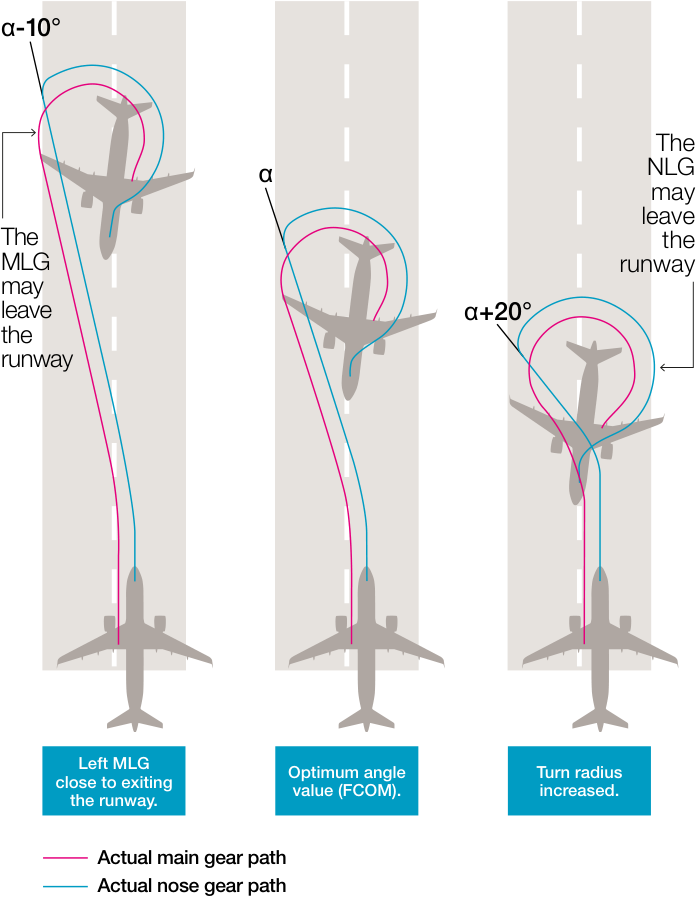
In order to optimize the turn initiation point and the distance required to complete the turn, it is recommended to adopt a divergence angle from the runway axis. The advisable divergence angle varies depending on the aircraft type but it typically ranges between 15° and 25°.
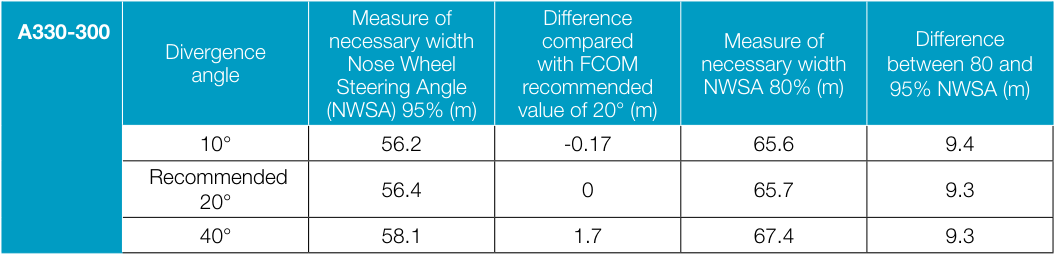
As illustrated in Figure 1, increasing the divergence angle leads to an increase in the turn radius. For example, adopting a divergence angle of 40° instead of the recommended 20° for an A330-300 leads to an increase of about 2 meters. Decreasing the divergence angle by too large an amount would result in the main landing gear possibly exiting the runway at initiation of the turn.
As mentioned earlier, any degradation of the runway state either due to runway surface condition or contamination requires additional precautions and margins. In terms of speed, it is safer to target the lower boundary of the recommended speed window, namely 5 kt, to perform a U-turn on a degraded runway.
BEST PRACTICE
Section titled “BEST PRACTICE”On A300/A310, A330/A340 and A350 families, on dry runways, the use of differential braking to stop one gear (Braked Pivot Turn technique) may induce stress on this gear and could have fatigue effects over time on the gear. Such a technique is therefore not recommended. However, on a wet or contaminated runway, the lower friction coefficient reduces the induced stresses and differential braking, whilst avoiding pivot braking, could help to manage the turn. This recommendation does not apply to A320 family and A380 aircraft, for which the Braked Pivot Turn technique is usually used without adverse effect on the gears.
Performing the turn
Section titled “Performing the turn”During the maneuver, the ground speed is a key parameter to manage: the objective is to maintain a low (5 to 10 kt) but steady ground speed. If too much speed is lost, turning the aircraft will become more diffi cult to manage and it may eventually come to a complete
stop. To avoid stopping, applying some additional thrust may be necessary. However, gaining too much speed could increase the chances of the aircraft exiting the runway. Maintaining a continuous speed before and during the turn is therefore of paramount importance.
Initiating the turn
Section titled “Initiating the turn”For field of view reasons, the turn is recommended to be performed by the crew member sitting on the seat opposite to the direction of the U-turn. This means that to turn right, the fl ight crew member on the left hand side of the cockpit is PF; respectively to turn left, the fl ight crew
member on the right hand side is PF.
The visual reference to initiate the turn depends on the aircraft type. On most Airbus aircraft, the turn is to be initiated when the PF assesses that he/she is physically directly over the runway edge.
PROCEDURES
Section titled “PROCEDURES”Once the PF reaches the appropriate initiation point, he/she needs to progressively use up to full tiller deflection to turn the aircraft.
During this initial maneuver, due to the aircraft inertia the nose wheels are not fully aligned with the aircraft trajectory. This misalignment reduces the grip of the nose wheels onto the runway and may lead the aircraft to skid if the nose wheels are not turned smoothly and
progressively. This is why an aggressive application of full nose wheel steering should not be done.
The speed can be maintained by applying small amounts of asymmetric thrust and keeping idle thrust on the engine on the inside of the turn. As explained before, maintaining a continuous speed is key and after any adjustment to the thrust, the speed must be carefully monitored.
During the turn
Section titled “During the turn”As shown in Figure 1 , if the divergence angle affects the required turning distance, then the steering value is a parameter even more significant. The minimum distance published in the operation documentation considers a full steering order throughout the whole maneuver.
Throughout the turn, the PF is focused on the dynamics of the maneuver. He/ she is looking outside in the direction of the expected aircraft trajectory, and adjusting the aircraft speed accordingly.
The role of the PM is at all times to monitor not only the aircraft trajectory but also the aircraft ground speed and to call out any deviation. The PM can monitor the heading, the ground speed indication as well as the ETACS when available. Indeed, by focusing on the outside, the PF cannot closely monitor these parameters and especially the aircraft ground speed to detect any excursion outside the recommended speed range; therefore, the role of the PM is essential.
Finishing the turn
Section titled “Finishing the turn”At any stage before or during the maneuver, should any problem arise, stop and call the tower to get support from a tug.
In this phase of the turn, the main challenge is to get the aircraft aligned on the centre of the runway without jeopardizing the remaining runway length or the planned take-off distance available.
When the aircraft is aligned with the runway, the tiller is to be released smoothly before stopping the aircraft to make sure that the nose wheel is aligned
with the aircraft and therefore ready to initiate the take-off roll in good conditions.
At any stage before or during the maneuver, should any problem arise, stop and call the tower to get support from a tug. Keep in mind that it is most preferable to call a tractor to finish the maneuver, rather than to recover the aircraft with a landing gear off of the runway.
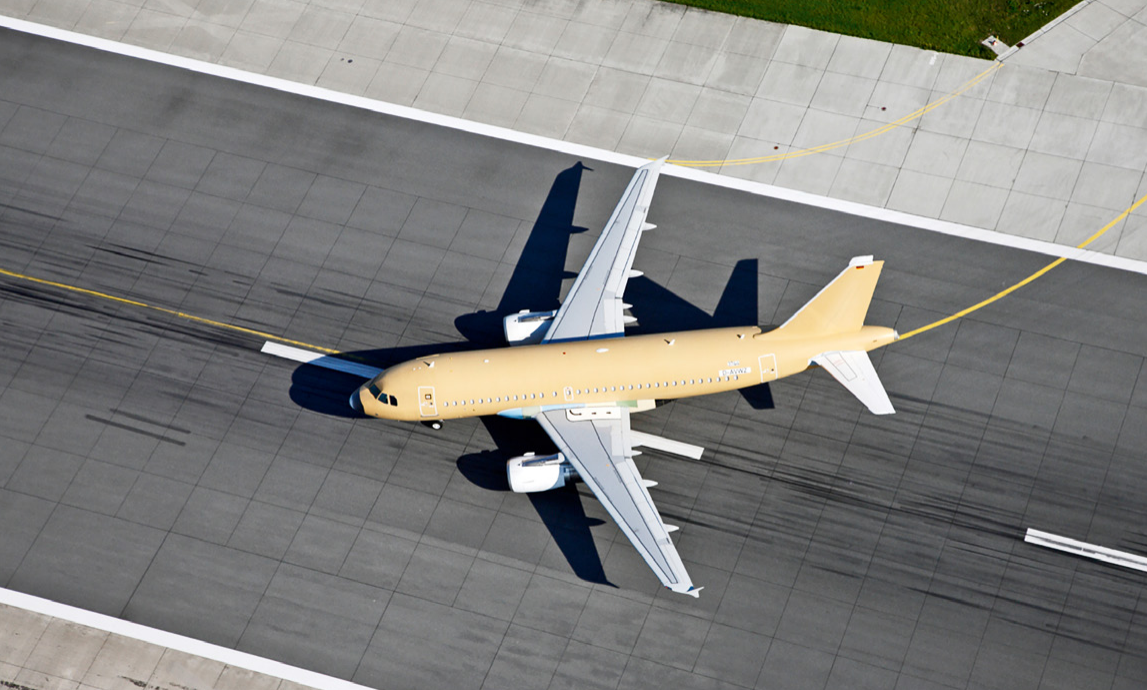

Performing a U-turn on a runway is not an insignificant maneuver. Safely performing it starts with good preparation and a precise initiation of the turn as well as implementing the technique properly at the right speed. Whether it has to be performed before taking-off or at the end of the flight, some key aspects are to be kept in mind:
-
Carefully check the minimum distance published in the operational manual versus the available runway width, keeping in mind that the minimum 180° turning distance published values correspond to a dry runway
-
Pay attention to the runway condition, both surface quality and contamination, as they may induce skid and may increase the turn width. Add reasonable margins accordingly
-
Adapt the speed to the runway condition (within the recommended speed range)
-
In case of a problem at any stage of the overall maneuver, stop the aircraft and call for support
-
Should the crew become aware that the aircraft has left the runway surface, even slightly, report the occurrence and inspect the aircraft before taking-off
Some simple advice to avoid big problems!
Safety first, #22 July, 2016. Safety first is published by Airbus S.A.S. - 1, rond point Maurice Bellonte - 31707 Blagnac Cedex/France. Publisher and Editor: Yannick Malinge, Chief Product Safety Officer. Concept Design by Airbus Multi Media Support 20161577. Reference: GS 420.0045 Issue 22. Photos by Airbus, Lindner Fotografie, T. Denson, S. Ramadier, H. Goussé, P. Masclet, F. Lancelot, M. Lindner, P. Pigeyre.
跑道上180°转弯
来源:Airbus Safety First URL:https://safetyfirst.airbus.com/180-turns-on-runway/ 发布日期:2016-07-29 杂志期号:2016-07 分类:飞行运行、180°转向、冲出、跑道、跑道冲出、滑行、滑行道、转弯、U形转弯 PDF:原文PDF
程序
在跑道上执行180°转弯或U形转弯,与飞行其他阶段相比,似乎是一个普通的机动动作。然而,过去10年的运行经验表明,在完成U形转弯时意外驶出跑道的情况时有发生,即使是经验丰富的飞行员,在任何条件下(包括干燥跑道),以及包括A320系列在内的任何机型上均可能发生。存在一种专门的技术用于执行此类U形转弯,以避免跑道冲出。
STÉPHANE BRIZAY 飞行运行工程师
XAVIER JOLIVET 飞行安全促进总监
跑道上U形转弯:跑道冲出的重要致因
Section titled “跑道上U形转弯:跑道冲出的重要致因”提及航空事故,有谁会自然联想到跑道上的U形转弯?虽然这种关联并非直觉上的认知,但它确实存在。事实表明,大量跑道冲出事故是由于未能正确管理此类机动动作所致。在不到10年的时间里,空客已收到超过20起跑道冲出报告,其中一些事件已引发国际民航组织(ICAO)附件13调查。
除可能造成严重的飞机损坏及检查和修复所需时间外,此类事件的后果主要体现在运营干扰方面。这些事件会导致航班取消、在需要将飞机移回路面时可能需要卸载和放油,还不包括对机场运营的影响,包括可能关闭跑道及其带来的相关安全隐患。由于现代视觉传播的速度之快涉事航空公司往往在品牌形象方面陷入尴尬境地。
近期事件数量的增加可能是由于报告偏差所致,但此问题现已从安全角度引起关注。
通过报告的事件,空客得以分析和理解此类事件的发生条件。
运行事件的教训
Section titled “运行事件的教训”某些可能的固有观念可以通过事实来驳斥,尤其是关于飞行员经验或机型方面的观念。让我们回顾过去10年报告给空客的21起事件的数据:
任何跑道冲出,无论看起来多么平稳,都需要在下一次飞行前对飞机进行检查。
除上述两个维度外,对事件的深入分析表明,跑道表面状况也是一个重要参数。事实上,退化或损坏的跑道表面对U形转弯性能的影响可能与污染跑道一样大。
至于飞行员的背景,调查发现各事件之间差异极大。换言之,在跑道上执行U形转弯时发生跑道冲出并非经验最少的飞行员的“专利”……
报告:增强安全的最宝贵输入
Section titled “报告:增强安全的最宝贵输入”为确保飞机在下一次飞行时的完整性、从安全角度汲取经验教训,并能够通过分析所有同类性质的事件采取适当的缓解措施,所有跑道冲出事件都需要报告。
在一个令人惊讶的事件中,尽管机组经历了跑道冲出,他们仍重新对准飞机并起飞。到达后发现起落架受损。即使在低速情况下,跑道冲出也可能对飞机造成影响后续飞行安全的损坏。任何跑道冲出,无论看起来多么平稳,都需要按照飞机维护手册(AMM)指南在下一次飞行前对飞机进行检查。
此外,为确保飞机在下一次飞行时的完整性、从安全角度汲取经验教训,并能够通过分析所有同类性质的事件采取适当的缓解措施,所有跑道冲出事件都需要报告。
到目前为止,通过报告获得的事件分析使空客能够驳斥可能的固有观念,例如:仅发生在经验最少的飞行员身上,或仅发生在污染跑道上,或仅发生在大型飞机上。分析还使我们能够突出在开始转弯和执行机动动作之前需要检查的关键点或参数,并强调执行此类转弯的安全最佳技术和要点。
最终,得益于航空公司的报告,目前飞行机组操作手册(FCOM)中提供的技术将作为飞行机组培训手册(FCTM)的一部分进行重新审视和改进。与推荐跑道宽度相关的关键数值将保留在飞行机组操作手册(FCOM)中。这些更新将于2016年底前提供。
在跑道上执行安全180°转弯的技术与提示
Section titled “在跑道上执行安全180°转弯的技术与提示”通过对运行事件的分析,能够对FCOM中180°转弯的技术进行重新审视。新修订版的理念将与现有内容保持一致,并强调成功且安全执行180°转弯技术的关键步骤。该技术最初是为在跑道上进行180°转弯而开发的,跑道边缘有标准标线。
尽可能地,在进入跑道之前就需要准备好180°转弯。准备工作包括:讨论谁将担任PF以及根据公司政策应向哪个方向转弯。
在跑道上执行安全的180°转弯不仅仅是管理转弯本身的问题。它在开始转弯之前就已经开始了……
在跑道上执行安全的180°转弯不仅仅是管理转弯本身的问题。它在开始转弯之前就已经开始了……
开始转弯之前
Section titled “开始转弯之前”在良好条件下开始转弯需要依赖除前述内容之外的多个互补方面。
跑道宽度与当日条件的适用性
Section titled “跑道宽度与当日条件的适用性”在跑道上执行安全的180°转弯需要预判完成该机动所需的空间。特定机型所需的最小跑道宽度已在FCOM中提供。但是,重要的是要记住,该数值基于以下假设:跑道干燥、跑道表面质量良好,并使用空客推荐的技术。因此,如果这些条件不满足(例如跑道污染),可能需要增加一些余量。
总之,在考虑在跑道上进行180°转弯之前,应检查跑道宽度相对于FCOM中公布的最小值是否足够,并可能需要根据当日的预期条件进行调整。
考虑实际跑道表面质量
Section titled “考虑实际跑道表面质量”如前所述,跑道状况可能要求对FCOM提供的余量进行适当调整。该机动应使用前轮最大可用转弯角度进行,在此配置下,差的表面可能导致车轮打滑并增加转弯半径。
surface. In other instances, pieces of multiple layers of painted surface became detached over time, thus generating depressions likely to retain rain water even though the remainder of the runway had already dried up.
As a consequence, special care must be taken when the trajectory requires taxiing the aircraft over a painted surface. A good friction coefficient experienced while still on the unpainted area is not necessarily representative of the one when on the painted marks. The crew must be ready to reassess the situation if any unexpected skidding during the turn is experienced.
It is important to keep in mind that painted areas such as runway threshold markings can be significantly more slippery than the rest of the runway. Indeed, some investigations highlighted that the repainting of the white strips tended to fill the runway’s textured
执行180°转弯所需的最小跑道宽度基于以下假设:干燥的跑道、良好的跑道表面以及正确的技术应用。
控制地速并根据当日条件进行调整
Section titled “控制地速并根据当日条件进行调整”在执行180°转弯时保持在跑道上需要始终控制轨迹。这涉及在开始转弯之前:
在转弯前稳定初始轨迹在许多方面都是关键。它允许:
-
优化转弯的起始点
-
符合用于确定所需最小跑道宽度的假设,即该机动正确执行(初始推荐偏出角)
-
减少转弯本身期间需要管理的参数数量。
为了优化转弯起始点和完成转弯所需的距离,建议采用相对于跑道轴线的偏出角。建议的偏出角因机型而异,但通常在15°至25°之间。
如图图1所示,增加偏出角会导致转弯半径增加。例如,对于A330-300,采用40°的偏出角而非推荐的20°会导致转弯半径增加约2米。过度减小偏出角可能导致主起落架在转弯开始时可能越出跑道。
如前所述,无论是由于跑道表面状况还是污染导致的跑道状况恶化都需要额外的预防措施和余量。在速度方面,在恶化的跑道上执行180°转弯时,更安全的做法是将目标速度定在推荐速度窗口的下限,即5节。
在 A300/A310、A330/A340 和 A350 系列机型上,在干燥跑道上使用差动刹车使一个主起落架制动(制动枢轴转弯技术)可能会对该起落架产生应力,长期下来可能对其造成疲劳影响。因此,不推荐使用该技术。然而,在湿或污染跑道上,较低的摩擦系数会降低产生的应力,此时使用差动刹车,同时避免枢轴制动,有助于控制转弯。此建议不适用于 A320 系列和 A380 飞机,其制动枢轴转弯技术通常使用且不会对起落架产生不利影响。
在机动过程中,地速是需要控制的关键参数:目标是保持较低(5 至 10 节)但稳定的地速。如果速度损失过多,转弯将变得更难控制,飞机最终可能会完全停住。为避免停住,可能需要增加一些推力。然而,速度增加过多可能会增加飞机冲出跑道的风险。因此,在转弯前和转弯过程中保持持续速度至关重要。
出于视野原因,建议由坐在转弯方向相反一侧的机组人员执行转弯。这意味着向右转弯时,驾驶舱左侧的飞行机组人员为 PF;相应地,向左转弯时,右侧的飞行机组人员为 PF。
开始转弯的目视参考点因飞机类型而异。在大多数空客飞机上,当 PF 判断自身已完全处于跑道边缘正上方时,即应开始转弯。
一旦 PF 到达适当的起始点,他/她需要逐步使用最大前轮转弯手柄偏转来转弯。
在最初这一机动过程中,由于飞机惯性,前轮并未完全与飞机轨迹对齐。这种不对齐会降低前轮在跑道上的抓地力,如果前轮转弯不平滑、逐步进行,可能导致飞机打滑。因此,不应猛然施加最大前轮转向。
速度可通过施加少量非对称推力并在内侧转弯发动机保持慢车推力来维持。如前所述,保持持续速度是关键,在任何推力调整后,必须仔细监控速度。
如图 1 所示,如果发散角会影响所需的转弯距离,那么转向值则是一个更为重要的参数。操作文件中公布的最小距离是基于在整个机动过程中施加最大转向指令这一前提。
在整个转弯过程中,PF 专注于机动动作的动态特性。他/她目视观察预期飞机轨迹的方向,并相应地调整飞机速度。
PM 的角色始终是不仅监控飞机的轨迹,还要监控飞机的地速,并在出现任何偏差时喊出。PM 可以监控航向、地速指示以及 ETACS(当可用时)。事实上,由于 PF 专注于外部观察,他无法密切监控这些参数,尤其是飞机的地速,以检测是否有超出推荐速度范围的情况;因此,PM 的角色至关重要。
在机动动作之前或期间的任何阶段,如出现问题,应停止并呼叫塔台以获得牵引车支援。
在转弯的这一阶段,主要挑战是在不危及剩余跑道长度或计划可用起飞距离的情况下,使飞机对准跑道中心线。
当飞机对准跑道后,应在停止飞机之前平稳松开转向手轮,以确保前轮已与飞机对齐,从而为以良好条件开始起飞滑跑做好准备。
在机动动作之前或期间的任何阶段,如出现问题,应停止并呼叫塔台以获得牵引车支援。请记住,呼叫牵引车来完成机动动作远比让飞机起落架偏离跑道表面后再进行恢复要好。
在跑道上进行 180° 转弯并非微不足道的机动动作。安全执行这一动作始于充分的准备、精确的转弯启动,以及以适当的速度正确实施技术。无论是在起飞前还是航班结束时执行,以下关键要点必须牢记:
-
仔细核对操作手册中公布的最小距离与可用跑道宽度的关系,牢记公布的最小 180° 转弯距离对应的条件为干燥跑道
-
注意跑道状况,包括表面质量和道面污染,因为它们可能导致打滑并增加转弯宽度。相应地增加合理的余量
-
根据跑道状况调整速度(在推荐速度范围内)
-
如果在整个机动动作的任何阶段出现问题,停止飞机并请求支援
-
如果机组意识到飞机已离开跑道表面,即使只是轻微偏离,也应报告事件,并在起飞前检查飞机
一些避免大问题的简单建议!
Safety first, #22 2016 年 7 月。Safety first 由空中客车公司出版 - 1, rond point Maurice Bellonte - 31707 Blagnac Cedex/France。出版人和编辑:Yannick Malinge,产品安全总监。概念设计由空中客车多媒体支持 20161577。参考编号:GS 420.0045 第 22 期。照片由空中客车、Lindner Fotografie、T. Denson、S. Ramadier、H. Goussé、P. Masclet、F. Lancelot、M. Lindner、P. Pigeyre 提供。