Facing the Reality of Everyday Maintenance Operations
Source: Airbus Safety First URL: https://safetyfirst.airbus.com/facing-the-reality-of-everyday-maintenance-operations/ Published: 2012-01-14 Magazine Issue: 2012-01 Category: Archive PDF: Original PDF
Safety
uwe EGGErLING
Section titled “uwe EGGErLING”Safety Director Engineering & Maintenance Customer Services
The aviation maintenance environment is a challenging working place. Mechanics work in physically demanding conditions, such as high above the ground in the aircraft structure, or in small confined surroundings. They can be exposed to high or low temperatures, and to demanding shift work.
There is an increasing workload and time pressure to get the aircraft back into service as quickly as possible after maintenance. Aircraft maintenance requires mechanics to follow procedures by the letter,
1. Introduction
Section titled “1. Introduction”Most maintenance engineers can remember cases where the use of a wrong, or inappropriate tool, has contributed to difficulties in maintenance operations. In most cases, this has lead to additional incurred costs, but on certain occurrences this has even represented a potential threat for the safety of maintenance personnel.
The absence of reliable statistical figures in how often specific maintenance tools have been involved in maintenance errors can be explained by the fact that there are no specific reporting requirements for
ensure good communication, diagnose and fix problems under time pressure, read and record various data, and continuously adapt to new technologies.
The Safety First magazine will dedicate a number of articles to the field of maintenance.
The objective is to share the lessons learned and experience reported from the Airbus fleet. It will also raise awareness, and provide recommendations for safe maintenance operations.
maintenance events involving tools as being at the origin of the event. The consequences resulting from the use of wrong, or inappropriate tools, are not always immediately evident in terms of aircraft dispatch indicators, and, even when they are, they may not have been reported as the origin of the event.
This article will cover the subject of tooling issues related to engine removal and installation procedures. However, the points raised here are illustrative as well of other maintenance operations.
2. Brief Events description
Section titled “2. Brief Events description”The following two events are representative of a number of similar hazardous engine removal/ installation incidents:
q On the first occurrence, one of the bootstraps failed, causing an engine to drop by a distance of three feet (fig. 1).
q On the second event, an engine fell to the ground during its removal. The forward left chain pulley disengaged while the maintenance team was performing Aircraft Maintenance Manual (AMM) subtask 71-00-00-020-053-A (fig. 2).
The reported problems in the use of the engine tools (the bootstrap), are not related to any one particular Airbus type.The majority of these incidents are the consequence of one, or a combination of the following reasons:
q Use of tools not listed in the AMM, and not approved by Airbus.
q Not using appropriately maintained tools.
q A too high pre-load applied to the tool, which can damage the tool.
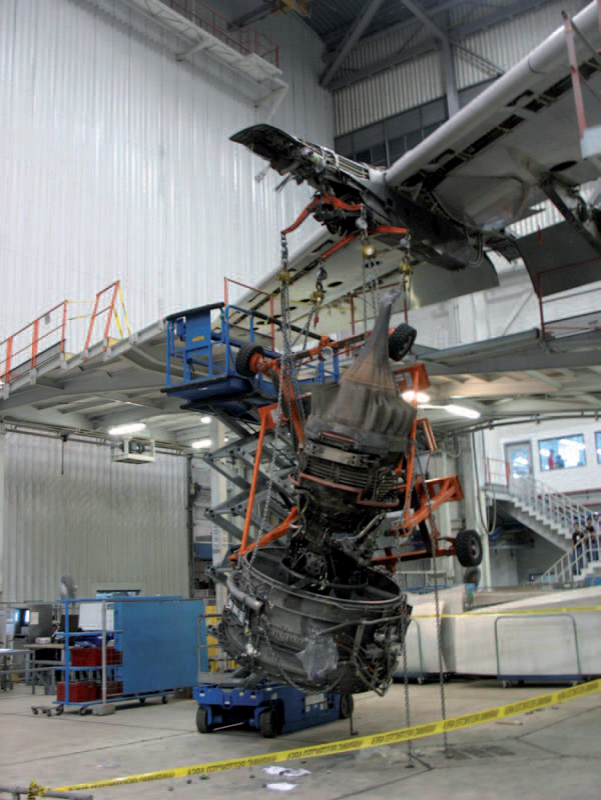
Figure 1 Consequence of failed bootstrap
3. use of Non Approved Aircraft Maintenance Tools
Section titled “3. use of Non Approved Aircraft Maintenance Tools”Depending on the level of the customized maintenance program selected, the investment in the required Ground Support Equipment (GSE) and tools can become significant.
Cheap GSE/tools may be offered from local suppliers, “round the corner”, as substitutes for approved or proprietary tools. These may be copied and manufactured by non- approved suppliers, and may therefore not conform to the Airbus technical specifications.
There have been instances where tools have been made from incomplete, or out-of-date drawings, incorrect material, and/or according to wrong protection processes. As a consequence, it is likely that these tools will not be of the appropriate quality, and not perform their intended function in a safe and satisfactory manner.
Such non-approved tools can be categorized into three main groups:
q Airbus and Supplier/Vendor tools manufactured and distributed by non-licensed companies based on non–controlled drawings.
q Copies of Vendor proprietary tools bearing the same part number, but copied from the original by unauthorized companies.
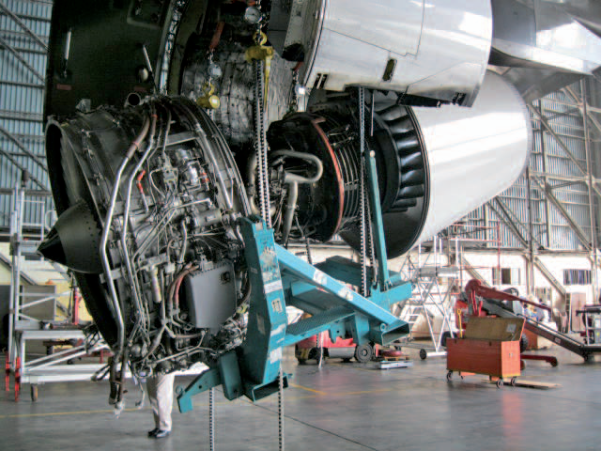
Figure 2 consequence of disengaged chain pulley
q “Alternate” tool design sold as so-called “equivalents”. These tools have a part number different to the one given in the manufacturer’s documentation.
Use of any of the above types of non-approved tools for maintenance could lead to aircraft or component damage and/or personnel injury. If non-approved tools are used, the test result may not reflect that of the approved tool.
Airbus therefore recommends that Airlines and Maintenance Centers use only the specific tools called for in the Airbus and/or Vendor documentation, and that users ensure that they are built by the approved manufacturer.
Safety
4. Non Appropriately Maintained Tools
Section titled “4. Non Appropriately Maintained Tools”Some GSE/tool devices require regular maintenance to be performed, as specified by the GSE/ tool manufacturer. Adherence to the GSE/tool maintenance instructions will contribute to a failurefree operation, and reduce the risk of personnel injuries.
As an example, let us consider the bootstrap (fig. 3). It consists of two main parts:
q The bootstrap structure, which is the interface between the pylon and the lifting device. This structure has to be periodically inspected and tested. A visual inspection should be done at each tool use. If any cracks or impacts are identified, the tool should not be further used.
Periodical tests consist of applying a load to the structure (125% of the Working Load Limit for Airbus tooling). Measurements are taken before and after the test, and should provide the same result. If the load test provides different results, the tool is damaged and should be discarded.
q The lifting device (chain hoist), which is the interface between the structure and the assembly to lift (the engine cradle). The lifting device is a device available on the market. The suppliers of the lifting device specify the maintenance recommendations to be applied. Typically, a visual inspection should be done every time the tool is used, and the friction brakes should be inspected at specified intervals.
Investigations of several cases of engine drops have determined that the hoist maintenance had never been done, and that the braking system was either damaged or showed presence of oil.
The engine installation procedure with the bootstrap system consists of two main phases:
q The lifting phase is the operation dedicated to lift up the engine from the ground to the pylon. This phase stops when the engine mounts start to enter in the pylon shear pins.
q The approaching phase is the operation dedicated to engage the pylon shear pins in the engine mount and to have contact between engine mount and the pylon.
The bootstrap system is equipped with needle dynamometers (fig. 4) indicating the applied loads.The approaching phase is sensitive because the technicians have to continuously monitor the loads applied on the bootstrap system. Several mechanics, working as a unit, are required to perform this operation. They have to ensure proper communication amongst the team in
order to ensure a balanced bootstrap movement and an adequate load monitoring at all times. An overload may cause a life threatening structural failure of the bootstrap.
Safety
6. Electric Bootstrap Tool
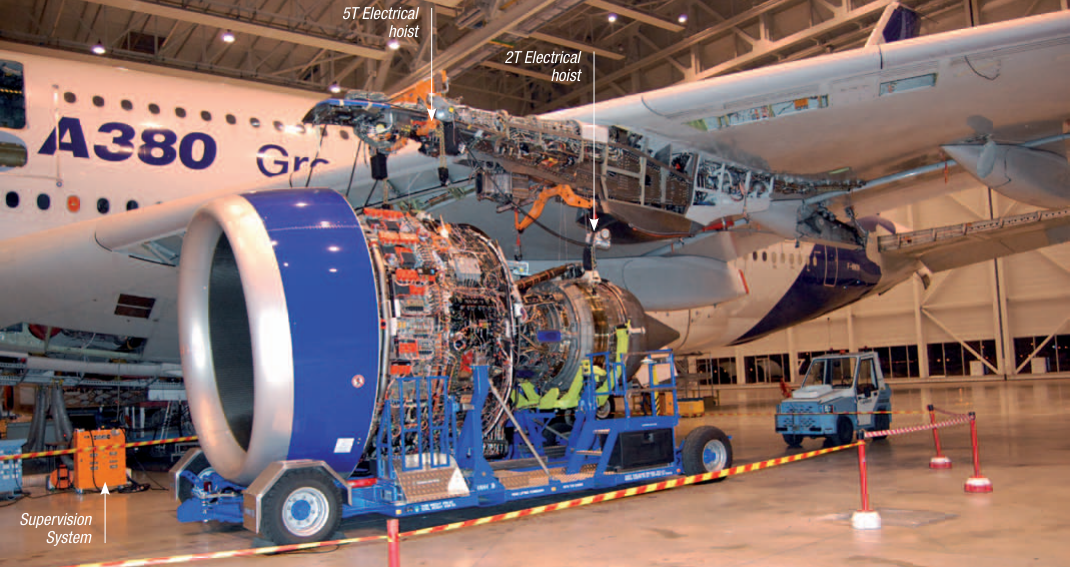
Section titled “6. Electric Bootstrap Tool”In addition to the standard tool required by the AMM, Airbus has developed a new “electrical bootstrap” tool (fig. 5).
It offers a number of enhancements, including easier handling and improved load monitoring, and requires less mechanics. It is therefore safer to operate.
The main features of this new GSE are:
q Wireless electrical hoists
q Integrated dynamometers q A load supervision system.
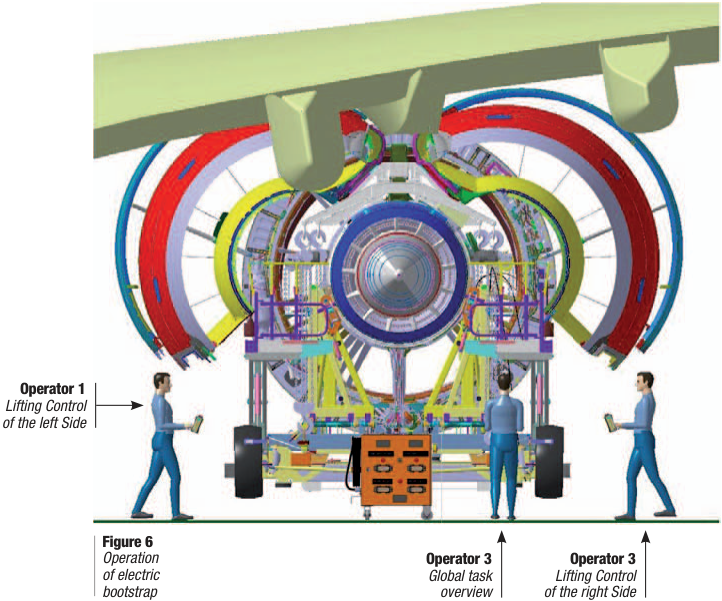
The lifting control achieved for the right and left hand side, as well as for the forward and aft hoists is performed by remote control devices (fig. 6) , which include integrated load control displays. A warning system prevents any risks of overload.
7. cONcLuSION
Section titled “7. cONcLuSION”The use of non approved, non appropriately maintained or improperly used aircraft maintenance tools represent safety hazards that need to be properly addressed.
Airbus therefore recommends to:
q Use only GSE/tools specified in the Airbus and/or Vendor documentation and to ensure that they are built by the approved manufacturer.
q Adhere to the GSE/tool manufacturers maintenance instructions. q Closely follow the procedures described in the Aircraft Maintenance Manual.
references
Section titled “references”|---|---|---|
Safety
Source: Airbus Safety First URL: https://safetyfirst.airbus.com/facing-the-reality-of-everyday-maintenance-operations/ Published: 2012-01-14 Magazine Issue: 2012-01 Category: Archive PDF: Original PDF
安全
Uwe Eggeling
Section titled “Uwe Eggeling”工程与维护客户服务中心安全总监
航空维护环境是一个充满挑战的工作场所。机械师在体力要求很高的条件下工作,例如在飞机结构的高处作业,或在狭小的受限空间内工作。他们可能暴露于高温或低温环境中,以及高要求的轮班工作。
维护后飞机尽快恢复服役的工作量和时间压力越来越大。飞机维护要求机械师一丝不苟地遵循程序,确保良好的沟通,在时间压力下诊断和排除故障,读取和记录各种数据,并持续适应新技术。
《Safety First》杂志将推出一系列关于维护领域的文章。
目标是分享空客机队的经验教训和经验报告。它还将提高认识,并为安全维护作业提供建议。
大多数维护工程师都能回忆起使用错误或不适当工具导致维护作业困难的案例。在大多数情况下,这导致了额外的成本增加,但在某些情况下,甚至对维护人员的安全构成了潜在威胁。
关于特定维护工具卷入维护错误的频率,目前缺乏可靠的统计数据,其原因在于对于涉及工具的维护事件作为事件起因,目前没有具体的报告要求。
使用错误或不适当工具的后果并不总是在飞机放行指标中立即显现,即使有所显现,也可能未被报告为事件的起因。
本文将讨论与发动机拆装程序相关的工具问题。然而,这里提出的观点同样适用于其他维护作业。
2. 事件简要描述
Section titled “2. 事件简要描述”以下两个事件是类似危险发动机拆装事故的典型案例:
q 在第一起事件中,其中一个张紧装置(bootstrap)失效,导致发动机坠落了三英尺(图1)。
q 在第二起事件中,发动机在拆卸过程中坠地。维护团队执行《 aircraft maintenance manual》(AMM)子任务 71-00-00-020-053-A 时,左前链轮脱开(图2)。
关于发动机工具(张紧装置)使用中报告的问题,与任何特定空客机型无关。大多数此类事件是以下一个或多个原因共同作用的结果:
q 使用了 AMM 中未列出且未经空客批准的工具。
q 未使用经过适当维护的工具。
q 对工具施加了过高的预载,可能损坏工具。
图1 张紧装置失效的后果
3. 使用未经批准的飞机维护工具
Section titled “3. 使用未经批准的飞机维护工具”根据所选择的定制维护计划级别,对所需地面支援设备(GSE)和工具的投资可能相当可观。
廉价的 GSE/工具可能来自当地供应商,就在”街角”,作为经批准或专有工具的替代品。这些可能是从未经批准的供应商那里复制和制造的,因此可能不符合空客的技术规范。
曾有过这样的情况:工具是根据不完整或过时的图纸、使用错误的材料和/或按照错误的防护工艺制造的。因此,这些工具很可能不具备适当的质量,无法以安全且令人满意的方式执行其预期功能。
此类未经批准的工具可分为三大类:
q 空客及供应商/厂商工具:由未经许可的公司基于非受控图纸制造和分销。
q 供应商专有工具的仿制品:带有相同件号,但由未经授权的公司仿制原始工具。
图2 链轮脱开的后果
q 作为所谓”等效”工具出售的”替代”设计。这些工具的件号与制造商文件中给出的件号不同。
使用上述任何类型的未经批准工具进行维护都可能导致飞机或部件损坏和/或人员伤害。如果使用了未经批准的工具,测试结果可能无法反映经批准工具的性能。
因此,空客建议航空公司和维护中心仅使用空客和/或供应商文件中规定的特定工具,并确保用户从经批准的制造商处采购。
安全
4. 未适当维护的工具
Section titled “4. 未适当维护的工具”某些 GSE/工具装置需要按照 GSE/工具制造商的规定进行定期维护。遵守 GSE/工具维护说明将有助于实现无故障运行,并降低人员受伤风险。
以 bootstrap 为例(图 3),它由两个主要部分组成:
q bootstrap 结构,这是挂架与吊装设备之间的接口。该结构必须定期检查和测试。每次使用工具时应进行目视检查。如果发现任何裂纹或撞击痕迹,应停止使用该工具。
定期测试包括对结构施加负载(空客工具的工作负载限制的 125%)。在测试前后分别进行测量,结果应保持一致。如果负载测试结果不一致,则表明工具已损坏,应予报废。
q 吊装设备(链条葫芦),这是结构与待吊装组件(发动机支架)之间的接口。吊装设备是一种市售装置。吊装设备供应商会指定应执行的维护建议。通常,每次使用工具时应进行目视检查,摩擦制动器应在规定间隔进行检查。
对多起发动机掉落事件的调查表明,葫芦从未进行过维护,制动系统要么已损坏,要么存在油污。
使用 bootstrap 系统安装发动机的程序包括两个主要阶段:
q 提升阶段是将发动机从地面吊升至挂架的作业。此阶段在发动机支架开始进入挂架剪切销时结束。
q 接近阶段是将挂架剪切销与发动机支架啮合,并使发动机支架与挂架接触的作业。
bootstrap 系统配有指针式测力计(图 4)显示所施加的负载。接近阶段较为敏感,因为技术人员必须持续监控作用于 bootstrap 系统的负载。执行此操作需要多名机械员协同工作。他们必须确保团队之间保持良好的通信,
以确保 bootstrap 运动保持平衡,并在整个过程中进行充分的负载监控。超载可能导致 bootstrap 发生危及生命的结构性故障。
6. 电动 Bootstrap 工具
Section titled “6. 电动 Bootstrap 工具”除了 AMM 规定的标准工具外,空客还开发了一种新的”电动 bootstrap”工具(图 5)。
它提供了多项改进,包括更易于操作和改进的负载监控,并且需要更少的机械员。因此,操作更加安全。
这款新 GSE 的主要特点是:
q 无线电动葫芦
q 集成测力计
q 负载监控系统。
通过遥控装置(图 6)对左右两侧以及前后葫芦的提升控制实现,这些装置包含集成的负载控制显示。警告系统可防止任何超载风险。
使用未经批准、未适当维护或使用不当的飞机维修工具代表了需要妥善解决的安全隐患。
因此,空客建议:
q 仅使用空客和/或供应商文档中指定的 GSE/工具,并确保由经批准的制造商制造。
q 遵守 GSE/工具制造商的维护说明。
q 严格遵循《飞机维护手册》中描述的程序。