Situation awareness and decision making
Source: Airbus Safety First URL: https://safetyfirst.airbus.com/situation-awareness-and-decision-making/ Published: 2010-08-14 Magazine Issue: 2010-08 Category: Archive PDF: Original PDF
Safety
dr. Claire pELEGRIN
Section titled “dr. Claire pELEGRIN”Director Human Factors Product Safety
1. Introduction
Section titled “1. Introduction”An A320 crew reported an in-flight problem with the elevators and decided to divert. The ensuing captain’s report described precisely their analysis of the situation, decision process, actions, and how the decision to divert was ultimately reached.
Surprisingly, however, subsequent read-out of the Post Flight Report and decoding of the DFDR contradicted the crew and indicated that the ECAM had displayed an aileron fault warning and nothing about the elevators.
In this event, the crew wrongly interpreted the ECAM message for some reason that may be explained by a lapse of attention and/or by the fact that they had perceived a slight nose-down tendency during the take-off phase of the flight.
The important point is that, as a consequence of this misperception, the crew’s awareness of the situation was flawed and the ensuing decision process was based on incorrect assumptions. This illustrates how perception is critical in the situation assessment process and thus in decision making.
This article will describe why, when faced with a challenge, situation awareness is crucial in implementing the appropriate actions. It will as well explain how situation awareness may lead to either the application of an “off the shelve” solution (referred to as mental template) or to a decision making process. The last part of the article will identify some of the main obstructions to sound decision making.
2. Situation awareness
Section titled “2. Situation awareness”Situation awareness implies a clear and up to date understanding of what is going on around us. To help us do so we use mental templates that are the product of our experience and which will be triggered in specific situations.
Pilots are educated and trained to use their experience to recognize the situation as an instance of a familiar type (a “typical situation”). Once it has been recognized as ‘that’ type of situation, the pilots can trigger the corresponding mental template.
The chosen mental template incorporates goals and intentions, typical actions, expectations and relevant cues. It pinpoints as well how to monitor the typical expected actions. For example, while “ready for take-off”, the crew’s template contains key parameters and a selected number of potential failures, which are crucial for this phase like:
q Tower clearance, runway length, wind, engine power…
q Engine failure, runway incursion, wheel bursts…
In the elevators/ ailerons confusion case described in the introduction, the main problem was with the assessment of the situation. This illustrates the importance of gathering the information to properly assess the situation, and represents where the crew should put its initial mental effort. The relevant clues should not be missed. An evalua-
tion of the situation should be done to ensure a proper diagnosis.
To ensure a good assessment of the situation, try to think about the situation changing the point of view: “can it be something else?”, “are we missing something?”
If the pilot does not recognize a “typical situation”, he will not be able to trigger the appropriate mental template and suitable actions, but will have to make a decision. The decision is defined with reference to situation awareness. Situation awareness is necessary in maintaining control of the situation and managing the risk assessment.
3. decision making
Section titled “3. decision making”3.1. The decision process
Section titled “3.1. The decision process”We all take many decisions every day. Decision making is the process of selecting a course of action among one or several alternative(s).
Before deciding we should assess the situation, analyze the problem, and then collect the information that will be used in our decision making. The problem must be precisely identified and assessed in the context of a specific situation. The decision should include:
q Clear and organized objectives
q Considered alternative actions
q Anticipated potential consequences If the solution is not reached, the loop starts again.
How safety is taken into account in the decision making process depends on the situation (e.g. flight phases) and the ability to anticipate potential consequences.
To put it simply, the pilot are trained to:
q Perceive the critical information in the environment
q Understand and assess the relevance and the importance of these informations in accordance with his/ her own objectives
q Predict what will happen next
q Adjust accordingly if possible.
In the cockpit, decisions have the following characteristics:
q They are intimately related to the evaluation of the situation
q They are “good” only if they may be applied with the appropriate knowledge and skills
q They have a limited life span: due to the dynamics of the situation, a decision is “good” only for a defined amount of time
q They cannot always been split from actions. Sometimes it is the possible actions which lead and orient the decision (e.g. Go Around, TCAS…). In aviation, every decision may have a major impact due to:
q The dynamics of the situation
q The interconnection of information
q The irreversibility of some crew actions (no “undo”!).
3.2. Mental simulation
Section titled “3.2. Mental simulation”Mental simulation is a conscious process that will allow choosing one option by evaluating consequences.
In case of a diversion (i.e. pax medical emergency or engine problems), the crew needs to decide if it is best to return to the original airport, to continue as planned, to land at the nearest suitable airport…? In this case there is no doubt on what has happened. The situation is clearly identified and assessed. Here the crew really needs to
decisions based on mental simulation
Section titled “decisions based on mental simulation”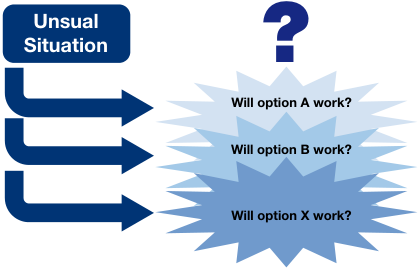
The following traps may seriously impair this mental simulation:
q The crew can choose an option that is poor or inappropriate: for example the crew can decide something, which is perceived as a “best solution” and then realize that they cannot implement it
q The crew can choose and accept the first alternative that might work without going through the complete mental simulation process and this may lead to a premature termination of evidence search.
Not only is the decision important, but the decision follow-up as well because sometimes the situation may evolve quickly and differently from what was expected.
Tips to improve the mental simulation: q Try to widen the range of options q Question the capabilities (can you make it, individually and as a crew) q Look for negative evidence:”Is there anything telling us we are wrong?”
q Decision follow up: watch how the situation evolves and be ready to adapt your decision or strategy accordingly.
3.3. Time pressure
Section titled “3.3. Time pressure”When assessing the situation, time pressure is important, as flying is a dynamic process. A trap when attention is focused is to loose time consciousness: thus pilots may believe they have plenty of time to think and evaluate the situation.
Under pressure, fewer options are envisaged and the evaluation of each option is limited. It is why often the first acceptable solution is taken.
Example of the Hudson accident: (extract from the NTSB report)
“ About one minute after the bird strike, it was evident to the flight crew that landing at an airport may not be an option. The captain indicated that, because of time constraints, they could not discuss every part of the decision process; therefore they had to listen to and observe each other. The captain further stated that they did not have time to consult all written guidance or complete the appropriate check-list, so he and the first officer had to work almost intuitively in a very closed-knit fashion. ”
In this event, the crew had to take an irreversible decision. In similar circumstances, some pilots may have been paralyzed or blocked by the analysis and the important stress experienced at that time.
Tips to manage the time pressure: q Fix a decision deadline q Stabilize the situation q Assess time factors (fuel!), be aware of the available time q Prioritize q Manage workload and use all resources q Do not forget to fly the aircraft.
3.4. decision aids
Section titled “3.4. decision aids”Procedures are tools to support decision making because they provide to the crew:
-
q Element of diagnosis
-
q Actions to perform
-
q Elements/ conditions to control.
Safety
Aircraft systems also support decision making by giving information for situation assessment and decision. The ECAM for example, which is based on a need to see concept, will provide the check lists and status of the aircraft for all anomalies detected by the aircraft systems.
4. Constraints to decision making
Section titled “4. Constraints to decision making”4.1. Level of fatigue, stress, workload and distraction
Section titled “4.1. Level of fatigue, stress, workload and distraction”When pilots are tired, the tendency will be to ignore some information (fixation on a specific item).
Stress will favor “short term” decisions (short benefit decisions) and may be detrimental to the decision process.
When workload is too high, the quality of decision making process deteriorates.
In the Hudson accident, the crew was able to manage their level of stress (resulting from high workload and time pressure) and they avoided the “tunnel vision” created by stress, which narrows the attention. They were also able to face series of aural alerts and many ATC communications, which did not distract them from their action plan.
4.2. personality type
Section titled “4.2. personality type”Personality may also impair the decision:
q Invulnerability: it won’t happen to me!
q Impulsivity: I have to act, to do something!
q Macho: I can do it!
q Anti-authority: don’t tell me!
q Resignation: what will be the interest of doing this?
Even if people cannot change personality, pilots should be aware of their natural trend in order to know their weaknesses and thus manage the decision process accordingly.
4.3. Expertise/ Experience
Section titled “4.3. Expertise/ Experience”Experience plays an important role in situation awareness and in the management of stress:
q An experienced pilot may take inappropriate shortcuts in the decision process
q A less experienced pilot may miss important points and priorities when taking his decision.
4.4. Risk perception
Section titled “4.4. Risk perception”Too deep analysis may be a trap for decision making, for example when the two pilots are head down trying to analyse a situation, thereby forgetting to fly the aircraft.
Pilots tend to favor decisions, which will reduce their perception of risk. The main risk is the feeling of “not being able to do in the available time”. Risk may be underestimated, possibly because a previous similar situation was successfully managed.
4.5. Individual biases
Section titled “4.5. Individual biases”Let’s look at some bias (not an exhaustive list!) which may impact decision making in flight:
q Frequency bias : tendency to over or underestimate the probability of occurrence of a particular event, because our evaluation is based solely on our personal experience
q Conformity bias: tendency to look for data (instrument values, events, etc) that support and confirm our decision rather than information that would contradict it. The confusion between elevators/ ailerons is a typical example
q Familiarity bias: tendency to choose the most familiar solution (linked to our preconceived ideas or to our experience)
q Recency : tendency to pay more attention on the most recent information and ignore the more distant one
q Illusion of control : We tend to believe we have more control on events than we really do. Thus we tend to underestimate future uncertainty. We believe we have control to minimize potential problems in our decisions.
4.6. Group thinking biases
Section titled “4.6. Group thinking biases”Each member may affect the collective decision making process. The crew should have the same information to build collective situational awareness and check for a common understanding and agree on goals:
q Authority bias: tendency to agree with the opinion held by the captain because of rank; and for the captain not to listen to the copilot’s inputs (thinking he/she is the boss)
q Group conformity or group think bias: tendency to agree with opinions held by the majority. In a two crewmembers cockpit, this will be similar to the authority bias.
q Source credibility bias: tendency to reject something from a person that we do not like or on whose abilities we have preconceived ideas.
5. Conclusion
Section titled “5. Conclusion”Situation awareness is key to implementing the appropriate action plan. It calls for the performance of a real, timely and complete assessment of the environment. It then serves as the basis either for the application of a mental template or for the launching of a decision making process.
A decision should include:
q Clear and organized objectives
q Considered alternative actions
q Anticipated potential consequences.
Reaching a good decision is critical but may be a difficult exercise, especially in a dynamic situation. It is therefore important to bear in mind the following two common pitfalls to reaching a sound decision: time pressure and human biases.
When taking a decision:
q Manage the time stress and do not rush into action
q Know yourself and beware of the obstructions to effective decision making.
Safety
情境意识与决策
Section titled “情境意识与决策”Dr. Claire PELEGRIN
人因产品安全总监
一架A320机组报告了飞行中升降舵出现问题并决定备降。机长随后的报告精确描述了他们对情况的分析、决策过程、所采取的行动,以及最终如何做出备降决定。
然而,出乎意料的是,随后读取的飞行后报告和DFDR译码与机组描述相矛盾,表明ECAM显示的是副翼故障警告,而非关于升降舵的任何信息。
在此次事件中,机组出于某种原因错误地解读了ECAM信息,这可能是因为注意力涣散,和/或因为他们在飞行起飞阶段感觉到轻微的低头趋势。
重点是,由于这种感知错误,机组的情境意识存在缺陷,后续的决策过程是基于错误的假设。这说明感知在情况评估过程中至关重要,进而影响决策。
本文将描述当面对挑战时,情境意识为何对采取适当行动至关重要。还将解释情境意识如何导致应用”现成的”解决方案(称为心理模板)或导致决策过程。文章最后部分将识别影响正确决策的一些主要障碍。
2. 情境意识
Section titled “2. 情境意识”情境意识意味着对我们周围发生的事情有清晰且最新的理解。为帮助我们做到这一点,我们使用心理模板,这些模板是经验的产物,会在特定情况下被触发。
飞行员通过教育和培训学会利用经验将情况识别为某一熟悉类型的实例(“典型情况”)。一旦被识别为”那种”情况,飞行员就可以触发相应的心理模板。
所选择的心理模板包含目标和意图、典型行动、预期和相关线索。它还指明如何监控典型的预期行动。例如,在”起飞准备”时,机组模板包含此阶段的关键参数和一定数量的潜在故障,这些对这一阶段至关重要:
- 塔台许可、跑道长度、风况、发动机功率……
- 发动机失效、跑道侵入、轮胎爆裂……
在引言中描述的升降舵/副翼混淆案例中,主要问题在于情况评估。这说明收集信息以正确评估情况非常重要,这代表机组应该首先投入精力的地方。不应遗漏相关线索。应对情况进行评估以确保正确的诊断。
为确保良好的情况评估,尝试改变视角思考情况:“可能是其他原因吗?""我们遗漏了什么?”
如果飞行员无法识别”典型情况”,他将无法触发适当的心智模板和适当行动,而必须做出决策。决策是相对于情境意识来定义的。情境意识对于保持对情况的控制和进行风险评估管理是必要的。
3.1. 决策过程
Section titled “3.1. 决策过程”我们每天都在做出许多决策。决策是从一个或多个备选方案中选择行动方案的过程。
在决策之前,我们应该评估情况、分析问题,然后收集用于决策的信息。问题必须根据特定情况精确识别和评估。决策应包括:
- 明确且有组织的目标
- 考虑过的备选行动
- 预期的潜在后果
如果未能找到解决方案,循环重新开始。
安全在决策过程中如何被考虑,取决于情况(如飞行阶段)和预见潜在后果的能力。
简而言之,飞行员接受的训练是:
- 感知环境中的关键信息
- 根据他/她的自身目标理解和评估这些信息的相关性和重要性
- 预测接下来会发生什么
- 如有可能,进行相应调整
在驾驶舱中,决策具有以下特征:
- 它们与情况评估密切相关
- 只有在具备适当知识和技能能够执行的情况下,它们才是”好的”
- 它们有有限的有效期:由于情况的动态性,决策只在特定时间段内是”好的”
- 它们不能总是与行动分离。有时是可行的行动引导和决定决策的方向(如复飞、TCAS等)
在航空领域,由于以下原因,每个决策都可能产生重大影响:
- 情况的动态性
- 信息的相互关联性
- 某些机组行动的不可逆性(没有”撤销”功能!)
3.2. 心理模拟
Section titled “3.2. 心理模拟”心理模拟是一个有意识的过程,通过评估后果来选择方案。
在备降情况下(如旅客医疗紧急情况或发动机故障),机组需要决定是返回原机场、按原计划继续飞行,还是在最近的合适机场着陆……?在这种情况下,事件本身没有疑问,情况已明确识别和评估。此时,机组真正需要做的是
基于心理模拟的决策
Section titled “基于心理模拟的决策”
以下陷阱可能会严重损害这种心理模拟:
- 机组可能选择一个不佳或不合适的方案:例如,机组可能决定了一个被认为是“最佳方案”的方案,然后意识到他们无法实施
- 机组可能选择并接受第一个可能可行的替代方案,而不进行完整的心理模拟过程,这可能导致过早终止证据搜索
决策不仅本身重要,决策的后续跟进也很重要,因为有时情况可能迅速演变,且与预期不同。
改善心理模拟的建议:
- 尝试扩大方案选项范围
- 质疑能力(作为个人和机组,你们能做到吗)
- 寻找反面证据:“有什么告诉我们是错误的吗?”
- 决策跟进:观察情况如何演变,并准备好相应地调整决策或策略
3.3. 时间压力
Section titled “3.3. 时间压力”在评估情况时,时间压力很重要,因为飞行是一个动态过程。当注意力集中时,容易陷入的陷阱是失去时间意识:因此飞行员可能认为他们有充足的时间来思考和评估情况。
在压力下,考虑的选项会减少,对每个选项的评估也很有限。这就是为什么通常会采纳第一个可接受的解决方案。
哈德逊河事故案例:(摘自 NTSB 报告)
“在鸟击发生约一分钟后,飞行机组明显意识到在机场着陆可能不是一个选项。机长表示,由于时间限制,他们无法讨论决策过程的每个部分;因此他们必须倾听和观察彼此。机长进一步表示,他们没有时间查阅所有书面指导或完成相应的检查单,所以他们必须以非常紧密的方式几乎凭直觉工作。”
在这起事件中,机组必须做出不可逆转的决策。在类似情况下,一些飞行员可能会被分析过程和当时承受的重要压力所困扰或陷入僵局。
管理时间压力的建议:
- 设定决策截止时间
- 稳定情况
- 评估时间因素(燃油!),注意可用时间
- 确定优先级 -管理工作负荷并利用所有资源
- 不要忘记驾驶飞机
3.4. 决策辅助工具
Section titled “3.4. 决策辅助工具”程序是支持决策的工具,因为它们为机组提供:
- 诊断要素
- 需执行的动作
- 需控制的要素/条件
安全
飞机系统也通过提供用于情况评估和决策的信息来支持决策。例如 ECAM,基于“需要看到”的概念,将为飞机系统检测到的所有异常提供检查单和飞机状态。
4. 决策的约束条件
Section titled “4. 决策的约束条件”4.1. 疲劳、压力、工作负荷和分心程度
Section titled “4.1. 疲劳、压力、工作负荷和分心程度”当飞行员疲劳时,往往会忽视一些信息(对特定项目的注意力固着)。
压力会促使“短期”决策(短期收益决策),可能对决策过程造成不利影响。
当工作负荷过高时,决策过程的质量会下降。
在哈德逊河事故中,机组能够管理自己的压力水平(源于高工作负荷和时间压力),他们避免了压力造成的“隧道视野”——这种视野会缩小注意力范围。他们还能够应对一系列音频警告和大量的 ATC 通信,而不会被这些因素分散对行动计划的注意力。
4.2. 性格类型
Section titled “4.2. 性格类型”性格也可能影响决策:
- “刀枪不入”心态:这种事不会发生在我身上!
- 冲动行事:我必须行动,必须做点什么!
- 大男子气概:我能做到!
- 反权威:别对我说教!
- 听天由命:做这个有什么好处?
即使人们无法改变性格,飞行员也应该意识到自己的自然倾向,以便了解自身的弱点,从而相应地管理决策过程。
4.3. 专业技能/经验
Section titled “4.3. 专业技能/经验”经验在情景意识和压力管理中起着重要作用:
- 经验丰富的飞行员可能在决策过程中采取不恰当的捷径
- 经验较少的飞行员在做出决策时可能遗漏重要的要点和优先级
4.4. 风险感知
Section titled “4.4. 风险感知”过于深入的分析可能成为决策的陷阱,例如当两名飞行员都埋头尝试分析情况时,从而忘记驾驶飞机。
飞行员倾向于选择能减少风险感知的决策。最大的风险是“无法在可用时间内完成”的感觉。风险可能被低估,可能因为之前类似的状况曾被成功处理。
4.5. 个人偏见
Section titled “4.5. 个人偏见”让我们看看一些可能影响飞行中决策的偏见(并非详尽列表!):
- 频率偏见:由于我们的评估完全基于个人经验,容易过度或低估特定事件发生的概率
- 一致性偏见:倾向于寻找支持并证实我们决策的数据(仪表值、事件等),而非可能与之矛盾的信息。升降舵/副翼混淆就是一个典型例子
- 熟悉性偏见:倾向于选择最熟悉的解决方案(与我们先入为主的观念或经验相关)
- 近期效应:倾向于更多地关注最新信息,而忽略较早的信息
- 控制幻觉:我们倾向于相信自己对事件的控制力超出实际。因此我们倾向于低估未来的不确定性。我们相信自己有控制力来最小化决策中的潜在问题
4.6. 群体思维偏见
Section titled “4.6. 群体思维偏见”每个成员都可能影响集体决策过程。机组应拥有相同的信息以建立集体情景意识,并检查是否具有共同理解和对目标达成一致:
- 权威偏见:由于职务级别而倾向于同意机长的意见;以及机长不听从副驾驶意见的倾向(认为自己是老板)
- 群体从众或群体思维偏见:倾向于同意多数人的意见。在双成员驾驶舱中,这与权威偏见类似
- 来源可信度偏见:倾向于拒绝来自我们不喜欢的人或对其能力有先入为主印象的人的信息
情景意识是实施适当行动方案的关键。它要求对环境进行真实、及时和完整的评估。然后它作为应用心理模板或启动决策过程的基础。
决策应包括:
- 明确且有组织的目标
- 考虑替代行动方案
- 预见潜在后果
做出好的决策至关重要,但可能是一项困难的任务,特别是在动态情况下。因此,重要的是记住达到合理决策的两个常见陷阱:时间压力和人类偏见。
做决策时:
- 管理好时间压力,不要仓促行动
- 了解自己,警惕有效决策的障碍