Preventing Tailstrike During Go-around Near the Ground
Source: Airbus Safety First URL: https://safetyfirst.airbus.com/preventing-tailstrike-during-go-around-near-the-ground/ Published: 2024-10-23 Category: Flight Ops, balked landing, go around, landing, pitch, rejected landing, tail strike PDF: Original PDF

The focus of this article is go-around near the ground, sometimes called, “rejected landing”. This follows our previous article: “A Focus on the Landing Flare” article published September 2020 and “A Focus on the Takeoff Rotation” published January 2021. Those articles provided recommendations for avoiding tailstrikes when performing landing flare and takeoff rotation. There is also a higher risk of tailstrike when a go-around is required near the ground. This article provides additional recommendations and observations for flight crews to help them avoid tailstrike events during this phase.
Check the latest version of this article on safetyfrst.airbus.com and on the Safety first app for iOS and Android devices.
CASE STUDY 1
Section titled “CASE STUDY 1”Event Description
Section titled “Event Description”An A320 aircraft was performing an RNAV approach on a day with good weather conditions. The METAR indicated wind with a 10 kt headwind component and a negligible crosswind. The landing was intended to be done in CONF FULL. The VAPP was 137 kt. The First Officer, who was the PF, disconnected the autopilot at 930 ft RA and maintained the autothrust ON. At 500 ft, the approach was stabilized.
Nose down input and wind gradient at 80 ft
Section titled “Nose down input and wind gradient at 80 ft”① At 80 ft RA, the PF applied ⅓of full nose-down input (fig.1). Simultaneously, the wind, which was about 5 kt headwind, suddenly changed to a 3 kt tailwind. The aircraft pitch reduced from +3.5° at 80 ft to ② +2.5° at 40 ft.
Go-around initiation during a light bounce
Section titled “Go-around initiation during a light bounce”From 40 ft RA, the PF started the flare with a progressive nose-up input up to a full nose-up input in the last 10 ft. ③ Thrust levers were retarded to idle at 10 ft RA. The pitch increased from +2.5° up to ④ +9° up at touchdown.
The aircraft slightly bounced while the ground spoilers started to extend, and the PF maintained an average ⅓nose-up input during 2 s. ⑤ The pitch reached +12° when the PF applied TOGA thrust and applied a full nose-up input.
Tailstrike during second touchdown
Section titled “Tailstrike during second touchdown”⑥ The aircraft touched down a second time during the engine spool-up and ground spoilers retraction. A tailstrike occurred with a pitch of +12.7° at a speed of 127 kt (VAPP - 10kt). The PF maintained the full nose-up input for 1 more second. The aircraft speed at that point was 122 kt (VAPP - 15 kt). The PF then partially released the nose-up input to ⅓of full nose-up input. ⑦ The pitch reduced to +11° and the aircraft achieved lift-off when the speed reached 128 kt.
The PF continued the go-around maneuver and performed a successful second approach.
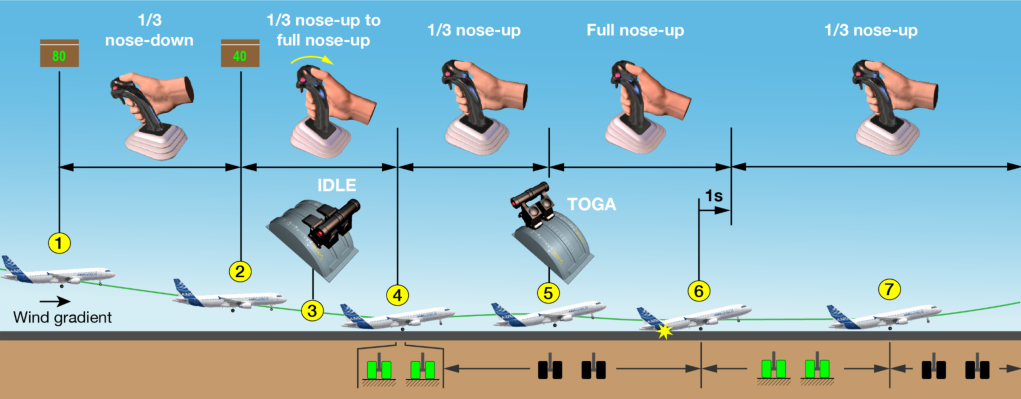
(fig.1) Illustration of the event: Case Study 1
Event Analysis
Section titled “Event Analysis”Light bounce due to high vertical speed and high pitch at touchdown
Section titled “Light bounce due to high vertical speed and high pitch at touchdown”Both the wind gradient and PF input at 80 ft RA created a lift reduction that led the aircraft vertical speed to increase to -800 ft/min at 40 ft RA. The flare reduced the vertical speed, which was still -350 ft/min at the first touchdown. The energy returned through the main landing gear shock absorbers, combined with the lift provided by the high pitch at touchdown (+9°), caused the aircraft to bounce.
Continuous nose-up input during the bounce and full backstick input at the initiation of the go-around near the ground caused the tailstrike
Section titled “Continuous nose-up input during the bounce and full backstick input at the initiation of the go-around near the ground caused the tailstrike”The ground spoilers extension during the bounce reduced the lift, and caused the second touchdown. The continuous nose-up input of the PF after the first touchdown, in addition to the full nose-up input when TOGA was selected, led to the pitch increase from +9° to +12.7°, which caused the tailstrike on the second touchdown.
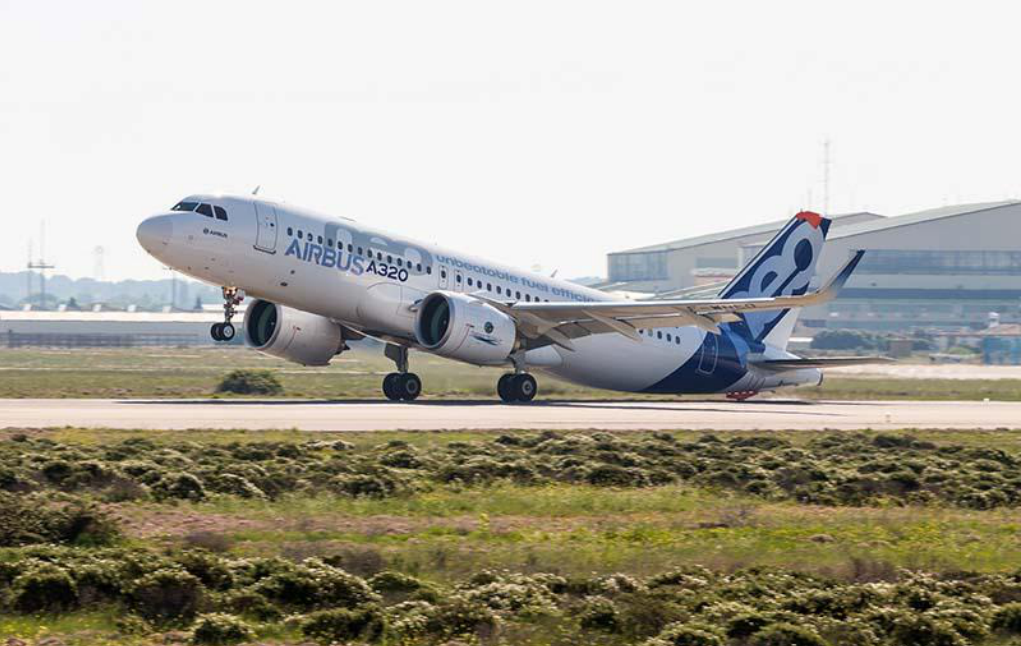
Image (above): A320 aircraft with a specific tail bumper fitted to protect the fuselage when performing Velocity Minimum Unstick (VMU) test
CASE STUDY 2
Section titled “CASE STUDY 2”Event Description
Section titled “Event Description”An A330 aircraft was performing an ILS approach with good visibility, but in gusty wind conditions. The intended landing configuration was CONF FULL.
The approach was stabilized at 500 ft RA. The First Officer, who was PF, disconnected the autopilot and kept the autothrust ON. The VAPP was 139 kt.
① From 90 ft RA, the PF alternated nose-down and nose-up inputs, leading to a nose-down tendency. The pitch reduced from +5.5° to ② +2.5° at 30 ft. The flare was initiated at 30 ft by application of a close to full nose-up input, which was partially released and then followed by another full nose-up input just prior to touchdown. ③ The thrust levers were retarded to IDLE simultaneously at the point of the hard touchdown. The pitch was +7° and the speed was 135 kt (VAPP - 4 kt) decreasing.
The PF maintained ½ full nose-up input for 2s and then ④ set the thrust levers to the TOGA detent combined with a full nose-up input. The Captain simultaneously applied ⅓nose down input briefly, which led to a “DUAL INPUT” callout. The engines began spool up to TOGA thrust, but the speed was still decreasing and the pitch increasing due to the full nose-up inputs applied by the PF. ⑤ A tailstrike occurred and the pitch reached 10.9° at a speed of 116 kt (VAPP - 23 kt).
⑥ The aircraft then accelerated and lift-off was achieved at around 130 kt. The PF continued the go-around maneuver and performed a successful second approach.
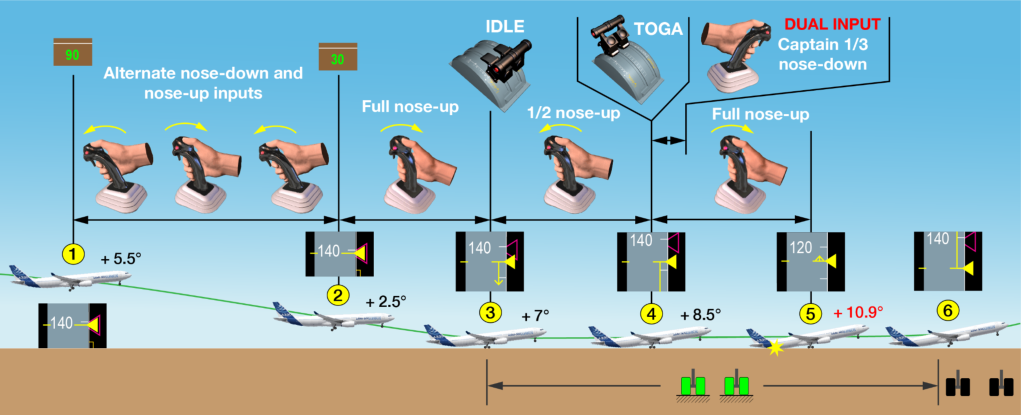
(fig.2) Illustration of the event: Case Study 2
Event Analysis
Section titled “Event Analysis”Hard landing caused by a nose-down tendency at 30 ft and a late flare
Section titled “Hard landing caused by a nose-down tendency at 30 ft and a late flare”The alternate nose-up and nose-down inputs, between 90 ft and 30 ft, led to a vertical speed increase from -550 ft/min at 90 ft up to -850 ft/min at 30 ft when the PF started the flare. This late flare, combined with the high vertical speed, led to the hard landing.
Continuous nose-up inputs after touchdown and full backstick order at low speed led to the tailstrike
Section titled “Continuous nose-up inputs after touchdown and full backstick order at low speed led to the tailstrike”The PF maintained a nose-up input after touchdown, leading the pitch to increase from 7° to 8.5° when the go-around was initiated. The PF then applied full nose-up input simultaneously with the TOGA thrust selection while the aircraft speed was as low as 116 kt (VAPP -23 kt). This led to the tailstrike.
Dual input
Section titled “Dual input”The brief nose-down input performed by the Captain, without pressing the sidestick priority pushbutton when the go-around was initiated, was not sufficient to counteract the full nose-up demand by the First Officer.
OPERATIONAL CONSIDERATIONS
Section titled “OPERATIONAL CONSIDERATIONS”Between January 2022 and September 2024, 49 tailstrike events were reported to Airbus with 5 (10 %) during takeoff, 23 (47 %) during landing and 21 (43 %) during a go-around near the ground (fig.3).
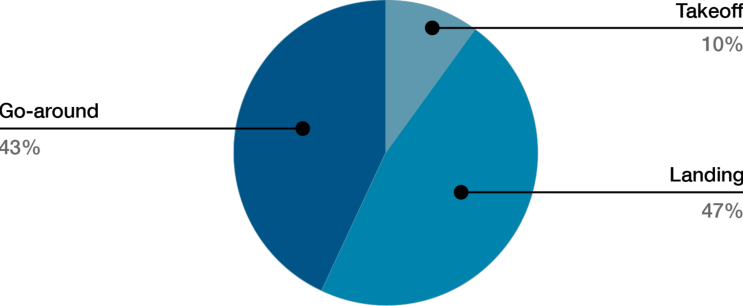
(fig.3) Percentage of tailstrike events per flight phase
For more information on tailstrike prevention during takeoff and landing, refer to the “A Focus on the Landing Flare” article published in September 2020, and “A Focus on the Takeof Rotation” published later in January 2021.
Performing a Safe Go-around Near the Ground
Section titled “Performing a Safe Go-around Near the Ground”The PF and the PM must carefully monitor the pitch during the maneuver
Section titled “The PF and the PM must carefully monitor the pitch during the maneuver”When going around close to the ground, both the PF and the PM must carefully monitor the pitch during the maneuver. The PM must make the “PITCH” callout when the pitch reaches the value provided in the standard callout chapter of the SOP.
Avoid high rotation rate
Section titled “Avoid high rotation rate”The application of full back stick by the flight crew was reported in many of the tailstrikes during go-around near to the ground events. This was a common contributor to these events as this action led to a high rate of rotation.
When performing a go-around near the ground, the PF and PM must monitor the pitch and the PF must avoid excessive nose-up input (fig.4).
Retract flaps and landing gear only when safely established into the go-around
Section titled “Retract flaps and landing gear only when safely established into the go-around”During a go-around near the ground, the flight crew must delay the flaps and landing gear retraction until the aircraft is established on its go-around trajectory (fig.4). Delaying the flaps retraction prevents the need for higher pitch in the early stage of the maneuver, when the aircraft is closer to the ground.
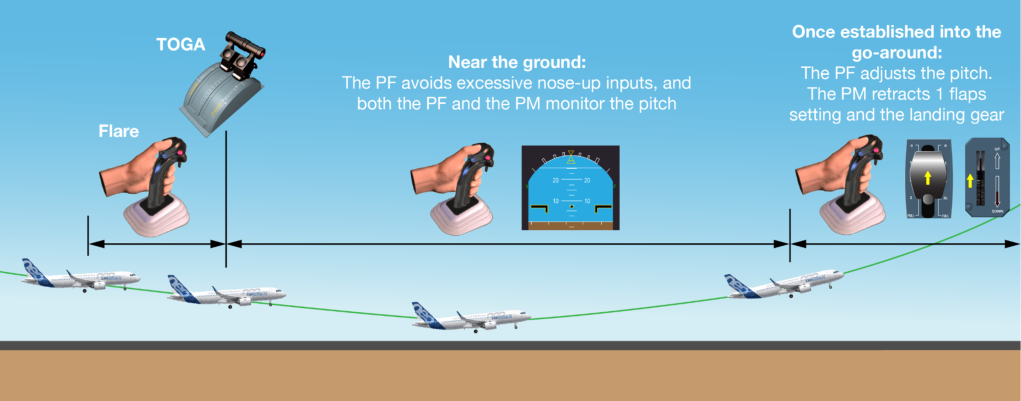
- (fig.4) Management of a go-around near the ground
Landing gear contact with the ground may happen
Section titled “Landing gear contact with the ground may happen”If the go-around is initiated when the aircraft is very close to the ground, the landing gear may contact the runway. The PF should not try to avoid this contact by further increasing the pitch.
Manage the energy of the aircraft
Section titled “Manage the energy of the aircraft”In many reported cases of tailstrike during go-around, the high nose-up demand applied when the aircraft was on ground, and at low speed, led to the tailstrike.
If engines are at idle when the go-around is initiated, they can take a few seconds to spool up. The flight crew should wait until the aircraft speed reaches at least VAPP to rotate the aircraft (fig.5).
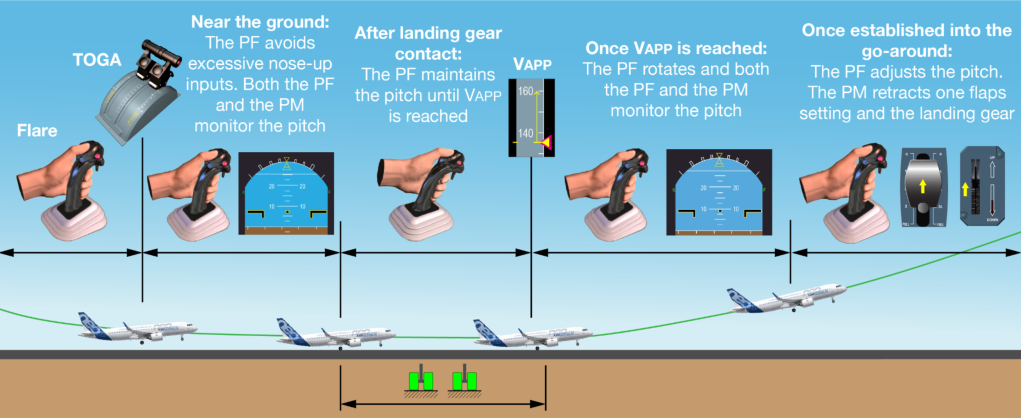
(fig.5) Management of energy after landing gear contact
Don’t try to avoid a second touchdown in the case of a go-around initiated during a bounce
Section titled “Don’t try to avoid a second touchdown in the case of a go-around initiated during a bounce”If a go-around is initiated during a bounce, the PF should maintain the pitch, allowing a potential second touchdown to happen. Then the PF can further adjust the pitch, ask the PM to retract one flap setting and retract the landing gear when the aircraft is established on its go-around trajectory (fig.6).
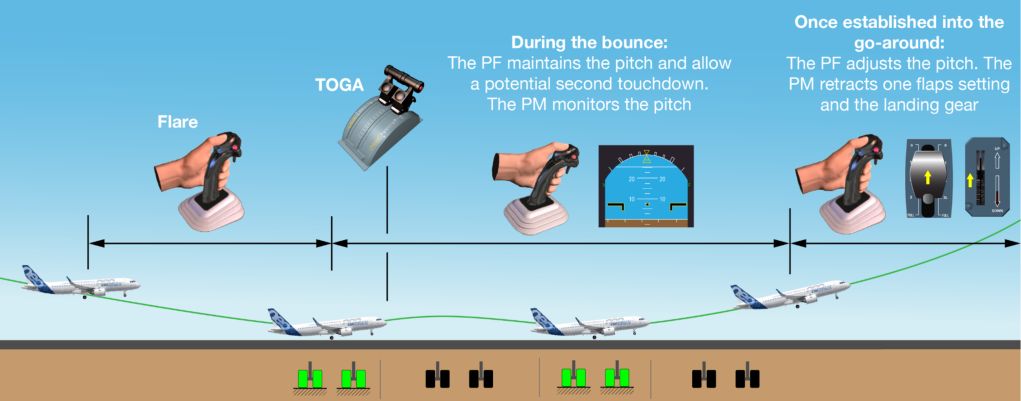
- (fig.6) Management of a bounce during go-around
Only one flight crew flies at a time
Section titled “Only one flight crew flies at a time”Case study 2 shows that the PM may intend to take control in such dynamic situations. As per the FCTM chapter about the use of sidestick: only one flight crew flies at a time. If the PM intends to apply inputs using the sidestick, they must do the following actions:
-
Clearly announce “ I have control ”
-
Press and maintain the sidestick priority pushbutton in order to get full control of the Fly-By-Wire system.
The flight crew should keep in mind that sidestick inputs are algebraically added and the “ DUAL INPUT ” alert triggers if the priority pushbutton is not pressed and maintained.
In case study 2, the dual input of the PM on the Captain’s sidestick did not prevent the tailstrike. In other reported cases, the dual input from the PM in the same direction as the PF increased the inputs up to an equivalent of full nose-up, and the resulting increased rate of rotation contributed to the tailstrike.
Thrust reversers selection means full stop
Section titled “Thrust reversers selection means full stop”It is important to recall the SOP that states the flight crew must not initiate a go-around once the reversers have been selected.
In several tailstrike events reported to Airbus, the go-around was initiated after the reversers selection. This contributed to the tailstrike due to the reduction of the aircraft speed before the go-around was initiated. The time taken for the thrust reversers to retract and lock also causes a delay of the engine spool-up to TOGA.
For more information, refer to the “Thrust Reverser Selection is a Decision to Stop” article published in June 2023.
TRAINING CONSIDERATION
Section titled “TRAINING CONSIDERATION”The Airbus Flight Crew Training Standards Manual (FCTS) recommends to train go-around near the ground in a simulator.
To create surprise effect and to have training conditions close to the conditions observed during in-service events, the instructor should order the go-around once thrust levers are set in idle position during the flare initiation.
For more information on the management of go-arounds, including go-arounds near the ground, refer to the “Go-around: Some threats and mitigations” video available on the Airbus Worldwide Instructor News (WIN) website.
Contributors:
Section titled “Contributors:”Bernard BESINET
Section titled “Bernard BESINET”Accident/Incident Investigator Aviation Safety
Hélène CARROLS
Section titled “Hélène CARROLS”Accident/Incident Investigator Aviation Safety
Nicolas GERARD
Section titled “Nicolas GERARD”Flight Controls development Engineer Design Office
Mehieddine KHENNOUSSI
Section titled “Mehieddine KHENNOUSSI”Flight Controls development Engineer Design Office
Maxime LANSONNEUR
Section titled “Maxime LANSONNEUR”Director Safety - Training and Flight Operations Customer Support
Denis MAZARGUIL
Section titled “Denis MAZARGUIL”Handling Quality Activity Product Leader Customer Support
Performing a Go-around near the ground is a very dynamic phase with a risk of tailstrike. If a go-around is initiated, the maneuver must be completed.
To ensure a safe go-around near the ground, the flight crew must avoid application of inputs that lead to a high rate of rotation, retract flaps, and retract the landing gear only when the aircraft is safely established in the go-around maneuver.
If the landing gear is in brief contact with the ground, this is acceptable. The PF should not try to avoid this contact by further increasing the pitch.
If the engines are already at idle when the go-around is initiated and the aircraft energy is low, the flight crew should wait until the aircraft speed reaches at least VAPP to rotate the aircraft.
Do not try to avoid the secondary touchdown in the case of a go-around initiated during a bounce. The PF should maintain the pitch, allowing a potential second touchdown to happen. Then the PF can further adjust the pitch, ask the PM to retract one flap setting and retract the landing gear when the aircraft is established on its go-around trajectory.
In all cases, it is important to recall that the SOP requires that a flight crew must not initiate a go-around once the reversers have been selected.
For further reading about avoiding tail strikes in other phases, you can read “A Focus on the Landing Flare” article published September 2020 and “A Focus on the Takeoff Rotation” published January 2021.
Capt. Gilbert SAVARY
Section titled “Capt. Gilbert SAVARY”Director Flight Operations and Training Standards Customer Support
With thanks to Eric JEANPIERRE from the Product Safety Enhancement team in Aviation Safety
Section titled “With thanks to Eric JEANPIERRE from the Product Safety Enhancement team in Aviation Safety”Safety first, 2024. Safety first is published by Airbus S.A.S. 1, rond point Maurice Bellonte - 31707 Blagnac Cedex/France.
Editor: Yannick Malinge, SVP AViation Safety.
Editorial team: Guillaume Estragnat, Vanessa Sadi, Gwyneth Duggan, Javier Martinez Marina, Tim Roach.
Photos by Airbus.
来源: Airbus Safety First 网址: https://safetyfirst.airbus.com/preventing-tailstrike-during-go-around-near-the-ground/ 发布日期: 2024-10-23 类别: 飞行操作、中止着陆、复飞、着陆、俯仰、中止着陆、擦机尾 PDF: 原始 PDF
本文重点关注低高度复飞,有时也称为“中止着陆”。本文延续了此前发表的文章:2020年9月发布的《聚焦着陆拉平》以及2021年1月发布的《聚焦起飞抬轮》。这些文章为避免在着陆拉平和起飞抬轮时发生擦机尾提供了建议。在低高度需要复飞时,擦机尾的风险也更高。本文为飞行机组提供额外的建议和观察,以帮助他们避免在此阶段发生擦机尾事件。
请在 safetyfirst.airbus.com 和 iOS 和 Android 设备上的 Safety First 应用上查看本文的最新版本。
案例研究 1
Section titled “案例研究 1”一架 A320 飞机在良好天气条件下执行 RNAV 进近。METAR 显示逆风分量 10 节,侧风可忽略。计划以 CONF FULL 完成着陆。VAPP 为 137 节。副驾驶作为 PF 在 930 ft RA 断开自动驾驶并保持自动推力接通。在 500 ft,进近已稳定。
80 ft 时的低头输入和风切变
Section titled “80 ft 时的低头输入和风切变”① 在 80 ft RA,PF 进行了 ⅓ 全量低头输入 (图 1)。同时,原本约 5 节逆风突然变为 3 节顺风。飞机俯仰角从 80 ft 时的 +3.5° 降至 ② 40 ft 时的 +2.5°。
轻微跳跃时的复飞启动
Section titled “轻微跳跃时的复飞启动”从 40 ft RA 开始,PF 以逐渐增加的方式进行抬头输入直至在最后 10 ft 达到全量抬头输入。③ 推力手柄在 10 ft RA 收至慢车。俯仰角从 +2.5° 增至 ④ 着陆时的 +9° 抬头。
飞机轻微跳跃,此时地面扰流板开始伸出,PF 在 2 秒内保持平均 ⅓ 抬头输入。⑤ 当 PF 施加 TOGA 推力并实施全量抬头输入时,俯仰角达到 +12°。
第二次接地时发生擦机尾
Section titled “第二次接地时发生擦机尾”⑥ 在发动机加速和地面扰流板收起期间,飞机第二次接地。在 127 节(VAPP - 10 节)的速度、+12.7° 俯仰角时发生擦机尾。PF 继续保持全量抬头输入 1 秒多。此时飞机速度为 122 节(VAPP - 15 节)。PF 随后将抬头输入部分释放至 ⅓ 全量抬头。⑦ 俯仰角降至 +11°,当速度达到 128 节时飞机获得离地。
PF 继续执行复飞机动并成功完成第二次进近。
(图 1) 事件图示:案例研究 1
高垂直速度和着陆时高俯仰角导致的轻微跳跃
Section titled “高垂直速度和着陆时高俯仰角导致的轻微跳跃”80 ft RA 时的风切变和 PF 输入共同造成了升力减小,导致飞机垂直速度在 40 ft RA 时增至 -800 ft/min。拉平减小了垂直速度,但在第一次接地时仍为 -350 ft/min。主起落架减震支柱释放的能量,加上着陆时高俯仰角(+9°)提供的升力,导致飞机跳跃。
接地跳跃后持续抬轮输入以及在地面附近复飞起始时全量后拉驾驶杆导致尾撬撞击
Section titled “接地跳跃后持续抬轮输入以及在地面附近复飞起始时全量后拉驾驶杆导致尾撬撞击”接地跳跃期间地面扰流板的伸出减小了升力,导致第二次接地。首次接地后操纵飞行员的持续抬轮输入,加上选择 TOGA 时全量抬轮输入,使俯仰角从 +9° 增至 +12.7°,导致第二次接地时发生尾撬撞击。
上图:A320 飞机装有专用尾撬保护装置,用于执行最小离地速度(VMU)测试时保护机身
案例研究 2
Section titled “案例研究 2”一架 A330 飞机执行 ILS 进近,能见度良好,但遇到阵风条件。预定着陆构型为 CONF FULL。
进近在 500 ft 无线电高度时已建立稳定。第一副驾驶(操纵飞行员)断开自动驾驶仪,保持自动推力开启。进近速度(VAPP)为 139 kt。
① 从 90 ft 无线电高度开始,操纵飞行员交替进行俯仰向下和俯仰向上的输入,导致飞机呈俯冲趋势。俯仰角从 90 ft 时的 +5.5° 减小至 30 ft 时的 +2.5°。② 操纵飞行员在 30 ft 开始执行拉平,通过近乎全量的俯仰向上输入启动拉平,随后部分松开并在接地带前再次施加全量俯仰向上输入。③ 推力手柄在硬着陆瞬间同时收至 IDLE。俯仰角为 +7°,速度为 135 kt(VAPP - 4 kt),且正在减小。
操纵飞行员保持 ½ 全量俯仰向上输入持续 2 秒,然后④将推力手柄设置至 TOGA 卡位并同时施加全量俯仰向上输入。机长同时短暂施加 ⅓ 俯仰向下输入,导致”DUAL INPUT”(双输入)语音警告。发动机开始加速至 TOGA 推力,但速度仍在减小,俯仰角由于操纵飞行员的全量俯仰向上输入而持续增加。⑤ 发生尾撬撞击,俯仰角达到 10.9°,速度为 116 kt(VAPP - 23 kt)。
⑥ 飞机随后开始加速,在约 130 kt 时实现离地。操纵飞行员继续执行复飞程序,并成功完成第二次进近。
(图 2) 事件图解:案例研究 2
30 ft 高度俯冲趋势及晚拉平导致硬着陆
Section titled “30 ft 高度俯冲趋势及晚拉平导致硬着陆”在 90 ft 至 30 ft 之间交替进行俯仰向上和俯仰向下的输入,导致垂直速度从 90 ft 时的 -550 ft/min 增至 30 ft 时(操纵飞行员开始拉平时)的 -850 ft/min。这种晚拉平加上高垂直速度导致了硬着陆。
接地后持续俯仰向上输入且低速时全量后拉驾驶杆导致尾撬撞击
Section titled “接地后持续俯仰向上输入且低速时全量后拉驾驶杆导致尾撬撞击”操纵飞行员在接地后保持俯仰向上输入,使俯仰角从复飞起始时的 7° 增至 8.5°。然后操纵飞行员在飞机速度低至 116 kt(VAPP - 23 kt)时同时施加全量俯仰向上输入并选择 TOGA 推力。这导致了尾撬撞击。
机长在复飞起始时未按侧杆优先按钮而进行的短暂俯仰向下输入,不足以抵消第一副驾驶的全量俯仰向上指令。
2022 年 1 月至 2024 年 9 月期间,共报告了 49 起尾撬撞击事件给空客,其中 5 起(10%)发生在起飞阶段,23 起(47%)发生在着陆阶段,21 起(43%)发生在地面附近的复飞阶段**(图 3)**。
(图 3) 各飞行阶段尾撬撞击事件百分比
有关起飞和着陆期间防止尾撬撞击的更多信息,请参阅 2020 年 9 月发表的”聚焦着陆拉平”文章,以及 2021 年 1 月发表的”聚焦起飞抬前轮”文章。
在地面附近执行安全复飞
Section titled “在地面附近执行安全复飞”操纵飞行员和监控飞行员必须在整个机动过程中密切监控俯仰角
Section titled “操纵飞行员和监控飞行员必须在整个机动过程中密切监控俯仰角”在地面附近执行复飞时,操纵飞行员和监控飞行员必须在整个机动过程中密切监控俯仰角。当俯仰角达到标准操作程序(SOP)标准喊话章节中规定的数值时,监控飞行员必须进行”PITCH”(俯仰角)标准喊话。
避免大仰角变化率
Section titled “避免大仰角变化率”在多起地面附近复飞尾撬撞击事件中,机组报告了全量后拉驾驶杆的操作。这是导致这些事件的常见因素,因为该动作导致大仰角变化率。
在地面附近执行复飞时,操纵飞行员和监控飞行员必须监控俯仰角,且操纵飞行员必须避免过度的俯仰向上输入**(图 4)**。
只有在安全建立复飞轨迹后才能收上襟翼和起落架
Section titled “只有在安全建立复飞轨迹后才能收上襟翼和起落架”在地面附近执行复飞时,机组必须延迟收上襟翼和起落架,直至飞机已安全建立在复飞轨迹上**(图 4)**。延迟收上襟翼可避免在机动初期(飞机更接近地面时)需要更大的俯仰角。
- (图 4) 地面附近复飞的管理
起落架可能接触地面
Section titled “起落架可能接触地面”如果飞机非常接近地面时才执行复飞,起落架可能会接触跑道。PF 不应通过进一步增大俯仰来试图避免这种接触。
管理飞机能量
Section titled “管理飞机能量”在多起复飞时尾撬触地的事件中,飞机在地面且低速时施加的高抬头需求导致了尾撬触地。
如果复飞启动时发动机处于慢车状态,可能需要几秒钟才能加速。机组应等待飞机速度至少达到 VAPP 后再抬机头 (图5)。
(图5) 起落架接触地面后的能量管理
复飞过程中不要试图避免二次接地
Section titled “复飞过程中不要试图避免二次接地”如果在跳跃过程中启动复飞,PF 应保持俯仰,允许可能发生的二次接地。然后 PF 可以进一步调整俯仰,要求 PM 收一档襟翼,并在飞机建立复飞轨迹后收起起落架 (图6)。
- (图6) 复飞中跳跃的管理
同时只能有一名机组人员操控
Section titled “同时只能有一名机组人员操控”案例研究 2 表明,PM 可能在这种动态情况下意图接管控制。根据 FCTM 关于侧杆使用的章节:同时只能有一名机组人员操控飞机。如果 PM 意图使用侧杆进行输入,必须执行以下动作:
-
清晰地宣布”我控制”
-
按下并保持侧杆优先按钮,以获得飞控系统的完全控制权
机组应记住,侧杆输入是代数相加的,如果优先按钮未被按下并保持,“双输入”警告将被触发。
在案例研究 2 中,PM 在机长侧杆上的双输入并未阻止尾撬触地。在其他报告的事件中,PM 与 PF 同向的双输入使输入累加达到相当于完全抬头的程度,导致的抬头速率增加促成了尾撬触地。
选择反推意味着只能全停
Section titled “选择反推意味着只能全停”重要的是要回顾 SOP 的规定:一旦选择了反推,机组不得启动复飞。
在多起向空客报告的尾撬触地事件中,复飞是在选择反推之后启动的。这导致了飞机在复飞启动前速度的减小,从而促成了尾撬触地。反推收回并锁定的所需时间也导致了发动机加速到 TOGA 的延迟。
更多信息,请参阅 2023 年 6 月发布的”选择反推就是决定停止”一文。
培训注意事项
Section titled “培训注意事项”空客飞行机组培训标准手册(FCTS)建议在模拟机中训练在地面附近进行复飞。
为产生意外效果并使培训条件接近实际运行事件中观察到的情况,教员应在进近时减速板启动阶段将推力手柄设置到慢车位置后下令复飞。
有关复飞管理的更多信息,包括在地面附近的复飞,请参阅空客全球教员新闻(WIN)网站上的”复飞:一些威胁与缓解措施”视频。
Bernard BESINET
Section titled “Bernard BESINET”事故/事件调查员 航空安全
Hélène CARROLS
Section titled “Hélène CARROLS”事故/事件调查员 航空安全
Nicolas GERARD
Section titled “Nicolas GERARD”飞行控制开发工程师 设计部
Mehieddine KHENNOUSSI
Section titled “Mehieddine KHENNOUSSI”飞行控制开发工程师 设计部
Maxime LANSONNEUR
Section titled “Maxime LANSONNEUR”安全总监——客户支持培训与飞行运营
Denis MAZARGUIL
Section titled “Denis MAZARGUIL”操纵品质活动产品负责人 客户支持
在地面附近进行复飞是一个具有尾撬触地风险的高动态阶段。如果启动了复飞,必须完成该机动动作。
为确保在地面附近安全复飞,机组必须避免施加导致高抬头速率的输入,收回襟翼,并且只有在飞机安全建立复飞机动后才能收起起落架。
如果起落架短暂接触地面,这是可以接受的。PF 不应通过进一步增大俯仰来试图避免这种接触。
如果复飞启动时发动机已处于慢车状态且飞机能量较低,机组应等待飞机速度至少达到 VAPP 后再抬机头。
在跳跃过程中启动复飞时,不要试图避免二次接地。PF 应保持俯仰,允许可能发生的二次接地。然后 PF 可以进一步调整俯仰,要求 PM 收一档襟翼,并在飞机建立复飞轨迹后收起起落架。
在所有情况下,重要的是要回顾 SOP 的要求:一旦选择了反推,机组不得启动复飞。
有关在其他阶段避免尾撬触地的更多信息,请参阅 2020 年 9 月发布的”聚焦着陆减速板使用”一文和 2021 年 1 月发布的”聚焦起飞抬轮”一文。
Capt. Gilbert SAVARY
Section titled “Capt. Gilbert SAVARY”客户支援飞行运营与培训标准总监
特别感谢航空安全产品安全提升团队的 Eric JEANPIERRE
Section titled “特别感谢航空安全产品安全提升团队的 Eric JEANPIERRE”Safety first,2024。Safety first 由空中客车股份有限公司出版,地址:法国,31707 布朗萨克,塞德克斯,莫里斯·贝隆特环形路口1号。
编辑:Yannick Malinge,航空安全高级副总裁
编辑团队:Guillaume Estragnat、Vanessa Sadi、Gwyneth Duggan、Javier Martinez Marina、Tim Roach
照片由空中客车提供。