Dual Side Stick Inputs
Source: Airbus Safety First URL: https://safetyfirst.airbus.com/dual-side-stick-inputs/ Published: 2006-12-14 Magazine Issue: 2006-12 Category: Archive PDF: Original PDF
By: Frédéric COMBES Flight Safety Manager
1 Introduction
Section titled “1 Introduction”One of the basic task sharing principle for any aircraft operation is that one pilot is Pilot Flying at a time. Therefore, if the Pilot Not Flying disagrees with the Pilot Flying inputs, he/she has to verbally request corrective actions or, if deemed necessary, to take over the controls by clearly announcing “I have controls”.
This will mean that he/she becomes Pilot Flying from that moment and the other Pilot Not Flying. Nevertheless, the feedback gained from line operations monitoring indicates that dual inputs still occur and are also sometimes involved in operational incidents analyzed by Airbus. This was the case for the below described event, experienced on an A320 during turbulence
2 Summary of the event
Section titled “2 Summary of the event”While climbing to FL 320 at about Mach 0.78, an A320-200 encountered significant turbulence that led roll to increase up to 40°.
Before the event the aircraft was in climb to FL 320. The airplane had a weight of 61,2t. and was in the following configuration:
-
G Clean with AP 2 engaged (CLIMB / NAV) and ATHR Engaged & Active in Thrust mode.
-
G Managed Mach target was 0,78
-
G Both ND CPT & FO were selected in ARC Mode with a range of 160NM
The aircraft began an uncommanded roll to the right, which was initially counteracted by the Auto Pilot. However, at a speed above 250 kts, Auto Pilot orders on ailerons are limited at 8°. Therefore, due to the high turbulence the roll reached a value of 40° to the right.
Both pilots reacted with full LH stick orders and 10° LH rudder pedals.
This induced the disengagement of the Auto Pilot. During the next 20 seconds, the Captain and First Officer applied dual stick inputs, which lead to roll values oscillating between 33° to the left and 49° to the right, as well as to a loss of 2400 feet altitude. The Captain then re-engaged the Auto Pilot, selected Flight Level 310, and the flight resumed without noticeable event.
The Pilots reacted to this roll departure by various dual sticks inputs in pitch and roll. The Auto Pilot disconnected consequently to stick input.
4 Operation of the sidestick
3 Types of dual stick input
Section titled “3 Types of dual stick input”Analysis of reported dual side stick inputs events, reveals that there are three types of occurrences:
The “Spurious” Dual Stick inputs
Section titled “The “Spurious” Dual Stick inputs”Typically due to an inadvertent movement of the stick by the PNF.
For example when grabbing the FCOM or when pressing the R/T.
A spurious dual stick input only marginally affects the aircraft behavior due to only time limited & small inputs.
The “Comfort” Dual Stick inputs
Section titled “The “Comfort” Dual Stick inputs”Typically due to short interventions from the PNF who wants to improve the aircraft’s attitude or trajectory:
These are generally experienced in approach, during a capture (altitude localizer), or in flare, and have minor effects on the aircraft’s altitude/trajectory. However, as the PF is not aware of the PNF’s interventions, he may be disturbed and may counteract the PNF’s inputs.
The “Instinctive” Dual Stick Inputs
Section titled “The “Instinctive” Dual Stick Inputs”Typically due to a “reflex” action on the part of the PNF on the stick. This instinctive reaction may come about when an unexpected event occurs, like for example an AP disengagement, an overspeed situation or a dangerous maneuver. Such interventions are more significant in terms of stick deflection and duration. Usually in such situations, both pilots push the stick in the same direction, which may lead to over control, a situation illustrated by the above occurrence.
The two sidesticks are not mechanically linked as they are on older types of aircraft.
This means that both sticks may be operated independently one of the other.
When one sidestick is operated it sends an electrical signal to the Fly By Wire computers. When both sticks are moved simultaneously, the system adds the signals of both pilots algebraically.
The total is limited to the signal that would result from the maximum deflection of a single sidestick.
To avoid both signals being added by the system, a priority P/B is provided on each stick. By pressing this button, a pilot may cancel the inputs of the other pilot.
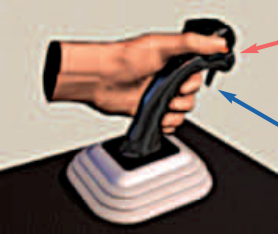
An audio signal will indicate which sidestick has priority,

A green light will come on in front of the pilot who has taken control if the other stick is not in neutral position.
With autopilot (AP) engaged, the sidesticks are kept in the neutral position, with no possibility of simultaneous inputs from either pilot.
5 Operational procedures
Section titled “5 Operational procedures”Indeed, when the A/P is engaged, it is normally disconnected by pressing the priority P/B (the pilot takes priority over the A/P) or instinctively at any time by a firm action on the stick: typically 5kg in pitch, 3.6kg in roll.
Simultaneous inputs by both PF and PNF on the sidesticks must be avoided. Thus, if the PNF feels he must intervene, he must do so by pressing the Priority P/B while saying “I have controls”.
These rules are reminded in the Flight Crew Training Manual 01.020 – Flight Controls and Flight Crew Operating Manual 1.27.40 – Flight Controls: Controls and Indicators”
6 Dual Sidestick inputs warning system
Section titled “6 Dual Sidestick inputs warning system”In order to warn the crew in case of dual sidestick operations, Airbus has designed a package of dual input indicators and audio warning. These operate when both side sticks are deflected simultaneously by more than 2°. These visual and aural warnings have proved to be efficient means to inform the pilot of dual inputs.
Visual indication
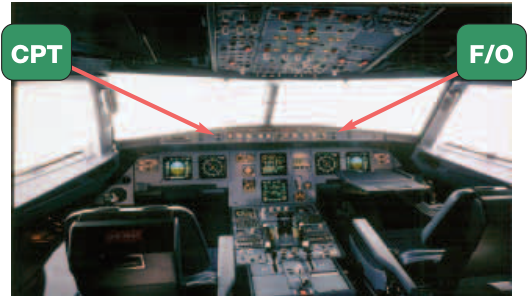
Section titled “Visual indication”When a dual input situation is detected, the two green priority lights located on the cockpit front panel flash simultaneously.
The visual indication is an ADVISORY of a dual input situation
The synthetic voice is a WARNING of a dual input situation Note: This audio has the lowest priority among the synthetic voice audio alerts.
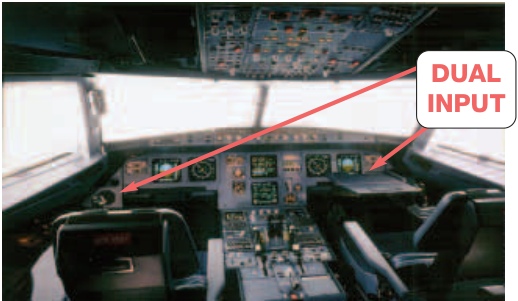
Experience has shown, that these warnings are very effective to:
-
G “Educate” the pilots to respect the basic task sharing principle;
-
G Reduce drastically the number of dual input occurrences.
The activation of these dual input warnings has no repercussion in term of :
G Crew training;
- G Mixed fleet flying.
HOW TO UPGRADE YOUR SA AND LR AIRCRAFT ?
Section titled “HOW TO UPGRADE YOUR SA AND LR AIRCRAFT ?”The light and aural indicators are basic, and free of charge on retrofit, on the A320 family and A330/A340.
It requires FCDC and FWC to be at a given standard already available on production line:
-
A320: FWC E2 Standard - FCDC 53 Standard
-
A330/A340: FWC K3/L7 Standard - FCDC M11/L14 Standard
Pin programs are activated on Operator request
来源:Airbus Safety First 网址:https://safetyfirst.airbus.com/dual-side-stick-inputs/ 发布日期:2006-12-14 杂志期号:2006-12 类别:档案 PDF:原文 PDF
作者:Frédéric COMBES 飞行安全经理
任何航空器运营的一项基本任务分工原则是:任何时候只能有一名飞行员担任操纵飞行员。因此,如果监控飞行员不同意操纵飞行员的输入,他/她必须通过语言提出修正请求,或者在必要时通过清晰宣布“我来操纵”来接管操纵。这将意味着他/她从那一刻起成为操纵飞行员,而另一名飞行员成为监控飞行员。然而,从航线运行监控中获得的反馈表明,双输入仍然时有发生,并且有时也涉及空客分析的运行事件。以下描述的事件便是如此,该事件发生在一架 A320 遭遇颠簸期间。
2 事件摘要
Section titled “2 事件摘要”一架 A320-200 在爬升至 FL 320(马赫数约 0.78)时遭遇了严重的颠簸,导致横滚角增大至 40°。
事件发生前,飞机正在爬升至 FL 320。飞机重量为 61.2 吨,当时构型如下:
-
形态光洁,AP 2 接通(CLIMB/NAV 模式),自动推力(ATHR)已衔接且在推力模式下工作正常。
-
管理马赫数目标为 0.78
-
机长和副驾驶的导航显示器(ND)均选择 ARC 模式,范围为 160 海里
飞机开始出现非指令性向右横滚,最初由自动驾驶仪进行修正。然而,当速度超过 250 节时,自动驾驶仪在副翼上的指令被限制在 8°。因此,由于强烈颠簸,横滚角达到了向右 40°。
两名飞行员均使用最大左侧杆输入和 10° 左侧方向舵脚蹬进行反应。
这导致自动驾驶仪脱开。在接下来的 20 秒内,机长和副驾驶施加了双侧杆输入,导致横滚角在向左 33° 至向右 49° 之间振荡,同时损失了 2400 英尺高度。随后机长重新接通了自动驾驶仪,选择了飞行高度层 310,航班恢复正常,未再发生异常事件。
飞行员通过各种俯仰和横滚双侧杆输入来应对这次横滚偏差。自动驾驶仪因侧杆输入而断开。
4 侧杆的操作
3 双侧杆输入的类型
Section titled “3 双侧杆输入的类型”通过对报告的双侧杆输入事件的分析,发现存在三种类型的发生情况:
“意外”双侧杆输入
Section titled ““意外”双侧杆输入”通常由监控飞行员不经意间移动侧杆所致。
例如在拿取 FCOM 或按下无线电发射键(R/T)时。
意外双侧杆输入仅对飞机行为产生轻微影响,因为输入时间有限且幅度较小。
“舒适”双侧杆输入
Section titled ““舒适”双侧杆输入”通常由监控飞行员希望改善飞机姿态或轨迹而进行的短暂干预所致:
这些情况通常发生在进近期间(高度截获、航道截获)或拉平阶段,对飞机高度/轨迹的影响较小。然而,由于操纵飞行员不了解监控飞行员的干预,他可能会受到干扰并可能对监控飞行员的输入进行反操作。
“本能”双侧杆输入
Section titled ““本能”双侧杆输入”通常由监控飞行员对侧杆的“本能”反应所致。这种本能反应可能在发生意外事件时出现,例如自动驾驶仪脱开、超速情况或危险机动。此类干预在侧杆偏转和持续时间方面更为显著。通常在这种情况下,两名飞行员会将侧杆推向同一方向,这可能导致过度控制,如上述事件所示。
两个侧杆不像老旧机型那样通过机械方式连接。
这意味着两个侧杆可以独立操作。
当操作一个侧杆时,它会向电传飞行计算机发送电信号。当两个侧杆同时移动时,系统会将两名飞行员的信号进行代数相加。
总和被限制在单侧杆最大偏转所产生的信号范围内。
为避免两个信号被系统相加,每个侧杆上都配有一个优先权(P/B)按钮。通过按下此按钮,一名飞行员可以取消另一名飞行员的输入。
音频信号将指示哪个侧杆具有优先权,
如果另一个侧杆不在中立位置,驾驶该侧的飞行员前方将亮起一个绿色指示灯。
当自动驾驶仪(AP)接通时,侧杆保持在中立位置,任何飞行员都不能同时输入。
5 Operational procedures
Section titled “5 Operational procedures”确实,当自动驾驶仪(A/P)接通时,通常通过按下优先按钮(P/B)(飞行员优先接管A/P),或在任何时候通过用力操作侧杆本能断开:通常俯仰5公斤、滚转3.6公斤。
必须避免PF和PNF同时操作侧杆。因此,如果PNF认为必须介入,必须在按下优先按钮的同时说“我已接手控制”。
这些规则在《飞行机组训练手册》01.020 – 飞行控制和《飞行机组操作手册》1.27.40 – 飞行控制:控制与指示中有相关说明。
6 Dual Sidestick inputs warning system
Section titled “6 Dual Sidestick inputs warning system”为了警告机组人员双侧杆操作的情况,空客设计了双输入指示器和音频警告的组合。当两个侧杆同时偏转超过2°时,这些指示器启动运行。实践证明,这些视觉和听觉警告是告知飞行员双输入情况的有效手段。
Visual indication
Section titled “Visual indication”当检测到双输入情况时,位于驾驶舱前面板上的两个绿色优先指示灯同时闪烁。
视觉指示是双输入情况的咨询级警告
合成语音是双输入情况的警告级警告
Note: This audio has the lowest priority among the synthetic voice audio alerts.
注:此音频在合成语音警报中优先级最低。
经验表明,这些警告非常有效:
-
G “教育”飞行员遵守基本任务分工原则;
-
G 大幅减少双输入事件的发生次数。
这些双输入警告的激活对以下方面没有影响:
G 机组培训;
- G 混合机队飞行。
HOW TO UPGRADE YOUR SA AND LR AIRCRAFT ?
Section titled “HOW TO UPGRADE YOUR SA AND LR AIRCRAFT ?”这些灯光和音频指示器在A320系列及A330/A340上的改装为基本配置且免费。
改装需要FCDC和FWC达到特定标准,该标准已在生产线可用:
-
A320:FWC E2标准 - FCDC 53标准
-
A330/A340:FWC K3/L7标准 - FCDC M11/L14标准
程序引脚在运营商提出要求时激活