Radio Altimeter erroneous values
Source: Airbus Safety First URL: https://safetyfirst.airbus.com/radio-altimeter-erroneous-values/ Published: 2011-01-14 Magazine Issue: 2011-01 Category: Archive PDF: Original PDF
Marc bAILLION
Section titled “Marc bAILLION”Flight safety Director
Lorraine dE bAuduS
Section titled “Lorraine dE bAuduS”Group Manager a318/a319/a320/a321 operational standards, Customer services
1. Introduction
Section titled “1. Introduction”In-service events occurred where a Radio Altimeter (RA) provided an erroneous height indication, which was recognized as valid information by the aircraft systems. This resulted in an early flare activation during the approach.
In response to these events, Airbus launched a series of investigation that led to the following conclusions: in the most critical scenario, an early activation of the flare law may lead to an increase of the Angle of Attack which, if not corrected, could reach the stall value. All Airbus aircraft are affected except the A380.
As a result of these investigations, Airbus published:
q A set of Operator Information Telex/Flight Operations Telex (OIT/ FOT) and Red Operations Engineering Bulletins (OEB) describing the operational consequences, and containing recommendations to follow, should a RA provide erroneous height readings.
2. System architecture
Section titled “2. System architecture”All Airbus aircraft, except the A380, are equipped with two RAs, which provide height information to several aircraft systems (fig. 1).
The A380 is fitted with three RAs, which provide the aircraft’s systems with a single median height value. As a result of this system architecture, a single erroneous RA height indication is not an issue for the A380.
This article will therefore concentrate on the other members of Airbus’ family of aircraft, fitted with two Radio Altimeters.
These two RAs provide height information to the Auto Pilots (AP), Auto Thrust (A/THR), Primary
Flight Displays (PFD)/ Navigation Displays (ND), Weather Radar (WXR), Flight Warning Computers (FWC), Traffic Alert and Collision Avoidance System (TCAS) and all audio indicators.
Height information is received from one RA at a time. In case of detected failure, the remaining RA is used as a back-up.
The following systems are designed to receive an RA signal from only a single source:
q On all aircraft models the Terrain Awareness and Warning System (TAWS) receives signals from RA1 only.
q On the A300B2/B4, A300-600 and A310, the Auto Pilot/ Flight Director use only their on-side RA.
q New tasks in the Trouble Shooting Manual (TSM) and Maintenance Planning Document (MPD) related to the RA antennas and coaxial cables.
Erroneous RA occurrences should be systematically reported so as to allow proper implementation of the recommended maintenance tasks. These consist in the inspection of the RA antennas coaxial cables, cleaning of the antennas and possibly replacement of the RA.
Design improvements are currently under development on the Radio Altimeter as well as on other aircraft systems, in order to better detect RA errors and to avoid untimely flare engagement.
Figure 1 RA1 and RA2 receiver (R) and transmitter (T) antennas location on an A320
Safety
3. Typical cause of erroneous RA height indications
Section titled “3. Typical cause of erroneous RA height indications”In-service experience has shown that a Radio Altimeter may provide erroneous height indications due to a direct link between the transmitter and the receiver antennas, without ground reflection. This can be related to causes that are either internal or external to the RA system.
The internal causes may be linked to: q Water flow on the antennas, e.g. due to a defective drain valve.
q Water ingress into the RA antenna installation affecting the antennas, and potentially the coaxial cables.
q Carbon dirt or ice accretion on the antennas.
q Degraded installation at connectors level.
The external causes may be linked to aircraft flying over:
q Other aircraft, hail clouds or bright spots, i.e. terrain presenting reflectivity variations.
q Runways contaminated with water or snow.
In these cases, the RA condition may not be detected by the systems, which continue to use the erroneous RA values. A value of -6ft has been observed in a number of events.
4. Operational consequences and recommendations
Section titled “4. Operational consequences and recommendations”An erroneous RA height indication may have effects on the:
q Primary Flight Displays (PFD)
q Systems Displays (SD)
q Warnings and callouts
q Auto Flight System mode changes
q Aircraft protections, such as the unavailability of the High Angle of Attack Auto Pilot disconnection.
The two following examples illustrate possible effects of an erroneous RA indication on an A320 Family/A330/A340 aircraft:
Consequences on the aircraft’s systems:
a) Indication lower than real height on RA1 during an ILS approach, with both APs/FDs engaged:
Section titled “a) Indication lower than real height on RA1 during an ILS approach, with both APs/FDs engaged:”q RA 1 provides height information to PFD 1, AP 1 and to the A/THR (the A/THR uses the same RA as the master AP).
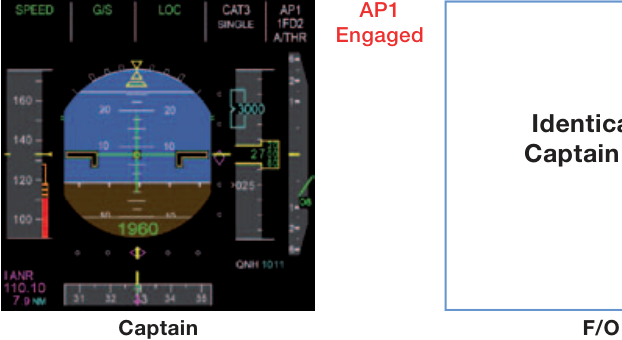
q Figure 2 shows the crew’s PFDs before the RA1 issue. Both RAs function properly and provide the same height of 1 960 ft. The vertical mode is on G/S, and the lateral mode is on LOC. The A/THR is engaged in SPEED.
Therefore:
-
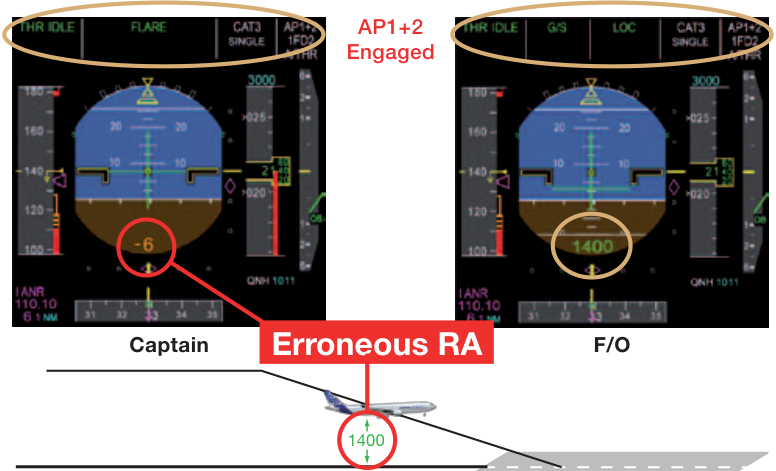
The RA reading on PFD 1 is – 6 ft
-
AP 1 engages in FLARE mode and PFD 1 displays “FLARE” on the FMA
q Figure 3 RA 1 provides an erroneous height indication of – 6 ft, while RA 2 delivers the correct height of 1 400 ft.
- The A/THR engages in RETARD mode and displays “THR IDLE” on the FMA of PFD 1 and PFD 2.
Figure 2
Section titled “Figure 2”Both RAs provide correct height of 1 960 ft
Erroneous RA 1 reading is – 6 ft, correct RA 2 reading is 1 400 ft. Both AP/FDs are engaged
q RA 2 provides height information to PFD 2 and to AP 2.
Therefore:
Section titled “Therefore:”- The AUTOLAND warning lights are activated.
Therefore:
-
The RA reading on PFD 2 is 1 400 ft
-
AP 2 is still engaged in G/S vertical mode and LOC lateral mode. PFD 2 therefore displays “G/S” and “LOC” on the FMA.
q AP 1 is engaged in FLARE mode and one RA height goes below 200 feet. In addition, the difference between both RA height indications is greater than 15 feet.
Figure 4
Section titled “Figure 4”Both RAs provide correct height of 1 960 ft
b) Indication lower than real height on RA1 during an ILS approach, with AP 1 and both FDs engaged:
Section titled “b) Indication lower than real height on RA1 during an ILS approach, with AP 1 and both FDs engaged:”q Figure 4 shows the crew’s PFDs before the RA1 issue. Both RAs function properly and provide the same height of 1 960 ft. The vertical mode is on G/S, and the lateral mode is on LOC. The A/THR is engaged in SPEED.
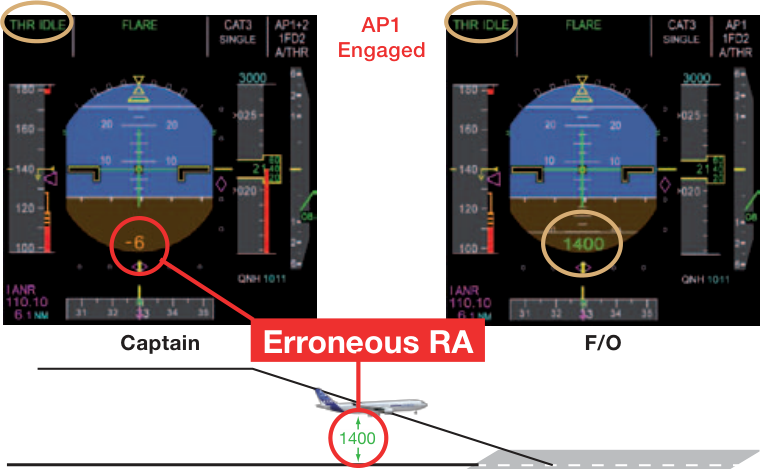
q Figure 5 shows that RA 1 provides an erroneous height indication of – 6 ft, while RA 2 delivers the correct height of 1 400 ft.
Consequences on the aircraft’s systems:
q RA 1 provides height information to PFD 1, AP 1 and to the A/THR (the A/THR uses the same RA as the master AP).
Therefore:
-
The RA reading on PFD 1 is – 6 ft
-
AP 1 engages in FLARE mode and displays “FLARE” on the FMAs of PFD 1 and PFD 2.
-
The A/THR engages in RETARD mode and displays “THR IDLE” on the FMAs of PFD 1 and PFD 2.
q RA 2 provides height information to PFD 2.
Therefore:
- The RA reading on PFD 2 is 1 400 ft.
Erroneous RA 1 reading is – 6 ft, correct RA 2 reading is 1 400 ft. AP 1 and both FDs are engaged
- The AUTOLAND warning lights are activated.
Safety
In the examples above, the risk of early flare engagement due to the too low height indication is compounded by the possible impact on the aircraft protections. On the A320 Family, for example, the CONF FULL High Angle of Attack Auto Pilot disconnection is not available in the event of a very low erroneous RA height indication.
Therefore, if a manual takeover is not performed when this early flare engagement occurs, the Angle Of Attack will increase and may reach the stall value.
The detailed effects on aircraft protection on the A300/A310, A320 and A330/A340 families can be found in the OIT / FOT and OEB referenced at the end of this article. These documents include as well the following operational recommendations in the event of an erroneous RA height reading:
-
q During all phases of flight, the flight crew must monitor and crosscheck all primary flight parameters and FMa indications.
-
q During iLs (or MLs, GLs) approach with ap engaged, in the event of an unexpected THR iDLe and FLaRe modes engagement, the flight crew must immediately react as follows:
-
Immediately perform an automatic Go Around (thrust levers set in ToGa),
or
- Immediately disconnect the AP , then continue the landing using raw data or visual references (FDs set to oFF) or, perform a manual Go around with thrust levers set to ToGa (significant longitudinal sidestick input may be required).
See OEB for detailed procedures
Several symptoms may assist the crew in identifying a potential erroneous RA reading:
q Untimely ECAM L/G NOT DOWN warnings
q Untimely or no “RETARD” callout q Interruption of, or no RA automatic callout
q Untimely TAWS alert (“PULL UP” or “TERRAIN AHEAD”)
q Impossible NAV mode engagement after takeoff
q Pulsing Cabin Differential Pressure Advisory on ECAM CAB PRESS page.
In addition to the above cockpit indications, RA fault messages from the Electrical Flight Control System (EFCS) may also be recorded in the Post Flight Record.
The Flight crews must report any of the above symptoms in the aircraft technical logbook, in order to ensure no dispatch with an erroneous RA.
5. Maintenance recommendations
Section titled “5. Maintenance recommendations”If the flight crews report symptoms of an erroneous RA height indication, the following maintenance actions should be performed:
q Clean the RA antennas and the adjacent area with cleaning agents (Material N° 11.010) and a lint free cloth
q If, during any subsequent flight, the symptoms persist:
-
Replace the RA antennas
-
Inspect the RA antennas coaxial cables. If they are not in correct conditions, repair or replace them.
These recommendations have been added in the following new TSM tasks:
q 34-42-00-810-844 (A320 Family)
q 34-42-00-810-862 (A330/A340) q 34-42-00-006-00 (A300/A310).
In addition, scheduled maintenance (MPD) include new tasks related to the RA:
-
Every 6 months: RA antenna surface cleaning
-
Every 12 years: replacement of RA antennas and RA coaxial cables during the heavy maintenance
visit for the structure section.
6. design Improvements
Section titled “6. design Improvements”The following improvements are being implemented in the RA system as well as in the aircraft systems which use the RA information:
q RA system:
-
A new gel gasket, between the antenna and the aircraft structure, will provide better isolation against water ingress.
-
A digital RA, with self monitoring capability to eliminate the erroneous heights, is under certification.
q Aircraft systems:
- Both the Auto Pilot and flight control systems will be enhanced to detect most RA erroneous height values.
7. conclusion
Section titled “7. conclusion”The aircraft systems may not always detect an erroneous Radio Altimeter value. Depending on the flight phase and AP/FD and A/THR status, prompt action from the crew may be required to prevent the consequences of such situation.
It is essential that the crew identifies the symptoms of an erroneous RA reading so as to:
q Take immediate actions.
q Report these symptoms to help maintenance teams troubleshoot erroneous RA readings.
References:
Section titled “References:”oiT/FoT se 999.0034/09 dated 4th May 2009 for a320/a330/a340 operators
q a318/a319/a320/a321: ReD oeB 201/2 q a330: ReD oeB 076/2 q a340: ReD oeB 091/2
oiT/FoT se 999.0035/09 dated 30th april 2009 for a300/a310 operators (no ReD oeB as the operational consequences are different than for the a320/a330/ a340).
The oiT/FoTs and oeBs are not applicable to the a380.
Safety
无线电高度表测量值错误
Section titled “无线电高度表测量值错误”来源: Airbus Safety First 网址: https://safetyfirst.airbus.com/radio-altimeter-erroneous-values/ 发布日期: 2011-01-14 杂志期号: 2011-01 类别: 档案 PDF: 原始PDF
Marc BAILLON
Section titled “Marc BAILLON”飞行安全总监
Lorraine DE BAUDUS
Section titled “Lorraine DE BAUDUS”A318/A319/A320/A321运营标准集团经理,客户服务部
运营中发生了无线电高度表(RA)提供错误高度指示的事件,飞机系统将其识别为有效信息。这导致在进近过程中提前激活了拉平(flare)。
作为对这些事件的回应,空客开展了一系列调查,得出了以下结论:在最关键的情况下,提前激活拉平法则可能导致迎角(Angle of Attack)增加,如果不加以修正,可能达到失速值。除A380外,所有空客飞机均受影响。
作为这些调查的结果,空客发布了:
- 一系列运营商信息电报/飞行运营电报(OIT/FOT)和红色运营工程通告(OEB),描述运营后果,并包含当RA提供错误高度读数时应遵循的建议。
2. 系统架构
Section titled “2. 系统架构”除A380外,所有空客飞机均配备两部RA,为多个飞机系统提供高度信息**(图1)**。
A380配备了三部RA,为飞机系统提供单一中值高度。因此,在此系统架构下,单个RA错误高度指示对A380不成问题。
因此,本文将集中讨论空客家族中配备两部无线电高度表的其他机型。
这两部RA为以下系统提供高度信息:自动驾驶仪(AP)、自动推力(A/THR)、主飞行显示器(PFD)/导航显示器(ND)、气象雷达(WXR)、飞行警告计算机(FWC)、空中交通防撞警告系统(TCAS)及所有音响指示器。
高度信息一次接收自一部RA。检测到故障时,使用剩余的RA作为备份。
以下系统设计为仅从单一来源接收RA信号:
- 在所有机型上,地面迫近警告系统(TAWS)仅接收来自RA1的信号。
- 在A300B2/B4、A300-600和A310上,自动驾驶仪/飞行指引仪仅使用其本侧RA。
故障诊断手册(TSM)和维护计划文件(MPD)中关于RA天线和同轴电缆的新任务。
应系统报告错误的RA事件,以允许正确执行推荐的维护任务。这些包括检查RA天线同轴电缆、清洁天线以及可能更换RA。
目前正在开发无线电高度表以及其他飞机系统的设计改进,以更好地检测RA错误并避免不当的拉平衔接。
图1 A320上RA1和RA2接收机(R)和发射机(T)天线位置
安全
3. 错误RA高度指示的典型原因
Section titled “3. 错误RA高度指示的典型原因”运营经验表明,无线电高度表可能在没有地面反射的情况下,由于发射天线和接收天线之间的直接链路而提供错误的高度指示。这可能与RA系统内部或外部的原因有关。
内部原因可能与以下有关:
- 天线上的水流,例如由于排水活门故障。
- 水渗入RA天线装置,影响天线,并可能影响同轴电缆。
- 天线上的积碳污垢或积冰。
- 连接器级别的安装退化。
外部原因可能与飞机飞越以下区域有关:
- 其他飞机、冰雹云或明亮区域,即呈现反射率变化的地形。
- 被水或雪污染的跑道。
在这些情况下,RA状况可能不被系统检测到,系统继续使用错误的RA值。在多个事件中已观察到-6ft的值。
4. 运营后果和建议
Section titled “4. 运营后果和建议”错误的RA高度指示可能影响:
- 主飞行显示器(PFD)
- 系统显示器(SD)
- 警告和语音提示
- 自动飞行系统模式变化
- 飞机保护,例如高迎角自动驾驶仪断开的不可用性。
以下两个示例说明错误的RA指示对A320系列/A330/A340飞机可能造成的影响:
对飞机系统的后果:
a) ILS 进近期间 RA1 高度指示低于实际高度,两部 AP/FD 均已接通:
Section titled “a) ILS 进近期间 RA1 高度指示低于实际高度,两部 AP/FD 均已接通:”q RA 1 向 PFD 1、AP 1 和 A/THR 提供高度信息(A/THR 使用与主 AP 相同的 RA)。
q 图 2 显示 RA1 故障前机组的主飞行显示器。两部 RA 工作正常,提供相同的高度值 1960 ft。垂直方式为 G/S,横向方式为 LOC。A/THR 接通在 SPEED 方式。
因此:
-
PFD 1 上的 RA 读数为 – 6 ft
-
AP 1 进入 FLARE 方式,PFD 1 在 FMA 上显示 “FLARE”
q 图 3 RA 1 提供错误的高度指示值 – 6 ft,而 RA 2 提供正确的高度值 1400 ft。
- A/THR 进入 RETARD 方式,并在 PFD 1 和 PFD 2 的 FMA 上显示 “THR IDLE”。
两部 RA 均提供正确高度值 1960 ft
Erroneous RA 1 reading is – 6 ft, correct RA 2 reading is 1 400 ft. Both AP/FDs are engaged
q RA 2 向 PFD 2 和 AP 2 提供高度信息。
- 自动着陆(AUTOLAND)警告灯被激活。
因此:
-
PFD 2 上的 RA 读数为 1400 ft
-
AP 2 仍保持在 G/S 垂直方式和 LOC 横向方式。因此 PFD 2 在 FMA 上显示 “G/S” 和 “LOC”。
q AP 1 进入 FLARE 方式,且一部 RA 高度低于 200 ft。此外,两部 RA 高度指示值之差大于 15 ft。
两部 RA 均提供正确高度值 1960 ft
b) ILS 进近期间 RA1 高度指示低于实际高度,AP 1 和两部 FD 均已接通:
Section titled “b) ILS 进近期间 RA1 高度指示低于实际高度,AP 1 和两部 FD 均已接通:”q 图 4 显示 RA1 故障前机组的主飞行显示器。两部 RA 工作正常,提供相同的高度值 1960 ft。垂直方式为 G/S,横向方式为 LOC。A/THR 接通在 SPEED 方式。
q 图 5 显示 RA 1 提供错误的高度指示值 – 6 ft,而 RA 2 提供正确的高度值 1400 ft。
对飞机系统的影响:
q RA 1 向 PFD 1、AP 1 和 A/THR 提供高度信息(A/THR 使用与主 AP 相同的 RA)。
因此:
-
PFD 1 上的 RA 读数为 – 6 ft
-
AP 1 进入 FLARE 方式,并在 PFD 1 和 PFD 2 的 FMA 上显示 “FLARE”。
-
A/THR 进入 RETARD 方式,并在 PFD 1 和 PFD 2 的 FMA 上显示 “THR IDLE”。
q RA 2 向 PFD 2 提供高度信息。
因此:
- PFD 2 上的 RA 读数为 1400 ft。
Erroneous RA 1 reading is – 6 ft, correct RA 2 reading is 1 400 ft. AP 1 and both FDs are engaged
- 自动着陆(AUTOLAND)警告灯被激活。
在上述示例中,由于高度指示过低而导致提前进入 FLARE 的风险,会因对飞机保护系统可能产生的影响而加剧。例如,在 A320 系列飞机上,当出现非常低的错误 RA 高度指示时,CONF FULL 大迎角自动驾驶仪脱开功能不可用。
因此,如果在提前进入 FLARE 时未执行人工接管,迎角将增加并可能达到失速值。
关于 A300/A310、A320 和 A330/A340 系列飞机保护系统的详细影响,请参见本文末尾引用的 OIT/FOT 和 OEB。这些文档还包含在发生错误 RA 高度读数时的以下操作建议:
-
q 在所有飞行阶段,机组必须监控并交叉检查所有主飞行参数和 FMA 指示。
-
q 在 ILS(或 MLS、GLS)进近且 AP 接通的情况下,如果意外出现 THR IDLE 和 FLARE 方式接通,机组必须立即按以下方式反应:
-
立即执行自动复飞(将推力手柄设置在 TOGA),
或
- 立即断开 AP,然后使用原始数据或目视参考继续着陆(FD 设置为 OFF),或执行手动复飞并将推力手柄设置在 TOGA(可能需要较大的纵向侧杆输入)。
详细程序请参见 OEB
以下症状可帮助机组识别潜在的错误 RA 读数:
q 不合时宜的 ECAM L/G NOT DOWN 警告
q 不合时宜或无 “RETARD” 语音提示
q RA 自动语音呼叫中断或无 RA 自动语音呼叫
q 不合时宜的 TAWS 警告(“PULL UP” 或 “TERRAIN AHEAD”)
q 起飞后无法接通 NAV 方式
q ECAM CAB PRESS 页面出现脉冲式客舱压差咨询。
除上述驾驶舱指示外,电气飞行控制系统(EFCS)的 RA 故障信息也可能记录在飞行后记录中。
机组必须在飞机技术记录本中报告上述任何症状,以确保不使用有故障的 RA 进行放行。
5. 维护建议
Section titled “5. 维护建议”如果飞行机组报告无线电高度表(RA)高度指示出现错误值的症状,应执行以下维护操作:
q 使用清洁剂(材料号 11.010)和无绒布清洁无线电高度表天线及其周边区域
q 如果在后续任何飞行中症状仍然存在:
-
更换无线电高度表天线
-
检查无线电高度表天线同轴电缆。如果状态不正确,修理或更换。
这些建议已添加至以下新增 TSM 任务:
q 34-42-00-810-844(A320 系列)
q 34-42-00-810-862(A330/A340)
q 34-42-00-006-00(A300/A310)
此外,计划性维护(MPD)包含与无线电高度表相关的新任务:
-
每 6 个月:无线电高度表天线表面清洁
-
每 12 年:在 Heavy Maintenance 期间更换无线电高度表天线和无线电高度表同轴电缆
有关结构部分的内容,请访问。
6. 设计改进
Section titled “6. 设计改进”无线电高度表系统以及使用无线电高度表信息的飞机系统正在实施以下改进:
q 无线电高度表系统:
-
天线和飞机结构之间将采用新型凝胶垫片,以提供更好的防水侵入隔离。
-
具备自监控能力的数字式无线电高度表正在认证中,以消除错误高度值。
q 飞机系统:
- 自动驾驶和飞行控制系统将得到增强,以检测大多数无线电高度表错误高度值。
飞机系统可能并非总能检测到错误的无线电高度表值。根据飞行阶段和 AP/FD 及 A/THR 的状态,可能需要机组迅速采取行动,以防止此类情况造成的后果。
机组识别无线电高度表错误读数的症状至关重要,以便:
q 立即采取行动。
q 向维护团队报告这些症状,以帮助排除无线电高度表错误读数的故障。
q T/FoT se 999.0034/09,日期为 2009 年 5 月 4 日,适用于 A320/A330/A340 运营商
q A318/A319/A320/A321:ReD oEB 201/2
q A330:ReD oEB 076/2
q A340:ReD oEB 091/2
q T/FoT se 999.0035/09,日期为 2009 年 4 月 30 日,适用于 A300/A310 运营商(无 ReD oEB,因为操作后果与 A320/A330/A340 不同)
T/FoT 和 oEB 不适用于 A380。
Safety