Using Aircraft as a Sensor on Contaminated Runways
Source: Airbus Safety First URL: https://safetyfirst.airbus.com/using-aircraft-as-a-sensor-on-contaminated-runways/ Published: 2018-07-16 Magazine Issue: 2018-07 Category: Flight Ops, BACF, brake, Brakes, Braking, CORSAIR, distance, landing, landing distance, performance PDF: Original PDF

AIRCRAFT
Section titled “AIRCRAFT”


RUNWAY EXCURSIONS AND THEIR CAUSES
Section titled “RUNWAY EXCURSIONS AND THEIR CAUSES”In the world of commercial jets, it is well known that Runway Excursions (RE) are one of the top three types of accident.
Accident statistics show that RE caused 35% of hull-losses and 14% of fatal accidents between 1998-2017. Given this status, Airbus and other manufacturers are investing in development of technology to reduce RE accidents.
IATA data show that 25% of Runway Excursions occur on contaminated runways
Product features such as Airbus’ ROPS (Runway Overrun Prevention System) are already in service and providing real time energy and landing performance monitoring information to flight crews.
However, accurate knowledge of the runway condition is also key for the validity of landing performance computations, and a clear case can be made for the need to improve pilot awareness of runway surface conditions.
Indeed, national Safety bodies including the NTSB of the USA and the UK AAIB have identified the need to develop “an operationally feasible airplane-based braking ability / runway surface condition measurement and communication system”.
Today’s Means of Measuring Runway Surface Conditions
Section titled “Today’s Means of Measuring Runway Surface Conditions”Today, there are typically three methods available by which runway surface conditions are evaluated:
-
Runway contaminant type and depth observations
-
Ground surface friction measurements
-
Braking action reports from pilots
Contaminant type and depth observations are in general physically conducted by airport personnel on the runway surface. The conditions are assessed through a combination of visual observations and spot-checks. However, it can be a difficult task to consolidate what may be differing conditions across the entire width and length of the runway into a succinct runway condition report.
AIRCRAFT
Section titled “AIRCRAFT”During raining or freezing/ melting conditions, the validity of runway condition information may become outdated soon after it is issued
In addition, during active precipitation and/or freezing/melting conditions, the validity of the information may become outdated soon after it is issued.
Ground surface friction measurements provide a more quantitative approach to taking measurements along certain points on a runway. However, as noted by the NTSB, they are useful for identifying trends in runway surface condition but are not recommended for use in predicting aircraft stopping performance.
This is due to the lack of correlation with aircraft braking performance, as well as variability in equipment design and calibration.
While the airport operator is responsible for generating the Runway Condition Codes for a runway, pilots are responsible for providing accurate braking action reports. Indeed, providing braking action reports is a significant role that pilots play in preventing runway excursions for all airplanes.
Braking action reports contain the pilot’s assessment of the manner in which an aircraft responds to the application of wheel brakes. The latest terminology for these reports is identified by rulemaking activity from the ICAO, the FAA, and the EASA, and is explained in Table 1.
Under these new rules, which are expected to become the applicable worldwide standard in November 2020, pilots will be required to radio braking action reports to ATC whenever they are requested, or if the pilot has assessed braking action is less than previously reported. ATC will be required to relay information to airport operators, and depending on the situation, to other pilots in approach.
The forthcoming rules also define the expected response from airports if runway surface conditions deteriorate enough that two consecutive reports of ‘Poor’ conditions are received. In this case, the airport will be expected to re-assess the runway conditions. Additionally, If “Less Than Poor” braking action is reported, the runway will be closed to further operations until the airport operator can improve the runway’s condition.
These reports thus play an important part in the cycle of runway surface condition assessment and reporting.
DEFINITION OF TERMINOLOGY FOR PILOT BRAKING REPORTS AND RUNWAY CONDITION ASSESSMENT
Section titled “DEFINITION OF TERMINOLOGY FOR PILOT BRAKING REPORTS AND RUNWAY CONDITION ASSESSMENT”The defi nition of standards for runway condition terminology was initiated in 2005 by the FAA with several airlines.
Subsequently, the TALPA Aviation Rulemaking Committee (ARC) was formed by the FAA to make recommendations on improving safety of operations on wet or contaminated runways, for both take-off and landing. This committee consisted of airlines/ aircraft manufacturers, airport operators, dispatchers and regulators.
The overall aims of TALPA were to identify an improved way of assessing runway conditions based on contaminant type, in order to provide operators with effective means of anticipating braking performance.
Two major outcomes of this activity have been the defi nition of the Runway Condition Assessment Matrix (RCAM), and the Runway Condition Code (RWYCC). The RCAM is a matrix with assessment criteria, allowing identifi cation of an RWYCC using a set of observed runway surface conditions and pilot reports of braking action.
This means of performing runway condition assessment, and format for pilot reports, has been in place in the US since October 1 2016.
To advance global rulemaking based on the RCAM / RWYCC approach, ICAO has issued State Letters 2016/12 and 2016/29. Additionally, EASA has issued Notice of Proposed Amendment (NPA) 2016-11 in order to align with ICAO. A decision is expected to be published by EASA in Q3 2018.
Table 1: Runway Condition Codes (RWYCC) defi nitions for contaminated runways
Section titled “Table 1: Runway Condition Codes (RWYCC) defi nitions for contaminated runways”Note: Runway Condition Code 6 identifi es normal braking behaviour on a dry and uncontaminated runway
|---|---|---| ||N/A|6|
AIRCRAFT
Section titled “AIRCRAFT”DIFFICULTIES INVOLVED IN MAKING BRAKING ACTION REPORTS
Section titled “DIFFICULTIES INVOLVED IN MAKING BRAKING ACTION REPORTS”Making an accurate braking report can be difficult for a pilot because it relies on their subjective experience of the landing
Aeroplane deceleration results from several forces: aerodynamic drag forces, generated by the airframe and in particular the ground spoilers; reverse thrust, if available; wheel braking.
In general, a braking action report should characterize the availability (or lack thereof) of wheel braking. The difficulty for a pilot is in differentiating in realtime, which portion of the total deceleration is coming from the wheel-brakes. This difficulty is compounded by the typical use of autobrakes on contaminated runways. As the autobrake commands an overall airplane deceleration rate, the pilot is able to detect a lack of wheel-braking when the target deceleration is not achieved, however it is still difficult to differentiate how much each component is contributing to the deceleration.
Once the aircraft decelerates to lower speeds (generally below 60kt), pilots often use manual braking and at these speeds the aerodynamic drag and reverse thrust forces are negligible. It is often in this zone where pilots are able to more easily “feel” the runway by using the brake pedals to understand the braking action.
Given these complexities, making an accurate report can be a difficult task for a pilot, and braking report quality can become subject to differences of subjectivity between different pilots. To resolve this and provide objective and consistent braking action reports, Airbus has developed technology which uses aircraft data measured during the ground run to identify the available braking action.
USING THE AIRCRAFT AS A SENSOR TO MEASURE RUNWAY CONDITION
Section titled “USING THE AIRCRAFT AS A SENSOR TO MEASURE RUNWAY CONDITION”Braking Action Computation Function
Section titled “Braking Action Computation Function”Airbus has been developing a new aircraft function to address the need identified by the NTSB and other national aviation Safety bodies, for “an operationally feasible airplane-based braking ability / runway surface condition measurement and communication system”.
BACF uses the data recorded by the aircraft during its deceleration roll to identify the braking level
The implementation of this function on Airbus aircraft is called the “Braking Action Computation Function’ (BACF)”.
The fundamental principle of the function is, post landing, to use the data measured by the aircraft during its deceleration roll to identify the braking action level. By using the aircraft performance model, it is possible to differentiate the part of deceleration coming from either aerodynamic, thrust reverse, or wheel-braking.
Subsequently, by comparing the actual wheel braking performance to models of wheel-braking performance under different “reference” runway conditions, the runway state which most closely resembles the experienced deceleration is determined.
Additionally, using GPS data available from the aircraft navigation systems, it is possible to identify which section of the runway the aircraft is on when a runway state is identifi ed. The function can identify several states at different points on the runway.
A few seconds after the aircraft speed has decreased below 30kts, details about the runway state become available to the pilot on a dedicated MCDU page (fi g.1). If the pilot felt that the runway was slippery, or in a different condition to that communicated by Air Traffi c Services (ATS), this information can be accessed by the pilot and radioed to ATS at an appropriate moment.
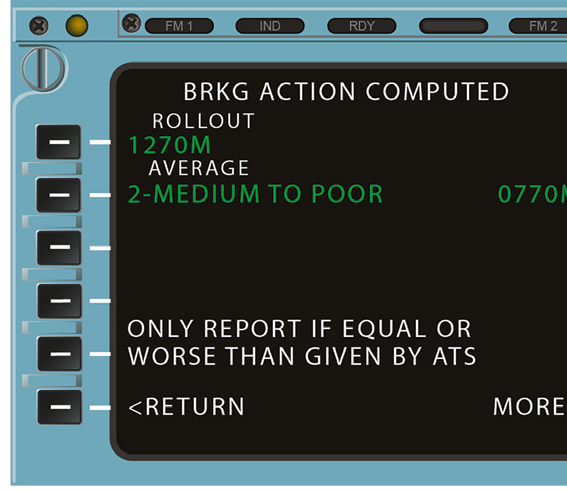
(fi g.1)
Section titled “(fi g.1)”Example MCDU screen with runway state outputs from the BACF
RunwaySense by NAVBLUE
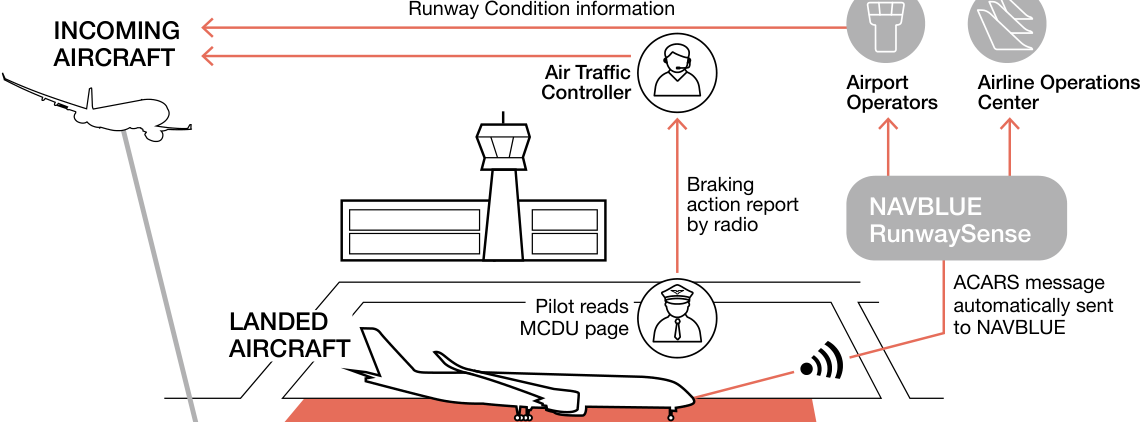
Section titled “RunwaySense by NAVBLUE”As shown in (fi g.2) , in addition to the information available to the pilot through the MCDU, the data calculated by BACF is also sent automatically by ACARS message to NAVBLUE.
NAVBLUE will collect and display the results on a web-service platform called RunwaySense. The users of this service are expected to include airports, airline operational centres, and air traffi c control.
This technological approach is similar to the various mobile traffi c applications which share traffi c data in real-time to allow drivers to see and avoid traffi c jams.
The goal is for airspace users to share reports in real-time, to better understand how the runway condition is trending
Indeed, the goal of this new Airbus-NAVBLUE technology is to provide a platform where airspace users are sharing reports in real-time to better understand how the runway condition is trending, and to allow the airport to anticipate and mitigate slippery conditions. The more aircraft which participate in the sharing, the better the real-time map of conditions becomes.
AIRCRAFT
Section titled “AIRCRAFT”(fi g.2)
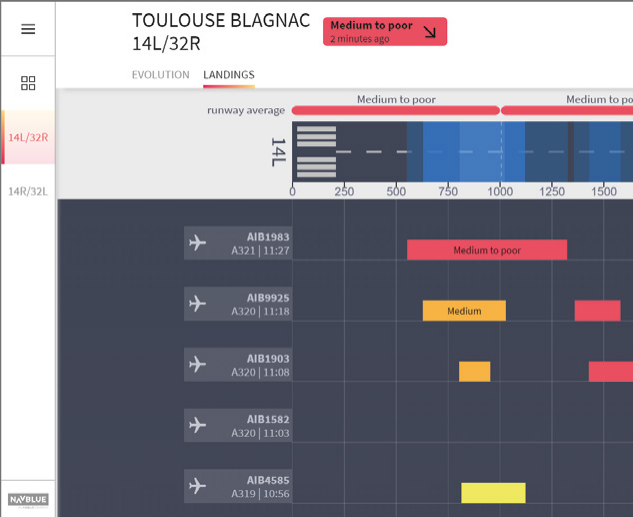
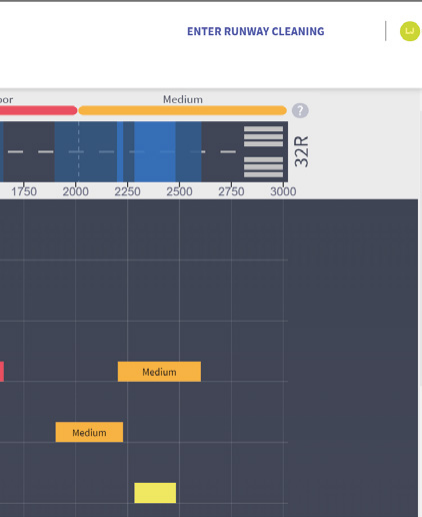
Section titled “(fi g.2)”Users of the service will be able to view runway condition information across a whole airport, or, as shown in (fi g.3) , on an individual runway. Airport level information will provide a high level status of the airport across the different runways, whilst runway level information will enable users to check runway condition trends versus different climatic conditions such as winds, temperatures and humidity.
Integration of BACF & NAVBLUE’s RunwaySense within airport and airline operations
NAVBLUE’s RunwaySense app illustrating a detailed view of a runway, including runway state information from recently landed aircraft
DEVELOPMENT & TESTING
Section titled “DEVELOPMENT & TESTING”The development of prototype BACF technology was started by Airbus in 2015. Subsequently, in-service testing with selected airlines has been ongoing since November 2017.
With over 50,000 in-service flights monitored to date, the function has indeed demonstrated its ability to detect runway contamination and identify the runway condition.
The most relevant experience during the in-service trials occurred when data from BACF equipped aircraft landing at a European airport during snowy weather was reviewed and found to have consistently identified a change in braking action following increased snowfall.
With over 50,000 in-service flights to date, the function has indeed demonstrated its ability to identify the runway condition
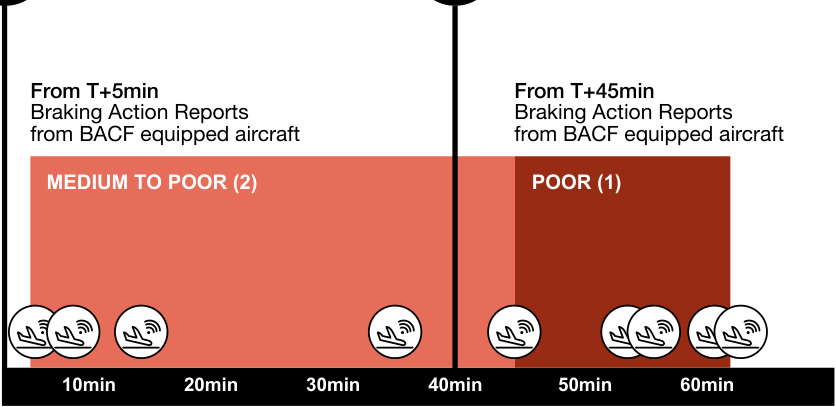
As shown in (fig.4) , with an initial covering of 2 mm of wet snow, the ATC was reporting “GOOD TO MEDIUM” (RWYCC 4) runway conditions to oncoming aircraft.
After that report, and over the course of approximately 35 minutes, 4 different aircraft equipped with BACF landed on the runway and recorded “MEDIUM TO POOR” (RWYCC 2) braking action. This demonstrated the advantage in accuracy gained by using aircraft as a sensor.
At around 40 minutes after the initial ATC report, the snowfall increased. Runway condition measurements subsequently recorded by five aircraft measured “POOR” (RWYCC 1) braking action. This highlighted the potential benefits for airports to receive real-time measurement data, for the management of operational safety.
(fig.4)
Section titled “(fig.4)”In-service testing in snow conditions illustrated the advantage of using aircraft as a sensor to identify the runway state
T0 ATC reported 2mm wet snow ‘GOOD TO MEDIUM (4)’
T + 40min Increased snowfall
AIRCRAFT
Section titled “AIRCRAFT”COMMERCIAL AVAILABILITY
Section titled “COMMERCIAL AVAILABILITY”Technical Availability
Section titled “Technical Availability”Initial availability of the BACF will be for A320 Family aircraft. A controlled Entry Into Service (EIS) is scheduled to start from September 2018 with six candidate airlines, leading to retrofit availability in mid-2019 and line-fit availability by the end of 2019.
A330 family aircraft will be the second program for which the function will be made available. Initial installation is expected to occur in 2020.
Selection of the function will be possible during the aircraft definition process. It will also be available for retrofit, by downloading an Airline Operations Centre (AOC) application onto the Air Traffic Service Unit (ATSU).
Decisions regarding availability of BACF on A350 XWB and A380 programs will be concluded over the course of 2019.
The function will not be available for A300/A310 aircraft.
Commercial Conditions
Section titled “Commercial Conditions”BACF and the RunwaySense collaborative web-platform are integrated as part of the overall RunwaySense Service from NAVBLUE.
The operational & safety benefit comes from sharing the data. To maximise the facilitation of the information, Airbus & NAVBLUE decided to make the BACF software Free of Charge (FOC) provided that airlines share the BACF ACARS messages through the RunwaySense platform.
The BACF software consists of an ATSU AOC application and will be available as an Airbus Service Bulletin.
All airlines which contribute will have basic access to the RunwaySense web platform where they can visualize and track all the BACF reports sent by their aircraft. Airlines can also choose to receive additional information about flight conditions at key airports in their route network.
For airport and ATC users, access to the NAVBLUE RunwaySense web platform will be possible through a paid subscription.
CONTRIBUTORS:
Section titled “CONTRIBUTORS:”Fabien MOLL
Section titled “Fabien MOLL”BACF Project Leader Design Office
Logan JONES Runway Safety Specialist NAVBLUE
Lars KORNSTAEDT
Section titled “Lars KORNSTAEDT”Aircraft Performance Expert Flight Operations Support
Adrien CHEN
Section titled “Adrien CHEN”Director Product Safety Enhancement Product Safety
Runway Excursions (RE) are a top cause of accidents. IATA data show that 25% of them occur on contaminated runways. Measuring the runway condition is therefore a key element in preventing RE events.
Braking action reports from pilots are one of the three main ways of identifying runway contamination levels. These contain the pilot’s assessment of the manner in which an aircraft responds to the application of wheel brakes.
Making an accurate report can be a difficult task for a pilot, and braking report quality can become subject to differences of subjectivity between different pilots.
To resolve this and provide objective and consistent braking action reports, Airbus has developed technology which will use aircraft data recorded during the landing roll to identify the available braking action.
In 2018, Airbus & NAVBLUE will start commercialisation of the technology and associated web service to objectively measure & disseminate runway braking action information.
This service will allow airports, airlines, and ATC to understand how the runway condition is trending, and will allow airports to anticipate and mitigate slippery conditions.
The technology will first be available in 2018 for A320 family aircraft, followed by A330 aircraft types in 2020. Decisions about availability on A380 and A350 XWB aircraft will be concluded over the year 2019.
Safety fi rst
Section titled “Safety fi rst”Safety fi rst, #26 July, 2018. Safety fi rst is published by Airbus S.A.S. - 1, rond point Maurice Bellonte - 31707 Blagnac Cedex/France. Publisher and Editor: Yannick Malinge, Chief Product Safety Offi cer. Concept Design by Airbus Multi Media Support 20180451. Reference: X00D16031905 Issue 26. Photos by Airbus, P. Pigeyre, g-stockstudio, H. Goussé, I. Howarth, F. Lancelot. Cover: J. Darcy.
来源: Airbus Safety First 网址: https://safetyfirst.airbus.com/using-aircraft-as-a-sensor-on-contaminated-runways/ 发布日期: 2018-07-16 期刊期号: 2018-07 分类: 飞行运行、BACF、制动、制动、制动、CORSAIR、距离、着陆、着陆距离、性能 PDF: 原始 PDF
跑道偏出/冲出及其原因
Section titled “跑道偏出/冲出及其原因”在商用喷气机领域众所周知,跑道偏出/冲出(RE)是三大事故类型之一。
事故统计数据表明,1998年至2017年间,跑道偏出/冲出造成35%的机体损毁和14%的致命事故。鉴于这一状况,空客及其他制造商正在投资开发减少跑道偏出/冲出事故的技术。
国际航空运输协会(IATA)数据显示,25%的跑道偏出/冲出发生在受污染的跑道上
空客的ROPS(跑道冲出预防系统)等产品功能已投入使用,并向机组提供实时能量和着陆性能监控信息。
然而,准确了解跑道状况对着陆性能计算的可靠性也至关重要,有充分理由表明需要提高飞行员对跑道表面状况的意识。
事实上,包括美国国家运输安全委员会(NTSB)和英国航空事故调查局(AAIB)在内的国家安监机构已确定需要开发”一种运营上可行的飞机制动能力/跑道表面状况测量与通信系统”。
当前测量跑道表面状况的方法
Section titled “当前测量跑道表面状况的方法”目前,通常有三种方法用于评估跑道表面状况:
-
跑道污染物类型和深度观测
-
地面摩擦力测量
-
飞行员制动效应报告
污染物类型和深度观测通常由机场人员在跑道表面进行物理测量。状况通过目视观测和抽样检查相结合的方式进行评估。然而,将可能存在差异的跑道全长和全宽条件汇总为简明的跑道状况报告是一项困难的任务。
在降雨或结冰/融冰条件下,跑道状况信息的有效性可能在发布后很快过时
此外,在持续降水和/或结冰/融冰条件下,信息的有效性可能在发布后很快过时。
地面摩擦力测量提供了沿跑道特定点位进行测量的更定量方法。然而,正如NTSB所指出的,这些方法有助于识别跑道表面状况的趋势,但不建议用于预测飞机减速性能。
这是由于其与飞机制动性能缺乏相关性,以及设备设计和校准方面的差异。
虽然机场运营商负责生成跑道的跑道状况代码,但飞行员负责提供准确的制动效应报告。实际上,提供制动效应报告是飞行员在防止所有飞机跑道偏出/冲出方面发挥的重要作用。
制动效应报告包含飞行员对飞机在施加机轮制动时响应方式的评估。国际民用航空组织(ICAO)、美国联邦航空管理局(FAA)和欧洲航空安全局(EASA)通过监管活动确定了这些报告的最新术语,如表1所示。
在这些新规定下(预计将于2020年11月成为全球适用的标准),飞行员在收到请求时,或当飞行员评估制动效应低于先前报告时,将被要求通过无线电向ATC报告制动效应。ATC将被要求将信息传递给机场运营商,并根据情况传递给进近中的其他飞行员。
即将出台的规定还定义了机场在跑道表面状况恶化到连续收到两次”差”状况报告时的预期响应。在这种情况下,机场将需要重新评估跑道状况。此外,如果报告了”差于差”的制动效应,在机场运营商改善跑道状况之前,该跑道将关闭,不再接受运行。
因此,这些报告在跑道表面状况评估和报告循环中发挥着重要作用。
飞行员制动报告与跑道状况评估术语定义
Section titled “飞行员制动报告与跑道状况评估术语定义”跑道状况术语标准的制定工作由美国联邦航空局(FAA)于2005年联合多家航空公司发起。
随后,FAA成立了TALPA航空规则制定委员会(ARC),旨在就改善湿跑道或污染跑道的起飞和着陆运营安全提出建议。该委员会由航空公司/飞机制造商、机场运营商、签派员和监管机构共同组成。
TALPA的总体目标是确定一种基于污染物类型的跑道状况评估改进方法,以便为运营人提供有效预测刹车性能的手段。
此项工作的两大成果是跑道状况评估矩阵(RCAM)和跑道状况代码(RWYCC)的定义。RCAM是一份评估标准矩阵,允许通过一组观察到的跑道表面状况和飞行员制动效果报告来识别RWYCC。
这种跑道状况评估方法和飞行员报告格式自2016年10月1日起在美国正式实施。
为推动以RCAM/RWYCC方法为基础的全球规则制定,国际民用航空组织(ICAO)已发布国家函件2016/12和2016/29。此外,欧洲航空安全局(EASA)已发布修订建议通知(NPA)2016-11,以与ICAO保持一致。EASA预计将于2018年第三季度发布相关决定。
表1:污染跑道的跑道状况代码(RWYCC)定义
Section titled “表1:污染跑道的跑道状况代码(RWYCC)定义”注意:跑道状况代码6表示干燥且未受污染跑道的正常刹车行为
|---|---|---| ||N/A|6|
编制制动效果报告的困难
Section titled “编制制动效果报告的困难”对于飞行员而言,编制准确的制动报告可能存在困难,因为它依赖于飞行员对着陆的主观体验。
飞机减速来自多种力的作用:气动阻力,由机体产生,特别是地面扰流板产生的阻力;反推(如可用);机轮刹车。
一般来说,制动效果报告应描述机轮刹车的可用性(或不可用性)。飞行员的困难在于实时区分总减速中有多大比例来自机轮刹车。污染跑道上通常使用自动刹车,这进一步增加了难度。由于自动刹车指令的是飞机整体减速率,当目标减速未达成时飞行员能够检测到机轮刹车的缺失,但仍然难以区分各部分对减速的贡献比例。
一旦飞机减速至较低速度(通常低于60节),飞行员通常会使用人工刹车;在这些速度下,气动阻力和反推力几乎可以忽略。正是在这一区间,飞行员往往能够更容易地通过使用刹车踏板来“感知”跑道,从而了解制动效果。
鉴于这些复杂性,编制准确报告对飞行员而言是一项困难的任务,制动报告的质量可能因不同飞行员的主观差异而受到影响。为解决这一问题并提供客观、一致的制动效果报告,空客开发了一种利用飞机在地面滑跑期间测得的数据来识别可用制动效果的技术。
将飞机作为传感器测量跑道状况
Section titled “将飞机作为传感器测量跑道状况”制动效果计算功能
Section titled “制动效果计算功能”空客一直在开发一项新的飞机功能,以满足NTSB和其他国家航空安全机构对“一种运营上可行的飞机刹车能力/跑道表面状况测量与通信系统”的需求。
BACF利用飞机在减速滑跑期间记录的数据来识别刹车等级。
该功能在空客飞机上的实现称为“制动效果计算功能”(BACF)。
该功能的基本原理是:在着陆后,利用飞机在减速滑跑期间测得的数据来识别制动效果等级。通过使用飞机性能模型,可以区分来自气动、反推或机轮刹车的减速部分。
随后,通过将实际机轮刹车性能与不同“参考”跑道状况下的机轮刹车性能模型进行比较,确定与所经历减速最相符的跑道状况。
此外,利用飞机导航系统提供的GPS数据,可以识别在确定跑道状况时飞机位于跑道的哪一段。该功能能够识别跑道上不同位置处的多种状况。
飞机速度降至30节以下几秒后,跑道状况的详细信息将显示在专用的MCDU页面上**(图1)**。如果飞行员认为跑道湿滑,或状况与空中交通服务(ATS)通报的不同,飞行员可在此页面查看该信息,并在适当时候通过无线电向ATS报告。
(fi g.1)
Section titled “(fi g.1)”带 BACF 跑道状态输出的 MCDU 屏幕示例
NAVBLUE 的 RunwaySense
Section titled “NAVBLUE 的 RunwaySense”如图 (fi g.2) 所示,除通过 MCDU 显示给飞行员的信息外,BACF 计算的数据也会通过 ACARS 报文自动发送至 NAVBLUE。
NAVBLUE 将收集结果并显示在一个名为 RunwaySense 的网络服务平台。该服务的用户预计将包括机场、航空公司运营中心和空中交通管制部门。
这种技术方案类似于各种交通类手机应用,通过实时共享交通数据让驾驶员能够看到并避开交通拥堵。
其目标是让空域用户实时共享报告,以更好地了解跑道状况的变化趋势。
事实上,空客与 NAVBLUE 这项新技术的目标是提供一个平台,让空域用户实时共享报告,以更好地了解跑道状况的变化趋势,并使机场能够预判并缓解湿滑状况。参与的飞机越多,实时状况图的精度就越高。
(fi g.2)
Section titled “(fi g.2)”服务用户将能够查看整个机场的跑道状况信息,或者如图 (fi g.3) 所示,查看单条跑道的状况。机场层面的信息将提供整个机场不同跑道的高级状态概览,而跑道层面的信息则使用户能够检查跑道状况随不同气候条件(如风速、温度和湿度)变化的趋势。
在机场和航空公司运营中集成 BACF 与 NAVBLUE 的 RunwaySense
NAVBLUE 的 RunwaySense 应用展示跑道详细视图,包括近期着陆飞机传来的跑道状态信息
BACF 原型技术的开发于 2015 年由空客启动。此后,自 2017 年 11 月起,与选定的航空公司开展了持续的实际运行测试。
目前已有超过 50,000 个航班被监控,该功能已充分证明其能够检测跑道污染并识别跑道状况。
在实际试验期间,最具参考价值的经验发生在对降雪天气下一架配备 BACF 的飞机在欧洲某机场着陆数据的复查中。数据显示,在降雪加剧后,制动效应发生了持续性变化。
截至目前已有超过 50,000 个航班参与测试,该功能已充分证明其能够识别跑道状况
如图 (fig.4) 所示,在初始覆盖 2 毫米湿雪的情况下,ATC 向即将进场的飞机报告跑道状况为”良好至中等”(RWYCC 4)。
在上述报告之后约 35 分钟内,4 架配备 BACF 的不同飞机在该跑道上着陆,并记录了”中等至较差”(RWYCC 2)的制动效应。这展示了使用飞机作为传感器所获得的精度优势。
在初始 ATC 报告后约 40 分钟,降雪增强。随后 5 架飞机测量的跑道状况记录为”较差”(RWYCC 1)的制动效应。这凸显了机场接收实时测量数据在运营安全管理方面的潜在效益。
(fig.4)
Section titled “(fig.4)”在降雪条件下的实际运行测试展示了使用飞机作为传感器识别跑道状态的优势
T0 ATC 报告 2 毫米湿雪 “良好至中等 (4)”
T + 40 分钟 降雪增强
BACF 的初始适用机型为 A320 系列飞机。受控的服役引入(EIS)计划于 2018 年 9 月开始,届时将有六家候选航空公司参与,随后于 2019 年中期提供改装方案,并于 2019 年底提供生产线装配。
A330 系列飞机将是该功能适用的第二个项目。预计将于 2020 年进行首次安装。
该功能可在飞机定义阶段选择。也可通过将航空公司运营中心(AOC)应用程序下载到空中交通服务单元(ATSU)来实现改装。
关于 BACF 在 A350 XWB 和 A380 项目上的可用性决定将于 2019 年内完成。
该功能不适用于 A300/A310 飞机。
BACF 和 RunwaySense 协作式网络平台作为 NAVBLUE 整体 RunwaySense 服务的一部分进行集成。
其运营和安全效益来自数据共享。为了最大限度地促进信息流通,空客与 NAVBLUE 决定将 BACF 软件免费提供,但前提是航空公司需通过 RunwaySense 平台共享 BACF ACARS 报文。
BACF 软件包含一个 ATSU AOC 应用程序,将作为空客服务通告(Service Bulletin)发布。
所有参与的航空公司将获得 RunwaySense 网络平台的基本访问权限,可视化并追踪其飞机发送的所有 BACF 报告。航空公司也可选择获取其航线网络中关键机场的飞行条件附加信息。
对于机场和 ATC 用户,可通过付费订阅方式访问 NAVBLUE RunwaySense 网络平台。
Fabien MOLL
Section titled “Fabien MOLL”BACF 项目负责人 设计部
Logan JONES 跑道安全专家 NAVBLUE
Lars KORNSTAEDT
Section titled “Lars KORNSTAEDT”飞机性能专家 飞行运营支援
Adrien CHEN
Section titled “Adrien CHEN”产品安全增强总监 产品安全
跑道偏出(RE)是事故的主要原因之一。IATA 数据显示,其中 25% 发生在污染跑道上。因此,测量跑道状况是防止跑道偏出事件的关键环节。
飞行员刹车效应报告是识别跑道污染程度的三种主要方法之一。这些报告包含飞行员对飞机响应刹车应用方式的评估。
对飞行员来说,撰写准确的报告是一项困难的任务,刹车报告的质量可能受到不同飞行员主观性差异的影响。
为解决这一问题并提供客观、一致的刹车效应报告,空客开发了一项技术,该技术将利用飞机在着陆滑跑期间记录的数据来识别可用刹车效应。
2018 年,空客与 NAVBLUE 将开始这项技术和相关网络服务的商业化推广,以客观测量和传播跑道刹车效应信息。
该服务将使机场、航空公司和 ATC 能够了解跑道状况的变化趋势,并使机场能够预测和缓解湿滑状况。
该技术将于 2018 年首先在 A320 系列飞机上可用,随后于 2020 年在 A330 系列飞机上可用。关于 A380 和 A350 XWB 飞机可用性的决定将于 2019 年内完成。
Safety first
Section titled “Safety first”Safety first,第 26 期 2018 年 7 月。Safety first 由空客 S.A.S. 出版 - 1, rond point Maurice Bellonte - 31707 Blagnac Cedex/France。出版人和编辑:首席产品安全官 Yannick Malinge。概念设计:空客多媒体支持 20180451。参考编号:X00D16031905 第 26 期。图片:空客、P. Pigeyre、g-stockstudio、H. Goussé、I. Howarth、F. Lancelot。封面:J. Darcy。