Are You Properly Seated?
Source: Airbus Safety First URL: https://safetyfirst.airbus.com/are-you-properly-seated/ Published: 2018-01-29 Magazine Issue: 2018-01 Category: Flight Ops, hud, position, seat, seat ajustment, seating position PDF: Original PDF
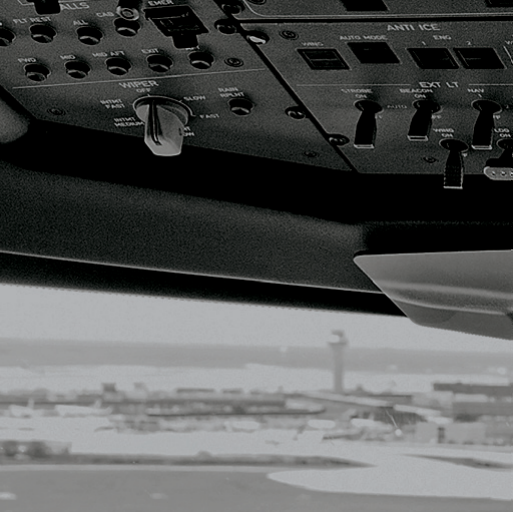

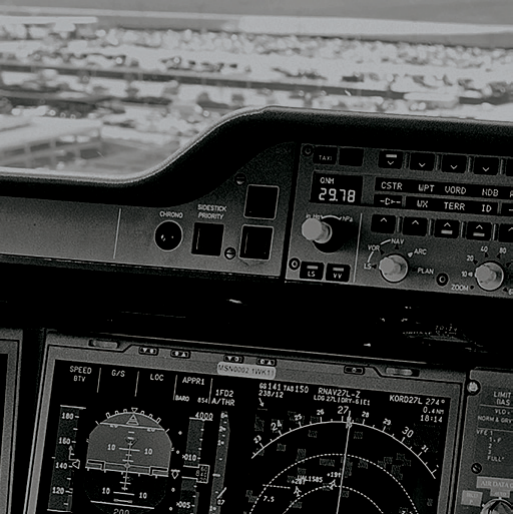
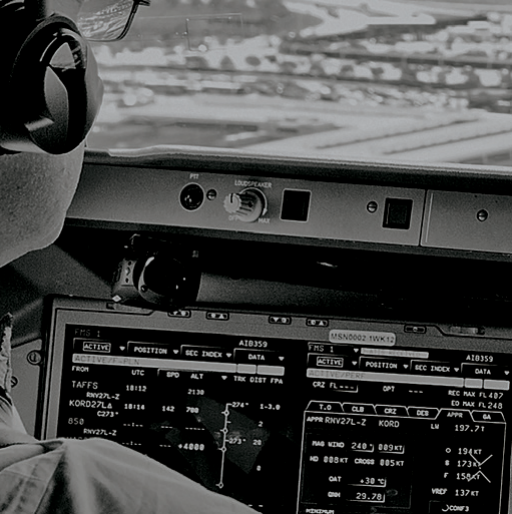
The best position for a pilot to fl y is not left to chance. It is the result of detailed analysis and design that provides the optimum seating position for both the Pilot Flying (PF) and the Pilot Monitoring (PM) to safely and comfortably operate their aircraft.

It may be surprising that something as simple as the pilot’s seat positioning can play a key role in the safe flying of an aircraft. This is why it is important to pay close attention to the seat adjustment phase during the “Before pushback and start” part of the Standard Operating Procedures (SOP). This article will describe the principle of Eye Reference Point and how this is pivotal in the design of an Airbus aircraft’s cockpit. It will also illustrate how a pilot seated in the correct position will avoid the potential consequences from operating the aircraft with a poorly adjusted seating position.
CERTIFICATION REQUIREMENTS
Section titled “CERTIFICATION REQUIREMENTS”Regulations require that the aircraft manufacturer provides a means which will aid the pilots to position themselves with precision and allowing them to have the best point of view from their seat. This is defined by the EASA CS 25.773 and FAA FAR 25.773.
A pilot who is between 1.58 m (5ft 2 inches) to 1·91 m (6ft 3 inches) tall shall have easy access to all of the aircraft’s controls in the cockpit and this is stipulated by EASA CS 25.777. This requirement ensures that the design fits to the vast majority of pilots.
When the pilots align themselves with the eye reference point, they will have adopted the optimum position to operate the aircraft.
These requirements are taken into account when a reference point is provided for the design of any cockpit. It is often referred to as the design eye position and also called eye reference point.
THE EYE REFERENCE POINT
Section titled “THE EYE REFERENCE POINT”Modern aircraft cockpits are built around the eye reference point. It is used to size the cockpit windows and define the location of all the controls, displays and instruments.
When the pilots align themselves with the eye reference point, they will have adopted the optimum position to operate the aircraft.
An optimized field of view
Section titled “An optimized field of view”The cockpit is designed so that when the pilot has aligned themselves to the eye reference point; all of the instruments and displays on the front panel are in their field of view (fig.1).
(fi g.2)
Section titled “(fi g.2)”Cut-off angle
A pilot needs to have good situational awareness during a fl ight. Alignment using the eye reference point enables the pilots to have an optimal fi eld of view through the cockpit’s windows to see what is around them outside the aircraft. The eye reference point position ensures the pilot can maintain the best cut-off angle that will provide the longest visual segment (fi g.2). This is especially important to get visual references during Low Visibility Operations (LVO).
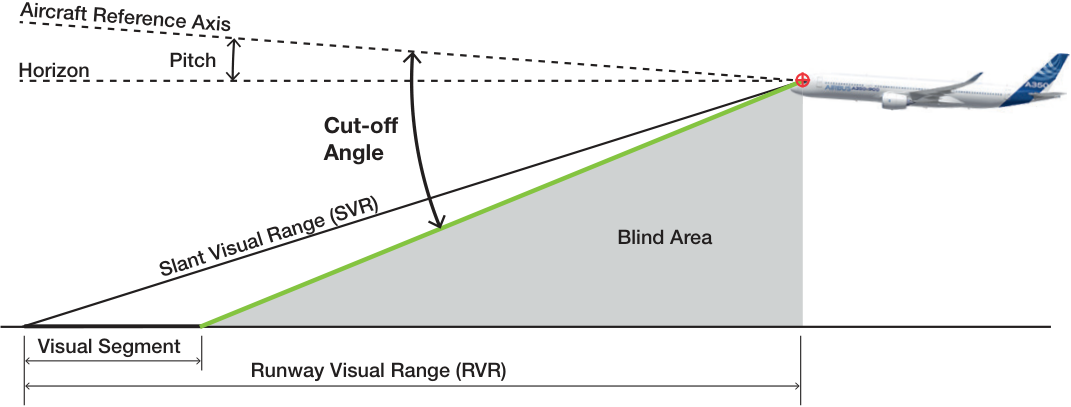
Having a consistent viewpoint gives several operational advantages such as easing the handling of the aircraft by providing pilots with a consistent visual reference, repeatable at every fl ight. This is especially useful during fi nal approach to be familiarized with the fi nal approach path angle and also for the fl are phase.
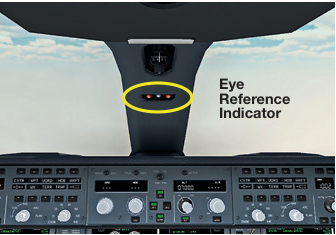
Since the A300 Airbus has provided an eye reference indicator on the centre structure of the windshield in all Airbus aircraft (fi g.3). It enables fl ight crew to adjust their seat position so that their eyes position matches the eye reference point. The indicator is a device that is fi tted with 3 balls painted red or white. To achieve a correct seating position, pilots must align the red and white ball meaning that the white ball is hidden when in the correct position.
(fi g.3)
Section titled “(fi g.3)”Example of the eye reference indicator in the A350
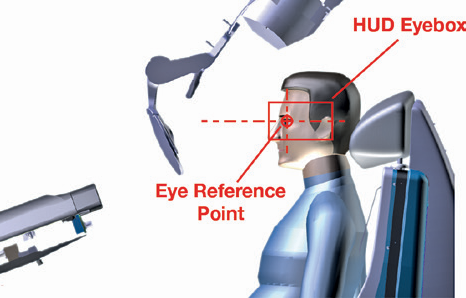
HUD symbols are fully visible when the pilot’s eyes are closest to the eye reference point. An “eye box” is defi ned as an area around the eye reference point that gives a position tolerance range (fi g.4). Hence the pilot correctly sees indications on the HUD when their eyes are positioned inside this virtual box. The HUD eye box area extends further aft than forward to allow HUD readability when seated in a more reclined position for comfort.
(fig.4)
Section titled “(fig.4)”HUD eyebox principle
An optimized access to aircraft controls
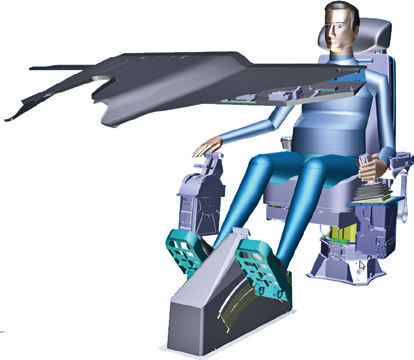
Section titled “An optimized access to aircraft controls”A pilot properly seated with their seat harness fastened is able to reach and operate all of the aircraft’s controls through their full range of motion or deflection as it is defined by the design certification requirements (fig.5).
(fig.5) 3D model to visualize the access to flight controls
What if seated too low?
Section titled “What if seated too low?”A pilot seated in a position that is too low may have difficulties to reach all of the system controls located on overhead panel.
On ground, if seated too low while taxiing the aircraft, the pilots’ situational awareness can be impaired to an extent where it may increase the risk of collision with airbridges, buildings, ground support vehicles or other aircraft on the ramp.
In flight, if pilots position themselves too low, during final approach their perception of the flight path angle may be inaccurate.
In flight, if pilots position themselves too low, during final approach their perception of the flight path angle may be inaccurate.
Eye Reference Point
Section titled “Eye Reference Point”Aircraft Reference Axis
Section titled “Aircraft Reference Axis”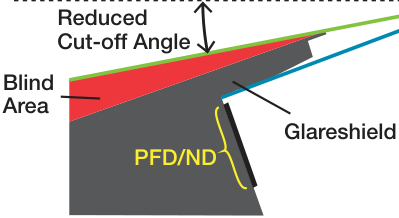
Impact of a too low seating position
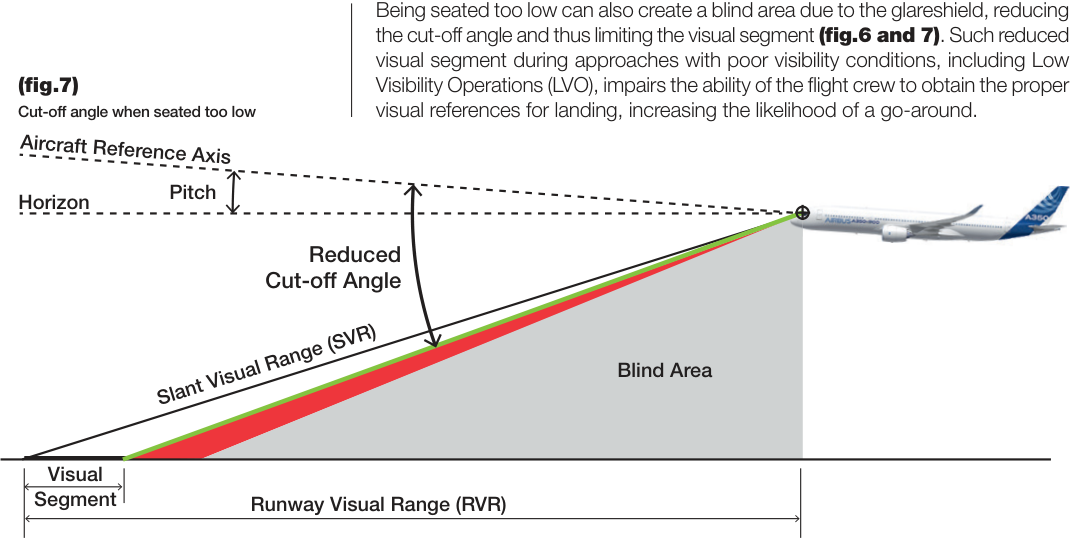
Towards the end of a fl ight, especially for long sectors, the pilot’s position may change due to muscle fatigue often causing them to adopt a position that is lower than at the beginning of the fl ight. Before commencing the approach, it is recommended to re-adjust the seating position to make to reconfi rm that their visual reference is aligned with eye reference point and their position is adjusted accordingly.
What if seated too high?
Section titled “What if seated too high?”If the pilot has adjusted their seat to a position that is too high, then the same effect can be experienced as for a pilot who has positioned themselves too low. During fi nal approach, the perception of the fl ight path angle may also be inaccurate.
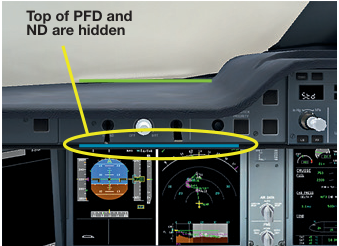
If the pilots’ eye level is above the eye reference point, then the glareshield impairs their view of the instrument panel and in some cases, hides the upper PFD and ND from view (fi g.8).
(fi g.8) Impaired view on the instrument panel when seated too high
Eye Reference Point
Section titled “Eye Reference Point”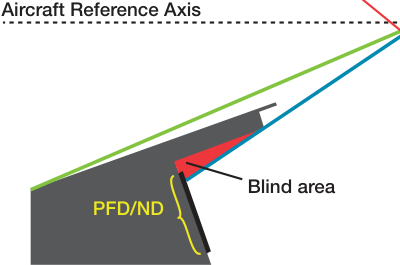
BEST PRACTICE
Section titled “BEST PRACTICE”During the cruise flight phase where the pilots’ eye level alignment is not as critical, for increased comfort, it is common practice for the pilots to adjust their seat to be out of the eye reference point position. However, and to be prompt to face any unexpected situation, the pilots should still ensure that they can reach all of the flight controls and their view of the control panels is not impaired.
ADJUSTMENT PROCEDURE
Section titled “ADJUSTMENT PROCEDURE”The flight crew must adjust their seating position before the aircraft moves, typically before the pushback or engine start according to the FCOM SOP.
How does a pilot adjust their seat to position themselves correctly?
Step 1: Adjust the seat longitudinal and vertical position to align your eye-level with the eye reference indicator and also check that the glareshield does not obstruct the view the upper PFD and ND (fig.9).
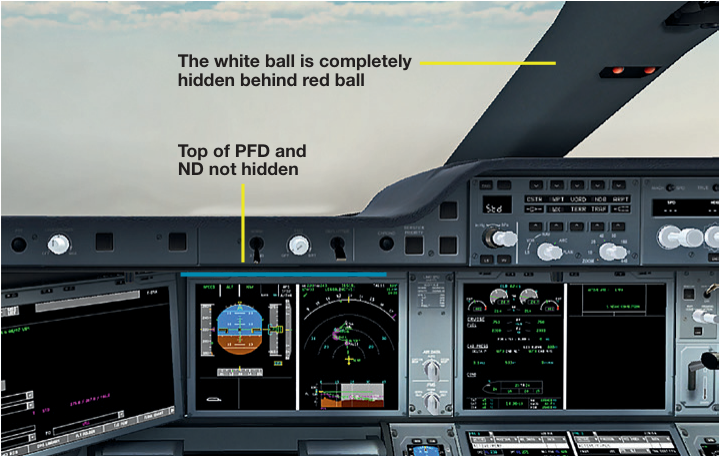
Correct seat adjustment
Step 2: Adjust the armrest to a position where your hand can grip the sidestick naturally without stretching the forearm and with a straight wrist. If the armrest is correctly adjusted, your forearm should rest comfortably on the armrest and you will only need to move your hand and fingers to give the appropriate inputs to the sidestick (fig.10).
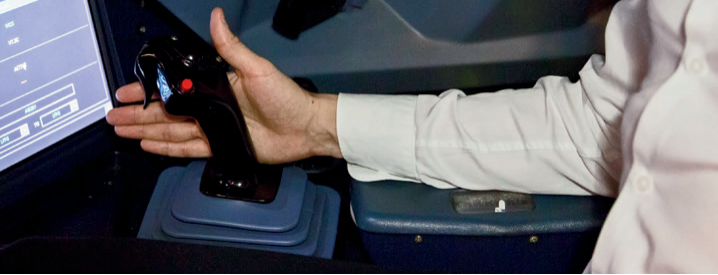
(fig.10) Correct armrest adjustment
Step 3: Adjust the Pedals position using the adjustment lever. Ensure the pedals can be moved through their full range of motion with your feet they can be fully deflected and that full manual braking can be applied.
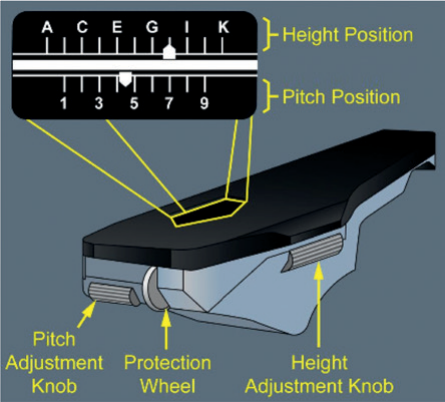
Tip: Take a note of the positions of both the armrest and pedals on their associated position indicators when your adjustment settings are correct and comfortable to save time when making seat adjustments for your next flights (fig.11).
(fig.11) Armrest position indicator
An armrest that is not properly adjusted makes it more difficult to make the appropriate inputs during manual flying.
The importance of armrest and pedals adjustment
Section titled “The importance of armrest and pedals adjustment”A correct armrest adjustment for a comfortable and precise manual flying
Section titled “A correct armrest adjustment for a comfortable and precise manual flying”The hand is the most dexterous part of the body that is most capable to perform the movements of the sidestick with the most precision. When the pilot’s armrest is adjusted correctly, their hand is in a comfortable position without any strain on the wrist, allowing for accurate inputs on the sidestick. An armrest that is not properly adjusted makes it more difficult to make the appropriate inputs during manual flying and a pilot can be more prone to overreaction and make excessive command inputs on the sidestick.
In addition, in turbulent conditions, the armrest stabilizes the pilot’s arm to avoid involuntary sidestick inputs due to vibrations.
An incorrect rudder pedals adjustment can have strong impact in some phases of flight
Section titled “An incorrect rudder pedals adjustment can have strong impact in some phases of flight”The ability to move the rudder pedal through their full range of motion is crucial.
The ability to move the rudder pedal through their full range of motion is especially crucial during the takeoff roll and initial climb after lift-off in the case of an engine failure or strong crosswinds. It is also a critical control input that is necessary during the flare and roll out in engine out or in crosswind landing conditions.
When on the ground, the pilots’ seat and pedals positions must enable the pilot to apply maximum manual braking if it is required following a rejected takeoff roll or should it be required after landing.
CONTRIBUTORS:
Section titled “CONTRIBUTORS:”Maurice GARNIER Displays/Warning/ HUD Systems Engineering
Gilles MARQUET Cockpit Design Engineering
Vincent SIBELLE Expert Pilot Flight Operations Support
Adjusting the seat position may be sometimes seen as an inconsequential step in the SOP. However, a poorly adjusted seating position can have significant effect on the pilot’s capability to make appropriate control inputs when flying or taxiing the aircraft.
Adjusting the seat to be correctly positioned with the pilots’ eyes level aligned with the Eye Reference Point ensures that all of the aircraft flight controls and systems control panels can be reached and operated properly. It is also crucial to ensure full visibility of all the instruments or displays in the cockpit. Finally, it provides the optimum position for the pilot’s field of view from the aircraft to enhance their situational awareness and have a correct perception of the flight path angle during approach.
Flight crew should keep in mind that a seating adjustment done at the right time ensures comfort and accurate aircraft handling in the critical phases of flight.
Safety fi rst
Section titled “Safety fi rst”Safety fi rst, #25 January, 2018. Safety fi rst is published by Airbus S.A.S. - 1, rond point Maurice Bellonte - 31707 Blagnac Cedex/France. Publisher and Editor: Yannick Malinge, Chief Product Safety Offi cer. Concept Design by Airbus Multi Media Support 20172357. Reference: X00D16031905 Issue 25. Photos by Airbus, A. Tchaikovski, S. Ramadier, P. Masclet, Lindner Fotografi e, P. Pigeyre, JB. Accariez, A. Doumenjou. Computer renderings by Fixion.
来源: Airbus Safety First 网址: https://safetyfirst.airbus.com/are-you-properly-seated/ 发布日期: 2018-01-29 杂志期号: 2018-01 类别: 飞行运营、平视显示器、位置、座椅、座椅调节、座位姿势 PDF: 原始 PDF
飞行员飞行的最佳姿势并非偶然决定,而是经过详细分析和设计的结果,旨在为飞行飞行员(PF)和监控飞行员(PM)提供安全、舒适地操作飞机的最佳座位姿势。
飞行员座椅位置的调整看似简单,却可能在飞行安全中发挥关键作用,这或许令人惊讶。正因如此,在标准操作程序(SOP)的”推出并启动前”阶段密切关注座椅调节至关重要。本文将阐述眼参考点的原理,以及它在空客飞机驾驶舱设计中的关键作用。同时还将说明,飞行员坐在正确位置将如何避免因座椅调节不当而操作飞机可能带来的后果。
法规要求飞机生产商提供一种手段,帮助飞行员精确地确定自身位置,并使其从座位上获得最佳视野。这在 EASA CS 25.773 和 FAA FAR 25.773 中有明确定义。
身高在 1.58 米(5 英尺 2 英寸)至 1.91 米(6 英尺 3 英寸)之间的飞行员应能方便地触及驾驶舱内所有控制装置,这由 EASA CS 25.777 规定。该要求确保设计适用于绝大多数飞行员。
当飞行员将自身与眼参考点对齐时,他们即已采用操作飞机的最佳姿势。
在驾驶舱设计的参考点提供时,这些要求已被纳入考量。它通常被称为设计眼位,也称为眼参考点。
现代飞机驾驶舱以眼参考点为中心设计。它用于确定驾驶舱窗户的尺寸,并定义所有控制装置、显示器和仪表的位置。
当飞行员将自身与眼参考点对齐时,他们即已采用操作飞机的最佳姿势。
优化的视野范围
Section titled “优化的视野范围”驾驶舱的设计确保当飞行员将自身与眼参考点对齐时,前面板上的所有仪表和显示器均处于其视野范围内 (图 1)。
截断角度
飞行员在飞行过程中需要良好的情景意识。使用眼参考点进行对齐,使飞行员能够通过驾驶舱窗户获得最佳视野,观察飞机外部周围环境。眼参考点位置确保飞行员能够保持最佳截断角度,从而提供最长的视觉段落 (图 2)。这在低能见度运行(LVO)期间获取目视参考尤为关键。
保持一致的视点带来多种操作优势,例如通过为飞行员提供一致的目视参考来简化飞机操控,且每次飞行均可重复获得。这在最后进近阶段尤其有用,飞行员可以熟悉最后进近航径角以及拉平阶段。
自 A300 以来,空客在所有空客飞机的风挡中央结构上提供了眼参考指示器 (图 3)。它使飞行机组能够调节座椅位置,使眼睛位置与眼参考点相匹配。该指示器是一个装配有三个红白双色球的装置。要达到正确的座位姿势,飞行员必须使红色和白色球对齐,即在正确位置时白色球被遮挡。
(fig.3)
Section titled “(fig.3)”A350 上眼位参考指示器的示例
当飞行员的眼睛最接近眼位参考点时,HUD 符号可完整显示。“目视区”(eye box)定义为眼位参考点周围的一个区域,提供位置容许范围 (图4)。因此,当飞行员的眼睛位于这个虚拟方框内时,即可正确看到 HUD 上的显示信息。HUD 目视区向后延伸的范围大于向前,以允许飞行员在更为后仰的舒适坐姿下仍能读取 HUD 信息。
(fig.4)
Section titled “(fig.4)”HUD 目视区原理
优化的飞机操控器件触及性
Section titled “优化的飞机操控器件触及性”按照设计取证要求,飞行员以正确坐姿系好座椅安全带后,应能够在整个运动或偏转范围内触及并操作所有飞机操控器件 (图5)。
(图5) 用于可视化飞行操控器件触及性的 3D 模型
坐得太低会怎样?
Section titled “坐得太低会怎样?”坐姿过低的飞行员可能难以触及顶板上的所有系统操控器件。
在地面滑行时,如果坐得太低,飞情景势意识可能会受到一定程度的影响,可能增加与廊桥、建筑物、地面保障车辆或机坪上其他飞机发生碰撞的风险。
在飞行中,如果飞行员坐姿过低,在最后进近时对航径角的感知可能不准确。
在飞行中,如果飞行员坐姿过低,在最后进近时对航径角的感知可能不准确。
飞机参考轴线
Section titled “飞机参考轴线”
坐姿过低的影响
在航班临近结束时,特别是远程航段,由于肌肉疲劳,飞行员的姿态可能会发生变化,往往会导致坐姿比航班开始时更低。建议在开始进近前重新调整坐姿,以确保视觉参考与眼位参考点对齐,并相应调整自身位置。
坐得太高会怎样?
Section titled “坐得太高会怎样?”如果飞行员将座椅调整到过高的位置,可能与坐得太低的飞行员遇到相同的影响。在最后进近时,对航径角的感知同样可能不准确。
如果飞行员的眼位高于眼位参考点,则防眩光板会遮挡仪表板的视野,在某些情况下还会遮蔽上方的 PFD 和 ND (图8)。
(图8) 坐姿过高时仪表板视野受阻
在巡航飞行阶段,飞行员的眼位对准要求并非关键,为增加舒适度,飞行员通常会将座椅调整到偏离眼位参考点的位置。然而,为能迅速应对任何突发状况,飞行员仍应确保能够触及所有飞行操控器件,且控制面板的视野不受影响。
按照 FCOM 标准操作程序,飞行机组必须在飞机移动前调整坐姿,通常是在推车或发动机启动前。
飞行员如何调整座椅以正确定位?
第一步: 调整座椅的纵向和垂直位置,使眼位与眼位参考指示器对齐,同时检查防眩光板是否遮挡了上方 PFD 和 ND 的视野 (图9)。
正确的座椅调整
第二步: 调整扶手至适当位置,使手能够自然握住侧杆而不必伸展前臂,手腕保持平直。如果扶手调整正确,前臂应舒适地搭在扶手上,只需移动手和手指即可向侧杆输入适当的指令 (图10)。
(图10) 正确的扶手调整
第三步: 使用调节杆调整蹬舵位置。确保双脚能够将蹬舵移动到整个行程范围内,使其能够完全偏转,并且能够实施完全人工刹车。
小贴士: 当调整到正确且舒适的位置时,记下扶手和蹬舵在相应位置指示器上的位置,以便下次飞行时进行座椅调整节省时间 (图11)。
(图11) 扶手位置指示器
扶手调整不当会使人工飞行时更难进行适当的输入。
扶手和脚蹬调节的重要性
Section titled “扶手和脚蹬调节的重要性”正确的扶手调节以实现舒适且精准的手动飞行
Section titled “正确的扶手调节以实现舒适且精准的手动飞行”手是身体最灵巧的部位,最能够精准地操控侧杆。当飞行员的扶手调节正确时,手处于舒适的位置,手腕不受任何压力,能够在侧杆上进行精确的输入。扶手调节不当会使手动飞行期间更难进行适当的输入,飞行员更容易反应过度并在侧杆上做出过度的指令输入。
此外,在颠簸条件下,扶手可以稳定飞行员的手臂,避免因振动而产生无意识的侧杆输入。
不正确的方向舵脚蹬调节可能对某些飞行阶段产生重大影响
Section titled “不正确的方向舵脚蹬调节可能对某些飞行阶段产生重大影响”能够将方向舵脚蹬移动到其整个行程范围至关重要。
在起飞滑跑和离地后初始爬升阶段,特别是在一台发动机失效或强侧风的情况下,这种能力尤为重要。这也是在发动机失效或侧风着陆条件下进行拉平和平滑减速所需的关键控制输入。
当在地面时,飞行员的座椅和脚蹬位置必须能够使飞行员在中止起飞滑跑后或着陆后需要时施加最大手动制动。
Maurice GARNIER 显示/警告/HUD 系统工程
Gilles MARQUET 驾驶舱设计工程
Vincent SIBELLE 试飞员飞行运行支持
调节座椅位置有时被视为标准操作程序中无关紧要的步骤。然而,座椅位置调节不当会对飞行员操控飞机飞行或滑行时做出适当控制输入的能力产生重大影响。
将座椅调节至与眼睛基准点平齐的正确位置,可确保所有飞机飞行控制和系统控制面板能够被正确触及和操作。同时,这对于确保驾驶舱内所有仪表或显示器的完整视野也至关重要。最后,它为飞行员提供了从飞机向外观察的最佳视野位置,可增强其态势感知并在进近期间正确感知航迹角。
飞行机组应记住,在适当时间进行的座椅调节可确保在关键飞行阶段的舒适性和精确的飞机操控。
Safety first
Section titled “Safety first”Safety first,第25期 2018年1月。Safety first 由空中客车公司出版——法国布拉尼亚克市莫里斯·贝尔东环路1号,31707 Cedex。出版人和编辑:首席产品安全官 Yannick Malinge。概念设计:空中客车多媒体支持 20172357。参考编号:X00D16031905 第25期。照片:空中客车、A. Tchaikovski、S. Ramadier、P. Masclet、Lindner Fotografie、P. Pigeyre、JB. Accariez、A. Doumenjou。计算机渲染:Fixion。