Automatic NAV engagement at Go-around
Source: Airbus Safety First URL: https://safetyfirst.airbus.com/automatic-nav-engagement-at-go-around/ Published: 2011-01-14 Magazine Issue: 2011-01 Category: Archive PDF: Original PDF
Stéphane GRANGER a320 Family autoflight system Manager Design office
Eric JEANPIERRE system Manager a320 Family program
Automatic NAV engagement at Go Around
Section titled “Automatic NAV engagement at Go Around”1. Introduction
Section titled “1. Introduction”Whatever the reasons to perform a Go Around, the need has arisen for an automatic engagement of Navigation (NAV) mode.
To meet this increasing interest, an operational enhancement called “NAV in Go Around” has been developed by Airbus.
This article presents the operational context, and the solution proposed with its advantages.
2. Operational context
Section titled “2. Operational context”2.1. Go Around options
Section titled “2.1. Go Around options”The crew must always be prepared for a Go Around, even though it is an infrequent occurrence.
After the initiation of a Go Around, there are two options:
q In the most probable one, the crew follows the published Missed Approach procedure.
q Otherwise, if cleared by ATC, the crew follows a constant heading. The heading target can be preset by the crew during the approach.
2.1. current Go Around procedure
Section titled “2.1. current Go Around procedure”The Go Around is systematically initiated by pushing the thrust levers to TOGA.
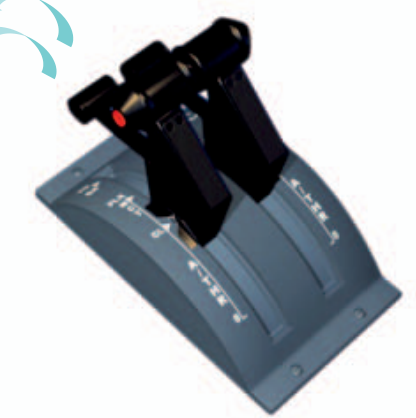
This ensures the engagement of the Go Around Track (GA TRK) Auto Pilot and/or Flight Director lateral mode[1].
The FMS entered published Missed Approach procedure becomes part of the ACTIVE F-PLN and the previously flown approach is strung back into the F-PLN at the end of the Missed Approach procedure.
The GA TRK mode guides the aircraft on a constant track (which is the current track when the Go Around is initiated with wings level).
Once the Go Around is initiated, the crew will likely fly the published Missed Approach procedure: the Pilot Flying (PF) or the Pilot Non Flying (PNF) will have to engage the NAV mode by pushing the HDG/ TRK selector on the Flight Control Unit (FCU).
Therefore, in the most probable Go Around scenario, the crew will perform two main actions (as far as the Autoflight system is concerned):
q Push the thrust levers to TOGA
q Push the HDG/TRK selector.
2.2. Objectives of the modification
Section titled “2.2. Objectives of the modification”The modification reduces the crew workload, and limits the potential deviations from the required flight path when performing a Go Around.
It covers the most probable Go Around scenario, where the crew has to follow the published Missed Approach procedure. Moreover, it makes the Go Around procedure as similar as possible to the Take Off procedure.
Finally, in the context of RNP-AR operations where the aircraft is more likely to be in a turn, it will not interrupt the turn in case of a Go Around.
1: As well as the Speed Reference System (SRS) Auto Pilot and/or Flight Director longitudinal mode, if the aircraft is not in a clean configuration.
Safety
3. Principle of the modification
Section titled “3. Principle of the modification”The principle is to keep the NAV mode engaged or, if a valid flight plan exists, to arm the NAV mode at the initiation of the Go Around. The pilot does not need to push the FCU selector anymore: the new logics do it automatically.
The Auto Flight System automatically follows the published Missed Approach procedure.
The AP/FD modes engaged are identical to the modes that would have been engaged by pushing on the FCU “HGD-TRK” selector immediately after the Go Around:
q In a non-precision approach with managed lateral guidance (NAV, APP NAV or FINAL APP), the NAV mode is kept engaged.
q In a non-precision approach with selected lateral guidance (HDG or TRK), the HDG or TRK mode is kept engaged and the NAV mode is automatically armed (if a valid flight plan exists).
q In a precision approach (ILS, MLS or GLS) or in a FLS / Mixed LOCVNAV approach, the GA TRK mode is initially engaged (as currently) and the NAV mode is automatically armed (if a valid flight plan exists and if no heading preset has been selected during the approach).
In other words, the AP/FD mode engagement sequence is strictly the same as when the pilot pushes the thrust levers to TOGA and pushes the HDG/TRK FCU selector.
The “NAV in Go Around” modification does not modify the aircraft behaviour on the longitudinal axis.
4. Typical operational scenarios
Section titled “4. Typical operational scenarios”Go Arounds during Precision Approaches are typically performed when visibility conditions are not met at the Decision Altitude/Height (DA/DH). The Standard Operating Procedures specify that a Go Around is performed by setting both thrust levers to TOGA.
The following table illustrates the reduction in workload introduced by the “NAV in Go Around” modification.
Section titled “The following table illustrates the reduction in workload introduced by the “NAV in Go Around” modification.”without with “NAV in Go Around” modification “NAV in GO Around” modification TOGA thrust is applied When TOGA thrust is applied, and the SRS / GA TRK modes are engaged. the SRS / GA TRK modes are engaged. In addition, the NAV mode is automatically armed without any crew action on the FCU. The crew has to arm the NAV mode manually by pushing on the FCU HDG/TRK knob. Then, the FMA displays the NAV mode. The NAV mode engages immediately (or as soon as the aircraft passes above 100ft if the Go Around has been initiated below 100 ft). The aircraft is guided along the Missed Approach procedure.
The “NAV in Go Around” modification does not change operational procedures in the following scenarios:
Section titled “The “NAV in Go Around” modification does not change operational procedures in the following scenarios:”q Go Around in Heading mode with a heading preset
Section titled “q Go Around in Heading mode with a heading preset”When cleared by ATC to follow a constant heading in case of Missed Approach, the crew may preset the heading on the FCU. If a Go Around is initiated, the NAV mode is not automatically armed (priority is given to the preset). The crew will then just have to pull the FCU HDG/TRK knob to engage the Heading mode.
q Go Around in Heading mode without heading preset
Section titled “q Go Around in Heading mode without heading preset”In case of a late clearance from ATC to follow a constant heading after the Go Around (no heading preset), the crew will have to turn the FCU HDG/TRK knob to select the heading target then pull to engage the Heading mode. In this case, the NAV mode is automatically armed then engaged at Go Around until the pull action on the FCU.
Impact on aircraft and associated MOd and Sb
Section titled “Impact on aircraft and associated MOd and Sb”For the A320 Family, A330/A340 and A380, the activation of the function requires the following:
q The hardware pin programming of each FMG(E)C or software pin programming of each PRIM computers, and if required, the upgrade of the flight guidance or PRIM software.
q The update of volumes: 1.22.30, 3.03.2, 4.05.80. of the Flight Crew Operating Manual (FCOM).
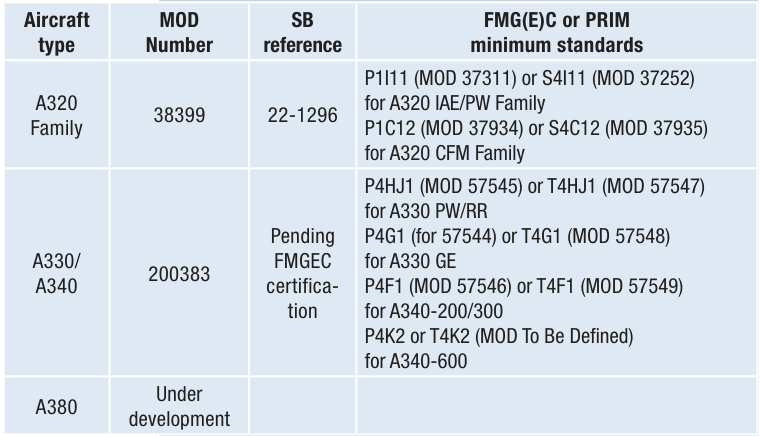
With the “NAV in Go Around” modification, the NAV mode is automatically armed at the initiation of the Go Around[2] . The mode will then engage as soon as the capture conditions are met.
This modification reduces the crew workload, and limits the potential deviations from the required flight path, when performing a Go Around.
The new logics are consistent with the most probable Missed Approach scenario and are essential for specific operations such as low RNP.
A320 Family
Section titled “A320 Family”The “NAV in Go Around” modification will become the production standard starting from: A318: MSN 4169 A319: MSN 4522 A320: MSN 4674 A321: MSN 4560
It will also be included in the low RNP modification packages (MOD 38073 Low RNP step2+, MOD 150371 / 150372 / 150373 Low RNP step 3 and MOD 151180 RNP 0.3 AR).
A330/A340
Section titled “A330/A340”The “NAV in Go Around” modification will become the production standard, MSN to be confirmed.
It will also be included in the low RNP modification packages (MOD 200192 Low RNP step 2 for FMS R1A Thales on the A330 and new MODS RNP step 2 for FMS R1A Honeywell on the A330 and A340-500/600).
The “NAV in Go Around” modification will become the production standard, MSN to be confirmed.
2 : If no heading preset.
Safety
Stéphane GRANGER A320 系列自动飞行系统主任设计师
Eric JEANPIERRE A320 系列项目系统经理
自动导航在复飞时的自动启动
Section titled “自动导航在复飞时的自动启动”无论执行复飞的原因是什么,对导航(NAV)模式自动启动的需求日益增长。
为满足这一日益增长的需求,空客开发了名为“复飞时自动启动导航”的操作增强功能。
本文介绍运营背景、所提出的解决方案及其优势。
2. 运营背景
Section titled “2. 运营背景”2.1. 复飞选项
Section titled “2.1. 复飞选项”即使复飞并不常见,机组必须始终做好复飞的准备。
复飞启动后,有两种选项:
- 在最常见的情况下,机组遵循公布的复飞程序。
- 否则,如果得到 ATC 许可,机组保持恒定航向飞行。航向目标可在进近过程中由机组预先设定。
2.1. 当前复飞程序
Section titled “2.1. 当前复飞程序”复飞通过将推力手柄推至 TOGA 来启动。
这确保了复飞航迹(GA TRK)自动驾驶仪和/或飞行指引仪横侧模式[1]的启动。
FMS 中输入的已公布复飞程序成为生效的 F-PLN 的一部分,此前执行的进近程序被回接至复飞程序的末端。
GA TRK 模式沿恒定航迹(当复飞启动时机翼水平,则为当前航迹)引导飞机。
复飞一旦启动,机组很可能需要遵循公布的复飞程序:操纵飞行员(PF)或监控飞行员(PNF)需要按下飞行控制组件(FCU)上的 HDG/TRK 选择器来启动 NAV 模式。
因此,在最常见的复飞场景中,就自动飞行系统而言,机组将执行两个主要动作:
- 将推力手柄推至 TOGA
- 按下 HDG/TRK 选择器。
2.2. 改装目标
Section titled “2.2. 改装目标”该改装降低了机组工作负荷,并在执行复飞时减少了对所需飞行航径产生偏差的可能性。
它涵盖了最常见的复飞场景,即机组需要遵循公布的复飞程序的情况。此外,它使复飞程序尽可能与起飞程序相似。
最后,在 RNP-AR 运行环境中,飞机更可能处于转弯状态,该功能不会在复飞时中断转弯。
1:以及速度基准系统(SRS)自动驾驶仪和/或飞行指引仪纵向模式(如果飞机不在光洁构型)。
3. 改装原理
Section titled “3. 改装原理”其原理是在复飞启动时保持 NAV 模式启动,或在存在有效飞行计划时预位 NAV 模式。飞行员不再需要按压 FCU 选择器:新的逻辑自动完成这一操作。
自动飞行系统自动遵循公布的复飞程序。
所启动的 AP/FD 模式与在复飞后立即按压 FCU“HDG-TRK”选择器所启动的模式完全相同:
- 在采用管理式横侧引导的非精密进近中(NAV、APP NAV 或 FINAL APP),保持 NAV 模式启动。
- 在采用选择式横侧引导的非精密进近中(HDG 或 TRK),保持 HDG 或 TRK 模式启动,并自动预位 NAV 模式(如果存在有效飞行计划)。
- 在精密进近(ILS、MLS 或 GLS)或 FLS/混合 LOC VNAV 进近中,最初启动 GA TRK 模式(如目前一样),并自动预位 NAV 模式(如果存在有效飞行计划且在进近过程中未选择预设航向)。
换言之,AP/FD 模式启动顺序与飞行员将推力手柄推至 TOGA 并按压 HDG/TRK FCU 选择器时完全相同。
“复飞时自动启动 NAV”改装不改变飞机在纵轴上的行为。
4. 典型运营场景
Section titled “4. 典型运营场景”精密进近中的复飞通常在决断高度/高(DA/DH)处不能达到能见度条件时执行。标准操作程序规定通过将两个推力手柄设置至 TOGA 来执行复飞。
下表说明了“复飞时自动启动 NAV”改装所降低的工作负荷。
| 无“复飞时自动启动 NAV”改装 | 有“复飞时自动启动 NAV”改装 |
|---|---|
| 推至 TOGA 推力 | 推至 TOGA 推力时,SRS/GA TRK 模式启动。 |
| 机组需通过按压 FCU HDG/TRK 旋钮手动预位 NAV 模式。然后,FMA 显示 NAV 模式。 | NAV 模式立即启动(或如果在 100 ft 以下启动复飞,则在飞机高于 100 ft 后尽快启动)。 |
| 飞机沿复飞程序引导。 |
“复飞时自动启动 NAV”改装在以下场景中不改变操作程序:
Section titled ““复飞时自动启动 NAV”改装在以下场景中不改变操作程序:”-
使用预设航向的航向模式复飞
当在复飞情况下得到 ATC 许可遵循恒定航向时,机组可在 FCU 上预设航向。如果启动复飞,NAV 模式不会自动预位(优先级给予预设航向)。机组只需拉出 FCU HDG/TRK 旋钮即可启动航向模式。
q 使用航向模式复飞且无航向预设
Section titled “q 使用航向模式复飞且无航向预设”若ATC在复飞后给出迟发的航向恒定指令(无航向预设),机组需转动FCU HDG/TRK旋钮选择航向目标,然后拉出以衔接航向模式。在此情况下,NAV模式将在复飞时自动预位,随后保持预位状态直到FCU上的拉出动作。
对飞机及相关改装和服务通告的影响
Section titled “对飞机及相关改装和服务通告的影响”对于A320系列、A330/A340和A380,启用此功能需要满足以下条件:
q 每个FMGEC的硬件引脚编程或每个PRIM计算机的软件引脚编程,必要时升级飞行指引或PRIM软件。
q 更新飞行机组操作手册(FCOM)的卷册:1.22.30、3.03.2、4.05.80。
通过”复飞时NAV模式”改装,NAV模式在复飞启动时自动预位[2]。该模式将在截获条件满足后立即衔接。
此改装减轻了机组工作负荷,并降低了执行复飞时偏离要求飞行轨迹的潜在风险。
新逻辑与最可能的复飞情景相一致,对于低RNP等特定运行至关重要。
A320系列
Section titled “A320系列”“复飞时NAV模式”改装将从以下MSN起成为生产标准: A318: MSN 4169 A319: MSN 4522 A320: MSN 4674 A321: MSN 4560
该改装还将包含在低RNP改装包中(MOD 38073 低RNP第2步+、MOD 150371/150372/150373 低RNP第3步以及MOD 151180 RNP 0.3 AR)。
A330/A340
Section titled “A330/A340”“复飞时NAV模式”改装将成为生产标准,MSN待确认。
该改装还将包含在低RNP改装包中(MOD 200192 A330 Thales FMS R1A低RNP第2步,以及A330和A340-500/600的Honeywell FMS R1A新RNP第2步改装)。
“复飞时NAV模式”改装将成为生产标准,MSN待确认。
[2]:若无航向预设。
Safety