The SMOKE-FUMES-AVNCS SMOKE Procedure
Source: Airbus Safety First URL: https://safetyfirst.airbus.com/the-smoke-fumes-avncs-smoke-procedure/ Published: 2013-01-14 Magazine Issue: 2013-02 Category: Archive PDF: Original PDF
Safety
Peimann TOFIGHI-NIAKI
Section titled “Peimann TOFIGHI-NIAKI”Senior Engineer, A320 Family/A330/A340 Standards Flight Operations Support and Safety Enhancement
The SMOKE/FUMES/ AVNCS SMOKE Procedure
Section titled “The SMOKE/FUMES/ AVNCS SMOKE Procedure”1. Introduction
Section titled “1. Introduction”Until 2002 the Quick Reference Handbook (QRH) contained six independent smoke procedures. The crew had to decide which one to apply according to the suspected smoke source: CARGO, LAVATORY, CREW REST COMPARTMENT, AVIONICS, AIR COND, CABIN EQUIPMENT.
In practice, it is often difficult to discriminate between the last three sources of fire: AVIONICS, AIR COND, CABIN EQUIPMENT.
The procedures applicable to these sources were therefore merged into the single SMOKE/FUMES/AVNCS SMOKE procedure, thus relieving
the crew from having to flip back and forth through the QRH pages and from repeating actions in case of switch to another suspected smoke source.
The first three sources of smoke - CARGO, LAVATORY, CREW REST COMPARTMENT- , which are easier to trace, have kept their own dedicated procedures.
This article will describe how the Airbus SMOKE/FUMES/AVNCS SMOKE procedure was developed. It will then explain its philosophy, thereby providing guidelines into the decision making process from the early stage of the procedure.
with a LAND ASAP message. In the frame of this procedure, the LAND ASAP message requests crews to be prepared for a diversion.
The “Immediate Landing” term, found in the QRH paper procedure, means: “Accept exceptional circumstances such as a tailwind landing, ditching, off airport landing etc”
2.2 The difficulty to Identify the Smoke Source
Section titled “2.2 The difficulty to Identify the Smoke Source”As stated in the introduction, Airbus decided to classify the known sources of smoke into two different categories:
- q The smoke sources that are easier to locate, because they have an ECAM and/or a local warning, and for which there are available means of fire treatment:
2. Procedure development
Section titled “2. Procedure development”The procedure takes into account three decisive challenges common to non immediately identified sources of smoke:
-
q The shortage of time
-
q The difficulty to identify the smoke source
-
q The need for two ways cockpit/ cabin crew communication.
2.1 The Shortage of Time
Section titled “2.1 The Shortage of Time”In a smoke situation, timing is critical. Studies show that a fire may become uncontrollable in as little as 8 minutes and that, in this case, the fight crew may have as little as 15 minutes to bring the aircraft on the ground.
For this reason the SMOKE/ FUMES/AVNCS SMOKE ECAM and QRH paper procedures both start
-
CARGO
-
LAVATORY
-
CREW REST COMPARTMENT
-
q The smoke sources that are more difficult to locate, which may, or may not, be covered by an ECAM alert and that are considered more difficult to deal with:
-
AVIONICS
-
AIR COND
-
CABIN EQUIPMENT
As stated above, these three smoke sources call for the single SMOKE/ FUMES/AVNCS SMOKE procedure.
note 1
Section titled “note 1”The QRH SMOKE/FUMES/AVNCS SMOKE paper procedure is to be applied whenever the source of smoke is suspected to be AVIONICS, AIR COND, CABIN EQUIPMENT or in case of doubt about the smoke origin. If another smoke warning is triggered (e.g. LAVATORY SMOKE), the flight crew must apply the dedicated existing procedure.
2.3 The Need for two Ways Cockpit/Cabin Communication
Section titled “2.3 The Need for two Ways Cockpit/Cabin Communication”Establishing good two ways communication with the cabin crew is essential in a smoke situation.
In case of smoke in the cabin, the cabin crew should inform the flight crew of the situation as soon as possible and should follow up on smoke dissipation. Vice versa, in case of smoke in the cockpit, the feedback from the cabin crew may prove useful to identify the smoke source.
Communication between cockpit and cabin is important in many situations. However, in a smoke/fire/fumes situation it is so important that Airbus added the CKPT/CABIN COM… ESTABLISH action step in the procedure.
In a smoke situation this message alerts the crew to anticipate the diversion.
Section titled “In a smoke situation this message alerts the crew to anticipate the diversion.”The procedure is then designed around the following action blocks:
-
q Immediate Actions
-
q AT ANY TIME Items
-
q Diversion Decision
-
q Troubleshooting.
3.1 Immediate Actions
Section titled “3.1 Immediate Actions”The first action block of the procedure is referred to as the “Immediate Actions” (fig. 1).
They have been designed to be quick, simple, and reversible. They are actions that will not make the situation worse, and prevent recirculation. They protect the crew and ensure communication. Immediate Actions must be applied without delay and prior to any further assessment from the flight crew.
SMOKE/FUMES/AVNCS SMOKE
Section titled “SMOKE/FUMES/AVNCS SMOKE”LAND ASAP
Section titled “LAND ASAP”APPLY IMMEDIATELY VENT EXTRACT … OVRD CAB FANS …OFF GALLEYS … OFF SIGNS …ON CKPT/CAB COM …ESTABLISH
IF REQUIRED: CREW OXY MASKS …ON/100%/EMERG
Figure 1 Immediate Actions
Figure 2 At AnytIme items
3.2 AT ANY TIME Items
Section titled “3.2 AT ANY TIME Items”3. Procedure Philosophy
Section titled “3. Procedure Philosophy”The trigger of a smoke alert is either an ECAM message, or a visual or olfactory perception of smoke (by either cabin or cockpit crew). As soon as an alert is triggered, for which there is no dedicated procedure, the flight crew must apply the SMOKE/ FUMES/AVNCS SMOKE procedure without delay. Both ECAM and QRH paper procedures are totally compatible with one another.
As mentioned in 2.1, the procedure starts with a LAND ASAP message.
”At ANytIME” items
Section titled “”At ANytIME” items”-
At ANy tIME of the procedure, if smoke/fumes becomes the GREAtESt tHREAt: SMOKE FUMES REMOVAL …CONSIDER ELEC EMER CONFIG …CONSIDER Refer to the end of procedure to set ELEC EMER CONFIG
-
At ANy tIME of the procedure, if situation becomes UNMANAGEAbLE: IMMEDIATE LANDING …CONSIDER
The “AT ANY TIME” items must be applied if the smoke becomes the greatest threat or if the situation becomes unmanageable (fig. 2).
As the name suggests, the flight crew can apply the “AT ANY TIME” items at any stage of the procedure, provided that they have at least completed the immediate actions. These items must be known by memory.
It is important to keep in mind that the smoke removal procedure does not stop the smoke source but rather aims at removing the smoke from the cockpit.
Safety
The electrical emergency configuration aims to shed as much equipment as possible. On the A330/A340 Family, it is important to note that in electrical emergency configuration, smoke removal cannot be performed. Therefore if considered necessary, the smoke removal procedure must be applied before the electrical emergency configuration is set.
Finally, if the situation becomes unmanageable, if the flight crew is not able to maintain the control of the aircraft until an airfield is reached, then an immediate landing is to be considered.
note 2
Section titled “note 2”As mentioned in 2.1, The “Immediate Landing” term, found in the paper SMOKE/FUMES/AVNCS SMOKE procedure, means: “Accept exceptional circumstances such as a tailwind landing, ditching, off airport landing etc”.
3.3 Diversion Decision Making
Section titled “3.3 Diversion Decision Making”The crew should consider the following two questions, which constitute the core of the SMOKE/FUMES/ AVNCS procedure:
- q Is the smoke source immediately obvious, accessible and extinguishable?
isolating different systems and assessing smoke dissipation.
3.4 Troubleshooting
Section titled “3.4 Troubleshooting”Once the diversion is initiated, the troubleshooting may be carried on in an attempt to identify and fight the origin of the smoke. The identification will be undertaken by
The different smoke sources listed for troubleshooting in the procedure appear in the most probable to least probable order.
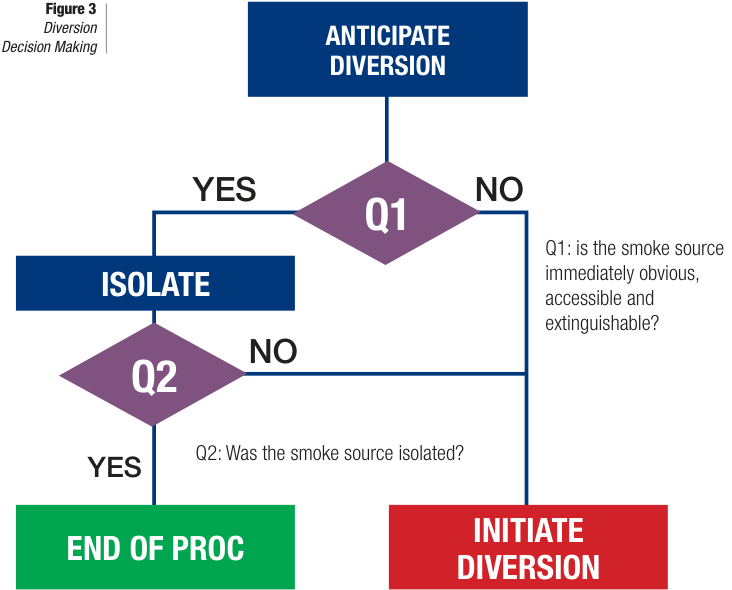
If the answer to these two questions is YES, then this is the end of the procedure.
On the other hand, if the answer to at least one of the two above questions is NO, then the diversion must be initiated. In case of doubt a diversion should be initiated (fig. 3).
tASK SHARING FOR CAbIN CREw
Section titled “tASK SHARING FOR CAbIN CREw”Airbus has developed a precise task sharing for cabin crew, which can be found in the Operator’s Cabin Crew Operating Manual (CCOM), or in the “Getting To Grips with Cabin Safety” publication, available on Airbus World. The task sharing identifies three main roles within a cabin crew working team, each having a specific task to best prevent any escalation of the event.
4. Conclusion
Section titled “4. Conclusion”In 2002 the SMOKE/FUMES/ AVNCS procedure replaced three different smoke procedures applicable to smoke sources that were difficult to locate: AVIONICS, AIR COND, CABIN EQUIPMENT. The other sources of smoke - CARGO, LAVATORY, CREW REST COMPARTMENT- , which are easier to trace, have kept their own dedicated procedures.
The SMOKE/FUMES/AVNCS procedure had to integrate the need to act quickly, the difficulty to identify the smoke source and the necessity to involve both cockpit and cabin crews. Equally, the challenge was to design a single procedure that would cover the largest number of situations while keeping it as simple as possible.
The SMOKE/FUMES/AVNCS procedure starts with an alert to anticipate a diversion and is then designed around four action blocks:
q Immediate Actions q AT ANY TIME Items q Diversion Decision Making q Troubleshooting.
The general action flow calls for the Immediate Actions to be performed first, followed by the decision on whether or not to divert. The troubleshooting actions are performed last.
As implied by the title, the AT ANY TIME items should be performed immediately whenever the smoke/ fumes becomes the greatest threat or whenever the situation becomes unmanageable.
Safety
来源: Airbus Safety First 网址: https://safetyfirst.airbus.com/the-smoke-fumes-avncs-smoke-procedure/ 发布日期: 2013-01-14 杂志期号: 2013-02 分类: 档案 PDF: 原始 PDF
安全
Peimann TOFIGHI-NIAKI
Section titled “Peimann TOFIGHI-NIAKI”高级工程师,A320 系列/A330/A340 标准飞行运行支援与安全改进
烟雾/烟雾异味/AVNCS 烟雾程序
Section titled “烟雾/烟雾异味/AVNCS 烟雾程序”截至 2002 年,快速参考手册 (QRH) 包含六个独立的烟雾程序。机组必须根据可疑的烟雾源决定采用哪一个程序:货舱、厕所、机组休息舱、航电设备、空调、客舱设备。
在实践中,区分后三个烟雾源通常很困难:航电设备、空调、客舱设备。
因此,适用于这些烟雾源的程序被合并为单一的烟雾/烟雾异味/AVNCS 烟雾程序,从而使机组无需在 QRH 页面之间来回翻阅,也无需在切换到另一个可疑烟雾源时重复操作。
前三个烟雾源——货舱、厕所、机组休息舱——由于更容易追踪,仍保留各自专用的程序。
本文将介绍空客烟雾/烟雾异味/AVNCS 烟雾程序的开发过程,并解释其设计理念,从而为该程序早期阶段的决策过程提供指导。
该程序以尽快着陆 (LAND ASAP) 消息开头。在这个程序框架内,LAND ASAP 消息要求机组做好备降准备。
QRH 纸质程序中出现的”紧急着陆”一词的含义是:“接受特殊情况下的着陆,如顺风着陆、水上迫降、机场外着陆等”。
2.2 识别烟雾源的困难
Section titled “2.2 识别烟雾源的困难”如引言所述,空客决定将已知的烟雾源分为两大类:
- q 更容易定位的烟雾源,因为它们有 ECAM 和/或本地警告,且有可用的灭火手段:
2. 程序开发
Section titled “2. 程序开发”该程序考虑了烟雾源未立即识别时常见的三个决定性挑战:
-
q 时间紧迫
-
q 难以识别烟雾源
-
q 需要驾驶舱/客舱机组双向通信。
2.1 时间紧迫
Section titled “2.1 时间紧迫”在烟雾情况下,时机至关重要。研究表明,火灾可能在短短 8 分钟内变得不可控制,在这种情况下,飞行机组可能只有 15 分钟的时间将飞机着陆。
因此,烟雾/烟雾异味/AVNCS 烟雾的 ECAM 程序和 QRH 纸质程序都以尽快着陆消息开始:
-
货舱
-
厕所
-
机组休息舱
-
q 更难定位的烟雾源,可能有或没有 ECAM 警报,且被认为更难处理:
-
航电设备
-
空调
-
客舱设备
如上所述,这三种烟雾源需要使用单一的烟雾/烟雾异味/AVNCS 烟雾程序。
当怀疑烟雾源为航电设备、空调、客舱设备或对烟雾来源存疑时,应使用 QRH 烟雾/烟雾异味/AVNCS 烟雾纸质程序。如果触发其他烟雾警告(如厕所烟雾),飞行机组必须采用现行的专用程序。
2.3 驾驶舱/客舱双向通信的必要性
Section titled “2.3 驾驶舱/客舱双向通信的必要性”在烟雾情况下,与客舱机组建立良好的双向通信至关重要。
如果在客舱中出现烟雾,客舱机组应尽快将情况告知飞行机组,并持续跟踪烟雾消散情况。反之,如果在驾驶舱出现烟雾,客舱机组的反馈可能有助于识别烟雾源。
驾驶舱与客舱之间的通信在许多情况下都很重要。然而,在烟雾/火灾/烟雾异味情况下,这一点尤为重要,因此空客在程序中添加了”驾驶舱/客舱通信……已建立” (CKPT/CABIN COM… ESTABLISH) 这一操作步骤。
在烟雾情况下,此消息提醒机组做好备降准备。
Section titled “在烟雾情况下,此消息提醒机组做好备降准备。”该程序随后围绕以下操作模块设计:
-
q 立即行动
-
q 任何时候的项目
-
q 备降决策
-
q 故障排除。
3.1 立即行动
Section titled “3.1 立即行动”该程序的第一个操作模块称为”立即行动”(图 1)。
这些行动被设计为快速、简单且可逆。它们是不会使情况恶化的行动,并防止烟雾再循环。它们保护机组并确保通信畅通。立即行动必须立即执行,无需飞行机组进行任何进一步评估。
烟雾/烟雾异味/AVNCS 烟雾
Section titled “烟雾/烟雾异味/AVNCS 烟雾”通风排气 … 超控
Section titled “通风排气 … 超控”客舱风扇 … 关
Section titled “客舱风扇 … 关”厨房 … 关
Section titled “厨房 … 关”标志灯 … 开
Section titled “标志灯 … 开”驾驶舱/客舱通信 … 已建立
Section titled “驾驶舱/客舱通信 … 已建立”如需要: 机组氧气面罩 … 开/100%/应急
Section titled “如需要: 机组氧气面罩 … 开/100%/应急”图 1 立即行动
图 2 任何时候的项目
3.2 任何时候的项目
Section titled “3.2 任何时候的项目”3. 程序理念
Section titled “3. 程序理念”烟雾警报的触发方式可以是 ECAM 消息,也可以是(客舱或驾驶舱机组的)视觉或嗅觉感知。一旦触发警报且没有专用程序,飞行机组必须立即执行烟雾/烟雾异味/AVNCS 烟雾程序。ECAM 和 QRH 纸质程序完全相互兼容。
如 2.1 节所述,该程序以尽快着陆消息开始。
“任何时机”项目
Section titled ““任何时机”项目”-
程序执行任何时机,若烟雾/异味成为最大威胁: 烟雾异味清除 …考虑电气应急构型 …考虑 参考程序末尾设置 电气应急构型
-
程序执行任何时机,若情况变得无法控制: 立即着陆 …考虑
“如果烟雾成为最大威胁或情况变得无法控制”,则必须执行“任何时机”项目(图 2)。
顾名思义,“任何时机”项目可在程序的任何阶段执行,但前提是飞行机组至少已完成立即动作。这些项目必须熟记于心。
重要的是要记住,烟雾清除程序并不能消除烟雾来源,其目的是将烟雾从驾驶舱中清除。
安全
电气应急构型旨在尽可能卸载设备。在 A330/A340 系列上,务必注意,在电气应急构型下无法执行烟雾清除。因此,如认为必要,必须在设置电气应急构型之前执行烟雾清除程序。
最后,如果情况变得无法控制,飞行机组无法保持对飞机的控制直至抵达机场,则应考虑立即着陆。
如 2.1 所述,SMOKE/FUMES/AVNCS SMOKE 程序中出现的“立即着陆”一词意为:“接受异常情况,如顺风着陆、水上迫降、机场外着陆等”。
3.3 改航决策
Section titled “3.3 改航决策”机组应考虑以下两个问题,这构成 SMOKE/FUMES/AVNCS 程序的核心:
- 烟雾来源是否立即可见、可及且可扑灭?
隔离不同系统并评估烟雾消散情况。
3.4 故障排除
Section titled “3.4 故障排除”一旦启动改航,可继续进行故障排除,以尝试识别和消除烟雾来源。识别工作将通过以下方式进行:
程序中列出的不同烟雾来源按从最可能到最不可能的顺序排列。
如果这两个问题的答案均为“是”,则程序到此结束。
另一方面,如果上述两个问题中至少有一个的答案为“否”,则必须启动改航。如有疑问,应启动改航(图 3)。
客舱乘务组任务分工
Section titled “客舱乘务组任务分工”空客制定了客舱乘务组精确的任务分工,可参见运营商《客舱乘务组操作手册》(CCOM),或《客舱安全全面掌握》出版物,该出版物可在空客 World 网站获取。任务分工确定了客舱乘务组工作团队的三个主要角色,每个角色都有特定任务,以最佳方式防止事件升级。
2002 年,SMOKE/FUMES/AVNCS 程序取代了适用于难以定位的烟雾来源的三种不同烟雾程序:航空电子设备、空调、客舱设备。其他烟雾来源——货舱、卫生间、乘务组休息舱——因较易追踪,仍保留各自的专用程序。
SMOKE/FUMES/AVNCS 程序必须整合快速响应的需求、识别烟雾来源的困难以及驾驶舱和客舱两个机组共同参与的必要性。同样,挑战在于设计一个能够覆盖最多种情况同时保持尽可能简单的单一程序。
SMOKE/FUMES/AVNCS 程序以预警改航为开始,围绕四个动作模块设计:
- 立即动作
- 任何时机项目
- 改航决策
- 故障排除
整体动作流程要求首先执行立即动作,然后决定是否改航。故障排除动作最后执行。
正如标题所示,无论何时,只要烟雾/异味成为最大威胁或情况变得无法控制,就应立即执行“任何时机”项目。
安全