Lessons Learned About the Teach-in Function
Source: Airbus Safety First URL: https://safetyfirst.airbus.com/lessons-learned-about-the-teach-in-function/ Published: 2019-01-25 Category: Maintenance, cabin, emergency lighting, EPSU, lighting, teach in PDF: Original PDF

Lessons Learned About the Teach-in and Load Reference Acquisition Functions
Section titled “Lessons Learned About the Teach-in and Load Reference Acquisition Functions”This article has been updated in November 2025. It was initially published in January 2019.
Emergency lights must illuminate when required for aircraft evacuations. If maintenance is not performed correctly, this can compromise the availability of the emergency lights.
Check the latest version of this article on safetyfirst.airbus.com and on the Safety first app for iOS and Android devices.
If all of the Emergency lights do not illuminate when they are most needed, especially if the cabin is dark or filling with smoke, the most efficient evacuation path to exit the aircraft may not be clearly visible when it is most critical. Passengers and crew may also need to see the cabin emergency lights to help them regain their orientation or situational awareness in an emergency.
Correctly setting-up the Emergency Lighting System during maintenance and performing regular checks to detect any defects are key to ensuring safe cabin operations. It is important to be aware of the correct use for the “Teach-In” function of the Emergency Power Supply Units (EPSU) and avoid system test or fault monitoring set-up errors. “Teach-In” is a configuration tool, but is not designed for troubleshooting.
The same principle applies for the LOad Reference Acquisition (LORA) procedure specific to the mini-EPSU (mEPSU) design.
No Lights May Mean NO-GO
Section titled “No Lights May Mean NO-GO”When critical cabin emergency lights are not illuminating, it may lead to a NO-GO condition. If these faults remain undetected due to incorrect system monitoring set-up, some of the cabin emergency lights may not illuminate when required. There is a risk that the aircraft could be dispatched with a NO-GO condition. If it is the case that faulty lights or components are hidden from the system test or monitoring, then only a complete visual check will identify all of the emergency lights which are not illuminating.
It is important for cabin crew to perform a thorough visual inspection of all emergency lights, as described by the Cabin Crew Operating Manualʼs Ground Check, as well as visual checks by maintenance personnel during troubleshooting.
EPSU SYSTEM TEST AND TEACH-IN/LORA - TWO DIFFERENT FUNCTIONS
Section titled “EPSU SYSTEM TEST AND TEACH-IN/LORA - TWO DIFFERENT FUNCTIONS”System Test Function
Section titled “System Test Function”The Emergency Light System Test is triggered either centrally from Multifunction Control Display Unit (MCDU on A320/A330/A340 family aircraft), On-board Maintenance Terminal (OMT for A350XWB/A380) or locally on the EPSU itself (fig.1). The EPSU starts a test routine that includes a self-test and a test of all the electrical components connected to it, including its battery and the emergency lights.
This test is a measurement of the actual current on each output compared with a reference value that is stored in the memory of the EPSU. If the tests detect differences in these values outside of pre-defined limits, this will generate a fault indication. In the case of a short circuit, an EPSU internal fuse will disconnect the output. The EPSU on A320/A330/A340 family aircraft is a thermal fuse, which requires removal of the unit to replace the fuse in a repair centre. An EPSU installed on A350XWB and A380 aircraft has a resettable solid state fuse.
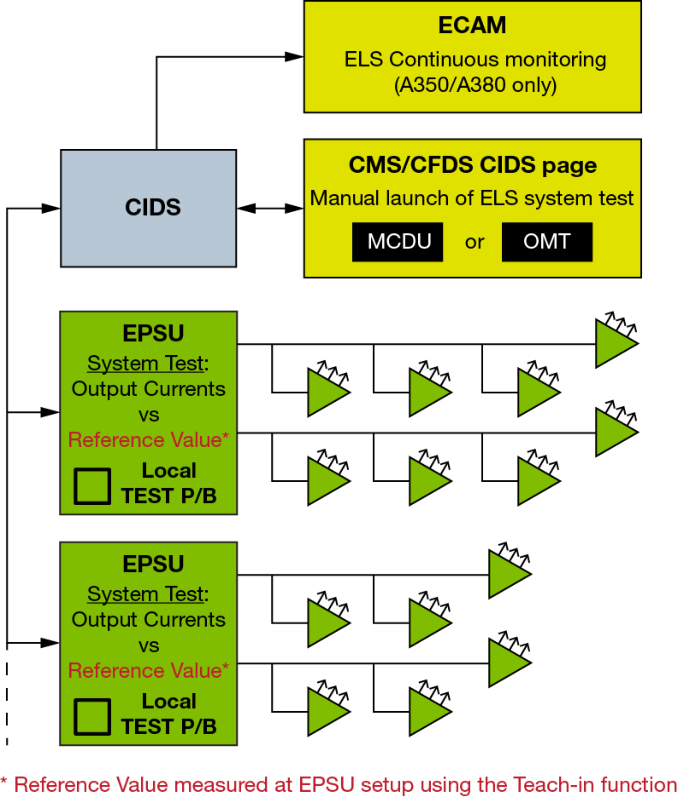
(fig.1) Emergency Light System Test is triggered centrally from the MCDU/OMT or locally on the EPSU TEST P/B (pushbutton)
Teach-In and LORA Function
Section titled “Teach-In and LORA Function”When an EPSU or mEPSU is installed on the aircraft it must first learn the correct reference values. This is managed by the EPSU “Teach-In” or mEPSU “LORA” procedure, which must only be performed after the assembly of the system is completed and a visual inspection to first verify the proper function of all emergency lights has been performed.
During the Teach-In/LORA procedure, all outputs are operated for a short time to capture their specific current. This value is stored in the EPSU/mEPSU as the reference value. It is used for comparison with the actual electrical loads, which are measured at the outputs of the EPSU/mEPSU during the System Test.
Teach-In starts automatically on A320/A330/A340 family aircraft, and for A380 aircraft, when an EPSU is connected to an aircraft which is powered, or when a battery pack is reconnected to the EPSU (fig.2). On A350XWB aircraft and A320 family aircraft fitted with mEPSU, the Teach In/LORA is manually triggered by pressing the test button on the EPSU/mEPSU for more than 5 seconds.
Why is there a Teach-In/LORA function on the EPSU/mEPSU?
Section titled “Why is there a Teach-In/LORA function on the EPSU/mEPSU?”Teach-In function on electronic units like the EPSU and mPSU allows for common part numbers to be used across a fleet of aircraft with different models, and with their various cabin configurations. Aircraft cabins are customized by each airline. The Emergency Lighting System must therefore be configurable to operate correctly in a customized cabin layout. It also allows for common EPSU part
numbers to be used with both the older emergency light systems fitted with traditional light bulbs, and the newer systems that have LED lights requiring much less electrical current.
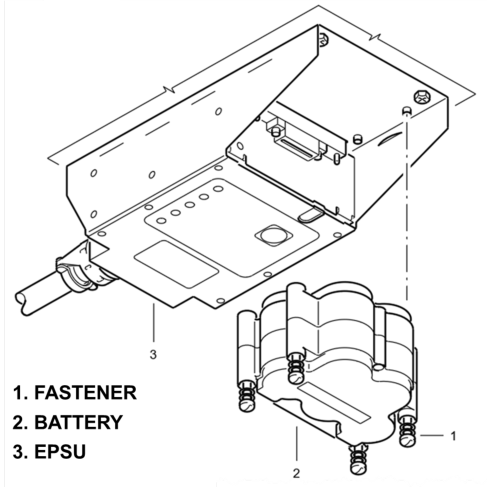
(fig.2) EPSU with battery removed – The Teach-In function will activate when 28V DC power is available on the aircraft and the battery is reinstalled
USING TEACH-IN/LORA FUNCTION
Section titled “USING TEACH-IN/LORA FUNCTION”The Right Way to Use Teach-In and LORA
Section titled “The Right Way to Use Teach-In and LORA”After any Emergency Light System configuration change, such as a cabin layout modification or replacing a systemʼs traditional “bulb” lights with modern LED lights, the Teach-In/LORA procedure is necessary to determine the correct reference value to store in the EPSU/mEPSU memory for the system test. Before starting the Teach-In/LORA, a visual inspection to verify that all lights are operative is required. The Teach-In/LORA procedure should only be done strictly in accordance with the applicable AMM/MP.
The Wrong Way to Use Teach-In and LORA
Section titled “The Wrong Way to Use Teach-In and LORA”The Teach-In/LORA function is not to be used during troubleshooting of the Emergency Light System and the EPSU/mEPSU. The Teach-In/LORA function is not a system reset function. There is NO Emergency Light fault RESET function on the EPSU.
Consequences of Using Teach-In or LORA to Clear Faults
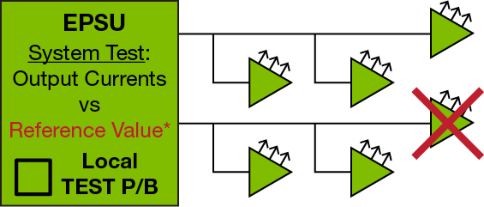
Section titled “Consequences of Using Teach-In or LORA to Clear Faults”Initiating the EPSU/mEPSU Teach-In/LORA procedure in an Emergency Light System that has inoperative lights or defects present has three main consequences. To avoid these consequences, DO NOT clear Emergency Light System faults, with their associated ECAM message, by either disconnecting the affected EPSUʼs battery, swapping EPSU positions or replacing an EPSU before first identifying and rectifying the root cause of the fault message. Hidden Defects After the Teach-In/LORA procedure is completed on the EPSU/mEPSU, it will no longer detect if the defect is present and a fault message will not be displayed. The defect is effectively hidden from the system test because the EPSU has stored a new reference value that was measured with the defective component in the system (fig.3).
● Hidden Defects
Section titled “● Hidden Defects”After the Teach-In/LORA procedure is completed on the EPSU, it will no longer detect if the defect is present and a fault message will not be displayed. The defect is effectively hidden from the system test because the EPSU has stored a new reference value that was measured with the defective component in the system (fig. 3)
DO NOT USE THE TEACH-IN FUNCTION TO CLEAR A FAULT!
Section titled “DO NOT USE THE TEACH-IN FUNCTION TO CLEAR A FAULT!”This will hide the fault from the next TEST and cause new fault message if the defect is rectified
● False Fault Message
Section titled “● False Fault Message”If the defect is later detected during a visual inspection and it is then repaired, the EPSU/mEPSU test will display a fault message even though there is no longer a defect present in the system. This is because there will be a difference between the measured electrical loads and the false reference value captured during the Teach-In/LORA when the defect was still present. This could generate confusion for maintenance personnel and it may lead to lengthy troubleshooting with the risk of operational delays.
(fig.3) Emergency Light System Fault – DO NOT USE TEACH-IN/LORA FUNCTION TO CLEAR A FAULT
● Repeated Fuse Tripping
Section titled “● Repeated Fuse Tripping”If the defect is a short circuit on the output of the EPSU on A320/A330/A340 family aircraft, then the EPSU must be replaced. If the cause of the short circuit is not repaired, this will immediately damage the fuse of the replacement unit EPSU. This fuse is only resettable on EPSU used for A350XWB and A380 aircraft. The fuse will repeatedly trip to disconnect the current at the EPSU output and this causes the fault to reappear until the defect is rectified.
DETECTING FAULTS IN THE EMERGENCY LIGHT SYSTEM
Section titled “DETECTING FAULTS IN THE EMERGENCY LIGHT SYSTEM”An Emergency Light System fault message only indicates a Fault Isolation Number (or FIN) for the affected EPSU, but that EPSU is usually not the direct cause of the defect. It is more likely that a component or light connected to that EPSU is defective and is the reason for the fault message.
There are 3 ways to identify faults or lights not illuminating in the Emergency Lighting System:
1. Visual Inspection
Section titled “1. Visual Inspection”A thorough visual check of all of the emergency lights by Cabin Crew or Maintenance Personnel should find any lights that are not illuminating. These should be reported by Cabin Crew, as per the CCOM Ground Check, or recorded by maintenance for troubleshooting or replacement in accordance with TSM & AMM/MP 33-51-00.
2. System BITE Monitoring
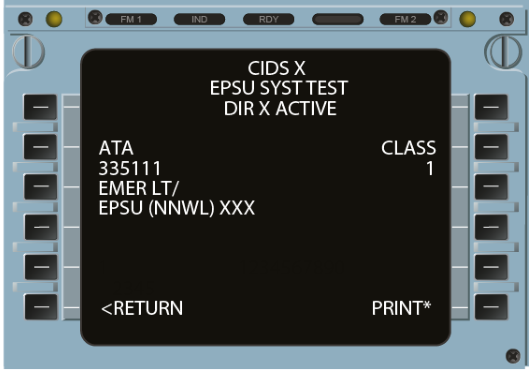
Section titled “2. System BITE Monitoring”On A350XWB and A380 aircraft, a continuous system monitoring compares the electrical loads at the outputs of the EPSU with a stored reference value during its previous Teach-In process. If the measured electrical load deviates from the stored reference value, a maintenance message (or “dispatch message” for A350XWB aircraft), will appear to alert Flight crew and maintenance of a defect in the aircraftʼs Emergency Lighting System (fig.4). In this case, refer to the Troubleshooting procedure in TSM & AMM/MP 33-51-00 and DO NOT use the EPSU Teach-In process to clear the fault.
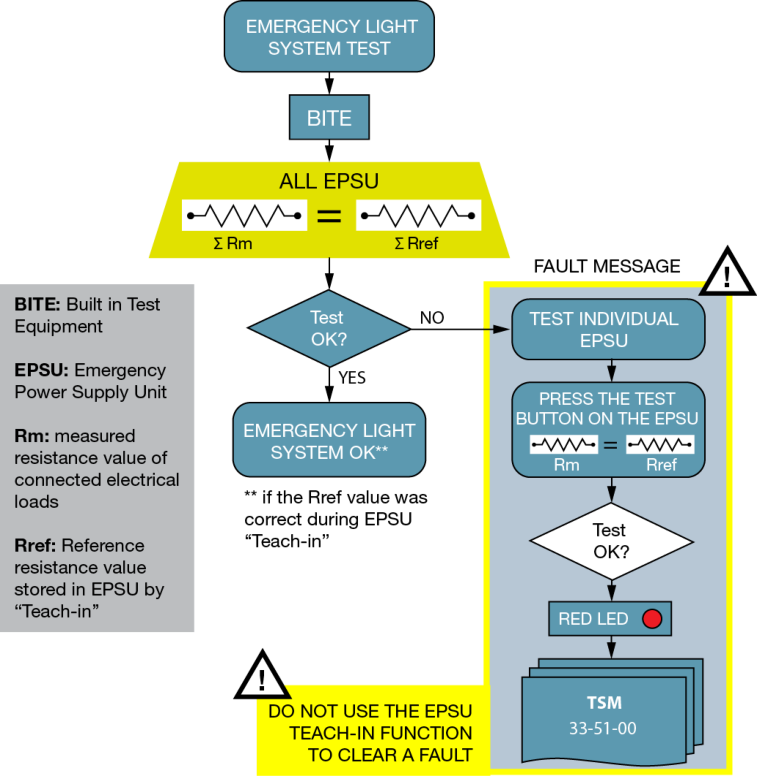
(fig.4) Emergency Light System test and fault detection
3. System Test
Section titled “3. System Test”Emergency Light System test is carried out by maintenance personnel in accordance with AMM/MP 33-51-00. This will manually launch the system monitoring described above (for System BITE monitoring). The LED indicator on the EPSU will advise what components to check to find the cause of the fault.
The Emergency Lighting System Test can be performed locally on each EPSU by pressing the TEST button (fig. 5). Caution: On A350XWB pressing the test button for more than 5 seconds launches the Teach-In function for that EPSU. On A320 Family A/C fitted with mEPSU, pressing the test button for more than 5 seconds launches the LORA function for that mEPSU.
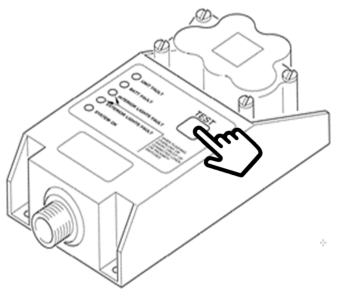
(fig.5) Example of TEST button to launch a test on the EPSU
Contributors:
Section titled “Contributors:”Pierre MONTANIER
Section titled “Pierre MONTANIER”Cabin Electronics eXpert Airbus Customer Engineering Support
Leslie Berthomieu
Customer Engineering Support Specialist
Initial Contributors: Carsten WEICHBROT
Teach-In/LORA function on the EPSU/mEPSU is not a reset function and it must not be used to troubleshoot a fault message related to the Emergency Light System. To avoid the risk of dispatching the aircraft in a NO-GO condition, DO NOT use the Teach-In/LORA function to clear EPSU failure messages coming from a system test or monitoring. Caution also needs to be taken to ensure that the Teach-In/LORA function is not inadvertently activated. This could cause the EPSU/mEPSU to store an incorrect electrical load reference value, and a wrong value may hide any defective emergency lights during the system test.
A pre-requisite prior to activating the Teach-In/LORA function is to first check that all of the emergency lights connected to an EPSU illuminate. By correctly configuring the Emergency Lighting System, conducting regular visual inspections and performing scheduled system tests to find and fix defects, it will ensure that all of the aircraftʼs emergency lights are operational when they are most needed – for lighting the path to the nearest and safest exit for passengers and crew during an emergency cabin evacuation.
Safety first, 2025. Safety first is published by Airbus S.A.S. 1, rond point Maurice Bellonte - 31707 Blagnac Cedex/France.
Editor: Yannick Malinge, SVP AViation Safety.
Editorial team: Guillaume Estragnat, Vanessa Sadi, Gwyneth Duggan, Javier Martinez Marina, Tim Roach.
Photos by Airbus.
从 Teach-In 功能中吸取的经验教训
Section titled “从 Teach-In 功能中吸取的经验教训”本文已于 2025 年 11 月更新。最初发布于 2019 年 1 月。
紧急灯光必须在飞机撤离时按需点亮。如果维护工作未正确执行,可能会影响紧急灯光的可用性。
请访问 safetyfirst.airbus.com 和适用于 iOS 和 Android 设备的安全首要(Safety first)应用程序查看本文最新版本。
如果在最需要的时刻所有紧急灯光未能点亮,特别是在客舱黑暗或充满烟雾的情况下,最有效的撤离路径可能无法在关键时刻清晰可见。乘客和机组人员可能还需要看到客舱紧急灯光,以帮助他们在紧急情况下重新定位或保持情景意识。
在维护期间正确设置紧急照明系统,并执行定期检查以检测任何缺陷,是确保客舱安全运营的关键。重要的是要了解应急电源装置(EPSU)“Teach-In”功能的正确使用方法,并避免系统测试或故障监控设置错误。“Teach-In”是一种配置工具,但并非设计用于故障排除。
同样原则也适用于专用于 mini-EPSU(mEPSU)设计的负载参考采集(LORA)程序。
无灯光可能意味着 NO-GO
Section titled “无灯光可能意味着 NO-GO”当关键的客舱紧急灯光未能点亮时,可能导致 NO-GO 状态。如果由于不正确的系统监控设置而导致这些故障未被检测到,部分客舱紧急灯光可能在需要时无法点亮。这就存在飞机可能带着 NO-GO 状态放行的风险。如果故障灯光或部件被系统测试或监控隐藏,那么只有全面的目视检查才能识别所有未点亮的紧急灯光。
重要的是,客舱机组人员要对所有紧急灯光进行彻底的目视检查,正如《客舱机组操作手册》地面检查所述,以及维护人员在故障排除过程中进行的目视检查。
EPSU 系统测试与 TEACH-IN/LORA — 两种不同功能
Section titled “EPSU 系统测试与 TEACH-IN/LORA — 两种不同功能”系统测试功能
Section titled “系统测试功能”紧急灯光系统测试可从多功能控制显示组件(MCDU,A320/A330/A340 系列飞机)、机载维护终端(OMT,A350XWB/A380)集中触发,或在 EPSU 上本地触发 (图 1)。EPSU 启动包含自检和对所有与其连接的电气部件(包括电池和紧急灯光)的测试程序。
该测试是对每个输出端的实际电流与存储在 EPSU 存储器中的参考值进行比较。如果测试检测到这些值超出预定义限制的差异,将产生故障指示。在短路情况下,EPSU 内部保险丝将断开输出。A320/A330/A340 系列飞机上的 EPSU 使用的是熔断式保险丝,需要拆卸装置并在维修中心更换保险丝。A350XWB 和 A380 飞机上安装的 EPSU 采用可复位的固态保险丝。
(图 1) 紧急灯光系统测试从 MCDU/OMT 集中触发,或在 EPSU 测试按钮上本地触发
Teach-In 和 LORA 功能
Section titled “Teach-In 和 LORA 功能”当 EPSU 或 mEPSU 安装到飞机上时,必须首先学习正确的参考值。这由 EPSU“Teach-In”或 mEPSU“LORA”程序管理,该程序仅应在系统组装完成并执行目视检查以首先验证所有紧急灯光正常功能后才能执行。
在 Teach-In/LORA 程序期间,所有输出端短暂运行以捕获其特定电流。该值作为参考值存储在 EPSU/mEPSU 中。它用于与在系统测试期间在 EPSU/mEPSU 输出端测量的实际电气负载进行比较。
Teach-In 在 A320/A330/A340 系列飞机上自动启动,对于 A380 飞机,当 EPSU 连接到已通电的飞机,或当电池组重新连接到 EPSU 时自动启动 (图 2)。在 A350XWB 飞机和装有 mEPSU 的 A320 系列飞机上,Teach-In/LORA 通过按压 EPSU/mEPSU 上的测试按钮超过 5 秒手动触发。
为什么 EPSU/mEPSU 上有 Teach-In/LORA 功能?
Section titled “为什么 EPSU/mEPSU 上有 Teach-In/LORA 功能?”像 EPSU 和 mPSU 这类电子装置上的 Teach-In 功能允许跨不同机型及其各种客舱配置的飞机机队使用通用件号。客舱由各航空公司定制。紧急照明系统因此必须可配置以在定制客舱布局中正确运行。它还允许使用相同的 EPSU 件号,既可配合装有传统灯泡的旧款紧急灯光系统,也可配合需要更少电流的新型 LED 灯光系统。
(图 2) 取出电池的 EPSU — 当飞机上有 28V 直流电源且重新安装电池时,Teach-In 功能将激活
Teach-In/LORA 功能的使用
Section titled “Teach-In/LORA 功能的使用”正确使用 Teach-In 和 LORA 的方法
Section titled “正确使用 Teach-In 和 LORA 的方法”在进行任何应急照明系统配置更改后(例如客舱布局修改或用现代 LED 灯替换系统中的传统”灯泡”),Teach-In/LORA 程序是确定正确参考值并将其存储在 EPSU/mEPSU 存储器中以供系统测试所必需的。在开始 Teach-In/LORA 之前,需要进行目视检查以验证所有灯是否正常工作。Teach-In/LORA 程序应严格按照适用的 AMM/MP 执行。
错误使用 Teach-In 和 LORA 的方法
Section titled “错误使用 Teach-In 和 LORA 的方法”Teach-In/LORA 功能不得用于应急照明系统和 EPSU/mEPSU 的故障排除。Teach-In/LORA 功能不是系统复位功能。EPSU 上没有应急灯故障复位功能。
使用 Teach-In 或 LORA 清除故障的后果
Section titled “使用 Teach-In 或 LORA 清除故障的后果”在存在不工作灯或缺陷的应急照明系统中启动 EPSU/mEPSU Teach-In/LORA 程序会产生三种主要后果。为避免这些后果,在首先识别并纠正故障信息的根本原因之前,不要通过断开受影响 EPSU 的电池、交换 EPSU 位置或更换 EPSU 来清除应急照明系统故障及其相关的 ECAM 信息。
● 隐藏的缺陷
Section titled “● 隐藏的缺陷”Teach-In/LORA 程序在 EPSU/mEPSU 上完成后,EPSU 将不再检测缺陷是否存在,也不会显示故障信息。缺陷有效地从系统测试中被隐藏,因为 EPSU 存储了一个新的参考值,该值是在缺陷组件仍在系统中时测量的(图 3)。
请勿使用 Teach-In 功能清除故障!
Section titled “请勿使用 Teach-In 功能清除故障!”这将使故障在下次测试中被隐藏,并在缺陷被修复后产生新的故障信息。
● 虚假故障信息
Section titled “● 虚假故障信息”如果在后续目视检查中发现缺陷并进行了修复,即使系统中不再存在缺陷,EPSU/mEPSU 测试也会显示故障信息。这是因为测量的电气负载与在存在缺陷时执行 Teach-In/LORA 期间捕获的虚假参考值之间存在差异。这可能会给维护人员造成混淆,并可能导致耗时的故障排除工作,存在运营延误的风险。
(图 3) 应急照明系统故障——请勿使用 Teach-In/LORA 功能清除故障
● 保险丝重复跳闸
Section titled “● 保险丝重复跳闸”如果缺陷是 A320/A330/A340 系列飞机上 EPSU 输出端的短路,则必须更换 EPSU。如果短路原因未修复,这会立即损坏更换单元 EPSU 的保险丝。此保险丝仅在用于 A350XWB 和 A380 飞机的 EPSU 上可复位。保险丝将重复跳闸以断开 EPSU 输出端的电流,这将导致故障再次出现,直到缺陷被纠正。
检测应急照明系统中的故障
Section titled “检测应急照明系统中的故障”应急照明系统故障信息仅指示受影响 EPSU 的故障隔离编号(FIN),但该 EPSU 通常不是缺陷的直接原因。更可能是连接到该 EPSU 的某个组件或灯有缺陷,这才是故障信息的原因。
有 3 种方法可以识别应急照明系统中的故障或不亮的灯:
1. 目视检查
Section titled “1. 目视检查”由客舱乘务组或维护人员进行的所有应急灯彻底目视检查应能发现任何不亮的灯。客舱乘务组应按照 CCOM 地面检查报告,维护人员应按照 TSM 和 AMM/MP 33-51-00 记录以进行故障排除或更换。
2. 系统 BITE 监控
Section titled “2. 系统 BITE 监控”在 A350XWB 和 A380 飞机上,持续的系统监控会将 EPSU 输出端的电气负载与上次 Teach-In 过程中存储的参考值进行比较。如果测量的电气负载偏离存储的参考值,将显示维护信息(或 A350XWB 飞机的”放行信息”),以提醒飞行机组和维护人员飞机应急照明系统存在缺陷(图 4)。在这种情况下,请参阅 TSM 和 AMM/MP 33-51-00 中的故障排除程序,不要使用 EPSU Teach-In 过程清除故障。
(图 4) 应急灯系统测试和故障检测
3. 系统测试
Section titled “3. 系统测试”应急照明系统测试由维护人员按照 AMM/MP 33-51-00 进行。这将手动启动上述系统监控(用于系统 BITE 监控)。EPSU 上的 LED 指示灯将指示需要检查哪些组件以找到故障原因。
应急照明系统测试可以通过按下 TEST(测试)按钮在每个 EPSU 上本地执行(图 5)。警告:在 A350XWB 上,按住测试按钮超过 5 秒将启动该 EPSU 的 Teach-In 功能。在装有 mEPSU 的 A320 系列飞机上,按住测试按钮超过 5 秒将启动该 mEPSU 的 LORA 功能。
(图 5) 在 EPSU 上启动测试的 TEST(测试)按钮示例
Pierre MONTANIER
Section titled “Pierre MONTANIER”空客客户工程支持客舱电子专家
Leslie Berthomieu
客户工程支持专员
初始贡献者:Carsten WEICHBROT
EPSU/mEPSU 上的 Teach-In/LORA 功能不是复位功能,不得用于排除与应急灯光系统相关的故障信息。为避免飞机以 NO-GO(不可放行)状态放行的风险,切勿使用 Teach-In/LORA 功能来清除由系统测试或监控产生的 EPSU 故障信息。同时需特别注意,确保 Teach-In/LORA 功能不会被意外激活。否则可能导致 EPSU/mEPSU 存储错误的电气负载参考值,错误的数值可能会在系统测试期间掩盖任何有缺陷的应急灯。
激活 Teach-In/LORA 功能的前提条件是,首先检查连接到 EPSU 的所有应急灯是否均能点亮。通过正确配置应急灯光系统、进行定期目视检查以及执行计划内的系统测试以发现并排除缺陷,将确保所有飞机的应急灯在最需要时——即在紧急客舱撤离期间为乘客和机组人员照亮通往最近且最安全出口的路径——能够正常工作。
Safety First,2025 年。Safety First 由空中客车公司出版。地址:1, rond point Maurice Bellonte - 31707 Blagnac Cedex/法国。
编辑:Yannick Malinge,航空安全高级副总裁。
编辑团队:Guillaume Estragnat、Vanessa Sadi、Gwyneth Duggan、Javier Martinez Marina、Tim Roach。
照片由空客提供。