Functional Check Flights 4/4 - Executing a Functional Check Flight
Source: Airbus Safety First URL: https://safetyfirst.airbus.com/functional-check-flights-4-4-executing-a-functional-check-flight/ Published: 2015-10-19 Category: Flight Ops PDF: Original PDF
The Airbus Safety Magazine October 2015
Special Issue
Safety first Functional Check Flights
Section titled “Safety first Functional Check Flights”Functional Check Flights
Functional Check Flights
002
001
Safety first, Special Edition October, 2015. Safety first is published by Airbus S.A.S. - 1, rond point Maurice Bellonte - 31707 Blagnac Cedex/France. Publisher: Yannick Malinge, Chief Product Safety Officer, Editor: Corinne Bieder, Director Product Safety Strategy & Communication. Concept Design by Airbus Multi Media Support 20151711. Reference: D15030884. Photos by Airbus, P. Masclet, Lindner Fotografie, S. Chobert, P. Pigeyre, C. Brinkmann. Printed in France.
This brochure is printed on Stucco. This paper is produced in factories that are accredited EMAS and certified ISO 900114001, PEFC and FSC CoC. It is produced using pulp that has been whitened without either chlorine or acid. The paper is entirely recyclable and is produced from trees grown in sustainable forest resources. The printing inks use organic pigments or minerals. There is no use of basic dyes or dangerous metals from the cadmium, lead, mercury or hexavalent chromium group.
The printer, Art & Caractère (France 81500), is engaged in a waste management and recycling programme for all resulting by-products.
© Airbus S.A.S. 2015 – All rights reserved. Proprietary documents.
By taking delivery of this Brochure (hereafter “Brochure”), you accept on behalf of your company to comply with the following guidelines:
No other intellectual property rights are granted by the delivery of this Brochure than the right to read it, for the sole purpose of information.
This Brochure and its content shall not be modified and its illustrations and photos shall not be reproduced without prior written consent of Airbus.
This Brochure and the materials it contains shall not, in whole or in part, be sold, rented, or licensed to any third party subject to payment.
This Brochure contains sensitive information that is correct at the time of going to press. This information involves a number of factors that could change over time, effecting the true public representation. Airbus assumes no obligation to update any information contained in this document or with respect to the information described herein.
Airbus S.A.S. shall assume no liability for any damage in connection with the use of this Brochure and of the materials it contains, even if Airbus S.A.S. has been advised of the likelihood of such damages.
Safety first
Section titled “Safety first”The Airbus magazine contributing to the enhancement of the safety of aircraft operations by increasing knowledge and communication on safety related topics.
Safety first is published by the Product Safety department. It is a source of specialist safety information for the restricted use of flight and ground crew members who fly and maintain Airbus aircraft. It is also distributed to other selected organisations.
Material for publication is obtained from multiple sources and includes selected information from the Airbus Flight Safety Confidential Reporting System, incident and accident investigation reports, system tests and flight tests. Material is also obtained from sources within the airline industry, studies and reports from government agencies and other aviation sources.
All articles in Safety first are presented for information only and are not intended to replace ICAO guidelines, standards or recommended practices, operator-mandated requirements or technical orders. The contents do not supersede any requirements mand ated by the State of Registry of the Operator’s aircraft or supersede or amend any Airbus type-specific AFM, AMM, FCOM, MMEL documentation or any other approved documentation.
Articles may be reprinted without permission, except where copyright source is indicated, but with acknowledgement to Airbus. Where Airbus is not the author, the contents of the article do not necessarily reflect the views of Airbus, neither do they indicate Company policy.
Contributions, comment and feedback are welcome. For technical reasons the editors may be required to make editorial changes to manuscripts, however every effort will be made to preserve the intended meaning of the original. Enquiries related to this publication should be addressed to:
Airbus Product Safety department (GS) 1, rond point Maurice Bellonte 31707 Blagnac Cedex - France safetycommunication@airbus.com Fax: +33(0)5 61 93 44 29
Past experience has shown that conducting Functional Check Flights like “normal” commercial flights poses significant safety problems.

Indeed, even though they may be performed in an airline environment, used to managing the safety of commercial flights, they differ from these routine flights in many respects: their status of non-revenue flights, the required pilots’ profile, the characteristics of suited operational environments, the guidance documentation or even the overall regulatory framework.
YANNICK MALINGE
Section titled “YANNICK MALINGE”Functional Check Flights are peculiar flights requiring specific safety attention. As such, addressing them deserved a peculiar format. This special issue of the Safety first magazine will take you through the specific Functional Check Flights preparation journey.
SVP & Chief Product Safety Officer
This journey starts way before performing the flight itself, at much more remote and wider organizational levels as well. It involves a variety of aspects at a variety of time horizons that all contribute to Be Prepared for such flights.
To address all these aspects as a consistent whole, this special issue deserved a special structure as well. Not a set of articles, but a single text structured along the various organizational levels and time horizons illustrating what it takes to be prepared for safe Functional Check Flights.
Enjoy your reading!
Functional Check Flights
Section titled “Functional Check Flights”What does it take to be prepared?
Section titled “What does it take to be prepared?”Every flight is singular and needs to be prepared as such by flight crews, considering the state of the aircraft, the route, weather conditions, their own condition, the fuel quantity, the aircraft weight and balance… However, flights involving aircraft functional checks are flights with additional specific risks that deserve even more safety attention.
Indeed, these flights, when flown within an airline environment, differ significantly from “normal”, routine airline flights in many respects. They are sometimes called Technical Check Flights, Post Maintenance Check
HARRY NELSON Experimental Test Pilot
SIMON PETERSON Flight Test Engineer Instructor
Flights, End of Lease Transfer Flights or Functional Check Flights. For the purposes of this magazine we shall use the abbreviation of Functional Check Flights, or put simply, FCFs.
Ensuring the safety of FCFs relies on various aspects and actors, at all organizational levels and phases. This special issue will provide you with an overview of what it takes to perform safe FCFs. It will address along a time / organizational unit line, the major aspects that, at each level, contribute to make FCFs safe. It is therefore arranged into the following sections:
Special flights Airline preparedness Planning Executing requiring special to perform Functional and preparing a Functional treatment Check Flights a Functional Check Flight Check Flight
Functional Check Flights 005
Special flights requiring special treatment
006 Functional Check Flights - Special flights
Section titled “006 Functional Check Flights - Special flights”Functional Check Flights - Special flights 007
What is a Functional Check Flight?
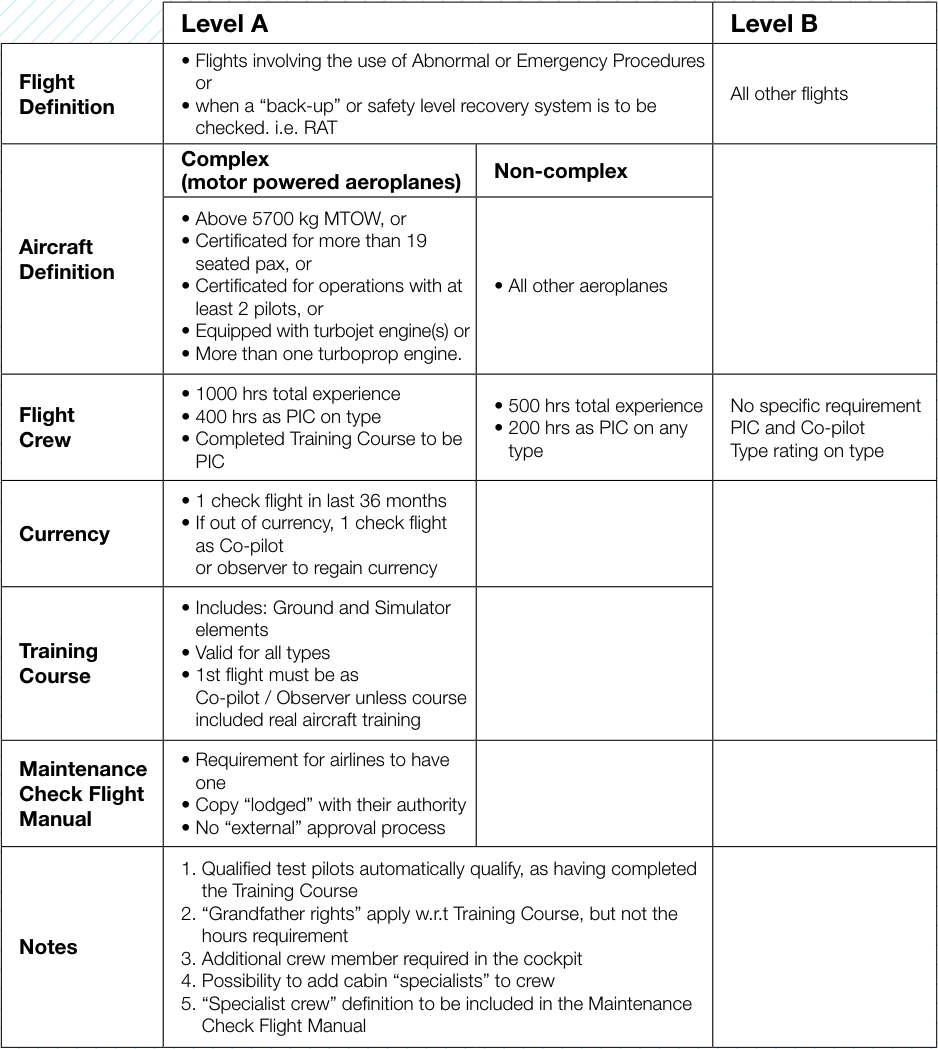
Section titled “What is a Functional Check Flight?”EASA REGULATION ON MAINTENANCE CHECK FLIGHTS AT A GLANCE
Section titled “EASA REGULATION ON MAINTENANCE CHECK FLIGHTS AT A GLANCE”Figure 1: Summary of Functional Check Flights regulations
Section titled “Figure 1: Summary of Functional Check Flights regulations”Non revenue
Technical check
Post maintenance check
End of lease
Functional Check flights are non-revenue flights following maintenance actions or repairs that could affect the aircraft’s inherent aerodynamic and/or system characteristics and operational performance or before a return to lessor of the aircraft. It is recommended that they are performed by three airline crew members, two pilots and an engineer.
Therefore, in the airline world, FCFs are flights that differ from routine activities in many respects.
To start with, FCFs are “non-revenue flights”. As this activity is not the core business of airlines, it also disturbs to some extent the aircraft and crew availability schedules by mobilizing aircraft as well as crews and all the other needed operational personnel.
In addition, considering the objectives of a FCF, which is to get close to the limits and check the systems and the aircraft response, FCFs are unusual flights for airline crews.
A specific framework
Section titled “A specific framework”Be it a matter of mind-set, of training, of documentation, of planning or all the other dimensions that contribute to making such flights safe, FCFs require specific preparation and conditions.
A preliminary condition to make such flights safe is to acknowledge this unique status and the need for special treatment of these flights at all levels.
From a regulation perspective, FCF specificities have been acknowledged and translated into the development of a dedicated regulation on Maintenance Check Flights that was issued in 2012 by EASA: Ref- EASA, NPA 2012-08. Maintenance Check Flights (MCF).
The regulatory requirements address a number of aspects contributing to the safety of FCF, namely:
-
Flight crew requirements
-
Additional crewmembers
-
Training course
-
Maintenance Check Flight Manual
In order to complete and reach beyond the regulatory material, the following sections provide some detailed and qualitative insights on key aspects that contribute to making FCF safe flights.
Airline preparedness to perform Functional Check Flights
Functional Check Flights - Airline preparedness 011
Selected and trained crews
Section titled “Selected and trained crews”Once it is acknowledged that FCF deserve special treatment, setting up all that is needed at the airline level to be prepared for performing such flights encompasses a number of aspects that are reviewed hereafter.
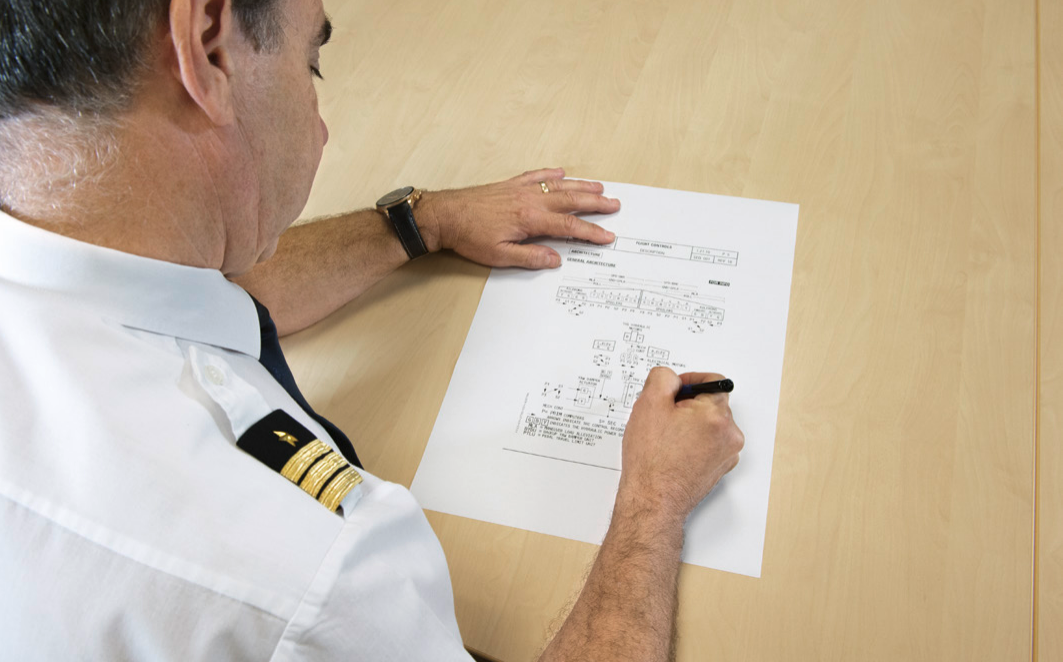
There are certain characteristics of individuals’ profiles that are more important in check flight work than in other tasks. In the airlines, most young pilots are selected against criteria with a different objective in mind. However, check flights are a fact of life for all airlines and often the task falls to the Chief Pilot or other senior personnel like the fleet captain, or the fleet technical pilot who may see such flights as a chance to get “out of the office”. Not all these categories of people, important as they are, may necessarily be best suited for the task nor do they necessarily have the available time to prepare in the way they should and probably would wish to. So what should be looked for in a pilot or engineer who will be recruited into the “checking community”?
There are 4 pillars on which a check crew member builds a successful career. These are Knowledge, Skill, Aptitude and Experience. “Not much difference there from my world” one may rightly say but let us look at some of these characteristics more closely in a “checking” sense.
KNOWLEDGE
Section titled “KNOWLEDGE”A deep knowledge is clearly required of the aircraft, the theory behind the task and the role. A determined inquisitive mind is essential if one is to survive in the check flight world, and one would expect all check aircrew to be asking questions and then more questions until they receive an answer that is both “right” and makes sense. Questions coming from newcomers are especially welcome, as they keep the organisation true and sharp. Disinformation is generally easy to recognise and has no time in the checking world, so the answers had better be good.
An answer that was right 5 years ago may not be right today. Circumstances change and those changes sometimes demand a re-think. Equally, it is important to be self-reliant in this regard. Don’t wait for the information to come to you, go looking for it and develop good contacts and sources of quality information.
A determined inquisitive mind is essential. Don’t wait for the information to come to you, go looking for it.
SKILLS
Section titled “SKILLS”Valued skills include Observation, Interpretation, Analysis and by no means least, Communication.
Valued skills include Observation, Interpretation, Analysis and by no means least, Communication. So called “motor function” flying skills for the pilots need to be pretty good too but it may be surprising to some that pure flying coordination and technique is not necessarily the top priority as long as this aspect is to an acceptable level for the task. However, flying ability does have an impact on the capacity of the pilot to handle high workload situations and therefore it will be referred to later in the section about Upsets.
Some of these skills do not come naturally to some. It is necessary to think through each check point or task and decide which parameters are important. Know also when and how often to read them and then when to record them. For the third crew member in this situation this recording task is always secondary to acting as the safety “observer”, someone with an immediate oversight of the way each of the check points is being conducted and someone who can therefore issue timely warnings.
Functional Check Flights - Airline preparedness
Functional Check Flights - Airline preparedness 013
012
APTITUDE
Section titled “APTITUDE”The right type of pilot or engineer should be naturally skilled at Crew Resource Management and be especially good at listening… the trick is to ensure on check flights that all those with knowledge and useful information are really heard, whatever their level, number of rings on their jacket, nationality, gender or salary grade.
Aptitude is a bit more complex. In this context, it refers to whether someone “thinks in the right way” and demonstrates the right judgement.
Firstly, check trainees need to be able to handle several apparent paradoxes. Let us take an example or two. Take the issue of when a check crew member has to stand their ground on a given topic versus when they can afford to be flexible. If we take a situation where an aircraft may need some re-work before or after a check flight but is due on the programme later in the day, you can immediately see the pressure that has to be handled in this fairly common situation and knowing when it is ok to be flexible or when a tougher stance has to be taken is part of the job.
Taking another example, in a typical group discussion about, for example, a specific systems check, certain people will inevitably have more knowledge than others, so the issue of when to speak from within your own knowledge and when to listen becomes a skill and a challenge. With the right level of sensitivity and awareness of each other, the team dynamic has to lead to the right answer.
Perhaps the most well-known is the issue of confidence. A check crew member has to have sufficient self-confidence to make decisions when necessary and to intervene in developing situations but not so much confidence that may lead to check points being flown in conditions outside the safe limits. There are many such paradoxical situations to be faced and correctly resolved in the world of check flights. Good team members get more of these situations right than wrong.
The right type of pilot or engineer should therefore be naturally skilled at Crew Resource Management and be especially good at listening. But check flight CRM is very different from the normal airline route situation. A ground engineer who is acting as a Functional Flight Check Engineer may well be the person with the best knowledge of a particular system. The second pilot likewise may be a specialist on a given area so the classic cockpit leadership balance may change during a check flight and should only tip with certainty towards the Captain when and if a final safety decision has to be made. Clearly, in the normal airline situation, the authority gradient is clearly defined. But each airline will need to decide how to handle the authority gradient issue in the context of their local and national culture. The trick is to ensure on check flights that all those with knowledge and useful information are really heard, whatever their level, number of rings on their jacket, nationality, gender or salary grade.
Check pilots in particular, also need to be able to achieve a good balance in their activities and maintain the necessary level of self-confidence without an over developed ego. Look for people who are not trying to prove how good they are but rather how good (or bad) the aircraft is. Interestingly, this trait is also critically important in the flight display world.
Look for people who are not trying to prove how good they are but rather how good (or bad) the aircraft is.
In some respects this is the key difference between the checking world and the normal operational pilot world. Younger pilots spend their developing career improving their skills as a pilot and having to demonstrate those skills under test conditions. If the flight doesn’t go too well the normal reaction is, “it must be me”. “I am having an off day”. In other words they look inwards at their own performance. The checking world is different. It demands that they become “the standard” and that they use that standard to assess the aircraft they are flying. It is the aircraft that is under examination, not the pilot. They have to look outwards. If the same type of aircraft was flown yesterday and its response through a given manoeuvre was “normal” but today it is not or it feels different, then what has changed? Has something altered? Is the weight and Centre of Gravity (CG) the same, or is it potentially something even more serious like a degraded flight control system due to something like trim damage?
It is the aircraft that is under examination, not the pilot.
Finally, and highest on the list of desirable characteristics, is personal integrity which is valued above everything else. The check flight specialists need to be people mentally strong enough to take responsibility for their decisions (good and bad) and then be able to live with their mistakes, learn from them and communicate them to others. Hours can be wasted chasing a non-snag or flight characteristic when in fact the culprit was the pilot who had selected the wrong configuration or moved the wrong switch at the wrong time. In the development test world there is no hiding place as everything done is filmed, instrumented, telemetered and examined by teams of specialists but this is not true of the airline check flight situation where good old fashioned integrity is vital. There is no more important characteristic in this activity.

Highest on the list of desirable characteristics, is personal integrity.
Functional Check Flights - Airline preparedness
014
EXPERIENCE
Section titled “EXPERIENCE”Look beyond the hours…
Section titled “Look beyond the hours…”Experience (of the right kind) is extremely valuable in terms of improving judgement, prioritisation of task and risk evaluation but experience can also be a great deceiver. There are many 35,000 hr airline guys, in some parts of the world, who are totally unsuited to check flight tasks. Such people have much experience of doing repetitive and similar tasks rather than a range of different experiences against which to make good informed check flight judgements. So look beyond the hours and find out what relevant checking experience lies within the log book and how many non-routine operations have been successfully carried out by an individual.
SPECIFIC TRAINING
Section titled “SPECIFIC TRAINING”Identifying these main characteristics during an interview and selecting the “right” kind of person for this kind of work will buy you many dividends in the check flight scenario. Indeed, if you get the people wrong, no matter how good the process, it will still be at risk. Yet, training these people to further develop the knowledge, skills and attitudes to perform check flights is an additional asset.
It is quite possible to train check flight pilots inside an airline when the right expertise exists and is supported fully by management who recognise the need to get their people “up to speed” in a check flight sense. Some of the airlines with very large fleets, have a dedicated professional department whose role is to carry out the checks on all their fleet aircraft.
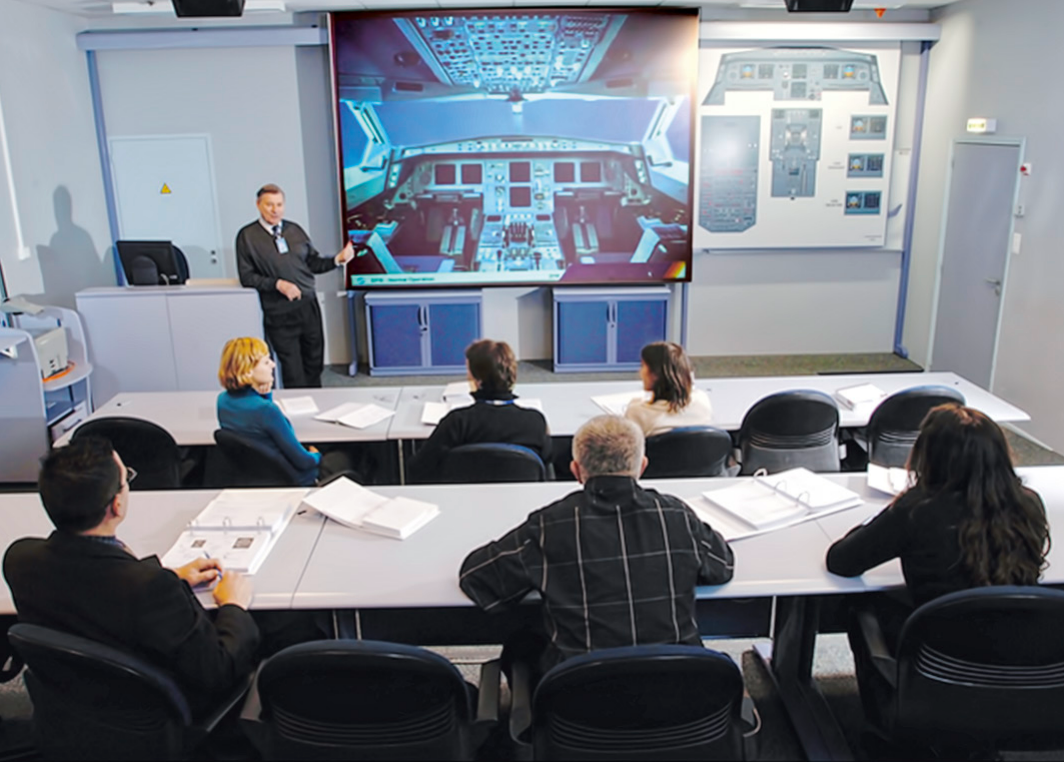
Equally, a manufacturers’ Functional Check Flight course has been developed by Airbus and has demonstrated very positive results. It is not designed to generate full test qualified crews but rather to give an initial immersion into the right type of thinking and to help airline check personnel get some way up the learning ladder and so prevent some basic errors. The course uses one of the Airbus aircraft types as a vehicle on which to hang the “generic” teaching elements and Airbus also uses this type to demonstrate the level of knowledge and skills that are needed to safely carry out FCFs.
Other aeronautical training agencies also do the same sort of thing but in a much more general way. The choice is with the airline.
THE AIRBUS TECHNICAL FLIGHT FAMILIARISATION COURSE
Section titled “THE AIRBUS TECHNICAL FLIGHT FAMILIARISATION COURSE”The analysis of actual Functional Check Flights that involved safety concerns allowed for highlighting some key aspects contributing to the safety of such flights:
Based on this feedback from experience, Airbus developed in 2009 a Technical Familiarization Flight course with the objective to provide flight crew with Knowledge, Skills and Attitude to improve safety, quality and efficiency for conducting:
-
an aircraft checking mindset
-
appropriate crew expectations
-
specific skills to perform manoeuvres different from line operations
-
Technical flights or Functional Check Flights (i.e. post maintenance, painting, etc.)
-
Acceptance flights (i.e. handover between operators)
-
recognition of the threat of differing objectives of crew members especially in an end of lease situation
-
keeping away from a “tick the box” approach
This course is designed for a crew of 3, 2 pilots and 1 engineer and is delivered by 2 instructors, 1 flight test pilot and 1 flight test engineer.
- an awareness of performance and handling differences associated with unfamiliar airplane weights and CG
It combines a ground phase (2 days), a Full Flight Simulator phase (2 days) and a flight to cover all the aforementioned aspects to make FCF as safe as possible.
-
new crew member skill sets and new knowledge
-
a positive ATC interface
Want to know more about Airbus Technical Flight Familiarization course? Contact or website
Functional Check Flights - Airline preparedness
Functional Check Flights - Airline preparedness
016
017

Guidance documentation
Section titled “Guidance documentation”Beyond having the right people, being prepared for performing functional check flights also relies on an understanding of what these checks are, what they are for and how to perform them.
There has been a certain amount of confusion over the years about which document an airline should use if it is intending to carry out its own post maintenance FCFs.
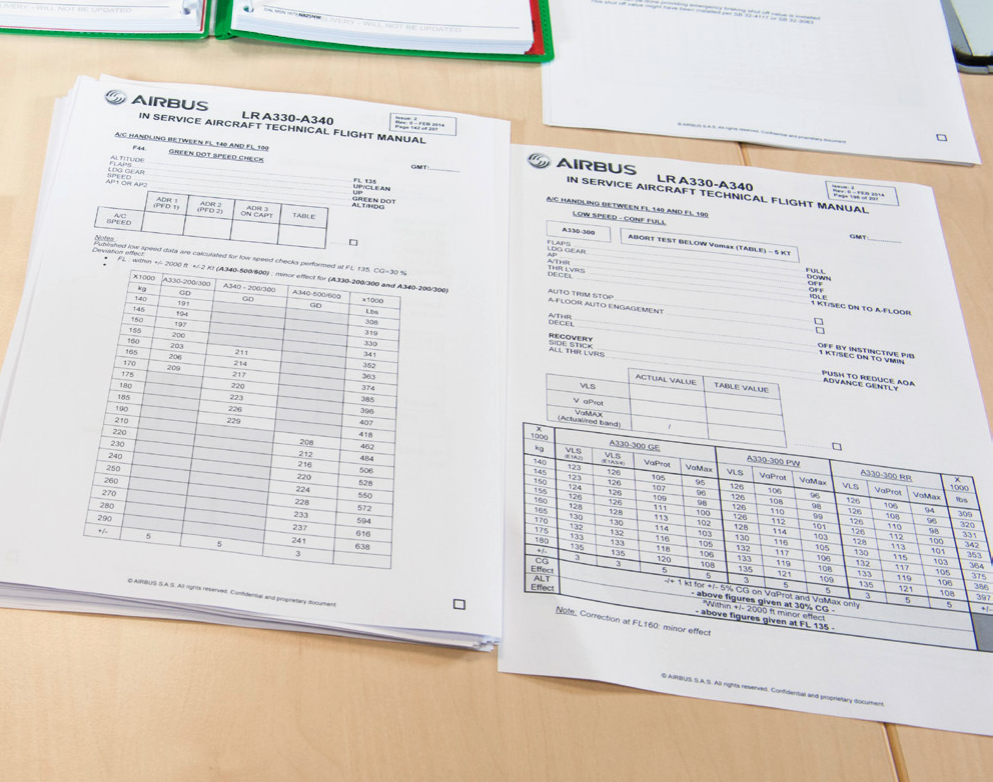
The only manual that is to be used to perform Functional Check Flights is the ISATFM. Do NOT use the CAM.
Mistaking one manual for another could induce hidden risks that have no place in the world of Functional Check Flights. So which one should be used?
A MANUAL FOR EACH CIRCUMSTANCE
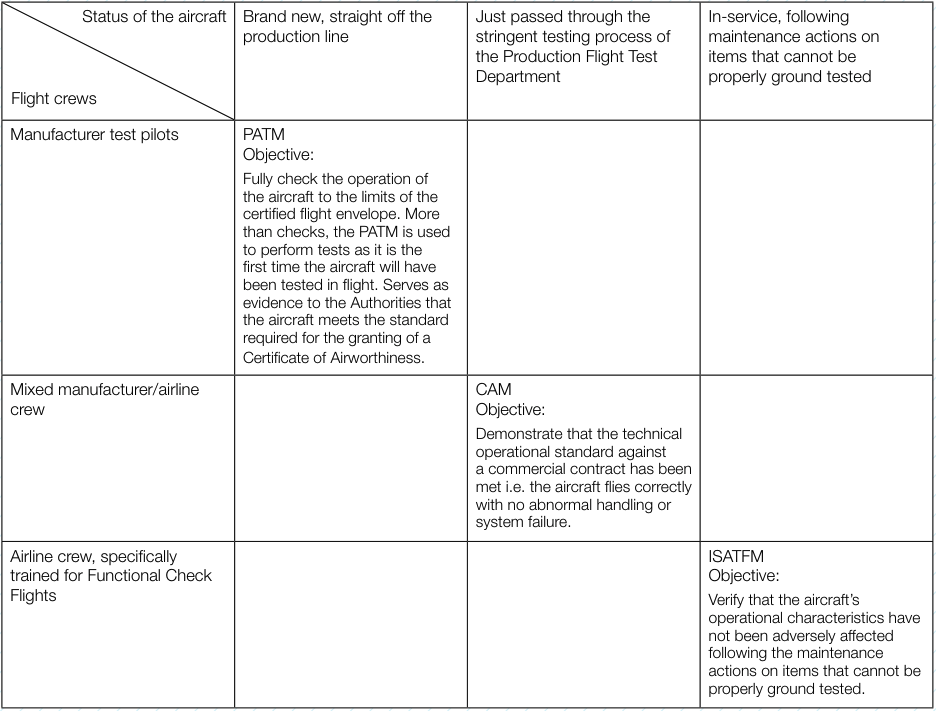
Section titled “A MANUAL FOR EACH CIRCUMSTANCE”A number of manuals have been developed by Airbus to perform “check” flights. Specifically, the ISATFM (In-Service Aircraft Technical Flight Manual), the PATM (Production Aircraft Test Manual) and the CAM (Customer Acceptance Manual). There has been a certain amount of confusion over the years about which document an airline should use if it is intending to carry out its own post maintenance flight check.
several hidden risks that have no place in the world of Technical Flight Checks. So which one should be used?
Although all the flights covered by these three manuals are meant to perform checks, each manual has a specific scope in terms of:
- The status of the aircraft (from straight off the production line to already in-service).
The easiest, and incorrect, solution seems to be to use the one that is most likely in hand….the Customer Acceptance Manual, which has been received by all Customers during the acceptance flight of a newly delivered aircraft. However, this “solution” carries with it
- The background of the pilots and the organization they belong to.
In a nutshell, these documents could be characterized as follows:
Functional Check Flights - Airline preparedness
Functional Check Flights - Airline preparedness 019
018
THE ISATFM (IN-SERVICE AIRCRAFT TECHNICAL FLIGHT MANUAL)
Section titled “THE ISATFM (IN-SERVICE AIRCRAFT TECHNICAL FLIGHT MANUAL)”As just mentioned, this is THE manual which must be used for In-Service aircraft. There is an ISATFM for each family of Airbus Aircraft: Wide Body for A300 family, Single Aisle for A320 family, Long Range for A330/A340 family, and Double Deck for the A380.
no flight checking experience. The manual was therefore divided so that “Part 2”, became the basic function checks of the aircraft within the normal envelope, and “Part 3” the advanced checks to be performed by crews who had been suitably trained and therefore allowed a deeper technical check of the aircraft and its systems.
Each manual is divided into 3 parts:
Section titled “Each manual is divided into 3 parts:”Part 1 is the Ground Check phase Part 2 is the Basic Flight Phase and Part 3 is the Flight Phase with additional checks for Trained Crews.
These phases should be carried out in the logical and numbered sequence.
In fact, Part 2 is intended to be used for aircraft already in service, with no significant maintenance actions prior to flight, allowing a handover phase between operators. It could be flown by regular line pilots.
These are the primary reasons why Part 2 should not be used as a manual for carrying out Technical Flights within airlines.
Here, we will deal only with the flight phases. (Parts 2 and 3)
In 2014, the ISATFM flight phase was divided into 2 parts after requests coming from the aircraft leasing community. It was recognised that the older generation of ISATFM manuals was quite complicated to fly for pilots who had
The Part 3 flight profile is very similar to a production first flight, but without the checks for performance or degraded modes. At the end of the flight, the crew have a very good picture of the technical state of the aircraft.
In order to fly the “Part 3” flight profile, it is recommended that the crew should be correctly trained.
HOW TO GET THE ISATFM MANUAL AND USE IT?
Section titled “HOW TO GET THE ISATFM MANUAL AND USE IT?”The philosophy of use of the ISATFM document developed by Airbus is to support airlines in the development of their own FCF manual, adapted and customized to their own context of operation (airfields, checks, pilots profile…). In other words, the ISATFM has been designed as an “a la carte” menu, and is a guideline recommended by Airbus based on its expertise. But in order to support the safety of FCFs, each airline needs to go through its own thinking process and design its own manual based on this reference. This reflection may lead an airline to remove some checks if it does not feel confident about performing them or add some specific information considering its environment…
In order to make sure all airlines are aware of and acknowledge this required step, the ISATFM is supplied by Airbus upon request, after signature and reception
of a legal waiver stating how to use this document. The legal waiver states that the airline should take control of its own document using the guidelines of the supplied ISATFM and that the reference to the document being an Airbus document should be removed and the Airline headings applied. Logically, it also states that the ISATFM document with Airbus headings should not be forwarded to third parties nor copied or stored, but this is only with the Airbus headings.
To receive the Waiver, airlines need to write (e-mail) to the secretariat of EVRT (evrt.control-room@airbus.com)
In turn, the airline will be supplied with the legal waiver which must be signed, and returned, in order to receive the document for their type of aircraft. The airline will then receive a pdf version of the document.
Functional Check Flights - Airline preparedness
Functional Check Flights - Airline preparedness 021
020
A FLAVOUR OF THE ISATFM… OR THE CHECKS TO BE PERFORMED IN FLIGHT
Section titled “A FLAVOUR OF THE ISATFM… OR THE CHECKS TO BE PERFORMED IN FLIGHT”The first major actions on the aircraft in flight are the flight control check. After ensuring that all loose objects are secured and the weather radar is switched off, the pilot will pitch and roll the aircraft towards, but not exceeding, its protection limits – that is +30 to -15 degrees pitch with a pull of up to +2.0g and push to no less than +0.5g, and just over 45 degrees LH and RH. The objective is to ensure that the aircraft response and the “feel” of the aircraft is “normal” and that the envelope protections function as per design.
Following this, the autoflight systems will be checked with normal and stick over-ride disconnections, followed by a check of global speed protection that is carried out to monitor the control law reversions.
During the climb, the 3rd crew member monitors, and records, the systems parameters, whilst checking for abnormal values. The pilots keep busy performing Radio and Navigation qualitative checks. On arriving at FL310, the crew perform a series of checks for the engines, lateral trim (to check that the aircraft flies wings level) and anemometry checks of the altimeters, and angle of attack probes. Once happy, the crew will proceed with pressure checks. The first check is to inflate the cabin up to its maximum pressure limit in order to check the correct functioning of the cabin pressure safety valves. This check is critical as the crew must monitor very carefully that the valves open within the correct limits. Leak rate and depressurisation checks follow, which may take the cabin up to 14000ft cabin altitude, whilst checking the cabin leak rate (caused by passenger and cargo door seals), pack valve sealing, cabin altitude warnings and finally the dropping of the oxygen masks. This later check involves good communication and coordination with any cabin engineers on board. If there are “non-crew members” working in the cabin, a depressurisation to a lower cabin altitude may be advisable – in which case stopping the depress at the Hi Altitude warning (9550 or 11300 feet cabin altitude) then using Mask Man On, is a more prudent option.
After this, the crew will fly towards the operational ceiling of the aircraft, performing more anemometry checks to complete RVSM checks. At the ceiling, the APU will be started, and when stabilised, each engine generator will
be selected OFF then ON, in turn, in order to check the correct transfer of electrical power to the APU generator.
The descent is relatively fast, with overspeed checks at MMO and VMO, plus speed brake deployments to check for any abnormal lateral behaviour. Wing and engine anti-ice are also checked in the descent, as is APU bleed at lower flight levels.
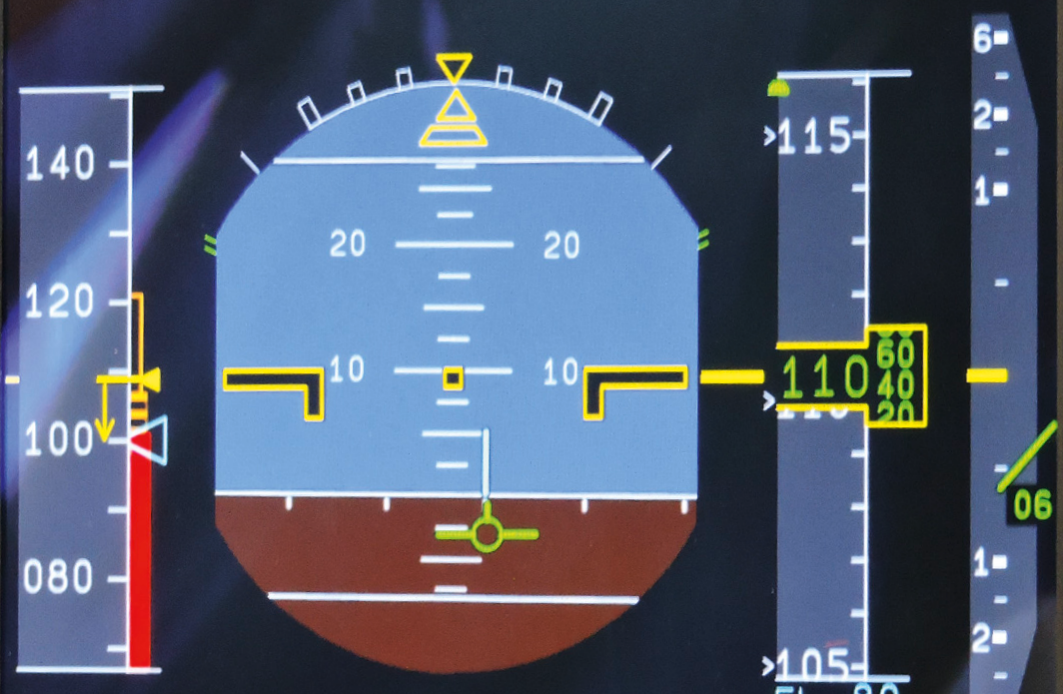
The descent is into an airspace known as “the block”. This is an altitude “block” agreed with Air Traffic Control normally FL100 to FL140 – but significantly depends on the geographical terrain where the aircraft is flying. If the terrain is high then a higher block altitude will be necessary! Here, the low speed checks are carried out provided that the aircraft has not acquired any ice in the descent. Prior to commencing any low speed checks, the Green Dot speed and AOA values are confirmed. If problems are found at this stage, then the remaining low speed checks may be abandoned. When the relevant values have been assessed and agreed, the aircraft will be decelerated in the clean configuration until it is stable at “alpha-max”. This condition is the stabilised minimum speed with full back stick using “normal law”. When the 3rd crew member has recorded the values, the pilot will perform the low speed recovery procedure and, immediately, the aircraft is set up for the alpha-lock test. This check is to confirm that, with a low speed / high angle of attack, if the slats are set from 1 to 0, they will not retract.
The aircraft will then be configured into the landing configuration and decelerated again to alpha max. It may be surprising to know that for A320s, A330s and A380s, the stabilised minimum speed will be roughly the same, in the region of 100 knots! Whilst both of these checks must be approached with caution and due care in terms of rate of speed reduction and gentle control use, provided the aircraft systems are working normally, they are relatively easy check points to fly.
The final checks in the low speed block, are to ensure that various systems are functioning correctly – Automatic Go-Around, Hydraulic locking of the spoilers (when hydraulic systems are degraded), emergency electric and Ram Air Turbine, and flap relief and audio warnings with various speeds and flap configurations.
The final check – depending on airfield capability – is an autoland. However this check needs to be carefully considered. Before checking the autoland system, the characteristics of any non Cat III ILS facility need to be assessed beforehand, preferably on another serviceable aircraft. (The readers may interpret that as meaning they need to fly another aircraft before they fly the check aircraft). The intended autoland also needs to be discussed with the local ATC as Cat 3 protection may need to be organised in advance.
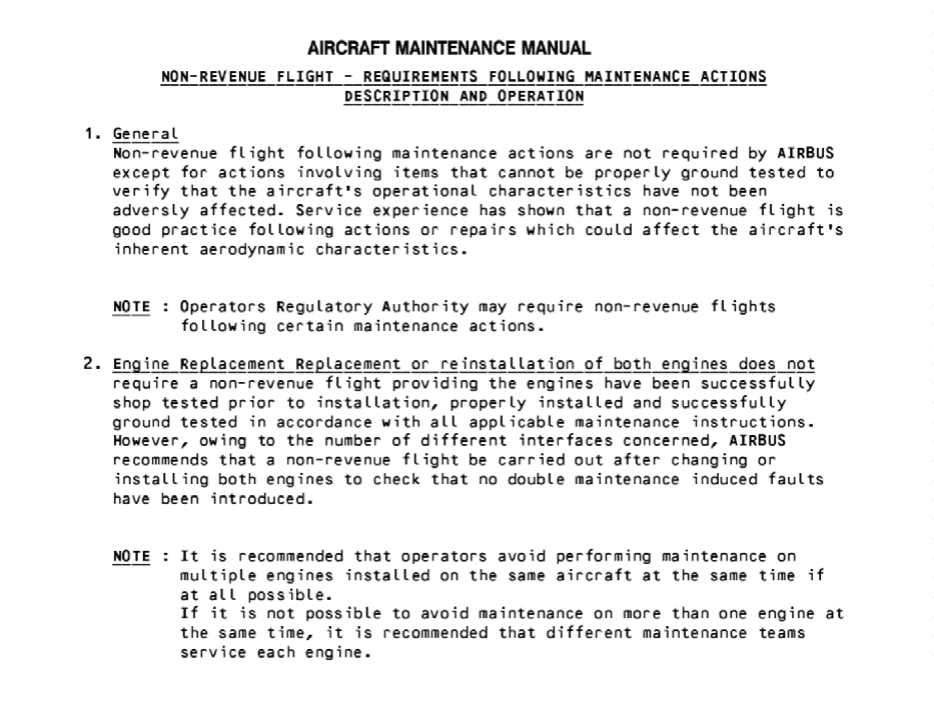
hanger staff are very good and thorough, there may be still some aspects which the airline management feels cannot be adequately checked on the ground. The airline decision will be – “do we need to do a dedicated technical flight?”
Such decisions must be based on the local engineering and operational judgement on, the level and depth of overall maintenance that has taken place, the number of systems that have been disturbed, the applied modifications, the maintenance “history” of a given unserviceability and the significance or all these issues with regard to the flight control system, the engines, the aerodynamics and the sensors of the aircraft. The Aircraft Maintenance Manual reads as follows:
It is important to note that the sequence of tests above has been carefully considered, is important and should be adhered to.
Why is it advisable to fly such a profile? The answer is that, while the ground checks performed by the
Functional Check Flights 023
Planning and preparing a Functional Check Flight
Functional Check Flights - Planning and preparing 025
Let us now move to the planning and preparation aspects. Many questions need to be asked and answered before the check flight takes off, starting with the need to understand the task. What exactly is the objective of the flight? Can the objective be met on the ground? What state is the aircraft in? Who will be doing it? When has it got to be done? Where is it to be done? And finally, with all that information, what are the risks and what will we do if it goes wrong? Some things seem to be common to most tasks. Let us try to capture those which come up most often.
ONLY those checks that cannot be performed on the ground should be performed in the air.
The first rule is to be able to justify why a flight check is being done in the first place. Many checks can be performed successfully on the test bench. Despite pilots’ love of flying, ONLY those checks that cannot be performed on the ground should be performed in the air. GPWS is a good case in point. The “box” has all the logic fixed and it can be bench tested. The software will have been correctly tested and certificated. What is then needed of a possible check flight? In reality, the “aircraft connections” only need to be verified in terms of flap signal, gear signal and radio altimeter. Such a check does not require all the modes to be flown.
The Aircraft
Section titled “The Aircraft”Let’s deal with the aircraft first. The check flight crew will need to know exactly what servicing has been carried out and which systems have been disturbed. They will also need to know if repairs, modifications and upgrades have been applied and if so, what impact they may have on the intended flight. Some notice of the flight is therefore required because a visit to the hangar is essential to get to the bottom of most of these aircraft questions. Talk to the servicing manager and look at the log books in depth. Take care with the “can you just come down this afternoon and carry out a quick check flight” type of request. More has often been disturbed or worked on than at first appears.
In the longer term develop a trustful working relationship with the mechanics in the hangar. It is amazing what they will tell you once that trust is established. Humour between people who know each other tends to help a lot here. If the situation does not encourage that, due to the use of an outstation or remote facility for instance,
Apply the principle that if it can happen, it will happen.
try to gauge the quality of the hangar guys (and their management) and the level of pressure they have all been working under.
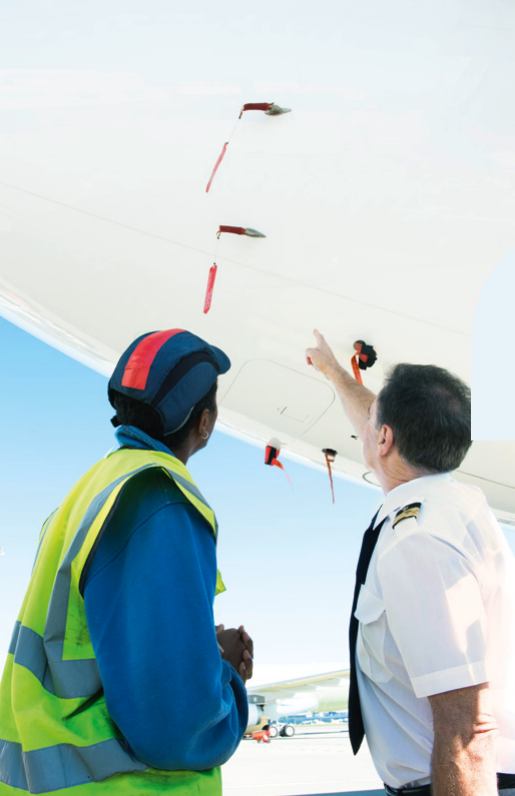
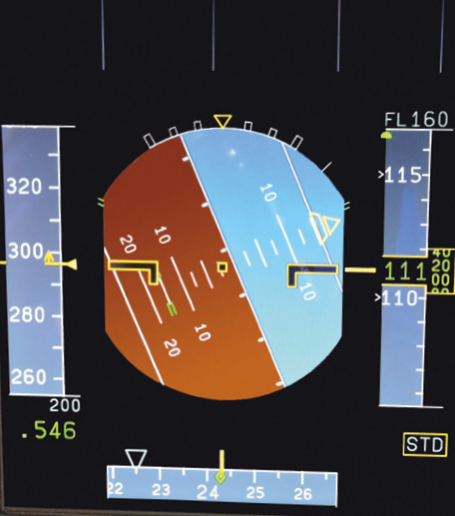
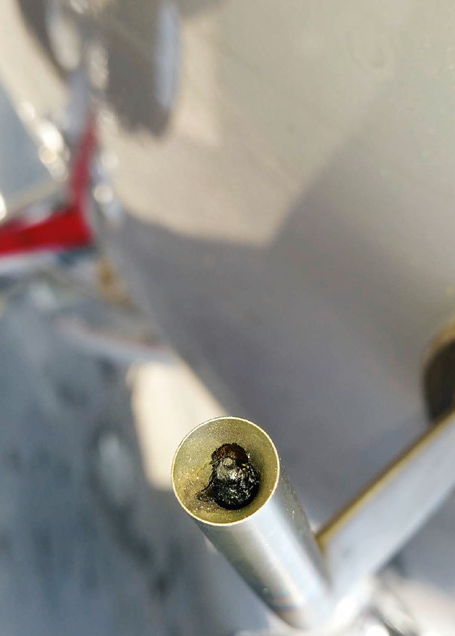
If the aircraft has been cleaned or painted, pay careful attention as these activities can give rise to numerous “knock on” technical issues such as pitot or AOA sensor damage. Always do a detailed walk around before such a check flight and take time over it. There have been many examples of jacking pads left on aircraft, masking tape covering elevator hinges and over spring tabs, not to mention paint on static plates and vents being blocked by FOD following deep servicing or painting.
Remember also all those systems that may have been required to be put into the Ground Test position to allow certain ground checks to be completed prior to flight clearance. Know what they are and make sure that they
are all correctly re-positioned to the flight position prior to flight. Apply the principle that if it can happen, it will happen. Your job as checker is to ensure that there is no adverse effect on the flight.
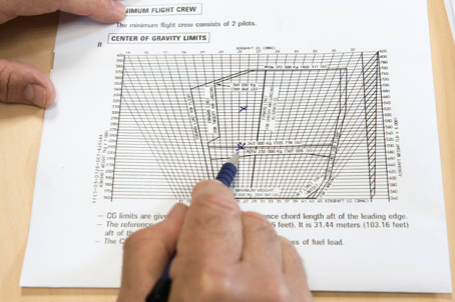
You will also need to think carefully about the weight and Centre of Gravity (CG) for the check flight. Loading ballast in an airline is not always the easy thing it is in the manufacturers test world and unusual CGs are not so common for the loads specialists. Even so, ask anyone who has been around a while in the test world and they will all have accrued a few mis-loading incidents in their life time. An advice would be to try to put the aircraft into a weight and loading situation with which you feel comfortable and use it as a standard for all subsequent similar flights.
Set up a mid CG if possible, avoid being on the limits and do consider the effect of the weight and CG on the expected “feel” of the controls. Expect that the aircraft will inevitably be much lighter than the aircraft on the line. No big problem there, but think about it and consider the speeds to be used in relation to stall speed and Minimum Control Speed. It may be that whilst you would normally be stall speed limited, you may now be on or near the Minimum Control Speed in the Air (Vmca) limits. It may also be that to fully test the fuel system a specific fuel load is needed and this may drive the CG.
Think carefully about the weight and Centre of Gravity (CG).
Functional Check Flights - Planning and preparing
026
Crewing
Section titled “Crewing”The primary role of management, with regards to check flight personnel, is to select the right people, then to let them do the job and finally be supportive in a safety sense, of their sometimes difficult decisions.
As previously said, often FCFs are seen by airline flight operations management personnel as a “chance to do some flying”. Understandable and tempting as this may be, they may well be the least able in terms of their ability to spend time researching and understanding the issues, keeping their flying skills at the right level and at being able to focus completely on the task and make the right technical judgments whilst handling the “pressure” to get the aircraft back on the line. Clearly, there are some management pilots who are “right” for the task but before selecting themselves, a totally honest review of their workload, experience and technical type knowledge needs to be carried out. The primary role of management, with regards to check flight personnel, is to select the right people, then to let them do the job and finally be supportive in a safety sense, of their sometimes difficult decisions. Checkers need to know that they will be supported by their operational boss in this regard and yes they will sometimes make mistakes too.
Having a small team of hand selected crew members who are properly prepared for the task is a better approach than trying to “be fair” and rotating the checking flights amongst all to give everyone the experience. A minimum group needs to be defined consisting of sufficient support or check engineers and pilots to manage the checking workload of the airline. They should have a nominated head who, through regular meetings with the team, reviews the schedules to be used, and ensures learning from the experience gained from each flight. He / she can also recommend to senior management how aircraft to be checked should be presented. Such a person can
also act as the liaison with the aircraft manufacturers to pick their brains and ensure that the airline receives the best advice possible from the manufacturers test specialists.
We recommend a crew of three wherever possible, so perhaps one of the major challenges for many airlines is to be able to integrate a ground operations engineer, a licenced quality engineer or specialist check engineer into the «test» crew environment in such a way that his voice is «heard» and his opinion weighed and valued alongside the pilot’s. No easy task in some cultures. Some airlines use a third pilot in this role but it must be clear that the primary role of this third crew member is not to be a third pilot but is to record data, maintain an over view of the checks to be carried out and most importantly to act as a safety back stop.
Having a small team of hand selected crew members who are properly prepared for the task is a better approach than trying to “be fair” and rotating the checking flights amongst all to give everyone the experience.
The checks to be undertaken will determine the number of check personnel in the full checking crew. With increasingly complex cabins and cabin systems, several Cabin Engineers are used by the manufacturers in a test capacity. The basic flight deck checking group should consist of the pilots and the senior Functional Check Engineer, who may also be cabin qualified. If needed, specialist Cabin Engineers can also be included. Take care during depressurisation checks, when using such a small team as there is a risk of one crew member being isolated in the cabin. The size of the cabin and the complexity of the systems checks in it, will generally dictate the overall size of the team in the back of the aircraft.
Airfield
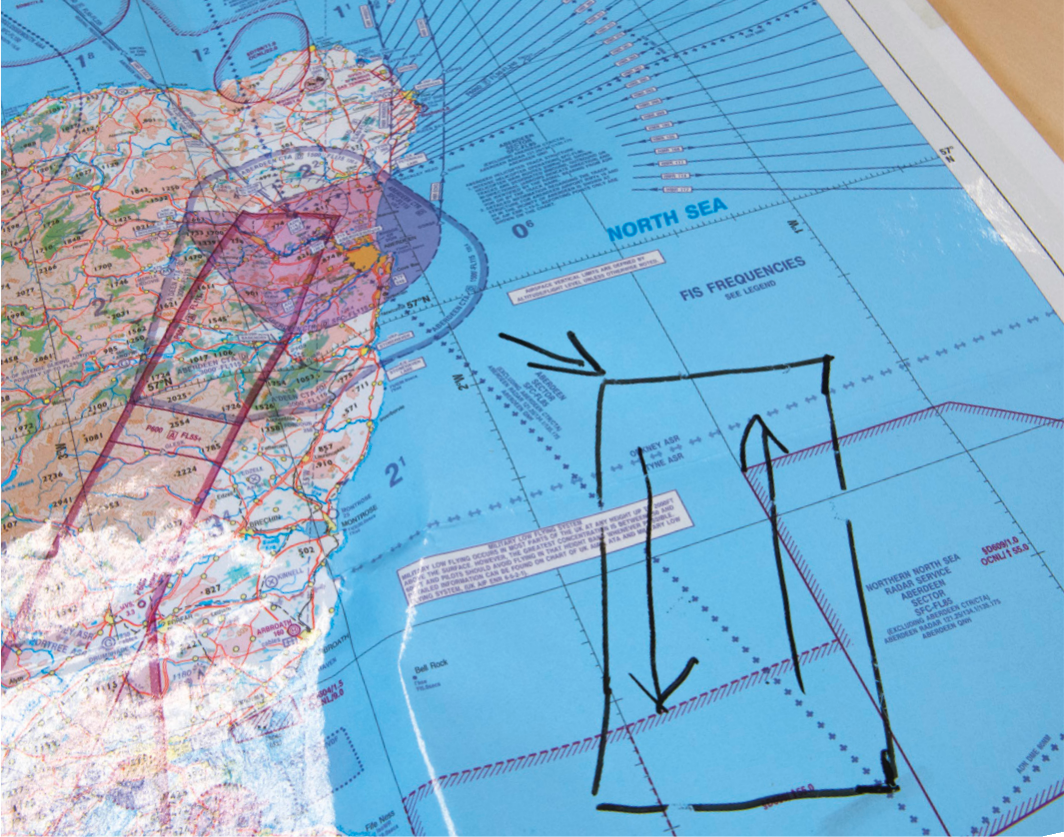
Section titled “Airfield”The airfield to be used is rarely a choice matter but it is wise to consider any implications stemming from the airfield itself. The runway capability, the height above sea level and its effect on performance, high ground and obstacles, the available navigation aids, and the active NOTAMs, all need to be considered as well as the general operational situation. For example before doing a rejected take-off or braking check, ask the question “is the operational runway the only runway in use?” and consider at what time of day the RTO will be carried out in respect to scheduled traffic. Burst a tyre at a busy time and you will not be too popular. At the bigger and busier central hubs, a short flight to another quieter airfield will probably be the answer.
Functional Check Flights - Planning and preparing 029
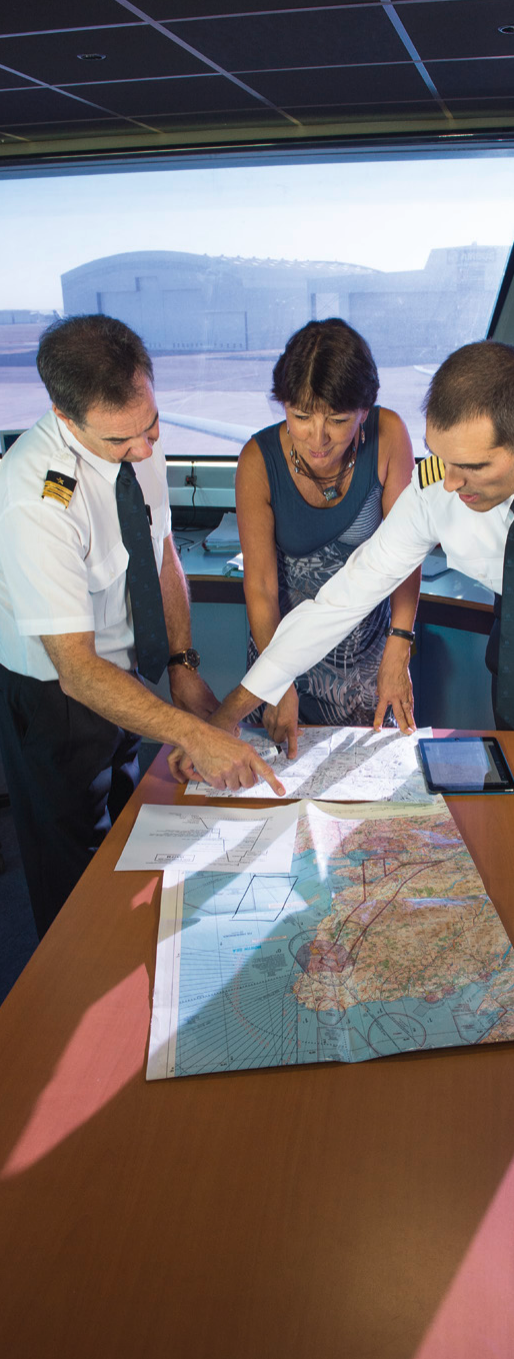
Pre-flight ATC briefings, directly between the pilots and the controller who will look after them, are very valuable and tend to act as a positive “bond” between pilot and controller. Wherever possible a quiet ATC environment is helpful.
Air Traffic and Airspace
Section titled “Air Traffic and Airspace”ATC can be your best friend or your worst enemy in a check flight sense. The check crew have got to ensure that they are a friend. Pre-flight ATC briefings, directly between the pilots and the controller who will look after them, are very valuable and tend to act as a positive “bond” between pilot and controller. The controller will then tend to move other traffic rather than the check aircraft. No briefing and the opposite happens. The controller may become irritated by the continual and seemingly illogical demands for turns and odd levels and can then add to the workload of the check crew by making things a lot more difficult.
It is also useful to annotate the flight plan in Section 18 with the words “This flight is a check flight””. The implication to a briefed ATC controller is that it will therefore be subject to many changes of height, heading and configuration and the crew workload may be high at times.
Wherever possible a quiet ATC environment is helpful and if the ATC agency has such a quiet frequency channel, it should be used. In the pure manufacturers test environment we have dedicated controllers to ensure efficient flight separation and conflict avoidance but normally an airline does not have this privilege. However, a careful look pre- flight at the airspace and the prevailing weather can often lead to selecting a good quiet, out of the way, corner of airspace like an inactive danger area which will serve the check aircraft flight profile well. If in doubt, ask the controller for his advice and through this advice he again tacitly binds himself to the success of the mission.
It is recommended that a daylight flight is better. If there are any serious weather concerns, a day only flight is the logical decision.
The day / night question
Section titled “The day / night question”Each organization will need to make a decision on the question of whether to carry out check flights by day only or by day and night. In principle, there is no major issue with carrying routine checks at night provided the meteorological conditions are VFR. However, there are nights when you can see for miles and there are other nights when it is inky black out there with no moon to assist. The combination of night and IFR should start to ring a warning bell or two and certainly will increase the workload on the crew a lot. So, it is recommended that a daylight flight is better, particularly for smaller airlines where these types of flight are flown less often and the crew currency may be lower. Also, after a significant deep service, the flight should commence in daylight if at all possible. In Airbus production testing, the last possible take off time for a first flight is related to the time of useful daylight so that at least the first slow speed handling checks can be carried out in daylight and VFR. If there are any serious weather concerns, a day only flight is the logical decision.
Ask the controller for his advice and through this advice he again tacitly binds himself to the success of the mission.
Weather
Section titled “Weather”During certification development flight testing, the weather criteria often drive the ability to carry out a given test. However, in the check flight world it is rare to have the privilege of waiting for perfect weather. That said, it is certainly wise to know what the bottom line is for the checks to be undertaken. It may not be wise to carry out a check of the brakes in a 30 kt crosswind for example.
In Airbus, the minimum weather for a first flight of a new build aircraft is defined. If full authority flight control checks or envelope protection checks are to be done then some clear vertical airspace between clouds is needed. Autoland systems are checked out in Cat I conditions before they are used for real and a lot of attention is paid to avoid icing layers in the descent for the low speeds handling. Even small amounts of icing can significantly change the onset of buffet speeds and the schedule speeds at which warnings operate.
So as part of the flight preparation and in the cool of the office it is best to define the rules of the game that will be applied from a meteorological point of view. Apply as few rules as possible as this will allow the greatest flexibility for the check crews. Apply only as many rules as may be needed to ensure safety. But then they must be respected - always.
Regarding weather, apply only as many rules as may be needed to ensure safety. But then they must be respected - always.
Functional Check Flights - Planning and preparing 031
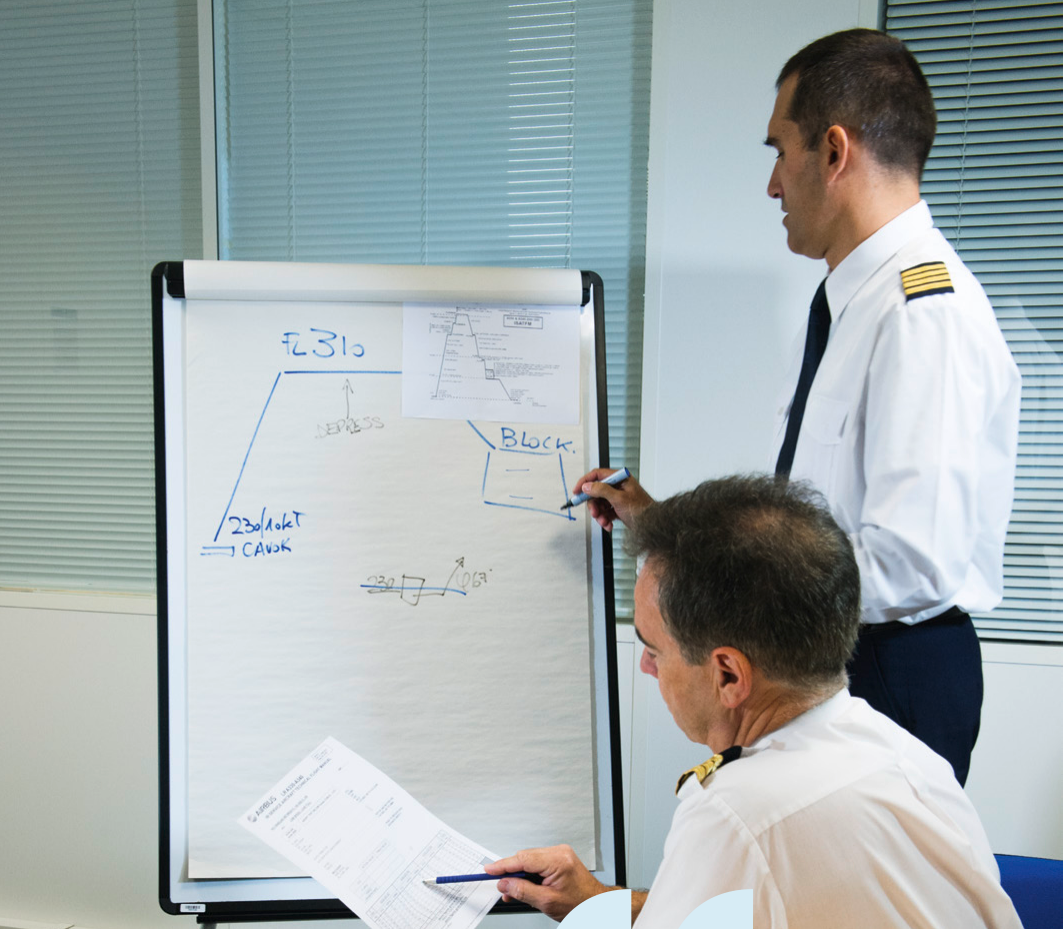
Checklists should still be used but they should be used for guidance and not treated as if they are the holy grail. No checklist can cover all check situations.
Checklists
Section titled “Checklists”Bearing in mind the more normal airline “standards driven” operational situation, the check crew will need to be able to think and work «outside» the standard checklist (whilst still understanding and recognising its importance) and be comfortable doing so. Checklists should still be used but they should be used for guidance and not treated as if they are the Law. No checklist can cover all check situations.
Test schedules
Section titled “Test schedules”In the airline world, Functional Check Flights are often looked at as not being necessary at all or at best a necessary irritation that interrupts the smooth aircraft allocation and planning process. It means that they are often conducted under great pressure from both operations and technical management who, of course want to see their costly asset getting back into the schedule where it is earning money for the airline as soon as possible. Whilst this is absolutely understandable, especially in the smaller airlines, management have a vital role to play in the check flight process, which is to shield their selected check personnel from such unhelpful pressures, whilst they in turn must do their job as safely and professionally as possible.
Therefore, planning for success means ensuring that the time element is considered. Ideally check flights should be flown in daylight and without the immediate pressure of a “back in line service” time. With smaller airlines sometimes this is simply not possible. However, the planning must allow time for a full briefing opportunity prior to flight and the opportunity to fully de-brief the technical staff.
Likewise, check flights should not be used to carry any form of passengers or people “along for the ride” or just for “the experience”. Whilst appearing to be tempting for various reasons, passengers in the checking situation often lead to adding complexity, health issues and pressure to an already complex exercise. If there is a requirement to move people from A to B then carry out the check flight first, land and then pick up the passengers for the subsequent transit.
Check flights should not be used to carry any form of passengers or people “along for the ride” or just for “the experience”
Different approaches to check schedules are used. A different check schedule can be developed for each type of check flight to be carried out or a master reference check schedule can be created where certain checks are crossed through if they are not applicable. The document should not only have the item to be checked but also any associated safety warnings written before the check together with the success criteria and the maximum tolerances allowed. Where a check demands the approach towards a hard limit like a VFE limit, then the NOT BEYOND figures need to be clearly written as this will form part of the mini item briefing later in the execution phase. Avoid writing a check over two pages if possible and certainly avoid having the safety warning detached from the check to be done. Better to have gaps on the pages. Also as check flights rarely work out as planned, format the schedule to make it easy to handle and use in a different order but take care with this. Certain checks should be carried out before others i.e. low speed handling before approaches.
The Airbus In Service Aircraft Flight Test Manual (ISAFTM) can be used as a reference by Customer airlines to create their own check schedules. Along with the data provided, the other factors mentioned above should all be taken into account in the final airline version. The process, of generating one’s own check schedules, forces the discipline of thinking about all the factors mentioned and ensures a better pre-flight preparation.
Functional Check Flights 033
Executing a Functional Check Flight
Section titled “Executing a Functional Check Flight”Functional Check Flights - Executing
Functional Check Flights - Executing
034
035
Ok, so now the right people have been selected and as much preparation as possible has been done. It is time to fly, but in this paper there is no intention of going through a test schedule check by check. This is well covered in Airbus Technical Flight Familiarization Course. The emphasis has deliberately been put on preparation. However, some of the
Briefing
Section titled “Briefing”Some guidelines on the briefing are useful here.
1. All involved parties need to be present and listening. Let us remember that this is a pre-flight briefing, not a long maintenance diatribe on what has been done item by item to the aircraft. Such data should already have been reviewed and frankly anyone can only remember a certain amount of detailed information at a time. The briefing is run by the Captain or the Check Engineer and needs to stay relevant to the flight. By all means have background technical people there to answer any questions that may arise.
2. Everyone must understand the task, their role in that task, the planned check sequence and the way in which the flight will be conducted. Any limits and key words should be agreed.
3. The weather needs to be specifically briefed with regards to any impact on any of the abovementioned aspect of the task.
4. Likewise the airfield and ATC and airspace situation must be reviewed.
5. A brief flight risk assessment should be made. This deals with the practical “what will we do if this or that happens?” question. It is not a deep engineering risk assessment but rather a review of the sequence assuming that things may not always go exactly as planned. It should include the things most likely to cause a problem and the fall back plan should they happen.
good things to do and some good general practices that should be followed will be mentioned.
Let us start with the briefing. No matter what the level of advance preparation certain things will change just before the flight and they need to be covered at a pre-flight briefing.

Always have one person flying.
The sections of the flight that are primarily a pure flying activity (like flight control checks or low speed handling) will be identified as will those which are essentially systems related (like a de-pressurization check) and it will be decided who is flying and who is monitoring. Always have one person flying. An observed tendency is that the whole crew gets “involved” in the detail of the check sequence. There is absolutely nothing wrong in having one crew member quietly listening but focused on the basic flying.
This pre-flight briefing will be later supported by mini “in flight briefings” that will be made before certain phases of the check flight to “remind” everyone what is coming next, what the limits are and what action needs to be taken by whom “in the event of” certain situations arising.
Getting airborne
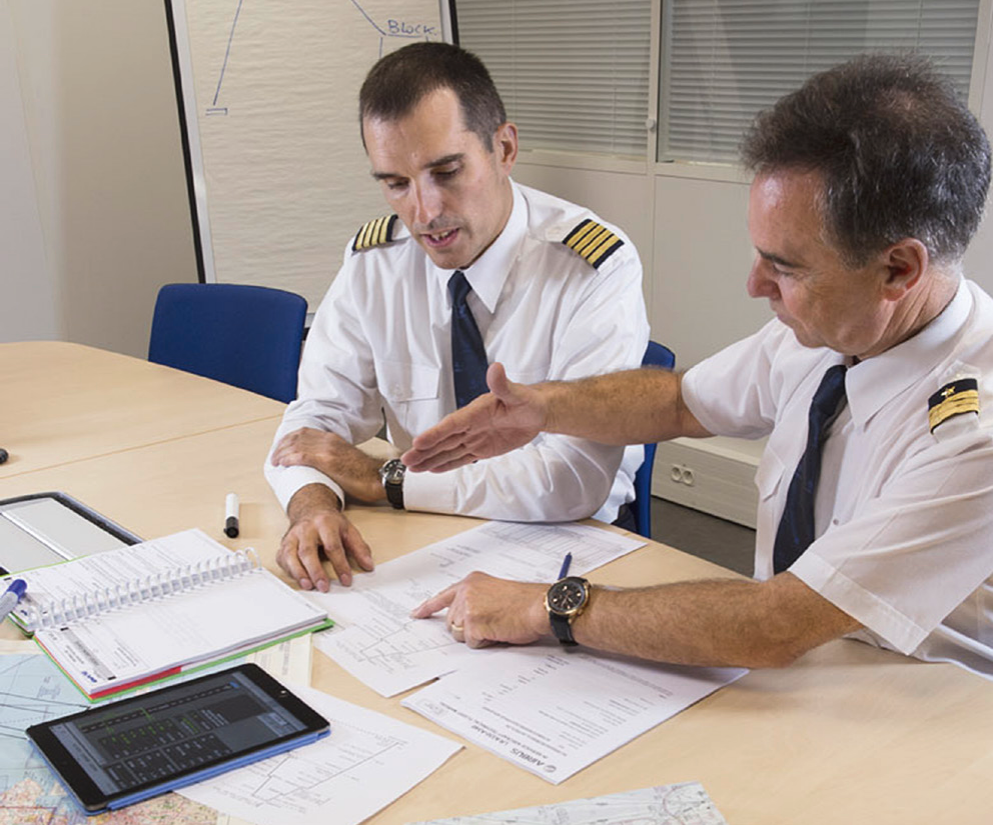
Section titled “Getting airborne”The pre-flight preparation should consider any need for FMS programming regarding fuel transfer and also back up flight plans in case the maneuvers flown early in the plan erase waypoints. Also electrical checks can sometimes cause some interesting computer responses on modern aircraft.
seat. His or her role is to record data and to monitor the work of the pilots in a non-intrusive way but with a “right of intervention” should something occur that he doesn’t understand or that he thinks may be incorrect.
Irrespective of the good use of checklists, along with most of the test fraternity, always carrying out a quiet final configuration check just before take-off and also just before landing seems a useful safety habit to develop.
As stated, it is expected that most airlines would use the standard checklists in the run up to getting airborne in their normal way. The difference is that a third crew member will probably be present in the jump
Functional Check Flights - Executing 037
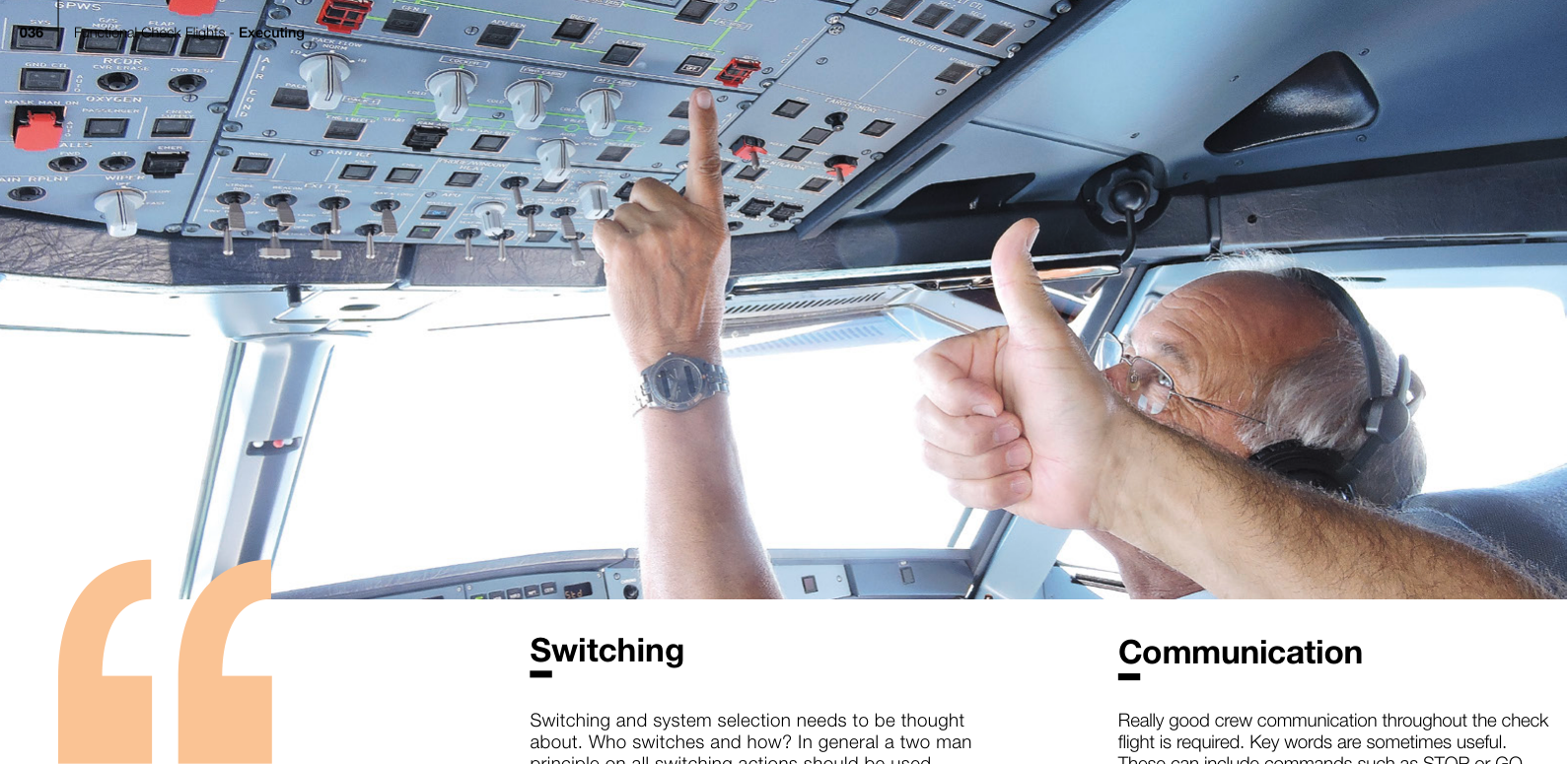
Really good crew communication throughout the check flight is required. Key words are sometimes useful. These can include commands such as STOP or GO AROUND but there are also some unwritten but absolutely clear rules for events such as one crew member not being comfortable with the test progression.
“Switching” confusion should be avoided by carrying out only one check at a time.
Really good crew communication throughout the check flight is required.
Take-off
Section titled “Take-off”If any test / check crew member says “I am not happy” the active pilot recovers immediately and the crew reviews the situation. Likewise if someone declares themselves as being “out of it” through workload or whatever, again, a recovery is carried out and then a re-brief to ensure all crew members are mentally on the same test point with the same level of understanding of the plan. Even silences need to be “listened to” as they can tell you that another crew member may be concerned about something. After a while it is possible to develop a “nose” for when it is not going according to plan and that is the time to slow it down and think about what is happening and whether the plan still makes sense. The
In the manufacturers test world, some specialist Flight Test Engineers are included in the take-off brief, so as to allow them the right to call STOP, as a key word command. The circumstances under which they would exercise this right are discussed and carefully considered and if in doubt they say nothing. In the airline world such a protocol probably would not be appropriate (subject to the experience and training) and we would recommend staying as close to the local standard practice as possible. In general, the flight deck should be quiet and free of unnecessary “chat” and certainly so below FL100. Careless words can be mis-interpreted and sometimes create a dangerous response.
Actually, in the manufacturer’s world, the principle is carried a bit deeper than this and it is normal to have two members of the three man check team always “in the loop”. Normally the flying pilot is allowed to concentrate on that task whilst the non-flying pilot and the “engineer” focus on system switching safety. It is also easy for one person to get “buried”, for example whilst carrying out radio checks (normally the non-flying pilot) but under those situations it is essential that the non-flying third member be in the loop with the person on the controls and aware of what is happening in a general flying sense. “Switching” confusion should be avoided by carrying out only one check at a time.
pacing has to be led by the slowest crew member but of course there are situations where ATC has no choice but to dictate the check pace such as when you are in the pattern or on the approach. Often the aircraft may be carrying a snag or two by this stage and the impact has to be continually re-assessed against the “remain to do” checks. This is where good check crews work together to continually formulate a new and safe plan of action.
As regards external communication, if there are significant radio problems, then the safe continuation of a check flight quickly becomes very challenging and it may well be wiser to concentrate on getting on the ground safely to get the radios fixed before continuing with other checks.
If there are significant radio problems, then the safe continuation of a check flight quickly becomes very challenging.
Functional Check Flights - Executing
Functional Check Flights - Executing
038
039
Workload
Section titled “Workload”Enter a hold or ask for a vector away from the airfield, to give thinking time.
Workload also has to be continually assessed on an individual and group basis. One person may become overloaded for a short while but if two out of the three reach this state then the situation can become very critical very quickly. The whole crew must never be allowed to reach this state, so if the test crew is only a two person crew the increased threat is obvious. A third, check qualified, crew member for this type of work is therefore strongly recommended.
One of the problems with workload is that it can rise very quickly and in such a way that the individual concerned, although aware that he or she is working too hard, is unable to take the decisions that will reduce that potentially dangerous situation. The person involved may even be unable to “see” the problem, never mind the solution.
As the workload increases the crew has to prioritize the tasks. The first priority is always securing the safety of the aircraft. Easy to say, but often this requires some tough decisions to be made and sometimes ones that local management may not be too happy with. Someone, normally the Captain, has to make it clear that until the technical systems issues are resolved or their implications fully understood, no more check points will
be carried out. Enter a hold or ask for a vector away from the airfield, to give thinking time, are useful workload reducing techniques. If the crew has a problem that they do not understand they should put the aircraft back on the ground while they think about it. There is no room for “pressing on” when a situation is not understood and may be potentially dangerous or worse, catastrophic.
Secondly, the objective is to secure good quality check or test data. There is no point in being there to gather poor data that the engineers cannot use. And finally the whole process should be carried out as expeditiously as possible. It is not a pleasure flight, although when done well, it’s extremely enjoyable. The objective is to re-clear the aircraft so that it can get back into the air quickly and re-start earning revenue with passengers on board.
The first priority is always securing the safety of the aircraft… Secondly, the objective is to secure good quality check or test data…
Snag resolution
Section titled “Snag resolution”The whole purpose of a check flight is be able to give an aircraft a clean bill of health, so it is not surprising that if a snag is found there is a desire to find out as much as possible about that snag to help the mechanics. Laudable as this may sound, it can lead quickly to some very unhealthy situations. Great care needs to be taken when “snag chasing”. The implications of one failure needs to be understood across all the systems affected, as do the implications of selecting certain associated systems into a degraded mode so as to “isolate” a snag. Remember too, that there may be another dormant but un-reported snag in the system already, which when coupled with the original snag and the crew switching may put the aircraft into a serious risk area. We tend to think, with modern aircraft, that everything is captured by the BITE system or is presented to us through the Flight Warning Computers but this is not so. This brings us back to the issue of integrity and if the crew do not know all the ramifications of complex and multiple switching actions then they simply should not do it. Put the aircraft on the ground, examine the situation very carefully, call the manufacturer if in doubt and only then proceed after having tried to fix the problem.
No anomalous indication on an aircraft appears for no reason. Some are small, some have little operational significance, some are intermittent (the worst kind) but there is always a reason. It is no good just hoping a snag has somehow just “gone away”. It may indeed not be easy to reproduce the symptoms or it may be limited to certain very precise flight or meteorological conditions but it will still be there and if left, these types of snag have a habit of returning at the worst possible moment. Sometimes the smallest of apparent issues can lead to failure scenarios with some very serious consequences. Watch out particularly for snags associated with “enabling” functions like weight on wheels switches and sensors. Their impact can be seen over several systems. Pressure controllers are another area where a snag can turn from fairly benign to very serious pretty quickly.
Watch out particularly for snags associated with “enabling” functions like weight on wheels switches and sensors.

No anomalous indication on an aircraft appears for no reason.
Note: In case the crew also needs to perform a Certificate of Airworthiness renewal which also includes checks, the crew must mentally separate these two demands and if possible clear the aircraft of snags first prior to completing the C of A renewal check points. If that is not possible (sometimes it is not) then crew awareness and good communication is essential.
Functional Check Flights - Executing 041
Tricky test points
Section titled “Tricky test points”Think about tricky test points on the ground carefully and decide how they should be flown and what the “break off” point is.
Some checks are certainly more difficult to fly than others or some may have a more immediate impact if they go wrong. The failure of a generator to come back on line does not have the same immediately damaging effect as allowing the speed to exceed Vmo by too much. So it is sensible to treat the “tricky test points” with the care they demand and not to rush them. Think about them on the ground carefully and decide how they should be flown and what the “break off” point is. These tricky tests can include speed limit checks, envelope boundary checks, depressurizations, initial handling checks, low speed checks and of course some engine checks.
It is also important not to become tempted to “take a look at” some of the certification test points. There are many “interesting” experiences in this category that could have developed into sad stories. Taking one example like Vmca definition, fuel starvation on some types of aircraft has occurred in the past on this test (which is done at very low altitude) causing the remaining engine to stop. The job of the checker is not to try to re-define the basic certification criteria of the aircraft. Those criteria have been flown and examined by experts under strict weather conditions and rigorously controlled conditions. The checkers job is to check “this” line aircraft against a pre-defined and approved Airworthiness standard or to clear a reported squawk or snag.

It is also important not to become tempted to “take a look at” some of the certification test points.
Different flight plans
Section titled “Different flight plans”With a modern aircraft check flight there are several “plans” being conducted at the same time. You have the desired planned check schedule. You have the approved Air Traffic Flight Plan which may involve some “on airways” flying and will often start with some sort of procedural departure. The FMS may have to be set up to a slightly different plan to ensure some functions work as they should like fuel transfer logics. There is also the Flight Warning Computer flight phase plan which may throw “stored” snags at you at pre-determined times and you also have an Air Traffic Control handover plan which drives the communication world and to some extent the workload. Finally, remember that you have no control over the most important “plan” and it’s called “the weather”.
The crews’ job is to safely carry out the check points whilst also conducting this “orchestra” of differing plans not all of which are in sequence and not all want to align conveniently. It’s not unusual to have a check point set up and ready, only to be asked to change frequency, squawk and then head straight towards a Cb.!! Or you may require an altitude or a block of altitudes only to run out of the ideal bit of airspace in which to do the next point. Patience is required and it is this aspect that benefits most from pre-planning, a good weather examination and pre-consultation with the ATC guys. It may be that on some days it simply becomes impossible and the sensible conclusion is to keep it safe and call it a day. Such judgments are not easy as they often have a considerable cost implication.
The crews’ job is to safely carry out the check points whilst also conducting this orchestra of differing plans not all of which are in sequence and not all want to align conveniently.
042 Functional Check Flights - Executing
Section titled “042 Functional Check Flights - Executing”Functional Check Flights
043
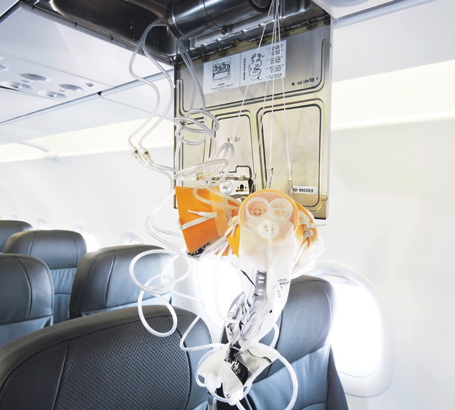
Cabin systems
Section titled “Cabin systems”Increasingly the area of cabin testing, as said before, is becoming more and more important. Complex seat systems and entertainment systems prevail and it is worth getting to know basically how they work. With the new larger aircraft, there is much closer integration between cabin systems and the flight deck, so cabin systems are no longer “something back there”. They are “passenger important” check areas that have to be thought about quite hard.
This whole paper could have dealt with pressurization issues that have occurred during testing but in order to be brief it is worth thinking about emergency oxygen if a depressurization is planned. Plan which oxygen sets the crew will use. The typical therapeutic oxygen bottles may be “a bridge too far” for someone working in the back of the aircraft to get to. Try getting one out of its stowage and in use in 20 secs and remember that if you are in the cabin checking something you may have to walk some distance to get to the bottle. A better idea is to select and allow a few well-placed oxygen masks to drop in the event of a full de-pressurization, so that the cabin checker can immediately take a seat and then breathe oxygen with the nearest passenger system.
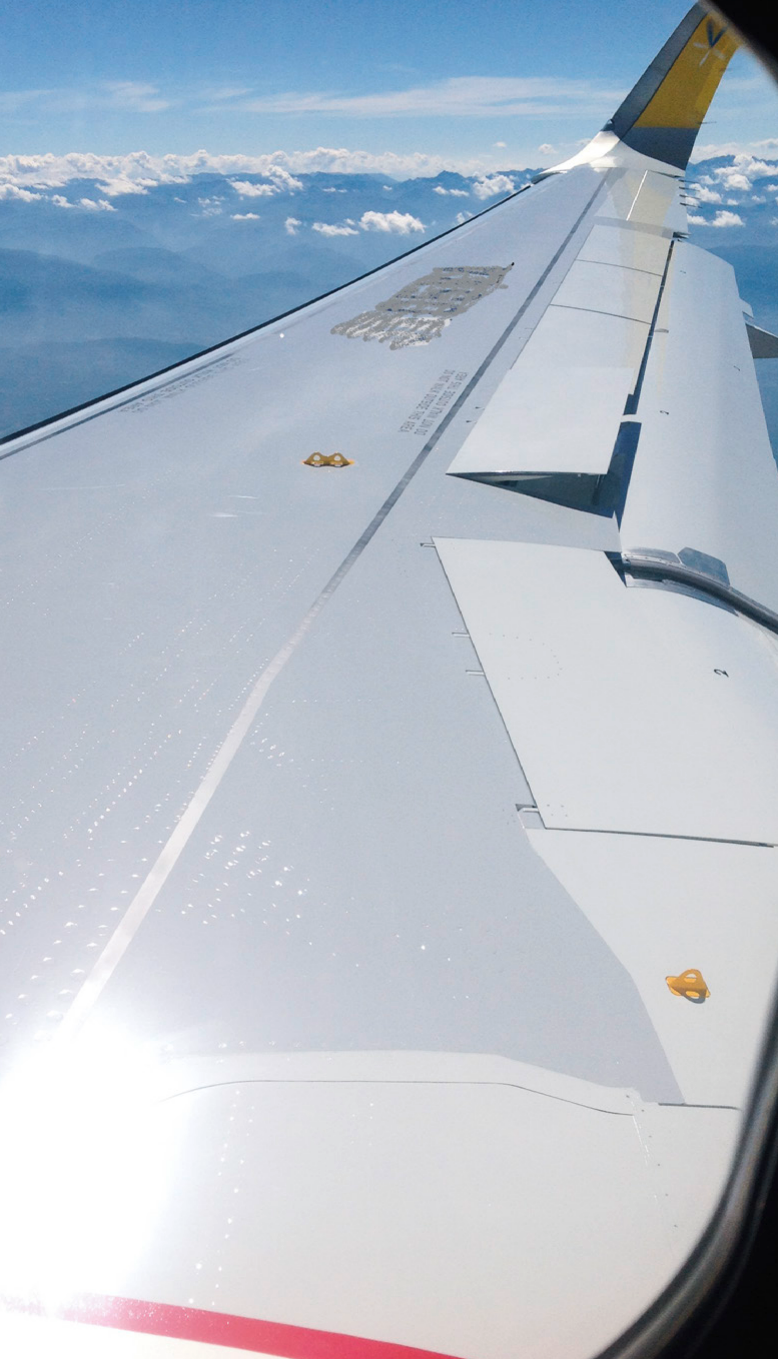
Think also about communication with the guys in the back and ensure the ability to inform them of what is going on and when to be strapped in. Likewise, there are many tasks they can help with like wing inspections and they will need to be able to communicate with the flight deck.
Conclusion
Section titled “Conclusion”The key to a successful FCF is to prepare thoroughly on the ground and to ensure the best information and knowledge is available to the well selected and correctly trained crew. Once airborne, the most common weakness in the overall checking “system”, of aircraft and crew, will probably be the active pilot as he is the most likely to become over loaded in a workload sense. Therefore, well communicated and timely support from the rest of the check crew is essential in ensuring the success of the check mission. It is the role of the Captain to encourage such communication. It is the duty of all check flight crew members to be active in a communication sense. The challenge for the crew is to avoid critical crew workload levels by excellent preparation, by regular mini briefings and by being ready for the unexpected as they conduct each test. Solid flying skills help as they allow a greater concentration on the communication aspects of the whole operation.
Always remember: Select the crews well, train them properly, brief carefully including the ATC and airspace agencies, plan the flight carefully and then fly the plan “defensively” with “escape routes” in mind and being failure minded. Never assume “it” will work perfectly. Finally, communicate well and no matter what the pressures are, always default to the safest decision.
We wish you good, safe check flights and remember always that preparation is the key.
044 Functional Check Flights
Section titled “044 Functional Check Flights”Articles published in previous ‘Safety first’ issues
Section titled “Articles published in previous ‘Safety first’ issues”Issue 20
Section titled “Issue 20”July 2015
Section titled “July 2015”-
Control your speed… during climb
-
Lateral runway excursions upon landing
-
Fuel monitoring on A320 Family aircraft
-
High-altitude manual flying
Issue 19
Section titled “Issue 19”January 2015
Section titled “January 2015”-
Tidy cockpit for safe flight
-
Landing on contaminated runways
-
Understanding weight & balance
-
Wind shear: an invisible enemy to pilots?
Issue 18
Section titled “Issue 18”July 2014
Section titled “July 2014”-
Control your speed… at take-off
-
Safe operations with composite aircraft
-
Learning from the evidence
-
A320 Family cargo Containers/ pallets movement
-
Parts Departing from Aircraft (PDA)
Issue 17
Section titled “Issue 17”January 2014
Section titled “January 2014”-
Airbus Brake Testing
-
Hard Landing, a Case Study for Crews and Maintenance Personnel
-
Aircraft Protection during Washing and Painting
-
Flight Data Analysis (FDA), a Predictive Tool for Safety Management System (SMS)
-
Flying a Go-Around, Managing Energy
Issue 16
Section titled “Issue 16”July 2013
Section titled “July 2013”• Performance Based
Section titled “• Performance Based”-
Navigation: RNP and RNP AR Approaches
-
Atlantic Airways: Introduction of RNP AR 0.1 Operations
• Flight Crews and De-Icing Personnel – Working together in Temporary Teamwork for safe Skies
-
Low Speed Rejected Take-Off upon Engine Failure
-
Late Changes before Departure
Issue 15
Section titled “Issue 15”January 2013
Section titled “January 2013”-
The Golden Rules for Pilots moving from PNF to PM
-
Airbus Crosswind Development and Certification
-
The SMOKE/FUMES/AVNCS SMOKE Procedure
-
Post-Maintenance Foreign Objects Damage (FOD) Prevention
-
Corrosion: A Potential Safety Issue
Issue 14
Section titled “Issue 14”July 2012
Section titled “July 2012”-
Thrust Reverser Selection means Full-Stop
-
Transient Loss of Communication due to Jammed Push-To-Talk A320 and A330/A340 Families
-
A380: Development of the Flight Controls - Part 2
-
Preventing Fan Cowl Door Loss
-
Do not forget that you are not alone in Maintenance
Issue 13
Section titled “Issue 13”January 2012
Section titled “January 2012”-
A320 Family / A330 Prevention and Handling of Dual Bleed Loss
-
The Fuel Penalty Factor
-
The Airbus TCAS Alert Prevention (TCAP)
-
• A380: Development of the Flight Controls - Part 1
-
Facing the Reality of everyday Maintenance Operations
Issue 12
Section titled “Issue 12”July 2011
Section titled “July 2011”-
Airbus New Operational Landing Distances
-
The Go Around Procedure
-
The Circling Approach
-
VMU Tests on A380
-
Automatic Landings in Daily Operation
Issue 11
Section titled “Issue 11”January 2011
Section titled “January 2011”-
What is Stall?
-
How a Pilot Should React in Front of a Stall Situation
-
Minimum Control Speed Tests on A380
-
Radio Altimeter Erroneous Values
-
Automatic NAV Engagement at Go Around
Issue 10
Section titled “Issue 10”August 2010
Section titled “August 2010”-
A380: Flutter Tests
-
Operational Landing Distances: A New Standard for In-flight Landing Distance Assessment
-
Go Around Handling
-
A320: Landing Gear Downlock
Issue 9
Section titled “Issue 9”Issue 6
Section titled “Issue 6”February 2010
Section titled “February 2010”July 2008
Section titled “July 2008”-
A320 Family: Evolution of Ground Spoiler Logic
-
A320: Runway Overrun
-
FCTL Check after EFCS Reset on Ground
-
Incorrect Pitch Trim Setting at Take-Off
-
A320: Possible Consequence of VMO/MMO Exceedance
-
• A320: Prevention of Tailstrikes
-
Technical Flight Familiarization
-
Oxygen Safety
-
Low Fuel Situation Awareness
Issue 8
Section titled “Issue 8”-
Rudder Pedal Jam
-
Why do Certain AMM Tasks Require Equipment Resets?
July 2009
Section titled “July 2009”-
Slide/raft Improvement
-
The Runway Overrun Prevention System
• Cabin Attendant Falling through the Avionics Bay Access Panel in Cockpit
-
The Take-Off Securing Function
-
Computer Mixability: An Important Function
Issue 5
Section titled “Issue 5”- Fuel Spills During Refueling Operations
December 2007
Section titled “December 2007”Issue 7
Section titled “Issue 7”- New CFIT Event During Non Precision Approach
February 2009
Section titled “February 2009”-
A320: Tail Strike at Take-Off?
-
Unreliable Speed
-
Airbus AP/FD TCAS Mode: • Compliance to Operational A New Step Towards Safety Procedures Improvement • The Future Air Navigation
-
• Braking System Cross System FANS B
-
Compliance to Operational Procedures
-
Braking System Cross Connections
Issue 4
Section titled “Issue 4”- Upset Recovery Training Aid, Revision 2
June 2007
Section titled “June 2007”-
Fuel Pumps Left in OFF Position
-
A320: Avoiding Dual Bleed Loss
-
Operations Engineering Bulletin Reminder Function
-
Avoiding High Speed Rejected Take-Offs Due to EGT Limit Exceedance
-
Do you Know your ATC/TCAS Panel?
-
Managing Hailstorms
-
Introducing the Maintenance Briefing Notes
-
A320: Dual hydraulic Loss
-
Terrain Awareness and Warning Systems Operations Based on GPS Data
Issue 3
Section titled “Issue 3”December 2006
Section titled “December 2006”-
Dual Side Stick Inputs
-
Trimmable Horizontal Stabilizer Damage
-
Pitot Probes Obstruction on Ground
-
A340: Thrust Reverser Unlocked
-
Residual Cabin Pressure
-
Cabin Operations Briefing Notes
-
Hypoxia: An Invisible Enemy
Issue 2
Section titled “Issue 2”September 2005
Section titled “September 2005”-
Tailpipe or Engine Fire
-
Managing Severe Turbulence
-
Airbus Pilot Transition (ATP)
-
Runway Excursions at Take-Off
Issue 1
Section titled “Issue 1”January 2005
Section titled “January 2005”-
Go Arounds in Addis-Ababa due to VOR Reception Problems
-
The Importance of the Pre-flight Flight Control Check
-
• A320: In-flight Thrust Reverser Deployment
-
Airbus Flight Safety Manager Handbook
-
Flight Operations Briefing Notes
-
Situation Awareness and Decision Making
来源: Airbus Safety First 网址: https://safetyfirst.airbus.com/functional-check-flights-4-4-executing-a-functional-check-flight/ 发布日期: 2015-10-19 类别: 飞行运营 PDF: 原始 PDF
空中客车安全杂志 2015年10月
特刊
Safety first 功能检查飞行
Section titled “Safety first 功能检查飞行”功能检查飞行
功能检查飞行
002
001
Safety first 特刊 2015年10月。Safety first 由空中客车公司出版——1, rond point Maurice Bellonte - 31707 布拉尼亚克塞德克斯/法国。出版人:Yannick Malinge,首席产品安全官;编辑:Corinne Bieder,产品安全战略与传播总监。概念设计由空中客车多媒体支持 20151711。编号:D15030884。图片由空中客车、P. Masclet、Lindner Fotografie、S. Chobert、P. Pigeyre、C. Brinkmann 提供。法国印刷。
本手册采用浮雕纸印刷。该纸张由获得 EMAS 认证并通过 ISO 9001/14001、PEFC 和 FSC CoC 认证的工厂生产。纸张采用无氯和无酸漂白工艺制造。纸张可完全回收利用,原料来源于可持续森林资源。印刷油墨使用有机颜料或矿物质,不使用偶氮染料或镉、铅、汞或六价铬组中的危险金属。
印刷商 Art & Caractère(法国 81500)实施了废弃物管理和回收计划,对所有相关副产品进行回收处理。
© 空中客车公司 2015 – 版权所有。专有文件。
贵方接收本手册(以下简称“手册”)即表示贵方代表贵公司同意遵守以下指南:
除阅读权外,本手册的交付不授予任何其他知识产权,仅供信息参考目的。
未经空中客车事先书面同意,不得修改本手册及其内容,不得复制其插图和照片。
本手册及其包含的材料不得全部或部分出售、出租或授权给任何第三方付费使用。
本手册包含在付印时属准确的信息。这些信息涉及多种可能随时间变化的因素,影响真实的公开表述。空中客车不承担更新本文件包含的任何信息或与本文所述信息相关的任何义务。
空中客车公司对于因使用本手册及其包含的材料而造成的任何损害不承担责任,即使空中客车公司已被告知发生此类损害的可能性。
Safety first
Section titled “Safety first”空中客车杂志旨在通过增进安全相关主题的知识和交流,提升航空器运营的安全性。
Safety first 由产品安全部门出版。它是飞行和地面机组人员(操作空中客车飞机)专用安全信息的来源,也分发给其他经选定的机构。
出版物素材来自多个渠道,包括来自空中客车飞行安全保密报告系统的精选信息、事故和事故调查报告、系统测试和飞行测试。素材还来自航空公司内部、政府机构的研究和报告以及其他航空来源。
Safety first 中的所有文章仅供信息参考,无意取代国际民航组织(ICAO)的指南、标准或推荐做法、运营人强制要求或技术指令。内容不取代注册国对运营人航空器的要求,也不取代或修订任何空中客车特定机型的飞行手册(AFM)、维护手册(AMM)、飞行机组操作手册(FCOM)、主最低设备清单(MMEL)文档或任何其他批准文件。
在注明版权来源的情况下,文章可以转载,但须注明空中客车。在非空中客车作者的情况下,文章内容不一定反映空中客车的观点,也不表示公司政策。
欢迎来稿、评论和反馈。因技术原因,编辑可能需要对稿件进行编辑修改,但将尽一切努力保留原文的原意。有关本出版物的咨询请联系:
空中客车产品安全部门(GS) 1, rond point Maurice Bellonte 31707 布拉尼亚克塞德克斯 - 法国 safetycommunication@airbus.com 传真:+33(0)5 61 93 44 29
过去的经验表明,将功能检查飞行当作“正常”商业飞行执行会带来重大的安全问题。
事实上,尽管功能检查飞行可能在航空公司环境中执行,且该环境习惯于管理商业飞行的安全性,但它们与这些日常飞行在许多方面存在差异:非收入航班的状态、所需飞行员资质要求、特定操作环境的特点、导航文档,甚至整体监管框架。
雅尼克·马林格
Section titled “雅尼克·马林格”功能检查飞行是特殊的飞行,需要特别的安全关注。因此,以一种特殊的形式来阐述它们是恰当的。本期《安全第一》杂志特刊将带您了解功能检查飞行的特殊准备流程。
高级副总裁兼产品安全官
这一流程远在实际飞行执行之前就已开始,涉及更广泛、更宏观的组织层面。它涵盖了多个时间维度和多方面内容,所有这些共同构成了此类飞行的“做好准备”。
为了将这些方面作为一个整体加以阐述,本期特刊也采用了特殊的结构。不是一组独立的文章,而是一篇沿不同组织层面和时间维度展开的完整文本,阐释安全功能检查飞行所需的准备条件。
祝您阅读愉快!
功能检查飞行
Section titled “功能检查飞行”需要做哪些准备?
Section titled “需要做哪些准备?”每一次飞行都是独一无二的,需要机组人员根据飞机状态、航线、天气条件、人员自身状况、燃油量、飞机重量和平衡等因素进行准备。然而,涉及飞机功能检查的飞行具有额外的特定风险,需要更加注重安全。
事实上,这类飞行在航空公司环境中执行时,与“正常”的常规航班在许多方面存在显著差异。它们有时被称为技术检查飞行、维修后检查飞行、租期结束转场飞行或功能检查飞行。为便于叙述,本刊将统一使用功能检查飞行(Functional Check Flights)的缩写,即 FCF。
确保 FCF 的安全涉及多个层面和阶段的各个方面和参与者。本期特刊将概述安全执行 FCF 所需的条件。本刊将沿时间/组织架构的维度,阐述在各个层面促进 FCF 安全的主要方面。因此,内容安排如下:
需要特殊处理的特殊飞行 | 航空公司准备执行功能检查飞行 | 规划并准备功能检查飞行 | 执行功能检查飞行
功能检查飞行 005
需要特殊处理的特殊飞行
006 功能检查飞行 - 特殊飞行
Section titled “006 功能检查飞行 - 特殊飞行”功能检查飞行 - 特殊飞行 007
什么是功能检查飞行?
Section titled “什么是功能检查飞行?”EASA 维修检查飞行法规概览
Section titled “EASA 维修检查飞行法规概览”图1:功能检查飞行法规摘要
Section titled “图1:功能检查飞行法规摘要”非商业飞行
技术检查
维修后检查
租约终止
功能检查飞行是指在维修操作或可能影响飞机固有气动特性和/或系统特性及运行性能的修理之后,或在飞机归还出租人之前所进行的非商业飞行。建议由三名航空公司机组人员执行,即两名飞行员和一名工程师。
因此,在航空公司的世界里,FCF 在许多方面与常规业务活动不同。
首先,FCF 是“非商业飞行”。由于这一活动不是航空公司的核心业务,它在一定程度上也会扰乱飞机和机组排班计划,需要动用飞机、机组及其他所需运行人员。
此外,考虑到 FCF 的目的是接近极限、检查系统状态和飞机响应,对于航空公司机组来说,FCF 是不同寻常的飞行。
无论是心态、培训、文档、计划,还是其他有助于安全飞行的各个维度,FCF 都需要特殊的准备和条件。
确保此类飞行安全的先决条件是承认其独特地位,并在各个层面认识到这些飞行需要特殊处理。
从监管角度看,FCF 的特殊性已得到认可,并转化为专门维修检查飞行法规的制定。该法规由 EASA 于 2012 年发布:参考文件 - EASA,NPA 2012-08。维修检查飞行(MCF)。
监管要求涉及多个有助于 FCF 安全的方面,包括:
- 飞行机组要求
- 额外机组人员
- 培训课程
- 维修检查飞行手册
为了补充并超越监管材料,以下各节将提供关于有助于使 FCF 成为安全飞行的关键方面的详细定性分析。
航空公司准备执行功能检查飞行
功能检查飞行 - 航空公司准备 011
精选与培训的机组
Section titled “精选与培训的机组”一旦承认功能检查飞行值得特殊对待,在航空公司层面建立执行此类飞行所需的一切准备就涵盖了多个方面,下文将逐一审查。
检查飞行工作中对个人特质的要求与其它任务有所不同。在航空公司中,大多数年轻飞行员的选拔标准有着不同的目标。然而,检查飞行是所有航空公司都必须面对的现实,任务往往落在首席飞行员或其他资深人员身上,如机队机长或机队技术飞行员,他们可能将此视为“走出办公室”的机会。尽管这些人员非常重要,但并非所有人都一定最适合这项任务,也未必能够以应有的、可能也希望的方式抽出时间进行准备。那么,应该在入选“检查团队”的飞行员或工程师身上寻找什么样的素质呢?
检查组成员要在这一领域取得成功,需要建立在 4 个支柱 上,即 知识、技能、天赋和经验。有人可能会说“这与我的领域没什么不同”,但让我们在“检查”的意义上更仔细地审视其中一些特质。
显然需要对飞机、任务背后的理论以及自身角色有深入的了解。在检查飞行领域生存下去,必须具有刨根问底的精神,人们期望所有检查空勤人员不断提问,一个问题接着一个问题,直到得到既“正确”又合理的答案。新人的问题尤其受欢迎,因为它们能保持组织的敏锐和准确。虚假信息通常容易识别,在检查领域没有容身之地,所以回答必须经得起推敲。
5 年前正确的答案在今天可能已经不适用。情况会发生变化,而这些变化有时需要重新思考。同样重要的是在这方面要保持自主性。不要等待信息主动找上门,而要主动去寻求,并建立良好的联系渠道和高质量的信息来源。
刨根问底的精神至关重要。不要等待信息主动找上门,而要主动去寻求。
有价值的技能包括观察、解读、分析,以及绝对不可忽视的沟通。
有价值的技能包括观察、解读、分析,以及绝对不可忽视的沟通。对于飞行员来说,所谓的“运动功能”飞行技能也需要相当不错,但有些人可能会惊讶地发现,纯粹的飞行协调和技术并不一定是首要优先事项,只要这方面达到任务可接受的水平即可。然而,飞行能力确实会影响飞行员处理高工作负荷情况的能力,因此这一点将在后文关于失速的章节中再次提及。
其中一些技能并非对所有人都与生俱来。有必要仔细考虑每个检查点或任务,确定哪些参数是重要的。还要了解何时以及多久读取一次这些参数,以及何时记录它们。在这种情况下,第三名机组成员的记录任务始终次于作为安全“观察员”的角色——负责即时监督每个检查点的执行方式,并因此能够及时发出警告。
功能检查飞行 - 航空公司准备就绪
功能检查飞行 - 航空公司准备就绪 013
012
APTITUDE(素质)
Section titled “APTITUDE(素质)”正确类型的飞行员或工程师应在驾驶舱资源管理方面具备天生的技能,尤其擅长倾听……诀窍在于确保在检查飞行中,所有具有知识和有用信息的人都能真正被倾听,无论他们的级别、制服上的条纹数量、国籍、性别或薪资等级如何。
素质(aptitude)要复杂一些。在本文语境中,它指的是某人是否“以正确的方式思考”并展现出正确的判断力。
首先,检查学员需要能够处理几个看似矛盾的情况。让我们举几个例子。以检查组成员在某个话题上何时需要坚持立场、何时可以灵活变通的问题为例。如果我们面对这样一种情况:一架飞机可能在检查飞行前后需要返工,但其计划排期在当天稍后时段,你会立即看到这种相当常见的情况下必须承受的压力,而知道何时可以灵活处理、何时必须采取更强硬的立场,正是工作的一部分。
再举一个例子,在典型的小组讨论中——例如关于某个特定系统检查——某些人不可避免地会比其他人拥有更多知识,因此何时基于自己的知识发言、何时应该倾听,就成为一项技能和挑战。通过适当的敏感度和彼此间的相互意识,团队动态必须导向正确答案。
也许最著名的问题是自信心。一个检查组成员必须具备足够的自信心,以便在必要时做出决策并介入正在发展的情况,但不能过度自信,以至于导致检查点在超出安全限制的条件下进行。检查飞行领域有许多类似的矛盾情况需要面对和正确解决。优秀的团队成员在这类情况中正确的时候多于错误的时候。
因此,正确类型的飞行员或工程师应在驾驶舱资源管理方面具备天生的技能,尤其擅长倾听。但检查飞行的CRM与正常航空公司航线飞行情况大不相同。一位担任功能飞行检查工程师的地面工程师,很可能正是对某个特定系统最为了解的人。同样,副驾驶也可能在某个领域是专家,因此经典的驾驶舱领导权平衡在检查飞行过程中可能会发生变化,而且只有当最终安全决策必须做出时,才应明确地向机长倾斜。显然,在正常的航空公司运行中,权威梯度是明确定义的。但每家航空公司都需要根据其当地和本国文化来决定如何处理权威梯度问题。诀窍在于确保在检查飞行中,所有具有知识和有用信息的人都能真正被倾听,无论他们的级别、制服上的条纹数量、国籍、性别或薪资等级如何。
尤其是检查飞行员,还需要能够在活动中实现良好的平衡,并保持必要的自信心,但不能过度自负。要寻找那些不是在试图证明自己有多优秀、而是致力于验证飞机有多好(或有多差)的人。有趣的是,这一特质在飞行展示领域同样至关重要。
寻找那些不是在试图证明自己有多优秀、而是致力于验证飞机有多好(或有多差)的人。
在某些方面,这正是检查世界与正常运营飞行员世界之间的关键区别。年轻的飞行员在成长阶段的职业生涯中不断提升自己的飞行技能,并在测试条件下展示这些技能。如果飞行表现不太理想,正常的反应是“一定是我自己的问题”“我今天状态不好”。换句话说,他们会向内审视自己的表现。检查世界则不同。它要求他们成为“标准”,并用这个标准来评估他们所驾驶的飞机。被检验的是飞机,而不是飞行员。他们必须向外看。如果同型号的飞机昨天飞过,对某个特定机动动作的反应是“正常的”,但今天不是了,或者感觉不同了,那么是什么发生了变化?有什么东西改变了吗?重量和重心(CG)是否相同?或者可能是更严重的问题,比如由于配平损伤等原因导致的飞行控制系统性能下降?
被检验的是飞机,而不是飞行员。
最后,也是最令人向往的特质列表中最重要的,是个人诚信,其价值高于一切。检查飞行专家需要是心智足够强大的人,能够为自己的决策(无论好坏)承担责任,然后能够与自己的错误共处,从中学习,并将其传达给他人。当真正的原因是飞行员选择了错误的构型或在错误的时机拨动了错误的电门时,可能会浪费大量时间来追查一个并不存在的问题或飞行特性。在研制试验领域,没有藏身之处,因为所做的一切都被拍摄、记录、遥测并由专家组审查,但在航空公司检查飞行的情况下并非如此,因此老式的诚信至关重要。在这项工作中,没有比这更重要的特质了。
最令人向往的特质列表中最重要的,是个人诚信。
Functional Check Flights - Airline preparedness
014
不要只看飞行小时数……
Section titled “不要只看飞行小时数……”正确的经验对于提高判断力、任务排序和风险评估极为有价值,但经验也可能是一个巨大的欺骗者。在世界某些地区,有许多累计飞行时间达35000小时的航空公司飞行员,他们完全不适合执行检查飞行任务。这些人拥有的是大量重复性、相似性任务的经验,而不是多种不同类型的经验,无法据此做出良好的、基于充分信息的检查飞行判断。因此,不要只看飞行小时数,而要深入了解飞行记录本中相关的检查飞行经验,以及个人成功完成过多少次非例行操作。
在面试中识别这些主要特质并为这类工作选择“合适”的人选,将在检查飞行场景中带来诸多益处。实际上,如果人选不当,无论流程多么完善,风险仍然存在。然而,对这些人进行培训以进一步发展执行检查飞行所需的知识、技能和态度,则是一项额外优势。
当航空公司内部存在适当的专业知识,并且管理层充分认识到需要让员工在检查飞行方面“跟上进度”时,在航空公司内部培训检查飞行员是完全可行的。拥有大型机队的部分航空公司设有专门的专业部门,负责对所有机队飞机执行检查。
同样,空客也开发了制造商的功能检查飞行课程,并已证明效果非常积极。该课程并非旨在培养完全合格的测试机组,而是为了让学员初步接触正确类型的思维方式,并帮助航空公司的检查人员沿着学习阶梯向上攀升,从而避免一些基本错误。该课程使用空客的一种机型作为载体来承载“通用”教学内容,空客也用这种机型来展示安全执行FCF所需的知识和技能水平。
其他航空培训机构也提供类似课程,但方式更为通用。选择权在航空公司手中。
空客技术飞行熟悉课程
Section titled “空客技术飞行熟悉课程”对涉及安全问题的实际功能检查飞行进行分析,能够突出此类飞行安全的关键方面:
基于经验的反馈,空客在2009年开发了技术熟悉飞行课程,旨在为飞行机组提供知识、技能和态度,以提升执行以下任务时的安全、质量和效率:
- 建立飞机检查的思维方式
- 适当的机组预期
- 执行与航线运营不同动作的特定技能
- 技术飞行或功能检查飞行(即维护后、喷漆后等)
- 接收飞行(即运营商之间的交接)
- 认识到机组人员目标不一致带来的威胁,特别是在租赁结束情况下
- 避免采用“打勾式”方法
该课程设计为3人机组(2名飞行员和1名工程师),由2名教官(1名试飞员和1名试飞工程师)授课。
- 了解与不熟悉的飞机重量和重心相关的性能和操控差异
该课程结合了理论阶段(2天)、全动飞行模拟机阶段(2天)和飞行训练,涵盖上述所有方面,使FCF尽可能安全。
- 新机组人员技能组合和新知识
- 积极的ATC协调
想了解更多空客技术飞行熟悉课程?请联系或访问网站
功能检查飞行 - 航空公司准备状态
功能检查飞行 - 航空公司准备状态
016
017
除了需要合适的人员,做好功能检查飞行的准备还依赖于对这些检查项目的理解:它们是什么、用于什么目的以及如何执行。
多年来,关于航空公司如果打算自行进行维修后功能检查飞行应使用哪份文件,一直存在一定程度的混淆。
执行功能检查飞空的唯一手册是 ISATFM。请勿使用 CAM。
将一份手册误认为另一份可能会引入功能检查飞行领域不应存在的隐藏风险。那么应该使用哪一份呢?
不同情况的手册
Section titled “不同情况的手册”空客开发了多份手册用于执行”检查”飞行。具体包括:ISATFM(In-Service Aircraft Technical Flight Manual,服役飞机技术飞行手册)、PATM(Production Aircraft Test Manual,生产飞机测试手册)和 CAM(Customer Acceptance Manual,客户接收手册)。多年来,关于航空公司如果打算自行进行维修后飞行检查应使用哪份文件,一直存在一定程度的混淆。
虽然这三份手册涵盖的所有飞行都旨在执行检查,但每份手册在以下方面都有特定的范围:
- 飞机的状态(从刚下生产线到已在服役状态)
最简单但错误的解决方案似乎是使用最顺手的那份——客户接收手册,该手册在客户接收新交付飞机的验收飞行时已收到。然而,这一”解决方案”存在一些不应出现在技术飞行检查领域中的隐藏风险。那么应该使用哪一份呢?
- 飞行员的背景及其所属组织的性质。
简而言之,这些文件可概括如下:
功能检查飞行 - 航空公司的准备工作
功能检查飞行 - 航空公司的准备工作 019
018
ISATFM(In-Service Aircraft Technical Flight Manual,服役飞机技术飞行手册)
Section titled “ISATFM(In-Service Aircraft Technical Flight Manual,服役飞机技术飞行手册)”如前所述,这是必须用于服役飞机的手册。每个空客飞机系列都有相应的 ISATFM:宽体机对应 A300 系列、单通道对应 A320 系列、远程对应 A330/A340 系列、双层对应 A380。
2014 年,在飞机租赁行业提出请求后,ISATFM 飞行阶段被分为两个部分。人们认识到,老一代 ISATFM 手册对于没有飞行检查经验的飞行员来说操作相当复杂。因此,手册被重新划分,“第 2 部分”成为正常包线范围内的飞机基本功能检查,“第 3 部分”为进阶检查,由经过适当培训的飞行员执行,从而允许对飞机及其系统进行更深入的技术检查。
每份手册分为 3 个部分:
Section titled “每份手册分为 3 个部分:”第 1 部分 为地面检查阶段,第 2 部分 为基本飞行阶段,第 3 部分 为经培训机组的附加飞行检查阶段。
这些阶段应按逻辑顺序和编号顺序执行。
实际上,第 2 部分旨在用于已服役的飞机,在飞行前没有重大维修动作,允许运营商之间的交接阶段。可由常规航线飞行员执行飞行。
这些是第 2 部分不应被用作航空公司内部执行技术飞行手册的主要原因。
在此,我们只讨论飞行阶段(第 2 部分和第 3 部分)。
第 3 部分飞行剖面与生产首飞非常相似,但不包括性能检查或降级模式检查。飞行结束时,机组成员对飞机的技术状态有非常好的了解。
为了飞行”第 3 部分”飞行剖面,建议机组成员应接受适当培训。
如何获取 ISATFM 手册及其使用方法?
Section titled “如何获取 ISATFM 手册及其使用方法?”空客开发的 ISATFM 文件使用理念是支持航空公司开发自己的 FCF 手册,并根据自身的运营环境(机场、检查项目、飞行员概况……)进行改编和定制。换句话说,ISATFM 被设计成一份”自助餐式”菜单,是空客基于其专业知识的推荐指南。但为了支持 FCF 的安全性,每家航空公司都需要经过自身独立的思考过程,并以此为参考设计自己的手册。这一思考过程可能导致航空公司删除某些其没有把握执行的检查项目,或根据其环境添加一些特定信息……
为确保所有航空公司了解和认可这一必要步骤,ISATFM 由空客在收到请求后提供,在签署并收到法律弃权书后方可获取。法律弃权书说明了如何使用此文件。弃权书规定,航空公司应使用所提供 ISATFM 的指南来控制自己的文件,并且应删除作为空客文件的引用标注,替换为航空公司的标题。从逻辑上讲,弃权书还规定,带有空客标题的 ISATFM 文件不得转发给第三方,不得复制或存储,但这仅适用于空客标题版本。
如需接收弃权书,航空公司需要致函 EVRT 秘书处(evrt.control-room@airbus.com)
作为回报,航空公司将收到法律弃权书,必须签署并返回,以便接收其机型对应的文件。航空公司随后将收到 PDF 格式的文件。
功能检查飞行 - 航空公司的准备工作
功能检查飞行 - 航空公司的准备工作 021
020
ISATFM 概览……或飞行中需执行的检查
Section titled “ISATFM 概览……或飞行中需执行的检查”飞行中飞机上的首要主要动作是飞行控制检查。在确认所有松散物品已固定好、气象雷达已关闭后,飞行员将操纵飞机俯仰和滚转至但不超过其保护极限——即俯仰角+30度至-15度,拉杆过载最大+2.0g,压杆过载不小于+0.5g,左、右滚转略超过45度。目的是确保飞机响应和”手感""正常”,包线保护功能按设计要求工作。
随后将检查自动飞行系统,包括正常断开和杆力超控断开,然后进行全局速度保护检查,以监控控制律的转换。
在爬升过程中,第三名机组成员监控并记录系统参数,同时检查是否有异常值。飞行员忙于执行无线电和导航定性检查。到达 FL310 时,机组将对发动机、侧向配平(检查飞机是否水平飞行)以及高度表和迎角探测器的空速仪检查执行一系列检查。确认无误后,机组将进行压力检查。第一项检查是将客舱充压至其最大压力极限,以检查客舱压力安全活门的正确工作。这一检查至关重要,因为机组必须非常仔细地监控活门在正确限制内打开。随后进行漏气率和释压检查,可能会使客舱高度达到 14000 英尺,同时检查客舱漏气率(由客货舱门封严造成)、组件活门密封、客舱高度警告,最后是氧气面罩的脱落。后一项检查需要与机上舱务工程师进行良好的沟通与协调。如果有”非机组成员”在客舱内工作,建议使用较低的客舱高度进行释压——在这种情况下,在高高度警告(客舱高度 9550 或 11300 英尺)处停止释压,然后使用”面罩人员就位”,是更为谨慎的选择。
此后,机组将飞向飞机的使用天花板,执行更多空速仪检查以完成 RVSM 检查。在天花板高度,将启动 APU,稳定后依次将每个 IDG(整体驱动发电机)选择 OFF(关)然后 ON(开),以检查电力向 APU 发电机的正确转换。
下降相对较快,在 MMO 和 VMO 进行超速检查,并使用减速板以检查是否有任何异常的横侧行为。翼面和发动机防冰也在下降过程中检查,低飞行高度时还检查 APU 引气。
下降进入被称为”空域块”的空域。这是与空中交通管制商定的”高度块”,通常为 FL100 至 FL140——但显著取决于飞机飞行地区的地理地形!如果地形较高,则需要更高的空域块高度!在这里,只要飞机在下降过程中未结冰,就执行低速检查。在开始任何低速检查前,确认绿点速度和迎角值。如果在此阶段发现问题,则可能取消剩余的低速检查。当相关值经过评估并达成一致后,飞机将在光洁构型下减速,直至在”最大迎角”状态下稳定。此状态为使用”正常法则”全拉杆时的稳定最小速度。第三名机组成员记录数值后,飞行员将执行低速改出程序,紧接着设置飞机进行迎角锁定测试。此检查用于确认在低速/高迎角时,如果缝翼从 1 收起至 0,它们将不会收回。
然后飞机将设置到着陆构型,再次减速至最大迎角。令人惊讶的是,对于 A320、A330 和 A380,稳定最小速度大致相同,约为 100 节!虽然这两项检查在减速速率和柔和的操纵使用方面必须谨慎小心,但只要飞机系统正常工作,它们是相对容易的检查点。
低速块中的最后检查是确保各种系统正常工作——自动复飞、液压系统降级时扰流板的液压锁定、应急电气和冲压空气涡轮,以及各种速度和缝翼构型下的卸压和音频警告。
最后一项检查——取决于机场能力——是自动着陆。然而此检查需要仔细考虑。在检查自动着陆系统之前,需要事先评估任何非 III 类 ILS 设施的特性,最好使用另一架可用的飞机。(读者可以将其理解为意味着他们在飞检查飞机之前需要先飞另一架飞机。)预期的自动着陆也需要与当地 ATC 协商,因为 III 类保护可能需要提前组织。
hangar 工作人员虽然非常出色和彻底,但仍可能存在航空公司管理层认为无法在地面充分检查的方面。航空公司的决定将是——“我们需要进行一次专门的技术飞行吗?”
此类决定必须基于当地工程和运行判断,包括所进行维护的整体水平和深度、被扰动的系统数量、所应用的改装、给定故障的维护”历史”以及所有这些问题相对于飞机飞行控制系统、发动机、气动和传感器的重要性。《 aircraft maintenance manual reads as follows: reads as follows: reads as follows: reads as follows: reads as follows: reads as follows:
重要的是,上述测试顺序经过仔细考虑,是重要的,应予以遵守。
为什么建议飞行这样的剖面?答案是,虽然 hangar 工作人员非常出色和彻底,但仍可能存在航空公司管理层认为无法在地面充分检查的方面。
功能检查飞行 023
功能检查飞行的计划与准备
功能检查飞行 - 计划与准备 025
现在让我们转向计划与准备方面。在检查飞行起飞之前,需要提出并回答许多问题,首先是理解任务。飞行的确切目标是什么?目标能在地面完成吗?飞机处于什么状态?谁来执行?什么时候必须完成?在何处执行?最后,有了所有这些信息,风险是什么?如果出了问题我们将怎么办?有些事情似乎对大多数任务是共同的。让我们试着捕捉最常出现的那些。
只有那些无法在地面执行的检查才应在空中执行。
第一条规则是能够说明为什么要进行飞行检查。许多检查可以成功地通过测试台执行。尽管飞行员热爱飞行,但只有那些无法在地面执行的检查才应在空中执行。GPWS 就是一个很好的例子。“黑匣子”有所有固定的逻辑,可以进行台架测试。软件已经过正确测试和认证。那么可能的检查飞行需要什么?实际上,只需要验证”飞机接口”——即缝翼信号、起落架信号和无线电高度表。在地面执行的检查。只有那些无法在地面执行的检查才应在空中执行。GPWS 就是一个很好的例子。“黑匣子”有所有固定的逻辑,可以进行台架测试。软件已经过正确测试和认证。那么可能的检查飞行需要什么?实际上,只需要验证”飞机接口”——即缝翼信号、起落架信号和无线电高度表。
让我们首先处理航空器的问题。功能检查飞行机组需要确切了解已完成哪些维修工作,以及哪些系统受到影响。他们还需要了解是否进行了修理、改装和升级,如果进行了,了解这些可能对计划飞行产生的影响。因此,需要提前通知飞行,因为需要访问机库来深入了解大部分航空器相关问题。与维修经理交谈并深入查阅飞行日志。对于“请您今天下午过来快速执行一次检查飞行”这类请求要谨慎对待。通常看起来已经处理或工作过的内容往往比最初显现的要多。
从长远来看,与机库的机务人员建立信任的工作关系。一旦建立了这种信任,他们会告诉您很多令人惊讶的事情。彼此熟悉的人之间的幽默感在这里非常有帮助。如果由于使用了外站或偏远设施等情况导致无法建立这种关系,
应用“可能发生的就一定会发生”这一原则。
尽量评估机库工作人员(及其管理层)的质量水平以及他们一直承受的工作压力。
如果航空器已进行清洗或喷漆,要特别注意,因为这些活动可能引发许多“连锁”技术问题,例如皮托管或迎角传感器(AOA)损坏。在此类的检查飞行前务必进行详细的绕机检查,并花时间仔细完成。曾经有过许多案例:千斤顶垫块遗留在航空器上、遮蔽胶带覆盖了升降舵铰链和弹簧式调整片,更不用说静压板上残留的油漆以及深度维修或喷漆后被外来物(FOD)堵塞的通风口。
还要记住那些可能需要设置为地面测试位置的系统,以便在飞行许可前完成某些地面检查。了解这些系统是什么,并确保它们
在飞行前都正确恢复到飞行位置。应用“可能发生的就一定会发生”这一原则。作为检查员,您的工作是确保没有对飞行产生不利影响。
还需要仔细考虑检查飞行的重量和重心(CG)。在航空公司中装载压舱物不像制造商测试世界那么简单,而且对于装载专业人员来说,非正常重心并不常见。尽管如此,询问任何在测试领域工作过一段时间的人,他们都会在自己的职业生涯中积累一些装载错误的事件。一个建议是尽量将航空器置于您感觉舒适的重量和装载状态,并将其作为所有后续类似飞行的标准。
如果可能的话设置中间重心,避免接近限制,并考虑重量和重心对预期控制“感觉”的影响。预期航空器将不可避免地比航线上的航空器轻得多。这不是大问题,但要考虑它,并考虑与失速速度和最小控制速度相关的速度。可能的情况是,虽然您通常受失速速度限制,但现在可能处于或接近空中最小控制速度(Vmca)限制。还可能是,为了完全测试燃油系统需要特定的燃油装载,这可能会决定重心的位置。
仔细考虑重量和重心(CG)。
功能检查飞行 - 规划和准备
026
管理层在检查飞行人员方面的主要职责是:选择合适的人员,然后放手让他们执行任务,并在安全方面支持他们有时作出的艰难决定。
如前所述,航空公司飞行运营管理人员往往将功能检查飞行视为“一次飞行的机会”。尽管这种想法可以理解且诱人,但从以下方面来看,他们可能是最不适合的人选:投入时间研究和理解问题、保持飞行技能在适当水平、以及在面对让飞机恢复运营的“压力”时能够完全专注于任务并作出正确的技术判断。显然,有些管理岗位飞行员是“适合”这项任务的,但在他们自我推荐之前,需要对其工作量、经验和机型技术知识进行完全客观的评估。管理层在检查飞行人员方面的主要职责是:选择合适的人员,然后放手让他们执行任务,并在安全方面支持他们有时作出的艰难决定。检查人员需要知道,他们在这些方面会得到业务上级的支持,而且是的,他们有时也会犯错。
由经过精心挑选且为任务做好充分准备的机组人员组成的小团队,是一种比试图“公平起见”、让所有人都轮流参与检查飞行以获取经验更好的做法。需要定义一个最小团队,由足够的支援或检查工程师和飞行员组成,以承担航空公司的检查工作负荷。他们应该有一位指定的负责人,通过与团队定期开会,审查将要使用的检查单,并确保从每次飞行中获得的经验教训得到总结。他/她还可以向高级管理层建议应如何呈现待检查的飞机。此人还可与飞机制造商联络,请教专业问题,并确保航空公司能够从制造商的测试专家处获得最佳建议。
我们建议尽可能采用三人机组,因此许多航空公司面临的重大挑战之一,可能是如何将一名地面运营工程师、一名持证质量工程师或专业检查工程师融入“测试”机组环境,使其声音被“听到”,其意见与飞行员的一样得到认真对待和重视。在某些文化背景下,这绝非易事。一些航空公司让第三飞行员担任这一角色,但必须明确的是,这名第三机组人员的主要角色不是充当第三飞行员,而是记录数据、保持对将要执行的检查项目的总体把握,最重要的是充当安全兜底。
由经过精心挑选且为任务做好充分准备的机组人员组成的小团队,是一种比试图“公平起见”、让所有人都轮流参与检查飞行以获取经验更好的做法。
将要执行的检查项目将决定完整检查机组中检查人员的数量。随着客舱及客舱系统日益复杂,制造商会在测试中使用数名客舱工程师。基本飞行驾驶舱检查组应由飞行员和高级功能检查工程师组成,后者可能也具备客舱资质。如有需要,也可加入专业客舱工程师。在进行释压检查时,由于团队规模较小,需特别注意存在一名机组人员被隔离在客舱中的风险。客舱的规模和其中系统检查的复杂性,通常将决定飞机后部团队的总体规模。
所使用机场的选择通常并非易事,但明智的做法是考虑机场本身可能带来的影响。跑道能力、海拔高度及其对性能的影响、高地与障碍物、可用的导航设施以及有效的航行通告(NOTAM),所有这些都需要加以考虑,同时还包括总体运行情况。例如,在进行中断起飞或制动检查之前,要先问自己一个问题:“正在运行的跑道是否是唯一使用的跑道?”还要考虑实施中断起飞的时间是否会与计划航班发生冲突。在繁忙时段发生爆胎,你可能不会太受欢迎。在较大的繁忙枢纽机场,转场到另一个较为清净的机场可能是解决办法。
功能检查飞行 - 计划与准备 029
飞行前与 ATC 管制员直接进行简报非常有价值,往往能在飞行员与管制员之间形成积极的“纽带”关系。在可能的情况下,安静的 ATC 环境会有所帮助。
空中交通与空域
Section titled “空中交通与空域”在检查飞行意义上,ATC 可以是你最好的朋友,也可以是你最大的敌人。检查机组必须确保自己成为朋友。飞行前与将负责指挥的管制员直接进行 ATC 简报非常有价值,往往能在飞行员与管制员之间形成积极的“纽带”关系。这样,管制员往往会移动其他航空器而不是检查飞机。不进行简报则会产生相反的效果。管制员可能会因为持续不断的、看似不合逻辑的高度和航向变化要求而感到恼怒,从而通过制造更多困难来增加检查机组的工作负荷。
在第18栏中标注“本航班为检查飞行”也非常有用。这对已收到简报的 ATC 管制员意味着该航班将可能发生多次高度、航向和构型的变化,且机组工作负荷可能不时处于较高水平。
在可能的情况下,安静的 ATC 环境有所帮助,如果 ATC 机构有这样的安静频率频道,应该加以使用。在纯粹的制造商测试环境中,我们有专门的管制员来确保高效飞行间隔和防撞冲突,但在一般情况下航空公司没有这种便利。然而,在飞行前仔细查看空域和当前天气情况,往往能够选择一个适合检查飞行剖面的安静、偏僻的空域角落,比如一个不活跃的危险区。如有疑问,请向管制员寻求建议,通过这一建议,他再次默许地保证了自己对任务成功的参与。
建议白昼飞行更好。如果存在任何严重天气顾虑,仅在白天飞行是符合逻辑的决定。
白天/夜间问题
Section titled “白天/夜间问题”每个组织都需要对是否仅在白天或白天和夜间进行功能检查飞行做出决定。原则上,在气象条件满足 VFR 的情况下,在夜间进行常规检查没有重大问题。然而,有些夜晚你能看到数英里之外,而有些夜晚则漆黑一片,没有月光相助。夜间与 IFR 的组合应该开始敲响一两个警钟,而且肯定会大大增加机组的工作负荷。因此,建议白昼飞行更好,特别是对于规模较小的航空公司,因为这类飞行执行较少,机组近期飞行经验可能较低。同样,在进行重大深度维修后,应尽可能在白天开始飞行。在空客生产测试中,首次飞行的最晚起飞时间与可用日光时间相关,以确保至少低速操控检查能在白天和 VFR 条件下进行。如果存在任何严重天气顾虑,仅在白天飞行是符合逻辑的决定。
如有疑问,请向管制员寻求建议,通过这一建议,他再次默许地保证了自己对任务成功的参与。
在型号审定开发飞行试验期间,气象条件往往是能否完成特定试验项目的决定性因素。然而,在检查飞行的世界里,能够等待完美天气的机会很少。话虽如此,了解所执行检查项目的底线要求肯定是明智的。例如,在30节侧风条件下执行刹车系统检查可能并非明智之举。
在空客,新生产飞机的首次飞行最低气象标准已有明确定义。如果需要执行全权限飞行控制检查或包线保护检查,则需要在云层之间有一定的垂直净空。自动着陆系统在以一类气象条件下完成验证后方可用于实际运行,并且在下降低速操纵特性测试过程中,会特别关注避开结冰层。即使少量的结冰也会显著改变抖振速度的出现时机和警告触发计划速度。
因此,作为飞行准备的一部分,在冷静的办公室里最佳做法是明确从气象角度出发将采用的规则。规则应尽可能少,以便为检查机组提供最大的灵活性。规则只需要多到足以确保安全的程度。但一旦制定,就必须遵守——始终如一。
关于气象,规则只需要多到足以确保安全的程度。但一旦制定,就必须遵守——始终如一。
功能检查飞行 - 计划与准备 031
检查单仍应使用,但应将其作为指导,而不应将其视为金科玉律。没有任何检查单能够覆盖所有检查情况。
考虑到更为常见的航空公司“标准驱动”运行情况,检查机组需要能够在“标准”检查单框架之外进行思考和工作(同时仍理解并认识到其重要性),并对此感到自在。检查单仍应使用,但应将其作为指导,而不应将其视为法律。没有任何检查单能够覆盖所有检查情况。
在航空公司的世界里,功能检查飞行常被视为完全不必要的,或者充其量是一种令人烦恼的干扰,打乱了顺畅的飞机调配和计划流程。这意味着检查飞行往往在运行和技术管理部门的巨大压力下进行——当然,他们希望看到这一昂贵的资产尽快恢复运营,为航空公司创造收益。虽然这绝对可以理解,尤其是在规模较小的航空公司,但管理层在检查飞行过程中扮演着至关重要的角色,即为选定的检查人员屏蔽这些无益的压力,同时检查人员必须尽可能安全、专业地完成任务。
因此,为成功而进行规划意味着要将时间因素纳入考虑。理想情况下,检查飞行应在白天进行,且没有“恢复运营”时间的直接压力。对于较小的航空公司,有时这根本无法实现。然而,规划必须留出足够的飞行前全面简令时间,以及对技术人员进行全面讲评的机会。
同样,检查飞行不应搭载任何形式的乘客或“顺便搭乘”的人员,或仅“为体验一番”而随行的人员。虽然出于各种原因这看似诱人,但在检查情况下搭载乘客往往会给已经复杂的任务增加复杂性、健康问题和压力。如果有从A点到B点运送人员的需求,应先执行检查飞行,着陆后再接载乘客进行后续转场。
检查飞行不应搭载任何形式的乘客或“顺便搭乘”的人员,或仅“为体验一番”而随行的人员
检查计划有不同的制定方法。可以针对每种类型的检查飞行制定不同的检查计划,也可以创建一个主参考检查计划,将不适用的检查项目划掉。该文件不仅应包含待检查项目,还应包含检查前预先编写的安全警告、成功标准和允许的最大容差。当某项检查要求接近硬边界限制(如VFE限制)时,需要清楚地写明不可超越数值,因为这将构成后续执行阶段分项简令的一部分。尽量避免将检查项目跨两页编排,更要避免将安全警告与待执行检查分离。页面上留有空白反而更好。此外,由于检查飞行很少按计划进行,应将计划格式设计为便于以不同顺序操作和使用,但需谨慎处理。某些检查应优先于其他检查执行,即低速操纵特性测试应先于进近检查。
空客在役飞机飞行试验手册(ISAFTM)可作为客户航空公司的参考,用于编制自己的检查计划。除提供的数据外,上述其他因素均应在最终航空公司版本中纳入考虑。编制自己检查计划的过程,强制了将所有提及因素纳入思考的纪律性,并确保了更好的飞行前准备工作。
功能检查飞行 033
执行功能检查飞行
Section titled “执行功能检查飞行”功能检查飞行 - 执行
功能检查飞行 - 执行
034
035
好的,现在合适的人员已选定,尽可能充分的准备工作也已就绪。是时候起飞了,但在本文中无意逐项逐一地解读测试大纲。这部分内容在空客技术飞行熟悉课程中已有详尽覆盖。本文的重点特意放在了准备阶段。然而,仍有一些好的做法和值得遵循的良好通用惯例需要提及。
关于简令的一些指导原则在此处非常有用。
1. 所有相关方都需要在场并保持专注。请记住,这是飞行前简令,而不是冗长的维修讨论会,逐一列举飞机上已完成的项目。这些数据应该已经过审查,而且坦白说任何人在同一时间都只能记住一定量的详细信息。简令由机长或检查工程师主持,必须与本次飞行相关。后方的技术人员当然可以在场回答可能出现的任何问题。
2. 每一个人都必须了解任务、自己在任务中的角色、计划的检查顺序以及飞行执行方式。任何限制条件和关键词都应达成一致。
3. 天气情况需要专门进行简令说明,特别是针对其对上述任务各方面可能产生的影响。
4. 同样,机场、ATC和空域情况也必须予以审查。
5. 应进行简要的飞行风险评估。这是为了应对“万一发生这种情况或那种情况我们该怎么办”这一实际问题。这不是深入的工程风险评估,而是对检查顺序的审查,假设事情可能不会完全按计划进行。它应该包括最可能导致问题的项目,以及一旦发生这些问题时的备用计划。
让我们从简令开始。无论前期准备程度如何,在飞行前某些事情总是会发生变化,需要在飞行前简令中加以涵盖。
始终保持一人负责飞行。
飞行中主要属于纯飞行活动的部分(如飞行控制检查或低速操控)会被识别出来,同样本质上属于系统相关的部分(如释压检查)也会被识别出来,然后将决定由谁负责飞行、谁负责监控。始终保持一人负责飞行。一种被观察到的倾向是全体机组人员都“陷入”检查顺序的细节中。让一名机组人员安静地聆听但专注于基本飞行操作是完全没有问题的。
这一飞行前简令后续将由某些检查飞行阶段前的简短“飞行中简令”所支持,以“提醒”每个人即将进行什么项目、限制条件是什么、以及“在某些情况发生时”需要由谁采取什么行动。
飞行前准备应考虑FMS编程中关于燃油转输的需求,以及备份飞行计划以防飞行早期执行的机动动作擦除航路点。同样,电气检查有时会在现代飞机上引起一些有趣的计算机响应。
无论是否充分利用了检查单,在起飞前以及着陆前都进行一次安静的最终构型检查似乎是一种值得养成的有用安全习惯。
如前所述,预期大多数航空公司会以正常方式使用标准检查单来完成起飞前的准备工作。不同之处在于,可能会有第三名机组人员出现在跳座上。他的职责是记录数据,并以非侵入式的方式监控飞行员的工作,但如果发生他不理解或认为可能不正确的某些情况,他拥有“干预权”。
无论是否充分利用了检查单,在起飞前以及着陆前都进行一次安静的最终构型检查似乎是一种值得养成的有用安全习惯。
如前所述,预期大多数航空公司会以正常方式使用标准检查单来完成起飞前的准备工作。不同之处在于,可能会有第三名机组人员出现在跳座上。他的职责是记录数据,并以非侵入式的方式监控飞行员的工作,但如果发生他不理解或认为可能不正确的某些情况,他拥有“干预权”。
功能检查飞行 - 执行 037
整个检查飞行过程中需要真正出色的机组通讯。关键词有时非常有用。这些可以包括STOP或GO AROUND等指令,但也有一些不成文但绝对明确的规则,例如当某名机组人员对测试进展感到不适时的情况。
应避免因“切换”而产生混淆,执行检查时应一次只进行一项。
整个检查飞行过程中需要真正出色的机组通讯。
如果任何测试/检查机组人员说“我状态不对”(I am not happy),正在操纵的飞行员应立即进行改出,机组人员随后对情况进行评估。同样,如果有人表示自己因为工作负荷或其他原因“无法胜任”(out of it),也应立即执行改出动作,然后重新进行简令,确保所有机组人员在同一测试点达到相同的理解水平。即使是沉默也需要被“倾听”,因为它可能表明另一名机组人员对某事有所担忧。随着时间推移,可能会培养出一种直觉,能嗅出计划是否偏离轨道——当这种感觉出现时,就是应该放慢节奏、思考正在发生的事情以及计划是否仍然合理的时候了。
在制造商的试飞领域,部分专业飞行测试工程师会参与起飞简令,以便赋予他们喊出“STOP”(停止)这一关键指令的权利。他们行使这一权利的情形会经过讨论和慎重考虑,如有疑问则保持沉默。在航空公司的运营环境中,这种协议可能并不适用(取决于经验和培训情况),我们建议尽可能贴近当地的标准化操作规范行事。总体而言,驾驶舱应保持安静,避免不必要的“闲聊”,尤其在FL100以下更是如此。随意的话语可能被误读,有时还会引发危险的反应。
事实上,在制造商的试飞领域,这一原则执行得更为深入。通常三名检查组成员中会有两名始终“保持沟通”(in the loop)。通常允许飞行飞行员专注于飞行任务,而非飞行飞行员和“工程师”则专注于系统开关操作的安全。此外,一个人很容易被“埋没”(buried),例如在执行无线电检查时(通常是未飞行的飞行员),但在这种情况下,未飞行的第三名成员必须与操纵飞行员保持沟通,并了解飞行的大致状况。一次只执行一项检查,以避免“开关操作”混乱。
检查节奏必须由最慢的组员来引领,但显然在某些情况下ATC别无选择只能控制检查节奏,例如在起落航线或进近时。到这一阶段,飞机可能已经携带了一两个缺陷,必须持续重新评估其对“待完成”检查项目的影响。这正是优秀的检查机组协同合作之处——他们会持续制定新的安全行动方案。
关于外部通信,如果存在重大无线电问题,安全地继续检查飞行很快就会变得极具挑战,此时更明智的做法可能是专注于安全着陆,在继续其他检查项目之前先修复无线电设备。
如果存在重大无线电问题,安全地继续检查飞行很快就会变得极具挑战。
Functional Check Flights - Executing
Functional Check Flights - Executing
038
039
进入等待或请求引导至远离机场的空域,以获得思考时间。
工作负荷还必须持续对个人和整体进行评估。一个人可能在短时间内处于超负荷状态,但如果三人中有两人达到这种状态,情况可能很快变得极为危急。绝不能让全体机组人员都达到这种状态,因此如果测试机组仅为两人编制,威胁增加是不言而喻的。因此,强烈建议为这类工作配备第三名具备检查资质的组员。
工作负荷的问题之一在于它可能迅速攀升,而且方式特殊,以至于当事人虽然意识到自己工作过于繁忙,却无法做出能够降低这种潜在危险局面的决策。当事人甚至可能无法“看到”问题,更不用说解决方案了。
随着工作负荷的增加,机组必须对任务进行优先级排序。首要优先级始终是确保航空器的安全。说起来容易,但往往需要做出一些艰难的决定,有时甚至是当地管理层不太乐见的决定。必须有人——通常是机长——明确表示:在技术系统问题得到解决或其影响被完全理解之前,不会再进行更多的检查点测试。进入等待或请求引导至远离机场的空域以获得思考时间,是降低工作负荷的有效技巧。如果机组遇到不理解的问题,应该将飞机降落在地面上进行思考。当情况不明且可能存在危险或更糟——灾难性的危险时,没有“强行继续”的空间。
其次,目标是获取高质量的检查或测试数据。收集工程师无法使用的低质量数据毫无意义。最后,整个过程应尽可能高效地完成。这不是一次观光飞行,尽管如果做得好,它会令人极其愉悦。目标是重新批准航空器恢复运行,使其能够尽快重返蓝天、重新开始承载旅客赚取收益。
首要优先级始终是确保航空器的安全……其次,目标是获取高质量的检查或测试数据……
检查飞行的全部目的是让飞机恢复适航状态,因此如果发现故障后想尽可能多地了解该故障以帮助维修人员,也就不足为奇了。尽管这听起来值得称道,但很快就会导致一些非常棘手的情况。在“追踪故障”时需要非常谨慎。一个故障的影响需要被理解其对所有受影响系统的含义,同样,将某些相关系统切换到降级模式以“隔离”故障也需要理解其影响。还要记住,系统可能已经存在另一个休眠但未报告的故障,当它与原故障和机组人员的操作结合时,可能会将飞机置于严重的危险区域。在现代飞机上,我们倾向于认为一切都由 BITE 系统捕获或通过飞行警告计算机呈现给我们,但事实并非如此。这让我们回到系统完整性的问题,如果机组人员不了解复杂和多次操作的全部影响,那么他们根本不应该这样做。将飞机停在地面,仔细检查情况,如有疑问请致电制造商,只有在尝试解决问题之后才能继续。
飞机上没有任何异常指示是无缘无故出现的。有些很小,有些几乎没有运行意义,有些是间歇性的(这是最糟糕的情况),但总有原因。仅仅希望故障已经“消失”是不够的。重现症状可能确实不容易,或者可能仅限于某些非常精确的飞行或气象条件,但它仍然存在,如果置之不理,这类故障往往会在最糟糕的时刻再次出现。有时最小的表面问题也可能导致后果非常严重的后果。特别要注意与“使能”功能相关的故障,如起飞重量感应开关和传感器。它们的影响可以在多个系统上看到。压力控制器是另一个领域,故障可以从相当良性迅速转变为非常严重。
特别要注意与“使能”功能相关的故障,如起飞重量感应开关和传感器。
飞机上没有任何异常指示是无缘无故出现的。
注:如果机组还需要进行适航证续签,其中包括检查,机组必须在心理上分开这两项要求,并尽可能先清除飞机的故障,然后再完成适航证续签检查点。如果不可能(有时确实不可能),则机组的警觉性和良好沟通至关重要。
Functional Check Flights - Executing 041
棘手的测试点
Section titled “棘手的测试点”在地面上仔细考虑棘手的测试点,决定应该如何飞行以及“中止”点是什么。
某些检查肯定比其他检查更难飞行,或者某些检查如果出错可能会产生更直接的影响。发电机未能重新接入电网不会像让速度超过 Vmo 太多那样立即造成损害。因此,明智的做法是用应有的谨慎对待“棘手的测试点”,不要急于求成。在地面上仔细考虑它们,决定应该如何飞行以及“中止”点是什么。这些棘手的测试可能包括速度限制检查、包线边界检查、释压、初始操纵检查、低速检查,当然还有一些发动机检查。
同样重要的是,不要被诱惑去“查看”一些认证测试点。这类测试中有许多“有趣”的经历本可能演变成悲剧。以 Vmca 定义为例,过去在某些机型的此测试(在非常低的高度进行)中曾发生过燃油耗尽,导致剩余发动机停车。检查员的工作不是试图重新定义飞机的基础认证标准。这些标准是在严格的天气条件下和严格受控的条件下由专家飞过和审查的。检查员的工作是根据预定义并经批准的适航标准检查“这架”航线飞机,或清除已报告的故障缺陷。
同样重要的是,不要被诱惑去“查看”一些认证测试点。
不同的飞行计划
Section titled “不同的飞行计划”在现代飞机检查飞行中,有多个”计划”同时进行。你有预先计划的检查时间表。你有经批准的空中交通飞行计划,其中可能涉及一些”航路”飞行,且通常以某种程序离场开始。FMS 可能需要设置为略有不同的计划,以确保某些功能(如燃油传输逻辑)正常工作。此外还有飞行警告计算机的飞行阶段计划,它可能在预定时间抛出”存储的”故障信息,同时还有一个空中交通管制交接计划,该计划驱动通信环境并在一定程度上影响工作负荷。最后,记住你无法控制最重要的”计划”,那就是”天气”。
机组人员的职责是安全地执行检查点,同时也要协调这一”交响乐团”式的不同计划——并非所有计划都按顺序进行,也并非所有计划都能方便地协调一致。准备好一个检查点然后被要求改变频率、应答机编码,然后直接飞向积雨云的情况并不罕见!或者你可能需要某个高度或一段高度层,却发现在执行下一个检查点时理想的空域已经用尽。需要耐心,而这一环节最得益于预先计划、仔细的天气分析以及与 ATC 人员的预先沟通。在某些日子里,检查飞行可能根本无法执行,明智的结论是保持安全并收工。这样的判断并不容易,因为通常涉及相当大的成本影响。
机组人员的职责是安全地执行检查点,同时也要协调这一不同计划的”交响乐团”,并非所有计划都按顺序进行,也并非所有计划都能方便地协调一致。
042 功能检查飞行 - 执行
Section titled “042 功能检查飞行 - 执行”功能检查飞行
043
如前所述,客舱测试领域正变得越来越重要。复杂的座椅系统和娱乐系统盛行,了解它们的基本工作原理是值得的。对于新型大型飞机,客舱系统与驾驶舱之间的集成度更高,因此客舱系统不再是”后面某处的东西”。它们是”对乘客重要”的检查区域,需要相当认真地考虑。
整篇论文本可以讨论测试过程中出现的增压问题,但为了简洁起见,值得考虑的是如果计划进行释压,应急氧气如何处理。计划机组将使用哪些氧气瓶。典型的治疗用氧气瓶对于在飞机后部工作的人来说可能”遥不可及”。试着把它从储物格里取出来并在 20 秒内使用,并且记住如果你在客舱检查某些东西,可能需要走一段距离才能到达氧气瓶。更好的做法是,在发生完全释压时选择并放下几个位置恰当的氧气面罩,这样客舱检查员可以立即坐下,然后使用最近乘客系统的氧气呼吸。
还要考虑与后方人员之间的通信,并确保能够告知他们正在发生什么以及何时需要系好安全带。同样,有许多任务他们可以帮助完成,比如机翼检查,他们需要能够与驾驶舱通信。
成功的 FCF 关键在于在地面上进行充分准备,并确保经过精心挑选和正确培训的机组能够获得最佳信息和知识。一旦在空中,飞机和机组这一整体检查”系统”中最常见的弱点可能是正在操作的主飞飞行员,因为他在工作负荷方面最容易出现过载。因此,检查机组其他成员之间良好的沟通和及时的支持对于确保检查任务的顺利完成至关重要。机长有责任鼓励这种沟通。所有检查飞行机组成员都有责任在沟通方面保持主动。对于机组而言,通过出色的准备、定期的小型简令和在执行每项测试时保持应对意外的准备,来避免达到临界机组工作负荷水平是具有挑战性的。扎实的飞行技能有所帮助,因为它们允许将更多的注意力集中在整个操作中的沟通方面。
始终记住:精心挑选机组,正确培训他们,仔细简令——包括与 ATC 和空域管理机构的沟通,仔细计划飞行,然后”防御性地”执行飞行计划,牢记”逃生路线”并具备故障意识。永远不要假设”它”会完美运行。最后,做好沟通,无论压力有多大,始终默认选择最安全的决定。
祝你们检查飞行顺利、安全,记住始终——准备是关键。
044 功能检查飞行
Section titled “044 功能检查飞行”往期《Safety First》已刊载文章
Section titled “往期《Safety First》已刊载文章”2015年7月
Section titled “2015年7月”- 控制您的速度……在爬升阶段
- 落地时的侧向跑道偏出
- A320系列飞机燃油监控
- 高海拔手动飞行
2015年1月
Section titled “2015年1月”- 整洁驾驶舱,安全飞行
- 在污染跑道上着陆
- 理解重量与平衡
- 风切变:飞行员的隐形敌人?
2014年7月
Section titled “2014年7月”- 控制您的速度……在起飞时
- 复合材料飞机安全操作
- 从证据中学习
- A320系列货物集装箱/托盘移动
- 机身部件脱落(PDA)
2014年1月
Section titled “2014年1月”- 空客制动测试
- 硬着陆:机组与维修人员案例研究
- 清洗和喷漆期间的飞机保护
- 飞行数据分析(FDA),安全管理体系的预测工具
- 复飞,管理能量
2013年7月
Section titled “2013年7月”• 基于性能
Section titled “• 基于性能”- 导航: RNP与RNP AR进近
- 大西洋航空: RNP AR 0.1运营引入
• 飞行机组与除冰人员——在临时团队合作中共同确保天空安全
- 发动机失效时的低速中断起飞
- 起飞前的最后变更
2013年1月
Section titled “2013年1月”- 从PNF转为PM飞行员的黄金法则
- 空客侧风研发与认证
- 烟雾/烟气/航电烟雾程序
- 维修后外来物损伤(FOD)预防
- 腐蚀: 一个潜在的安全问题
2012年7月
Section titled “2012年7月”- 选择反推意味着全停
- A320及A330/A340系列因按住通话键卡阻导致的短暂通信中断
- A380: 飞行控制发展 - 第二部分
- 防止风扇包皮门脱落
- 不要忘记在维修工作中你并非孤军奋战
2012年1月
Section titled “2012年1月”- A320系列/A330双引气丧失的预防与处置
- 燃油惩罚因子
- 空客TCAS警戒预防(TCAP)
- • A380: 飞行控制发展 - 第一部分
- 面对日常维修工作的现实
2011年7月
Section titled “2011年7月”- 空客新型运营着陆距离
- 复飞程序
- 盘旋进近
- A380上的VMU测试
- 日常运营中的自动着陆
2011年1月
Section titled “2011年1月”- 什么是失速?
- 飞行员面对失速情况应如何反应
- A380最低控制速度测试
- 无线电高度表错误数值
- 复飞时自动导航接通
2010年8月
Section titled “2010年8月”- A380: 颤振测试
- 运营着陆距离: 飞行中着陆距离评估的新标准
- 复飞处置
- A320: 起落架下锁
2010年2月
Section titled “2010年2月”2008年7月
Section titled “2008年7月”- A320系列: 地面扰流板逻辑演变
- A320: 跑道冲出
- 地面EFCS复位后的飞行控制检查
- 起飞时的不正确俯仰配平设置
- A320: VMO/MMO超限的可能后果
- • A320: 尾撬碰撞预防
- 技术飞行熟悉
- 氧气安全
- 低燃油状况意识
- 方向舵踏板卡阻
- 为什么某些AMM任务需要设备复位?
2009年7月
Section titled “2009年7月”- 滑梯/救生筏改进
- 跑道冲出预防系统
- 乘务员从驾驶舱航电舱通道面板坠落
- 起飞锁定功能
- 计算机混用性: 一项重要功能
- 燃油溢漏
2007年12月
Section titled “2007年12月”- 非精密进近期间的新CFIT事件
2009年2月
Section titled “2009年2月”- A320: 起飞时尾撬碰撞?
- 不可靠空速
- 空客AP/FD TCAS模式: • 运营程序改进的合规性 • 未来空中导航
- 制动系统跨系统FANS B
- 运营程序合规性
- 制动系统跨接连接
- 失控恢复训练辅助,修订版2
2007年6月
Section titled “2007年6月”- 燃油泵保持在关闭位置
- A320: 避免双引气丧失
- 运营工程通告提醒功能
- 避免因EGT超限导致的高速中断起飞
- 您了解您的ATC/TCAS面板吗?
- 应对冰雹
- 介绍维修简报
- A320: 双液压失效
- 基于GPS数据的地形意识和警告系统运营
2006年12月
Section titled “2006年12月”- 双侧杆输入
- 可配平水平安定面损伤
- 地面皮托管堵塞
- A340: 反推未锁
- 残余客舱压力
- 客舱运营简报
- 缺氧: 隐形敌人
2005年9月
Section titled “2005年9月”- 尾喷管或发动机火警
- 应对严重颠簸
- 空客飞行员转型(ATP)
- 起飞时跑道偏出
2005年1月
Section titled “2005年1月”- 因VOR接收问题在亚的斯亚贝巴复飞
- 飞行前飞行控制检查的重要性
- • A320: 空中反推展开
- 空客飞行安全经理手册
- 飞行运营简报
- 情景意识与决策