Minimum control speed tests on A380
Source: Airbus Safety First URL: https://safetyfirst.airbus.com/minimum-control-speed-tests-on-a380/ Published: 2011-01-14 Magazine Issue: 2011-01 Category: Archive PDF: Original PDF
claude LELAIE
Section titled “claude LELAIE”special advisor to Ceo
When the aircraft has an engine shut down with the 3 others at maximum thrust, it has a tendency to yaw toward the “failed” engine. The pilot can deflect the rudder and create a yaw moment in the other direction in order to maintain the heading. However, when the speed is decreasing the engines create more or less the same yaw, but the aerodynamic efficiency of the fin and the rudder are reducing. At a given speed, with wings level, the rudder is on the stop and just able to counter the effect of the engines. Then, we could say that we have reached some kind of minimum control speed as it is a limit of manoeuvrability.
On any multi-engine aircraft, below the Minimum Control speeds (VMC), there is a risk of losing the control of the plane in the case of failure of one engine (outer for a quad) with the other(s) at maximum thrust. There are several VMC: for takeoff configurations, it is called VMCA (A for Airborne), for approach, VMCL (L for Landing). On a quad, another one, VMCL-2, is associated with the failure of 2 engines on the same side, in the approach configuration. It has to be demonstrated for certification, although this last situation is mainly considered when taking off for a ferry flight on 3 engines, without passengers, and if unfortunately a failure happens on the other engine of the same side. Finally, there is a VMC covering the case of the ground acceleration at takeoff. It is called VMCG (G for Ground).
Everything is not black and white and it is not because the aircraft is flying below a VMC that control will always be lost or that a crash will inevitably occur. But what is sure is that, when reaching the VMC, the pilot is on a limit of manoeuvrability and he cannot do what he wants freely in a manoeuvring sense. Some rules of determination of the VMCs are rather strange, and it is difficult to understand which logic is behind that. Nevertheless they have been applied for a very long time and their validity has been proven by the long experience on a huge number of flight hours on all aircraft types. For all VMC airborne, there is first a static demonstration of the value, followed by dynamic tests to show that the manoeuvrability remains sufficient at this speed. VMCG is obtained only by a dynamic exercise.
By nature, determinations of VMCA and VMCL are risky flight tests, as one engine is shut down at very low altitude. On a twin, the failure of the “live” engine gives just enough time to relight the other one. On a quad, the situation is different, as in the event of the loss of the other engine on the same side as the “failed” one, the thrust on the remaining engines must be reduced immediately to avoid a loss of control.
However, the risk of failure of another engine during these tests has a very low probability. The critical issue is the execution of the
dynamic tests, as it can lead very quickly to a loss of control, due to the rapid build up of side slip. Such an event occurred a very long time ago in a test flight, but fortunately control was immediately recovered and then modifications were made to the flight controls to reduce drastically this risk. Anyway, we have to be very cautious in the execution of these tests and they are only performed by well experienced test pilots.
Measurement of VMCs is not a key priority at the beginning of the development of a long range aircraft. The reason is that all these speeds are rather low and therefore do not affect takeoff and landing performances, except for operations at very low weights. This is not penalizing for an aircraft like the A380. However, it is always useful to perform some measurements at an early stage of the flight program to be sure that we will not have a bad surprise, which might have an impact on performances at higher weight than expected or could necessitate a modification of the design of the flight controls.
For the A380, we had an issue to start these tests as, during the first month of flights, we discovered that the vertical fin had to be modified. Due to the delay necessary for this modification, it was decided to postpone VMCs determination by several weeks, until we receive the improved fin.
Safety
When engines and systems are configured, we start about 20 kt above the predicted value, then, we decelerate slowly keeping heading constant. Necessary rudder increases as the speed decreases, eventually up to the stop. Further deceleration will need some bank to still keep the heading constant. The “true” VMCA is obtained when the bank angle reaches 5° in the opposite sense to the “failed” engine (fig. 1). This bank angle is very important as it allows a further speed reduction of about 5 to 10 kt, compared to the same test performed with wings levelled. Where is this strange rule coming from? It is a mystery! Maybe that, in the old times, when reliable flight test installations where not existing, somebody had imagined to have some tolerance on the bank angle, because it is true that a perfect stabilization of the bank angle is difficult when the rudder is on the stop. In doing so, he put some knots “in his pocket”! Then the tradition has been kept and officialised. This hypothesis could explain the choice of this odd 5° value.
The tests to obtain VMCL and VMCL-2 are similar.
But there is more to do. A demonstration that the roll manoeuvrability at VMC is sufficient must be performed. The rules are slightly different for VMCA and VMCL
and here we will just show one example for the VMCL. At this speed, the rolling capacity is reduced on the side of the deflection of the rudder (at the opposite of the “failed” engine). The rule is that it must be possible to go from 5° bank angle on the side of the rudder deflection, up to 25° in less than 5 seconds. Whatever the type of aircraft, there are risks in this test as the side slip is building up very quickly, because it cannot be compensated by the yaw damper, the rudder being already on the stop. When passing 25° bank, the recovery must be immediate and very smooth, with the engines reduced to idle, the speed increased and the side slip carefully minimized. At the very beginning of the Fly By Wire programs, there was plenty of roll capability at low speed. But in order to avoid reaching too high side slip, the roll rate commanded by the pilot was divided by 2 to be limited at 7.5 deg/s at low speed when the flight controls computers detect a large asymmetry in thrust. This roll rate allows this test to be passed with almost no margin. The available roll efficiency to react to turbulence is not modified.
There are some other specific dynamic tests at VMCA, but the demonstration is straightforward for our aircraft.
The first VMCA and VMCL test flight on A380 were performed
at the end of May 2006, unfortunately in weather conditions not ideal for these types of measurements. Some days later, with better weather, a second flight allowed us to confirm the results and also to perform VMCL-2 tests. A third and final flight was dedicated to certification. Usually, on other programs, all these tests are performed directly with the Authorities on board. However, due to some particularities of the aircraft, the decision was made to perform preliminary flights to be sure that there was no issue with what was going to be presented for certification.
There was no surprise coming from these flights and the VMCA, VMCL and VMCL-2 values were found to be as expected.
2. VMcG
Section titled “2. VMcG”The VMCG is established with a dynamic test. The aircraft is accelerated with all engines at maximum thrust, with the nose wheel steering disconnected to simulate a wet or contaminated runway. At a given speed, the outer engine is shut down with the master lever. The pilot must try to minimize the lateral excursion, using the rudder (fig. 2). As for the VMCA, at high speed a small deflection is needed. But at low speed, even with full rudder, there could be a significant deviation. By definition, the VMCG is the shut down speed for which the deviation is 30 ft.
This test must be performed in perfect weather conditions, because even a very light cross wind or some small turbulence can have an impact on the results. Generally the flight test is planned at sunrise. The first test is usually not critical, as the shut down speed is about 10 kt above the planned VMCG. Then some more trials are performed with a progressive reduction of the shut down speed, by steps of 3, 2 or even 1 kt, depending on the results. Most of the time, after about 6 tests, the 30 ft deviation is reached.
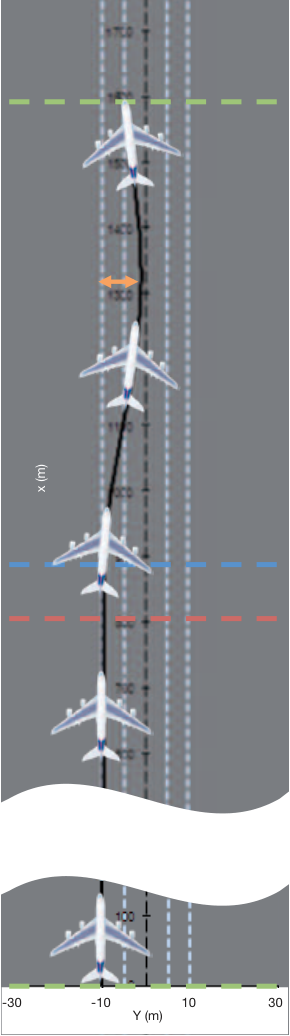
During this series of tests, the pilot in the left hand seat is in charge of the trajectory. He tries to minimize the deviation and then completes the takeoff when the maximum deviation has been reached. The pilot in the right hand seat shuts down the engine at the planned value.
R otation Maximum lateral deviation reached
F ull left rudder pedal input E ngine # 4 shutdown
B rake release
Figure 2 VMCG test
It is important to have always the same pilot doing the same action as, if there is a bias in the shut down speed, it is most probably going to be the same for all tests and the speed decrease is going to be as progressive as planned. Data reduction will then allow the analysis team to determine the right value. In the cockpit, on the jump seat, a test flight engineer monitors the engines and is in charge of the specific relight procedures generally given by the engine Manufacturers, following such shut downs at maximum thrust.
As for the VMCA, most of the time, these tests are directly used for certification, with an EASA pilot in the left hand seat and an Airbus pilot on the right. One of the reasons for minimising the number of times these tests are done, is that repeating several shut downs at maximum thrust is damaging for an engine and we try to reduce this risk. However, for the A380, due to numerous new systems features and some uncertainties on the predictions, we decided to perform a first evaluation ourselves. The initial results demonstrated that we were right.
The first VMCG flight could only be performed after the installation of the modified fin and it took place on March 30th 2006. Takeoff weight was 450 tons, configuration 3 and the predicted VMCG was 122 kt. As usual, we decided to perform the first test with the engine shut down at 132 kt, 10 kt above the predicted value. It was planned to “fail” the right outer engine, therefore we lined up the aircraft 10 meters on the left of the centre line. To help, we have on one of the Toulouse runways, full length blue lines at 5 and 10 meters on each side. This makes it easier for the handling pilot to keep precisely the distance from the centre line during the acceleration. The right engine was shut down at 132 kt as planned. At a speed about 10 kt above the VMCG, the deviation should not exceed 2 meters, but we had a surprise as the aircraft started to skid laterally and we eventually reached
Safety
Figure 3 VMCG – enhanced yaw control on ground
Rudders close to stop
Spoiler and ailerons deflection
a deviation of 15 meters and we went on the other side of the centre line. A good demonstration that it was a sound idea to take some precautions and line up 10 meters on the left, as if we were already at the VMCG! An extrapolation let us think that the VMCG was probably at least 13 kt above the estimated value, which would have had serious adverse consequences for aircraft performance.
We landed immediately and decided to redo the test at a slightly higher speed: 134 kt. A new surprise: the deviation was almost the same, just a bit smaller. The videos were showing the tyres of the main landing gears skidding on the runway. A third test was performed at 136 kt. The deviation was 18 meters. It was increasing with the speed! Clearly, something was abnormal.
The following day, in order to understand the reasons of this strange behaviour, we tried again, but this time with a configuration 1+F instead of 3. With a lower flaps setting, we were expecting higher forces on the landing gears, which should have improved friction and therefore reduce skidding. We shut down the engine at 135 kt and the deviation reached 18 meters. Basically, no change! On top, we discovered an anomaly: because of a hidden failure, the deflection of one of the 2 rudders was too slow. Only one servo control of this rudder was active, instead of 2 in this
type of situation. This was not the main reason for the huge deviation, but the system was not robust. A batch of modifications was needed before continuing VMCG tests.
To improve the situation, it was necessary to enhance the efficiency of the flight controls in yaw after an engine failure. Therefore, in order to create some additional yaw, the solution was to increase the drag on the wing which is on the side of the deflected rudders when they are close to their stop. For that, one spoiler and 2 of the 3 ailerons were fully deflected in the upper direction while the centre aileron was put down (fig. 3). Having ailerons in different directions permitted to minimize the effect on the bank angle. Some modifications were also made in the computers, allowing faster deflection of rudders in this specific situation.
Due to weather conditions, we performed the tests with all these modifications at Istres Air Base on June 14[th] with excellent results: the VMCG was now as planned, around 122 kt. However the exact value was finally determined during the certification flight at the beginning of September. The reason is that the value of the VMCG is very sensitive to the pilot reaction time. This one is around 0.6 seconds, but 0.1 second more or less can modify the VMCG by 1 or 2 kt. The official value is given by the tests performed by the certification pilot from EASA. The final value agreed after data reduction for the
Rolls Royce engines is 119 or 121 kt, depending upon the maximum engine thrust (option chosen by the Customers), which is slightly less than the planned figures.
Safety
A380 最小控制速度试验
Section titled “A380 最小控制速度试验”CLAUDE LELAIE
Section titled “CLAUDE LELAIE”执行长特别顾问
当飞机一台发动机停车而另外三台处于最大推力状态时,它会趋向于向“失效”发动机一侧偏航。飞行员可以通过偏转方向舵并产生一个反向的偏航力矩来保持航向。然而,当速度降低时,发动机产生的偏航力矩大致相同,但垂直尾翼和方向舵的气动效率在下降。在某一特定速度下,当机翼水平时,方向舵已偏转到止动位置,恰好能够抵消发动机的偏航效应。那么,我们可以说达到了某种最小控制速度,因为这是机动性的一个极限。
对于任何多发动机飞机,在最小控制速度(VMC)以下,当一台发动机失效(对于四发飞机为外侧发动机)且其他发动机处于最大推力状态时,存在失去飞机控制的危险。VMC 有多种类型:对于起飞构型,称为 VMCA(A 表示空中);对于进近构型,称为 VMCL(L 表示着陆)。对于四发飞机,还有另一种 VMCL-2,与进近构型下同一侧两台发动机失效有关。虽需在取证时进行演示,但最后一种情况主要考虑的是三发起飞(不带乘客)的 ferry flight,如果在同侧另一台发动机上不幸发生失效。最后,还有一种涵盖地面加速起飞情况的 VMC,称为 VMCG(G 表示地面)。
事情并非非黑即白,飞机在 VMC 以下飞行并不一定总是会失去控制或不可避免地导致坠毁。但可以肯定的是,当达到 VMC 时,飞行员处于机动性极限,在机动方面无法自由地进行他想做的动作。VMC 测定规则中有一些相当奇怪的条款,很难理解其背后的逻辑。然而,这些规则已经应用了很长时间,并通过在各种机型上大量飞行小时积累的丰富经验证明了其有效性。对于所有空中 VMC,首先进行值的静态演示,然后进行动态试验以证明在该速度下机动性仍然足够。VMCG 仅通过动态演练获得。
本质上,VMCA 和 VMCL 的测定是危险的飞行试验,因为一台发动机在非常低的高度停车。对于双发飞机,“工作”发动机的失效给了足够的时间来重新点燃另一台发动机。对于四发飞机,情况不同,因为在“失效”发动机同侧的另一台发动机也失效的情况下,必须立即减小剩余发动机的推力以避免失去控制。
然而,在这些试验期间另一台发动机失效的概率非常低。关键问题在于动态试验的执行,因为这可能由于侧滑的快速积累而很快导致失去控制。这种事件很久以前在一次试飞中发生过,但幸运的是控制被立即恢复,随后对飞控系统进行了修改以大幅降低这种风险。无论如何,在执行这些试验时必须非常谨慎,而且只能由经验丰富的试飞员进行。
VMC 的测量在远程飞机开发的初期阶段并非关键优先事项。原因是所有这些速度都相当低,因此不影响起飞和着陆性能,除非在非常轻的重量下运营。对于像 A380 这样的飞机来说,这并不构成限制。然而,在飞行项目的早期阶段进行一些测量总是有益的,以确保不会出现意外情况,可能对高于预期的重量性能产生影响,或可能需要对飞控系统设计进行修改。
对于 A380,我们在开始这些试验时遇到了一个问题,因为在飞行的第一个月,我们发现垂直尾翼需要修改。由于此次修改所需的延迟,决定将 VMC 的测定推迟数周,直到收到改进后的垂直尾翼。
当发动机和系统配置完成后,我们在预测值以上约 20 节开始,然后保持航向恒定进行缓慢减速。所需方向舵偏转量随速度降低而增加,最终达到止动位置。进一步减速将需要一定的坡度来继续保持航向恒定。真正的 VMCA 是在坡度角达到向“失效”发动机反方向 5° 时获得的(图 1)。这个坡度角非常重要,因为与机翼水平进行的相同试验相比,它允许进一步降低约 5 至 10 节的速度。这个奇怪的规则从何而来?这是一个谜!也许在过去,当可靠的飞行试验设备还不存在时,有人想象出在坡度角上留有一些容差,因为确实很难在方向舵处于止动位置时完美地稳定坡度角。通过这样做,他把一些节数“放进了口袋”!然后这个传统被保留下来并被正式化。这个假设可以解释这个奇怪的 5° 值的选择。
获得 VMCL 和 VMCL-2 的试验类似。
但还有更多工作要做。必须证明在 VMC 时滚转机动性是足够的。VMCA 和 VMCL 的规则略有不同,这里我们将仅展示 VMCL 的一个例子。在这个速度下,在方向舵偏转的一侧(与“失效”发动机相反的一侧)滚转能力降低。规则要求必须能够在 5 秒内从方向舵偏转一侧的 5° 坡度角达到 25°。无论飞机类型如何,这个试验都存在风险,因为侧滑积累非常快,因为它无法被偏航阻尼器补偿,方向舵已经在止动位置。当坡度角超过 25° 时,必须立即且非常柔和地进行改出,减小发动机推力至慢车,增加速度并仔细减小侧滑。在电传飞控项目开始时,在低速下有充足的滚转能力。但为了避免产生过大的侧滑,当飞控计算机检测到大的推力不对称时,飞行员指令的滚转率被限制为低速时的 7.5 度/秒。这种滚转率使得该试验几乎没有任何余量地通过。可用的滚转效率不会因对紊流的反应而改变。
在 VMCA 还有一些其他特定的动态试验,但对于我们的飞机来说,演示是直接明了的。
A380 首次 VMCA 和 VMCL 试飞于 2006 年 5 月底进行,遗憾的是天气条件对这些类型的测量来说并不理想。几天后,在更好的天气条件下,第二次飞行使我们能够确认结果,同时也进行了 VMCL-2 试验。第三次也是最后一次飞行专门用于取证。通常,在其他项目上,所有这些试验都由局方直接参与。然而,由于飞机的某些特殊性,决定先进行预备飞行,以确保将要提交的取证内容没有问题。
这些飞行没有出现意外,VMCA、VMCL 和 VMCL-2 的值与预期一致。
2. 地面最小控制速度(VMCG)
Section titled “2. 地面最小控制速度(VMCG)”地面最小控制速度通过动态测试确定。飞机在所有发动机处于最大推力状态下加速,前轮转向系统断开以模拟湿跑道或污染跑道。在给定速度下,使用主控杆关闭外侧发动机。飞行员必须使用方向舵尽量减少侧向偏移 (图2)。与空中最小控制速度一样,在高速时只需很小的偏转。但在低速时,即使使用全方向舵偏转,也可能产生显著偏差。根据定义,地面最小控制速度是指偏差达到30英尺时的发动机停车速度。
此测试必须在完美的天气条件下进行,因为即使非常轻微的侧风或小型湍流都可能影响结果。通常飞行测试计划在日出时进行。首次测试通常不会很关键,因为停车速度大约比计划的地面最小控制速度高10节。然后进行更多试验,逐步降低停车速度,根据结果每次降低3、2甚至1节。大多数情况下,大约6次测试后即可达到30英尺的偏差。
R otation 最大侧向偏差达到
F ull left rudder pedal input E ngine # 4 shutdown
B rake release
图2 VMCG测试
重要的是始终由同一名飞行员执行同一操作,因为如果在停车速度上存在偏差,很可能在所有测试中都是相同的,而速度的降低将按计划逐步进行。数据处理后,分析团队就能确定正确的数值。在驾驶舱的折叠座椅上,一名试飞工程师监控发动机,并负责按照发动机制造商提供的特定重新启动程序执行操作,这种在最大推力状态下的停车后重新启动程序。
与空中最小控制速度一样,大多数情况下这些测试直接用于认证,左座为欧洲航空安全局飞行员,右座为空客飞行员。尽量减少测试次数的原因之一是,在最大推力状态下反复进行多次停车会对发动机造成损害,我们试图降低这种风险。然而,对于A380飞机,由于众多新系统功能和预测中的一些不确定性,我们决定先自己进行初步评估。初步结果证明我们的做法是正确的。
安装改进型垂直安定面后,才能进行首次VMCG飞行,测试于2006年3月30日进行。起飞重量为450吨,构型为3,预测的VMCG为122节。按照惯例,我们决定以132节进行首次测试,比预测值高10节。计划”失效”右侧外侧发动机,因此我们将飞机对准位于中心线左侧10米的位置。为了便于操作,图卢兹有一条跑道上每侧都有距中心线5米和10米的全长蓝色标线。这使得操控飞行员在加速过程中更容易精确保持与中心线的距离。右侧发动机按计划在132节时关闭。在比VMCG高约10节的速度下,偏差不应超过2米,但我们有一个意外发现,飞机开始侧向滑行,最终偏差达到
安全
图3 VMCG – 增强型地面偏航控制
方向舵接近止动位置
扰流板和副翼偏转
15米,我们越过了中心线到了另一侧。这很好地证明了采取预防措施、在中心线左侧10米处对准位置的想法是正确的,因为我们已经接近VMCG!外推分析使我们认为VMCG可能比估计值至少高13节,这将对飞机性能产生严重的负面影响。
我们立即着陆,并决定以稍高的速度重新测试:134节。新的意外出现了:偏差几乎相同,只是略小一些。视频显示主起落架的轮胎在跑道上打滑。以136节进行了第三次测试。偏差达到18米。它随着速度增加而增加!显然,有什么不对劲。
第二天,为了理解这种奇怪行为的原因,我们再次尝试,但这次使用构型1+F而不是构型3。使用较小的襟翼设置,我们预计起落架上的力更大,这应该能改善摩擦力从而减少打滑。我们在135节关闭发动机,偏差达到18米。基本上没有变化!更重要的是,我们发现了一个异常:由于一个隐藏的故障,两个方向舵中有一个的偏转速度过慢。在这个情况下,只有一个方向舵的伺服控制是有效的,而不是两个。这是一个次要原因,但不是造成巨大偏差的主要原因,系统不够稳健。在继续VMCG测试之前,需要进行一系列修改。
为了改善这种情况,有必要在发动机失效后增强飞控系统的偏航效率。因此,为了产生额外的偏航力,解决方案是增加在方向舵偏转接近止动位置时偏转方向一侧机翼上的阻力。为此,一个扰流板和三个副翼中的两个在向上方向完全偏转,而中央副翼则向下偏转 (图3)。使副翼处于不同偏转方向可以最小化对坡度角的影响。在计算机方面也做了一些修改,允许在这种特定情况下更快地偏转方向舵。
由于天气条件,我们于6月14日在伊斯特雷斯空军基地进行了所有这些修改后的测试,取得了优异的结果:VMCG现在符合计划,约为122节。然而,最终数值是在9月初认证飞行期间确定的。原因是VMCG的数值对飞行员的反应时间非常敏感。反应时间约为0.6秒,但多或少0.1秒都可能使VMCG改变1到2节。官方数值由欧洲航空安全局认证飞行员进行的测试给出。罗尔斯·罗伊斯发动机数据处理后商定的最终数值根据客户选择的最大发动机推力选项为119或121节,略低于计划数值。
安全