Preventing Falls from Height
Source: Airbus Safety First URL: https://safetyfirst.airbus.com/preventing-falls-from-height/ Published: 2017-07-29 Magazine Issue: 2017-08 Category: Cabin Ops, Flight Ops, Ground Ops, Maintenance, barrier, door, doors, Falls, harness, height, platform, RPWS, stairs, strap, tailcone, wingrip PDF: Original PDF

The Falls From Height (FFH) hazard at aircraft level can be categorized into two main categories: (i) falling from the aircraft doors and (ii) falling from the aircraft’s structure. This article provides an overview of the various servicing equipment that are available for Airbus aircraft and the associated recommendations.
FALLS FROM THE AIRCRAFT’S DOORS
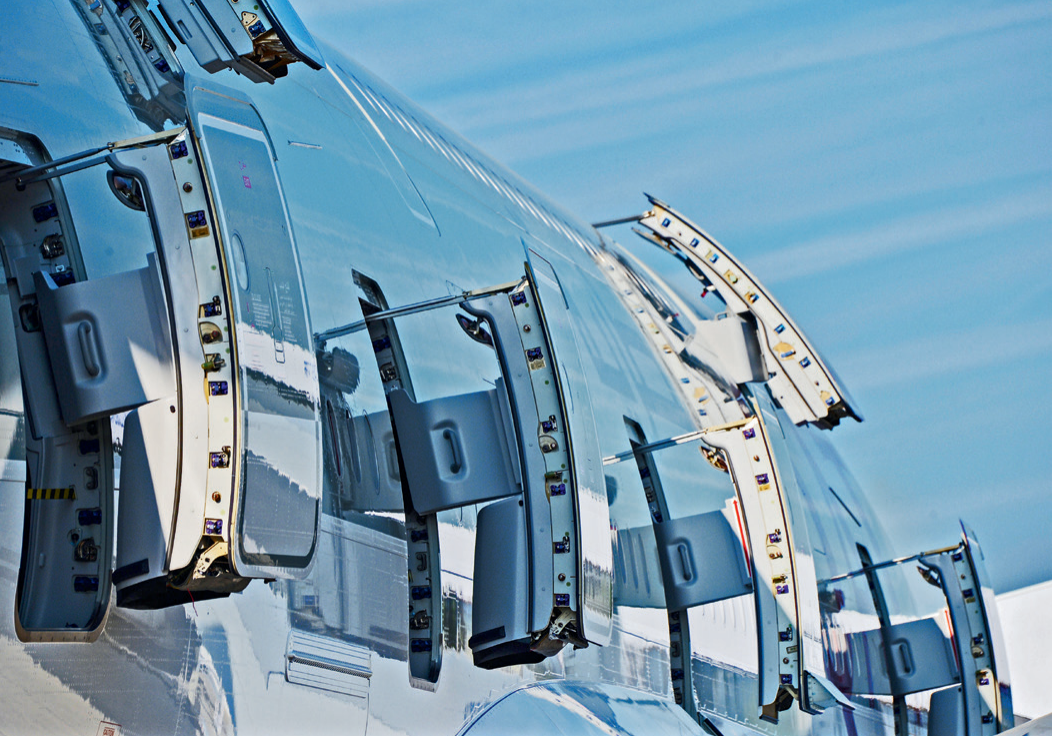
Section titled “FALLS FROM THE AIRCRAFT’S DOORS”Any person entering the aircraft is exposed to the hazard of falling from the doors. This includes Airlines’ personnel (flight crew, cabin crew, maintenance personnel) as well as passengers, and external ground staff such as servicing, cleaning and catering personnel. Aircraft doors refer to passenger doors, cargo doors and ground service access doors to various areas of the fuselage.
During transit or during maintenance visits, the aircraft doors may need to remain open for a number of reasons. In such cases, safety equipment must be used and certain precautions followed.
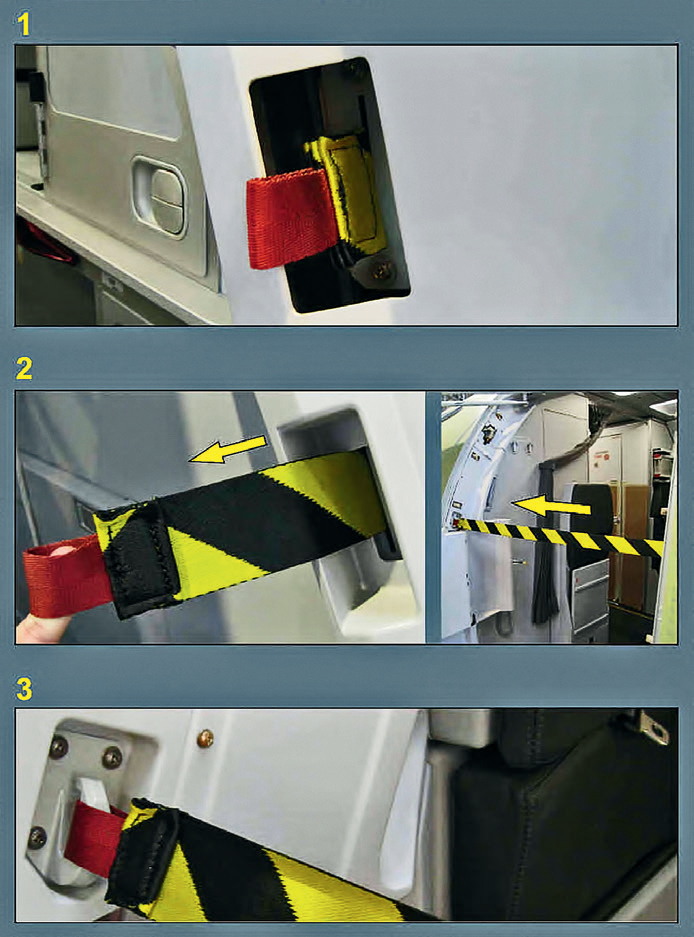
The safety strap is a device used for indication purposes.
(fig.1)
Section titled “(fig.1)”Safety Strap Operation. Extract of the A330 Cabin Crew Operating Manual (CCOM)
Whenever a cabin door is open with no stairs or no gateway in position, the safety strap should be installed and the door should not be left unattended.
Cabin Door Safety Strap
Section titled “Cabin Door Safety Strap”All passenger doors of Airbus aircraft are equipped with a safety strap (fig.1). The safety strap, rolled and stowed in each cabin door frame, is a device used for indication purposes only. It should only be used for a limited time pending the closure of the door. A safety strap does not prevent from a fall. The Cabin Crew Operating Manual (CCOM), states that whenever a cabin door is open with no stairs or no gateway in position, the safety strap should be installed and the door should not be left unattended.
Door Safety Barrier (Door Net)
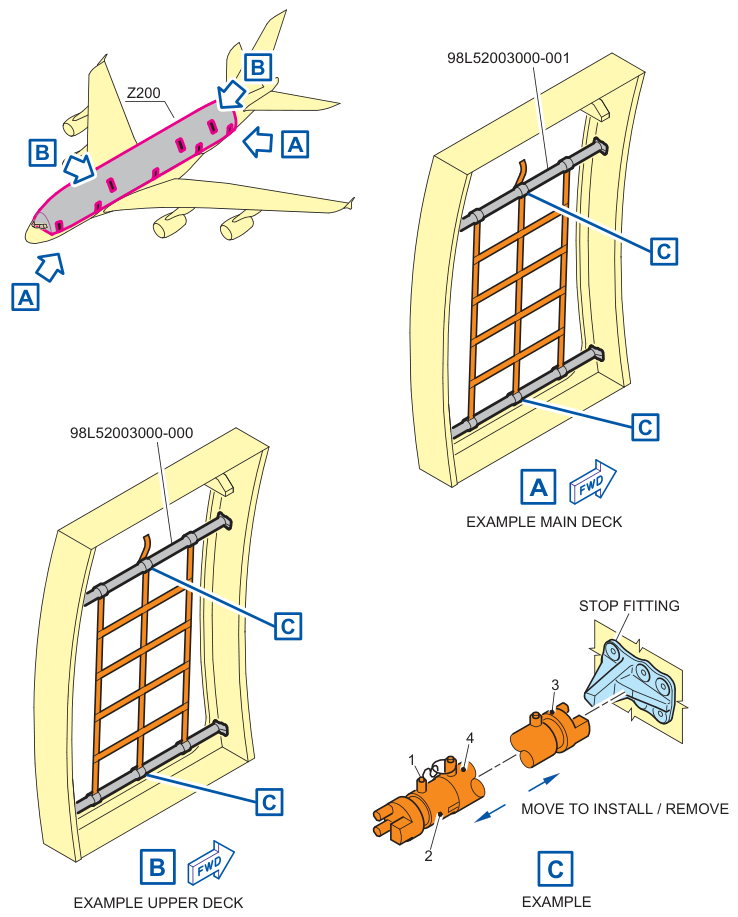
Section titled “Door Safety Barrier (Door Net)”When a door remains open and unattended for a long period of time, Airbus recommends the installation of a safety barrier (fig.2) in absence of stairs or gateway. This same recommendation is made in IATA’s Airport Handling Manual (AHM). The safety barrier is designed to prevent people from falling through the open doorway. It is the most efficient protection against falls from an open door. All Airbus aircraft have a safety barrier available for each door type including passenger doors, emergency doors and cargo doors. The Safety barrier is not stored on board the aircraft. It is installed by maintenance personnel and its reference can be found in the Tool and Equipment Manual (TEM) for each aircraft type.
(fig.2)
Section titled “(fig.2)”Example of an A380 Door Safety Barrier. Extract from the A380 AMM.
Airbus Recommendations to Avoid Falls from the Passenger Doors
Section titled “Airbus Recommendations to Avoid Falls from the Passenger Doors”Opening a passenger door
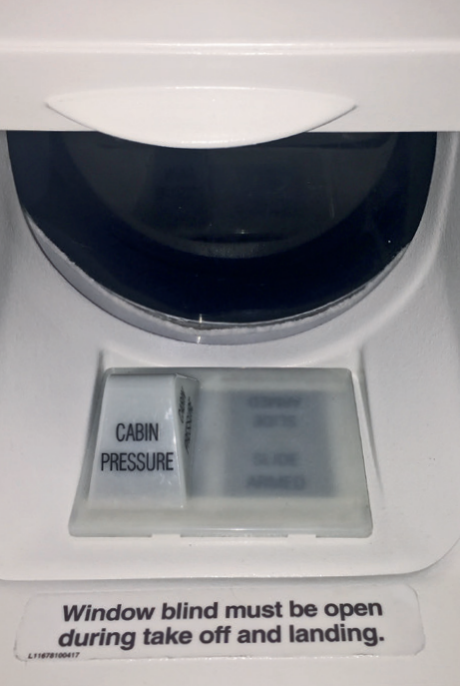
Section titled “Opening a passenger door”To open a passenger door, the procedure and associated safety precautions listed in the Aircraft Maintenance Manual (AMM) or CCOM must be followed. A check that the Residual Pressure Warning System (RPWS) does not flash (fig.3) confirms that there is no residual air pressure in the cabin to avoid potential injuries or falls due to an unexpected violent opening of the passenger door. Refer to the Article “Residual Cabin Pressure” from the issue #3 of the Safety first magazine.
(fig.3)
Section titled “(fig.3)”Example of a RPWS on an A350 cabin door
General recommendations
Section titled “General recommendations”When approaching an open door whilst on board the aircraft, flight crew, cabin crew and ground personnel should confirm the presence and correct positioning of an aerobridge, stairs or access platform. If none are present, either close the door, if it is not necessary for the door to remain open or install the safety strap and monitor the open door until the stairs, access platform or gateway are put in place.
When removing aerobridge or stairs
Section titled “When removing aerobridge or stairs”Inform anyone on the aircraft when ground personnel remove the aerobridge, stairs or access platform from the aircraft’s passenger door to ensure they are aware to not use that door to exit the aircraft. Then ensure the door is secured by either closing it, or installing a safety barrier prior to removing the stairs.
FALLS FROM THE AIRCRAFT’S STRUCTURE
Section titled “FALLS FROM THE AIRCRAFT’S STRUCTURE”Working at height represents a common working situation for the maintenance staff with the risk of fall from the aircraft structure if the proper precautions are not followed. Falls can be from the aircraft’s external structure (wings, horizontal stabilizer) or with the aircraft’s internal structure including the non-pressurized section of the aft fuselage, landing gear bays, and the avionics bay. Several safety devices are available on Airbus aircraft and the AMM provides specifi c instructions and procedures that must be followed to prevent falls from height.
“NO STEP” Areas
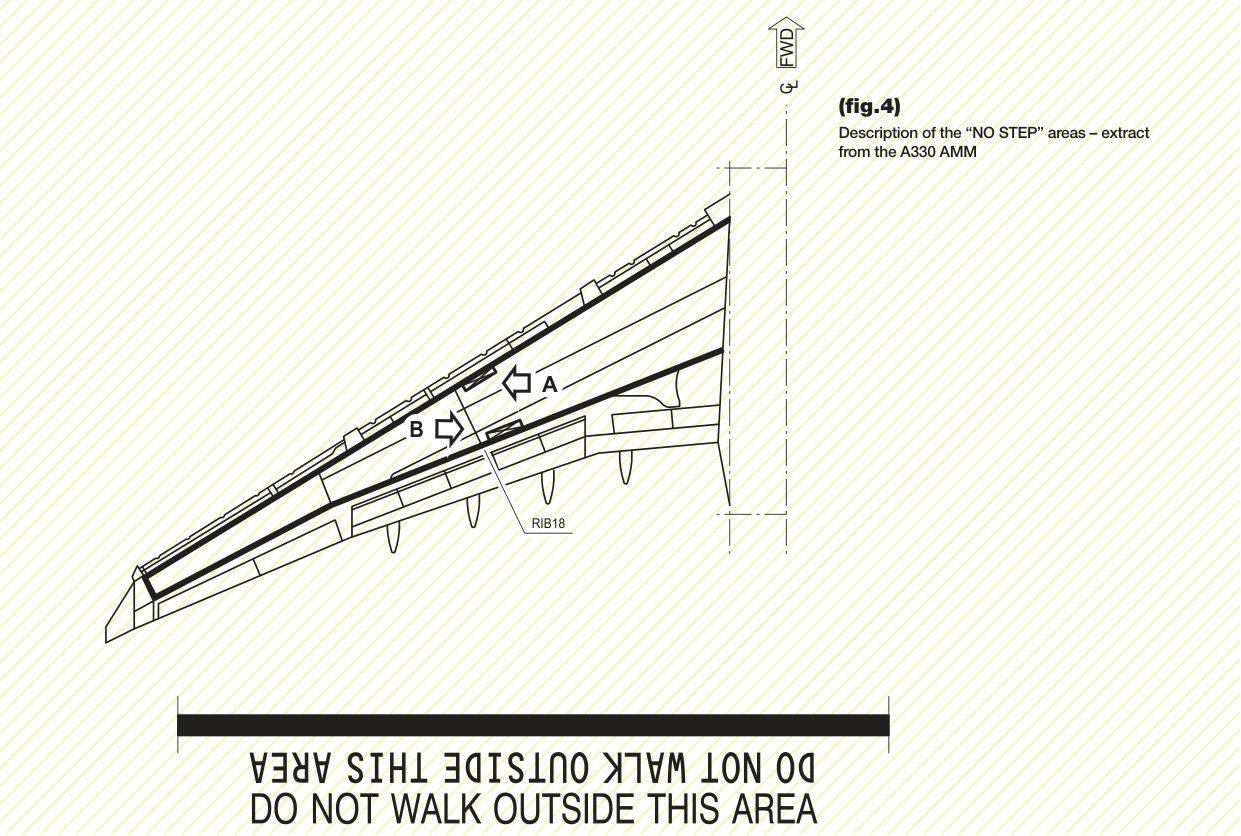
Section titled ““NO STEP” Areas”On Airbus aircraft, visible markings identify “NO STEP” areas. These are visible on the aircraft’s external structure on the wings (fi g.4) , and horizontal stabilizers. “NO STEP” zones are also marked on areas inside the aircraft where there are fuselage compartment access doors. Stepping on these areas is prohibited due to risks of falling and causing injury or damaging critical areas. A description of the “NO STEP” areas for each airbus aircraft can be found in the AMM.
Safety Harness
Section titled “Safety Harness”As per AMM procedures, safety harness shall be used by maintenance personnel when working from height. The safety harness is composed of the harness itself and of a safety rope that has to be attached to suitable attachment point. Safety Harness’ condition is inspected regularly. A validity date is displayed on each harness. If the validity date is exceeded, the harness is considered unserviceable and must not be used.
List of attachment points
Section titled “List of attachment points”Several attachment points are available on the aircraft structure. They are listed in the AMM and are identifi able by a placard (fi g.5).
(fi g.5)
Section titled “(fi g.5)”Description of an attachement point – extract of the A380 AMM
Use of wingrip system
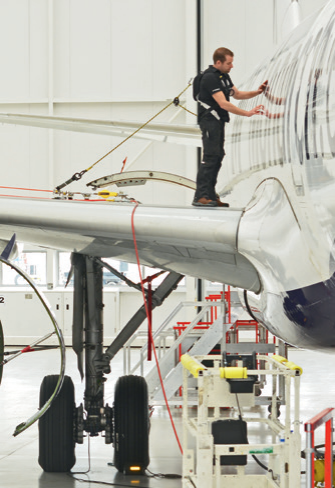
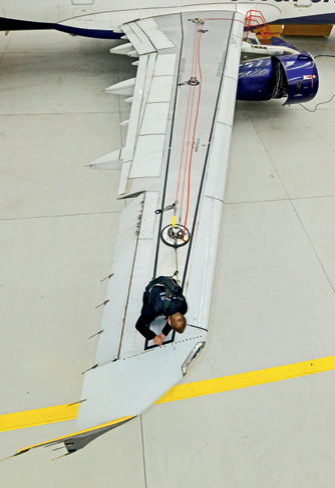
Section titled “Use of wingrip system”When working on the wings, the AMM recommends the use of wingrip, which is a system used to attach the safety rope and harness with single or multiple moveable vacuum pads (fi g.6). Installing and using a wingrip system must be done by specifi cally trained personnel. The associated procedure and safety recommendations are provided in the AMM.
(fi g.6)
Section titled “(fi g.6)”Use of a wingrip system on an A320 wing. Photos courtesy of Latchways
A380 TAIL CONE AREA SAFETY IMPROVEMENT
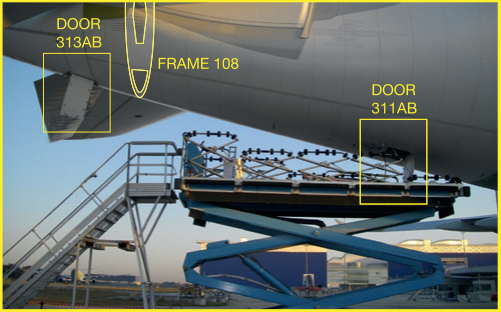
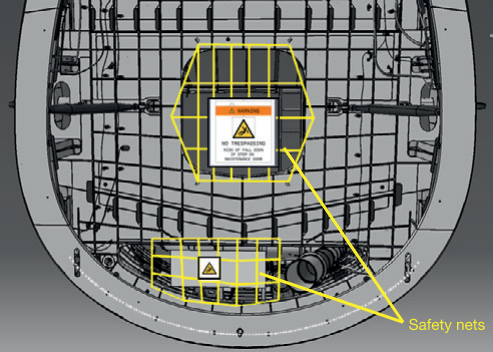
Section titled “A380 TAIL CONE AREA SAFETY IMPROVEMENT”Following a reported injury to a mechanics performing maintenance tasks in the fuselage area aft of the rear pressure bulkhead of an A380 on the ground, Airbus responded with a mitigation to install an additional safety device in the sizeable tail cone area of this aircraft (fi g.7).
released and this access door opened causing the person to fall from the height of the tail cone to the ground level.
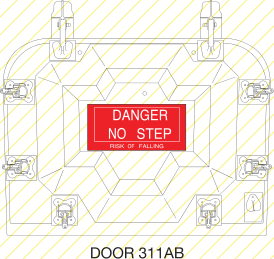
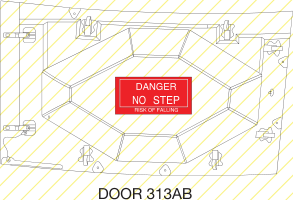
The Airbus modification adds two safety nets for this area, which prevents access from one compartment to the other, together with warning labels around the cut-outs of frame 108 and larger warning placards on the insides of the access doors. A monitored retrofit campaign is on-going to modify the in-service A380 fl eet and these features are now included on all delivered A380 aircraft.
The person who was injured initially used the access door 311AB located forward of frame 108 and then proceeded to climb through a cutout in the frame 108 to access to the rear part of the tail cone area. The access door 313AB should normally be used to access this area. Access door 313AB is also designed as a blow-out panel by releasing its spring-loaded latch and opening if there is excessive air pressure differential pushing on the inside surface of the door in fl ight. When the person inadvertently stepped on the inside surface of the access door 313AB, its spring loaded latch
When accessing any compartment of the aircraft to perform maintenance or ground servicing tasks, it is important to follow the instructions of the Aircraft’s Maintenance Manual (AMM) and to only gain access to specifi c compartments in the fuselage using the appropriate access door designated by the AMM procedure.
(fi g.7) A380 Safety Improvement
LOCAL SAFETY POLICIES
Section titled “LOCAL SAFETY POLICIES”Local safety policies apply in addition to safety devices provided by Airbus described in this article with their associated procedures and recommendations. Each airline, maintenance and repair organisation, airport or country defines its own safety policy in terms of prevention of injuries caused by falls from height. These policies will account for local conditions, regulations and constraints in addition to following all of the, warnings, cautions or recommendations provided in the relevant manuals and as described by this article.
CONTRIBUTORS:
Section titled “CONTRIBUTORS:”Andreas BEHRMANN Customer Support - Head of Cabin and Cargo Systems
Uwe EGGERLING Senior Director Safety Engineering and Maintenance
Falls from height prevention is a matter for all actors involved in the daily aircraft operations. Flight crew, cabin crew, ground personnel are all affected and must follow the local safety policy in addition to using the correct equipment and following procedures provided in the Airbus manuals to ensure that, when an aircraft is parked on the ground, nobody is falling from height.
Jean-Paul VIEU Flight Operation Engineer - Cabin Standards
With thanks to Jade PELLOQUIN and Sidney ORSOLLE from the Health & Safety at Airbus.
Safety fi rst
Section titled “Safety fi rst”Safety fi rst, #24 August, 2017. Safety fi rst is published by Airbus S.A.S. - 1, rond point Maurice Bellonte - 31707 Blagnac Cedex/France. Publisher and Editor: Yannick Malinge, Chief Product Safety Offi cer. Concept Design by Airbus Multi Media Support 20171210. Reference: X00D16031905 Issue 24. Photos by Airbus, Lindner Fotografi e, S. Ramadier, H. Goussé, P. Masclet, F. Lancelot, A, Doumenjou, J. V. Reymondon, A. Tchaikovsky, C. Sadonnet, P. Pigeyre, A. Balazh. Computer renderings by Fixion.
来源: Airbus Safety First 网址: https://safetyfirst.airbus.com/preventing-falls-from-height/ 发布日期: 2017-07-29 杂志期号: 2017-08 类别: 客舱运营, 飞行运营, 地面运营, 维修, barrier, door, doors, Falls, harness, height, platform, RPWS, stairs, strap, tailcone, wingrip PDF: 原始 PDF
飞机层面的高处坠落(FFH)危险可分为两大类:(i)从舱门坠落;(ii)从飞机结构坠落。本文概述了空客飞机的各类勤务设备及相关建议。
从飞机舱门坠落
Section titled “从飞机舱门坠落”任何进入飞机的人都面临从舱门坠落的危险。这包括航空公司人员(飞行机组、客舱乘务组、维修人员)、乘客,以及外部地面工作人员,如勤务、清洁和配餐人员。飞机舱门包括乘客舱门、货舱门和通往机身各区域的地面勤务入口门。
在过站或维修检查期间,舱门可能需要保持打开状态。在这种情况下,必须使用安全设备并遵循相应的预防措施。
安全带是一种用于警示目的的装置。
安全带操作。A330 客舱乘务员操作手册(CCOM)节选
每当客舱门打开且无登机梯或无登机桥就位时,应安装安全带,且不得使舱门处于无人值守状态。
客舱门安全带
Section titled “客舱门安全带”空客飞机的所有乘客舱门均配备安全带 (图1)。安全带卷起后存放在每个客舱门门框内,是一种仅用于警示目的的装置。仅限在舱门即将关闭的短时间内使用。安全带不能防止坠落。客舱乘务员操作手册(CCOM)明确规定,每当客舱门打开且无登机梯或无登机桥就位时,应安装安全带,且不得使舱门处于无人值守状态。
舱门安全护栏(舱门安全网)
Section titled “舱门安全护栏(舱门安全网)”当舱门长时间打开且无人值守时,空客建议在无登机梯或登机桥的情况下安装安全护栏 (图2)。国际航空运输协会(IATA)的《机场操作手册》(AHM)也提出了同样的建议。安全护栏用于防止人员从打开的舱门坠落。它是防止从打开舱门坠落的最有效防护措施。所有空客飞机均可为每种舱门类型提供安全护栏,包括乘客舱门、应急舱门和货舱门。安全护栏不存放于飞机上,由维修人员安装,其件号可从每种机型的手册(TEM)中查到。
A380 舱门安全护栏示例。摘自 A380 AMM。
防止从乘客舱门坠落——空客建议
Section titled “防止从乘客舱门坠落——空客建议”打开乘客舱门
Section titled “打开乘客舱门”打开乘客舱门时,必须遵循飞机维护手册(AMM)或 CCOM 中规定的程序及相关安全预防措施。检查残余压力警告系统(RPWS)是否闪烁 (图3),以确认客舱内无残余气压,从而避免因舱门意外猛烈打开而造成的人身伤害或坠落。请参阅《Safety First》杂志第 3 期文章《客舱残余压力》。
A350 客舱门上的 RPWS 示例
当机上人员(飞行机组、客舱乘务组和地面人员)接近已打开的舱门时,应确认廊桥、登机梯或登机平台是否存在且位置正确。如均未就位,若非必要保持舱门打开,则应关闭舱门;否则应安装安全带,并在登机梯、登机平台或登机桥到位之前对打开的舱门进行监控。
拆除登机桥或舷梯时
Section titled “拆除登机桥或舷梯时”当地面人员从飞机客舱门拆除登机桥、舷梯或登机平台时,应告知机上人员,使其知晓不得使用该舱门离开飞机。然后在拆除舷梯前,应通过关闭舱门或安装安全屏障的方式确保舱门已固定。
从飞机结构坠落
Section titled “从飞机结构坠落”对于维修人员而言,高空作业是一种常见工作场景。若未遵循适当的防护措施,则存在从飞机结构坠落的风险。坠落可能发生在飞机外部结构(机翼、水平安定面)或内部结构上,包括后机身非增压区、起落架舱和电子设备舱。空客飞机上配备多种安全装置,且维修手册(AMM)提供了具体的操作说明和程序,必须遵循这些规定以防止高处坠落。
“禁止踩踏”区域
Section titled ““禁止踩踏”区域”在空客飞机上,“禁止踩踏”区域有明显的标记。这些标记在机翼外部结构**(图4)**和水平安定面上可见。飞机内部在机身舱门附近区域也标有“禁止踩踏”区域。严禁踩踏这些区域,因为存在坠落风险,可能导致人员受伤或损坏关键区域。每架空客飞机的“禁止踩踏”区域说明可查阅维修手册(AMM)。
根据维修手册(AMM)的程序规定,维修人员在高空作业时必须使用安全带。安全带由背带本体和安全绳组成,安全绳须连接至合适的连接点。安全带状况定期检查,每条安全带上均标有有效期。如超过有效期,该安全带视为不可使用,不得使用。
飞机结构上设有多个连接点,列于维修手册(AMM)中,并通过标牌进行标识**(图5)**。
连接点说明——A380 维修手册(AMM)摘录
翼面保护装置(wingrip)的使用
Section titled “翼面保护装置(wingrip)的使用”在机翼上作业时,维修手册(AMM)建议使用 wingrip 系统,该系统通过单个或多个可移动真空吸盘将安全绳和安全带连接固定**(图6)**。安装和使用 wingrip 系统须由经过专门培训的人员操作。相关程序和安全建议见维修手册(AMM)。
在 A320 机翼上使用 wingrip 系统。照片由 Latchways 提供
A380 尾锥区域安全改进
Section titled “A380 尾锥区域安全改进”在收到一份关于维修人员在 A380 停在地面时于后压力隔框后方的机身区域执行维修任务受伤的报告后,空客采取了缓解措施,在该机型尺寸较大的尾锥区域安装了额外的安全装置**(图7)**。
该受伤人员最初使用 108 框前方的舱门 311AB,随后通过 108 框的切口攀爬进入尾锥区域后部。正常情况下应使用舱门 313AB 进入该区域。舱门 313AB 还设计为泄压板,在飞行中若内侧表面受到过度气压差压力时,可通过释放其弹簧锁闩打开。当该人员不慎踩到舱门 313AB 的内侧表面时,其弹簧锁闩
在对飞机任何舱室进行维修或地面勤务工作时,务必遵循维修手册(AMM)的说明,并仅使用维修手册(AMM)程序指定的相应舱门进入机身特定舱室。
(图7) A380 安全改进
本地安全政策
Section titled “本地安全政策”本地安全政策是对空客提供的安全设备及其相关程序和建议的补充。航空公司、维修机构、机场或国家在防止坠落伤害方面各有自己的安全政策。这些政策在遵循相关手册中的所有警告、注意事项或建议以及本文所述内容的同时,还需考虑当地条件、法规和约束因素。
Andreas BEHRMANN 客户支援部——客舱与货舱系统主管
Uwe EGGERLING 高级安全工程与维修总监
防止高处坠落涉及日常飞机运营中的所有相关方。飞行机组、客舱机组和地面人员均受到影响,必须在遵守本地安全政策的同时,使用正确的设备并遵循空客手册中的程序,以确保飞机在地面停放时无人发生高处坠落。
Jean-Paul VIEU 飞行运营工程师——客舱标准
特别鸣谢空客健康与安全部门的 Jade PELLOQUIN 和 Sidney ORSOLLE。
Safety first
Section titled “Safety first”Safety first, #24 2017年8月。Safety first 由空中客车公司出版——法国布拉尼亚克塞德,31707,Maurice Bellonte 1号环岛,31707。出版人与编辑:首席产品安全官 Yannick Malinge。概念设计:空客多媒体支持 20171210。参考资料:X00D16031905 第24期。图片提供:空客、Lindner Fotografi e、S. Ramadier、H. Goussé、P. Masclet、F. Lancelot、A. Doumenjou、J. V. Reymondon、A. Tchaikovsky、C. Sadonnet、P. Pigeyre、A. Balazh。计算机渲染:Fixion。