Hypoxia an Invisible Enemy
Source: Airbus Safety First URL: https://safetyfirst.airbus.com/hypoxia-an-invisible-enemy/ Published: 2006-12-14 Magazine Issue: 2006-12 Category: Archive PDF: Original PDF
Hypoxia an Invisible Enemy Cabin depressurization effects on human physiology
Section titled “Hypoxia an Invisible Enemy Cabin depressurization effects on human physiology”Hartwig Asshauer
Section titled “Hartwig Asshauer”Certification Manager Hydro-Mechanical & Air Systems Airbus Engineering
This article first appeared in issue 38
Section titled “This article first appeared in issue 38”When public air transportation first became commonly available, flights did not reach altitudes that represented a significant risk of reduced oxygen supply - called hypoxia - to either passengers or crew. However, in the late 1940s and 1950s aircraft were developed that allowed safe transport of the flying public at altitudes around 40,000ft, which have remained relatively constant since then.
DEFINITIONS OF HYPOXIA
Section titled “DEFINITIONS OF HYPOXIA”Hypoxia is separated into four types:
-
Hypoxic hypoxia is a condition caused by reduced barometric pressure, affecting the body’s ability to transfer oxygen from the lungs to the bloodstream.
-
Histotoxic hypoxia can be induced by the introduction of substances like alcohol or drugs into tissue, reducing its ability to accept oxygen from the bloodstream.
-
Hypaemic hypoxia (or anaemic hypoxia ) is a result of the blood being unable to carry oxygen, e.g. caused by exposure to carbon monoxide.
1 Introduction
Section titled “1 Introduction”Operating at high altitude without adequate understanding, training or equipment protection can be dangerous as shown by the following extracts from two accident reports:
‘One of the first encounters with the dangers of high altitude flight was reported in 1862 when a balloon flight was made to study the effects of low ambient pressure. The balloon ascended to approximately 29,000ft and during the flight a series of “strange” symptoms, notably loss of visual and hearing capability, paralysis of arms and legs, and finally, unconsciousness occurred. The team could have been lost, but was saved by one member pulling the balloon valve rope with his teeth (his arms were already paralysed), to descend the balloon. The team recovered as the balloon descended, but this marked for the first time the risk of low ambient pressure.’
‘In 1998 a decompression incident occurred on an aircraft at 35,000ft. Both the captain and the first officer had received altitude-chamber training during their previous military careers and knew about the effects of low cabin pressure. The first officer attempted to control the cabin rate of climb by switching to the standby pressurization system. When use of the standby system failed to improve
- Stagnant hypoxia results from the body’s inability to carry oxygen to the brain, which can result from high gravity-forces causing blood to pool in the lower extremities of the body.
Human physiology
Section titled “Human physiology”the situation, he donned his oxygen mask. The captain, who had been talking with a passenger who was visiting the flight deck, attempted to don his oxygen mask too, but in doing so he knocked his glasses to the floor. When trying to retrieve them he lost consciousness and slumped forward. The first officer attempted to help the captain but was unable to do this, so initiated a descent to 25,000ft. A short time later the first officer asked the senior flight attendant to assist the captain. To enter the flight deck the flight attendant had to remove her oxygen mask connected to the fixed cabin oxygen system. She decided not to use the portable oxygen equipment and went straight to the flight deck. Before being able to assist the captain she collapsed onto the floor. Once again, the first officer attempted to put on the oxygen mask for the captain, this time successfully. Soon afterward, the captain regained consciousness and was unaware he had been unconscious, which is a typical reaction from a victim of hypoxia.’
2 The hypoxia effects of a quick cabin depressurization
Section titled “2 The hypoxia effects of a quick cabin depressurization”During a quick depressurization the partial pressure of oxygen in the lungs/alveolae reduces rapidly with the effect of reverse diffusion. This means that once the oxygen partial pressure in the alveolae has reached a level that is below the level in the blood, the blood oxygen moves out of the body back into the ambient air. This effect of reverse diffusion unfortunately further reduces the already very limited oxygen storing capability of blood and supports hypoxia effects. Holding of breath cannot stop the reverse flow since the pulmonary gas expansion would lead to serious lung injury.
Within the lungs the alveola provide the interface between air and blood. The blood which is returned from the body tissue into the alveolae has given away most of its oxygen so that the oxygen partial pressure in the lungs is higher than in the arriving blood. A process of diffusion then drives oxygen through the thin alveolar wall into the blood.
GENERAL BLOOD CIRCULATION
Section titled “GENERAL BLOOD CIRCULATION”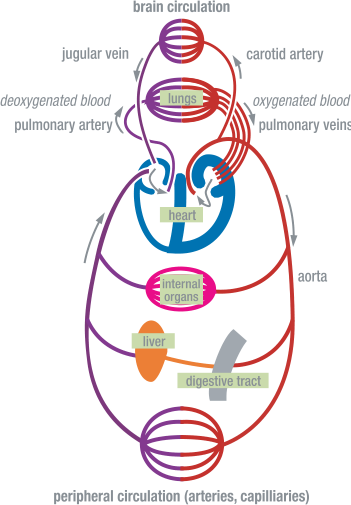
The most important parameters for the oxygen diffusion process are the oxygen percentage and barometric ambient pressure. Changing these parameters changes immediately the oxygen saturation level in blood and with it the oxygen supply to the body tissue.Unfortunately, there is no significant storage of oxygen in the human body, unlike many other chemical substances necessary to maintain life. The blood is the only storehouse for oxygen, and its capacity is very limited.Hence,the human body lives only a hand-to-mouth existence with its oxygen supply.
As the pressure of air in the atmosphere decreases with increasing altitude, the partial pressure of oxygen in the air reduces and with it the diffusion of oxygen into the body. Reduction of oxygen availability in the body results in loss of functions ranging from slight impairment up to death.It is the nervous system,in particular in the higher centres of the brain, and the eyes which have a high metabolism with no oxygen reserve. These are most sensitive to oxygen depletion and therefore are the first to be affected by a reduced oxygen supply.
For healthy persons altitude exposure up to 15,000ft is usually not hazardous since cardiovascular and respiratory compensatory mechanisms (faster breathing and increased pulse rate/blood circulation) act to maintain adequate oxygenation at the cellular level.
The effects of reduced oxygen supply to the body (hypoxia) vary between persons,depending on health,physical fitness,age,activity level and statistical scatter with the population. Pilots and flight attendants usually require more oxygen during an emergency than healthy, seated passengers and might therefore suffer earlier from hypoxia effects.
* Dalton’s Law (1766 -1844) In 1801, the English astronomer and chemist, John Dalton, discovered the pressure relationship among gases in a mixture. Dalton’s Law states that the pressure exerted by a mixture of gases is equal to the sum of the pressures that each would exert if it alone occupied the space filled by the mixture.
Severe hypoxia caused by a significant reduction in cabin pressure is very dangerous for flight crew because:
-
G The victims of hypoxia rarely notice that they are about to pass out.
-
G Usually there is quickly a loss of critical judgment G Most victims often experience a mildly euphoric state
-
G Thinking is slowed, muscular coordination is impaired
The only effective means of protection is the quick donning of oxygen masks as the first action - before troubleshooting!
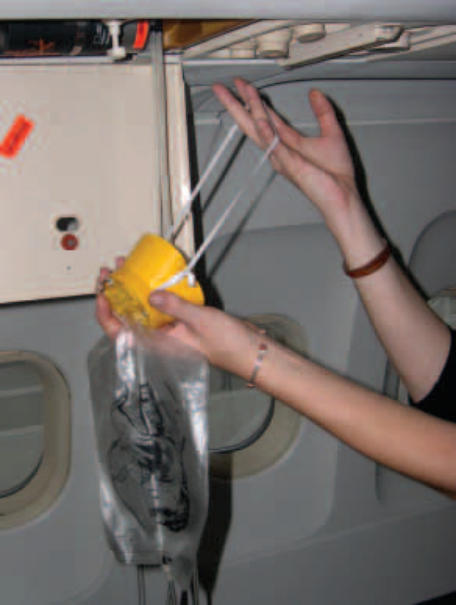
Early type of shaped oxygen mask for passengers
3 Oxygen partial pressure
Section titled “3 Oxygen partial pressure”The concentration of oxygen in the atmosphere is constant at 20.95% at altitudes up to 100,000ft, which means that according to Dalton’s Law* the oxygen partial pressure at sea level is 212mbar (20.95% of 1013mbar where 1013mbar is the standard atmospheric pressure at sea level).
As altitude increases above sea level the partial pressure of the component gases decreases consistent with the decrease in total atmospheric pressure. For example, the partial pressure of oxygen at 40,000ft is reduced to 39mbar only, which is far too inadequate to support human metabolism.
One means to increase oxygen partial pressure is to increase the oxygen concentration in breathing air. At 40,000ft cabin altitude an oxygen partial pressure of maximum 188mbar can be achieved by breathing pure oxygen (100% oxygen concentration without overpressure).
Another additional means for hypoxia protection is positive pressure breathing, which is usually found in modern crew oxygen masks and means the delivery of pure oxygen under pressure into the respiratory tract. For civil applications positive
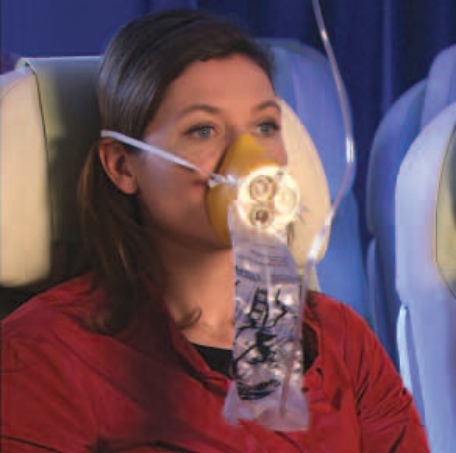
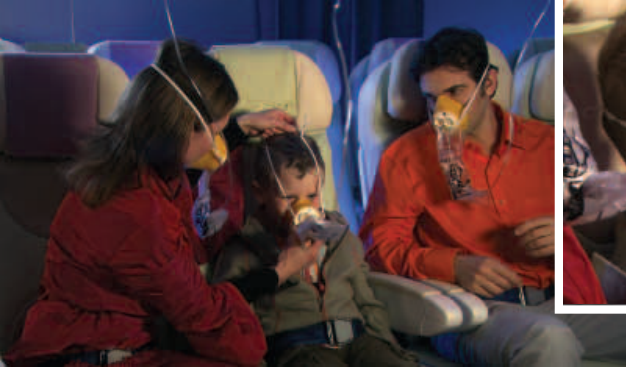
Current oxygen mask for passengers
pressure breathing is able to increase additionally the oxygen partial pressure by around 20 to 30mbar provided that the overpressure condition is limited to some minutes only. This means that at 40,000ft it requires 100% oxygen concentration of the breathing gas combined with positive pressure breathing to achieve sea level equivalent conditions. Positive pressure breathing requires some training and is tiring and inconvenient, which is the rationale for having so far provided this protection feature to flight crew only (for short time use only).
4 Time of Useful
Section titled “4 Time of Useful”Consciousness
Section titled “Consciousness”In the ‘World of Hypoxia’ the Time of Useful Consciousness (TUC) is a very important parameter. For low ambient pressure conditions it indicates the time available to perform purposeful activities, such as oxygen mask donning or aircraft control. Beyond this time frame mental and physical capabilities are dangerously impaired and finally result in unconsciousness and potentially death.
As shown in the table on the right, TUC is negatively correlated with altitude. It is important to note that even if activities are performed within the TUC time frame there is a significant deterioration of work rate and mental capability, which is correlated with the time spent at low pressure conditions (at the end of the TUC time frame, performance is much lower than at the beginning).
The TUC is the ‘Window of Opportunity’ for donning an oxygen mask and can be very limited so must take overriding precedence over any other activities.
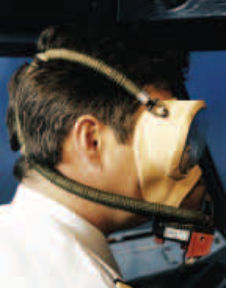
Mask straps inflated Mask in place
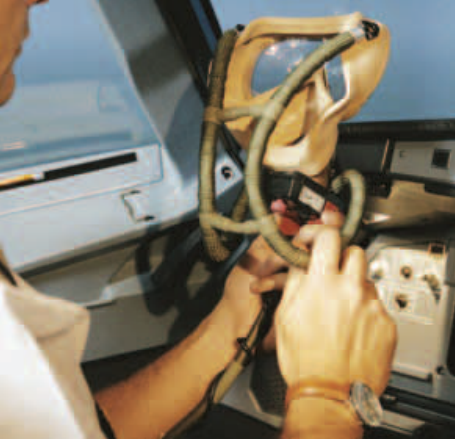
Flight crew oxygen mask *
5 Time of Safe
Section titled “5 Time of Safe”Unconsciousness
Section titled “Unconsciousness”Some experts believe that for passengers - in contradiction to the flight crew - a short period of unconsciousness during cabin depressurization can be tolerated since they are not performing an operational task. Unconsciousness is a clear sign of insufficient oxygen supply to the brain and it is obvious that this time can only be very short before permanent brain damage occurs. So far, it has not been possible to associate a specific time frame for the safe time of unconsciousness.
The uncertainties in extrapolation of animal data and the wide variability in individual tolerances have so far prevented determination of a commonly agreed value for Time of Safe Unconsciousness (TSU) among human physiology experts. It is believed that a safe time of unconsciousness is somewhere between 90 seconds and 4 minutes.
These data on TUC are averaged values based on tests with healthy individuals when breathing ambient air (no supplemental oxygen provided).
TIME OF USEFUL CONSCIOUSNESS
Section titled “TIME OF USEFUL CONSCIOUSNESS”- 20,000ft All unacclimatized persons lose useful consciousness within 10 minutes
25,000ft Useful consciousness is lost after 2.5 minutes or less
A large individual variation in the effects of hypoxia has been found. There is evidence that TUC is shorter for people exposed to stress conditions.
-
30,000ft TUC: approx. 30 seconds
-
37,000ft TUC: approx. 18 seconds 45,000ft TUC: approx.15 seconds
* Manufacturer EROS
6 Oxygen equipment on civil aircraft
Section titled “6 Oxygen equipment on civil aircraft”Effect on human physiology of moderate cabin altitude
Section titled “Effect on human physiology of moderate cabin altitude”On modern aircraft oxygen equipment is installed to provide adequate protection against the damaging effects of hypoxia in case of cabin depressurization:
For flight crew there are usually quick donning oxygen masks installed, which can be donned with one hand in less than 5 seconds. The mask straps are combined with elastic tubes that inflate and stiffen when the mask is taken from its stowage, allowing the mask to be easily put over the head with one hand. Once the grip on the mask is released, the tubes deflate and their elastic characteristics ensure a perfect fit. The required oxygen concentration of the breathing air is automatically adapted to the cabin pressure.
Very large numbers of aircrew and passengers have been exposed to breathing air at cabin altitudes up
to 8,000ft over the last 60 years without significant deleterious effects. Although exposure to this altitude reduces the oxygen partial pressure in the pulmonary tract the tissues of the body are maintained well above the required level.
Some airlines still allow smoking in the aircraft cabin, which results in carbon monoxide inhalation with the smoke. Carbon monoxide has a 240-times greater tendency than oxygen to attach to red blood haemoglobin, thus inactivating a large amount of haemoglobin as an oxygen carrier. It has been found that the hypoxia effects from carbon monoxide and altitude are additive; hence chronic smokers are at a higher equivalent altitude than non-smokers in terms of blood oxygen supply.
Also, alcohol poisons body tissues in such a manner that they cannot use oxygen properly. Usually, it is noticed by passengers that the physiological effect of alcohol consumed during flight is more intense than at sea level, which is due to the additive hypoxia effects of alcohol and altitude.
For the passenger oxygen supply the continuous flow concept is used on all Airbus aircraft. Oxygen is delivered continuously to an expandable oxygen bag where it is conserved during exhalation, so it is available during the next inhalation to supplement the steady oxygen flow.
It was decided at an early stage in passenger oxygen mask development that the untrained civilian population should not be expected to recognize the correct orientation for a shaped mask, and it was required that a mask should be operable in any position in which it might be donned by the user. A second basic requirement was a universal size, which finally defined the well-known cylindrical mask body.
Extract of the prime requirements
Section titled “Extract of the prime requirements”GENERAL
Section titled “GENERAL”-
CS/FAR 25.841 (a): Maximum cabin pressure altitude under normal operation: 8,000ft
-
CS/FAR 25.841 (a): Maximum cabin pressure altitude after any probable failure condition in the pressurization system: 15,000ft
-
FAR 25.841 (a) (2) (i): Maximum exposure time to cabin pressure altitude exceeding 25,000ft: 2 minutes
-
FAR 25.841 (a) (2) (ii): Exposure to cabin pressure altitude that exceeds 40,000ft: Not allowed
CABIN OCCUPANTS
Section titled “CABIN OCCUPANTS”-
CS/FAR 25.1443 (c): Provides oxygen system performance data on oxygen flow and required partial pressure of oxygen
-
CS/FAR 25.1447 (c) (1): The total number of masks in the cabin must exceed the number of seats by at least 10%
-
CS/FAR 25.1443 (d): Defines oxygen flow for first-aid oxygen equipment (for cabin depressurization treatment)
-
JAR OPS 1.760/FAR 121.333 (e) (3): Requires first-aid oxygen for at least 2% of passengers
-
JAR OPS 1.770 (b) (2) (i)/FAR 121.329 (c): Defines the percentage of passengers that need to be provided with supplemental oxygen (cabin pressure altitude dependent)
FLIGHT CREW
Section titled “FLIGHT CREW”-
CS/FAR 25.1443 (a) & (b): Provides oxygen system performance data on oxygen flow and required partial pressure of oxygen
-
CS/FAR 25.1447 (c) (2) (i): For aircraft operating above 25,000ft quick donning oxygen masks are required for the flight crew which can be donned with one hand within 5 seconds
-
FAR 121.333 (c) (2) (i) (A): One flight crew member needs to wear permanently his oxygen mask when the aircraft is operated above FL410
-
FAR 121.333 (c) (3): In case one flight crew member leaves the controls the remaining pilot needs to use his oxygen mask when the aircraft is operated above 25,000ft
7 Airworthiness requirements
Section titled “7 Airworthiness requirements”The Airworthiness authorities have identified the risk of hypoxia and have created requirements (see table on the left).
Also, after an accident in the USA the FAA initiated a Special Certification Review (SCR) on pressurization systems. The SCR recommends that the aircraft flight manual (for aircraft certified for flights above 25,000ft) require in the emergency procedures the donning of oxygen masks as the first crew action after a cabin altitude warning.
This highlights again the importance of immediate donning of oxygen masks when cabin depressurization occurs.
8 Conclusion
Section titled “8 Conclusion”The first step for any flight crew member faced with cabin depressurization should be the immediate donning of an oxygen mask. Any delay in donning a mask will significantly increase the risk of losing consciousness before cabin pressure is regained. Severe hypoxia leads usually to the loss of critical judgement combined with a mildly euphoric state,
which makes hypoxia very dangerous for flight crew. This is highlighted also in the FAA Special Certification Review that was issued some years ago on the effects of cabin depressurization.
Moreover, in case of rapid cabin depressurization a quickly accomplished emergency descent is often the only means of fast re-oxygenation of passengers that were unable to protect themselves against hypoxia by using the passenger oxygen masks provided. Severe hypoxia is very dangerous for unprotected passengers and requires a quick return to an adequate cabin pressure or where not possible (above high terrain), it requires a check by the flight attendants that the passenger oxygen masks are correctly used.
For a long time transport aircraft have been equipped with oxygen systems for flight crew and passengers that provide an adequate protection against hypoxia. As long as these oxygen systems are used according to their simple procedures the invisible enemy hypoxia poses little danger to flight crews and passengers.
CONTACT DETAILS
Section titled “CONTACT DETAILS”Hartwig Asshauer Certification Manager Hydro-Mechanical & Air Systems Airbus Engineering Tel: +33 (0)5 62 11 04 98 Fax: +33 (0)5 61 93 31 55 hartwig.asshauer@airbus.com
缺氧——无形的敌人 客舱释压对人体生理的影响
Section titled “缺氧——无形的敌人 客舱释压对人体生理的影响”Hartwig Asshauer
Section titled “Hartwig Asshauer”认证经理 液压机械与空气系统 空客工程部
本文首次发表于第 38 期
Section titled “本文首次发表于第 38 期”当公共航空运输最初普及之时,航班飞行高度尚未达到会对乘客或机组人员造成明显缺氧风险的高度。所谓缺氧(hypoxia),即氧气供应减少。然而,在二十世纪四十年代末和五十年代,飞机的设计已能够以约 40,000 英尺高度安全运送旅客,此后的飞行高度基本保持在这一水平。
缺氧分为四种类型:
-
低氧性缺氧(Hypoxic hypoxia) 是由气压降低引起的,会影响氧气从肺部进入血液的能力。
-
组织毒性缺氧(Histotoxic hypoxia) 可由酒精或药物等物质进入组织而诱发,从而降低组织从血液中摄取氧气的能力。
-
血源性缺氧(Hypaemic hypoxia)(或贫血性缺氧(anaemic hypoxia))是血液携带氧气能力下降的结果,例如由一氧化碳暴露引起。
-
循环性缺氧(Stagnant hypoxia) 是由于人体无法将氧气输送到大脑而导致的,这可能是由于高重力导致血液淤积在下肢而引起的。
如果在缺乏充分了解、培训或防护设备的情况下在高空飞行,可能会非常危险。以下是两起事故报告的摘录:
“最早一次遭遇高空飞行危险的报告是在 1862 年,当时进行了一次气球飞行以研究低环境气压的影响。气球上升至约 29,000 英尺,在飞行过程中出现了一系列“奇怪”的症状,尤其是视力和听力丧失、四肢麻痹,最终陷入昏迷。气球团队本可能全部遇难,但其中一名成员用牙齿拉下了气球阀门绳(他的手臂已经麻痹),使气球下降。团队随着气球下降而恢复知觉,但这首次标志着低环境气压的风险。”
“1998 年,一架飞机在 35,000 英尺高度发生释压事件。机长和副驾驶都曾在以前的军事生涯中接受过高空舱训练,了解低客舱压力对人体的影响。副驾驶试图通过切换到备用增压系统来控制客舱上升率。当使用备用系统仍未能改善状况时,他戴上了氧气面罩。当时机长正在与一位参观驾驶舱的旅客交谈,他也试图戴上氧气面罩,但在操作过程中把眼镜碰落到了地板上。在试图捡回眼镜时,他失去了意识,身体向前倾倒。副驾驶试图帮助机长,但未能成功,于是开始下降到 25,000 英尺。片刻后,副驾驶请求乘务长协助机长。乘务长要进入驾驶舱,必须摘下连接到固定客舱氧气系统的氧气面罩。她决定不使用便携式氧气设备,直接前往驾驶舱。在能够协助机长之前,她倒在地板上。副驾驶再次尝试为机长戴上氧气面罩,这一次成功了。随后,机长恢复了意识,但不知道自己曾经失去过意识,这是缺氧受害者的典型反应。”
2 快速客舱释压的缺氧效应
Section titled “2 快速客舱释压的缺氧效应”在快速释压过程中,肺部/肺泡中的氧气分压随着反向扩散效应而迅速降低。这意味着,一旦肺泡中的氧气分压降至低于血液中的水平,血液中的氧气就会离开身体,重新进入周围空气中。反向扩散的不利影响会进一步削弱本就极为有限的血液储氧能力,加剧缺氧效应。屏住呼吸无法阻止反向流动,因为肺内气体的膨胀会导致严重的肺部损伤。
在肺部,肺泡是空气与血液之间的界面。从身体组织返回肺泡的血液已经释放了大部分氧气,因此肺部中的氧气分压高于到达的血液中的氧气分压。扩散过程随后驱动氧气穿过薄薄的肺泡壁进入血液。
全身血液循环
Section titled “全身血液循环”
氧扩散过程中最重要的参数是氧气的百分比和大气环境压力。改变这些参数会立即改变血液中的血氧饱和度,进而影响身体组织的氧气供应。不幸的是,与许多维持生命所必需的其他化学物质不同,人体内没有大量的氧气储存。血液是唯一的氧气储存库,但其容量非常有限。因此,人体对氧气的供应只能勉强维持。
随着海拔升高,大气中的气压降低,空气中的氧分压也随之降低,氧气向人体的扩散也会减少。体内氧气供应的减少会导致从轻微功能损害到死亡等一系列后果。神经系统,特别是大脑的高级中枢,以及眼睛,因其高代谢率且没有氧气储备,对缺氧最为敏感。因此,这些器官最先受到氧气供应减少的影响。
对于健康人来说,在15,000ft高度以下的暴露通常不会有危险,因为心血管和呼吸系统的代偿机制(呼吸加快、脉搏加速/血液循环加快)会维持细胞层面的充足氧合。
缺氧对身体的影响因人而异,取决于健康状况、体能、年龄、活动水平和人群的统计学差异。飞行员和乘务员在紧急情况下通常比健康、坐着的乘客需要更多氧气,因此可能更早出现缺氧症状。
* 道尔顿定律*(1766-1844)1801年,英国天文学家兼化学家约翰·道尔顿发现了混合气体中各气体之间的压力关系。道尔顿定律指出:混合气体所施加的压力等于各气体单独占据混合气体所占据空间时所能施加的压力之和。
因客舱压力显著下降导致的严重缺氧对飞行机组非常危险,因为:
-
G 缺氧受害者很少注意到自己即将失去意识。
-
G 通常会迅速丧失关键判断力
-
G 大多数受害者经常处于轻度欣快状态
-
G 思维减慢,肌肉协调能力受损
唯一的有效防护手段是在排除故障之前,将迅速佩戴氧气面罩作为首要行动!
早期乘客用成形氧气面罩
在大气中,氧气的浓度在100,000ft高度以下保持恒定,为20.95%。这意味着根据道尔顿定律*,海平面处的氧分压为212mbar(1013mbar的20.95%,其中1013mbar是海平面的标准大气压)。
随着海拔升高,组分的分压随大气总压的降低而降低。例如,在40,000ft高度,氧分压仅为39mbar,远远不足以维持人体新陈代谢。
增加氧分压的一种方法是提高呼吸空气中氧气的浓度。在40,000ft的客舱高度,通过呼吸纯氧(100%氧浓度,无过压)可获得最大188mbar的氧分压。
缺氧防护的另一种附加手段是正压呼吸,这通常见于现代机组氧气面罩,是指在压力下将纯氧输送到呼吸道中。对于民用应用,正压呼吸能够额外增加约20至30mbar的氧分压,但过压条件仅限于几分钟。这意味着在40,000ft高度,需要100%浓度的呼吸气体结合正压呼吸才能达到海平面等效条件。正压呼吸需要一定的训练,且令人疲劳和不适,这就是迄今为止只向飞行机组提供此防护功能的原因(仅供短时间使用)。
当前乘客用氧气面罩
4 意识有效时间
Section titled “4 意识有效时间”在”缺氧世界”中,意识有效时间(Time of Useful Consciousness,简称TUC)是一个非常重要的参数。对于低压环境,它表示执行有目的活动(如佩戴氧气面罩或控制飞机)的时间。超过这一时间范围,精神和身体能力将受到危险的损害,最终导致意识丧失甚至死亡。
如下图所示,TUC与海拔高度呈负相关。值得注意的是,即使在TUC时间范围内执行活动,工作效率和思维能力也会显著下降,这与在低压条件下所花费的时间有关(在TUC时间范围结束时,性能比开始时低得多)。
TUC是佩戴氧气面罩的”机会窗口”,时间可能非常有限,因此必须优先于任何其他活动。
面罩头带充气 面罩佩戴就位
飞行机组氧气面罩 *
5 意识安全时间
Section titled “5 意识安全时间”一些专家认为,与飞行机组相反,乘客在客舱释压期间可以耐受短暂的意识丧失,因为他们不执行操作任务。意识丧失是大脑供氧不足的明确迹象,显而易见,在发生永久性脑损伤之前,这段时间只能非常短暂。迄今为止,尚无法确定意识安全时间的具体范围。
由于动物数据外推的不确定性以及个体耐受性的广泛差异,迄今为止阻碍了人体生理学专家就意识安全时间(TSU)达成一致认定。据认为,意识安全时间介于90秒至4分钟之间。
这些TUC数据是基于健康受试者在呼吸环境空气(未提供补充氧气)条件下的测试得出的平均值。
有效意识时间
Section titled “有效意识时间”- 20,000ft 所有未适应的人员在10分钟内丧失有效意识
25,000ft 有效意识在2.5分钟或更短时间内丧失
研究发现,缺氧的影响存在显著的个体差异。有证据表明,处于应激条件下的人员其TUC更短。
-
30,000ft TUC:约30秒
-
37,000ft TUC:约18秒 45,000ft TUC:约15秒
* 制造商 EROS
6 民用航空器上的氧气设备
Section titled “6 民用航空器上的氧气设备”中等客舱高度对人体生理的影响
Section titled “中等客舱高度对人体生理的影响”现代航空器上安装的氧气设备可在客舱释压时提供充分的保护,抵御缺氧的有害影响:
对于飞行机组,通常配装有快速佩戴氧气面罩,可在5秒内单手完成佩戴。面罩头带与弹性管相结合,当面罩从储物盒取出时,弹性管充气并变硬,便于单手将面罩轻松套在头上。一旦松开面罩,弹性管放气,其弹性特性确保面罩贴合完美。呼吸空气中所需的氧浓度自动适应客舱压力。
在过去的60年里,大量空勤人员和乘客暴露于客舱高度高达8,000ft的呼吸空气中,未出现明显的有害影响。尽管暴露于该高度会降低肺部的氧分压,但身体组织仍维持在所需水平之上。
部分航空公司仍允许在飞机客舱内吸烟,导致烟雾中一氧化碳的吸入。一氧化碳与血红蛋白结合的倾向性比氧气高240倍,从而使其大量失活而无法作为氧气载体。研究发现,一氧化碳和高度的缺氧效应是叠加的;因此,慢性吸烟者在血液供氧方面相当于处于比非吸烟者更高的海拔高度。
此外,酒精会以使身体组织无法正常利用氧气的方式毒害身体组织。乘客通常会注意到,在飞行中饮酒的生理效应比在海平面时更强烈,这是由于酒精和高度的缺氧效应叠加所致。
对于乘客供氧,所有空客飞机均采用连续供氧方式。氧气持续输送至一个可膨胀的氧气袋中,在呼气时得以保存,以便在下次吸气时补充稳定的氧气流量。
在乘客氧气面罩研发的早期阶段就已决定,不应期望未经训练的普通民众能够识别异形面罩的正确佩戴方向,因此要求面罩在任何可能被佩戴的姿态下都能正常使用。第二个基本要求是通用尺寸,这最终定义了众所周知的圆柱形面罩主体。
主要要求摘录
Section titled “主要要求摘录”-
CS/FAR 25.841 (a):正常运行时最大客舱气压高度:8,000ft
-
CS/FAR 25.841 (a):增压系统任何可能的失效状况后最大客舱气压高度:15,000ft
-
FAR 25.841 (a) (2) (i):客舱气压高度超过25,000ft的最大暴露时间:2分钟
-
FAR 25.841 (a) (2) (ii):客舱气压高度超过40,000ft的暴露:不允许
-
CS/FAR 25.1443 (c):提供氧气系统性能数据,包括氧气流量和所需的氧分压
-
CS/FAR 25.1447 (c) (1):客舱内面罩总数必须至少超过座位数10%
-
CS/FAR 25.1443 (d):规定急救氧气设备的氧气流量(用于客舱释压处置)
-
JAR OPS 1.760/FAR 121.333 (e) (3):要求至少为2%的乘客提供急救氧气
-
JAR OPS 1.770 (b) (2) (i)/FAR 121.329 (c):规定需要提供补充氧气的乘客比例(取决于客舱气压高度)
-
CS/FAR 25.1443 (a) & (b):提供氧气系统性能数据,包括氧气流量和所需的氧分压
-
CS/FAR 25.1447 (c) (2) (i):对于在25,000ft以上运行的航空器,要求飞行机组配备快速佩戴氧气面罩,可在5秒内单手完成佩戴
-
FAR 121.333 (c) (2) (i) (A):当航空器在FL410以上运行时,一名飞行机组人员需全程佩戴氧气面罩
-
FAR 121.333 (c) (3):若一名飞行机组人员离开操纵位置,当航空器在25,000ft以上运行时,剩余飞行员需使用氧气面罩
7 适航要求
Section titled “7 适航要求”适航当局已确认缺氧风险并制定了相关要求(见左侧表格)。
此外,在美国发生一起事故后,FAA 针对增压系统启动了专项认证审查(SCR)。该审查建议飞行手册(适用于认证飞行高度 25,000 英尺以上的飞机)在应急程序中要求座舱高度警告后的第一项机组成员行动是佩戴氧气面罩。
这再次强调了发生座舱释压时立即佩戴氧气面罩的重要性。
任何面临座舱释压的飞行机组成员的第一步都应是立即佩戴氧气面罩。任何延迟佩戴面罩都会显著增加在座舱压力恢复前失去意识的风险。严重缺氧通常会导致关键判断力丧失,并伴随轻度欣快状态,这使得缺氧对飞行机组成员非常危险。FAA 数年前发布的关于座舱释压影响的专项认证审查也再次强调了这一点。
此外,在发生快速座舱释压时,迅速完成紧急下降往往是为无法通过乘客氧气面罩进行自我防护的乘客快速补充氧气的唯一手段。严重缺氧对未防护的乘客极为危险,需要迅速恢复适当的座舱压力;若无法实现(位于高地形上方),则需要乘务员确认乘客氧气面罩使用正确。
长期以来,运输类飞机已为飞行机组成员和乘客配备了氧气系统,能够提供充分的缺氧防护。只要按照简单的程序使用这些氧气系统,这个隐形的敌人——缺氧——对飞行机组成员和乘客构成的威胁就很小。
Hartwig Asshauer 认证经理 液压机械与空气系统 空客工程部 电话:+33 (0)5 62 11 04 98 传真:+33 (0)5 61 93 31 55 hartwig.asshauer@airbus.com