Look out for Ice Ridges on the Lower Nose Fuselage
Source: Airbus Safety First URL: https://safetyfirst.airbus.com/look-out-for-ice-ridges-on-the-lower-nose-fuselage/ Published: 2023-12-20 Category: Flight Ops, Ground Ops, Maintenance, airspeed, christals, freeze, pitot, speed, unreliable PDF: Original PDF

With the start of the winter season in the northern hemisphere, it is a timely reminder to re-publish this article, initially written in 2018.
Ice on the lower nose can cause ridges fuselage Computed Airspeed (CAS) values delivered by the ADRs to be lower than the actual airspeed which may lead to unreliable events. This article describes the effect on airspeed potential the aircraft’s systems from the takeoff phase and how to prevent such a situation.
This article is also available on safetyfirst.airbus.com and on the Safety first app for iOS and Android devices.
ANALYSIS OF AN EVENT
Section titled “ANALYSIS OF AN EVENT”Event Description
Section titled “Event Description”The crew of an A320 arrived at the aircraft to start a new day of flight early on a winter’s morning in Northern Europe. The ground temperature was reading -5°C and their aircraft was still covered with snow and ice from the overnight layover.
A two step de-icing/anti-icing was performed before departure. Sprayed areas were the wings, vertical fin and horizontal stabilizers. The fuselage areas were not de-iced.
With the ground servicing complete, the flight crew proceeded to takeoff. At lift-off, the flight controls law reverted to alternate law and the AUTO FLT A/THR OFF ECAM caution triggered. 12 seconds later, the Flight Directors (FD), Characteristic Speeds, TLU function and Autopilot availability were also lost. The FD and SPD LIM red flags were displayed on both PFD (fig.1) and at the end of the ECAM take-off inhibition phase, when the aircraft reached 1500ft, three ECAM alerts were displayed:
-
NAV ADR DISAGREE
-
F/CTL ALTN LAW
-
● AUTO FLT RUD TRV LIM SYS
The flight crew identified an airspeed discrepancy issue and then compared PFD1, PFD2 and the standby speed indications with the ground speed on the navigation display. They proceeded to switch off ADR 1+3 and performed an in-flight turn-back with the ADR2 ON.
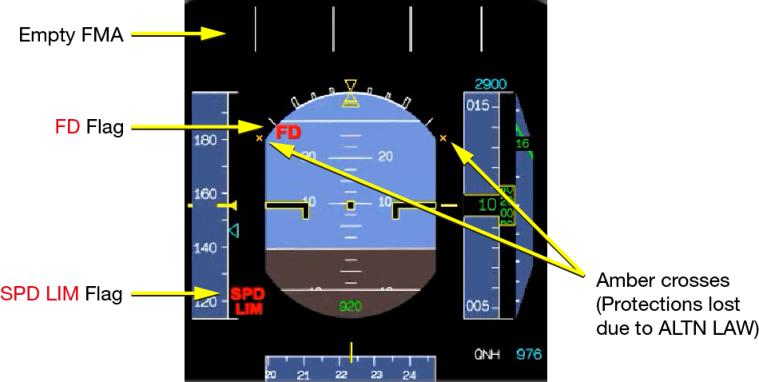
(fig.1) Impact on the PFD indications: FD and SPD LIM red flags, empty FMA and amber crosses of the alternate law.
Flight Data Analysis and Investigation
Section titled “Flight Data Analysis and Investigation”The analysis of the flight recorder’s data shows successive discrepancies during the takeoff roll and takeoff phase between ADR1 and ADR 3 airspeeds. The ADR2 airspeed is not recorded in the DFDR.
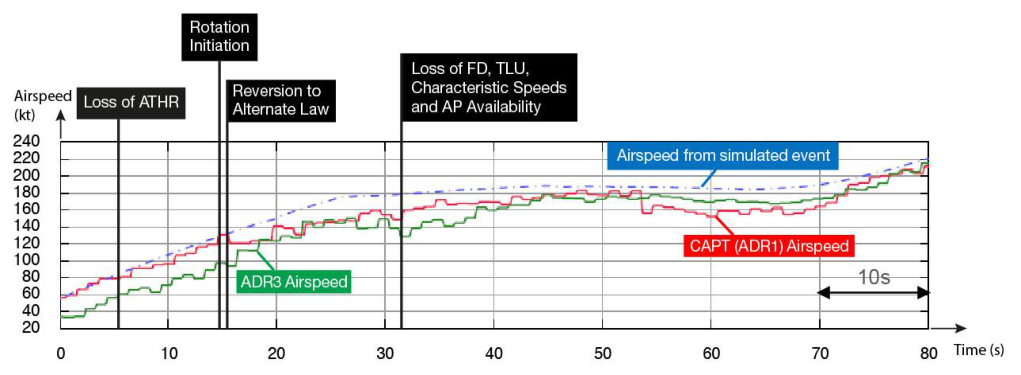
For investigation purposes, the airspeed during the take-off was simulated based on an aerodynamic model of an A320 and using the recorded pitch and stick inputs from the event.
The resulting Computed Airspeed (CAS) from the simulation, representative of the actual airspeed, is shown in blue on the graph (fig.2). This was compared to the recorded CAPT CAS (from ADR1) shown in red and ADR3 CAS, which is shown in green on the graph (fig.2).
From the beginning of the take-off roll, ADR3 airspeed is perpetually underestimated up to 40kts and ADR1 airspeed is underestimated from take-off roll up to 10kts and from rotation up to 35kts.
ICE RIDGES PHENOMENON
Section titled “ICE RIDGES PHENOMENON”Root Cause
Section titled “Root Cause”The main cause of ice ridges over the lower nose fuselage of the aircraft is ice accretion during a long stay on ground in cold conditions (fig.3). A review of in-service events from the last 6 years shows that a large majority of ice ridges related events occurred during the first flight of the day.
Reported events also show that ice ridges may be dislodged during the flight or may remain attached to the lower nose fuselage for the entire flight (fig.4).
A second possible cause of reported ice ridge related events is when snow falling on a heated windshield melts and the water running down from the windshield refreezes in ridges on the lower fuselage. The caution note of the FCOM PRO-NOR-SUP- ADVERSE WEATHER – Ground Operations in Cold Weather Conditions describes this phenomenon.
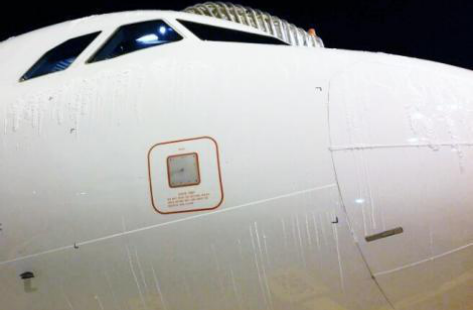
(fig.3) Example of thin ice ridges forward of the Pitot probes of an A320 family aircraft
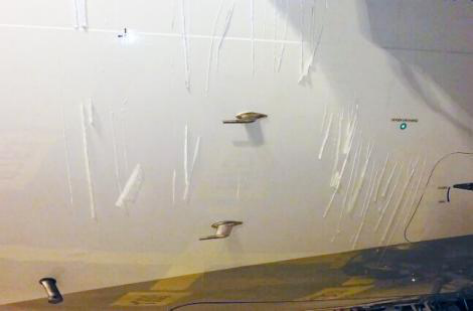
(fig.4) Example of ice ridges that remain on the lower fuselage even after completing a flight
Effects of the ice ridges
Section titled “Effects of the ice ridges”The presence of ice ridges located forward of the Pitot probes on the lower nose fuselage creates airflow perturbations (fig.5) and may lead to airspeed data from the ADR of the impacted probe(s) to be lower than the actual airspeed.
The effect of ice ridges on the measured airspeed value will depend on the location, shape and number of ice ridges present. A large ice ridge but also successive thin ice ridges can significantly impact the airspeed measurement.
Regarding the effect of airflow perturbation caused by ice ridges, theoretically they could also affect the static ports or AOA sensors, but in-service data shows no effect on static pressures and rare effect on AOA measurements.
A large ice ridge but also successive thin ice ridges can significantly impact the airspeed measurement.
All “ice ridge” related in-service events that were reported to Airbus occurred on A320 family aircraft with the exception of one A330 event. However, we cannot rule out potential effects of ice ridges on the Multifunction Probes (MFP) installed on the A380 and A350 families, even if they are of a different design to the probes installed on other Airbus aircraft families (A300/A310/A320/A330/A340)
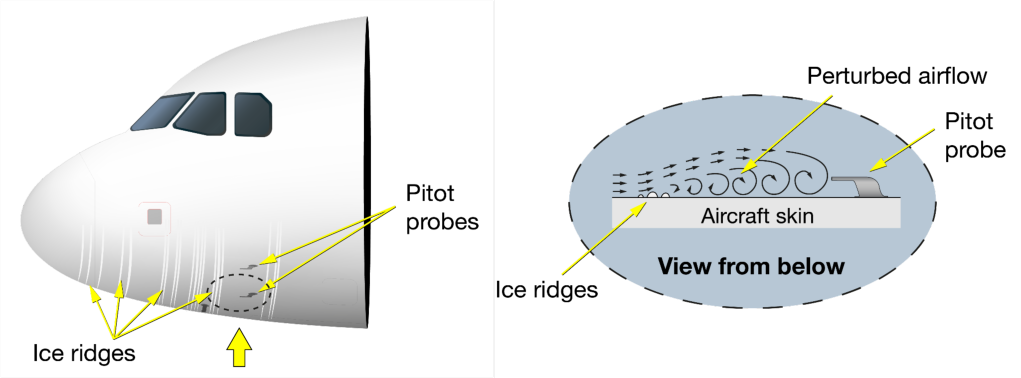
(fig.5) Effects of the ice ridges on the airflow forward of the Pitot probes
Effects of ice ridges perturbations on the aircraft systems:
Section titled “Effects of ice ridges perturbations on the aircraft systems:”The perturbation of the airflow in front of the Pitot tubes/MFPs can lead to the following effects on the aircraft systems:
A300/A310 aircraft family:
Section titled “A300/A310 aircraft family:”On A300/A310 aircraft, in addition to the erroneous airspeed indication, if one Pitot is impacted, the affected ADC sends an incorrect speed to the associated Auto Flight System (AFS1 for ADC1 and AFS 2 for ADC2). The flight crew must select the opposite AFS that uses a correct speed. Moreover, switching manually to the non-impacted ADC displays a correct airspeed on the affected PFD.
If both ADC1 and ADC2 are impacted, the AFS must not be used by the flight crew as per FCOM procedure.
A320/A330/A340 aircraft families:
Section titled “A320/A330/A340 aircraft families:”-
If one probe is affected, there is no associated system loss
-
● If two or three Pitot probes are affected, the Auto Flight System and Electrical Flight Control System may reject the 3 ADRs. This can result in the following:
-
Loss of Autopilot
-
Loss of Flight Directors
-
Loss of Auto-thrust
-
Loss of computation of the Characteristic Speeds
-
Loss of the rudder travel limiter function
-
Reversion to manual Alternate Law.
A380 aircraft family:
Section titled “A380 aircraft family:”A380 aircraft has four airspeed probes (3 MFPs + 1 Pitot tube for ISIS) as a consequence:
-
If one or two probes are affected, there is no associated system loss
-
If three or four probes are affected, this results in the following:
-
Loss of Autopilot
-
Loss of Flight Directors
-
Loss of Auto-thrust
-
Loss of Characteristic speeds computation
-
Reversion to manual Direct Law.
A350 aircraft family:
Section titled “A350 aircraft family:”A350 aircraft also has four airspeed probes (3 MFPs + 1 Pitot tube for ISIS) but uses a different speed monitoring. As a consequence:
-
If one or two probes are affected, there is no associated system loss
-
If three sources are affected (3 MFPs or 2 MFPs + ISIS Pitot):
-
Reversion to Alternate Law
-
CAT I only
-
If the four probes are affected, this results in the following:
-
Automatic display of the Backup Speed scale
-
Loss of Autopilot
-
Loss of Flight Directors
-
Loss of Auto-thrust
-
Reversion to manual Direct Law.
Preventing Unreliable Airspeed Events Due to Ice Ridges
Section titled “Preventing Unreliable Airspeed Events Due to Ice Ridges”The presence of ice ridges in front of Pitot probes during flight can occur when the lower nose fuselage is not de-iced at all or not completely de-iced. This is why all personnel working to dispatch an aircraft, from maintenance staff to flight crew, should pay particular attention to the potential presence of ice ridges in cold weather conditions, especially for the first flight of the day or after an extended stay on ground. The lower nose fuselage must be clear of ice before departure to avoid unreliable airspeed situations due to ice ridges, and even thin ice ridges must be removed before departure.
Maintenance & De-Icing Crew:
Section titled “Maintenance & De-Icing Crew:”The maintenance crew shall follow the guidelines in the AMM/MP Procedure 12-31-12 ICE & SNOW REMOVAL - MAINTENANCE PRACTICES to remove the snow and de-ice the aircraft.
The lower nose fuselage must be clear of ice before departure to avoid unreliable airspeed situation due to ice ridges, and even thin ice ridges must be removed before departure.
On A320, A330 and A340 aircraft families, a dedicated AMM procedure 12-31-12-660-008-A - Forward Fuselage Ice Accretion De-Icing provides guidelines for removing ice and snow from the forward fuselage.
While performing ice removal from lower nose fuselage it is recommended that:
The operator should spray the de-icing fluid from the rear to the front to avoid contaminating the Pitot tube
Never spray de-icing fluid directly on static probes and AOA probes to avoid contamination
More generally, the AMM of all Airbus Aircraft types has been enhanced to highlight Ice ridges phenomenon and to provide additional guidelines for de-icing operation. It highlights that while thin hoarfrost is permitted, for example on the top surface of the fuselage, it must be distinguished from thin ice ridges that must be removed from the lower nose fuselage.
Flight Crew:
Section titled “Flight Crew:”The FCOM and FCTM of all Airbus aircraft were updated in 2018 to take into account the lessons learnt from these events. During the exterior walkaround ● Modification of FCOM in cold weather The FCOM (A320/A330/A340/A350/A380: PRO-NOR-SUP- ADVERSE conditions, the flight WEATHER – Ground Operations in Cold Weather Conditions , A300/A310: Procedures and Techniques - Inclement Weather Operation crew must check - Aircraft Preparation for Cold Weather Operation ) have been modified to that there are no explain that, during the exterior walkaround in cold weather conditions, ice ridges on the the flight crew must check that there are no ice ridges on the lower nose lower nose fuselage, in front of the air probes. If ice ridges are detected, the flight crew must ask the de-icing personnel to remove them. fuselage, in front of the air Lower nose fuselage check should be performed carefully because ice ridges can be difficult to see, especially on a white fuselage during night probes. time
● FCTM modification: The FCTM (A320/A330/A340/A350/A380: PR-NP-SPADVERSE WEATHER – Cold Weather Operations and Icing Conditions – General section, A300/A310: Supplementary Information - Inclement Weather Cold Weather Operations And Icing Conditions ) was updated to explain the effect of ice ridges in front of Pitot probes on the airspeed measurement and the potential subsequent unreliable airspeed situation. What to do in the case of an unreliable speed event during takeoff?
The means to prevent ice ridges described in this article can reduce the likelihood of unreliable airspeed events related to this phenomenon, however in any event where an airspeed discrepancy is detected by the flight crew, the UNRELIABLE SPEED INDICATION must be applied. Refer to FCOM UNRELIABLE SPEED INDICATION procedure and associated FCTM chapter for more information on the procedure application.
CONTRIBUTORS
Section titled “CONTRIBUTORS”Panxika CHARALAMBIDES Flight Safety Director Product Safety
Adrien CHEN Flight Safety Director Product Safety
David MARCONNET Safety Enhancement Manager - Flight Operations Support & Training Standards Customer Services
Aymeric JACQUOT Air Data and Inertial System Engineer Design Office
The potential consequences of ice ridges located forward of the Pitot probes (or MFPs) on the lower nose fuselage is not very well known by flight crews, maintenance and ground personnel. It is important to be aware that these ice ridges may create airflow perturbations forward of the probes. This can lead to the airspeed data coming from the ADR (or ADC) associated with the affected probe, or probes, to be at a value that is significantly lower than the actual airspeed. The outcome may be an unreliable airspeed situation from take-off, or later during the flight, with its related effects on the aircraft systems.
The FCOM and FCTM were updated in 2018 to raise awareness of this phenomenon. They highlight the need to pay particular attention to this area when performing the walk around in cold weather conditions. If the flight crew observes (even thin) ice ridges, they must ask the ground personnel to remove them before departure.
The AMM also highlights this phenomenon and provides additional guidance for de-icing the lower nose fuselage area.
Remy DAYRE Aircraft Control System Engineer Design Office
With Thanks to Eric LATRE and Marc LE-LOUER and Marie LULLIEN-JOUGLA from the Flight Operations Support Department
Safety first , 2021. Safety first is published by Airbus S.A.S. 1, rond point Maurice Bellonte - 31707 Blagnac Cedex/France.
Editor: Yannick Malinge, Chief Product Safety Officer.
Editorial team: Guillaume Estragnat, Vanessa Sadi, Gwyneth Duggan, Tim Roach.
- Reference: X00D16031905.
Photos by Airbus and Masterfilm: H. GOUSSE.
© Airbus S.A.S. 2021 – All rights reserved. Proprietary documents.
Section titled “© Airbus S.A.S. 2021 – All rights reserved. Proprietary documents.”Source: Airbus Safety First URL: https://safetyfirst.airbus.com/look-out-for-ice-ridges-on-the-lower-nose-fuselage/ Published: 2023-12-20 Category: Flight Ops, Ground Ops, Maintenance, airspeed, christals, freeze, pitot, speed, unreliable PDF: Original PDF
随着北半球冬季的开始,重新发布这篇文章是一个及时的提醒,该文章最初写于2018年。
下机身前部结冰会导致ADR提供的计算空速(CAS)值低于实际空速,从而可能导致不可靠空速事件。本文描述了对飞机起飞阶段空速系统潜在的影响,以及如何防止此类情况的发生。
本文也可在 safetyfirst.airbus.com 和适用于 iOS 和 Android 设备的 Safety first 应用程序上获取。
北欧冬季清晨,一架空客A320的机组人员抵达飞机,准备开始新一天的飞行。当时地面温度为零下5°C,飞机经过夜间停场后仍被积雪和冰覆盖。
起飞前执行了二步除冰/防冰程序。喷洒区域包括机翼、垂直安定面和水平安定面。机身区域未进行除冰。
地面勤务完成后,飞行机组继续执行起飞。离地时,飞控法则恢复为备用法则,AUTO FLT A/THR OFF(自动飞行 推力自动断开)ECAM警戒触发。12秒后,飞行指引仪(FD)、特征速度、TLU功能和自动驾驶可用性也同时失效。两侧PFD上显示FD和SPD LIM红色旗标 (图1),在ECAM起飞抑制阶段结束时,当飞机到达1500英尺高度时,显示了三条ECAM警告:
-
NAV ADR DISAGREE(导航 ADR 不一致)
-
F/CTL ALTN LAW(飞控 备用法则)
-
AUTO FLT RUD TRV LIM SYS(自动飞行 方向舵行程限制系统)
飞行机组识别出空速不一致问题,随后将PFD1、PFD2和备用空速指示与导航显示器上的地速进行比较。他们决定关闭ADR 1+3,在仅保留ADR2工作的状态下执行了返场着陆。
(图1) 对PFD指示的影响:FD和SPD LIM红色旗标、FMA空白以及备用法则的琥珀色叉号。
飞行数据分析与调查
Section titled “飞行数据分析与调查”飞行记录器数据分析显示,在起飞滑跑和起飞阶段,ADR1和ADR3的空速之间存在连续偏差。ADR2空速未记录在DFDR中。
为便于调查,基于A320的气动模型,并使用事件中记录的俯仰和操纵杆输入,对起飞过程中的空速进行了模拟。
模拟得出的计算空速(CAS)(代表实际空速)以蓝色显示在图表中 (图2)。并与记录的CAPT CAS(来自ADR1,红色)和ADR3 CAS(绿色)进行了比较 (图2)。
从起飞滑跑开始,ADR3空速持续低估,最高可达40节;ADR1空速在滑跑阶段低估至10节,从抬轮开始低估至35节。
飞机下机身前部冰脊的主要成因是在寒冷条件下长时间停场期间形成的结冰 (图3)。对过去6年服务事件的分析表明,绝大多数与冰脊相关的事件发生在当天首次飞行期间。
报告的事件还表明,冰脊可能在飞行过程中脱落,也可能整个航段都附着在下机身前部 (图4)。
报告的冰脊相关事件的第二个可能原因是落在加温风挡上的雪融化后,从风挡流下的水在下机身上重新结冰形成冰脊。FCCOM的注意事项 PRO-NOR-SUP- 不利天气 – 寒冷天气条件下的地面操作 中描述了这一现象。
(图3) A320系列飞机皮托管(Pitot probe)前方的薄冰脊示例
(图4) 完成飞行后仍残留在下机身上的冰脊示例
位于下机头机身皮托管前方的冰脊会产生气流扰动 (图5),并可能导致受影响皮托管的 ADR 提供低于实际空速的空速数据。
冰脊对测量空速值的影响取决于冰脊的位置、形状和数量。大型冰脊以及连续的薄冰脊都可能对空速测量产生重大影响。
关于冰脊引起的气流扰动的影响,理论上它们也可能影响静压孔或迎角传感器,但运营数据显示对静压无影响,对迎角测量的影响也很罕见。
大型冰脊以及连续的薄冰脊都可能对空速测量产生重大影响。
所有向空客报告的与“冰脊”相关的运营事件均发生在 A320 系列飞机上,仅有一例 A330 事件。然而,我们不能排除冰脊对 A380 和 A350 系列飞机上安装的多功能探头(MFP)的潜在影响,尽管它们的探头设计与空客其他机型系列(A300/A310/A320/A330/A340)上安装的探头不同。
(图5) 冰脊对皮托管前方气流的影响
冰脊扰动对飞机系统的影响:
Section titled “冰脊扰动对飞机系统的影响:”皮托管/MFP 前方的气流扰动可能导致以下飞机系统影响:
A300/A310 系列飞机:
Section titled “A300/A310 系列飞机:”在 A300/A310 飞机上,除空速指示错误外,如果一个皮托管受影响,受影响的 ADC 会向相关自动飞行系统(AFS)发送错误的速度:ADC1 对应 AFS1,ADC2 对应 AFS2。飞行机组必须选择使用正确速度的另一侧 AFS。此外,手动切换至未受影响的 ADC 可在受影响的 PFD 上显示正确的空速。
如果 ADC1 和 ADC2 同时受影响,根据 FCOM 程序,飞行机组不得使用 AFS。
A320/A330/A340 系列飞机:
Section titled “A320/A330/A340 系列飞机:”-
如果只有一个探头受影响,则不会造成相关系统损失
-
如果两个或三个皮托管受影响,自动飞行系统和电气飞行控制系统可能会拒绝全部 3 个 ADR。这可能导致以下情况:
- 自动驾驶断开
- 飞行指引仪消失
- 自动推力断开
- 特征速度计算失效
- 方向舵行程限制功能失效
- 切换至人工备用法则
A380 系列飞机:
Section titled “A380 系列飞机:”A380 飞机有四个空速探头(3 个 MFP + 1 个供 ISIS 使用的皮托管),因此:
-
如果一到两个探头受影响,则不会造成相关系统损失
-
如果三个或四个探头受影响,将导致以下情况:
- 自动驾驶断开
- 飞行指引仪消失
- 自动推力断开
- 特征速度计算失效
- 切换至人工直接法则
A350 系列飞机:
Section titled “A350 系列飞机:”A350 飞机同样有四个空速探头(3 个 MFP + 1 个供 ISIS 使用的皮托管),但采用了不同的速度监控方式。因此:
-
如果一到两个探头受影响,则不会造成相关系统损失
-
如果三个探头受影响(3 个 MFP 或 2 个 MFP + ISIS 皮托管):
- 切换至备用法则
- 仅限 CAT I 运行
-
如果四个探头全部受影响,将导致以下情况:
- 自动显示备份速度刻度
- 自动驾驶断开
- 飞行指引仪消失
- 自动推力断开
- 切换至人工直接法则
预防因冰脊导致的不可靠空速事件
Section titled “预防因冰脊导致的不可靠空速事件”在飞行中皮托管前方形成冰脊的原因可能是下机头机身未进行除冰或未完全除冰。因此,从维修人员到飞行机组,所有参与放行飞机的人员都应特别关注寒冷天气条件下可能存在的冰脊,尤其是在当天首次飞行或长时间停场后。下机头机身必须在起飞前清除冰块,以避免因冰脊导致不可靠空速的情况,且即使是薄冰脊也必须在起飞前予以清除。
维修与除冰人员:
Section titled “维修与除冰人员:”维修人员应遵循 AMM/MP 程序 12-31-12 冰雪清除 - 维修规程 中的指南来清除积雪和对飞机进行除冰。
下机头机身必须在起飞前清除冰块,以避免因冰脊导致不可靠空速的情况,且即使是薄冰脊也必须在起飞前予以清除。
在 A320、A330 和 A340 系列飞机上,专用的 AMM 程序 12-31-12-660-008-A - 前机身结冰除冰 提供了清除前机身冰和雪的指南。
在对下机头机身进行除冰时,建议如下:
运营商应从后向前喷洒除冰液,以避免污染皮托管
切勿将除冰液直接喷洒在静压孔和迎角探头上,以免造成污染
更一般性地,所有空客机型系列的 AMM 均已增强,以突出冰脊现象并提供除冰操作的额外指南。AMM 强调,虽然薄的霜冻是允许的(例如在机身上表面),但必须将其与必须从下机头机身清除的薄冰脊区分开来。
所有空客飞机的 FCOM 和 FCTM 已于 2018 年更新,以总结这些事件的经验教训。在寒冷天气条件下进行外部绕机检查时,飞行机组必须检查低机身前部是否有冰脊。● FCOM 修订:FCOM(A320/A330/A340/A350/A380:PRO-NOR-SUP-ADVERSE 天气 – 地面寒冷天气条件下的运行_,A300/A310:程序和技术 – 不利天气运行)已修订,解释了进行外部绕机检查时飞行机组必须检查低机身前部(空速探头前方)是否存在冰脊。如果发现冰脊,飞行机组必须要求除冰人员将其清除。低机身检查应仔细进行,因为冰脊可能难以发现,尤其是在夜间白色机身上。
● FCTM 修订:FCTM(A320/A330/A340/A350/A380:PR-NP-SP-ADVERSE WEATHER – 寒冷天气运行与结冰条件 – 概述 部分,A300/A310:补充信息 – 不利天气寒冷天气运行与结冰条件)已更新,解释了空速探头前方冰脊对空速测量的影响,以及可能由此导致的不可靠空速状况。起飞时发生空速不可靠事件该怎么办?
本文所述的防止冰脊的措施可以降低与该现象相关的空速不可靠事件的发生概率,但一旦机组检测到空速差异,必须执行不可靠空速指示程序。相关 FCOM 不可靠空速指示程序及 FCTM 相关章节提供了程序应用的更多信息。
Panxika CHARALAMBIDES 产品安全飞行安全总监
Adrien CHEN 产品安全飞行安全总监
David MARCONNET 运行支持与培训标准客户服务安全增强经理
Aymeric JACQUOT 设计办公室空速与惯性系统工程师
飞行机组、维护人员和地面人员对皮托管(或 MFP)前方低机身上的冰脊潜在后果了解不多。重要的是要意识到这些冰脊可能在探头前方产生气流扰动。这可能导致来自受影响探头(或多个探头)相关 ADR(或 ADC)的空速数据显著低于实际空速。结果可能是从起飞时起或飞行途中出现不可靠空速状况,并对其相关系统产生影响。
FCOM 和 FCTM 已于 2018 年更新,以提高对该现象的认识。它们强调在寒冷天气条件下进行绕机检查时需要特别关注该区域。如果飞行机组观察到冰脊(即使很薄),必须在起飞前要求地面人员将其清除。
AMM 也对该现象进行了说明,并为低机身区域的除冰提供了额外指导。
Remy DAYRE 设计办公室飞机控制系统工程师
特别感谢运行支持部的 Eric LATRE、Marc LE-LOUER 和 Marie LULLIEN-JOUGLA
Safety first,2021 年。Safety first 由空中客车 S.A.S. 出版。1, rond point Maurice Bellonte - 31707 Blagnac Cedex/France。
主编:Yannick Malinge,首席产品安全官。
编辑团队:Guillaume Estragnat、Vanessa Sadi、Gwyneth Duggan、Tim Roach。
20192534。参考编号:X00D16031905。
图片由 Airbus 和 Masterfilm 提供:H. GOUSSE。