Avoiding Fuel Spills on A320 Family Aircraft
Source: Airbus Safety First URL: https://safetyfirst.airbus.com/avoiding-fuel-spills-on-a320-family-aircraft/ Published: 2020-03-09 Magazine Issue: 2020-03 Category: Flight Ops, Ground Ops, Maintenance, fuel, fuel overflow, fuel spillage, overfill, overflow, refuel, refuelling, spillage PDF: Original PDF

Cases of fuel spillage have been reported to Airbus on A320 family aircraft equipped with fuel transfer jet-pumps in the center tank.
This article recalls the protections available against tank overfi ll. It explains why fuel spillage happened on the reported events and provides recommendations on how to avoid it.
OVERFILL AND OVERFLOW PROTECTION AND MONITORING
Section titled “OVERFILL AND OVERFLOW PROTECTION AND MONITORING”Fuel tanks on Airbus aircraft are designed so that fuel spills into the vent tank through their vent line in the event of a tank overfi ll. Each vent tank is equipped with a NACA duct where fuel can fl ow out and onto the ground if the vent tank is full.
Refuel valves automatic closure
Section titled “Refuel valves automatic closure”The test of overfi ll protection must be done before every refuelling operation by pushing the TEST switch of the refuel/defuel panel, fi rst to the LTS position to check the integrity of the indication lights, and then to the HI LVL position to test the protection and the overfl ow sensor located in each vent tank.
On A320 family aircraft, the refuel valve for a fuel tank will automatically close when the targeted fuel quantity is reached, or fuel is detected by the high level sensor fi tted in the tank during refuelling.
(fi g.1)
Section titled “(fi g.1)”Functional schematic of the refuelling and venting system of an A320 aircraft
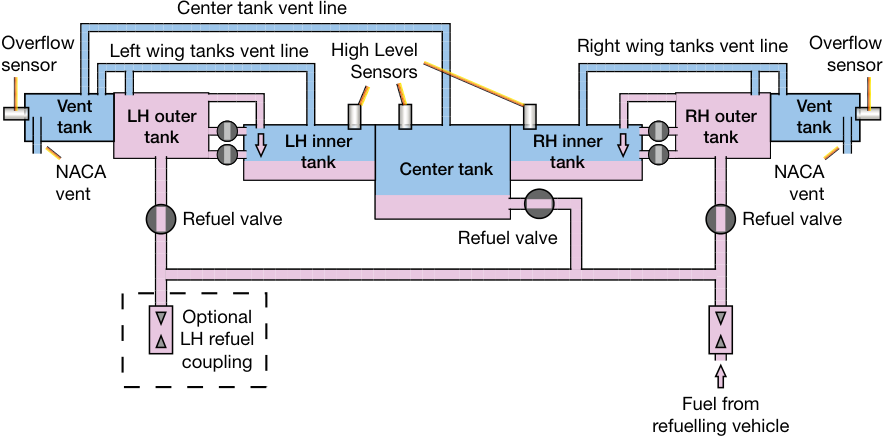
A monitoring function was first introduced on A321 aircraft to trigger a FUEL L(R) WING TK OVERFLOW ECAM alert in the case of a fuel overfl ow detected in the vent tank by the overfl ow sensor. The ECAM alert (Modifi cation 154427) is now also installed in production on A319/A320 aircraft since May 2013 (aircraft serial number 5597 and onward). It can be installed on previously built A318/A319/A320 aircraft with Service Bulletin A320-28-1216.
A319/A320/A321 AIRCRAFT FITTED WITH TRANSFER JET-PUMPS IN THE CENTER TANK
Section titled “A319/A320/A321 AIRCRAFT FITTED WITH TRANSFER JET-PUMPS IN THE CENTER TANK”(fi g.2)
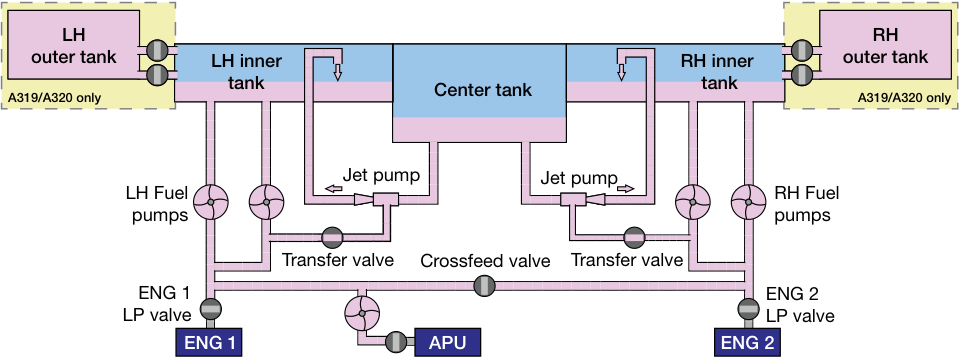
Section titled “(fi g.2)”Comparison of the fuel feeding system of A320 family aircraft equipped with or without fuel transfer jet-pumps
Transfer jet-pumps were introduced on the A321 aircraft at its entry into service to simplify the fuel system, replacing the center tank electrical fuel boost pumps previously used on A320 family aircraft (fig.2). To take advantage of this simplifi cation, the transfer jet-pumps were introduced in the center tank of A319ceo and A320ceo aircraft delivered from 2014. and are standard on all A319neo, A320neo, and A321neo aircraft.
A318/A319/A320 aircraft without fuel transfer jet pumps
Section titled “A318/A319/A320 aircraft without fuel transfer jet pumps”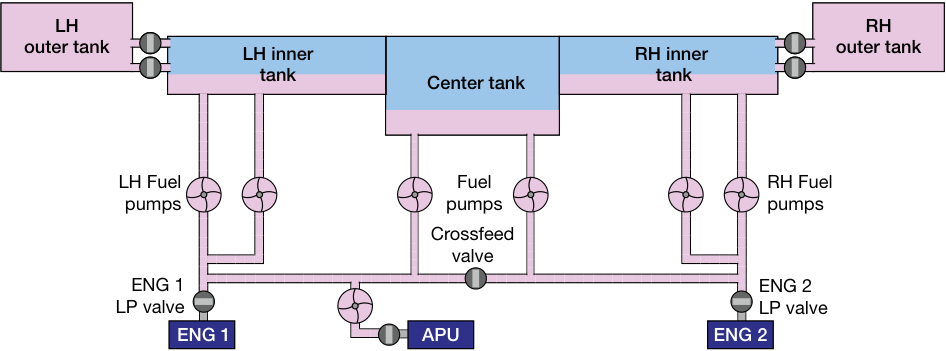
Refuelling operation
Section titled “Refuelling operation”The center tank transfer mode selector should be in the AUTO position (no light) during the refuelling operation. This means the left and right transfer valves will remain closed. The fuel pumps and the Left and Right CTR TK XFR pushbutton switches can be ON or OFF. The switches will be OFF (no light) if the flight crew has already performed their cockpit preparation.
The center tank and the outer wing tanks are filled first in a normal refuelling operation. Once the outer tank is full of fuel, the inner wing tank will be filled with fuel passing through the spill pipe (fig.3).
(fig.3)
Section titled “(fig.3)”Normal refuelling on A320 family aircraft equipped with transfer jet-pumps (Cockpit preparation already done in this example)
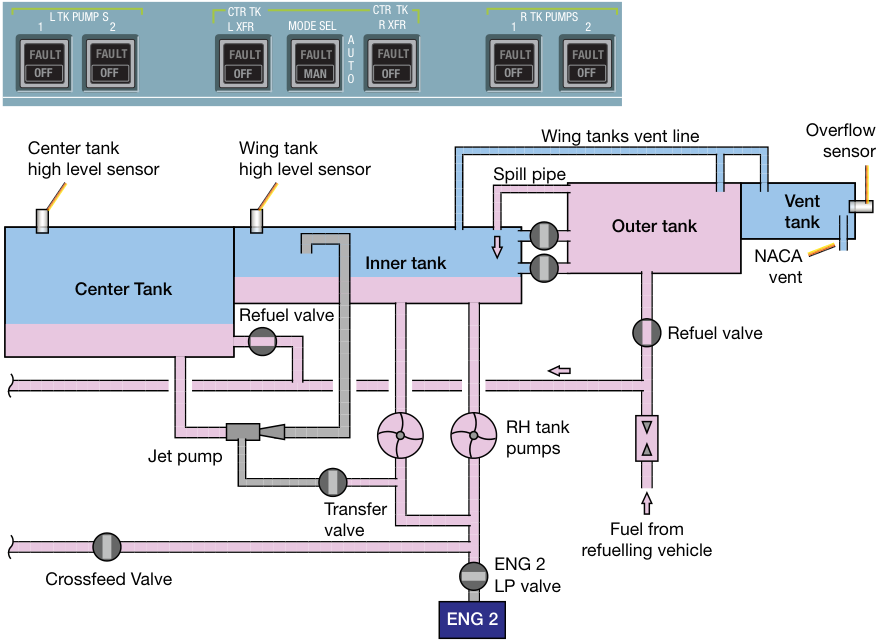
Cases of fuel spillage were reported to Airbus during refuelling of A320 family aircraft equipped with transfer jet-pumps in the center tank. The transfer mode selector was left in the MAN position during the refuelling operation of the reported events. This condition forced the transfer valves to open and fuel was supplied to the jetpumps (fig.4). With the jet pumps ON and fuel flow provided by the fuel pumps, fuel was moved from the center tank to the wing tanks. Even though the refuel valves automatically closed when the preselected quantity of fuel was reached, the transfer valves remained open and the jet-pumps continued to transfer the fuel out of the center tank into the inner tank. When the wing tanks were completely full, fuel was pushed through the wing tank vent lines into the vent tanks and eventually overflowed from the NACA vent causing fuel to spill to the ground.
The center tank transfer mode selector should be in the AUTO position (no light) during the refuelling operation.
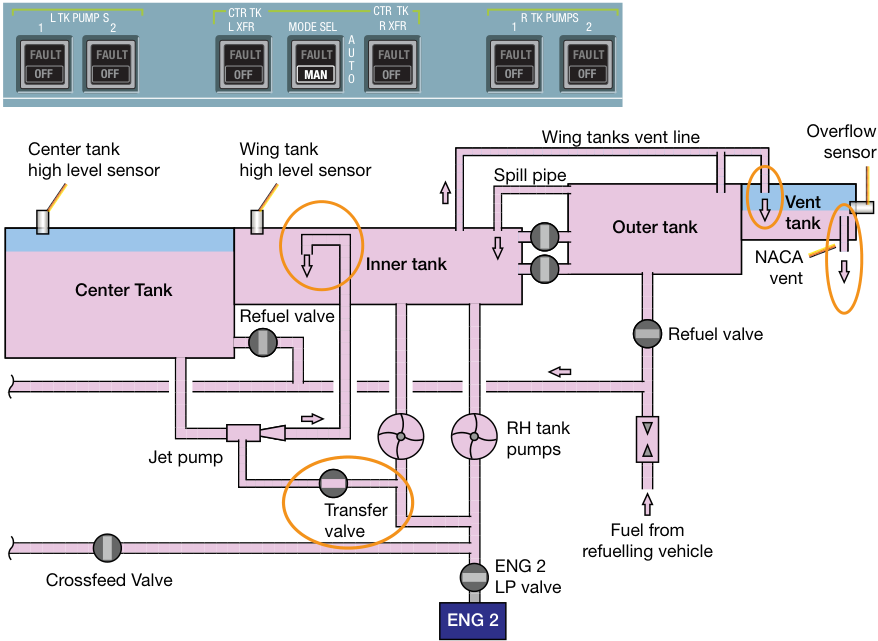
Fuel spillage due to mode selector left on the manual position on A320 family aircraft equipped with transfer jet-pumps
Adherence to SOP prevents leaving the FUEL MODE SEL in** MAN **position
Section titled “Adherence to SOP prevents leaving the FUEL MODE SEL in** MAN **position”PARKING procedure
Section titled “PARKING procedure”The parking SOP requests the flight crew to set the fuel pumps and center transfer valves OFF. This means that the fuel pumps and the Left and Right CTR TK XFR pushbutton switches should be in the OFF position. The fuel mode selector should be in AUTO mode.
(fig.5)
Section titled “(fig.5)”Configuration of the FUEL Overhead panel as per PARKING SOP
Before the next flight, the flight crew must extinguish all white lights from the overhead panel during the cockpit preparation following the “dark cockpit” philosophy. The fuel pumps are switched ON and the Left and Right CTR TK XFR pushbutton switches should be pushed to extinguish their OFF light (fig.6). If the flight crew observes the FUEL MODE SEL MAN light ON, it must be switched OFF at this stage.
(fig.6)
Section titled “(fig.6)”Configuration of the FUEL Overhead panel as per COCKPIT PREPARATION SOP (all lights OFF)
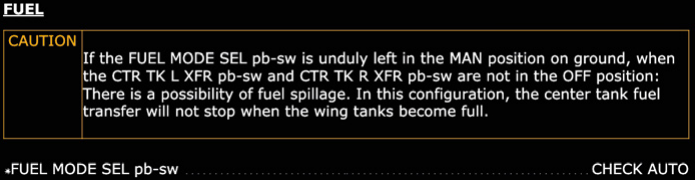
In addition, SOP requests specifi cally to check that the FUEL MODE SEL is set to AUTO in the FUEL section of the cockpit preparation (fi g.7). A dedicated caution warns the fl ight crew of the potential fuel spillage if the FUEL MODE SEL is set to MAN position on ground with the CTR TK L XFR and TR TK R XFR pushbutton switches not in the OFF position.
(fi g.7)
Section titled “(fi g.7)”Extract from the A320 FCOM PRO-NOR-SOP Cockpit preparation - Fuel
WHAT TO DO IN THE CASE OF A FUEL SPILLAGE?
Section titled “WHAT TO DO IN THE CASE OF A FUEL SPILLAGE?”In the event of a fuel spillage, Airbus recommends the following actions:
-
Perform TSM Task “Refuel - Fuel Spillage From NACA Vent During Refuel’ to identify the root cause of the spillage
-
Notify Airbus about the fuel spillage event and provide the following information:
-
Fuel Spillage Sheet (available in the TSM task)
-
Fault Reports
-
Shop Reports of replaced components if any, including Part Number and Serial Number.
CONTRIBUTORS:
Section titled “CONTRIBUTORS:”Stéphane BERNARD Fuel System Engineer Engineering Support
Regis PERNET
Section titled “Regis PERNET”Flight Operations Support Engineer Customer Support
Ross WALKER
Section titled “Ross WALKER”Fuel System / Fuel Tank Safety Design Office
Protection is available to prevent fuel spill incidents from Airbus aircraft during refuelling. Sensors fitted to the center tank and wing tanks will automatically close the refuel valves to stop the refuelling operation in the case of overfill. Fuel spills are avoided if these protections are operating correctly and this should be checked by a quick test just before refuelling the aircraft.
Fuel spillages were reported to Airbus on A320 family aircraft fitted with transfer jet pumps where the fuel transfer mode selection was mistakenly left in MANUAL. Ensuring that the FUEL MODE SELector is set to AUTO before refuelling the aircraft will avoid a fuel spill incident.
March, 2020. Safety fi rst is published by Airbus S.A.S. - 1, rond point Maurice Bellonte - 31707 Blagnac Cedex/France. Publisher and Editor: Yannick Malinge, Chief Product Safety Offi cer. Concept Design by Airbus MultiMedia Studio 20192534. Reference: X00D16031905 Issue 30. Photos by Airbus, A. Doumenjou, P. Masclet.
来源: Airbus Safety First URL: https://safetyfirst.airbus.com/avoiding-fuel-spills-on-a320-family-aircraft/ 发布日期: 2020-03-09 杂志期号: 2020-03 类别: 飞行操作, 地面操作, 维修, 燃油, 燃油溢流, 燃油泄漏, 过度加油, 溢流, 加油, 加油, 泄漏 PDF: Original PDF
空客收到了 A320 系列飞机中央油箱装有燃油传输喷射泵时发生燃油泄漏的报告。
本文回顾了防止油箱过度加油的可用保护措施,解释了报告事件中燃油泄漏的原因,并提供了避免燃油泄漏的建议。
过度加油与溢流保护和监控
Section titled “过度加油与溢流保护和监控”空客飞机的燃油箱设计为在油箱过度加油的情况下,燃油通过通气管线溢出到通气油箱。每个通气油箱都配有一个 NACA 管道,当通气油箱满时,燃油可以通过该管道流出并排到地面。
加油活门自动关闭
Section titled “加油活门自动关闭”每次加油操作前必须进行过度加油保护测试,按下加油/抽油面板上的 TEST 开关,先置于 LTS 位置以检查指示灯的完整性,然后置于 HI LVL 位置以测试位于每个通气油箱中的保护和溢流传感器。
在 A320 系列飞机上,当达到目标燃油量,或在加油过程中高油面传感器检测到燃油时,燃油箱的加油活门将自动关闭。
A320 飞机加油和通风系统功能示意图
监控功能首先在 A321 飞机上引入,当通气油箱中的溢流传感器检测到燃油溢流时,触发 FUEL L(R) WING TK OVERFLOW ECAM 警戒。该 ECAM 警戒(改装编号 154427)自 2013 年 5 月起也在 A319/A320 飞机的生产中安装(飞机序列号 5597 及以后)。可通过服务通告 A320-28-1216 安装到先前制造的 A318/A319/A320 飞机上。
装有中央油箱传输喷射泵的 A319/A320/A321 飞机
Section titled “装有中央油箱传输喷射泵的 A319/A320/A321 飞机”装有或不装有燃油传输喷射泵的 A320 系列飞机燃油供给系统对比
传输喷射泵在 A321 飞机投入运营时引入,以简化燃油系统,取代了 A320 系列飞机先前使用的中央油箱电动燃油助推泵 (图 2)。为了利用这一简化方案,传输喷射泵在 2014 年交付的 A319ceo 和 A320ceo 飞机的中央油箱中引入,并且是所有 A319neo、A320neo 和 A321neo 飞机的标准配置。
未装燃油传输喷射泵的 A318/A319/A320 飞机
Section titled “未装燃油传输喷射泵的 A318/A319/A320 飞机”
加油操作期间,中央油箱传输模式选择器应置于 AUTO 位置(无灯亮)。这意味着左、右传输活门将保持关闭。燃油泵和左、右 CTR TK XFR 按压开关可以置于 ON 或 OFF。如果机组已完成驾驶舱准备,开关将置于 OFF(无灯亮)。
在正常加油操作中,中央油箱和外侧翼油箱首先被加油。一旦外侧油箱燃油加满,燃油将通过溢流管流入内翼油箱 (图 3)。
装有传输喷射泵的 A320 系列飞机正常加油(本例中驾驶舱准备已完成)
在装有中央油箱传输喷射泵的 A320 系列飞机加油期间,空客收到了燃油泄漏报告。报告事件中的传输模式选择器在加油操作期间被留在 MAN 位置。此状态强制传输活门打开,燃油被输送到喷射泵 (图 4)。在喷射泵开启且燃油泵提供燃油流量的情况下,燃油从中央油箱被移动到翼油箱。即使加油活门在达到预设燃油量时自动关闭,传输活门仍然保持打开,喷射泵继续将燃油从中央油箱传输到内油箱。当翼油箱完全加满时,燃油被推入翼油箱通气管线进入通气油箱,最终从 NACA 通气口溢出,导致燃油泄漏到地面。
加油操作期间,中央油箱传输模式选择器应置于 AUTO 位置(无灯亮)。
装有传输喷射泵的 A320 系列飞机因模式选择器留在手动位置导致的燃油泄漏
遵守SOP可防止将燃油模式选择器留在 MAN ~~**~~位置
Section titled “遵守SOP可防止将燃油模式选择器留在 MAN ~~**~~位置”停机SOP要求机组将燃油泵和中央传输活门设置为OFF。这意味着燃油泵和左、右中央油箱传输电门应处于OFF位置。燃油模式选择器应处于AUTO模式。
根据停机SOP设置的燃油跳开关面板构型
在下次飞行前,机组必须在遵循“暗驾驶舱”理念的驾驶舱准备期间熄灭跳开关面板上的所有白色指示灯。燃油泵应设置为ON,左、右中央油箱传输电门应按下以熄灭其OFF指示灯**(图6)**。如果机组观察到燃油模式选择器MAN指示灯亮起,应在此阶段将其关闭。
根据驾驶舱准备SOP设置的燃油跳开关面板构型(所有指示灯熄灭)
此外,SOP特别要求在驾驶舱准备的燃油部分检查燃油模式选择器是否设置为AUTO**(图7)**。专用警告会在燃油模式选择器设置为MAN位置且中央油箱左传输和右传输电门未处于OFF位置时,提醒机组注意潜在的燃油溢出风险。
A320 FCOM PRO-NOR-SOP 驾驶舱准备—燃油部分节选
发生燃油溢出时该怎么办?
Section titled “发生燃油溢出时该怎么办?”一旦发生燃油溢出,空客建议采取以下措施:
-
执行TSM任务“加油—加油期间NACA通气口燃油溢出”,以确定溢出的根本原因
-
将燃油溢出事件通知空客,并提供以下信息:
-
燃油溢出报告单(可在TSM任务中找到)
-
故障报告
-
所更换部件的修理厂报告(如有),包括件号和序列号
Stéphane BERNARD 燃油系统工程师 工程支持
Regis PERNET
飞行运行支援工程师 客户支援
Ross WALKER
燃油系统/燃油箱安全 设计工程
空客飞机在加油期间配备了防护装置以防止燃油溢出事件。安装在中央油箱和机翼油箱上的传感器将在发生溢出时自动关闭加油活门以停止加油操作。如果这些防护装置正常运行,加油前通过快速测试进行检查,即可避免燃油溢出。
据报告,配备传输抽油泵的A320系列飞机曾发生燃油溢出事件,原因是燃油传输模式选择被错误地留在MANUAL位置。在加油前确保燃油模式选择器设置为AUTO可避免燃油溢出事件的发生。
2020年3月。《Safety First》由空客股份有限公司出版——地址:1, rond point Maurice Bellonte,31707 Blagnac Cedex/法国。出版人和编辑:Yannick Malinge,首席产品安全官。概念设计由空客多媒体工作室制作 20192534。参考编号:X00D16031905 第30期。图片由空客、A. Doumenjou、P. Masclet提供。