Don’t Forget to Check the Alternate
Source: Airbus Safety First URL: https://safetyfirst.airbus.com/don-t-forget-to-check-the-alternate/ Published: 2026-03-31 Category: Flight Ops, Maintenance, Alternate braking, brake, Brakes, braking system, loss of braking PDF: Original PDF
CASE STUDY Event Description
Section titled “CASE STUDY Event Description”After a transit of 3 hours and 42 minutes, the flight crew of an A330-300 was ready for an early afternoon, 5-hour return flight to their origin airport.
Loss of the green hydraulic system
Section titled “Loss of the green hydraulic system”The takeoff was normal. Five minutes later, while climbing through 10 800 feet, the HYD G SYS LO PR and HYD G RSVR LO LVL ECAM alerts triggered followed by the BRAKES NORM BRK FAULT and BRAKES AUTO BRK FAULT ECAM alerts.
The flight crew performed the ECAM procedures and evaluated the situation with the assistance of an onboard maintenance engineer. They contacted the Maintenance Control Center of the airline, and agreed to continue the flight to the destination airport that had a long runway.
The flight crew checked all related FCOM procedures during cruise, and prepared their approach accordingly: Landing gear gravity extension was necessary, autobrake was not available, and the alternate braking system was to replace the normal braking system.
Loss of braking at landing
Section titled “Loss of braking at landing”The aircraft landed in CONF FULL. At touchdown, the PF selected MAX REV and applied full brake pedals. Because no deceleration was felt, the PF applied the LOSS OF BRAKING memory items, that requests the PM to set the A/SKID switch to OFF. The PF then reapplied pedal braking, which was not successful. In the end, the PF applied the parking brake 3 times, and the aircraft finally stopped.
Main landing gear wheels burst
Section titled “Main landing gear wheels burst”All tires of the main landing gear burst (fig.1). Damage occurred to the main landing gear, the main landing gear doors, the forward water drain mast and the left engine.
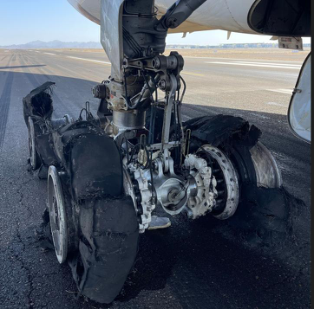
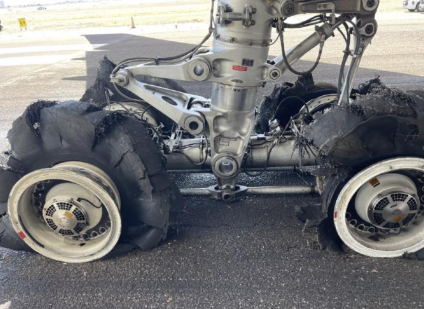
(fig.1) All wheels of the main landing gear burst during the event (images from the investigation board)
Event Analysis
Section titled “Event Analysis”Takeoff with a hidden alternate braking failure
Section titled “Takeoff with a hidden alternate braking failure”Recorder data analysis indicated that when the flight crew performed the pre-flight check of the alternate braking system, the pressure only reached a maximum of 416 psi instead of the expected value between 2200 and 2700 psi. Despite this low pressure value, the flight crew proceeded with the flight without seeking maintenance intervention, allowing the aircraft to take off with an inoperative alternate braking system.
In-flight loss of the normal braking system
Section titled “In-flight loss of the normal braking system”The loss of the normal braking system during flight was caused by the failure of the green hydraulic system. An overpressure inside the pitch trimmer actuator of the right main landing gear bogie resulted in the crushing of its piston rod, which caused an hydraulic leak (fig.2).
This type of damage on the pitch trimmer actuator can result from shocks caused by a damaged runway at the departure airport.
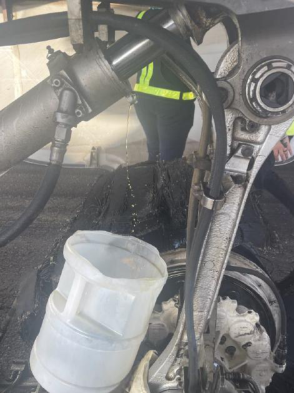
(fig.2) Visible hydraulic leak on the actuator of the pitch trimmer of the RH main landing gear (photo from the investigation board)
An enhancement of the pitch trimmer actuator is available to prevent this type of damage. Refer to the Technical Follow-Up TFU 32.11.00.018 available on the AirbusWorld portal for more information.
Loss of braking at landing
Section titled “Loss of braking at landing”The combination of the undetected alternate braking system malfunction during the pre-flight checks, with the in-flight failure of the normal braking system, caused the loss of braking during the landing roll. Consequently, the flight crew could only rely on the parking brake to stop the aircraft during the landing roll.
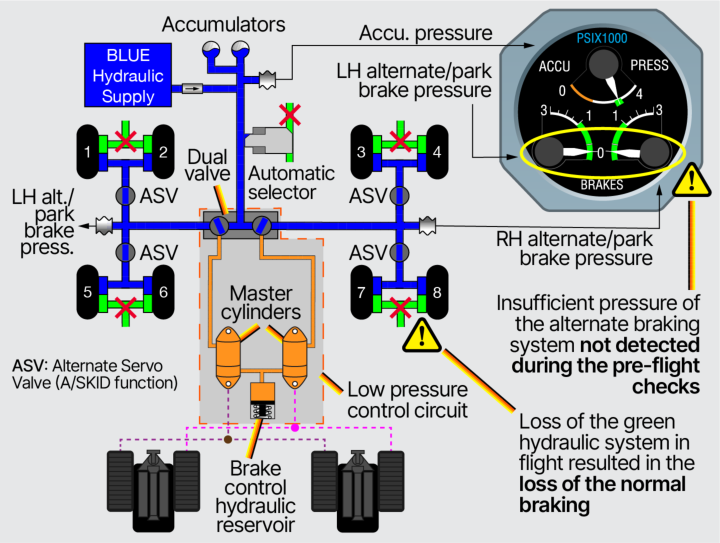
(fig.3) An undetected insufficient pressure of the alternate braking system during the pre-flight checks, combined with a loss of normal braking caused by a leak on the green hydraulic system during flight, are at the origin of the event.
Previous repetitive problems with the alternate braking system with inappropriate corrective actions
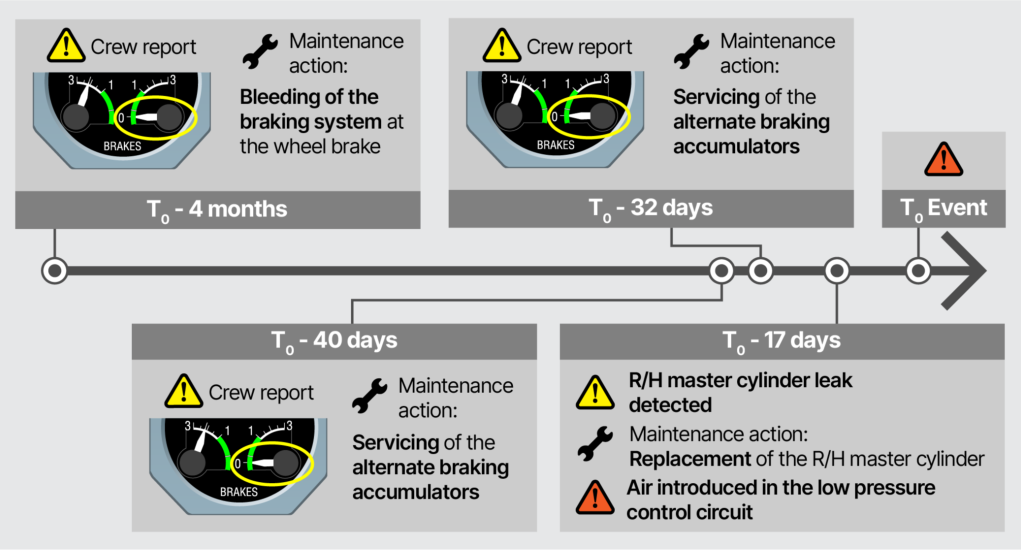
Section titled “Previous repetitive problems with the alternate braking system with inappropriate corrective actions”Analysis of the aircraft maintenance records indicates that several malfunctions of the alternate braking system were reported during the four months before the event (fig.4). Three separate flight crew reports of a low brake pressure indication on the right side during the check of the alternate braking system were recorded, including one with a “spongy” right brake pedal.
Each time either the high-pressure circuit of the alternate braking system at the wheel brakes was bled, or the nitrogen charge pressure of the brake accumulators was adjusted. This did not address the issue.
Application of the appropriate TSM task in the case of reported low alternate brake pressure (TSM 32-43-00-810-807-A “Brakes - Alternate-Braking Pressures Do Not Get to 2200 psi When Brake Pedals Applied (with Blue Hydraulic System Depressurized)”) would have helped the maintenance personnel to identify and fix the issue.
Replacement of the right master cylinder
Section titled “Replacement of the right master cylinder”17 days before the event, maintenance personnel found a leak on the right master cylinder, which was probably the root cause of the previous low alternate braking pressure events on the right side. The cylinder was replaced by a new one.
Air introduced in the low pressure control circuit
Section titled “Air introduced in the low pressure control circuit”Investigation revealed the presence of air in the low pressure control circuit of the alternate braking system that caused the insufficient pressure on both sides of the alternate braking system during the event.
An incorrect servicing of the low pressure control circuit after the installation of the new master cylinder is most probably the cause of the introduction of air in the system.
(fig.4) Sequence of maintenance actions performed before the event
ALTERNATE BRAKING SYSTEM
Section titled “ALTERNATE BRAKING SYSTEM”There are two types of control for the alternate braking system of Airbus aircraft.
Hydromechanical control
Section titled “Hydromechanical control”A300, A310, A330, A340-200, A340-300, and A320 family aircraft delivered before 2007 are equipped with a hydromechanical system for alternate braking control.
The brake pedals are mechanically connected to two master cylinders, converting the pedal displacement into a hydraulic pressure that activates the dual valve (fig.5). The dual valve regulates the quantity of hydraulic pressure coming from the blue (A330, A340-200/300 aircraft) or the yellow hydraulic system (A300, A310 and A320 family aircraft) to activate the brake pistons.
Electrical control
Section titled “Electrical control”An electrical control of the alternate braking system was first introduced on the A340-500/600 aircraft, and Airbus decided to also progressively equip A320 family aircraft with this enhanced technology from 2005 (the last A320 family aircraft equipped with an hydromechanical control was delivered in December 2007).
The position of the brake pedals is sent to the Braking & Steering Control Unit (BSCU) and Emergency (or Alternate) Braking Control unit (EBCU or ABCU).
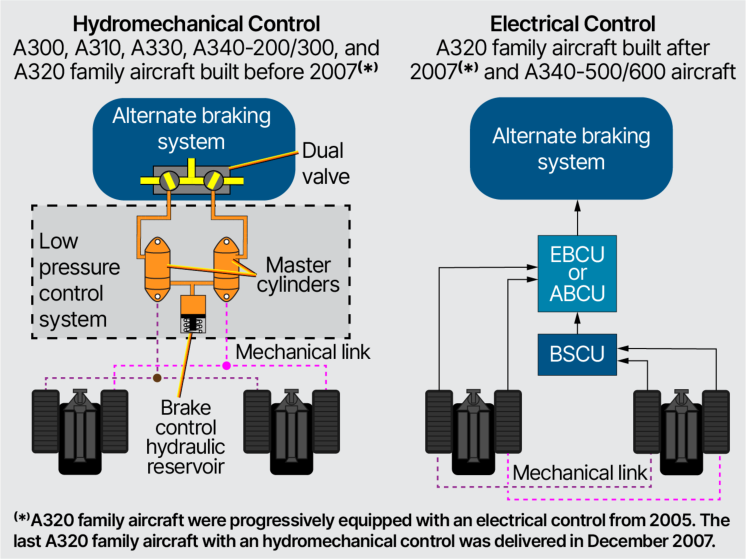
(fig.5) Types of control for the alternate braking system on A300, A310, A320 family, A330, and A340 aircraft
OPERATIONAL CONSIDERATIONS
Section titled “OPERATIONAL CONSIDERATIONS”Check of the Alternate Braking System before the first flight of the day
Section titled “Check of the Alternate Braking System before the first flight of the day”On aircraft equipped with hydromechanical control of the alternate braking system, (the) SOP requests that the flight crew check the alternate braking system:
-
During the preliminary cockpit preparation, before the exterior walkaround of the first flight of the day, or
-
● If there is a flight crew change.
The test is performed after checking that the brake accumulator(s) pressure is within the green zone on the triple pressure indicator. If this is not the case, the flight crew should switch the blue (A330 & A340-200/300 aircraft) or yellow (A320 family, A300 & A310 aircraft) ELEC PUMP to ON to refill the accumulators.
On aircraft equipped with an alternate braking system with electrical control , the check of the operability of the alternate braking system is performed automatically. Therefore, it is not requested by the SOP to check the alternate braking system before the exterior walkaround on these aircraft. However, operators with a fleet that has aircraft equipped with both hydromechanical and electrical control can request that their crew manually perform the test on all their aircraft for SOP commonality.
Ensuring that the low pressure control circuit is operational
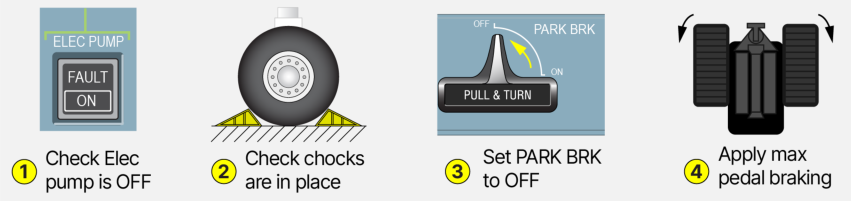
Section titled “Ensuring that the low pressure control circuit is operational”① The flight crew should first check that the blue (A330 & A340-200/300 aircraft) or yellow (A320 family, A300 & A310 aircraft) electrical pump is OFF. ② Then, they should check that the wheel chocks are in position. ③ The flight crew should set the parking brake to OFF. ④ Fully pressing the brake pedals compresses both master cylinders that send hydraulic pressure to open both sides of the dual valve.
(fig.6) Check of the Alternate Braking System (part 1 of 2)
Spongy pedals = air in the low pressure control circuit
Section titled “Spongy pedals = air in the low pressure control circuit”The brake pedals have an artificial feel that requires some force to activate the brakes. If the flight crew feels that the artificial feel is lost while pressing the brake pedals (brake pedals are “spongy”), maintenance action must be performed. This indicates that there is air in the low pressure control system.
Brake pressure must be in the correct range
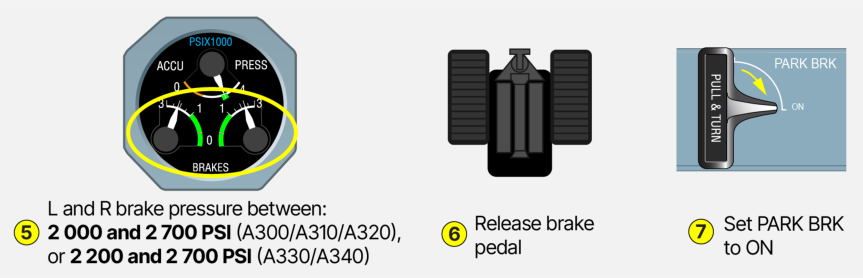
Section titled “Brake pressure must be in the correct range”When the brake pedals are fully pressed, ⑤ the brake pressure must be between 2 000 (or 2 200 PSI) and 2 700 PSI on both sides of the triple pressure indicator. If not, maintenance action must be performed. ⑥ The flight crew must then release the brake pedals and ⑦ set the PARK BRK back to ON, so that they can check the brake wear indicators during the exterior walkaround.
(fig.7) Check of the Alternate Braking System (part 2 of 2)
The check of the alternate braking system before the exterior walkaround of the first flight of the day ensures that the low pressure control circuit accurately transfers the command of the brake pedals to the dual valve.
MAINTENANCE CONSIDERATIONS
Section titled “MAINTENANCE CONSIDERATIONS”Applying the Appropriate Troubleshooting Task
Section titled “Applying the Appropriate Troubleshooting Task”When the flight crew reports a failed check of the alternate system, the appropriate troubleshooting task must be applied, based on the reported symptoms.
Reported loss of artificial feel (spongy pedals)
Section titled “Reported loss of artificial feel (spongy pedals)”If the flight crew reports that one of both pedals feel ‘spongy’, corresponding to a loss of the artificial feel, one of the following tasks should be applied:
-
A320 TSM 32-43-00-810-805-A “Loss of the Pedal Artificial Feel on the Two Sides (Auxiliary Low-Pressure System Failure)”
-
A320 TSM 32-43-00-810-806-A “Loss of the Pedal Artificial Feel on the Right Side (Auxiliary Low-Pressure System Failure)”
-
A320 TSM 32-43-00-810-807-A “Loss of the Pedal Artificial Feel on the left Side (Auxiliary Low-Pressure System Failure)”
-
● A330/A340 TSM 32-43-00-810-802-A “Brakes - Loss of the Brake-Pedal Artificial Feel or Spongy Pedals”
-
● A300/A310 TSM 32-43-00 “Alternate Braking Fault Symptoms”
Brake pressure was not in the correct range
Section titled “Brake pressure was not in the correct range”If the displayed brake pressure was not in the correct range during the test, the following task should be applied:
-
A320 TSM 32-43-00-810-805-A “Loss of the Pedal Artificial Feel on the Two Sides (Auxiliary Low-Pressure System Failure)”
-
A320 TSM 32-43-00-810-806-A “Loss of the Pedal Artificial Feel on the Right Side (Auxiliary Low-Pressure System Failure)”
-
A320 TSM 32-43-00-810-807-A “Loss of the Pedal Artificial Feel on the left Side (Auxiliary Low-Pressure System Failure)”
-
A320 TSM 32-44-00-810-801-A “Loss of the Right Yellow Pressure Indication on the Triple Indicator (Electrical Failure)”
-
A320 TSM 32-44-00-810-802-A - Loss of the Left Yellow Pressure Indication on the Triple Indicator (Electrical Failure)
-
A330/A340 TSM 32-43-00-810-807-A “Brakes - Alternate-Braking Pressures Do Not Get to 2200 psi When Brake Pedals Applied (with Blue Hydraulic System Depressurized)”
-
A300/A310 TSM 32-43-00 “Alternate Braking Fault Symptoms”.
Correct Servicing of the Low Pressure Control Circuit
Section titled “Correct Servicing of the Low Pressure Control Circuit”Each time one or several components of the low pressure control circuit is replaced, the low pressure control circuit must be serviced to ensure:
-
The correct filling of the brake control hydraulic reservoir
-
That there is no air in the low pressure control circuit.
Use of an appropriate filling tool
Section titled “Use of an appropriate filling tool”The use of an appropriate tool to do the servicing of the low pressure control circuit is essential to ensure correct filling.
Slow filling of the low pressure circuit
Section titled “Slow filling of the low pressure circuit”Airbus recommends performing the refilling procedure slowly, to ensure that all the air is removed from the low pressure control circuit. Prefer refiling with an off-aircraft hydraulic source
As a general rule, Airbus recommends using an off-aircraft hydraulic source for the refilling of the low pressure control circuit. These devices have a deaeration function to remove air from the hydraulic fluid.
If the fluid is obtained from the green hydraulic reservoir, maintenance personnel must observe at least a one hour waiting period before starting the refilling procedure. During this hour, no systems powered by green hydraulics should be operated.
Contributors:
Section titled “Contributors:”Xavier Barriola
Section titled “Xavier Barriola”Accident/Incident Investigator Aviation Safety
James Gooding
Section titled “James Gooding”Landing Gear Hydraulics Specialist
Design Office
Mark Johnson
Section titled “Mark Johnson”Landing Gear Systems Principal Engineer Design Office
Maxime Lansonneur
Section titled “Maxime Lansonneur”Director Safety - Training and Flight Operations Customer Support
Mathieu Laussel
Section titled “Mathieu Laussel”Customer Engineering Support Product Leader Customer Support
Pre-flight checks are essential to detect any hidden failure before the flight.
Failing to detect a failure of the alternate braking system during the pre-flight check may lead to a loss of braking situation if combined with a loss of the normal braking during the flight. In this case, the flight crew can only rely on the parking brake to stop the aircraft during the landing roll.
The check of the alternate braking system must be performed on an aircraft equipped with a hydromechanical control system:
-
Before the exterior walkaround of the first flight of the day, or
-
If there is a flight crew change
This includes A300, A310, A330, A340-200/300 aircraft and also A320 family aircraft delivered before 2007 (with the exception of A320 family aircraft delivered between 2005 and 2007 that were already fitted with an electrically controlled alternate braking system).
This check ensures that the low pressure control circuit of the alternate braking system accurately transfers the command of the brake pedals to the dual valve.
The flight crew must make a report to maintenance if:
-
The check indicates ‘spongy’ brake pedals (a loss of the artificial feel in the brakes), or
-
The pressure indicated on the triple pressure indicator is not in the correct range when the brake pedals are fully pressed.
In this case, maintenance action must be performed before the next flight, to restore the correct operation of the alternate braking system.
Maintenance personnel must make sure that the appropriate troubleshooting task is applied on the low pressure control circuit when spongy pedals and/or insufficient alternate braking pressure are reported.
If one of the components of the low pressure control circuit needs to be replaced, maintenance personnel must
-
Make sure that the circuit is serviced to refill the brake control hydraulic reservoir.
-
Remove air from the circuit before returning the aircraft into service.
To do so, the use of appropriate tools is essential.
Safety first, 2026. Safety first is published by Airbus S.A.S. 1, rond point Maurice Bellonte - 31707 Blagnac Cedex/France.
Editor: Yannick Malinge, SVP Head of Aviation Safety.
Editorial team: Guillaume Estragnat, Javier Martinez Marina, Vanessa Sadi, Eliza Pal, Gwyneth Duggan, Agathe Sanz, Bruno Fargeon.
Photos by Airbus.
Section titled “Photos by Airbus.”案例研究 事件描述
Section titled “案例研究 事件描述”在一段3小时42分钟的中转后,一架A330-300的机组正准备执飞一段下午早些时候出发、时长5小时的回程航班,目的地为起飞机场。
绿色液压系统失效
Section titled “绿色液压系统失效”起飞正常。5分钟后,在爬越10800英尺高度时,触发了HYD G SYS LO PR(绿色液压系统低压)和HYD G RSVR LO LVL(绿色储压器低液位)ECAM警告,随后触发了BRAKES NORM BRK FAULT(正常刹车故障)和BRAKES AUTO BRK FAULT(自动刹车故障)ECAM警告。
机组执行了ECAM程序,并在机上维修工程师的协助下评估了情况。他们联系了航空公司的维修控制中心,并商定继续飞往目的地机场——该机场拥有一条长跑道。
机组在巡航阶段检查了所有相关的FCOM程序,并相应地准备了进近:需要使用起落架重力放下,自动刹车不可用,需使用备用刹车系统替代正常刹车系统。
着陆时刹车失效
Section titled “着陆时刹车失效”飞机以CONF FULL(全形态)着陆。接地时,PF选择了MAX REV(最大反推)并踩下全行程刹车脚蹬。由于未感受到减速,PF执行了刹车失效记忆项目,要求PM将A/SKID(防滞)电门置于OFF位。随后PF重新施加脚蹬刹车,但未能成功。最终PF三次施加停机刹车,飞机最终停了下来。
主起落架轮胎爆胎
Section titled “主起落架轮胎爆胎”主起落架所有轮胎均爆胎**(图1)**。主起落架、主起落架舱门、前部放水桅杆和左发动机受损。
(图1) 事件中主起落架所有轮胎爆胎(图片来源于调查委员会)
起飞时存在隐藏的备用刹车故障
Section titled “起飞时存在隐藏的备用刹车故障”记录器数据分析表明,当机组执行备用刹车系统的起飞前检查时,压力仅达到最大416 psi,而非预期的2200至2700 psi之间的值。尽管压力值如此之低,机组仍继续飞行而未寻求维修干预,导致飞机带着备用刹车系统不工作的状态下起飞。
飞行中正常刹车系统失效
Section titled “飞行中正常刹车系统失效”正常刹车系统在飞行中失效是由绿色液压系统故障引起的。右主起落架减震支柱的俯仰调节器作动筒内部过压,导致其活塞杆被挤压损坏,进而造成液压泄漏**(图2)**。
此类俯仰调节器作动筒损坏可能是由起飞机场道面损坏造成的冲击引起的。
(图2) 右主起落架俯仰调节器作动筒可见液压泄漏(照片来源于调查委员会)
已有机身俯仰调节器作动筒的改进方案可防止此类损坏。更多信息请参阅AirbusWorld门户上提供的技术跟进TFU 32.11.00.018。
着陆时刹车失效
Section titled “着陆时刹车失效”起飞前检查期间未被发现的备用刹车系统故障与飞行中正常刹车系统的失效相结合,导致了着陆滑跑时刹车失效。因此,机组在着陆滑跑中只能依靠停机刹车来使飞机停下。
(图3) 起飞前检查期间备用刹车系统压力不足未被检测到,加上飞行中绿色液压系统泄漏导致正常刹车失效,是此次事件的根本原因。
此前备用刹车系统反复出现问题且纠正措施不当
Section titled “此前备用刹车系统反复出现问题且纠正措施不当”对这架飞机维修记录的分析表明,在事件发生前的四个月内,备用刹车系统出现了多次故障**(图4)**。记录了三次机组报告在检查备用刹车系统时右侧刹车压力低的报告,其中包括一次“软绵绵”的右侧刹车脚蹬。
每次的维修措施要么是对轮刹处备用刹车系统的高压管路进行放气,要么是调整刹车储压器的氮气充气压力。这并未解决根本问题。
如果维修人员在收到备用刹车压力低的报告时应用适当的TSM任务(TSM 32-43-00-810-807-A“刹车——在蓝色液压系统释压时刹车脚蹬踩下后备用刹车压力达不到2200 psi”),将有助于维修人员识别并修复该问题。
更换右侧主缸
Section titled “更换右侧主缸”在事件发生前17天,维修人员发现右侧主缸存在泄漏,这可能是此前右侧备用刹车压力低事件的根本原因。该缸已被新件更换。
低压控制管路中进入空气
Section titled “低压控制管路中进入空气”调查发现,备用刹车系统低压控制管路中存在空气,导致事件期间备用刹车系统两侧压力不足。
更换主缸后对低压控制管路进行不正确的维护,很可能是导致空气进入系统的原因。
(图 4) 事件前执行的维护操作序列
备用刹车系统
Section titled “备用刹车系统”空客飞机备用刹车系统有两种类型的控制方式。
液力机械控制
Section titled “液力机械控制”A300、A310、A330、A340-200、A340-300 以及 2007 年前交付的 A320 系列飞机配备了液力机械式备用刹车控制系统。
刹车踏板通过机械方式与两个主缸相连,将踏板位移转换为液压压力,从而驱动双活门 (图 5)。双活门调节来自蓝色(A330、A340-200/300 飞机)或黄色液压系统(A300、A310 及 A320 系列飞机)的液压压力,以驱动刹车活塞。
电动备用刹车控制系统首次应用于 A340-500/600 飞机,空客决定从 2005 年起也逐步为 A320 系列飞机配备这一增强技术(最后一批配备液力机械控制方式的 A320 系列飞机于 2007 年 12 月交付)。
刹车踏板位置信号被传输至刹车与转向控制组件(BSCU)和应急(或备用)刹车控制组件(EBCU 或 ABCU)。
(图 5) A300、A310、A320 系列、A330 和 A340 飞机备用刹车系统的控制方式
运营注意事项
Section titled “运营注意事项”首次飞行前备用刹车系统检查
Section titled “首次飞行前备用刹车系统检查”对于配备液力机械式备用刹车控制系统的飞机,标准操作程序(SOP)要求飞行机组在以下时机检查备用刹车系统:
-
首次飞行当天的初步驾驶舱准备期间,外部绕机检查之前,或
-
飞行机组换班时。
在确认刹车蓄压器压力在三联压力指示器的绿色区域内后执行测试。如果不在绿色区域,飞行机组应将蓝色(A330 和 A340-200/300 飞机)或黄色(A320 系列、A300 和 A310 飞机)电动泵(ELEC PUMP)置于 ON 以补充蓄压器。
对于配备电动控制备用刹车系统的飞机,备用刹车系统的可用性检查是自动执行的。因此,对于这些飞机,SOP 不要求在外部绕机检查前检查备用刹车系统。但是,机队中同时配备液力机械和电动控制两种机型的运营人,可以要求其全体机组人员在所有飞机上手动执行测试,以保持 SOP 的一致性。
确保低压控制管路运行正常
Section titled “确保低压控制管路运行正常”① 飞行机组应首先确认蓝色(A330 和 A340-200/300 飞机)或黄色(A320 系列、A300 和 A310 飞机)电动泵处于 OFF 状态。② 然后确认轮挡已就位。③ 飞行机组应将停留刹车置于 OFF。④ 完全踩下刹车踏板,使两个主缸压缩,向双活门两侧输送液压压力。
(图 6) 备用刹车系统检查(第 1 部分,共 2 部分)
踏板松软 = 低压控制管路中有空气
Section titled “踏板松软 = 低压控制管路中有空气”刹车踏板具有人工感觉,需要一定的力才能启动刹车。如果飞行机组感觉在踩下刹车踏板时人工感觉消失(刹车踏板”松软”),必须执行维护措施。这表明低压控制系统中有空气。
刹车压力必须在正确范围内
Section titled “刹车压力必须在正确范围内”当刹车踏板完全踩下时,⑤ 刹车压力在三联压力指示器的两侧必须在 2,000(或 2,200 PSI)至 2,700 PSI 之间。 如果不在此范围内,必须执行维护措施。⑥ 然后飞行机组必须松开刹车踏板,⑦ 将停留刹车(PARK BRK)重新置于 ON,以便在外部绕机检查期间检查刹车磨损指示器。
(图 7) 备用刹车系统检查(第 2 部分,共 2 部分)
首次飞行当天外部绕机检查前对备用刹车系统进行检查,可确保低压控制管路准确地将刹车踏板指令传递给双活门。
维护注意事项
Section titled “维护注意事项”应用适当的故障排除任务
Section titled “应用适当的故障排除任务”当机组报告备用系统检查失败时,必须根据报告的症状应用适当的故障排除任务。
报告人工感觉丧失(软踏板)
Section titled “报告人工感觉丧失(软踏板)”如果机组报告任一或两个踏板感觉”软”,即人工感觉丧失,应执行以下任务之一:
-
A320 TSM 32-43-00-810-805-A “两侧踏板人工感觉丧失(辅助低压系统故障)”
-
A320 TSM 32-43-00-810-806-A “右侧踏板人工感觉丧失(辅助低压系统故障)”
-
A320 TSM 32-43-00-810-807-A “左侧踏板人工感觉丧失(辅助低压系统故障)”
-
A330/A340 TSM 32-43-00-810-802-A “刹车—刹车踏板人工感觉丧失或软踏板”
-
A300/A310 TSM 32-43-00 “备用刹车故障症状”
刹车压力不在正确范围内
Section titled “刹车压力不在正确范围内”如果在测试过程中显示的刹车压力不在正确范围内,应执行以下任务:
-
A320 TSM 32-43-00-810-805-A “两侧踏板人工感觉丧失(辅助低压系统故障)”
-
A320 TSM 32-43-00-810-806-A “右侧踏板人工感觉丧失(辅助低压系统故障)”
-
A320 TSM 32-43-00-810-807-A “左侧踏板人工感觉丧失(辅助低压系统故障)”
-
A320 TSM 32-44-00-810-801-A “三指示器上右侧黄色压力指示丧失(电气故障)”
-
A320 TSM 32-44-00-810-802-A - 三指示器上左侧黄色压力指示丧失(电气故障)
-
A330/A340 TSM 32-43-00-810-807-A “刹车—踩下刹车踏板时备用刹车压力未达到2200 psi(蓝液压系统释压状态)”
-
A300/A310 TSM 32-43-00 “备用刹车故障症状”。
低压控制回路的正确维护
Section titled “低压控制回路的正确维护”每次更换低压控制回路的一个或多个部件时,必须对该回路进行维护以确保:
-
刹车控制液压油箱的正确加油
-
低压控制回路中无空气
使用适当的加油工具
Section titled “使用适当的加油工具”使用适当的工具对低压控制回路进行维护对于确保正确加油至关重要。
低压回路的缓慢加油
Section titled “低压回路的缓慢加油”空客建议缓慢执行重新加油程序,以确保从低压控制回路中排出所有空气。优先使用机外液压源重新加油
通常,空客建议使用机外液压源对低压控制回路进行重新加油。这些设备具有除气功能,可从液压油中去除空气。
如果液压油来自绿液压油箱,维护人员必须在开始重新加油程序前至少等待一小时。在此期间,不得操作由绿液压系统驱动的任何系统。
Xavier Barriola
Section titled “Xavier Barriola”事故/事件调查员 航空安全
James Gooding
Section titled “James Gooding”起落架液压专家
设计办公室
Mark Johnson
Section titled “Mark Johnson”起落架系统首席工程师 设计办公室
Maxime Lansonneur
Section titled “Maxime Lansonneur”安全总监 - 培训与飞行运营 客户支持
Mathieu Laussel
Section titled “Mathieu Laussel”客户工程支持产品负责人 客户支持
飞行前检查对于在飞行前发现任何隐藏故障至关重要。
如果在飞行前检查中未能检测到备用刹车系统的故障,而飞行中又同时发生正常刹车丧失,则可能导致刹车失效的情况。在这种情况下,机组只能依靠停留刹车在着陆滑跑期间停止飞机。
备用刹车系统的检查必须在装有液压机械控制系统的飞机上进行:
-
在当日首次飞行的外部绕机检查之前,或
-
如果有飞行员更换
这包括 A300、A310、A330、A340-200/300 飞机,以及2007年之前交付的A320系列飞机(2005年至2007年间交付的已装有电控备用刹车系统的A320系列飞机除外)。
此检查确保备用刹车系统的低压控制回路准确地将刹车踏板指令传递到双活门。
如果出现以下情况,机组必须向维护部门报告:
-
检查显示刹车踏板”软”(刹车中人工感觉丧失),或
-
当刹车踏板完全踩下时,三压力指示器上显示的压力不在正确范围内
在这种情况下,必须在下次飞行前执行维护措施,以恢复备用刹车系统的正常工作。
当报告出现软踏板和/或备用刹车压力不足时,维护人员必须确保在低压控制回路上应用了适当的故障排除任务。
如果低压控制回路的某个部件需要更换,维护人员必须
-
确保对回路进行维护以重新加注刹车控制液压油箱
-
在飞机恢复服役前从回路中排出空气
为此,使用适当的工具至关重要。
Safety first, 2026. Safety first is published by Airbus S.A.S. 1, rond point Maurice Bellonte - 31707 Blagnac Cedex/France.
Editor: Yannick Malinge, SVP Head of Aviation Safety.
Editorial team: Guillaume Estragnat, Javier Martinez Marina, Vanessa Sadi, Eliza Pal, Gwyneth Duggan, Agathe Sanz, Bruno Fargeon.
Photos by Airbus.