Management of Overspeed Events in Cruise
Source: Airbus Safety First URL: https://safetyfirst.airbus.com/management-of-overspeed-events-in-cruise/ Published: 2019-06-19 Magazine Issue: 2019-06 Category: Flight Ops PDF: Original PDF


Modern aircraft operate at high altitude and close to their high speed limits. As a consequence, temporary overspeed events can occur in cruise in changing wind conditions.
The analysis of in-service data shows the need to remind the appropriate techniques to manage such temporary overspeed and avoid potential signifi cant trajectory deviation.
This article therefore recalls the aircraft capabilities to cope with overspeed and the recommended techniques to safely prevent and manage overspeed conditions in cruise.
FLIGHT DATA ANALYSIS
Section titled “FLIGHT DATA ANALYSIS”Airbus studied the data provided by Operators for over a million of fl ights to gain an insight into overspeed management in actual operational conditions.
This study indicates that there is about one VMAX exceedance every 1 400 fl ights, which demonstrates that overspeed events occur frequently. Temporary overspeed scenarios are more often occurring in the cruise phase where the aircraft can be subject to changing wind conditions.
Temporary overspeed excursions often happen in cruise phase where the aircraft can be subject to changing wind conditions
Managing overspeed: the importance of applying recommended techniques
Section titled “Managing overspeed: the importance of applying recommended techniques”Analysis showed that the handling of overspeed is not always done in accordance with the recommended techniques provided by the Flight Crew Techniques Manual (FCTM). Focusing on the fl ights with VMAX exceedance, the following can be highlighted:
Numerous manual autopilot disconnections
Section titled “Numerous manual autopilot disconnections”In 25% of these fl ights, fl ight crew disconnects the autopilot and takes over control of the aircraft.
Several cases of abrupt and large control inputs during manual takeover leading to a signifi cant altitude deviation were reported to Airbus.
No reduction of speed target
Section titled “No reduction of speed target”In 30% of these fl ights, speed target is not reduced to increase margins when approaching VMAX.
No use of speedbrakes
Section titled “No use of speedbrakes”In 60% of these fl ights speedbrakes are not used to prevent or manage the overspeed.
AIRCRAFT CAPABILITIES
Section titled “AIRCRAFT CAPABILITIES”In cruise, VMO/MMO provides a signifi cant margin to design limits
Section titled “In cruise, VMO/MMO provides a signifi cant margin to design limits”All Airbus aircraft are designed and tested to be safe to fl y up to design limit speed, which is a value with margin well above VMO/MMO at cruising altitude. (Refer to the Safety First article « Control Your Speed in Cruise », published in 2016). There is therefore no need to rush in taking over manually when the aircraft reaches VMO/MMO.
Autopilot is robust to overspeed
Section titled “Autopilot is robust to overspeed”The AP will remain engaged throughout most of the overspeed events encountered in cruise.
The AP will remain engaged throughout most of the overspeed events encountered in cruise
The AP will only automatically disconnect if there is a large or prolonged VMO/MMO exceedance.
Keeping the AP and A/THR ON in the case of an overspeed event minimizes altitude excursion and reduces the crew workload
On fly-by-wire aircraft, when the aircraft is in overspeed situation, as long as the autopilot is engaged, the High Speed Protection (HSP) is not active and the AP flight objectives remain unchanged. The autopilot will automatically disconnect if the HSP activates. The HSP will command the appropriate pitch up input.
Inspection following an overspeed event
Section titled “Inspection following an overspeed event”Aircraft inspection is only required when the speed exceeds VMO by 20 kt (or MMO+0.02 for A330/A340 aircraft and MMO+0.04 for A320 family). There have been no findings reported following inspections performed after overspeed events on Airbus fly-by-wire aircraft.
RECOMMENDED TECHNIQUES
Section titled “RECOMMENDED TECHNIQUES”The Flight Crew Techniques Manual (FCTM) provides efficient techniques to prevent and recover from an overspeed situation.
Overspeed Prevention Technique
Section titled “Overspeed Prevention Technique”The following overspeed prevention techniques must be applied in the case of significant speed variations close to VMO/MMO:
Keep autopilot and autothrust ON
Section titled “Keep autopilot and autothrust ON”The autopilot maintains the aircraft on the intended flight path and the autothrust will automatically command idle thrust.
That is why keeping the autopilot and autothrust ON during an overspeed event minimizes altitude excursion and reduces crew workload.
Select a lower speed target
Section titled “Select a lower speed target”Selection of a lower speed target increases the margin to VMO/MMO. The selected speed must remain above Green Dot speed to avoid any speed decay.
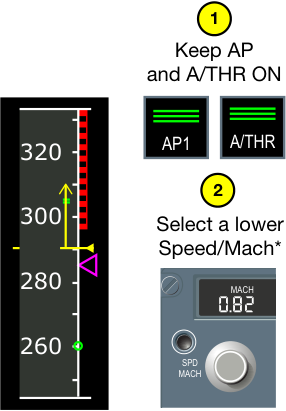
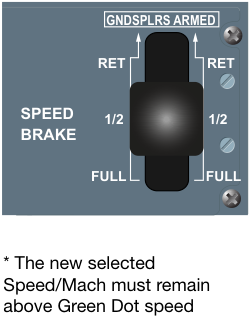
Monitor the speed trend arrow and use speedbrakes if necessary
Section titled “Monitor the speed trend arrow and use speedbrakes if necessary”At any time, when the speed trend arrow approaches or exceeds VMO/MMO, the flight crew should use the speedbrakes to decelerate the aircraft.
The use of speedbrakes is the most efficient way to decelerate the aircraft without destabilizing its trajectory.
On A380, when autopilot and autothrust are engaged, the speedbrakes automatically extend in cruise above VMO-5 kt. Refer to FCOM and FCTM for more information.
The use of speedbrakes is the most efficient way to decelerate the aircraft without destabilizing the aircraft trajectory
Overspeed Recovery Technique
Section titled “Overspeed Recovery Technique”The flight crew must apply the Overspeed Recovery Technique if the speed exceeds VMO/MMO.
Keep autopilot and autothrust ON
Section titled “Keep autopilot and autothrust ON”The autopilot being robust to overspeed situation, the flight crew must not disconnect manually the autopilot and autothrust in the case of an overspeed situation. Manual takeover should be limited to the cases where the HSP activates and automatically disconnects the autopilot.
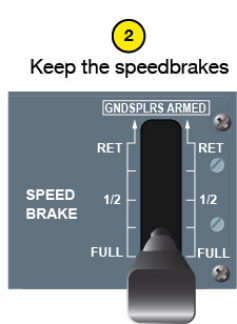
Use the speedbrakes
Section titled “Use the speedbrakes”The use of speedbrakes will reduce the VMAX exceedance and duration. Using speedbrakes can help to prevent reaching the speed threshold that causes HSP to activate and the autopilot to disconnect.
For A350, the speed brakes fully extend at VMO+5 kt automatically, regardless of the position of the SPEED BRAKES lever. Refer to the FCOM/FCTM for more information.
Monitor IDLE thrust on the Engine/Warning Display (E/WD)
Section titled “Monitor IDLE thrust on the Engine/Warning Display (E/WD)”The flight crew should monitor that the autothrust commands idle thrust on the E/WD or set the thrust levers to idle if the autothrust is disconnected.
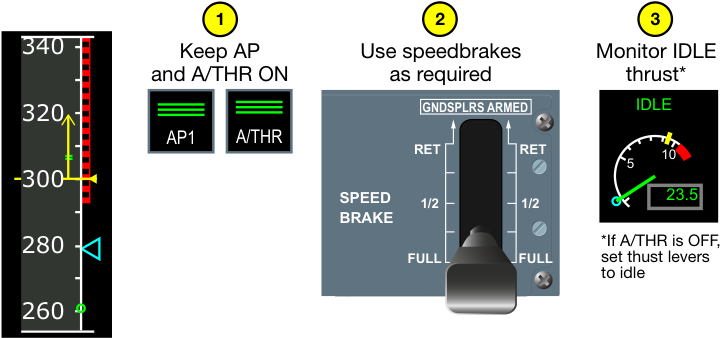
(fig.2)
Section titled “(fig.2)”Overspeed Recovery technique
What to do if the HSP activates and disconnects the autopilot?
Section titled “What to do if the HSP activates and disconnects the autopilot?”On fly-by-wire aircraft, the autopilot may automatically disconnect due to the activation of the HSP. In this case, the aircraft reverts in manual flight with the HSP active. The HSP is designed to target VMO or MMO stick free and to limit the excursion beyond VMO/MMO when a full forward stick input is applied. When the Mach or speed decreases close to VMO/MMO, the HSP protection deactivates, the aircraft remaining in manual flight mode.
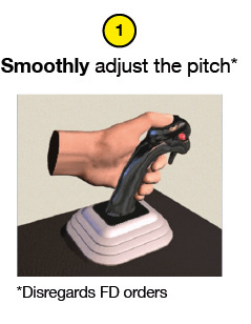
In case of automatic autopilot disconnection due to the HSP, the fl ight crew can smoothly adjust the pitch attitude but without overreacting, especially at high altitude and should keep speed brakes extended because they are compatible with HSP.
If AP disconnection due to HSP activation:
Always apply smooth control inputs
(fi g.3)
Section titled “(fi g.3)”Actions to be taken after an AP disconnection due to HSP activation
What to do after an overspeed recovery?
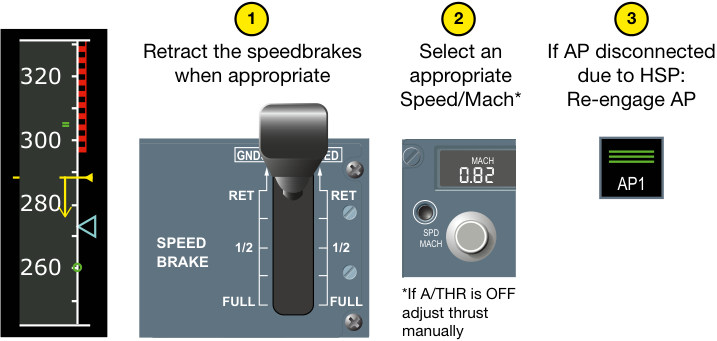
Section titled “What to do after an overspeed recovery?”Once the aircraft’s speed decreases below VMO/MMO, the fl ight crew should apply the following steps:
Retract the speed brakes when appropriate
Section titled “Retract the speed brakes when appropriate”Retracting the Speedbrakes too early could lead to re-occurence of the VMO/MMO exceedance, but retracting too late may cause speed decay.
Adjust the speed target as necessary
Section titled “Adjust the speed target as necessary”The fl ight crew should adjust the speed target to increase the margin to VMO/MMO if the risk of overspeed due to the external conditions remains, but ensure the speed target is set above Green Dot speed. If the autothrust is OFF, the fl ight crew should manually adjust thrust levers and engage autothrust.
Re-engage autopilot if it was disconnected
Section titled “Re-engage autopilot if it was disconnected”If AP was previously disconnected due to HSP, the fl ight crew should recover the fl ight path smoothly and re-engage the AP.
CONTRIBUTORS:
Section titled “CONTRIBUTORS:”Panxika CHARALAMBIDES Incident/Accident Investigator Product Safety
Gilbert SAVARY
Section titled “Gilbert SAVARY”Head of Flight Operations Support and Training Standard pilots group
Overspeed scenarios often occur in cruise due to changing wind conditions. Applying the recommended overspeed prevention and recovery techniques from the FCTM reduces the risk of aircraft’s altitude variation and minimizes the flight crew’s workload when managing overspeed events.
On Airbus aircraft the autopilot is designed to cope with temporary overspeed situations. The High Speed Protection will disconnect the autopilot and provide optimum pitch up command to slow the aircraft only in the case of a large and prolonged overspeed. Flight Crews should not manually disconnect the autopilot in anticipation of High Speed Protection activation.
In the case of AP disconnection following HSP activation, the flight crew must apply smooth pitch inputs to avoid sudden inappropriate and excessive control inputs with their inherent consequences on the aircraft trajectory.
Keeping the autopilot and autothrust ON, combined with an optimal use of speedbrakes, enables a smooth and safe recovery of an overspeed event in cruise.
Safety fi rst, #28 June, 2019. Safety first is published by Airbus S.A.S. - 1, rond point Maurice Bellonte - 31707 Blagnac Cedex/France. Publisher and Editor: Yannick Malinge, Chief Product Safety Officer. Concept Design by Airbus Multi Media Studio 20190588. Reference: X00D16031905 Issue 28. Photos by S. Ramadier.
来源: Airbus Safety First 网址: https://safetyfirst.airbus.com/management-of-overspeed-events-in-cruise/ 发布日期: 2019-06-19 期刊期号: 2019-06 类别: 飞行运营 PDF: 原始 PDF
现代飞机在高空飞行,接近其高速限制。因此,在巡航阶段遇到风向变化时,可能会发生临时超速事件。
通过对运行数据的分析,发现有必要提醒飞行机组采用适当的技术来管理此类临时超速事件,避免潜在的显著轨迹偏差。
本文旨在回顾飞机应对超速的能力,以及在巡航阶段安全预防和管理超速状况的推荐技术。
飞行数据分析
Section titled “飞行数据分析”空中客车研究了运营人提供的超过一百万次飞行的数据,以深入了解实际运行条件下的超速管理情况。
该研究表明,大约每 1400 次飞行会发生一次 VMAX 超限,这表明超速事件频繁发生。临时超速情况更常发生在巡航阶段,此时飞机可能受到风向变化的影响。
临时超速超限通常发生在巡航阶段,此时飞机可能受到风向变化的影响
管理超速:应用推荐技术的重要性
Section titled “管理超速:应用推荐技术的重要性”分析表明,超速的处理并不总是按照《飞行机组技术手册》(FCTM) 提供的推荐技术进行。针对 VMAX 超限的飞行,可突出以下几点:
大量人工断开自动驾驶
Section titled “大量人工断开自动驾驶”在这些飞行的 25% 中,飞行机组断开了自动驾驶并手动接管飞机控制。
据空中客车报告,有多起案例显示在人工接管过程中出现剧烈和大幅度的控制输入,导致显著的高度偏差。
未降低速度目标
Section titled “未降低速度目标”在这些飞行的 30% 中,当接近 VMAX 时未降低速度目标以增加余度。
未使用减速板
Section titled “未使用减速板”在这些飞行的 60% 中,未使用减速板来预防或管理超速。
在巡航中,VMO/MMO 为设计限制提供了显著的余度
Section titled “在巡航中,VMO/MMO 为设计限制提供了显著的余度”所有空中客车飞机均经过设计和测试,在设计限制速度以下飞行是安全的,该值在巡航高度远高于 VMO/MMO。(参阅 2016 年发表的《控制你的巡航速度》Safety First 文章)。因此,当飞机达到 VMO/MMO 时,无需急于人工接管。
自动驾驶对超速具有稳健性
Section titled “自动驾驶对超速具有稳健性”自动驾驶在巡航中遇到的大多数超速事件期间将保持接通。
自动驾驶在巡航中遇到的大多数超速事件期间将保持接通
只有在大跨度或持续 VMO/MMO 超限时,自动驾驶才会自动断开。
在超速事件中保持自动驾驶和自动推力接通,可将高度偏移降至最低并减少机组工作负荷
在电传操纵飞机上,当飞机处于超速状况时,只要自动驾驶接通,高速保护 (HSP) 不会启动,自动驾驶的飞行目标保持不变。高速保护启动时自动驾驶将自动断开。高速保护将指令适当的抬头输入。
超速事件后的检查
Section titled “超速事件后的检查”只有当速度超过 VMO 20 节时(或对于 A330/A340 飞机超过 MMO+0.02,对于 A320 系列飞机超过 MMO+0.04)才需要进行飞机检查。据报告,在空中客车电传操纵飞机上超速事件后进行的检查中,未发现任何问题。
《飞行机组技术手册》(FCTM) 提供了预防和处置超速状况的有效技术。
超速预防技术
Section titled “超速预防技术”在接近 VMO/MMO 发生显著速度变化时,必须采用以下超速预防技术:
保持自动驾驶和自动推力接通
Section titled “保持自动驾驶和自动推力接通”自动驾驶保持飞机在预期的飞行轨迹上,自动推力将自动指令慢车推力。
因此,在超速事件中保持自动驾驶和自动推力接通,可将高度偏移降至最低并减少机组工作负荷。
选择较低的速度目标
Section titled “选择较低的速度目标”选择较低的速度目标可增加相对于 VMO/MMO 的余度。所选速度必须保持在绿点速度以上,以避免速度衰减。
监控速度趋势箭头并在必要时使用减速板
Section titled “监控速度趋势箭头并在必要时使用减速板”任何时候,当速度趋势箭头接近或超过 VMO/MMO 时,飞行机组应使用减速板减速。
使用减速板是在不使飞机轨迹失稳的情况下减速的最有效方法。
在 A380 上,当自动驾驶和自动推力接通时,减速板在巡航中超过 VMO-5 节时会自动伸出。更多信息请参阅 FCOM 和 FCTM。
使用减速板是在不使飞机轨迹失稳的情况下减速的最有效方法
超速改出技术
Section titled “超速改出技术”如果速度超过 VMO/MMO,飞行机组必须执行超速改出技术。
保持自动驾驶仪和自动推力接通
Section titled “保持自动驾驶仪和自动推力接通”由于自动驾驶仪能够承受超速情况,在超速情况下飞行机组不得手动断开自动驾驶仪和自动推力。手动接管应仅限于 HSP 接通并自动断开自动驾驶仪的情况。
使用减速板可以减少 VMAX 超限的程度和持续时间。使用减速板有助于防止达到导致 HSP 接通和自动驾驶仪断开的速度阈值。
对于 A350,当速度达到 VMO+5 kt 时,减速板会自动完全伸出,无论 SPEED BRAKES 操纵杆的位置如何。更多信息请参阅 FCOM/FCTM。
监控发动机/警告显示(E/WD)上的慢车推力
Section titled “监控发动机/警告显示(E/WD)上的慢车推力”飞行机组应监控自动推力是否在 E/WD 上指令慢车推力,或者如果自动推力已断开,则应将推力手柄设置为慢车。
超速改出技术
如果 HSP 接通并断开自动驾驶仪,该怎么办?
Section titled “如果 HSP 接通并断开自动驾驶仪,该怎么办?”在电传操纵飞机上,自动驾驶仪可能由于 HSP 接通而自动断开。在这种情况下,飞机恢复手动飞行且 HSP 处于工作状态。HSP 旨在将目标速度控制在 VMO 或 MMO 无杆状态,并在施加全向前驾驶杆输入时限制超出 VMO/MMO 的程度。当马赫数或速度降至接近 VMO/MMO 时,HSP 保护解除,飞机保持在手动飞行模式。
如果因 HSP 导致自动驾驶仪自动断开,飞行机组可以平滑地调整俯仰姿态,但不要反应过度,尤其是在高高度,并且应保持减速板伸出,因为减速板与 HSP 兼容。
如果因 HSP 接通而导致 AP 断开:
始终采用平滑的操纵输入
HSP 接通导致 AP 断开后应采取的措施
超速改出后该怎么办?
Section titled “超速改出后该怎么办?”一旦飞机速度降至 VMO/MMO 以下,飞行机组应执行以下步骤:
在适当时机收上减速板
Section titled “在适当时机收上减速板”过早收上减速板可能导致 VMO/MMO 再次超限,但收上过晚可能导致速度衰减。
必要时调整速度目标
Section titled “必要时调整速度目标”如果由于外部条件仍存在超速风险,飞行机组应调整速度目标以增加与 VMO/MMO 的裕度,但应确保速度目标设置在绿点速度之上。如果自动推力已关闭,飞行机组应手动调整推力手柄并接通自动推力。
如果自动驾驶仪已断开,请重新接通
Section titled “如果自动驾驶仪已断开,请重新接通”如果 AP 之前因 HSP 断开,飞行机组应平滑地恢复飞行轨迹并重新接通 AP。
Panxika CHARALAMBIDES 事故/事故调查员,产品安全
Gilbert SAVARY
飞行运行支援与培训标准飞行员组负责人
超速场景通常在巡航阶段由于风条件变化而发生。应用 FCTM 中建议的超速预防和改出技术可降低飞机高度变化的风险,并在管理超速事件时最大限度地减少飞行机组的工作量。
在空客飞机上,自动驾驶仪的设计能够应对暂时超速情况。高速保护仅在出现严重且持续的超速时才会断开自动驾驶仪并提供最佳的抬杆俯仰指令以减速飞机。飞行机组不应在预期高速保护接通之前手动断开自动驾驶仪。
在因 HSP 接通导致 AP 断开的情况下,飞行机组必须采用平滑的俯仰输入,以避免突然不恰当的过量操纵输入及其对飞机轨迹的固有后果。
保持自动驾驶仪和自动推力接通,结合最佳使用减速板,能够实现巡航中超速事件的平滑安全改出。
Safety first, #28 2019 年 6 月。Safety first 由空客 S.A.S. 出版 - 1, rond point Maurice Bellonte - 31707 布拉尼亚克/法国。出版人和编辑:首席产品安全官 Yannick Malinge。概念设计:空客多媒体工作室 20190588。参考编号:X00D16031905 第 28 期。照片由 S. Ramadier 提供。