A320 - Runway overrun
Source: Airbus Safety First URL: https://safetyfirst.airbus.com/a320-runway-overrun/ Published: 2008-07-29 Magazine Issue: 2008-07 Category: Archive PDF: Original PDF
A320/ Runway overrun
Section titled “A320/ Runway overrun”By: Marc BAILLION Flight Safety Director
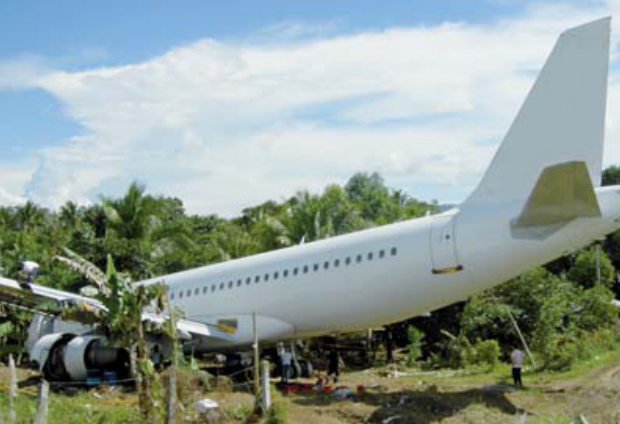
It stopped approximately 200 meters beyond the runway limit and the 156 occupants were able to evacuate the plane safely. There was no post impact fire, but the aircraft suffered a hull loss.
1 Introduction
Section titled “1 Introduction”The following sequence of events has been retrieved from the DFDR and CVR. Data from the latter is incomplete as the Captain’s voice was not audible.
Flight conditions at 4 700ft :
Section titled “Flight conditions at 4 700ft :”Runway excursions, together with Controlled Flight Into Terrain (CFIT), are one of the main categories of incidents and accidents. In the last two years, ten runway excursions were reported to Airbus. This article will describe on of these occurrences, where the aircraft was damaged beyond economical repair
The root causes of this event are common to many other runway excursions, and it is therefore worthwhile to share the lessons learned from this accident and to repeat the following key safety messages:
• Fly stabilized approaches
The aircraft was performing a visual approach. Gross weight was 64t (Max landing weight is 64.5t) Configuration clean (Slat 0° / Flaps 0°) with landing gears up and locked.
Autopilot 1 was engaged in DES (longitudinal mode) and NAV (lateral mode). Both Flight Directors (FD) were engaged. ATHR was engaged in thrust mode. Captain was the Pilot Flying (PF).
Selected altitude on FCU was 3 000ft. Aircraft heading was 155°.
• Be go-around minded
2 Descri tion p of the event
Section titled “2 Descri tion p of the event”Wind speed was 23kt, and wind direction 300°. This resulted in a 20kt tailwind and a 13kt right crosswind.
Speed target was managed by the FMGC and was equal to 285kt. CAS was 306kt Vapp = 138kt
An A320 performed a visual approach to a runway 12. The aircraft landed at 6h23’ local time and overran the end of the 1966 meter long runway at a speed of approximately 85kt.
Approach
Section titled “Approach”Approaching 3 000ft, The crew contacted ATC :
-
F/O : “… approaching 10 DME 3 000”
-
ATC : Roger and wind is calm. Report finals runway 12”.
-
F/O : “Check finals runway 12 …”.
As the aircraft approached 3 000ft, the A/P vertical mode changed to Altitude Acquire (ALT*) then to Altitude Hold (ALT). The ATHR changed to speed mode.
The A/P vertical mode was then changed to Flight Path Angle (FPA), with a selected –3° FPA target. The aircraft descended accordingly.
The selected FPA was then changed to 0° and the aircraft leveled off at 2 800ft RA. The crew selected configuration 1[1] and, 3 seconds later, landing gears down.
The crew armed the ground spoilers, and the selected FPA was successively changed to –3.6°, then to –5.5° and –7° after having selected configuration 2[2] at about 2 600ft RA (CAS was 198kt ; VFE = 200kt).
The F/O announced “Still high” and immediately after “Too close”.
At 2 300ft RA, the Captain disconnected the A/P and disengaged both FD. ATC announced “Wind is calm[3] , cleared to land runway 12”.
At 1 600ft RA, configuration 3[4] was selected (CAS was 186kt; VFE = 185kt).
At about 1 150ft RA, during the LH turn to intercept the runway centerline, configuration FULL[5] was selected (CAS was 170kt; VFE = 177kt) and within about one second, speedbrake lever was pushed aft to command extension. To do that, the crew disarmed the ground spoilers.
The F/O announced “High speed he” and immediately after “Let’s circle again it’s too high” followed by “High”.
Slats and flaps surfaces reached the position FULL about 3s after the crew selected this configuration. Speedbrakes started to retract (speedbrakes are inhibited in configuration FULL on A320).
A Single Chime (SC) sounded, which corresponds to the “SPD BRK DISAGREE” caution, triggered because of the difference between the actual position of the speedbrakes (retracted) versus the commanded position (extended).
The speedbrake lever remained in the extended position until the end of recorded data. The ground spoilers were not rearmed.
The Captain then pushed the stick and increased the rate of descent up to 1 900ft/min.
At 600ft RA the EGPWS alarm “Sink Rate” triggered and sounded twice.
The Captain decreased the nose-down pitch from –6.5° to –2.5°. The aircraft rate of descent decreased.
At 500ft RA CAS was approximately 170kt (Vapp+ 32), and the rate of descent was about 1 800ft/min.
F/O said “Our speed is too high. We can make another circuit. How about that”. The Captain continued the approach.
1 Configuration 1: Slats 18° / Flaps 0°
2 Configuration 2: Slats 22° / Flaps 15°
3 The wind information was not reliable because the wind indication system had been out of order for several months. A NOTAM had been issued, but the crew was not aware.
Both brake pedals were kept pressed while Autobrake mode selection was changed to MAX.
This had no effect because the Autobrake was not activated.
Landing
Section titled “Landing”At 200ft RA the wind characteristics were: 11kt tailwind and 6kt crosswind from the left.
At 170ft RA, Autobrake MED was selected.
At about 150ft RA, the EGPWS alarm “Sink Rate” triggered and sounded twice.
The Captain pulled the stick and adjusted the pitch from –2.5° nose down to +1° nose up (reached at about 50ft). The aircraft rate of descent decreased.
At approximately 50ft RA, both thrust levers were retarded to idle. CAS was 159kt (Vapp + 21).
The aircraft flew over the runway 12 threshold, at a height of 35ft.
F/O called out “Speed”.
The Captain then pulled full back stick and the thrust levers were set to TOGA for about 2s (while the aircraft was 316 meters from the runway end) and back to idle.
CAS was approximately 113kt.
The brake pedals were slightly released, and then were fully pressed again[7].
The aircraft left the runway at a ground speed of approximately 85kt, crossed a field, descended a steep gradient and came to a stop in some trees.
3 Key Points
Section titled “3 Key Points”-
The aircraft was performing a visual approach to the 1 966m long runway 12, with A/P1 and both FD engaged.
-
A/P was disconnected at 2 300ft RA.
The aircraft floated above the runway during 9s and both main landing gears touched down at about 740m beyond the runway 12 threshold (1 226m of runway left), CAS was 150kt (Vapp+12). The aircraft bounced and touched down again at 1 070m beyond the runway threshold (896m of runway left). CAS was 146kt (Vapp+8), ground speed was 158kt.
Both brake pedals were fully pressed and the aircraft longitudinal deceleration reached 0.3g.
The thrust levers remained at idle and no reverser thrust was selected.
Note: Pressing the brake pedals normally deactivates the Autobrake. Here, the Autobrake did not activate since the ground spoilers did not deploy as they had been disarmed upon speedbrake selection. Ground spoilers, even disarmed, extend at touchdown at reverser thrust selection. However, as mentioned above, in this event reverser thrust was not selected.
4 Configuration 3 : Slats 22° / Flaps 20°
5 Configuration FULL: Slats 27° / Flaps 35°
6 Spoilers 2 to 4 act as speed brakes
-
At about 1 200ft RA, during left final turn, configuration FULL was selected and immediately after, speed brake lever was pushed aft. This disarmed the ground spoilers.
-
At 500ft RA, CAS was approximately 170kt (Vapp+32) and the rate of descent was about 1 800ft/min.
-
The approach was never stabilized.
-
The aircraft first touched down at 740m from the runway threshold (1 226m left), CAS was 150kt (Vapp+12).
-
The second touch down occurred at about 1 070m from the runway threshold (896m left), CAS was 146kt (Vapp+8).
-
Both thrust levers remained at idle. No thrust reverser was selected.
-
The crew performed manual braking, deceleration rate reached 0.3g.
-
The aircraft left the runway at about 85kt.
Note : With ground spoilers deployed at touch down without reversers, the aircraft would have stopped at about 350m before the runway end
(400m if reversers had been selected).
7 Since CAPT and F/O brake pedals are mechanically linked, the DFDR does not allow to determine who actually pressed on the pedals.
4 Lessons learned
Section titled “4 Lessons learned”4.1 Stabilized approach
Section titled “4.1 Stabilized approach”The approach was never stabilized.
An unstabilized approach may result from an inappropriate evaluation of the situation and inadequate time management to plan, prepare and execute the approach.
This adequate preparation should be done through briefings, which are safety nets to ensure:
-
Shared evaluation of the situation and setting of common objectives.
-
A clear definition of the tasks and task sharing to be performed.
-
A mutually agreed action plan, which includes preparing a go-around strategy if, for unexpected reasons, the approach has to be aborted.
During the approach, the crew should then monitor flight parameters and external conditions carefully in order to detect deviations from the planned approach, as even small deviations may lead to reduced safety margins.
FCOM 3.03.20 p.1, Visual Approach, indicates: “Perform the approach on a nominal 3-degree glideslope using visual references. Approach to be stabilized by 500 feet AGL on the correct approach path, in the landing configuration, at VAPP.”
In addition, the Visual Approach SOP contained in FCOM 3.03.20 indicates : “Have the aircraft stabilized by 500 feet AGL, on the correct approach path at VAPP (or ground speed mini) with the appropriate thrust applied. If not stabilized, a go-around should be considered.”
A go-around should be considered as well when confusion exists about :
-
The use of automation
-
The aircraft’s response
-
4.3 Ground spoilers, thrust reversers and auto brake
The ground spoilers were disarmed when the crew selected the speed brakes.
At touch down, the PF did not select the reversers and the PNF did not check the ground spoilers extension nor the reversers deployment.
Airbus recommends adherence to the SOP in FCOM 3.03.22. p5/6. The touchdown procedures have been revised in June 2008 (REV 42) to include, among other modifications, notes reminding crews that:
-
If ground spoilers are not armed, ground spoilers extend at reverser thrust selection on both engines.
-
• Autobrake is inhibited if the ground spoilers do not extend.
The revised touchdown procedures are shown hereafter:
4.2 Be go-around minded
Section titled “4.2 Be go-around minded”The Flight Crew Training Manual 02.070 Approach Briefing reads as follows :
“The crew must be ready mentally for go-around at any stage of the approach. Should a failure occur above 1 000 ft RA, all ECAM actions (and DH amendment if required) should be completed before reaching 1 000 ft RA, otherwise a go-around should be initiated. This ensures proper task sharing for the remainder of the approach. Any alert generated below 1 000 ft should lead to a go-around.“
|---|---|---|
* At touchdown :
Section titled “* At touchdown :”− REV … .
Section titled “− REV … .”REV … … … … … … … … … … … … … … … . MAX. Select MAX REV immediately after the main landing gear touches down. If the airport regulations restrict the use of thrust reversers, select and maintain the thrust levers in reverse idle position until taxi speed is reached. A slight pitch up that can be easily controlled by the pilot, may occur when the thrust reversers are deployed before the nose landing gear touches down. Lower the nosewheel without undue delay. . The PNF continues to monitor the attitude. . In the case of an engine failure, the use of the remaining thrust reverser is recommended. . Braking may begin before the nosewheel has touched down, if required for performance reasons. However, when comfort is the priority, the flight crew should delay braking until the nosewheel has touched down. During rollout, the flight crew should avoid sidestick inputs (either lateral or longitudinal). If directional control problems are encountered, the flight crew should reduce thrust to reverse idle until directional control is satisfactory. . After reverse thrust is selected, the flight crew must perform a full stop landing.
R − GROUND SPOILERS … … … … … … … … . CHECK/ANNOUNCE R Check that the ECAM WHEEL page displays the ground spoilers extended after R touchdown. R . If no ground spoilers are extended : R −Verify and confirm that both thrust levers are set to IDLE or REV detent R −Set both thrust reverser levers to REV MAX, and fully press the brake pedals. R Note : If ground spoilers are not armed, ground spoilers extend at reverser thrust R selection. R − REVERSERS … … … … … … … … … … . CHECK/ANNOUNCE R Check that the ECAM E/WD page displays that the reverse deployment is as R expected (REV green). − DIRECTIONAL CONTROL … … … … … … … … … … ENSURE. Use rudder pedals for directional control. . Do not use the nosewheel steering control handle before reaching taxi speed. − BRAKES … … … … … … … … … … … … … . AS RQRD. Monitor the autobrake, if it is on. When required, brake with the pedals. . Although the green hydraulic system supplies the braking system, if pedals are pressed rapidly, a brake pressure indication appears briefly on the BRAKE PRESS indicator. R Note : If no ground spoilers are extended, the autobrake is not activated.
5 Conclusion
Section titled “5 Conclusion”This event illustrates the need to prepare each approach and to perform an adequate briefing, which will help the crews in:
-
The execution of a stabilized approach
-
The recognition of the need to carry out a timely go-around
-
The performance of a safe go-around
Runway excursions remains a major category of incidents and accidents. Avoiding them requires following two golden rules :
This message is essential as insufficient preparation of the approach and/or minor deviations in the flight path may result in major safety consequences.
Airbus also recommends giving consideration to the Flight Operation Briefing Notes (FOBN)
“Flying Stabilized Approach”, FOBN “Descent and Approach Profile Management” and FOBN “Aircraft Energy Management during Approach”. The Flight Operation Briefing Notes are available on the Airbus website at the following address and can be downloaded at:
http://www.airbus.com/en/corporate/ethics/safety_lib/
-
Fly stabilized approaches
-
Be go-around minded
Source: Airbus Safety First URL: https://safetyfirst.airbus.com/a320-runway-overrun/ Published: 2008-07-29 Magazine Issue: 2008-07 Category: Archive PDF: Original PDF
A320/跑道冲出
Section titled “A320/跑道冲出”By: Marc BAILLION 飞行安全总监
飞机在距离跑道末端约200米处停止,156名机上人员安全撤离。未发生撞击后起火,但飞机遭受了全损。
以下事件过程已从 DFDR 和 CVR 中获取数据。由于机长声音无法听清,CVR 数据不完整。
4700ft 飞行条件:
Section titled “4700ft 飞行条件:”跑道冲出,连同可控飞行撞地(CFIT),是事故和事故征候的主要类别之一。在过去两年中,空客收到十起跑道冲出报告。本文将描述其中一起事件,飞机受损已无经济修复价值。
该事件的根本原因与许多其他跑道冲出事故相同,因此有必要分享此次事故的经验教训,并重申以下关键安全信息:
• 执行稳定进近
飞机执行目视进近。起飞重量为64吨(最大着陆重量为64.5吨)。光洁形态(缝翼0°/襟翼0°),起落架收上并锁好。
自动驾驶仪1已接通,纵向模式为 DES(下降),横向模式为 NAV。两部飞行指引仪(FD)均已接通。自动推力(ATHR)已接通在推力模式。机长为操纵飞行员(PF)。
FCU 选择高度为3000ft。飞机航向为155°。
• 保持复飞意识
2 事件描述
Section titled “2 事件描述”风速23节,风向300°。导致20节顺风和13节右侧正侧风。
速度目标由 FMGC 管理,等于285kt。CAS 为306kt,Vapp = 138kt。
一架 A320 执行目视进近,使用12号跑道。飞机于当地时间6时23分着陆,在1966米长的跑道上以约85节的速度冲出终点。
接近3000ft时,机组联系 ATC:
-
副驾驶:”… 接近10 DME 3000”
-
ATC:“收到,风已平静。报告五边,12号跑道”。
-
副驾驶:“确认五边,12号跑道”。
当飞机接近3000ft时,A/P 垂直模式从高度获取(ALT*)变为高度保持(ALT)。ATHR 变为速度模式。
随后 A/P 垂直模式更改为航迹角(FPA),选择目标 -3° FPA。飞机随之下降。
所选 FPA 更改为0°,飞机在2800ft RA 平飞。机组选择形态1[1],3秒后放起落架。
机组预位地面扰流板,所选 FPA 在约2600ft RA 选择形态2[2]后依次更改为 -3.6°、-5.5° 和 -7°(CAS 为198kt;VFE = 200kt)。
副驾驶宣布”仍然偏高”,紧接着”太近了”。
在2300ft RA,机长断开 A/P 并脱开两部 FD。ATC 宣布”风已平静[3],可以着陆12号跑道”。
在1600ft RA,选择形态3[4](CAS 为186kt;VFE = 185kt)。
在约1150ft RA,左转切入跑道中线时,选择 FULL 形态[5](CAS 为170kt;VFE = 177kt),并在约一秒内将减速板手柄向后推以指令伸出。为此,机组脱开了地面扰流板。
副驾驶宣布”高速偏高”,紧接着”让我们复飞吧,太高了”,随后又说”高”。
缝翼和襟翼在机组选择该形态约3秒后到达 FULL 位置。减速板开始收起(在 A320 FULL 形态下减速板被抑制)。
响起一声单音(SC),对应”SPD BRK DISAGREE”警告,这是由于减速板实际位置(收起)与指令位置(伸出)之间的差异所触发。
减速板手柄保持在伸出位置直到数据记录结束。地面扰流板未重新预位。
随后机长推杆并将下降率增加至1900ft/min。
在600ft RA,EGPWS 警报”Sink Rate”触发并响了两次。
机长将低头俯仰从 -6.5° 减小至 -2.5°。飞机下降率减小。
在500ft RA,CAS 约170kt(Vapp+ 32),下降率约1800ft/min。
副驾驶说”我们的速度太快了。我们可以再飞一圈。怎么样”。机长继续进近。
1 形态1:缝翼18°/襟翼0°
2 形态2:缝翼22°/襟翼15°
3 风信息不可靠,因为风指示系统已故障数月。虽然已发布 NOTAM,但机组并不知情。
两个刹车脚蹬保持踩下,同时将自动刹车模式选择切换至 MAX。
这没有效果,因为自动刹车未预位。
在 200ft RA 时,风的状况为:11kt 顺风,左侧 6kt 侧风。
在 170ft RA 时,选择了自动刹车 MED 位。
在约 150ft RA 时,EGPWS 警告”Sink Rate”触发并响了两次。
机长拉杆并将俯仰从 –2.5° 机头向下调整至 +1° 机头向上(在约 50ft 处达到)。飞机下降率减小。
在约 50ft RA 时,两个推力手柄收至慢车。CAS 为 159kt(Vapp + 21)。
飞机飞越 12 号跑道入口时高度为 35ft。
副驾驶喊出”Speed”。
随后机长拉杆至全后仰,推力手柄设置为 TOGA 约 2 秒(当时飞机距跑道尽头 316 米),然后收至慢车。
CAS 约 113kt。
刹车脚蹬略微松开,然后再次全力踩下[7]。
飞机以约 85kt 的地速冲出跑道,越过一片田野,沿着陡峭的坡度下降,最终停在一片树林中。
-
飞机使用自动驾驶 A/P1 和两侧飞行指引仪进行 1 966m 长的 12 号跑道目视进近。
-
自动驾驶在 2 300ft RA 时断开。
飞机在跑道上空飘浮了 9 秒,两台主起落架在 12 号跑道入口后约 740m 处接地(剩余跑道 1 226m),CAS 为 150kt(Vapp+12)。飞机弹跳并在距跑道入口 1 070m 处再次接地(剩余跑道 896m)。CAS 为 146kt(Vapp+8),地速为 158kt。
两侧刹车脚蹬全力踩下,飞机纵向减速率达到 0.3g。
推力手柄保持慢车位,未选择反推。
注:正常情况下踩下刹车脚蹬会使自动刹车失效。在此,由于地面扰流板未放出(因选择减速板而被解除预位),自动刹车未启动。即使解除预位,地面扰流板在选择反推时仍会在接地时伸出。然而,如上所述,本事件中未选择反推。
4 形态 3:缝翼 22° / 襟翼 20°
5 形态 FULL:缝翼 27° / 襟翼 35°
6 扰流板 2 至 4 作为减速板使用
-
在约 1 200ft RA 时,左侧最后转弯期间选择了形态 FULL,随后立即将减速板手柄向后推。这使地面扰流板解除预位。
-
在 500ft RA 时,CAS 约 170kt(Vapp+32),下降率约 1 800ft/min。
-
进近从未稳定。
-
飞机首次接地在距跑道入口 740m 处(剩余 1 226m),CAS 为 150kt(Vapp+12)。
-
第二次接地发生在距跑道入口约 1 070m 处(剩余 896m),CAS 为 146kt(Vapp+8)。
-
两台推力手柄保持在慢车位。未选择反推。
-
机组执行了人工刹车,减速率达到 0.3g。
-
飞机以约 85kt 的速度冲出跑道。
注:如在接地时地面扰流板放出且无反推,飞机本应在跑道尽头前约 350m 处停止。
(如选择反推则为 400m。)
7 由于机长和副驾驶的刹车脚蹬是机械连接的,DFDR 无法确定是谁实际踩下了脚蹬。
4 经验教训
Section titled “4 经验教训”4.1 稳定进近
Section titled “4.1 稳定进近”进近从未稳定。
不稳定的进近可能是由于对情况评估不当和时间管理不善,导致计划、准备和执行进近的时间不足。
充分的准备应通过简令完成,简令作为安全网确保:
-
对情况和共同目标的一致评估。
-
明确界定要执行的任务和任务分工。
-
共同商定的行动计划,其中包括准备复飞策略,以防因意外原因必须中止进近。
在进近过程中,机组应仔细监控飞行参数和外部条件,以发现与计划进近的偏差,因为即使是小偏差也可能导致安全裕度降低。
FCOM 3.03.20 p.1,目视进近,指出:“使用目视参考沿标准 3° 下滑道执行进近。进近应在高于地面 500ft 时稳定于正确进近航道,处于着陆形态,以 VAPP 飞行。”
此外,FCOM 3.03.20 中的目视进近 SOP 规定:“在高于地面 500ft 时使飞机稳定于正确进近航道,以 VAPP(或地速最小值)飞行,并施加适当推力。如未稳定,应考虑复飞。”
当存在以下困惑时,也应考虑复飞:
-
自动化功能的使用
-
飞机的响应
-
4.3 地面扰流板、反推和自动刹车
当机组选择减速板时,地面扰流板被解除预位。
在接地时 PF 未选择反推,PNF 也未检查地面扰流板伸出或反推展开情况。
空客建议遵守 FCOM 3.03.22 p5/6 中的 SOP。接地程序已于 2008 年 6 月修订(REV 42),增加了包括以下内容在内的修改,以及提醒机组的注意事项:
-
如地面扰流板未预位,选择双发动机反推时地面扰流板会伸出。
-
• 如果地面扰流板未伸出,自动刹车将被抑制。
修订后的接地程序如下:
4.2 保持复飞意识
Section titled “4.2 保持复飞意识”《飞行机组训练手册》02.070 进近简令内容如下:
“飞行机组必须在进近的任一阶段做好复飞的心理准备。若在距跑道入口1000英尺无线电高度以上发生故障,所有ECAM动作(如需修正决断高度也应完成)应在到达1000英尺无线电高度前完成,否则应执行复飞。这确保了进近剩余阶段的任务合理分配。任何在1000英尺以下触发的警告都应导致复飞。”
|---|---|---|
* 着陆时:
Section titled “* 着陆时:”− 反推 … .
Section titled “− 反推 … .”反推 … … … … … … … … … … … … … … … … MAX。主起落架接地后立即选择最大反推。若机场规章限制使用反推,将推力手柄设置并保持在反推慢车位置,直至到达滑行速度。在前起落架接地前使用反推时,可能会出现轻微的抬头现象,飞行员可轻松控制。前轮应及时接地。. PF 继续监控姿态。. 若发生发动机失效,建议使用剩余的发动机反推。. 如需满足性能要求,可在前轮接地前开始刹车。但若以舒适为优先,飞行机组应延迟刹车直至前轮接地。滑跑过程中,飞行机组应避免侧杆输入(无论是侧向还是纵向)。若遇到方向控制问题,飞行机组应将推力减至反推慢车,直至方向控制满意。. 选择反推后,飞行机组必须执行全停着陆。
R − 地面扰流板 … … … … … … … … … … … … . . 检查/宣布 R 检查 ECAM WHEEL 页面显示地面扰流板在接地后伸出。 R . 若地面扰流板未伸出: R − 核实并确认两个推力手柄设置在 IDLE 或反推卡位 R − 将两个反推手柄设置到反推最大位,并全力踩下刹车踏板。 R 注:如地面扰流板未预位,选择反推时地面扰流板会伸出。 R − 反推 … … … … … … … … … … … … … . . 检查/宣布 R 检查 ECAM E/WD 页面显示反推展开符合预期(REV 绿色)。 − 方向控制 … … … … … … … … … … … … … . . 确保。使用方向舵踏板进行方向控制。. 在到达滑行速度前不要使用前轮转弯控制手柄。 − 刹车 … … … … … … … … … … … … … … 按需. 监控自动刹车(如已接通)。需要时使用踏板刹车。. 虽然绿色液压系统为刹车系统提供动力,但若快速踩下踏板,刹车压力指示器上会短暂显示刹车压力指示。 R 注:若地面扰流板未伸出,自动刹车不会启动。
该事件说明,每次进近都需做好准备并进行充分的简令,这将有助于飞行机组:
- 执行稳定的进近
- 及时识别执行复飞的必要性
- 安全完成复飞
跑道偏出仍然是事故和事故征候的主要类别之一。避免此类事件需遵循两条黄金法则:
此信息至关重要,因为进近准备不足和/或航径的轻微偏离可能导致重大的安全后果。
空中客车公司还建议参阅《飞行运行简报笔记》(FOBN)《实施稳定进近》《下降与进近剖面管理》以及《进近期间的飞机能量管理》。《飞行运行简报笔记》可从空中客车公司网站下载,地址如下:
http://www.airbus.com/en/corporate/ethics/safety_lib/
-
执行稳定的进近
-
保持复飞意识