Inappropriate V/S Target during Autoflight Mode Reversion
Source: Airbus Safety First URL: https://safetyfirst.airbus.com/inappropriate-v-s-target-during-autoflight-mode-reversion/ Published: 2024-01-09 Category: Flight Ops, autopilot, glideslope intercept from above, go around, guidance, intercept PDF: Original PDF

Two cases of inappropriate V/S target during an autoflight reversion to V/S mode after a go-around were recently reported to Airbus. In both cases, the inappropriate V/S target resulted in a pitch down command of the autopilot with high thrust. The flight guidance used the previously selected V/S value set during the preceding ILS glide slope intercept from above as a V/S target for the mode reversion.
This article describes one of these events in detail and explains the conditions that caused this autoflight behavior. It provides operational recommendations to flight crews to prevent and detect this situation. It also lists the system enhancements that were launched to avoid the use of an inappropriate V/S or FPA target during a mode reversion of the flight guidance.
Check the latest version of this article on safetyfrst.airbus.com and on the Safety first app for iOS and Android devices.
Section titled “Check the latest version of this article on safetyfrst.airbus.com and on the Safety first app for iOS and Android devices.”CASE STUDY
Section titled “CASE STUDY”Event Description
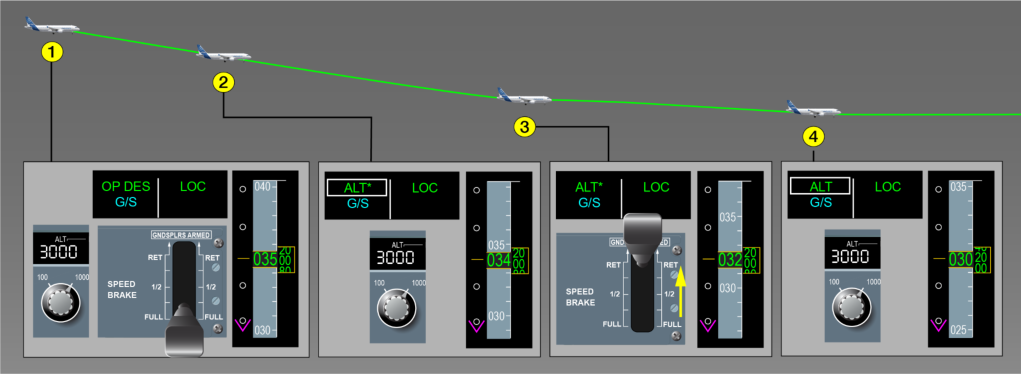
Section titled “Event Description”An A320 aircraft was descending toward its destination airport in IMC and the flight crew prepared for an ILS approach. Late clearance from air traffic control meant that the aircraft was high. The aircraft captured the localizer, but was above the ILS glide slope (fig.1).
① At 3 500 ft, the aircraft was in OP DES I LOC mode with AP, FD, and autothrust ON. The selected altitude was 3 000 ft, the speed brakes were fully deployed, and speed was selected at 174 kt. Flaps configuration was CONF 2 and the landing gear was down.
② At approximately 3 400 ft, the ALT* mode engaged.
③ At 3 200 ft, the flight crew retracted the speed brakes and twice attempted to engage the V/S mode by pulling the V/S/FPA knob, but the ALT* mode reengaged 1 s after each attempt.
④ At 3 000 ft, the ALT mode engaged and the aircraft leveled off.
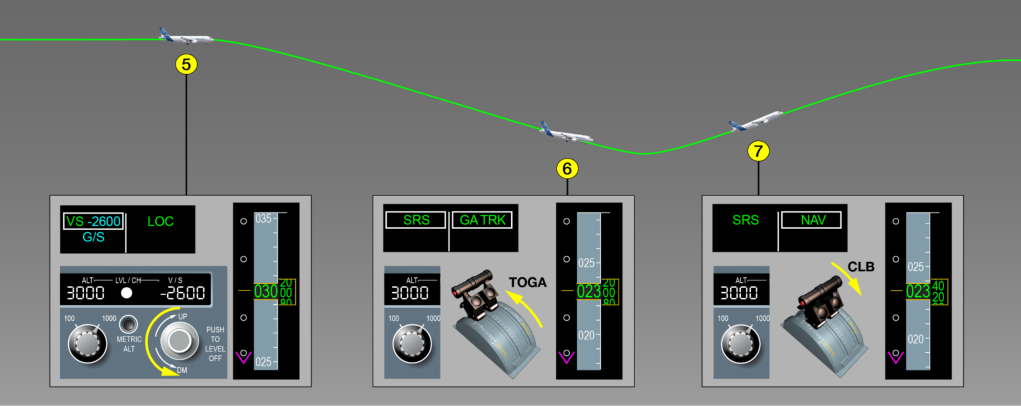
⑤ The flight crew then pulled the V/S/FPA knob to engage the V/S mode and selected a V/S value of -2 600 ft/min on the FCU. The aircraft began to descend.
(fig.1) Event description (1 of 3)
⑥ At approximately 2 300 ft (1 600 ft RA), the aircraft was still too high above the glide slope and the flight crew pushed the thrust levers to TOGA to initiate a go-around with the autopilot engaged. The aircraft started to climb toward the 3 000 ft altitude that was still selected on the FCU. The NAV mode engaged shortly after and ⑦ the PF moved the thrust levers back to the CLB detent at approximately 2 700 ft.
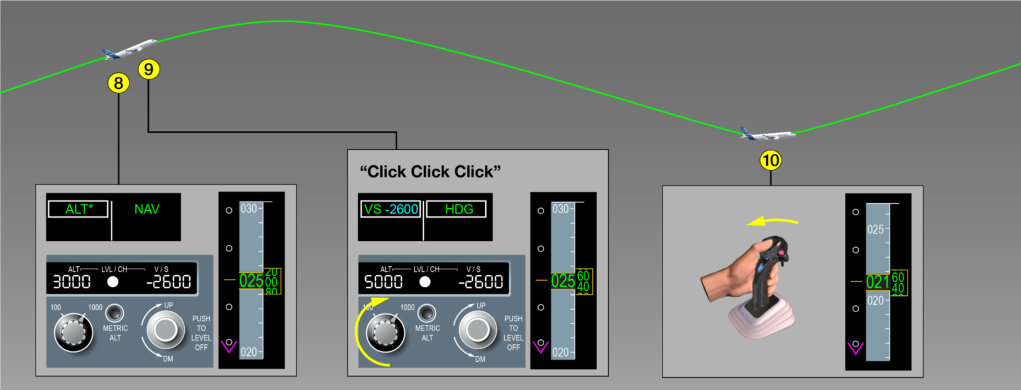
⑧ The ALT* mode engaged at approximately 2 500 ft. ⑨ The flight crew immediately increased the altitude target from 3 000 ft to 5 000 ft on the FCU. As a result, the flight guidance reverted to V/S I HDG modes with associated alerts (triple-click sound, white box on FMA, and FD bars flashing for 10s). The aircraft pitch began to decrease. It climbed up to approximately 2 950 ft and then started to descend and accelerate. At 2 800 ft, the aircraft vertical speed reached -2 600 ft/min and remained constant until ⑩ the flight crew manually took over by pulling the sidestick. The aircraft reached 2 100 ft (1 400 ft RA) and started to climb again.
(fig.2) Event description (2 of 3)
The flight crew later reengaged the autopilot and successfully performed a second ILS approach.
Event Analysis
Section titled “Event Analysis”(fig.3) Event description (3 of 3)
Reversion to the previously selected V/S value
Section titled “Reversion to the previously selected V/S value”When the flight crew increased the selected altitude from 3 000 ft to 5 000 ft on the FCU in step ⑨ , the ALT* mode was engaged. This triggered a reversion to the V/S mode as per flight guidance logic. Since the V/S value was modified shortly before the go-around, it was still in the memory and displayed on the FCU. This led the V/S mode to use this previously selected value instead of the current aircraft V/S. We will describe this inappropriate behavior later in this article.
Flight crew reaction
Section titled “Flight crew reaction”It took more than 30 s from the mode reversion to V/S - 2600 in step ⑨ , and 24 s from the start of the pitch down, for the flight crew to realize that the aircraft did not respond as expected.
AUTOFLIGHT SYSTEM BEHAVIOR
Section titled “AUTOFLIGHT SYSTEM BEHAVIOR”The event described above is due to a combination of two functions of the flight guidance system: The V/S or FPA preselection function and the reversion to V/S or FPA modes.
V/S or FPA Target Preselection
Section titled “V/S or FPA Target Preselection”The V/S or FPA target preselection enables the flight crew to preselect a V/S or FPA target to be prepared to activate the associated flight guidance mode when appropriate. To do so, when the flight crew selects a V/S or FPA target on the FCU, this preselected value is stored in the memory and remains displayed on the FCU for 45 s (10 s on A300, A310, and A300-600 aircraft) to activate the guidance mode later.
The duration of the V/S or FPA preselected value stored in the memory was increased from 10 s (on A300, A300-600, A310 aircraft) to 45 s for the A320 family, A330, A340, A350, and A380 aircraft. It enables the flight crew to ① preselect an FPA value earlier while the aircraft flies toward the Final Descent Point (FDP) during an approach using FPA guidance, in order to ② anticipate the engagement of the FPA mode when the aircraft reaches the FDP.
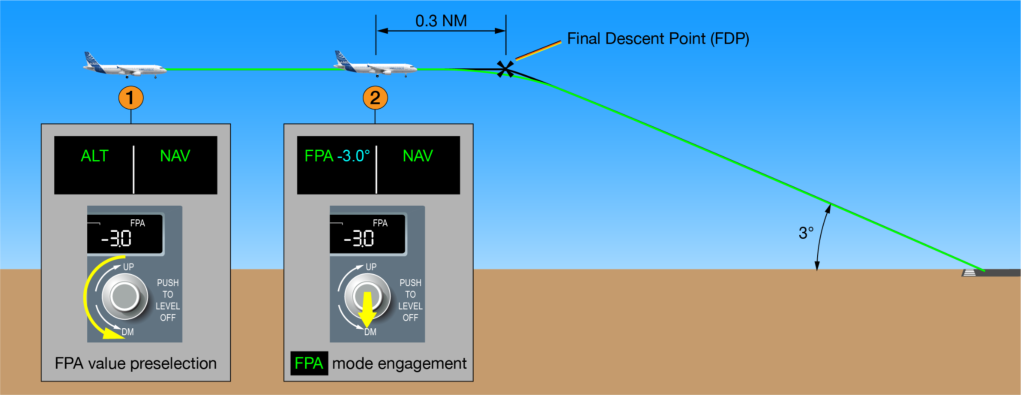
(fig.4) Preselection of the FPA value is used during approach using FPA guidance
Mode Reversion to ** V/S ** or ** FPA ** modes
Section titled “Mode Reversion to ** V/S ** or ** FPA ** modes”The flight guidance automatic mode reversion to V/S or FPA modes is a logic designed to maintain the current aircraft trajectory when the altitude selection by the flight crew is inconsistent with the objectives of the current guidance mode. In the event described in this article, the reversion was triggered by changing the target altitude while the autopilot was in the ALT* altitude capture mode.
FCOM DSC-AUTO FLIGHT - FLIGHT GUIDANCE - AP/FD MODES - V/S / FPA MODE provides all the conditions for reversion to V/S or FPA modes.
An Inappropriate Combination
Section titled “An Inappropriate Combination”During a reversion to V/S or FPA modes, the flight guidance V/S or FPA target usually synchronizes with the current aircraft V/S or FPA in order to maintain the aircraft trajectory. However, if a V/S or FPA value is selected on the FCU and if the mode reversion happens within 45 s (10 s on A300-600 and A310 aircraft), the flight guidance V/S or FPA target synchronizes with this selected value.
This inappropriate combination of the V/S or FPA target preselection function with the mode reversion function may cause inappropriate behavior of the flight guidance as seen in the previous example.
The shorter time that the selected value on A300-600 and A310 aircraft is stored in the memory significantly reduces the probability of mode reversion to the selected value within 10 s after the selection.
Several scenarios can lead to this inappropriate behavior, but not all aircraft are concerned due to some differences in their guidance logic.
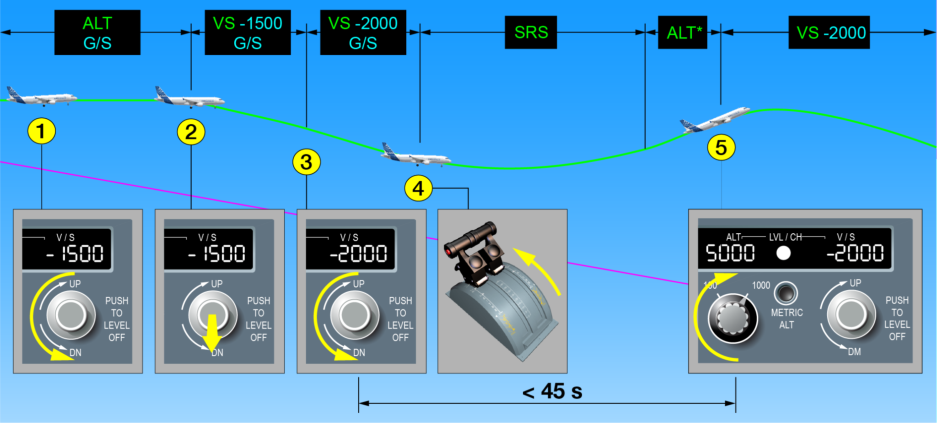
Scenario 1: Go-around during glide slope intercept from above (A300-600 A310 and A320 family aircraft only)
The most common scenario where the flight crew may face this issue is a go-around during or after a glide slope intercept from above, as in the example described earlier in this article. ① A V/S value is preselected, ② V/S mode is engaged and ③ the V/S may be adjusted. ④ A go-around is then performed. ⑤ If the mode reversion happens within the 45 s after the V/S value preselection or last V/S modification, the inappropriate behavior will occur.
Only A300-600, A310, and A320 family aircraft are concerned. On A330, A340, A350, and A380 aircraft, the V/S or FPA preselected value is reset as soon as the V/S or FPA is engaged.
(fig.5) Scenario 1: Go-around during glide slope intercept from above (A300-600 A310, and A320 family aircraft only)
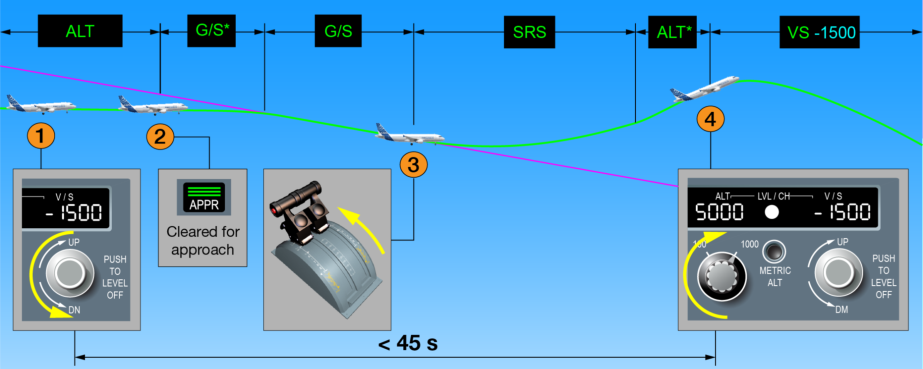
Scenario 2: Go around after glideslope interception with a preselected V/S (without engagement of the V/S mode)
In this case, ① a negative V/S value is preselected in anticipation of a glide slope intercept from above due to possible late ATC clearance. ② When cleared for approach, the flight crew presses the APPR pushbutton and G/S* mode engages, followed by G/S mode. ③ A go-around is performed. ④ If a mode reversion (fig.6) Scenario 2: Go happens less than 45 s after the V/S preselection, the preselected negative V/S around after glideslope value is used. interception with a preselected V/S All aircraft are concerned by this scenario, except A220 aircraft and A350 aircraft that (without engagement of are equipped with PRIM 14.1. (because the V/S or FPA selected value is reset at the V/S mode) go-around engagement with PRIM 14.1).
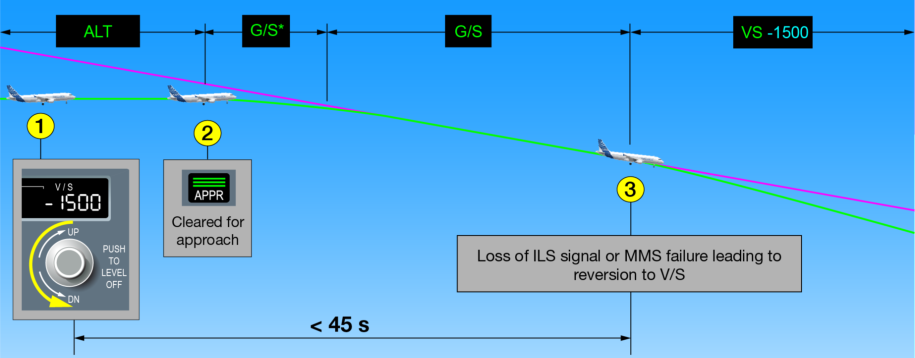
Scenario 3: Mode reversion due to the loss of an approach mode
Section titled “Scenario 3: Mode reversion due to the loss of an approach mode”In this scenario, ① a V/S or FPA value was preselected, as it was for scenario 2, and ② Approach mode is engaged when cleared by ATC. A mode reversion happens during the next 45 s after the preselection due to a loss of approach mode for reasons such as: ● G/S or F-G/S, APP DES or FINAL APP mode disengagement (e.g. loss of ILS signal, MMR failure, loss of flight plan, etc.) ● LOC or F-LOC or NAV mode disengagement ● The flight crew selects a target altitude higher than the actual aircraft altitude on FCU in DES or OP DES mode.
(fig.7) Scenario 3: Mode In this case, the effect on the trajectory is generally limited due to an already reversion due to the loss descending trajectory. It may be more difficult for the flight crew to detect the of an approach mode behavior.
Scenario 4: Visual manual approach using HUD
Section titled “Scenario 4: Visual manual approach using HUD”When performing a visual manual approach using the Head Up Display (HUD), the flight crew may select the FPA value corresponding to the final approach path on the FCU as a guidance (fig.8).
If a go-around is performed the FD will come ON and SRS mode will engage. If a mode reversion happens within 45s after the last selection of the FPA value, the guidance mode will revert to V/S mode using V/S value corresponding to the FPA selected value, typically around -700 ft/min for a -3° FPA.
(fig.8) Selection of the FPA during a visual approach using FPA mode can also lead to the unintended behavior if a mode reversion happens within the next 45 s.
OPERATIONAL CONSIDERATIONS
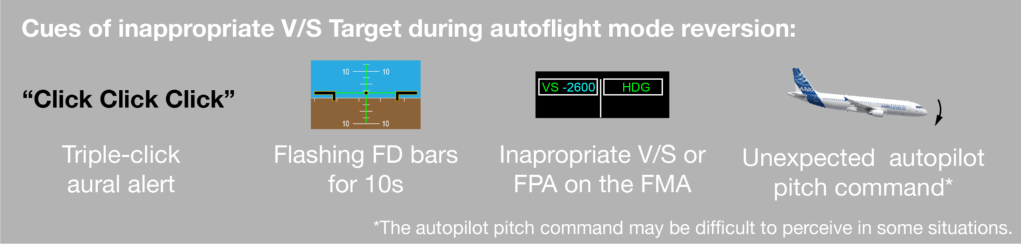
Section titled “OPERATIONAL CONSIDERATIONS”Flight crews can identify an occurrence of an inappropriate V/S target during autoflight mode reversion thanks to several cues.
Aural and visual alerts When a reversion to V/S or FPA mode occurs, the triple-click (except on A300-600 and A310 aircraft), FD flashing and guidance mode boxing on the FMA triggers to attract the attention of the flight crew who can check the reversion parameters. Understand your FMA at all times Careful monitoring and understanding of the FMA, as stated in the “Airbus Golden Rules for Pilots” will enable the flight crew to detect the reversion to V/S or FPA mode, and detect any inappropriate V/S or FPA target value. Effect on the pitch An unexpected pitch command by the autopilot can also be the sign of an (fig.9) Several cues enable inappropriate V/S or FPA target after a mode reversion. Note that in scenario 3 the flight crew to detect an described above (mode reversion due to the loss of an approach mode), the inappropriate V/S target unexpected autopilot pitch command may be limited and, therefore, difficult to during an autoflight mode perceive. reversion
Importance of the Pilot Monitoring
Section titled “Importance of the Pilot Monitoring”The pilot monitoring plays an important role in detecting the issue and alerting the pilot flying when the pilot flying does not detect the inappropriate behavior.
Take action if things do not go as expected
Section titled “Take action if things do not go as expected”If the inappropriate behavior occurs, the flight crew should take appropriate action as per the golden rules.
SYSTEM ENHANCEMENTS
Section titled “SYSTEM ENHANCEMENTS”System enhancements are available, or will be made available on most of the concerned aircraft to prevent the inappropriate combination of the V/S or FPA Target Preselection function with the Mode Reversion function.
Enhancement 1: Reset of the V/S or FPA Preselected Value after** V/S or FPA **Mode Engagement
Section titled “Enhancement 1: Reset of the V/S or FPA Preselected Value after** V/S or FPA **Mode Engagement”Whenever a V/S or FPA target is preselected in the FCU, if the flight crew engages V/S or FPA mode, the preset value is used for the guidance and is reset when the V/S or FPA mode engages. It prevents the use of a preselected value in a subsequent reversion to V/S or FPA as in the example described in this article but also in other phases of flight.
This modification is already installed on A330, A340, A350 and A380 aircraft (table 1). It is planned to be introduced on A320 family aircraft. No availability date was defined at the time of authoring of this article.
|---|---|---|---|---|---|---|---|---|---|---| |**(table 1)**Availability of the reset of||the V/S or FPA preset value after|||V/S|or|FPA mode engagement||||
Enhancement 2: Reset of the V/S or FPA Preselected Value at Go-around Engagement
Section titled “Enhancement 2: Reset of the V/S or FPA Preselected Value at Go-around Engagement”This modification cancels any V/S or FPA preselected value when the flight crew performs a go-around. This prevents the use of an inappropriate V/S of FPA value if V/S or FPA mode was not engaged before the go-around.
This enhancement was already implemented on A350 aircraft in PRIM P14.1 standard certified in December 2022. The enhancement will be introduced on A320 family, A330, and A380 aircraft (table 2).
|---|---|---|---|---|---|---|---|
(table 2) Availability of the reset of the V/S or FPA preselected value at go-around engagement
Enhancement 3: Reset of the V/S or FPA Preselected or selected Value in the case of a reversion to** V/S or FPA **Mode
Section titled “Enhancement 3: Reset of the V/S or FPA Preselected or selected Value in the case of a reversion to** V/S or FPA **Mode”This enhancement ensures that the current V/S or FPA is used during a mode reversion so that the current trajectory is maintained.
This enhancement is planned to be installed on A320 family, A330, A350, and A380 aircraft (see table 3).
|---|---|---|---|---|---|---|---|---|
Contributors:
Section titled “Contributors:”Thierry BOURRET
Section titled “Thierry BOURRET”Autoflight and Flight Operation Senior expert Design Office
Jean FOISNEAU
Section titled “Jean FOISNEAU”Aircraft Safety Enhancement Manager Design Office
Maxime LANSONNEUR
Section titled “Maxime LANSONNEUR”Director Safety - Training and Flight Operations Customer Support
V/S or FPA Target Preselection and Mode Reversion to V/S or FPA mode are two useful functions of the flight guidance system. However, in certain circumstances, their combination may create inappropriate behavior of the flight guidance. System enhancements are available, or will be made available on most of the concerned aircraft to prevent the inappropriate combination of the two functions.
The role of the pilot monitoring is especially important to support the pilot flying in detecting when an inappropriate reversion to V/S or FPA mode occurs. The warning to listen and look for are the triple-click (except on A300-600 and A310 aircraft), FD flashing, and guidance mode boxing on the FMA. These cues get the attention of the crew who can check the reversion flight parameters and take action if needed.
GILBERT SAVARY
Section titled “GILBERT SAVARY”Director Flight Operations and Training Standards Customer Support
To “understand the FMA at all times” and “take action if things do not go as expected” are two of the Airbus Golden Rules for Pilots that are very relevant to avoid the effects of inappropriate V/S target during autoflight mode reversion.
With thanks to Daniel LOPEZ FERNANDEZ from Product Safety, Laurent MOURE and Fabien PERRIN from the A300/A310 Engineering, Thomas GOBEAUT and Marc LE-LOUER from the A300/A310 Flight Operations Support.
Safety first, 2024. Safety first is published by Airbus S.A.S. 1, rond point Maurice Bellonte - 31707 Blagnac Cedex/France.
Editor: Yannick Malinge, Chief Product Safety Officer.
Editorial team: Guillaume Estragnat, Vanessa Sadi, Gwyneth Duggan, Javier Martinez Marina, Tim Roach.
Photos by Airbus.
自动飞行模式转换期间不适当的V/S目标
Section titled “自动飞行模式转换期间不适当的V/S目标”来源:Airbus Safety First 网址:https://safetyfirst.airbus.com/inappropriate-vs-target-during-autoflight-mode-reversion/ 发布日期:2024-01-09 类别:飞行操作、自动驾驶、从上方截获下滑道、复飞、引导、截获
最近有两起在复飞后自动飞行系统恢复到V/S模式期间出现不适当V/S目标的事件报告给空客。在这两起事件中,不适当的V/S目标导致自动驾驶发出俯仰向下指令,同时推力较高。飞行指引使用了在先前从上方截获ILS下滑道期间所选的V/S值作为模式转换的V/S目标。
本文详细描述了其中一起事件,并解释了导致此自动飞行行为的原因。文章还向飞行机组提供了防止和发现此情况的操作建议,并列出了为避免在飞行指引模式转换期间使用不适当的V/S或FPA目标而进行的系统改进。
请在safetyfirst.airbus.com网站以及iOS和Android版Safety first应用程序上查看本文的最新版本。
Section titled “请在safetyfirst.airbus.com网站以及iOS和Android版Safety first应用程序上查看本文的最新版本。”一架A320飞机在仪表气象条件(IMC)下向目的地机场下降,飞行机组准备进行ILS进近。空中交通管制的晚点许可意味着飞机处于较高位置。飞机截获了航向道,但位于ILS下滑道上方**(图1)**。
① 在3 500 ft时,飞机处于_OP DES I LOC_模式,自动驾驶、飞行指引仪和自动推力均已接通。选择了3 000 ft的高度,减速板已完全放出,速度选择为174 kt。襟翼为构型2,起落架已放下。
② 约在3 400 ft时,_ALT*_模式接通。
③ 在3 200 ft时,飞行机组收起减速板,并两次尝试通过拉V/S/FPA旋钮接通_V/S_模式,但_ALT*_模式在每次尝试后1秒重新接入。
④ 在3 000 ft时,_ALT_模式接通,飞机平飞。
⑤ 随后飞行机组拉V/S/FPA旋钮接通_V/S_模式,并在FCU上选择了-2 600 ft/min的V/S值。飞机开始下降。
(图1) 事件描述(1/3)
⑥ 约在2 300 ft(RA 1 600 ft),飞机仍高于下滑道太多,飞行机组将推力手柄推至TOGA以在自动驾驶接通状态下开始复飞。飞机开始向FCU上仍选定的3 000 ft高度爬升。NAV模式不久后接通,⑦ PF约在2 700 ft将推力手柄收回至CLB卡位。
⑧ 约在2 500 ft时,_ALT*_模式接通。⑨ 飞行机组立即在FCU上将高度目标从3 000 ft增加至5 000 ft。结果,飞行指引恢复到_V/S I HDG_模式,并伴随相应警告(三次咔嗒声、FMA上的白色方框以及飞行指引仪杆闪烁10秒)。飞机俯仰开始减小。飞机爬升至约2 950 ft,然后开始下降并加速。在2 800 ft时,飞机垂直速度达到-2 600 ft/min并保持不变,直到⑩ 飞行机组通过拉侧杆手动接管。飞机降至2 100 ft(RA 1 400 ft)后再次开始上升。
(图2) 事件描述(2/3)
飞行机组随后重新接通了自动驾驶,并成功完成了第二次ILS进近。
(fig.3) 事件描述(3/3)
恢复到先前选择的 V/S 值
Section titled “恢复到先前选择的 V/S 值”当飞行机组在第⑨步通过 FCU 将选定高度从 3000 ft 增加到 5000 ft 时,ALT* 模式接通。这触发了按飞行引导逻辑恢复为 V/S 模式。由于 V/S 值在复飞前不久被修改过,因此仍保存在内存中并显示在 FCU 上。这导致 V/S 模式使用该先前选择的值而非当前飞机 V/S 值。我们将在本文后续部分描述这种不当行为。
飞行机组反应
Section titled “飞行机组反应”从第⑨步模式恢复为 V/S -2600 起,飞行机组用了超过 30 秒,从俯冲开始起用了 24 秒,才意识到飞机未按预期响应。
自动飞行系统行为
Section titled “自动飞行系统行为”上述事件是由于飞行引导系统的两个功能共同作用所致:V/S 或 FPA 预选功能和恢复到 V/S 或 FPA 模式功能。
V/S 或 FPA 目标预选
Section titled “V/S 或 FPA 目标预选”V/S 或 FPA 目标预选功能使飞行机组能够预选 V/S 或 FPA 目标,以便在适当时机激活相关的飞行引导模式。为此,当飞行机组在 FCU 上选择 V/S 或 FPA 目标时,该预选值被存储在内存中,并在 FCU 上保持显示 45 秒(A300、A310 和 A300-600 飞机为 10 秒),以便稍后激活引导模式。
V/S 或 FPA 预选值在内存中的存储时间从 A300、A300-600 和 A310 飞机上的 10 秒增加到 A320 系列、A330、A340、A350 和 A380 飞机上的 45 秒。这使飞行机组能够 ① 在飞机沿使用 FPA 引导的进近过程中飞向最终下降点(FDP)时,提前预选 FPA 值,以便 ② 在飞机到达 FDP 时预期接通 FPA 模式。
(fig.4) 在使用 FPA 引导的进近过程中预选 FPA 值
恢复到 V/S 或 FPA 模式
Section titled “恢复到 V/S 或 FPA 模式”飞行引导自动恢复到 V/S 或 FPA 模式是一种逻辑设计,用于在飞行机组选择的高度与当前引导模式的目标不一致时,保持飞机当前的轨迹。在本文所述事件中,恢复是由在自动驾驶仪处于 ALT* 高度捕获模式时更改目标高度所触发的。
FCOM DSC-AUTO FLIGHT - FLIGHT GUIDANCE - AP/FD MODES - V/S / FPA MODE 中提供了恢复到 V/S 或 FPA 模式的所有条件。
一种不当组合
Section titled “一种不当组合”在恢复到 V/S 或 FPA 模式期间,飞行引导 V/S 或 FPA 目标通常与当前飞机 V/S 或 FPA 同步,以保持飞机轨迹。然而,如果在 FCU 上选择了 V/S 或 FPA 值,且模式恢复发生在 45 秒内(A300-600 和 A310 飞机为 10 秒),则飞行引导 V/S 或 FPA 目标将与该选定值同步。
V/S 或 FPA 目标预选功能与模式恢复功能的这种不当组合可能导致飞行引导出现如前例所示的不当行为。
A300-600 和 A310 飞机上选定值在内存中的存储时间较短,显著降低了在选择后 10 秒内恢复到选定值的概率。
多种场景可能导致这种不当行为,但由于引导逻辑存在差异,并非所有飞机都会受到影响。
场景 1:从上方切入下滑道期间的复飞(仅限 A300-600、A310 和 A320 系列飞机)
飞行机组最可能遇到此问题的场景是从上方切入下滑道期间或之后的复飞,如本文前文所述示例。① 预选了 V/S 值,② 接通了 V/S 模式,③ 可能会调整 V/S,④ 然后执行复飞。⑤ 如果模式恢复发生在 V/S 值预选或最后一次 V/S 修改后的 45 秒内,则会发生不当行为。
只有 A300-600、A310 和 A320 系列飞机会受到影响。在 A330、A340、A350 和 A380 飞机上,一旦接通 V/S 或 FPA,V/S 或 FPA 预选值即被重置。
(fig.5) 场景 1:从上方切入下滑道期间的复飞(仅限 A300-600、A310 和 A320 系列飞机)
场景 2:使用预选 V/S 切入下滑道后的复飞(未接通 V/S 模式)
在这种情况下,① 由于可能迟到 ATC 许可,预先选择了一个负 V/S 值以备从上方切入下滑道。② 当获准进近时,飞行机组按下 APPR 按钮,G/S* 模式接通,随后 G/S 模式接通。③ 执行复飞。④ 如果模式恢复发生在 V/S 预选后 45 秒内,则使用预选的负 V/S 值。所有飞机都会受到此场景影响,A220 飞机和配备 PRIM 14.1 的 A350 飞机除外(因为配备 PRIM 14.1 时,V/S 或 FPA 选定值在复飞接通时被重置)。
(fig.6) 场景 2:使用预选 V/S 切入下滑道后的复飞(未接通 V/S 模式)
场景 3:由于进近模式丧失导致的模式重接
Section titled “场景 3:由于进近模式丧失导致的模式重接”在此场景中,① 与场景 2 相同,预选了 V/S 或 FPA 值,② 当获 ATC 许可后衔接进近模式。由于以下原因导致进近模式丧失,将在预选后的 45 秒内发生模式重接: ● G/S 或 F-G/S、APP DES 或 FINAL APP 模式脱开(例如 ILS 信号丢失、MMR 故障、飞行计划丢失等) ● LOC 或 F-LOC 或 NAV 模式脱开 ● 飞行机组在 DES 或 OP DES 模式下在 FCU 上选择的目标高度高于飞机当前高度。
(fig.7) 场景 3:由于进近模式丧失导致的模式重接 在此情况下,由于已处于下降轨迹中,对轨迹的影响通常有限。但飞行机组可能更难察觉该行为。
场景 4:使用 HUD 的目视人工进近
Section titled “场景 4:使用 HUD 的目视人工进近”当执行使用平视显示器(HUD)的目视人工进近时,飞行机组可以在 FCU 上选择与最终进近航道对应的 FPA 值作为引导 (fig.8)。
如果执行复飞,飞行指引仪(FD)将自动接通,SRS 模式将衔接。如果在最后选择 FPA 值后的 45 秒内发生模式重接,引导模式将重接至 V/S 模式,此时使用的 V/S 值对应所选的 FPA 值,对于 -3° 的 FPA 通常约为 -700 ft/min。
(fig.8) 在使用 FPA 模式进行目视进近时选择 FPA 值,如果在接下来的 45 秒内发生模式重接,也可能导致不当行为。
运行注意事项
Section titled “运行注意事项”飞行机组可通过多种提示识别自动飞行模式重接期间不适当的 V/S 目标。
听觉和视觉警告 当重接至 V/S 或 FPA 模式时,三声咔嗒音(A300-600 和 A310 飞机除外)、飞行指引仪闪烁以及 FMA 上的引导模式方框会触发,以吸引飞行机组的注意,机组可据此检查重接参数。始终了解你的 FMA 按照”空客飞行员黄金法则”所述,仔细监控和理解 FMA,将使飞行机组能够检测到 V/S 或 FPA 模式的重接,并检测任何不适当的 V/S 或 FPA 目标值。对俯仰的影响 自动驾驶的意外俯仰指令也可能是 (fig.9) 多种提示使飞行机组能够检测自动飞行模式重接后不适当的 V/S 或 FPA 目标。请注意,在上述场景 3(由于进近模式丧失导致的模式重接)中,意外自动驾驶俯仰指令可能较轻微,因此难以察觉。
监控飞行员的重要性
Section titled “监控飞行员的重要性”监控飞行员在检测问题以及当飞行飞行员未能察觉不当行为时提醒飞行飞行员方面发挥着重要作用。
如果情况未按预期发展,请采取行动
Section titled “如果情况未按预期发展,请采取行动”如果发生不当行为,飞行机组应根据黄金法则采取适当行动。
系统增强功能已在或将在大多数相关飞机上提供,以防止 V/S 或 FPA 目标预选功能与模式重接功能的不当组合。
增强措施 1:在 V/S 或 FPA 模式衔接后重置 V/S 或 FPA 预选值
Section titled “增强措施 1:在 V/S 或 FPA 模式衔接后重置 V/S 或 FPA 预选值”每当在 FCU 上预选 V/S 或 FPA 目标时,如果飞行机组衔接 V/S 或 FPA 模式,预设值将用于引导,并在 V/S 或 FPA 模式衔接时重置。此举可防止在后续重接至 V/S 或 FPA 时使用预选值(如本文所述的示例),也可防止在其他飞行阶段使用。
此改装已在 A330、A340、A350 和 A380 飞机上安装 (table 1)。计划在 A320 系列飞机上引入。本文撰写时尚未确定可用日期。
|---|---|---|---|---|---|---|---|---|---|---| |(table 1)|V/S 或|FPA 模式衔接后重置 V/S 或 FPA 预设值的可用性||||
增强措施 2:在复飞衔接时重置 V/S 或 FPA 预选值
Section titled “增强措施 2:在复飞衔接时重置 V/S 或 FPA 预选值”此改装在飞行机组执行复飞时取消任何 V/S 或 FPA 预选值。如果在复飞前未衔接 V/S 或 FPA 模式,此增强措施可防止使用不适当的 V/S 或 FPA 值。
此增强功能已在 A350 飞机上实现,PRIM P14.1 标准于 2022 年 12 月获得认证。计划在 A320 系列、A330 和 A380 飞机上引入 (table 2)。
|---|---|---|---|---|---|---|---||
(table 2) 在复飞衔接时重置 V/S 或 FPA 预选值的可用性
增强措施 3:在重接至 V/S 或 FPA 模式时重置 V/S 或 FPA 预选或选定值
Section titled “增强措施 3:在重接至 V/S 或 FPA 模式时重置 V/S 或 FPA 预选或选定值”此增强措施确保在模式重接期间使用当前 V/S 或 FPA,以保持当前轨迹。
此增强措施计划在 A320 系列、A330、A350 和 A380 飞机上安装 (见 table 3)。
|---|---|---|---|---|---|---|---|---|---|
Thierry BOURRET
Section titled “Thierry BOURRET”自动飞行与飞行操作高级专家 设计部门
Jean FOISNEAU
Section titled “Jean FOISNEAU”飞机安全增强经理 设计部门
Maxime LANSONNEUR
Section titled “Maxime LANSONNEUR”安全总监 - 培训与飞行运营客户支持
V/S 或 FPA 目标预选和模式恢复至 V/S 或 FPA 模式是飞行引导系统的两个有用功能。然而,在某些情况下,两者的组合可能会导致飞行引导出现不当行为。系统增强功能已在或将在大多数相关飞机上提供,以防止这两个功能的不当组合。
监控飞行员的角色尤为重要,可协助主飞飞行员发现何时发生了不恰当的 V/S 或 FPA 模式恢复。需要警惕的警示信号包括三声咔嗒(A300-600 和 A310 飞机除外)、FD 闪烁以及 FMA 上的引导模式框选。这些提示会提醒机组人员注意,以便检查恢复后的飞行参数并在需要时采取行动。
GILBERT SAVARY
Section titled “GILBERT SAVARY”飞行运营与培训标准客户支持总监
“始终理解 FMA”和“当情况不符合预期时采取行动”是空客飞行员的黄金规则之二,对于避免自动驾驶模式恢复期间不恰当 V/S 目标的影响至关重要。
特别鸣谢来自产品安全部门的 Daniel LOPEZ FERNANDEZ,来自 A300/A310 工程部门的 Laurent MOURE 和 Fabien PERRIN,以及来自 A300/A310 飞行运营支持的 Thomas GOBEAUT 和 Marc LE-LOUER。
Safety first, 2024. Safety first is published by Airbus S.A.S. 1, rond point Maurice Bellonte - 31707 Blagnac Cedex/France.
编辑:Yannick MALINGE,首席产品安全官。
编辑团队:Guillaume ESTRAGNAT、Vanessa SADI、Gwyneth DUGGAN、Javier MARTINEZ MARINA、Tim ROACH。
图片由空客提供。