Good Quality Hydraulic Fluid for Safe Operations
Source: Airbus Safety First URL: https://safetyfirst.airbus.com/good-quality-hydraulic-fluid-for-safe-operations/ Published: 2022-04-25 Category: Maintenance, Acid, Hydraulic, skydrol PDF: Original PDF

Several cases of uncommanded spoiler extension were reported to Airbus in recent years. Investigations showed that a level of the was a high acidity hydraulic fluid contributor to these events.
This article recalls the importance of checking the quality of the hydraulic fluid and describes the improvements made to the AMM/MP procedure to perform hydraulic fluid analysis and reduce of acid in the It also recalls some buildup fluid. good practices to prevent hydraulic fluid contamination during maintenance or servicing operations.
This article is also available on safetyfrst.airbus.com and on the Safety first app for iOS and Android devices.
CASE STUDY
Section titled “CASE STUDY”Event Description
Section titled “Event Description”An A320 family aircraft was on descent passing through 14 000 ft. After a brief extension and retraction of the speed brakes by the flight crew, the aircraft suddenly banked to the right and the F/CTL SPOILER FAULT ECAM alert triggered. The pilot flying disconnected the autopilot and manually flew the aircraft. The flight crew observed that spoiler 3 of the wing on the right side was still fully extended. They performed the ECAM actions and the pilot flying continued to manually fly the aircraft and safely landed without further incident. Spoiler 3 remained fully extended with the aircraft on the ground. Maintenance crews found that the servo valve of spoiler 3 was stuck in the extended position. It was replaced and sent to the equipment supplier for analysis and repair.
Event Analysis
Section titled “Event Analysis”Analysis of the faulty servo valve removed from spoiler 3 revealed that the high acidity of the hydraulic fluid led to corrosion of the internal parts and a crack was found. This caused the servo valve to malfunction, which resulted in the spoiler 3 to remain deployed after the speed brakes retraction command.
REGULARLY CHECK HYDRAULIC FLUID QUALITY
Section titled “REGULARLY CHECK HYDRAULIC FLUID QUALITY”Poor quality hydraulic fluid can cause damage to the hydraulic circuit and the hydraulic components in systems such as flight controls, braking, and steering. A regular check of the hydraulic fluid quality can help to prevent damage.
Checks on A300, A310, A320 family, A330, A340, A350, and A380 aircraft
Section titled “Checks on A300, A310, A320 family, A330, A340, A350, and A380 aircraft”The Maintenance Planning Document (MPD) task for A300/A310/A320 family/A330/A340/A350/A380 aircraft requests sampling and analysis of the hydraulic fluid from each hydraulic circuit. This is to check the quality of the fluid, and these checks should be performed at regular intervals shown in the table below.
| Aircraft | A300/A310 | A320 family | A330/A340/A350/A380 | |||
|---|---|---|---|---|---|---|
| Fluid sampling interval | 24 MO | 24 MO or 7500 FH | 36 MO |
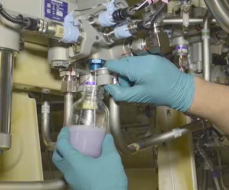
To take a sample of the hydraulic fluid, it is important to apply the steps in the AMM/MP procedure. Avoid contaminating the sample to prevent an erroneous contamination measurement. Flush the sampling valve by discarding the first 200 ml of hydraulic fluid to remove any particles. Then collect the fluid sample in a clean and dry chlorine-free bottle.
The hydraulic fluid sample must be sent to an approved laboratory for analysis in accordance with NSA307110 standard recommendations. This documentation can be found in the Airbus Process and Material Specification (PMS) available in Airnav[X].
Checks on A220 Aircraft
Section titled “Checks on A220 Aircraft”An A220 MPD AMP task requests a check of the Differential Pressure Indicator (DPI) of the pressure filter, case drain filter, and return filter every 1 200 FH. Hydraulic fluid sampling should be done if contamination is identified during this check. The sample should then be sent to an approved laboratory for analysis.
Laboratory checks and results
Section titled “Laboratory checks and results”The laboratory analysis checks the physical and chemical characteristics of the hydraulic fluid:
Particle contamination
Section titled “Particle contamination”Contamination of the hydraulic fluid by particles may cause erosion and damage to components such as pumps, valves, and ultimately cause components to jam or fail.
If the particle contamination is above the tolerance value provided in the AMM/MP, then the hydraulic fluid must be flushed and replaced or cleaned. For A220 aircraft, the hydraulic fluid must be replaced.
Viscosity & density
Section titled “Viscosity & density”The hydraulic fluid must also have the correct viscosity and density characteristics to ensure the appropriate level of performance and responsiveness for the hydraulic system.
If the viscosity or density is not in the range provided in the AMM/MP/AMP, the hydraulic fluid must be replaced within the permitted time frame.
Electrical conductivity
Section titled “Electrical conductivity”If the electrical conductivity of the fluid is too low, it may lead to electrical discharging effects and arcing within the hydraulic system. This may further degrade the hydraulic fluid quality and cause damage to hydraulic components.
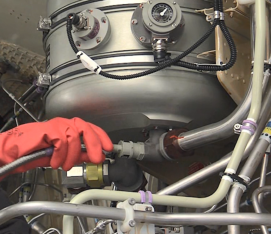
If the electrical conductivity is below the value provided in the AMM/MP/AMP, the hydraulic fluid must be replaced within the permitted time frame. Acidity High acidity of the hydraulic fluid leads to corrosion and erosion of the components it is in contact with. The Total Acid Number (TAN) is used to measure the hydraulic fluid acidity. The TAN is the number of milligrams of potassium hydroxide (KOH) needed to neutralize the acid in one gram of hydraulic fluid. The AMM/MP will define the amount of hydraulic fluid that must be replaced depending on the measured TAN value in the laboratory analysis report for the sample taken. This can range from replacing the quantity of hydraulic fluid in the reservoir (between 10 and 15% of the total fluid quantity) (fig.1) to full replacement (flush) of the fluid. For A220 aircraft, the hydraulic fluid must be replaced.
(fig.1) Replacement of the hydraulic fluid contained in an hydraulic reservoir
Chlorine content
Section titled “Chlorine content”The use of chlorinated solvents to clean components of the hydraulic system introduces chrorine in the hydraulic fluid. Chlorine creates acid when combined with any water present in the fluid and this will increase the level of acid in the fluid.
If the quantity of chlorine is greater than the tolerance value provided in the AMM/MP, the hydraulic fluid must be either cleaned or flushed and replaced within the permitted time frame.
Water content
Section titled “Water content”Water content can lead to an increase of acid in the fluid and can modify the physical characteristics of the hydraulic fluid, which may reduce the performance of the system. It also can contribute to corrosion of hydraulic circuit components.
If the quantity of water is greater than the tolerance value provided in the AMM/MP/AMP, the hydraulic fluid must either be cleaned or changed within the permitted time frame. Additional inspections and tests may be required depending on the level of water contamination.
The maximum water content permitted in hydraulic fluids is 0.8 %. However, Airbus recommends a limit of 0.5 %, which will increase the life of the hydraulic fluid.
IMPROVED PROCEDURE FOR FLUID ACIDITY CORRECTION
Section titled “IMPROVED PROCEDURE FOR FLUID ACIDITY CORRECTION”In 2021, Airbus launched an improvement of the AMM/MP procedure for analysis of the hydraulic fluid of A300/A310/A320 family/A330/A340/A350/A380 aircraft. The AMM/MP of A320 family, A350, and A380 aircraft was updated accordingly in 2021. The AMM of A330/A340 aircraft will be updated by mid 2022.
The AMM/MP improvement modifies the acidity thresholds and their associated fluid replacement procedure. This is to increase the hydraulic fluid lifetime and reduce the risk of reaching high TAN values, which may result in system malfunctions.
Typical Evolution of the TAN
Section titled “Typical Evolution of the TAN”An acid scavenger is an additive in hydraulic fluid to reduce the likelihood of acid level increases in the fluid. This additive is progressively consumed over time and the level of acid in the fluid will begin to rise. When most of the additive is consumed, the acid level can rapidly increase (fig.2).
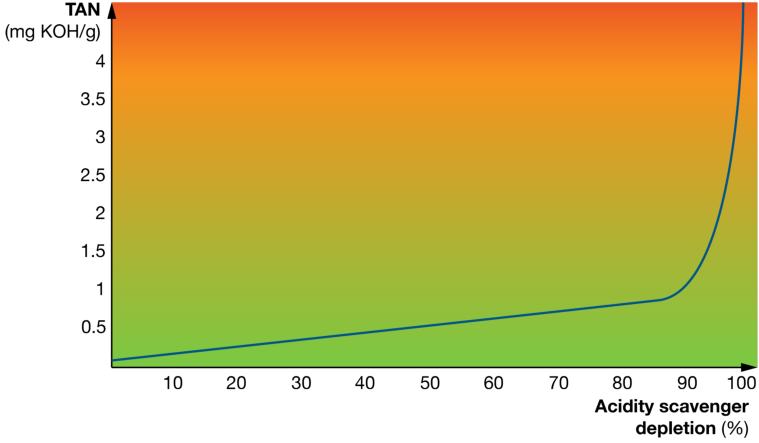
(fig.2) Typical evolution of the TAN
Improved procedure for acidity correction
Section titled “Improved procedure for acidity correction”The improved procedure now requests corrective actions to reduce the acidity of the fluid from a TAN threshold of 1.0 mg KOH/g instead of the previous threshold of 1.5 mg KOH/g.
This lower limit for acid levels of 1.0 mg KOH/g was determined using in-service data analysis. This showed that when the results from the analysis of hydraulic fluid samples had a TAN value between 1.0 and 1.5 mg KOH/g, the very next sample taken was likely to show a significant increase of acid levels.
Performing corrective actions from 1.0 mg KOH/g will further prevent reaching high acidity values and this will improve the reliability of hydraulic components.
|---|---|---|---| |TAN < 1.0|N/A|N/A|Next MPD check| |1.2 < TAN < 1.5||3x reservoir fuid replacement (1)|| |1.5 < TAN < 1.8|14 Days|4x reservoir fuid replacement (1)|| |1.8 < TAN < 2.2||5x reservoir fuid replacement (1)|| |2.2 < TAN < 2.5||6x reservoir fuid replacement (1)||
1 complete fluid change can be selected optionally
2 for Parking and Storage the flight cycle can be replaced by an operation of the flight controls for 5 minutes
As an example, (fig.3) shows that the 1.5 mg KOH/g TAN threshold would require a full hydraulic fluid replacement at the third check. This would allow the TAN value to exceed 2.0 mg KOH/g for one year and would be likely to reach high TAN values above 4.5 mg KOH/g before the fluid replacement is due.
The 1.0 mg KOH/g threshold requires that only a volume of fluid 2x the hydraulic reservoir contents is replaced at the second and fourth checks. This will maintain the TAN value below 1.3 mg KOH/g during the entire period.
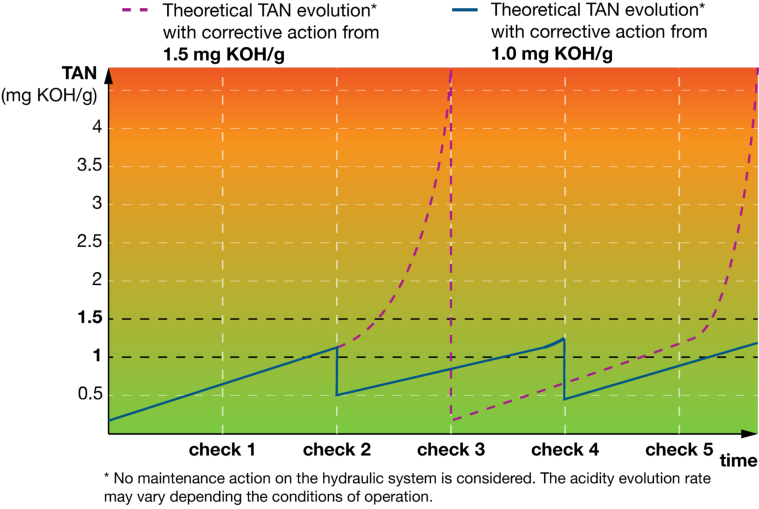
(fig.3) Theoretical evolution of the TAN with time
PREVENTION OF HYDRAULIC FLUID CONTAMINATION
Section titled “PREVENTION OF HYDRAULIC FLUID CONTAMINATION”Precautions taken during servicing and maintenance operations can reduce the risk of contamination of the hydraulic fluid and reduce the likelihood of increased levels of acid in the fluid.
Hydraulic fluid handling and storage
Section titled “Hydraulic fluid handling and storage”New fluid containers must be correctly blanked to prevent water ingress from humidity in the ambient air. They should be stored in dedicated areas and away from used fluids. Operators should refer to the recommendations provided by the fluid supplier for fluid handling and storage.
Hydraulic Ground Cart
Section titled “Hydraulic Ground Cart”Airbus recommends periodic monitoring of fluids that are contained in hydraulic ground cart reservoirs. This is to prevent contamination during refilling of the hydraulic system when using a cart.
Maintenance operations
Section titled “Maintenance operations”Any maintenance operation (especially hydraulic component replacement) can have a risk of hydraulic fluid contamination. Hydraulic lines and equipment must be blanked and stored in clean areas. Aircraft hydraulic servicing ports must be blanked and hydraulic equipment must be suitably protected against contamination.
Contributors:
Section titled “Contributors:”Rolf GÖSSING Hydraulic Equipment & Fluid Expert Design Office
Stéphane ACOSTA Product Leader A320 family aircraft - Hydraulic System Engineering Support Customer Support
Martin TROTTIER
Section titled “Martin TROTTIER”A220 Hydraulic Engineering Specialist A220 Design Office
Degraded hydraulic fluid can cause damage to hydraulic components. In some reported cases, high acid levels in hydraulic fluid was a contributing factor that led to component damage in the flight control spoiler system causing unintended flight control surface behavior.
It is essential to regularly check that the hydraulic fluid quality is within the limits defined in the AMM/MP/AMP.
Airbus improved the AMM/MP procedure for hydraulic fluid analysis of A300/A310/A320family/A330/A340/A350/A380 aircraft by reducing the threshold for corrective actions of the fluid acidity. This will further prevent the likelihood of reaching a high level of acid in the hydraulic fluid.
Operators should carefully follow the instructions and precautions provided in the maintenance documentation to prevent contamination of the hydraulic circuits during maintenance and servicing. All of these actions combined will ensure that the hydraulic fluid is of good quality, and that it retains its physical and chemical characteristics for safe and efficient operations.
Safety first, 2022. Safety first is published by Airbus S.A.S. 1, rond point Maurice Bellonte - 31707 Blagnac Cedex/France.
Editor: Yannick Malinge, Chief Product Safety Officer.
Editorial team: Guillaume Estragnat, Vanessa Sadi, Gwyneth Duggan, Tim Roach.
- Reference: X00D16031905.
Photos by Airbus.
来源: Airbus Safety First URL: https://safetyfirst.airbus.com/good-quality-hydraulic-fluid-for-safe-operations/ 发布日期: 2022-04-25 类别: 维护、酸度、液压、skydrol PDF: 原始 PDF
近年来,空客收到多起非指令性扰流板伸展的报告。调查表明,液压油高酸度是造成这些事件的主要因素。
本文回顾了检查液压油质量的重要性,并描述了对AMM/MP程序所做的改进,以进行液压油分析和减少液压油中的酸积聚。本文还回顾了在维护或服务操作中防止液压油污染的一些良好做法。
本文也可在 safetyfirst.airbus.com 以及 iOS 和 Android 设备的 Safety First 应用程序上获取。
一架A320系列飞机在下降穿越14000英尺时,机组短暂收放减速板后,飞机突然向右倾斜,触发了F/CTL SPOILER FAULT(飞行控制-扰流板故障)ECAM警告。飞行员断开自动驾驶仪并人工操纵飞机。机组观察到右翼3号扰流板仍然完全伸出。他们执行了ECAM动作,飞行员继续人工操纵飞机并安全着陆,无进一步事故。3号扰流板在飞机停场后仍保持完全伸出状态。维护人员发现3号扰流板的伺服阀卡在伸出位置。该伺服阀已被更换并送交设备供应商进行分析和修理。
对从3号扰流板拆下的故障伺服阀进行分析,发现液压油的高酸度导致内部部件腐蚀并产生裂纹。这导致伺服阀发生故障,从而在减速板收上指令后3号扰流板仍然保持伸出状态。
定期检查液压油质量
Section titled “定期检查液压油质量”劣质液压油可能损坏液压管路和液压部件,例如飞行控制、刹车和转向系统中的部件。定期检查液压油质量有助于防止损坏。
A300、A310、A320系列、A330、A340、A350和A380飞机的检查
Section titled “A300、A310、A320系列、A330、A340、A350和A380飞机的检查”A300/A310/A320系列/A330/A340/A350/A380飞机的维护计划文件(MPD)任务要求对每个液压管路进行液压油取样和分析。这是为了检查流体质量,这些检查应按照下表所示的间隔定期进行。
| 飞机 | A300/A310 | A320系列 | A330/A340/A350/A380 | ||
|---|---|---|---|---|---|
| 流体取样间隔 | 24个月 | 24个月或7500 FH | 36个月 |
为取液压油样品,严格按照AMM/MP程序中的步骤操作非常重要。避免样品污染以防止错误的污染测量结果。冲洗取样阀,丢弃前200毫升液压油以去除颗粒。然后将流体样品收集在干净、干燥的无氯瓶中。
液压油样品必须按照NSA307110标准的建议送交经批准的实验室进行分析。该文档可在**Airbus工艺与材料规范(PMS)中找到,文件位于Airnav[X]**中。
A220飞机的检查
Section titled “A220飞机的检查”A220 MPD AMP任务要求每1200 FH检查一次压力过滤器、回流过滤器和壳体排放过滤器的压差指示器(DPI)。如果在检查中发现污染,应进行液压油取样,然后将样品送交经批准的实验室进行分析。
实验室检查和结果
Section titled “实验室检查和结果”实验室分析检查液压油的物理和化学特性:
液压油中的颗粒污染可能导致泵、阀门等部件的侵蚀和损坏,并最终导致部件卡阻或失效。
如果颗粒污染超过AMM/MP中提供的容差值,则必须冲洗并更换或清洁液压油。对于A220飞机,必须更换液压油。
液压油还必须具有正确的粘度和密度特性,以确保液压系统具有适当的性能和响应能力。
如果粘度或密度不在AMM/MP/AMP中提供的范围内,必须在允许的时间范围内更换液压油。
如果液压油的电导率过低,可能导致液压系统内部产生放电效应和电弧。这可能进一步降低液压油质量,并对液压部件造成损坏。
如果电导率低于 AMM/MP/AMP 中规定的数值,必须在允许的时间范围内更换液压油。
酸度
液压油的高酸度会导致与其接触的部件发生腐蚀和侵蚀。总酸值 (TAN) 用于测量液压油的酸度。TAN 是中和 1 克液压油中的酸所需的氢氧化钾 (KOH) 毫克数。AMM/MP 将根据所采集样品的实验室分析报告中测得的 TAN 值,规定必须更换的液压油量。这可以从更换油箱中的液压油量(占总量的 10% 至 15%)(fig.1) 到完全更换(冲洗)液压油。对于 A220 飞机,必须更换液压油。
(fig.1) 液压油箱中液压油的更换
使用氯化溶剂清洁液压系统部件会在液压油中引入氯。氯与油中存在的任何水结合会产生酸,这会增加油中的酸度。
如果氯含量超过 AMM/MP 中规定的容限值,必须在允许的时间范围内清洁或冲洗并更换液压油。
含水量会导致油中酸度增加,并可能改变液压油的物理特性,这可能降低系统性能。水分还可能导致液压管路部件腐蚀。
如果含水量超过 AMM/MP/AMP 中规定的容限值,必须在允许的时间范围内清洁或更换液压油。根据水分污染程度,可能需要进行额外的检查和测试。
液压油中允许的最大含水量为 0.8%。然而,空客建议将限值设定为 0.5%,这将延长液压油的使用寿命。
改进的液压油酸度修正程序
Section titled “改进的液压油酸度修正程序”2021 年,空客启动了 A300/A310/A320 系列/A330/A340/A350/A380 飞机液压油分析 AMM/MP 程序的改进工作。A320 系列、A350 和 A380 飞机的 AMM/MP 于 2021 年相应更新。A330/A340 飞机的 AMM 将于 2022 年中前更新。
AMM/MP 改进修改了酸度阈值及其相关的液压油更换程序。这是为了延长液压油的使用寿命,并降低达到可能导致系统故障的高 TAN 值的风险。
TAN 的典型变化趋势
Section titled “TAN 的典型变化趋势”酸中和剂是液压油中的一种添加剂,用于减少油中酸度上升的可能性。这种添加剂会随时间逐渐消耗,油中的酸度将开始上升。当大部分添加剂被消耗后,酸度可能会迅速上升 (fig.2)。
(fig.2) TAN 的典型变化趋势
改进的酸度修正程序
Section titled “改进的酸度修正程序”改进后的程序现在要求从 1.0 mg KOH/g 的 TAN 阈值开始采取纠正措施以降低油的酸度,而不是之前的 1.5 mg KOH/g 阈值。
1.0 mg KOH/g 的这一较低酸度限值是通过使用服役数据分析确定的。这表明,当液压油样品分析结果的 TAN 值在 1.0 至 1.5 mg KOH/g 之间时,下一次采集的样品很可能显示出酸度的显著增加。
从 1.0 mg KOH/g 开始采取纠正措施将进一步防止达到高酸度值,这将提高液压部件的可靠性。
|---|---|---|---| |TAN < 1.0|不适用|不适用|下次 MPD 检查| |1.2 < TAN < 1.5||3 倍油箱油量更换 (1)|| |1.5 < TAN < 1.8|14 天|4 倍油箱油量更换 (1)|| |1.8 < TAN < 2.2||5 倍油箱油量更换 (1)|| |2.2 < TAN < 2.5||6 倍油箱油量更换 (1)||
1 可选择进行 1 次完全换油
2 对于停场和封存,可用飞行操纵系统操作 5 分钟来替代飞行循环
例如,(fig.3) 显示 1.5 mg KOH/g 的 TAN 阈值需要在第三次检查时进行全液压油更换。这将允许 TAN 值在一年内超过 2.0 mg KOH/g,并且在液压油更换到期之前很可能达到 4.5 mg KOH/g 以上的高 TAN 值。
1.0 mg KOH/g 的阈值要求在第二次和第四次检查时仅更换 2 倍液压油箱容量的油量。这将使 TAN 值在整个期间保持在 1.3 mg KOH/g 以下。
(fig.3) TAN 随时间变化的理论趋势
液压油污染预防
Section titled “液压油污染预防”在勤务和维护作业过程中采取的预防措施可降低液压油被污染的风险,并减少液压油中酸含量升高的可能性。
液压油的处理与储存
Section titled “液压油的处理与储存”新液压油容器必须正确封堵,以防止环境空气中湿气侵入。容器应存放在专用区域,并与使用过的油液隔离。操作人员应参照油液供应商提供的处理和储存建议。
液压地面勤务车
Section titled “液压地面勤务车”空中客车建议定期监测液压地面勤务车储液罐中的液压油,以防止在使用勤务车对液压系统进行补液时发生污染。
任何维护作业(尤其是液压部件更换)都可能存在液压油污染风险。液压管路和设备必须进行封堵并存放于清洁区域。飞机液压勤务口必须封堵,液压设备必须采取适当的防护措施以防止污染。
Rolf GÖSSING 液压设备与油液专家 设计工程部
Stéphane ACOSTA A320 系列飞机产品负责人 - 液压系统工程支持 客户支援部
Martin TROTTIER A220 液压工程专家 A220 设计工程部
液压油性能下降可能导致液压部件损坏。在一些已报告案例中,液压油中酸含量过高是导致飞行控制扰流板系统部件损坏并引发非预期飞行控制面运动的一个影响因素。
必须定期检查液压油质量是否符合 AMM/MP/AMP 中规定的限值。
空中客车改进了 A300/A310/A320 系列/A330/A340/A350/A380 飞机液压油分析的 AMM/MP 程序,降低了液压油酸度纠正措施的阈值。这将进一步防止液压油中酸含量达到高水平。
操作人员应严格遵循维护文件中提供的说明和预防措施,以防止在维护和勤务作业期间污染液压管路。所有这些措施相结合,将确保液压油保持良好质量,并维持其物理和化学特性,以实现安全高效的运行。
Safety first, 2022. Safety first 由空中客车公司出版。地址:法国布拉尼亚克,31707,Maurice Bellonte 环岛 1 号,31707。
主编:Yannick Malinge,首席产品安全官。
编辑团队:Guillaume Estragnat、Vanessa Sadi、Gwyneth Duggan、Tim Roach。
20192534。参考编号:X00D16031905。
照片由空中客车公司提供。