Use the Correct BARO Setting for Approach
Source: Airbus Safety First URL: https://safetyfirst.airbus.com/use-the-correct-baro-setting-for-approach/ Published: 2022-11-15 Category: Flight Ops, altimeter setting, altimetry, ALTSM, barometric, QFE, QNH, TAWS PDF: Original PDF

Using an erroneous barometric reference setting during approach may cause the aircraft to fly lower than the published approach path, when the vertical guidance and trajectory deviations use the barometric reference. This can lead to a risk of controlled into flight terrain in poor visibility conditions or at night.
This article explains the potential consequences of an erroneous barometric reference. It also provides guidance to flight crews on how to detect it, and describes the available system enhancements to alert flight crews when an erroneous BARO reference is detected.
This article is also available on safetyfrst.airbus.com and on the Safety first app for iOS and Android devices.
CASE STUDY
Section titled “CASE STUDY”Event Description
Section titled “Event Description”The flight crew of an A320 was preparing for an RNP approach with LNAV/VNAV minima toward its destination airport, before initiating descent from their cruise Flight Level. The ATIS provided them with an airport QNH of 1001 hPa.
During the descent, ATC cleared the flight crew to descend to 6000 ft QNH 1011 hPa, followed 2 minutes later by a clearance down to 5000 ft QNH 1011 hPa. The flight crew acknowledged both clearances repeating the erroneous 1011 hPa QNH, which was 10 hPa above the current QNH of the airport.
① The aircraft leveled off at 5000 ft QNH 1011 hPa (fig.1). This placed it approximately 280 ft below the intended altitude of 5000 ft with a correct QNH of 1001 hPa. With autopilot and autothrust ON, the A320 reached its Final Descent Point and ② commenced its final descent using FINAL APP guidance mode. The aircraft was flying with no visual reference and light turbulence through a rain shower.
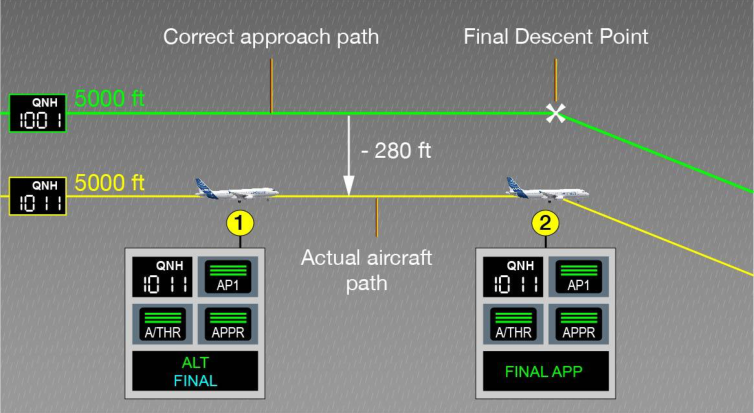
(fig.1) The aircraft commenced its approach 280 ft below the published approach
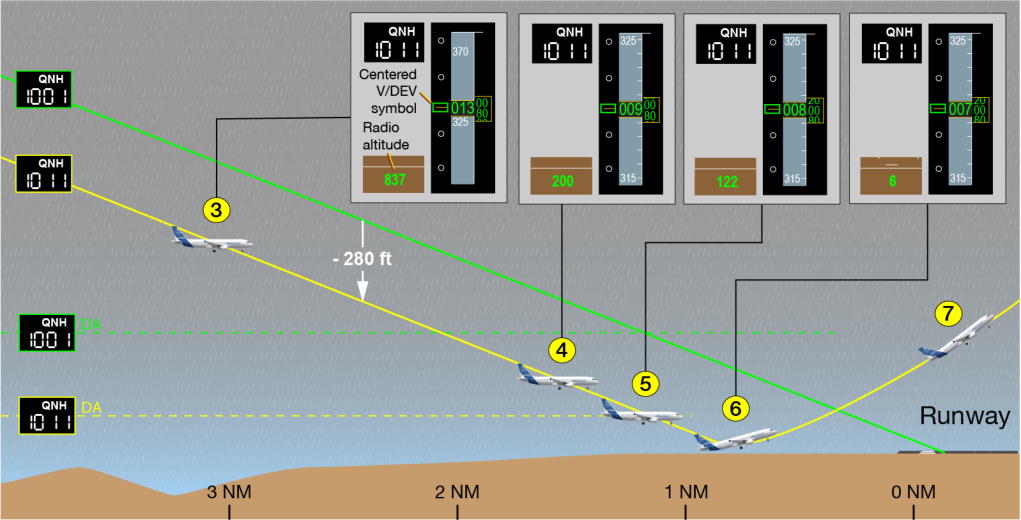
③ At 1392 ft indicated altitude (1000 ft above the airfield altitude), the aircraft was stabilized in CONF FULL at Vapp and the ND and PFD indicated that it was on its expected horizontal and vertical flight path (fig.2).
④ ATC received a Minimum Safety Altitude Warning (MSAW) when the aircraft was 1.53 NM from the runway threshold and had an indicated altitude of 891 ft.
⑤ The aircraft passed an 802 ft indicated altitude, corresponding to the Decision Altitude (DA) of the published approach plus 50 ft as per the airline policy. ATC transmitted a warning to the flight crew stating that they had an MSAW and asked the flight crew to confirm they had the runway in sight. The PF initiated a go-around 6 seconds after crossing the DA, at 735 ft indicated altitude.
⑥ The aircraft radio altitude indicated a descent to 6ft during the go-around maneuver. ⑦ The flight crew announced the go-around seconds later and were vectored for a second approach.
The second approach was also performed using the erroneous 1011 QNH value. ATC received another MSAW alert and alerted the flight crew. The flight crew had established visual contact with the runway on this approach. They disconnected the autopilot at 572 ft RA, used the PAPI indication to correct their trajectory, and they performed a manual landing.
(fig.2) After the initiation of the go-around, the aircraft descended as low as 6ft radio altitude before climbing
Event Analysis
Section titled “Event Analysis”During the final approach, the flight crew did not detect the erroneous vertical position because:
-
The vertical deviation symbol was centered
-
Altitude vs. distance checks were correct
-
There was no Terrain Avoidance Warning System (TAWS) alert.
Several RA auto-callouts should have been triggered according to the aircraft configuration. However, the cockpit voice recorder data was deleted during subsequent flights, and was therefore not available to confirm if the auto-callouts were triggered or not.
The runway approach lights were not turned ON for their first approach attempt in poor weather conditions, which made it extremely difficult for the flight crew to visually detect the runway. The lights were switched to ON before the second approach, and the flight crew was able to see the runway and correct their trajectory.
EFFECTS OF AN ERRONEOUS BARO SETTING
Section titled “EFFECTS OF AN ERRONEOUS BARO SETTING”An erroneous QNH/QFE value can seriously affect the safety of the flight as presented in the close call event described above.
Barometric altitude shift effect
Section titled “Barometric altitude shift effect”From the altimetry basics, a 1 hPa difference in the QNH/QFE value creates a 28 ft shift of the barometric altitude displayed on the PFD.
Effect on final approach guidance modes
Section titled “Effect on final approach guidance modes”All final approach guidance modes that use the barometric reference are affected by an erroneous entry on the QNH selector.
|---|---|---|---|---|---|---|---| |||||F-G/S||F-G/S|| |||||||||
(*) Only when RNP is selected for VNAV
Managed guidance
Section titled “Managed guidance”The FMS uses the aircraft barometric altitude to compute the deviation of the aircraft trajectory with the computed final descent path. If an erroneous barometric altitude is used, the aircraft will follow a flight path that is parallel to the published path but is shifted either above or below it (fig.3). The vertical deviation symbol, or the FLS symbol, will indicate that the aircraft is on the correct flight path even if it is not the case.
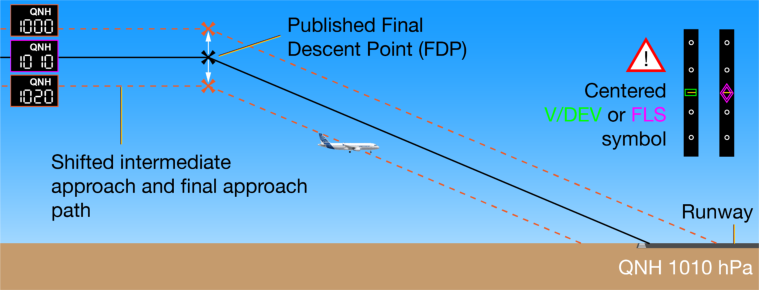
(fig.3) Example of the effects of an incorrect BARO setting on A320 family aircraft
Selected guidance
Section titled “Selected guidance”An erroneous barometric setting will also cause the FDP height above ground to be incorrect when using selected guidance. The flight crew is likely to commence final descent from an incorrect height above ground and therefore fly an approach path that is too high or too low.
Effect on altitude-vs-distance checks
Section titled “Effect on altitude-vs-distance checks”The flight crew will not detect an incorrect flight path with altitude-vs-distance checks if the barometric setting is erroneous. These checks use the displayed barometric altitude, which is based on the erroneous barometric setting. The effect is the flight crew will observe that they are at the expected altitude for each distance value, even if the aircraft is flying above or below the published flight path.
Potential absence of TAWS alert
Section titled “Potential absence of TAWS alert”Honeywell EGPWS
Section titled “Honeywell EGPWS”The relative proximity of the actual flight path to the published path prevents the TOO LOW TERRAIN EGPWS alert from triggering, because the path remains outside of the Terrain Clearance Floor (TCF) alert envelope (fig.4).
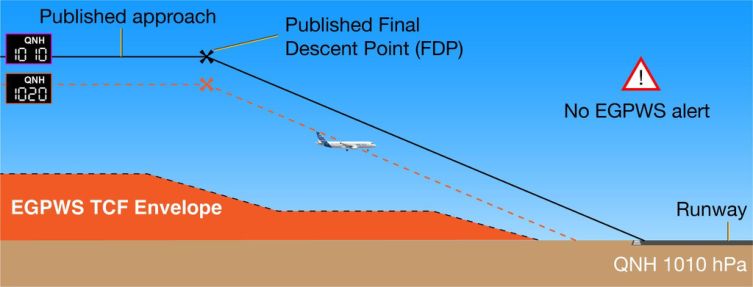
(fig.4) The TAWS may not detect a too low flight path
ACSS T2CAS and T3CAS
Section titled “ACSS T2CAS and T3CAS”The Premature Descent Alert (PDA) of the T2CAS and T3CAS may also not be triggered depending on the situation.
** G/S ** vertical guidance mode is not affected
Section titled “** G/S ** vertical guidance mode is not affected”The final approach path of approaches using ILS, GLS, or SLS guidance are not affected, because the G/S guidance mode uses the ILS signal or a beam computed with an augmented GPS altitude. The final approach path will remain aligned with the correct ILS/GLS/SLS beam even if the intermediate approach segment shifts due to the erroneous barometric setting (fig.5).
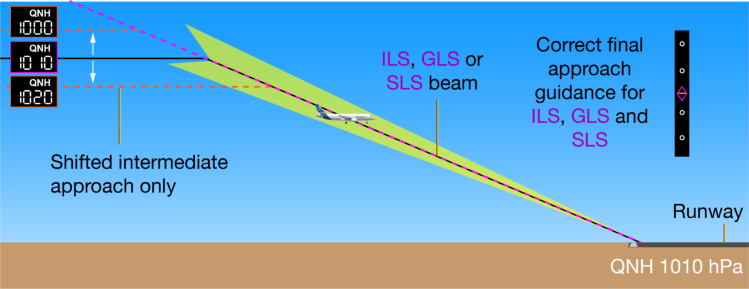
(fig.5) The final descent path of ILS, GLS, and SLS modes is not affected by an erroneous barometric setting
OPERATIONAL CONSIDERATIONS
Section titled “OPERATIONAL CONSIDERATIONS”Flight crews have two opportunities to detect a barometric reference setting discrepancy. The first is during descent and the second is during final approach.
Crosscheck the barometric reference
Section titled “Crosscheck the barometric reference”During descent, when cleared to an altitude, the flight crew should pay attention to a barometric reference that significantly differs from the ATIS barometric reference used for the approach preparation. Such a difference could be a symptom of barometric reference error. In this case, the flight crew should confirm that they have the correct barometric reference from all available sources.
Unexpected low RA callouts in final approach
Section titled “Unexpected low RA callouts in final approach”An abnormally decreasing RA audio callout while the barometric altitude is still high above airfield elevation is a clue that the aircraft may be too low on its final approach path. This can be due to a barometric reference discrepancy. However, RA callouts depend on the terrain profile and therefore may not be present if low terrain is located before the runway.
SYSTEM ENHANCEMENTS
Section titled “SYSTEM ENHANCEMENTS”ALTimeter Setting Monitoring (ALTSM) function
Section titled “ALTimeter Setting Monitoring (ALTSM) function”The ALTSM function, currently available on some Honeywell EGPWS standards, compares the barometric altitude on the captain side with the GPS altitude. If the difference exceeds a threshold, the EGPWS emits an “ALTIMETER SETTING” alert, and it is repeated if an incorrect barometric setting is still detected after some time.
Availability of the ALTSM function
Section titled “Availability of the ALTSM function”A first step of the ALTSM function is already proposed on A320 and A330 aircraft equipped with Honeywell EGPWS standards P/N 965-1676-006, 69000942-151, and 69000942-251. It can be activated on the compatible computer standards via a Service Bulletin (SB). This first step prepares the introduction of the second step of the function that will add a flashing QNH/QFE value on the PFD in addition to the audio alert. It will also protect the QFE setting. This second step will be included in the Landing Surveillance package, to be incrementally certified from 2023 to 2024. It will be available on production aircraft and proposed for retrofit, for both EGPWS and T3CAS computers. More information on ALTSM and on the Landing Surveillance package is available at: https://www.navblue.aero/product/landing-surveillance.
A similar function will be available in the next A350 surveillance computer standard that is planned to be available in 2027 on newly produced aircraft.
The following table provides an overview of ALTSM availability on Airbus aircraft:
| Function | A220 | A300/A310 | A320 family | A330/A340 | A350 | A380 |
|---|
Contributors:
Section titled “Contributors:”David CARLU Surveillance System Designer Design Office
Pierre LABRO
Section titled “Pierre LABRO”Accident/Incident Investigator Product Safety
Maxime LANSONNEUR Flight Operations Standards Expert Customer Support
Lorenz
Section titled “Lorenz”WILLER-CERCLIER Landing Safety - Navblue
With thanks to Cedric DESCHEEMAEKER and Domenico SPATARO from Product Safety, Brigitte LECONTE DABIN and Julien ROBIN from the FMS Design Office, Thomas GOBEAUT and Andy RICOME from Flight Operations Customer Support.
An undetected erroneous BARO setting can cause an aircraft to fly above or below the published final approach flight path when following approach guidance that uses a barometric reference. Vertical deviation indications are shown as correct, even if the aircraft is not on the correct flight path, with an incorrect BARO setting. Standard altitude-vs-distance checks will also wrongly confirm that an aircraft is on the correct trajectory, because it uses the same erroneous barometric reference. If visual conditions are not sufficient, the flight crew may not be able to detect that their aircraft is on an incorrect flight path in time to adjust their trajectory or perform a go-around.
Flight crew can detect a potential erroneous barometric reference by comparing the barometric reference provided by the ATC at the first altitude clearance during descent, with the value provided by the ATIS during descent preparation. If there is a significant discrepancy between the two values, the flight crew should crosscheck the barometric references with all available sources.
Depending on the terrain configuration, abnormally decreasing RA audio callouts while the barometric altitude is still high above airfield elevation might also help the flight crew to diagnose an issue with the barometric reference.
The ALTimeter Setting Monitoring (ALTSM) function is currently available on some TAWS computer standards. It compares the barometric altitude on the captain side with the GPS altitude and warns the crew if the exceeds a threshold. Airbus is flight difference working on an update of the ALTSM function that will be available for more TAWS computer standards and will provide a visual alert in addition to the current audio alert.
Safety first, 2022. Safety first is published by Airbus S.A.S. 1, rond point Maurice Bellonte - 31707 Blagnac Cedex/France.
Editor: Yannick Malinge, Chief Product Safety Officer.
Editorial team: Guillaume Estragnat, Vanessa Sadi, Gwyneth Duggan, Tim Roach.
- Reference: X00D16031905.
Photos by Airbus.
来源:Airbus Safety First 网址:https://safetyfirst.airbus.com/use-the-correct-baro-setting-for-approach/ 发布日期:2022-11-15 类别:飞行运营、高度表设置、气压高度测量、ALTSM、气压式、QFE、QNH、TAWS PDF:原始 PDF
在进近过程中使用错误的气压基准设置可能导致飞机低于公布的进近航道飞行,因为垂直引导和轨迹偏差使用的是气压基准。这会在低能见度条件或夜间飞行时增加可控撞地风险。
本文阐述了错误气压基准的潜在后果,并为飞行机组提供了如何检测此类错误的指导,同时介绍了在检测到错误 BARO 基准时提醒飞行机组可用的系统增强功能。
本文也可在 safetyfirst.airbus.com 以及 iOS 和 Android 设备上的 Safety first 应用中获取。
一架空客 A320 的飞行机组在从巡航飞行高度层下降之前,准备执行一次 RNP 进近,航迹为 LNAV/VNAV 最低标准。自动终端情报服务(ATIS)为他们提供了机场 QNH 为 1001 hPa。
在下降过程中,空中交通管制(ATC)指示飞行机组下降至 6000 ft QNH 1011 hPa,两分钟后又指示下降至 5000 ft QNH 1011 hPa。飞行机组确认了两次指令,复述了错误的 1011 hPa QNH,该值比机场当前 QNH 高出 10 hPa。
① 飞机在 5000 ft QNH 1011 hPa 处平飞**(图 1)**。这使得它比使用正确 QNH 1001 hPa 的预期 5000 ft 高度低约 280 ft。自动驾驶仪和自动推力接通,A320 到达最终下降点后②使用 FINAL APP 引导模式开始最终下降。飞机在无目视参考、轻度颠簸的情况下穿过一阵雨。
**(图 1)**飞机比公布的进近航道低 280 ft 开始进近
③ 在指示高度 1392 ft 处(高于机场高度 1000 ft),飞机在 CONF FULL、Vapp 形态下稳定,ND 和 PFD 显示飞机处于预期的水平和垂直航迹上**(图 2)**。
④ 当飞机距跑道入口 1.53 NM、指示高度为 891 ft 时,ATC 收到最低安全高度警告(MSAW)。
⑤ 飞机通过指示高度 802 ft,对应公布的进近决断高度(DA)按公司政策加 50 ft。ATC 向飞行机组发送警告,告知他们触发了 MSAW,并要求飞行机组确认已目视跑道。PF 在穿过 DA 后 6 秒、指示高度 735 ft 处开始复飞。
⑥ 在复飞机动过程中飞机无线电高度降至 6 ft。⑦ 飞行机组稍后宣布复飞并被引导进行第二次进近。
第二次进近同样使用了错误的 1011 QNH 值。ATC 再次收到 MSAW 警报并提醒飞行机组。飞行机组在这次进近中目视建立了对跑道的参考。他们在无线电高度 572 ft 处断开自动驾驶仪,使用 PAPI 指示修正轨迹,执行了人工着陆。
**(图 2)**复飞开始后,飞机下降至无线电高度 6 ft 后才上升
在最终进近过程中,飞行机组未能检测到错误的垂直位置,因为:
- 垂直偏差符号居中
- 高度与距离检查正常
- 没有触发地形感知与警告系统(TAWS)警报。
根据飞机形态,应触发多个 RA 自动呼叫。但驾驶舱语音记录器的数据在后续飞行中被删除,因此无法确认自动呼叫是否被触发。
第一次进近尝试时,在恶劣天气条件下跑道进近灯未打开,这使得飞行机组几乎无法目视发现跑道。第二次进近前灯光打开,飞行机组能够看到跑道并修正轨迹。
错误 BARO 设置的影响
Section titled “错误 BARO 设置的影响”如上述险情事件所示,错误的 QNH/QFE 值会严重影响飞行安全。
气压高度偏移效应
Section titled “气压高度偏移效应”根据高度测量原理,QNH/QFE 值每相差 1 hPa,PFD 上显示的气压高度就会产生 28 ft 的偏移。
对最后进近引导方式的影响
Section titled “对最后进近引导方式的影响”所有使用气压基准的最后进近引导方式都会受到 QNH 选择器错误输入的影响。
|---|---|---|---|---|---|---|---| |||||F-G/S||F-G/S|| |||||||||
(*) 仅当 VNAV 选择了 RNP 时
FMS 使用飞机气压高度来计算飞机轨迹与计算的最终下降轨迹之间的偏差。如果使用了错误的气压高度,飞机会沿一条与公布轨迹平行的轨迹飞行,但会偏离其上方或下方(图3)。垂直偏差符号或 FLS 符号会指示飞机在正确的飞行轨迹上,即使事实并非如此。
(图3) A320 系列飞机上错误 BARO 设置的影响示例
使用选择引导时,错误的气压设置也会导致 FDP 高度高于地面的数值不正确。机组人员很可能从错误的高度高于地面开始最终下降,因此飞出的进近轨迹会过高或过低。
对高度-距离检查的影响
Section titled “对高度-距离检查的影响”如果气压设置错误,机组人员将无法通过高度-距离检查发现错误的飞行轨迹。这些检查使用显示的气压高度,而该高度基于错误的气压设置。结果是机组人员会观察到他们在每个距离值处都处于预期高度,即使飞机实际飞行的轨迹高于或低于公布的飞行轨迹。
TAWS 警告可能缺失
Section titled “TAWS 警告可能缺失”霍尼韦尔 EGPWS
Section titled “霍尼韦尔 EGPWS”实际飞行轨迹与公布轨迹的相对接近度会阻止 TOO LOW TERRAIN EGPWS 警告触发,因为该轨迹仍处于地形间隙面(TCF)警告包线之外(图4)。
(图4) TAWS 可能无法检测到过低的飞行轨迹
ACSS T2CAS 和 T3CAS
Section titled “ACSS T2CAS 和 T3CAS”根据情况,Premature Descent Alert(PDA)也可能不会被 T2CAS 和 T3CAS 触发。
G/S 垂直引导方式不受影响
Section titled “G/S 垂直引导方式不受影响”使用 ILS、GLS 或 SLS 引导的进近的最后进近轨迹不受影响,因为 G/S 引导方式使用 ILS 信号或使用增强型 GPS 高度计算的波束。即使中间进近段因错误的气压设置而偏移,最终进近轨迹仍将与正确的 ILS/GLS/SLS 波束对齐(图5)。
(图5) ILS、GLS 和 SLS 模式的最终下降轨迹不受错误气压设置的影响
运营注意事项
Section titled “运营注意事项”机组人员有两次机会发现气压基准设置差异。第一次是在下降期间,第二次是在最后进近期间。
交叉检查气压基准
Section titled “交叉检查气压基准”在下降期间,当被许可至某一高度时,机组人员应注意气压基准与用于进近准备的 ATIS 气压基准之间存在显著差异。这种差异可能是气压基准错误的症状。在这种情况下,机组人员应从所有可用来源确认他们拥有正确的气压基准。
最后进近中意外的低声高无线电高度(RA)喊话
Section titled “最后进近中意外的低声高无线电高度(RA)喊话”当气压高度仍远高于机场标高时,出现声高无线电高度(RA)音频喊话异常递减是飞机在最后进近路径上可能过低的线索。这可能是由于气压基准差异造成的。然而,RA 喊话取决于地形剖面,因此如果低地形位于跑道之前,则可能不会出现。
系统增强功能
Section titled “系统增强功能”气压高度设置监控(ALTSM)功能
Section titled “气压高度设置监控(ALTSM)功能”ALTSM 功能目前已在部分霍尼韦尔 EGPWS 标准中可用,将机长侧的气压高度与 GPS 高度进行比较。如果差值超过阈值,EGPWS 会发出”ALTIMETER SETTING”警告,如果在一段时间后仍检测到错误的气压设置,则会重复该警告。
ALTSM 功能的可用性
Section titled “ALTSM 功能的可用性”ALTSM 功能的第一步已在配备霍尼韦尔 EGPWS 标准 P/N 965-1676-006、69000942-151 和 69000942-251 的 A320 和 A330 飞机上提出。可通过服务通告(SB)在兼容的计算机标准上激活此第一步。该第一步为第二步功能的引入做准备,第二步将在音频警告的基础上增加 PFD 上闪烁的 QNH/QFE 数值。它还将保护 QFE 设置。第二步将包含在进近监控(Landing Surveillance)数据包中,计划于 2023 年至 2024 年逐步认证。它将可用于生产飞机,并建议进行改装,适用于 EGPWS 和 T3CAS 计算机。有关 ALTSM 和进近监控数据包的更多信息,请访问:https://www.navblue.aero/product/landing-surveillance。
类似的功能将在计划于 2027 年在新生产飞机上推出的下一代 A350 监控计算机标准中提供。
下表概述了空中客车飞机上 ALTSM 的可用性:
| 功能 | A220 | A300/A310 | A320 系列 | A330/A340 | A350 | A380 |
|---|
David CARLU 监视系统设计师 设计办公室
Pierre LABRO 事故/事件调查员 产品安全
Maxime LANSONNEUR 飞行操作标准专家 客户支持
Lorenz WILLER-CERCLIER 着陆安全 - Navblue
特别感谢产品安全的 Cedric DESCHEEMAEKER 和 Domenico SPATARO,FMS 设计办公室的 Brigitte LECONTE DABIN 和 Julien ROBIN,以及飞行操作客户支持的 Thomas GOBEAUT 和 Andy RICOME。
未被发现的错误 BARO 设置会导致飞机在使用气压基准的进近引导时,高于或低于公布的最后进近航迹飞行。即使飞机不在正确航迹上,如果 BARO 设置错误,垂直偏差指示仍会显示为正确。标准高度-距离检查也会错误地确认飞机在正确轨迹上,因为它使用相同的错误气压基准。如果目视条件不足,机组可能无法及时发现飞机处于错误的进近航迹,从而无法调整其轨迹或执行复飞。
机组可以通过将 ATC 在下降过程中首次高度许可中提供的气压基准值与在下降准备期间 ATIS 提供的气压值进行比较来检测潜在的气压基准错误。如果两个数值之间存在显著差异,机组应使用所有可用来源交叉检查气压基准。
根据地形配置,当气压高度仍远高于机场标高时,出现异常递减的 RA(无线电高度)语音提示也可能帮助机组诊断气压基准问题。
ALTimeter Setting Monitoring(气压基准设置监控,ALTSM)功能目前已在部分 TAWS 计算机标准上可用。它将机长侧的气压高度与 GPS 高度进行比较,如果差值超过阈值,则向机组发出警告。空客正在开发 ALTSM 功能的升级版本,将适用于更多 TAWS 计算机标准,除现有音频警告外还将提供视觉警告。
Safety first, 2022. Safety first 由空客 S.A.S. 出版 地址:1, rond point Maurice Bellonte - 31707 Blagnac Cedex/France
编辑:Yannick Malinge,产品安全总监
编辑团队:Guillaume Estragnat、Vanessa Sadi、Gwyneth Duggan、Tim Roach
编号:20192534。参考编号:X00D16031905
照片由空客提供。