Unreliable Speed
Source: Airbus Safety First URL: https://safetyfirst.airbus.com/unreliable-speed/ Published: 2007-12-14 Magazine Issue: 2007-12 Category: Archive PDF: Original PDF
By: Joelle Barthe Flight Operations Engineer
1 Introduction
Section titled “1 Introduction”Unreliable speed is one of the difficult situations that a pilot has to face. Once the failure has been identified, a procedure, based on pitch angles and thrust settings, will assist the pilot in safely flying the aircraft.
But the main difficulty is to rapidly detect an unreliable speed situation. Reaction time is crucial, since the aircraft may stall and overspeed conditions could cause aircraft damage.
In issue #3 of the Safety First magazine (December 2006), an article described the effects of pitot probes obstruction on ground. It intended to make ground and flight crew more sensitive to the consequences of obstructed probes, and to prevent take-off with unreliable speed.
But once airborne, how can the crew handle an unreliable speed situation?
This article therefore provides guidelines to recall how an unreliable speed situation can be identified, but also how to deal with it.
Note: this article is based on A320/A330/A340 design. Cockpit effects, identification and troubleshooting, remains similar for wide body aircraft and A380, with some specificities covered in the operational documentation.
2 Effects and consequences in the cockpit
Section titled “2 Effects and consequences in the cockpit”Water, ice, dust, ashes, etc. may partially or totally block pitot probes and static ports. Equally, tubes misconnected to the Air Data Modules (ADM), plastic covers not removed from the probes, insect nests, radome damage, may lead to erroneous pressure measurements.
The consequences of this erroneous pressure information, once used by the ADRs and/or the standby instruments, are the computation and the display of unreliable speed and/or altitude for all users.
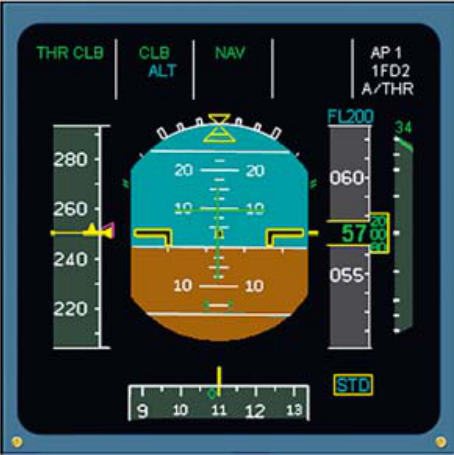
CAPT PFD
Erroneous speed or altitude indications can be suspected, among others, in the following cases:
-
Speed discrepancy (between ADR 1, 2, 3 and standby indication),
-
The fluctuation of the Indicated Air Speed or of the Pressure Altitude,
-
Abnormal correlation between basic flight parameters (IAS, attitude, pitch, thrust, climb rate),
-
Abnormal AP/FD/ATHR behaviour,
-
STALL and OVERSPEED warnings or FLAP RELIEF on ECAM that are in contradiction with at least one of the indicated airspeeds,
-
Inconsistency between radio altitude and pressure altitude,
-
Impossibility of extending the landing gear by the normal landing gear system.
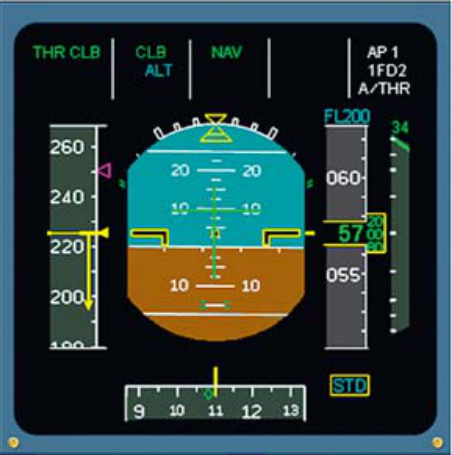
F/O PFD
Depending on the affected probe, i.e. pitot probe or static port, different indications in the cockpit will become unreliable. Therefore the crew should be aware that some of the usual cues to fly could be unreliable as indicated:
|---|---|---| |Indicated Speed/Mach|Erroneous|Erroneous| |Altitude|Ok|Erroneous| |Vertical Speed|Ok|Erroneous| |FPV|Ok|Erroneous| |AP/FD|Erroneous|Erroneous| |ATC altitude report|Ok|Erroneous|
Nevertheless, it should be emphasized that identifying an unreliable speed indication is not always obvious: no single rule can be given to conclusively identify all possible erroneous indications and the display of contradictory information may confuse the flight crew. Pilots should therefore be aware of unreliable speed symptoms and consequences.
3 Identification and Handling of Unreliable Speed situations
Section titled “3 Identification and Handling of Unreliable Speed situations”Airbus has developed procedures and guidelines to help crews identify and handle an unreliable speed situation.
The Volume 3 of the Flight Crew Operating Manual (FCOM) and the Quick Reference Handbook (QRH) provide the UNRELIABLE SPEED INDIC / ADR CHECK PROC procedure.
In addition, Airbus has developed training material in the Flight Crew Training Manual (FCTM, available for A320/A330/A340/A380). The FCTM provides information about the causes and consequences of unreliable ADR computations. It also provides information on how to apply the UNRELIABLE SPEED INDIC / ADR CHECK PROC of the QRH.
An interactive training tool, the e-Briefing, is also available on https://w3.airbus.com/ in the Flight Operations community, under the heading “Safety and Operational materials”.
4 Procedures
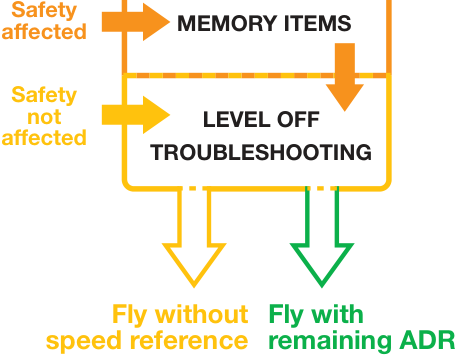
Section titled “4 Procedures”As soon as a doubt about airspeed indication arises, or a relevant ECAM alert is triggered (relative to ADRs failure or discrepancy for instance), the UNRELIABLE SPEED INDICATION/ADR CHECK PROC procedure should be applied by the crew, following this sequence:
-
- If the safe conduct of the flight is affected, APPLY THE MEMORY ITEMS, i.e. fly a pitch with TOGA or CLB thrust,
-
- If the safe conduct of the flight is not affected, or once the memory items have been applied, LEVEL OFF, if necessary, and start TROUBLESHOOTING,
-
- If the affected ADR can be identified, fly with the remaining ADR.
-
- If the affected ADR cannot be identified or all airspeed indications remain unreliable, FLY WITH PITCH/THRUST REFERENCES.
4.1 Memory Items
Section titled “4.1 Memory Items”If the safe conduct of the flight is affected, the flight crew applies the memory items: these allow “safe flight conditions” to be rapidly established in all flight phases (take-off, climb, cruise) and aircraft configurations (weight and slats/flaps). The memory items apply more particularly when a failure appears just after take-off.
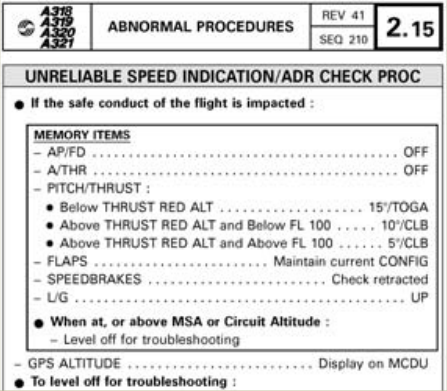
Once the target pitch attitude and thrust values have been stabilized at or above minimum safe altitude, or when the safe conduct of the flight is not affected, the flight crew will enter the 2nd part of the QRH procedure: level off the aircraft and perform troubleshooting.
4.2 Troubleshooting and isolation
Section titled “4.2 Troubleshooting and isolation”The table provided in the QRH gives the pitch (°) and thrust (%N1) to be applied to level off the aircraft according to its weight, altitude and configuration, along with flying technique advices.
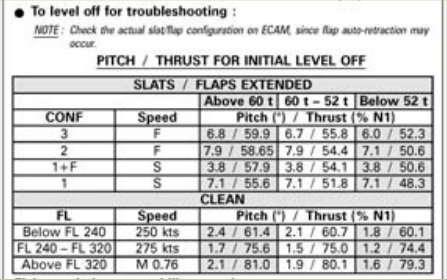
In situations where most primary flight data are erroneous, some indications may still remain correct and should consequently be used to help the crew stabilize the flight path. This is the case for the Flight Path Vector (FPV), reliable if the static ports are not blocked, and for the GPS altitude displayed on the MCDU, when GPS is installed.
When the flight path is stabilized, the flight crew will start the troubleshooting, keeping in mind that sometimes two or even all three ADRs might provide identical but erroneous data (e.g. due to icing conditions, flight in volcanic ashes, etc.).
Therefor, do not instinctively reject an ADR that is suspected to be affected.
If the troubleshooting procedure enables the crew to identify the affected ADR(s), then a normal situation can be resumed.
But if the affected ADR cannot be identified, or all ADRs are affected, then the flight crew will fly without speed reference, using the pitch and thrust tables.
4.3 Flying using pitch/thrust tables
Section titled “4.3 Flying using pitch/thrust tables”First, the crew has to switch OFF two ADRs and keep one ADR ON, to keep the Stall Warning Protection.
Then, the crew will fly the aircraft without speed references, using pitch (°) and thrust (%N1) settings.
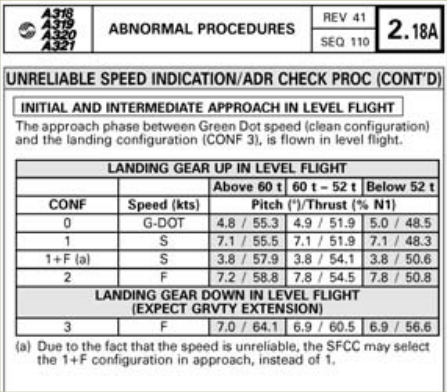
To fly the aircraft using pitch and thrust settings, the crew will find in the QRH the tables relative to each phase of flight: Climb, Cruise, Descent and Approach, taking into account the aircraft weight, configuration and altitude. With these tables, the crew will be able to safely land the aircraft.
5 Back Up Speed Scale (BUSS)
Section titled “5 Back Up Speed Scale (BUSS)”In order to decrease the crew workload in case of unreliable speed, Airbus has developed the BackUp Speed Scale (BUSS) that replaces the pitch and thrust tables. The BUSS is optional on A320/A330/A340. It is basic on A380, being part of the ADR Monitoring functions.
This indication is based on angle of attack (AOA) sensor information, and is therefore not affected by erroneous pressure measurements.
The BUSS comes with a new ADIRU standard (among other new system standards), where the AOA information is provided through the IRs and not through the ADRs. This enables selecting all ADRs off without loosing the Stall Warning Protection.
The AOA information provides a guidance area in place of the speed scale. When the crew selects all ADRs OFF, then:
-
The Back-Up Speed Scale replaces the PFD speed scale on both PFDs,
-
GPS Altitude replaces the Altitude Scale on both PFDs.
The Back-Up Speed Scale then enables to fly at a safe speed, i.e. above stall speed and below maximum structural speeds, by adjusting thrust and pitch.
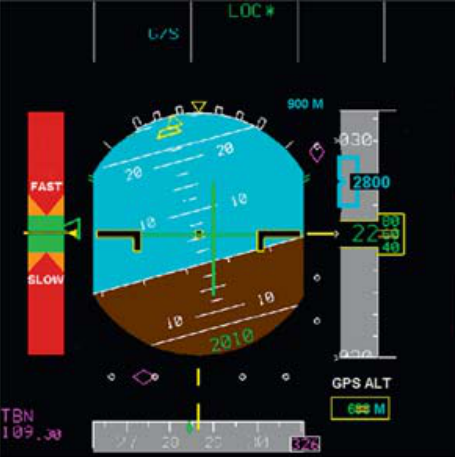
Buss: “Fly the green”
The BUSS will be displayed once all ADRs are switched OFF. Therefore, on aircraft that have the BUSS, when the flight crew cannot identify the faulty ADR(s) when performing the troubleshooting, or when all ADRs are affected, the flight crew will switch OFF all ADRs, and will fly the green area of the BUSS.
6 Conclusion
Section titled “6 Conclusion”An unreliable speed situation may be difficult to identify, due to the multiple scenarios that can lead to it. Therefore, training is a key element: indeed the flight crew’s ability to rapidly detect the abnormal situation, and to correctly handle it, is crucial.
In case of any doubt, the pilot should apply the pitch/thrust memory items, and then refer to the QRH to safely fly the aircraft, and to positively determine the faulty source(s) before eliminating it (them).
In addition, to further assist the pilot in detecting the failure and safely fly the aircraft, Airbus has developed the BUSS, which provides a safe flying range indication.
Finally, to reduce the probability of experiencing unreliable speed situations, on-ground actions, such as comprehensive maintenance and thorough pre-flight exterior inspection, should be stressed.
However, if the safe conduct of the flight is affected, the memory items must still be applied before troubleshooting.
As the BUSS is associated to the ADR monitoring functions, some unreliable speed situations can be automatically detected (e.g. new ECAM warning “NAV ADR 1+2+3 FAULT”), and some ECAM procedures will lead to the BUSS activation by requesting to switch OFF all ADRs.
来源: Airbus Safety First 网址: https://safetyfirst.airbus.com/unreliable-speed/ 发布日期: 2007-12-14 杂志期号: 2007-12 分类: Archive PDF: Original PDF
作者:Joelle Barthe 飞行操作工程师
不可靠空速是飞行员必须面对的困难情况之一。一旦识别出故障,基于俯仰角和推力设置的程序将帮助飞行员安全驾驶飞机。
但主要困难在于快速检测到不可靠空速情况。反应时间至关重要,因为飞机可能失速,而超速状况可能导致飞机损坏。
在《Safety First》杂志第3期(2006年12月)中,一篇文章描述了皮托管(pitot probe)阻塞对地面的影响。该文旨在使地面和飞行机组人员对阻塞探头的后果更加敏感,并防止在不可靠空速状态下起飞。
但一旦在空中,机组人员如何处理不可靠空速情况?
因此,本文提供了指导原则,以回顾如何识别不可靠空速情况,以及如何处理。
注:本文基于A320/A330/A340设计。对于宽体飞机和A380,驾驶舱效应、识别和故障排除方法基本相似,具体特性在运营文件中有所涵盖。
2 驾驶舱内的影响和后果
Section titled “2 驾驶舱内的影响和后果”水、冰、灰尘、灰烬等可能导致皮托管和静压口部分或完全堵塞。同样,连接到大气数据模块(ADM)的管路连接错误、探头上的塑料保护罩未拆除、昆虫巢穴、雷达天线罩损坏等可能导致错误的压力测量。
一旦大气数据基准(ADR)和/或备用仪表使用这些错误的压力信息,其后果是为所有用户提供不可靠的速度和/或高度的计算和显示。
机长主飞行显示器(PFD)
在以下情况(以及其他情况)下,可怀疑空速或高度指示有误:
- 速度不一致(ADR 1、2、3与备用指示之间)
- 指示空速或气压高度的波动
- 基本飞行参数(IAS、姿态、俯仰、推力、爬升率)之间的异常关联
- 自动驾驶仪/飞行指引仪/自动推力(AP/FD/ATHR)行为异常
- ECAM上的失速和超速警告或FLAP RELIEF与至少一个指示空速相矛盾
- 无线电高度与气压高度之间不一致
- 正常起落架系统无法放出起落架
副驾驶主飞行显示器(PFD)
根据受影响的探头(即皮托管或静压口),驾驶舱内的不同指示将变得不可靠。因此,机组人员应意识到某些常用的飞行参考可能不可靠,如下所示:
|---|---|---| |指示空速/马赫数|错误|错误| |高度|正常|错误| |垂直速度|正常|错误| |FPV(飞行航迹矢量)|正常|错误| |AP/FD(自动驾驶仪/飞行指引仪)|错误|错误| |ATC高度报告|正常|错误|
然而,应强调的是,识别不可靠空速指示并不总是一目了然的:没有单一规则可以明确识别所有可能的错误指示,矛盾信息的显示可能会使飞行机组感到困惑。因此,飞行员应了解不可靠空速的症状和后果。
3 不可靠空速情况的识别和处理
Section titled “3 不可靠空速情况的识别和处理”空中客车公司已开发了程序和指南,以帮助机组识别和处理不可靠空速情况。
《飞行机组操作手册》(FCOM)第3卷和《快速参考手册》(QRH)提供了UNRELIABLE SPEED INDIC / ADR CHECK PROC(不可靠空速指示/ADR检查程序)程序。
此外,空中客车公司还在《飞行机组培训手册》(FCTM,适用于A320/A330/A340/A380)中开发了培训材料。FCTM提供了关于不可靠ADR计算的原因和后果的信息,还提供了如何应用QRH中UNRELIABLE SPEED INDIC / ADR CHECK PROC程序的说明。
在https://w3.airbus.com/的飞行操作社区中,标题为”Safety and Operational materials”(安全与操作材料)下,还提供了一种互动培训工具——e-Briefing。
一旦对空速指示产生疑问,或触发了相关ECAM警告(例如与ADR故障或不一致相关),机组人员应按以下顺序应用UNRELIABLE SPEED INDICATION/ADR CHECK PROC(不可靠空速指示/ADR检查程序)程序:
-
- 如果飞行的安全操作受到影响,应用记忆项目,即使用TOGA或CLB推力进行俯仰飞行,
-
- 如果飞行的安全操作未受影响,或在应用记忆项目后,如有必要,改为平飞,并开始故障排除,
-
- 如果能够识别受影响的ADR,使用剩余的ADR飞行,
-
- 如果无法识别受影响的ADR或所有空速指示仍然不可靠,使用俯仰/推力参考飞行。
4.1 记忆项目
Section titled “4.1 记忆项目”如果安全飞行受到影响,机组应执行记忆项目:这些项目可以在所有飞行阶段(起飞、爬升、巡航)和飞机构型(重量和缝翼/襟翼)下快速建立“安全飞行条件”。记忆项目尤其适用于故障发生在刚起飞后的情况。
一旦目标俯仰姿态和推力值在最低安全高度或以上稳定,或者当安全飞行不受影响时,机组将进入快速参考手册程序的第二部分:使飞机改平并进行故障排除。
4.2 故障排除与隔离
Section titled “4.2 故障排除与隔离”快速参考手册中提供的表格给出了根据飞机重量、高度和构型改平飞机所需应用的俯仰角(°)和推力(%N1),以及飞行技术建议。
在大多数主要飞行数据错误的情况下,某些指示仍可能保持正确,因而应被用来帮助机组稳定飞行轨迹。飞行轨迹矢量(FPV)就是这种情况——在静压口未堵塞的情况下是可靠的;当装有 GPS 时,导航控制显示单元(MCDU)上显示的 GPS 高度也是如此。
当飞行轨迹稳定后,机组将开始故障排除,同时记住有时两个甚至全部三个大气数据基准(ADR)可能提供相同但错误的数据(例如,由于结冰条件、在火山灰中飞行等)。
因此,不要本能地拒绝一个疑似受影响的 ADR。
如果故障排除程序使机组能够识别受影响的 ADR,则可以恢复正常状况。
但如果无法识别受影响的 ADR,或者所有 ADR 都受到影响,则机组将在没有速度参考的情况下飞行,使用俯仰角和推力表格。
4.3 使用俯仰角/推力表飞行
Section titled “4.3 使用俯仰角/推力表飞行”首先,机组必须关闭两个 ADR 并保持一个 ADR 接通,以保留失速警告保护功能。
然后,机组将使用俯仰角(°)和推力(%N1)设置,在没有速度参考的情况下驾驶飞机。
为了使用俯仰角和推力设置驾驶飞机,机组将在快速参考手册中找到与每个飞行阶段相关的表格:爬升、巡航、下降和进近,并考虑飞机重量、构型和高度。有了这些表格,机组将能够安全地驾驶飞机落地。
5 备用速度刻度(BUSS)
Section titled “5 备用速度刻度(BUSS)”为了降低不可靠空速情况下的机组工作负荷,空客开发了备用速度刻度(BackUp Speed Scale,BUSS),取代俯仰角和推力表格。BUSS 在 A320/A330/A340 上为选装项目。在 A380 上为基本配置,作为 ADR 监控功能的一部分。
该指示基于攻角(AOA)传感器信息,因此不受错误气压测量的影响。
BUSS 随新的 ADIRU 标准(以及其他新系统标准)一同提供,其中攻角信息通过惯性基准(IR)提供,而非通过 ADR 提供。这使得可以在不失去失速警告保护功能的情况下选择关闭所有 ADR。
攻角信息提供一个替代速度刻度的引导区域。当机组选择关闭所有 ADR 时:
- 备用速度刻度在两个主飞行显示(PFD)上取代主飞行显示速度刻度,
- GPS 高度在两个主飞行显示上取代高度刻度。
然后备用速度刻度通过调节推力和俯仰,使飞机以安全速度飞行,即高于失速速度且低于最大结构速度。
BUSS:“飞绿色区域”
BUSS 将在所有 ADR 关闭后显示。因此,在装有 BUSS 的飞机上,当机组在执行故障排除时无法识别故障 ADR,或者当所有 ADR 都受到影响时,机组将关闭所有 ADR,并驾驶 BUSS 的绿色区域。
不可靠空速情况可能难以识别,因为导致该情况的情景众多。因此,培训是关键要素:事实上,机组迅速发现异常情况并正确处理的能力至关重要。
如有任何疑问,飞行员应执行俯仰角/推力记忆项目,然后参阅快速参考手册安全驾驶飞机,并在排除故障源之前积极确定故障源。
此外,空客开发了 BUSS,以进一步帮助飞行员检测故障并安全驾驶飞机,BUSS 提供安全飞行范围指示。
最后,为了降低发生不可靠空速情况的概率,应强调地面措施,例如全面维护和飞行前仔细的外观检查。
但是,如果安全飞行受到影响,在进行故障排除之前仍必须执行记忆项目。
由于 BUSS 与 ADR 监控功能相关,某些不可靠空速情况可以被自动检测(例如,新的电子 centralized aircraft monitoring 电子中央式飞机监控系统警告“导航 ADR 1+2+3 故障”),某些电子中央式飞机监控系统程序将通过要求关闭所有 ADR 来触发 BUSS 启动。