A Focus on the Landing Flare
Source: Airbus Safety First URL: https://safetyfirst.airbus.com/a-focus-on-the-landing-flare/ Published: 2020-09-01 Category: Flight Ops, bounce, flare, go around, landing, overrun, retard, runway overrun, stabilized, strike, tail strike, tailstrike PDF: Original PDF

There were several cases of aircraft touching down with their nose landing gear first or hard landings reported to Airbus over the last 2 This article will some years. present key points coming from the analysis of two of these incidents and recall the operational recommendations for performing the flare phase that are key to ensuring a safe landing.
This article is also available on safetyfirst.airbus.com and on the Safety first app for iOS and Android devices.
CASE STUDY 1: BOUNCED
Section titled “CASE STUDY 1: BOUNCED”LANDING, NOSE LANDING GEAR IMPACT, AND A TAIL STRIKE ON GO-AROUND
Event Description
Section titled “Event Description”An A320 was on the final approach segment of its ILS approach, configured for landing (CONF FULL).
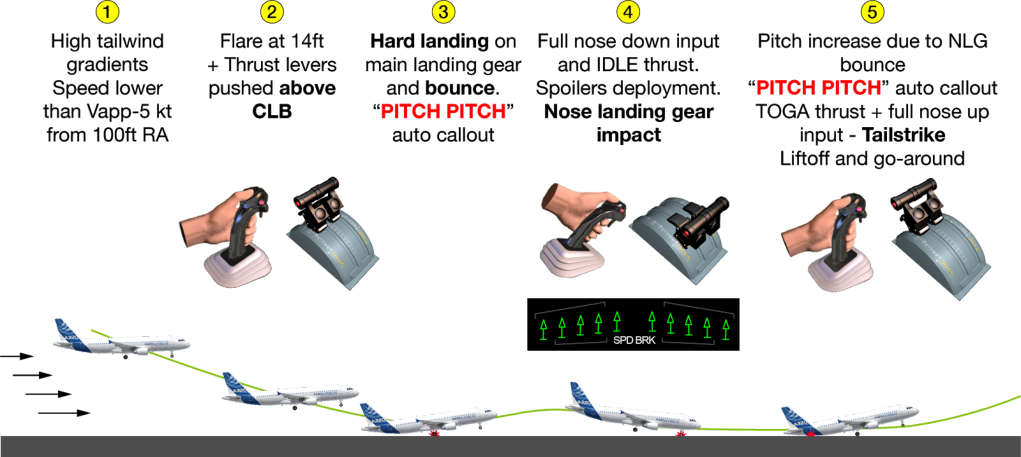
The Pilot Flying (PF) disconnected the autopilot at 370 ft Radio Altitude (RA) and kept autothrust ON. At 200 ft, tailwind variations caused the airspeed drop below approach speed (Vapp).
From 100 ft RA and below, high tailwind gradients maintained the airspeed below Vapp -5 kt despite autothrust increase and reached a minimum of 119 kt (Vapp -20 kt) at 5 ft RA.
The PF performed the flare at 14 ft and at the same time started to slowly push the thrust levers above CLB detent.
The aircraft touched down on its main landing gear and bounced. During the bounce, a PITCH PITCH auto callout triggered.
The PF applied full nose down order and retarded the thrust levers to IDLE. This triggered an extension of ground spoilers leading the aircraft to heavily impact the runway , first with its nose landing gear and then its main landing gear.
The impact of the nose gear resulted in another sudden increase of the aircraft’s pitch and the PITCH PITCH auto callout triggered for a second time. The PF initiated a go-around by setting TOGA thrust and applying a full nose up command. There was a tail strike as the aircraft lifted off from the runway at 133 kt.
The NLG wheels separated due to the impact of the NLG on the runway and one wheel was sucked into Engine 1, causing this engine to stall. Other system failures occurred due to the impact on the NLG and these caused the aircraft to revert to alternate law. The flight crew diverted to a different airport and eventually landed the aircraft.
Operational Considerations
Section titled “Operational Considerations”(fig.1) Sequence of events from case study 1
Role of the Pilot Monitoring (PM)
Section titled “Role of the Pilot Monitoring (PM)”The FCOM SOP for landing requests a SPEED callout by the PM in the case of speed deviation of 5 kt below the target speed. The PF should initiate a go-around unless they consider that a stabilized condition can be recovered small corrections to the aircraft and within sufficient time prior to landing.
The FCTM states that the risk of tail strike is increased due to the high angle of attack and high pitch attitude if the speed of the aircraft is allowed to decrease too far below Vapp before the flare.
Looking at step in the event described above, it shows the speed went below Vapp -5 kt from 100 ft and below. If the PM had made a “SPEED” callout then the PF may have noticed the speed decay and attempted to correct it or initiate a go-around if it was not likely to stabilize in time.
Flare Height
Section titled “Flare Height”The FCOM states that in a stabilized approach, the flare should be initiated at 30 ft for A320 family aircraft (the values for other Airbus aircraft are provided later in this article).
The FCTM recommends initiating the flare earlier if there is a tailwind. This because a tailwind will contribute to a higher ground speed with an associated increase in vertical speed to maintain the approach slope. Initiating the flare earlier would have reduced the high vertical speed of the aircraft in the event described above.
Thrust Lever Management
Section titled “Thrust Lever Management”The A320 FCTM explains that the flight crew can rapidly retard all thrust levers to IDLE either earlier or later than the 20 ft “RETARD” auto callout reminder depending on the conditions. However, the thrust levers should be at IDLE by touchdown to ensure that the ground spoilers will extend and keep the aircraft on the ground.
In step of the event, the PF pushed the thrust levers above the CLB detent during flare. This increased thrust and inhibited the ground spoiler extension during the initial touchdown, which contributed to the aircraft bounce.
Bounce Management
Section titled “Bounce Management”For a high bounce, as was the case in the incident described above, the FCTM recommends maintaining the aircraft’s pitch attitude and performing a go-around.
The hard impact of the nose landing gear with the runway described in step of the event was caused by extension of the ground spoilers when the thrust levers were retarded to IDLE during the bounce combined with a full forward stick input after the bounce.
Go-Around Close to the Ground
Section titled “Go-Around Close to the Ground”The FCTM recommends avoiding an excessive rotation rate during a go-around close to the ground and to counteract any pitch-up effect due to the thrust increase.
In step of the event, it was the full back stick input combined with the nose landing gear bounce and thrust increase that contributed to the tail strike.
CASE STUDY 2: A321 NOSE LANDING GEAR LANDING
Section titled “CASE STUDY 2: A321 NOSE LANDING GEAR LANDING”Event Description
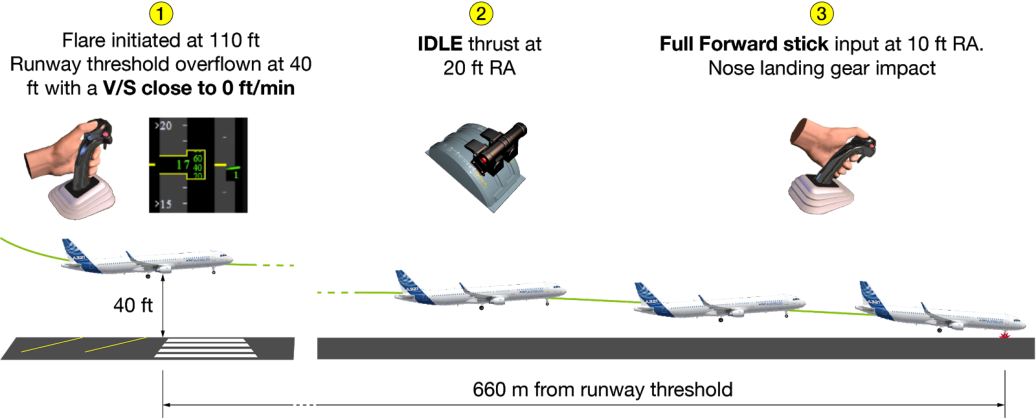
Section titled “Event Description”The A321 performed an ILS approach in night conditions. The weather was fine and there was a 10 kt headwind. The flight crew switched OFF the autopilot at 940 ft RA and kept the FD ON. The autothrust was ON and the speed was stabilized at approach speed. From 110 ft RA to 50 ft RA, the PF applied several nose up inputs that increased the aircraft pitch attitude to 3.8° nose up. The autothrust commanded a thrust increase to maintain Vapp. The aircraft consequently flew over the runway threshold at around 40 ft RA with a vertical speed close to 0 ft/min.
The PF applied several pitch up inputs that maintained the nose up pitch attitude and the aircraft subsequently floated above the runway for 4 seconds. At around 20 ft RA, the PF retarded the thrust levers progressively to IDLE. 4 seconds later the aircraft was at around 10 ft and the PF applied a full forward stick input. The nose landing gear heavily impacted the runway 660 m after the runway threshold, followed by the main landing gear. Both nose landing gear wheels separated due to the severe impact and the aircraft finally stopped on the runway centerline resting on its nose landing gear axle.
Operational Considerations
Section titled “Operational Considerations”(fig.2) Sequence of events from case study 2
Flare Height
Section titled “Flare Height”The FCOM recommends a flare manoeuvre at around 30ft for an A320 family aircraft in a stabilized condition.
The flare described in the case study 2 was initiated too early at 110 ft RA and autothrust was kept engaged. This Led to the aircraft crossing the runway threshold with a vertical speed close to 0 ft/min.
Thrust Lever Management
Section titled “Thrust Lever Management”The autothrust is active and targets the approach speed or selected speed long as thrust levers are not retarded to IDLE detent.
In this event, the aircraft descent rate was almost 0 ft/min at the runway threshold. The A/THR was still active (thrust levers remained in CLB detent) and targeting the approach speed. This led the aircraft to float above the runway for several seconds until the PF retarded the thrust levers.
Pitch Control
Section titled “Pitch Control”The FCTM states that the PF must avoid using nose down inputs once flare initiated. The PF can release the back stick input slightly as required.
In step of this event, the aircraft pitch down effect due to the full forward stick input, combined with the aircraft’s descent rate, resulted in a heavy impact of the nose landing gear with the runway surface.
Go-Around Decision
Section titled “Go-Around Decision”The FCTM states that if a normal touchdown point cannot be reached, go-around (or rejected landing) should be performed.
In this event, the appropriate action would have been for the PF to initiate go-around when the aircraft was in a float condition above the runway.
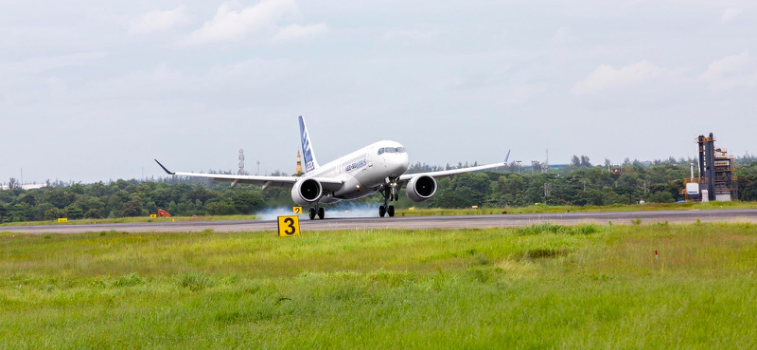
RECIPE FOR A SAFE LANDING
Section titled “RECIPE FOR A SAFE LANDING”The recommendations below summarize the procedures and techniques provided in the FCOM and FCTM.
Be stabilized
Section titled “Be stabilized”A safe flare can only be achieved when the aircraft is stabilized, meaning that all of the flight parameters areas expected, including:
-
the aircraft is on its expected final flight path (lateral and vertical)
-
- speed is close to Vapp, and
-
- wings are level.
If the aircraft reaches the flare height at the correct speed and it is on the expected flight path, then a normal flare technique will lead to a safe landing.
PM must call out any flight parameter deviation
Section titled “PM must call out any flight parameter deviation”Careful monitoring of the flight parameters including speed, pitch, bank and vertical speed, enables the PM to raise the attention of the PF to any deviation during the final approach. This will enable the PF to respond accordingly and initiate a go-around, if required.
Refer to the FCOM SOP for Approach for more information about the PM callout related to the flight parameter deviation threshold.
Flare at the right time
Section titled “Flare at the right time”Flare should be initiated at around 30 ft RA (A220/A300/A310/A320) / 40 ft (A330/A340/A350/A380) in stabilized conditions.
“If the aircraft reaches the flare height at the correct speed and it is on the expected flight path, then a normal flare technique will lead to a safe landing.”
“Careful monitoring of the flight parameters including speed, pitch, bank and vertical speed, enables the PM to raise the attention of the PF to any deviation during the final approach.”
Factors that may require an earlier initiation of the flare:
-
Steeper approach slope (more than the nominal 3°)
-
Increasing runway slope or rising terrain before the runway threshold
-
- Tailwind
-
High airport elevation.
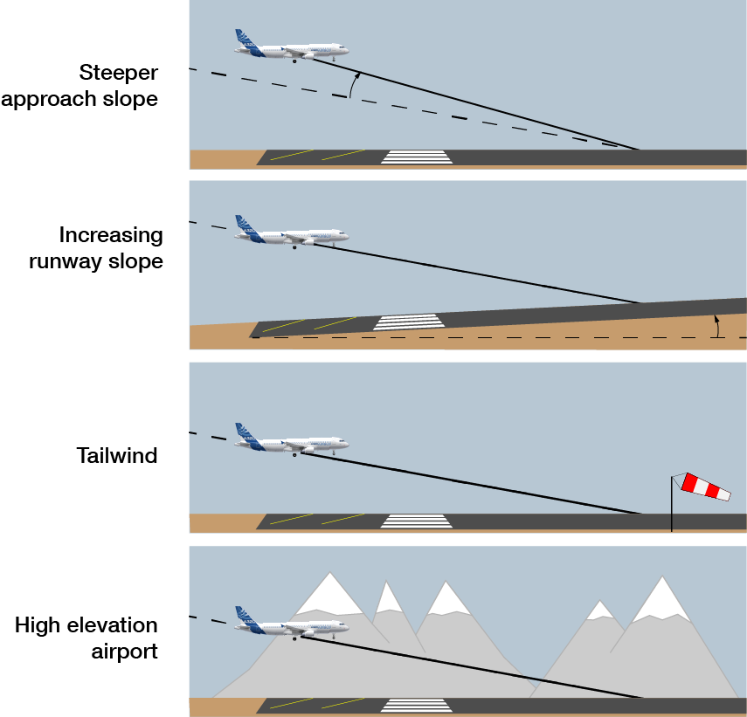
(fig.3) Factors that may require an earlier flare
Flare correctly
Section titled “Flare correctly”On Airbus fly-by-wire aircraft
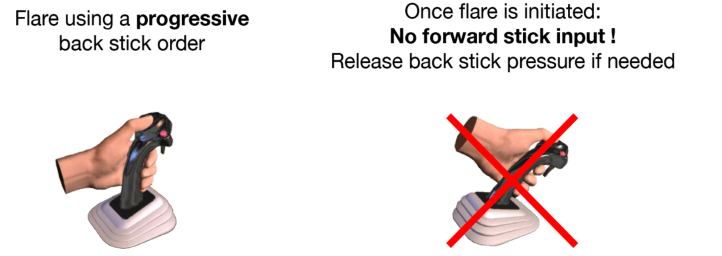
Section titled “On Airbus fly-by-wire aircraft”The PF should apply a progressive and gentle back stick order until touchdown.
The PF must avoid forward stick inputs once flare is initiated. The PF can gradually release the back stick input if needed. The PF must perform go-around If a normal touchdown point cannot be reached.
“The PF must avoid forward stick inputs once flare is initiated.”
Any forward stick input after flare is initiated will increase the risk of landing on NLG with hard impact.
(fig.4) Flare technique on Airbus fly-by-wire aircraft
On A300/A310 aircraft:
Section titled “On A300/A310 aircraft:”The PF must start the flare with a positive and prompt back pressure on the control column to break the descent rate. The PF must then maintain a constant and positive back input on the control column until touchdown.
Retard!
Section titled “Retard!”A320/A330/A340/A350/A380 aircraft
Section titled “A320/A330/A340/A350/A380 aircraft”The 20 ft “RETARD” auto callout is a reminder, not an order. The PF can retard the thrust levers earlier or later depending on the conditions.
The PF must ensure that the thrust levers are at idle in any case, touchdown at the latest, to enable automatic extension of the ground spoilers.
Delaying the retard of the thrust levers may increase the landing distance because the autothrust will target Vapp or the selected speed until it disconnected by moving the levers to the IDLE detent.
A220 aircraft
Section titled “A220 aircraft”“The PF must ensure that the thrust levers are at idle in any case, by touchdown at the latest, to enable automatic extension of the ground spoilers.
The A220 is different from the rest of the Airbus family, because when the thrust levers are engaged, they continuously respond to autothrust commands. The A220 does not have any callout for retard. The Flight Mode Annunciator displays the status of the autothrust (when it is armed and active) at the top the PFD or the HUD. When the autothrust RETARD function is activated, it will automatically reduce the thrust levers to idle. When the autothrust RETARD function is armed, it will be activated at 30 ft AGL(except in the case of an autoland, when it will be activated between 20 and 15 ft AGL depending on the condition).
If the autothrust is not armed or if the autothrust RETARD function is not activated, the flight crew manually retards the thrust levers to idle at 30 ft AGL.
Note that the A220 ground spoiler is activated if the thrust levers are at or near the idle position.
A300/A310 aircraft
Section titled “A300/A310 aircraft”If autothrust is engaged, the PF monitors throttle reduction to idle at 30 ft. If the thrust is controlled manually, the PF retards throttles progressively to idle 20-30 ft. The PF should hold a positive back pressure input on the control column to counter the nose-down pitching moment as the thrust is reduced.
Maintain the aircraft pitch in the case of a bounce
Section titled “Maintain the aircraft pitch in the case of a bounce”The FCTM recommends to maintain the pitch attitude in the case of a light bounce at landing. The aircraft will make a second lighter touchdown and the landing roll can continue.
(fig.5) Management of a light bounce
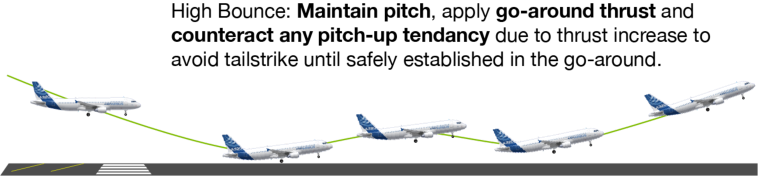
The FCTM recommends to maintain the pitch attitude and initiate a go-around in the case of a high bounce . Maintaining the pitch attitude, and counteracting any pitch-up tendency due to the thrust increase, enables the flight crew to avoid tail strike and ensure a softer secondary touchdown should this occur.
Be go-around minded
Section titled “Be go-around minded”The PF must perform a go-around if any parameter deviation becomes excessive, or if the aircraft is destabilized just prior to the flare.
If the aircraft floats above the runway, the flight crew must initiate a go-around instead of attempting to recover the situation.
The PF can abort the landing and go-around at any time until the thrust reversers are selected. However, when the reversers are selected, the landing must be continued.
Avoid excessive rotation rate in a go-around close to the ground
Section titled “Avoid excessive rotation rate in a go-around close to the ground”(fig.6) Management of a high bounce
“The PF can abort the landing and go-around at any time until the thrust reversers are selected. However, when the reversers are selected, the landing must be continued.”
When the flight crew initiates a go-around close to the ground, they must avoid an excessive rotation rate to limit the risk of tail strike.
The flight crew must wait until the aircraft is safely established in the go-around before retracting the flaps by one step and the landing gear.
Contributors :
Section titled “Contributors :”Raimund GEUTER
Section titled “Raimund GEUTER”Expert Pilot Flight Operations Support
Sundeep GUPTA Accident/Incident Investigator Product Safety
Thomas LEPAGNOT Accident/Incident Investigator Product Safety
Marc LE-LOUER A300/A310 Flight Operations Support Engineer Customer Support
With thanks to Xavier LESCEU , Andris LITAVNIKS and Christian PAQUIN-LAVIGNE and from Airbus Canada.
Section titled “With thanks to Xavier LESCEU , Andris LITAVNIKS and Christian PAQUIN-LAVIGNE and from Airbus Canada.”The landing phase is very demanding and it requires good coordination between the flight crew. The FCOM procedure and FCTM provide the recommended techniques that must be carefully followed to ensure a safe landing.
The Pilot Flying must ensure that the aircraft is established on the expected final approach path at the approach speed. They will apply progressive back stick input at the correct height, which has been determined depending on external parameters. Any forward stick inputs must be avoided once flare is initiated. The thrust levers must be retarded to IDLE, by touchdown at the latest, for the ground spoilers to deploy.
In the case of a bounce at touchdown, the PF must maintain the pitch attitude and decide to either continue the landing if the bounce was light, or to go-around if it is a high bounce. In the case of a high bounce, the PF must not attempt to land the aircraft by applying nose down input on the sidestick.
The PM also plays an essential role throughout the entire landing sequence.The PM is expected to call out any deviation of the flight parameter to the PF, which will ensure that the PF can react accordingly or initiate a go-around if the deviation cannot be corrected in a timely manner. Avoiding an excessive rotation rate of the aircraft for a go-around initiated close to the ground will prevent a tail strike.
The PF must be prepared for a go-around, and initiate a go-around in the case of late destabilization or if the aircraft floats above the runway. A go-around can be initiated at any time during flare landing roll until thrust reversers are selected. However when the reversers are selected, the landing must be continued.
Safety first , 2020. Safety first is published by Airbus S.A.S. 1, rond point Maurice Bellonte - 31707 Blagnac Cedex/France.
Publisher and Editor: Yannick Malinge, Chief Product Safety Officer.
Editorial team: Gwyneth Duggan, Guillaume Estragnat, Timothy Roach, Vanessa Sadi.
来源:Airbus Safety First 网址:https://safetyfirst.airbus.com/a-focus-on-the-landing-flare/ 发布日期:2020-09-01 类别:飞行运营、弹跳、拉平、复飞、着陆、超限、反桨、跑道冲偏、稳定、撞击、尾撬撞击、尾擦 PDF:原始 PDF
在过去几年中,空客收到多起报告,反映飞机以前起落架先触地或硬着陆的事件。本文将通过对其中两起事故的分析,阐述关键要点,并回顾执行拉平阶段的标准操作建议,这些要点和建议是确保安全着陆的关键。
本文也可在 safetyfirst.airbus.com 以及适用于 iOS 和 Android 设备的安全优先(Safety First)应用程序上查阅。
案例研究 1:弹跳着陆、复飞时前起落架撞击及尾撬撞击
Section titled “案例研究 1:弹跳着陆、复飞时前起落架撞击及尾撬撞击”一架 A320 飞机在 ILS 进近的最后进近阶段,以着陆形态(CONF FULL)飞行。
操纵飞行员(PF)在 370 ft 无线电高度(RA)处断开自动驾驶仪,并保持自动推力开启。在 200 ft 时,顺风变化导致空速低于进场速度(Vapp)。
从 100 ft RA 及以下,较大的顺风梯度使空速维持在 Vapp -5 kt 以下,尽管自动推力已增加,在 5 ft RA 时仍达到最低值 119 kt(Vapp -20 kt)。
PF 在 14 ft 执行了拉平动作,同时开始缓慢将推力手柄推过 CLB 卡位。
飞机在主起落架上触地并弹跳。在弹跳过程中,**PITCH PITCH(俯仰俯仰)**自动语音提示触发。
PF 施加大幅低头指令并将推力手柄收至慢车(IDLE)。这导致地面扰流板伸出,使飞机重重撞击跑道,先以前起落架撞击,随后主起落架撞击。
前起落架的撞击导致飞机俯仰角再次突然增大,PITCH PITCH 自动语音提示第二次触发。PF 通过设置 TOGA 推力并施加大幅抬头指令,执行了复飞。飞机在 133 kt 时从跑道上起飞,造成尾撬撞击。
前起落架机轮因撞击跑道而脱落,其中一个机轮被吸入 1 号发动机,导致该发动机停车。由于前起落架撞击还引发了其他系统故障,导致飞机进入备用法则。机组备降另一机场并最终安全着陆。
运营注意事项
Section titled “运营注意事项”**(图 1)**案例研究 1 的事件序列
监控飞行员(PM)的职责
Section titled “监控飞行员(PM)的职责”FCOM SOP 要求,当空速偏差低于目标速度 5 kt 时,PM 应进行”SPEED”呼叫。除非 PF 认为能够在距着陆足够时间内通过小幅修正使飞机恢复稳定状态,否则应执行复飞。
FCTM 指出,若飞机在拉平前空速降至远低于 Vapp 的水平,由于高迎角和高俯仰姿态,尾撬撞击风险会增加。
回顾上述事件中的操作步骤,空速从 100 ft 开始就低于 Vapp -5 kt。如果 PM 进行了”SPEED”呼叫,PF 可能会注意到空速衰减并尝试修正,或在无法及时稳定的情况下执行复飞。
FCOM 规定,在稳定进近中,A320 系列飞机的拉平应在 30 ft 开始(其他空客飞机的数值见本文后续部分)。
FCTM 建议,在存在顺风的情况下应提前开始拉平。这是因为顺风会导致更高的地速,从而需要增加垂直速度以保持进近下滑道。在上述事件中,提前开始拉平可以降低飞机的高垂直速度。
推力手柄管理
Section titled “推力手柄管理”A320 FCTM 解释道,飞行机组可以根据情况选择在 20 ft “RETARD”自动语音提示之前或之后快速将所有推力手柄收至慢车(IDLE)。但是,推力手柄应在触地前处于慢车位置,以确保地面扰流板伸出并将飞机保持在地面。
回顾上述事件中的操作步骤,PF 在拉平过程中将推力手柄推过 CLB 卡位。这增加了推力,并抑制了初次触地时地面扰流板的伸出,导致飞机弹跳。
对于高高度弹跳(如上述事件中的情况),FCTM 建议保持飞机俯仰姿态并执行复飞。
事件描述中步骤里前起落架与跑道的剧烈撞击,是由弹跳期间推力手柄收至慢车(IDLE)导致地面扰流板伸出,以及弹跳后全前置驾驶杆输入共同造成的。
FCTM 建议,在低高度复飞时避免过快的抬轮速率,并抵消推力增加带来的任何抬头效应。
在上述事件中的步骤中,全后置驾驶杆输入结合前起落架弹跳和推力增加,共同导致了尾撬撞击。
案例研究 2:A321 前起落架着陆
Section titled “案例研究 2:A321 前起落架着陆”A321 在夜间条件下执行 ILS 进近。天气良好,逆风 10 节。飞行机组在 940 ft RA 时关闭自动驾驶,保持飞行指引(FD)开启。自动推力处于接通状态,速度稳定在进近速度。从 110 ft RA 到 50 ft RA 期间,主飞(PF)多次输入抬头指令,使飞机俯仰姿态增加至 3.8° 抬头。自动推力指令增加推力以保持 Vapp。飞机因此在约 40 ft RA 高度越过跑道入口,垂直速度接近 0 ft/min。
PF 多次输入抬头指令,保持抬头俯仰姿态,飞机随后在跑道上空飘飘了 4 秒。约在 20 ft RA 时,PF 逐渐将推力手柄收至慢车(IDLE)。4 秒后飞机约在 10 ft 高度,PF 输入满前侧杆。前起落架在距跑道入口 660 米处猛烈撞击跑道,随后主起落架接地。两个前起落架轮子因剧烈撞击而脱落,飞机最终停在跑道中线上,以前起落架轴为支撑点。
运营注意事项
Section titled “运营注意事项”(图 2) 案例研究 2 的事件序列
FCOM 建议在稳定状态下,A320 系列飞机在约 30 ft 高度执行拉平动作。
案例研究 2 中描述的拉平在 110 ft RA 时过早开始,且自动推力保持接通。这导致飞机以接近 0 ft/min 的垂直速度越过跑道入口。
推力手柄管理
Section titled “推力手柄管理”只要推力手柄未收至慢车卡位,自动推力即处于激活状态,并以进近速度或选定速度为目标。
在本次事件中,飞机在跑道入口处的下降率几乎为 0 ft/min。A/THR 仍处于激活状态(推力手柄保持在 CLB 卡位),并以进近速度为目标。这导致飞机在跑道上空飘飘了数秒,直到 PF 将推力手柄收至慢车。
FCTM 规定,一旦拉平开始,PF 必须避免使用低头输入。如有需要,PF 可略微放松拉杆输入。
在本次事件的最后阶段,PF 的满前侧杆输入产生的低头效应,加上飞机自身的下降率,导致前起落架与跑道表面发生剧烈撞击。
FCTM 规定,如果无法到达正常接地点,应执行复飞(或中断着陆)。
在本次事件中,当飞机在跑道上空飘飘时,PF 应执行复飞。
安全着陆要点
Section titled “安全着陆要点”以下建议总结了 FCOM 和 FCTM 中提供的程序和技术。
只有当飞机处于稳定状态时,才能实现安全拉平,即所有飞行参数均符合预期,包括:
-
飞机处于预期的最终航迹(侧向和垂直方向)
-
速度接近 Vapp
-
机翼水平
如果飞机在正确速度下到达拉平高度,且处于预期航迹上,则正常拉平技术将确保安全着陆。
监控(PM)必须报出任何飞行参数偏差
Section titled “监控(PM)必须报出任何飞行参数偏差”仔细监控飞行参数,包括速度、俯仰、坡度和垂直速度,使监控(PM)能够在最后进近期间提醒 PF 注意任何偏差。这将使 PF 能够做出相应响应,并在需要时执行复飞。
有关飞行参数偏差阈值的 PM 报出详情,请参阅 FCOM 进近标准操作程序(SOP)。
在稳定条件下,拉平应在约 30 ft RA(A220/A300/A310/A320)/ 40 ft(A330/A340/A350/A380) 高度开始。
“如果飞机在正确速度下到达拉平高度,且处于预期航迹上,则正常拉平技术将确保安全着陆。”
“仔细监控飞行参数,包括速度、俯仰、坡度和垂直速度,使监控(PM)能够在最后进近期间提醒 PF 注意任何偏差。”
可能需要提前开始拉平的因素:
-
更陡的进近下滑角(超过标准 3°)
-
跑道入口前跑道坡度增加或地形升高
-
顺风
-
高海拔机场。
(图 3) 可能需要提前拉平的因素
在空客电传操纵飞机上
Section titled “在空客电传操纵飞机上”PF 应在接地带之前逐渐柔和地输入拉杆指令。
一旦拉平开始,PF 必须避免前推侧杆输入。如有需要,PF 可逐渐放松拉杆输入。如果无法到达正常接地点,PF 必须执行复飞。
“一旦拉平开始,PF 必须避免前推侧杆输入。”
拉平开始后任何前推侧杆输入都将增加前起落架硬着陆的风险。
(图 4) 空客电传操纵飞机上的拉平技术
A300/A310 飞机:
Section titled “A300/A310 飞机:”PF 必须以正向且果断的驾驶杆后拉动作开始拉平,以减小下降率。随后 PF 必须保持对驾驶柱持续、正向的后拉输入,直至接地。
A320/A330/A340/A350/A380 飞机
Section titled “A320/A330/A340/A350/A380 飞机”20 ft 时的“RETARD(收油门)”自动提示是一种提醒,而非指令。PF 可根据实际条件提前或推迟收油门。
PF 必须确保在任何情况下,油门杆在接地时(最迟)已收至慢车位置,以使地面扰流板自动伸出。
延迟收油门可能会增加着陆距离,因为自动推力会持续跟踪 Vapp 或所选速度,直至将油门杆移至 IDLE 卡位才会断开。
A220 飞机
Section titled “A220 飞机”PF 必须确保在接地时(最迟)油门杆已收至慢车位置,以使地面扰流板自动伸出。
A220 与空客其他机型不同,因为当油门杆处于 engagement 状态时,会持续响应自动推力指令。A220 没有任何收油门的语音提示。飞行模式显示器(FMA)在 PFD 或 HUD 顶部显示自动推力的状态(当其预位并接通时)。当自动推力 RETARD 功能被激活时,将自动把油门杆收至慢车。当自动推力 RETARD 功能预位后,将在 30 ft AGL 时激活(自动着陆情况下除外,此时根据条件会在 20 至 15 ft AGL 之间激活)。
如果自动推力未预位或自动推力 RETARD 功能未激活,飞行机组应在 30 ft AGL 手动将油门杆收至慢车。
请注意,A220 地面扰流板在油门杆处于或接近慢车位置时被激活。
A300/A310 飞机
Section titled “A300/A310 飞机”如果自动推力接通,PF 监控在 30 ft 时推力减速至慢车。如果推力是手动控制的,PF 在 20-30 ft 逐渐将油门收至慢车。PF 应在推力减小时保持对驾驶柱的正向后压输入,以抵消低头俯仰力矩。
发生跳跃时保持飞机俯仰姿态
Section titled “发生跳跃时保持飞机俯仰姿态”飞行机组训练手册(FCTM)建议,在轻着陆跳跃时保持俯仰姿态。飞机会进行第二次较轻的接地,随后可继续着陆滑跑。
(图 5) 轻跳跃的处置
飞行机组训练手册(FCTM)建议,在高跳跃情况下保持俯仰姿态并执行复飞。保持俯仰姿态并抵消推力增加带来的任何抬头趋势,使飞行机组能够避免擦尾,并确保在发生二次接地时更加柔和。
具备复飞意识
Section titled “具备复飞意识”如果任何参数偏差过大,或飞机在进入拉平前已失去稳定,PF 必须执行复飞。
如果飞机在跑道上空飘起,飞行机组必须执行复飞,而不是试图挽救局面。
在反推被选择之前,PF 可随时中止着陆并执行复飞。然而,一旦选择了反推,则必须继续完成着陆。
避免在低空复飞时过大的抬轮速率
Section titled “避免在低空复飞时过大的抬轮速率”(图 6) 高弹跳的处理
“只要推力反推尚未选择,PF 可在任何时候中止着陆并执行复飞。然而,一旦选择了反推,则必须继续完成着陆。”
当飞行机组在低空执行复飞时,必须避免过大的抬轮速率,以降低擦尾风险。
飞行机组必须等待飞机安全建立复飞姿态后,方可收起襟翼一个档位和起落架。
Raimund GEUTER
Section titled “Raimund GEUTER”专家飞行员飞行运行支援
Sundeep GUPTA 事故/事故征候调查员产品安全
Thomas LEPAGNOT 事故/事故征候调查员产品安全
Marc LE-LOUER A300/A310 飞行运行支援工程师客户支援
特别致谢 Xavier LESCEU、Andris LITAVNIKS、Christian PAQUIN-LAVIGNE 以及 Airbus Canada 团队。
Section titled “特别致谢 Xavier LESCEU、Andris LITAVNIKS、Christian PAQUIN-LAVIGNE 以及 Airbus Canada 团队。”着陆阶段要求极高,需要飞行机组之间良好的协调配合。FCOM 程序和 FCTM 提供了推荐的技术方法,必须严格遵守以确保安全着陆。
PF 必须确保飞机以进近速度建立在预期的最后进近航径上。他们应在根据外部参数确定的高度上,施加逐步增加的后拉杆输入。一旦开始拉平,应避免任何前推杆输入。推力手柄必须在最迟接地时收回至 IDLE 位,以使地面扰流板正常展开。
若在接地时发生弹跳,PF 必须保持俯仰姿态,并根据弹跳程度决定继续着陆(轻弹跳)或执行复飞(高弹跳)。在高弹跳情况下,PF 不得通过操作侧杆输入低头来尝试再次接地。
在整个着陆过程中,PM 同样发挥着至关重要的作用。PM 应及时向 PF 喊话报告任何飞行参数的偏差,确保 PF 能够做出适当反应,或在偏差无法及时修正的情况下执行复飞。在低空执行复飞时,避免飞机过大的抬轮速率可防止擦尾事件。
PF 必须做好复飞准备,并在出现晚点不稳定或飞机飘越跑道上空时执行复飞。在拉平着陆滑跑过程中,直到选择推力反推之前,任何时候均可执行复飞。然而,一旦选择了反推,则必须继续完成着陆。
Safety first,2020 年。Safety first 由 Airbus S.A.S. 出版。地址:1, rond point Maurice Bellonte - 31707 Blagnac Cedex/法国。
出版人与编辑:首席产品安全官 Yannick Malinge。
编辑团队:Gwyneth Duggan、Guillaume Estragnat、Timothy Roach、Vanessa Sadi。