Learning from the evidence
Source: Airbus Safety First URL: https://safetyfirst.airbus.com/learning-from-the-evidence/ Published: 2014-07-29 Magazine Issue: 2014-07 Category: Flight Ops, ACE, cockpit, competence, EBT, evidence, ITQI, simulator, skill, training, type-rating PDF: Original PDF
TRAINING
Section titled “TRAINING”
A350: the fl agship of a new training concept
In September 2014, Airbus will inaugurate its new A350 pilots Type-Rating course. The drivers for this development were both the EBT (Evidence-Based Training) principles and an analysis of natural learning mechanisms.


CHRISTIAN NORDEN
Section titled “CHRISTIAN NORDEN”Director A350 Flight Operations & Training Support
DAVID OWENS
Section titled “DAVID OWENS”Senior Director Training Policy

How humans learn to perform complicated and safety critical tasks is a complex science. Our new approach to training has moved the emphasis from focusing on the outcome of events or exercises, towards understanding and assessing the underlying behaviours required for successful execution.
The advent of the A350 programme was just the right signal to put theory into practice and establish a brand new pilots training system for the new aircraft.
INJECTING REALITY INTO TRAINING
Section titled “INJECTING REALITY INTO TRAINING”Lessons learned
Section titled “Lessons learned”For decades, the content of flight crew training programmes remained unchanged, according to regulation. Training curricula included repetitive exposures to a set of prescribed events, which, as technology evolved, became highly improbable with modern aeroplanes. In addition, these events were mainly examples of negative performance and we just expected crews to learn effectively from them. In some cases, we learned what NOT to do but rarely what could or should have been done to change the outcome of the event. This gives little help to the crew if faced with a similar or any other challenge.
Training programmes were consequently saturated with items that may not necessarily mitigate the real risks or enhance safety in modern air transport operations.
Furthermore, training approaches traditionally regarded non-technical skills (through Crew Resource Management courses) and technical flying skills (during simulator sessions) separately. Learning from past events, we have come to realize that air incidents and accidents rarely result from the improper use of a given skill alone, but rather involve a combination of both technical and non-technical aspects.
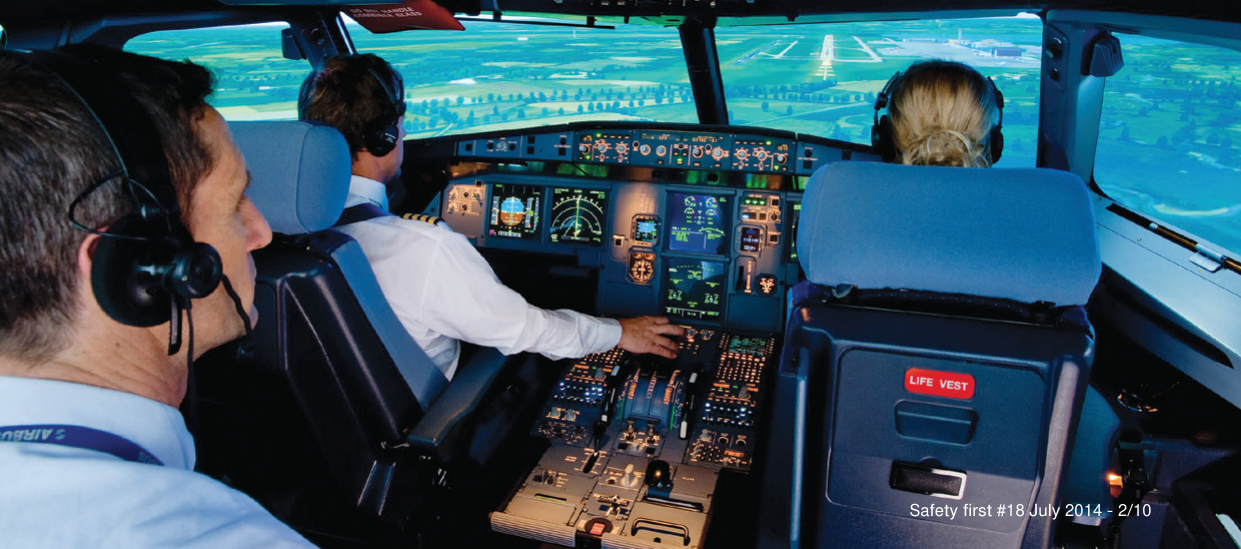
TRAINING
Section titled “TRAINING”Building a new competency-based training philosophy
Section titled “Building a new competency-based training philosophy”Pilots need to be trained to mitigate the risks of the unpredictable
These observations clearly established the need for our industry to revisit some training principles.
In today’s rapidly changing fl ying environment, it is impossible to predict every single plausible situation that might arise in operations.
“When people and complex systems interact, there will always be an infi nite number of possible outcomes”, explains Michael VARNEY, Senior Director Training Policy.
In other words, pilots need to be trained to mitigate the risks of the unpredictable. And means to reach this very objective do not seem obvious at fi rst glance.
The ICAO Evidence-Based Training (EBT) concept is a safety-improvement initiative part of the ITQI project (IATA Training and Qualifi cation Initiative) that precisely addresses this challenge by prioritizing the development and assessment of a fi nite number of key competencies. The EBT basically recommends to train competencies (not events) and choose training scenarios based on evidence collected from in service data to make sure pilots are able to demonstrate a good performance in front of realistic threats and errors.
Although this concept was primarily designed for recurrent training, the regulatory prescriptions of a Type-Rating skill test can also be achieved using this modern competency-based approach.
INFORMATION
Section titled “INFORMATION”The EBT and ITQI initiatives
Section titled “The EBT and ITQI initiatives”In 2007, Airbus started work on a concept eventually titled Evidence-Based Training (EBT). The initiative was supported by other OEMs and stakeholders, and was taken to IATA to form part of the IATA Training and Qualifi cation Initiative (ITQI).
The ITQI is an industry-wide project steered by a committee comprising the IATA, the ICAO, the International Federation of Air Line Pilots (IFALPA) and the Royal Aeronautical Society (RAeS). This initiative focuses on 2 different areas: Flight operations and Engineering & maintenance. Their objective is to improve operational safety, quality and effi ciency of commercial aviation by developing international agreement on a common set of pilot training, instruction and evaluation standards and processes that will result in ICAO provisions.
Based on the success of the EBT approach, ICAO published new guidance material in ICAO Doc 9868 PANS-TRG and ICAO Doc 9995 Manual of Evidence-Based Training in 2013. EBT was born as a new option for safety improvement and is now making rapid progress, defi ning a new paradigm for training worldwide.
FROM DEVELOPING THE SKILLS NEEDED TO MANAGE AN INVENTORY OF PRE-DEFINED SITUATIONS, TO TRAINING WHAT IT TAKES TO MANAGE ANY OPERATIONAL SITUATION…
Section titled “FROM DEVELOPING THE SKILLS NEEDED TO MANAGE AN INVENTORY OF PRE-DEFINED SITUATIONS, TO TRAINING WHAT IT TAKES TO MANAGE ANY OPERATIONAL SITUATION…”Competencies as training tools
Section titled “Competencies as training tools”Competencies are the backbone of the new training concept; therefore the ones we wanted to use for our training courses needed to be defined with great care and accuracy. It was also important to base our approach on work previously and diligently undertaken during the development of the EBT concept.
tem and introduced its own set of core competencies in the Autumn of 2013. These competencies are the key driver for all training and assessment in Airbus, including the A350 curriculum development.
The Airbus 9 core competencies are listed alphabetically as follows:
- Application of procedures
In principle, such competencies needed to be defined against the real threats and risks airline pilots will face in everyday operations. This implied understanding those threats through a comprehensive review of safety-related evidence, i.e. data collected from both training results and operations, including the facts of pilot involvement in accident scenarios. Experts in the practice of flight crew training analysed the available wealth of data and agreed definitions of:
-
Communication
-
Flight path management – Automation
-
Flight path management – Manual
-
Knowledge
-
Leadership and teamwork
-
Problem solving and decision making
-
Situation awareness
-
Workload management
To create an effective training programme, we had to understand the relationship between this finite number of competencies, and the capability to manage an infinite number of operational situations. Doing so, our efforts were directed towards understanding the underlying conditions for effective performance, rather than on the outcome of events and maneuvers as was traditionally the case. Instructional technique needed to evolve to the person and not to the event.
-
core competencies and
-
associated performance indicators aiming to enable training instructors to evaluate those competencies
Both were eventually introduced in ICAO Doc 9995.
Whilst keeping the current regulatory framework, Airbus adapted this sys-

TRAINING
Section titled “TRAINING”Facilitating and communicating: our new instructional technique
Section titled “Facilitating and communicating: our new instructional technique”The role of the instructor becomes essential in this approach
Psychologists have developed a theory that our learning retention rate gets higher if we learn step-by-step by improving our performance, rather than just getting things right or wrong after a demonstration or lecture. Effective learning demands retention, which can be enhanced by enquiry, practice and feedback from performance.
Better than realizing a scenario went right or wrong, we want to understand why the outcome was negative or positive, and learn from this analysis. This includes viewing an incident not only in terms of its causes, but also with respect to what prevented a more serious outcome.
The role of the instructor becomes essential in this approach: (s)he no longer is just a speaker, but a facilitator and an advisor, continuously interacting with the trainee. He/she gives the trainee the necessary freedom to learn by discovering functionalities and guides him/her when necessary following his/her observations.
In this respect, our approach to training now includes “Facilitated de-brief” during which the instructor adopts a non-judgmental attitude and raises simple questions as a prelude to an open and unfiltered discussion with the trainee:
This new approach is meant to ease the discussion between the instructor and the trainee, and build a relationship of trust and honesty between them. With this mindset, it becomes possible for trainee pilots to develop from both their achievements as well as their mistakes.
“When an ILS approach is not completed successfully, rather than considering that the exercise is failed because it was “out of limits”, we want to ask ourselves why it was not completed satisfactorily.” mentions Michael VARNEY.
The upstream cause may be poor descent planning, FMS handling, communication or energy management leading to a rushed approach. A simple repeat of the ILS approach would probably ultimately result in a successful approach, but this method would not necessarily address any of the descent planning, FMS programming or energy management root causes.
To make learning effective, the relationship between the trainer and the trainee is crucial, both of them now being considered as partners in the process of developing confidence and capability in the operation of a modern jet transport aircraft.
-
“How did it feel?”
-
“What did you do well? Why was it
-
effective?”
-
“What could have been done better?”

Assessing and grading competence
Section titled “Assessing and grading competence”Modernizing our training programmes involved reviewing our approach to trainees’ performance assessment. Traditionally, the successful completion of training courses was marked by the trainee’s ability to pass tests. However, those tests did not focus on a demonstration of performance to measure the trainee’s actual ability to fly an airplane and manage the threats a crew may face in today’s operational environment.
Since October 2013, Airbus Training instructors assess trainee pilots’ performance according to a new competency-based grading system. This new grading system requires a demonstration of each of the 9 core competencies, as opposed to the traditional assessment that was made up of right or wrong proposals.
“Training is more than ticking boxes”, says Jean-Michel BIGARRE, Director of Airbus Flight Training. “It is a matter of bringing the pilot and the aircraft work safely and efficiently together” he adds.
In line with this philosophy, the new grading concept uses Pass or Fail criteria, based on a list of observable performance indicators and a grading scale.
The performance indicators detail clearly observable criteria that were designed to enable the trainer to grade all skills in an objective manner - including the non-technical ones. At all times during the training or checking session, the instructor observes the trainee’s performance in relation to these pre-defined performance indicators. Then, by determining the consistency and frequency of these indicators, he/she is able to make a holistic appraisal of the trainee’s understanding of each competence, and his/her ability to exercise it using the grading scale. At the end of the training session, this grading scale offers a global picture of the trainee’s performance during the session by showing a mark between 1 and 5 against each of the 9 core competencies.
Training is more than ticking boxes, says JeanMichel BIGARRE, Director of Airbus Flight Training.
TRAINING
THE A350 TRAINING CONCEPT: COMBINING EBT AND NATURAL LEARNING PRINCIPLES…
Section titled “THE A350 TRAINING CONCEPT: COMBINING EBT AND NATURAL LEARNING PRINCIPLES…”The new A350 Type-Rating course is fundamentally modelled on the EBT approach and it is built in accordance with the principles described earlier. But it also proposes beyond a new approach to delivering training to trainee pilots. Fundamentally, it focuses on engendering trainee pilots’ confi dence in their own competencies as well as in the aircraft they interact with.
The A350, a new approach to developing the “Flight Path Management – Manual” competence
Section titled “The A350, a new approach to developing the “Flight Path Management – Manual” competence”Among the 9 core competencies, the “Flight Path Management – Manual” appeared to us as one of the most challenging to maintain in line operations. Maintaining profi ciency and adequate fl ying skills can be a challenge indeed, particularly for commercial aviation pilots who manual fl y relatively infrequently, thus creating the potential for manual fl ying skills degradation from non-use. In effect, the loss of control in fl ight remains one of the main causes for accidents ; therefore efforts seeking to advocate for a return to the basics of manual fl ying clearly have a benefi cial potential to invert this tendency.
For this reason, whilst developing the A350 Type-Rating curriculum, Airbus put a particular emphasis on this manual fl ying competence.
Traditionally, trainee pilots started practical training on a new aircraft with a maximum of fl ight guidance systems and automation engaged, making them reluctant to switch it off if needed operationally.
“The Airbus Golden Rules require to take over if the need arises, and our training regime needs to prepare them exactly to do this.”, says Dominique DESCHAMPS, Vice President Flight Operations and Training Support.
INFORMATION
Section titled “INFORMATION”Airbus Cockpit Experience (ACE)
Section titled “Airbus Cockpit Experience (ACE)”ACE is a brand new training tool developed by Airbus for the A350 Type-Rating course. It is a 3D laptop-based cockpit simulator that is used from day 1 of the course to allow trainee pilots practicing systems knowledge and Standard Operating Procedures as often and early in the scheme as possible.
The device has the functionality of the real aircraft, the pilot being led by computer guided instruction, defi ned exercises and even free-play modules to connect to the new “offi ce”. ACE enables to offl oad a lot of training content from the APT (Airbus Pilot Transition) and even Full Flight Simulator (FFS), thus giving more time for realistic and dynamic maneuvering training in the FFS.
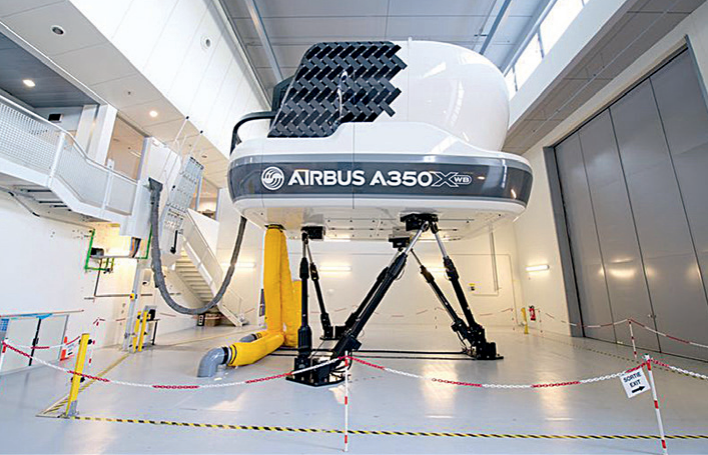
For its A350 Type-Rating course, Airbus has developed a hands-on “learning by discovery” process for trainee pilots to familiarize themselves with the aircraft and its manual handling characteristics through early and frequent practicing. This concept follows the principle described earlier of humans learning step-by-step with progressive skill improvement by cleverly sequencing theory in classroom, and practice in the Flight Training devices.
The goal of a Type-Rating program is to make a pilot proficient in interacting with a new complex technical system (the aircraft), using a new Human Machine Interface (the cockpit). Traditional Type-Rating programs introduce in priority the technical systems first (in the last decades by CBT style training). The cockpit is only introduced during the latter stages of the program using Flight Simulation Training Devices (FSTDs).
The Airbus A350 training concept has reversed this paradigm, introducing the cockpit interface and the Full Flight Simulator (FFS) as early as possible in the curriculum. According to this approach, practice on ACE is introduced from day 1 of the course. Then, systems description modules are integrated in ACE as “quick user guides” to enable the pilot to start learning in the most realistic environment rapidly.
For FFS sessions, instructors are given guidance as to when they should let the trainee discover on his/her own, finding out how the aircraft works by experimenting, and when they should demonstrate. This principle echoes the way in which people frequently ignore the instructions guide when
they try a new device, and simply turn it on and try to find out how it works by experimenting. They would consult the instructions guide after they had tried various actions, and eventually could not manage by themselves.
We have considered that the same happens with a new aircraft: we want to let trainee pilots get to grips with the aircraft by experimenting in the FFS early in the scheme, thus enabling them to develop their manual flying instinct.
We want to let trainee pilots get to grips with the aircraft by experimenting
“Our ambition is to re-ignite this very feeling they had when they first flew a real aircraft, by not overloading them with theory before they had a chance to try and experiment.”, says Franck VESSIOT, designer of the FFS training sessions.
Only after manual flying consolidation, automated systems are introduced gradually, one after the other, both in theory, and in practice in the FFS. The “Bird” (Flight Path Vector) comes first, then the Flight Director, Auto Thrust and eventually the Auto Pilot.
In the end, the approach to training is reversed: pilots are encouraged to appreciate flying the aircraft manually and consider automated systems a full benefit, rather than considering manual flying a degraded and potentially challenging configuration.
TRAINING
Section titled “TRAINING”Surprise…
Section titled “Surprise…”This element of surprise brings training closer to real situations
Incidents and accidents analyses show that abnormal situations rarely present themselves in a standardized or predictable sequence. Although the potential element of surprise is more suited in the recurrent training domain, we decided to include some elements of surprise while programming the A350 Type-Rating courseware. Prior to the training session, trainees will be informed of the subjects that will be covered, but they will have no information about the exact nature or sequence of events the instructor will use. In the final sessions, the instructor will have a choice between several malfunctions and events intended to develop the same competencies, thus limiting, if not avoiding pre-planned or routinized actions by the crew.
This element of surprise brings training closer to real situations, and raises opportunities for the trainee and the instructor to discuss the available options and solutions on a case by case basis.
In addition, keeping it a surprise allows enough flexibility for the instructor to play scenarios the closest possible to the airline’s specific operations.
The training programme really is customized according to the airline’s operational constraints in order to ensure the pilots are confident in managing real threats and hazards as they commence supervised and ultimately unsupervised line flying.

Developing the new A350 Type-Rating training programme, Airbus has endorsed a new philosophy for pilots training using new training principles, new training devices and a new training scheme.
We, as an industry, can learn from studying accidents and incidents, but we also need to study events with positive outcomes to learn from the success of others as well as our own achievements. We should study “what went right?” every day for every flight, then analyze “why did it go right?”.
Understanding the path to an outcome of a particular area of performance, whether positive or negative, rather than just the outcome itself, can raise avenues of reflection to progress. This concept underlies the new A350 Type-Rating course, which will enter into service in September 2014. Our objectives were mainly: facilitate trainee pilots’ appreciation of new technology features and focus on their ability to handle the aircraft, not just the automated systems.
With the ICAO having published the Evidence-Based Training principles as a regulation for recurrent training in May 2013, Airbus is fully committed to applying elements of the evidence-based and competency-based training in all Type-Rating programmes. Today on the A350, in a near future on all of its legacy aircraft platforms.
A350:新培训概念的旗舰机型
2014年9月,空客将推出其全新A350飞行员机型等级课程。该项目开发的驱动因素是EBT(基于证据的训练)原则和对自然学习机制的分析。
克里斯蒂安·诺登(CHRISTIAN NORDEN)
Section titled “克里斯蒂安·诺登(CHRISTIAN NORDEN)”A350飞行运营与培训支持总监
大卫·欧文斯(DAVID OWENS)
Section titled “大卫·欧文斯(DAVID OWENS)”培训政策高级总监
人类如何学习执行复杂且安全关键的任务是一门复杂的科学。我们新的培训方法已将从关注事件或练习的结果,转向理解和评估成功执行所需的基础行为。
A350项目的出现正是将理论付诸实践的恰当时机,为这款新飞机建立了全新的飞行员培训体系。
将真实性注入培训
Section titled “将真实性注入培训”几十年来,根据法规要求,飞行机组培训课程的内容基本保持不变。培训课程包括对一系列规定事件的重复练习,而随着技术发展,这些事件在现代飞机上已变得极不可能发生。此外,这些事件主要是负面表现的案例,而我们只是期望机组能够从中有效学习。在某些情况下,我们学到了什么”不该做”,但很少了解为了改变事件结果可以做或应该做什么。这对于机组在面对类似或其他挑战时几乎没有帮助。
因此,培训课程充斥着可能无法真正降低现代航空运输运营实际风险或增强安全性的内容。
此外,传统培训方法将非技术技能(通过机组资源管理课程)与技术飞行技能(在模拟机训练期间)分开对待。从过去的事件中学习,我们逐渐认识到航空事故和事故很少仅仅源于某项技能的不当使用,而是涉及技术方面和非技术方面的组合。
构建基于能力的新培训理念
Section titled “构建基于能力的新培训理念”飞行员需要接受培训以应对不可预测的风险
这些观察清楚地表明,我们的行业有必要重新审视某些培训原则。
在当今快速变化的飞行环境中,不可能预测运营中可能出现的每一个合理情况。
“当人类与复杂系统相互作用时,总会有无限多的可能结果,“高级培训政策总监迈克尔·瓦尼(Michael VARNEY)解释道。
换句话说,飞行员需要接受培训以应对不可预测的风险。而实现这一目标的方法起初似乎并不明显。
ICAO基于证据的训练(EBT)概念是一项安全改进倡议,属于ITQI项目(IATA培训与资质认证倡议)的一部分,正是为了应对这一挑战,其核心是优先发展和评估有限数量的关键能力。EBT基本上建议训练能力(而非事件),并根据从实际运营数据中收集的证据选择培训场景,以确保飞行员能够在面对真实威胁和差错时表现出色。
虽然这一概念主要为复训而设计,但机型等级技能考试也可采用这种现代基于能力的方法来满足法规要求。
EBT和ITQI倡议
Section titled “EBT和ITQI倡议”2007年,空客开始开发一个最终命名为基于证据的训练(EBT)的概念。这一倡议得到了其他原始设备制造商和利益相关方的支持,并被提交给IATA,成为IATA培训与资质认证倡议(ITQI)的一部分。
ITQI是一个由IATA、ICAO、国际 airline驾驶员联合会(IFALPA)和皇家航空学会(RAeS)组成委员会主导的行业项目。该倡议聚焦两个不同领域:飞行运营和工程与维修。其目标是,通过制定飞行员培训、教学和评估标准及流程的国际协议,提高商业航空的运营安全、质量和效率,最终实现ICAO条款的更新。
基于EBT方法取得的成功,ICAO于2013年在ICAO Doc 9868 PANS-TRG和ICAO Doc 9995《基于证据的训练手册》中发布了新的指导材料。EBT作为一种新的安全改进方案应运而生,目前正在快速推进,在全球范围内定义新的培训范式。
从培养管理预定义情境清单所需的技能,到训练管理任何运营情境所需的能力……
Section titled “从培养管理预定义情境清单所需的技能,到训练管理任何运营情境所需的能力……”作为培训工具的能力素质
Section titled “作为培训工具的能力素质”能力素质是新培训概念的支柱;因此,我们希望用于培训课程的能力素质需要非常谨慎且精确地进行定义。同样重要的是,我们的方法应基于在EBT概念开发过程中先前认真开展的工作。
空客在2013年秋季采用了这一体系并引入了自己的一套核心能力素质。这些能力素质是空客所有培训和评估的关键驱动因素,包括A350课程开发。
空客9项核心能力素质按字母顺序排列如下:
- 程序执行
原则上,这些能力素质需要根据航线飞行员在日常运营中面临的真实威胁和风险来定义。这需要通过对安全相关证据进行综合审查来理解这些威胁,即从培训结果和运营中收集的数据,包括飞行员参与事故场景的事实。飞行机组培训方面的专家分析了可用的丰富数据,并就以下内容达成了一致的定义:
-
通讯
-
飞行轨迹管理——自动驾驶
-
飞行轨迹管理——人工
-
知识
-
领导力与团队协作
-
问题解决与决策
-
情景意识
-
工作负荷管理
为创建有效的培训项目,我们必须理解这有限数量的能力素质与应对无限运营场景的能力之间的关系。在此过程中,我们的努力方向是理解有效表现的内在条件,而不是像传统做法那样关注事件和机动动作的结果。教学技巧需要针对人而发展,而不是针对事件。
-
核心能力素质,以及
-
相关绩效指标,旨在使培训教员能够评估这些能力素质
两者最终都被纳入ICAO Doc 9995。
在不改变现行法规框架的情况下,空客采用了这一体系,并在2013年秋季推出了自己的一套核心能力素质。
促进与沟通:我们的新型教学技巧
Section titled “促进与沟通:我们的新型教学技巧”在这一方法中,教员的作用变得至关重要
心理学家提出了一个理论:如果我们通过逐步改进表现来学习,而不是在演示或讲座后简单地判断对错,我们的学习保持率会更高。有效的学习需要保持力,这可以通过探究、练习和表现反馈来增强。
我们希望理解结果为何是负面的或正面的,并从中分析学习,而不仅仅是意识到一个场景是对还是错。这包括不仅从原因的角度看待事件,还要从阻止更严重后果的因素的角度来看待。
在这一方法中,教员的作用变得至关重要:(s)他/她不再只是一个演讲者,而是一个促进者和顾问,不断与学员互动。他/她给予学员必要的自由,通过发现功能来学习,并根据他/她的观察在必要时给予指导。
在这方面,我们现在的培训方法包括”促进式讲评”,教员在此过程中采取非评判性的态度,提出简单的问题,作为与学员进行开放且不受限制的讨论的序幕:
这种新方法旨在促进教员和学员之间的讨论,并在他们之间建立信任和诚实的关系。有了这种心态,学员飞行员就能够从他们的成就和错误中成长。
“当ILS进近没有成功完成时,与其认为这个练习因为’超出限制’而失败,我们不如问问自己为什么没有令人满意地完成。” Michael VARNEY如是说。
根本原因可能是下降计划不佳、FMS操作、通讯或能量管理不当,导致进近过于仓促。简单地重复ILS进近最终可能会成功地完成进近,但这种方法不一定能解决下降计划、FMS编程或能量管理的根本原因。
要使学习有效,教员和学员之间的关系至关重要,他们现在都被视为在现代喷气式运输机运营中建立信心和能力的过程中的伙伴。
-
“感觉如何?”
-
“你哪些方面做得好?为什么有效?”
-
“哪些方面可以做得更好?”
能力评估与等级评定
Section titled “能力评估与等级评定”现代化培训项目涉及重新审视我们对受训者绩效评估的方法。传统上,培训课程的顺利完成以受训者通过考试的能力为标志。然而,这些考试并未侧重于对表现的演示,以衡量受训者驾驶飞机和管理机组在当今运行环境中可能面临的威胁的实际能力。
自2013年10月起,空客培训教员根据新的基于能力的评分系统对受训飞行员进行绩效评估。新的评分系统要求对9项核心能力逐一进行演示,而传统评估则是由对错方案组成。
“培训不仅仅是打勾勾”,空客飞行培训总监Jean-Michel BIGARRE表示,“这是将飞行员和飞机安全高效地结合在一起的问题”,他补充道。
遵循这一理念,新的评分概念采用通过或失败标准,基于可观察绩效指标清单和评分量表。
绩效指标详细规定了明确的可观察标准,旨在使教员能够客观地评定所有技能——包括非技术技能。在培训或检查过程的任何时刻,教员都会对照这些预定义的绩效指标观察受训者的表现。然后,通过确定这些指标的一致性和频率,他/她能够对受训者理解每项能力的程度及其使用评分量表运用该能力的能力做出整体评估。在培训课程结束时,该评分量表通过对9项核心能力中的每一项显示1至5之间的分数,提供受训者在整个课程中表现的总体画面。
培训不仅仅是打勾勾,空客飞行培训总监Jean-Michel BIGARRE如是说。
培训
A350培训理念:结合EBT与自然学习原则……
Section titled “A350培训理念:结合EBT与自然学习原则……”新型A350机型等级课程从根本上以EBT方法为模型,并根据前文所述的原则构建。但它还提出了超越向受训飞行员交付培训的新方法。从根本上讲,它侧重于培养受训飞行员对其自身能力的信心,以及对其所操作飞机的信心。
A350,开发“飞行轨迹管理——手动”能力的新方法
Section titled “A350,开发“飞行轨迹管理——手动”能力的新方法”在9项核心能力中,“飞行轨迹管理——手动”对我们来说是在航线运营中最难保持的能力之一。保持熟练程度和适当的飞行技能确实是一项挑战,尤其是对于手动飞行相对不频繁的商业航空飞行员而言,这可能导致因不使用而造成手动飞行技能退化。事实上,失去对飞行的控制仍然是事故的主要原因之一;因此,努力倡导回归手动飞行的基础知识具有逆转这一趋势的潜在益处。
出于这一原因,在开发A350机型等级课程时,空客特别强调了这一手动飞行能力。
传统上,受训飞行员在新飞机上开始实操训练时,最大程度地使用飞行引导系统和自动化设备,这使得他们在运行需要时不愿意关闭自动化。
“空客黄金规则要求在需要时接管,我们的培训体系需要准确地为他们做到这一点做准备”,飞行运营与培训支持副总裁Dominique DESCHAMPS表示。
空客驾驶舱体验(ACE)
Section titled “空客驾驶舱体验(ACE)”ACE 是空客为 A350 型别等级培训课程开发的一款全新训练工具。这是一款基于笔记本电脑的 3D 驾驶舱模拟器,从课程第一天起即可使用,使学员飞行员能够尽可能早地、尽可能频繁地练习系统知识和标准操作程序。
该设备具有真实飞机的功能,由计算机引导教学、预设练习模块乃至自由练习模块来引导飞行员熟悉新的”驾驶舱”。ACE 能够将大量培训内容从 APT(空客飞行员改装培训)乃至全动飞行模拟机(FFS)中分担出来,从而为 FFS 中的真实动态机动训练腾出更多时间。
对于 A350 型别等级培训课程,空客为学员飞行员开发了一套实践性的”探索式学习”流程,通过尽早且频繁的练习来熟悉飞机及其人工飞行特性。这一理念遵循前文所述的人类学习原则——通过巧妙地将课堂理论与飞行训练设备的实践相结合,实现渐进式技能提升。
型别等级培训项目的目标是使飞行员熟练操作一个复杂的新技术系统(飞机),使用一个新的人机界面(驾驶舱)。传统的型别等级培训项目优先引入技术系统(在过去几十年中采用计算机辅助培训形式的训练)。驾驶舱仅在培训项目后期通过飞行模拟训练设备(FSTD)引入。
空客 A350 培训理念颠覆了这一范式,将驾驶舱界面和全动飞行模拟机(FFS)尽早引入课程。按照这一方法,ACE 练习从课程第一天起即开始引入。随后,系统描述模块作为”快速用户指南”集成在 ACE 中,使飞行员能够迅速在最真实的环境中开始学习。
对于 FFS 训练环节,教员会获得指导,明确何时应让学员自行探索——通过实践来发现飞机如何运作,何时应进行演示。这一原则呼应了人们接触新设备时的常见方式:通常会忽略说明书,直接开机并通过尝试来摸索其工作原理。他们会在尝试了各种操作之后才查阅说明书,最终仍无法自行解决。
我们认为,飞行员面对新飞机时也是如此:我们希望让学员飞行员尽早通过在 FFS 中实践来熟悉飞机,从而培养其人工飞行直觉。
我们希望让学员飞行员通过实践来熟悉飞机
“我们的目标是重新点燃他们在第一次驾驶真机时的那种感觉,不是在他们有机会尝试和实践之前就用大量理论来充斥他们。“FFS 训练课程设计师弗兰克·维西奥(Franck VESSIOT)说道。
只有在人工飞行能力巩固之后,自动系统才逐步引入——无论在理论上还是在 FFS 实践中。“小鸟”(飞行航径矢量)首先出现,然后是飞行指引仪、自动推力,最终是自动驾驶仪。
最终,培训方法被逆转了:鼓励飞行员欣赏人工驾驶飞机的体验,将自动系统视为完整的收益,而非将人工飞行视为一种降级的、可能具有挑战性的配置。
出人意料……
Section titled “出人意料……”这种出人意料的要素使培训更贴近真实情况
对事故和事故征候的分析表明,异常状况很少以标准化或可预测的顺序出现。尽管意外因素更适合在定期复训领域运用,但我们仍决定在 A350 型别等级培训课件中纳入一些出人意料的要素。在培训课程开始前,将告知受训飞行员将要涵盖的科目,但不会提供任何关于教员将采用的事件具体性质或顺序的信息。在最终阶段,教员可在多个旨在发展相同能力的故障和事件中进行选择,从而限制(若非完全避免)机组预先计划或习惯性的动作。
这种出人意料的要素使培训更贴近真实情况,并为受训飞行员和教员提供了逐案讨论可选方案和解决方案的机会。
此外,保持这种不确定性使教员能够灵活地设计与航空公司特定运行最为接近的场景模拟。
培训课程确实根据航空公司的运行限制进行了定制,以确保飞行员在开始带飞航线飞行并最终实现独立航线飞行时,能够自信地管理真实的威胁与风险。
在开发新的 A350 型别等级培训课程时,空客采用了一种新的飞行员培训理念,包括新的培训原则、新的培训设备和完善的培训体系。
作为行业,我们可以通过研究事故和事故征候来汲取经验,但我们也需要研究具有正面结果的事件,从他人的成功以及我们自身的成就中学习。我们应该每天、每个航班都思考”哪些做对了?“然后分析”为什么做对了?”。
理解某一特定绩效领域通向结果的过程,无论是正面的还是负面的,而不仅仅是结果本身,可以开辟反思的途径以促进进步。这一理念是新 A350 型别等级课程的基础,该课程将于 2014 年 9 月投入运营。我们的主要目标是:帮助受训飞行员更好地理解新技术的特点,并聚焦于他们操控飞机的能力,而不仅仅是自动化系统。
随着国际民航组织(ICAO)于 2013 年 5 月发布了基于证据的培训原则作为定期复训的规章,空客致力于在所有型别等级培训课程中应用基于证据和基于能力的培训要素。目前先在 A350 上实施,未来将推广至所有现有机型平台。