A330-300 Trimmable Horizontal Stabilizer Damage
Source: Airbus Safety First URL: https://safetyfirst.airbus.com/a330-300-trimmable-horizontal-stabilizer-damage/ Published: 2006-12-14 Magazine Issue: 2006-12 Category: Archive PDF: Original PDF
By: Marc BAILLION Flight Safety Manager
1 Introduction
Section titled “1 Introduction”This article describes an uneventful flight, during which, the aircraft was in an unsafe condition. As a result of what was erroneously considered as a minor damage, the limit loads of the THS were no more sustainable. This resulted from a wrong appreciation of composite structure damage. The objective of this article is to highlight the paramount importance of building a good knowledge of composite structure damage and repair.
Composite structure training is available at Airbus training center.
The Structure Repair Manual’s (SRM) procedures must be respected and, if outside SRM limits, Airbus must be contacted to always ensure aircraft structural integrity.
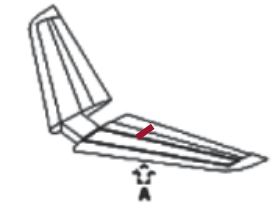
On 21[st] of August 2004 upon landing, the subject airplane was found with a torn lower skin of the right hand THS Lateral Box. This damage was thought to be due to a Foreign Object Damage (FOD) and resulted in a leaking Trim Tank.
A missing water servicing door (164AR) was suspected to have caused the damage. The damage was inspected externally only. The external cut was measured to be about 330mm length by 3mm width, in line of flight, located at the THS bottom skin panel, just behind second THS inboard handhole access panel.
The visible damage is shown on the picture: Based on external visual findings, the operator performed a temporary repair, by filling the damage
Location of the damage
Rib
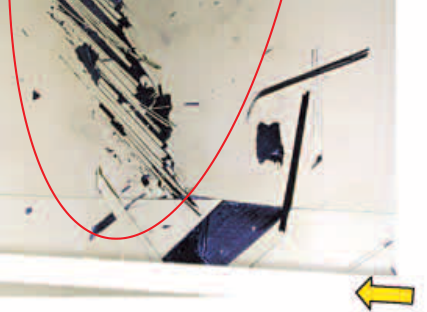
Stringer
Resulting internal delamination
with adhesive (EA934) and covered with two layers of Glass Fiber Reinforced Polymer (GFRP) plies. Trim tanks were emptied and a/c was flown back under MEL.
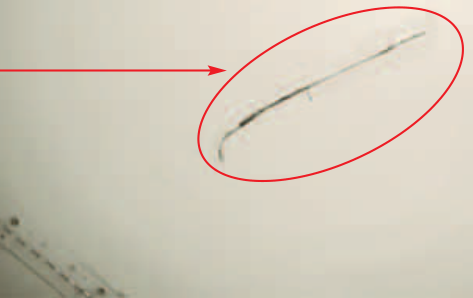
External view of the damage
The operator issued then an engineering note for:
-
G Performing a close visual inspection upon next aircraft landing, to confirm that there was no repair deterioration, crack propagation or any other adverse findings;
-
G Ensure that the trim tanks of the horizontal stabilizer were inop as per A330 AMM;
-
G Repeat close visual inspection at every transit
-
G Perform permanent repair at next B check (2 months later).
When informed, Airbus requested immediate damage assessment (including NDT) inside the THS trim tank before next flight (as per standard SRM requirement), in order to define a valid repair.
3 Damage Description
Section titled “3 Damage Description”As per the inspection, the monolithic CFRP panel was found cracked throughout the cut length, with large delaminations in the surrounding area.
Two stringers located on the THS bottom skin panel had been severely damaged.
Internal views of the THS are shown opposite.
4 Actions Launched
Section titled “4 Actions Launched”The aircraft required immediate appropriate repair, as the temporary repair did not restore the required structural integrity of the THS.
An OIT was issued (reference SE 999.0115/04 dated 15th Oct. 2004) for A310/A300-600/A300600ST/A318/A319/A320/A321/A330/A340. OIT recommendations are as follows:
“In case of damage, composite structure degrades in a different way compared to metallic structure. In the particular case of impact with a foreign object the internal damage might be larger than the visible external damage. On monolithic structure, impact damage will usually result in delamination around perforation and damage to structure underneath”
“…AI instructions for inspection and repair of composite structure given in the SRM are to be followed, to detect damage in its full extent, and to prevent […] inappropriate repair”
Composite structure courses are available at Airbus training department to provide specific knowledge with regard to maintenance and repair of composite structure.
See Airbus customer portal, structure training catalogue available:
Composite structure NDT inspection (XSB2) Composite repaire for technicians - basic (XSA2)
- Advanced composite repari for technicians (XSA3)
And a new course:
Structure repair for engineers composite structures (XSC3)
For more information, please connect to: https://w3.airbus.com/crs/A233_Train/0500_catalog s/Structure_MENU.htm
5 Conclusion
Section titled “5 Conclusion”-
G Internal damage might be larger than the visible external damage on composite structure (monolithic, sandwich, CFRP, GFRP);
-
G Airbus instructions related to repair of composite structure given in the SRM are to be followed, to detect damage in its full extent, and to prevent inappropriate repair;
-
G SRM repair procedure to be respected or, if outside SRM limits, contact Airbus to always ensure aircraft structural integrity;
-
G Composite structure courses are available at Airbus training department to provide specific knowledge with regard to maintenance and repair of composite structure.
作者:Marc BAILLION 飞行安全经理
本文描述了一次看似正常的飞行,期间飞机处于不安全状态。由于错误地将损伤视为轻微损伤,可调水平尾翼的极限载荷已无法承受。这是由于对复合材料损伤的错误评估所致。本文的目的是强调建立复合材料损伤与修理方面良好知识的重要性。
空客培训中心提供复合材料结构培训。
必须遵守结构修理手册(SRM)中的程序,如超出SRM限制,必须联系空客,以确保飞机结构完整性。
2004年8月21日,飞机着陆后发现右侧可调水平尾翼横向盒的下蒙皮撕裂。该损伤被认为是由外来物损伤(FOD)造成的,并导致配平油箱渗漏。
疑似因水勤务舱门(164AR)缺失造成该损伤。仅对该损伤进行了外部检查。外部切口沿飞行方向测量约为330mm长、3mm宽,位于可调水平尾翼底部蒙皮板上,紧靠第二个可调水平尾翼内侧手孔盖板之后。
如图所示为可见损伤:基于外部目视检查结果,运营人使用粘接剂(EA934)进行了临时修理并覆盖两层玻璃纤维增强聚合物(GFRP)层合板。配平油箱被排空,飞机依据最低设备清单(MEL)放行飞行。
损伤位置
肋
长桁
产生的内部分层
损伤外部视图
运营人随后签发工程通告:
-
G 在下一次飞机着陆时进行详细目视检查,以确认修理无劣化、裂纹扩展或任何其他不良发现;
-
G 按照A330飞机维护手册(AMM)确保水平尾翼配平油箱不可用;
-
G 在每次过站时重复详细目视检查;
-
G 在下一次B检(两个月后)时进行永久修理。
空客得知后,要求在下次飞行前立即进行损伤评估(包括无损检测),评估部位为可调水平尾翼配平油箱内部(依据SRM标准要求),以确定有效的修理方案。
3 损伤描述
Section titled “3 损伤描述”检查表明,单向CFRP面板沿切口全长发现裂纹,周围区域存在大面积分层。
位于可调水平尾翼底部蒙皮板上的两根长桁严重受损。
如下图所示为可调水平尾翼内部视图。
4 已启动的措施
Section titled “4 已启动的措施”由于临时修理未能恢复可调水平尾翼所需的结构完整性,飞机需要进行立即适当的修理。
针对A310/A300-600/A300-600ST/A318/A319/A320/A321/A330/A340发布了运行工程通告(OIT)(编号:SE 999.0115/04,日期:2004年10月15日)。OIT建议如下:
“在损伤情况下,复合材料结构的退化方式与金属结构不同。在外来物撞击的特殊情况下,内部损伤可能大于可见的外部损伤。对于单体结构,撞击损伤通常会在穿孔周围产生分层,并对下层结构造成损坏”
“…应遵循SRM中给出的复合材料结构检查和修理空客说明,以全面探测损伤,并防止[…]不当修理”
空客培训部提供复合材料结构课程,以提供有关复合材料结构维护和修理的专门知识。
详情请访问空客客户门户,结构培训目录如下:
复合材料结构无损检测检查(XSB2) 复合材料修理技术员——基础(XSA2)
- 复合材料修理技术员——高级(XSA3)
以及新课程:
工程师复合材料结构修理(XSC3)
更多信息请访问:https://w3.airbus.com/crs/A233_Train/0500_catalog s/Structure_MENU.htm
-
G 复合材料结构(单体、夹层、CFRP、GFRP)的内部损伤可能大于可见的外部损伤;
-
G 应遵循SRM中给出的复合材料结构修理空客说明,以全面探测损伤,并防止不当修理;
-
G 应遵守SRM修理程序,或在超出SRM限制时联系空客,始终确保飞机结构完整性;
-
G 空客培训部提供复合材料结构课程,以提供有关复合材料结构维护和修理的专门知识。