The Circling Approach
Source: Airbus Safety First URL: https://safetyfirst.airbus.com/the-circling-approach/ Published: 2011-07-25 Category: Archive PDF: Original PDF
The Airbus Safety Magazine
david OwENS
Section titled “david OwENS”Senior Director Training Policy
1. Introduction
Section titled “1. Introduction”The circling approach used to be a frequent and normal part of standard airline operations. Today, it is not flown as frequently, and is no longer part of recurrent training for everyone. Yet, it remains a challenging maneuver.
2. what is a Circling Approach?
Section titled “2. what is a Circling Approach?”Airbus Definition:
Section titled “Airbus Definition:”When landing runway is different from instrument approach runway.
JAR Ops Definitions:
Section titled “JAR Ops Definitions:”q Circling: the visual phase of an instrument approach to bring an aircraft into position for landing on a runway which is not suitably located for a straight-in approach.
q Visual approach: an approach when either part or all of an instrument approach procedure is not completed and the approach is executed with visual reference to the terrain.
JAR-OPS 1 E 1.435 (1) and (8)
Section titled “JAR-OPS 1 E 1.435 (1) and (8)”3. The Circling Approach Rules
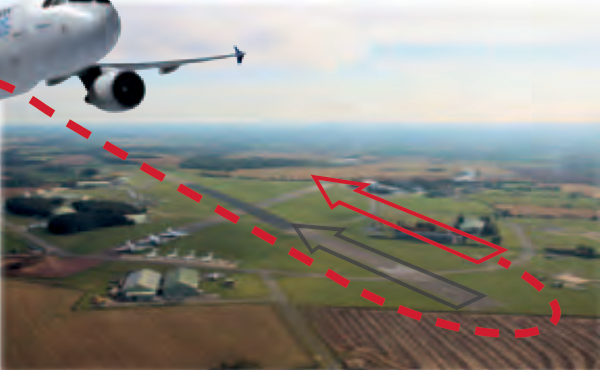
Section titled “3. The Circling Approach Rules”From the beginning of the level flight phase, at or above the Mini-
an ILS, the MAPt associated with an ILS procedure without glide path (GP out procedure) should be taken in account.
mum Descent Altitude/Height (MDA/H), the instrument approach track determined by radio navigation aids should be maintained until:
IEM to Appendix 1 to JAR-OPS 1.430, 4.2 and 3.2
q The pilot estimates that, in all probability, visual contact with the runway or runway environment will be maintained during the entire procedure;
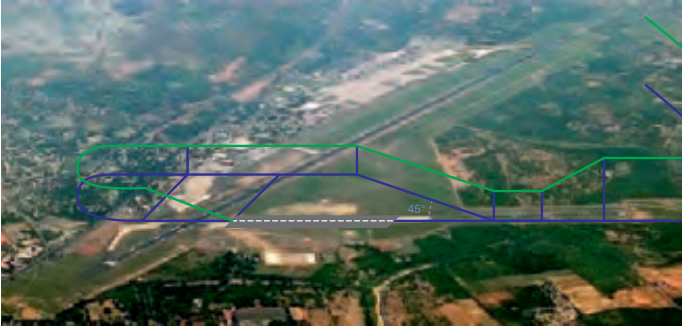
The flight maneuvers should be conducted within the circling area, and in such a way that a visual contact with the runway, or the runway environment, is maintained at all times.
q The pilot estimates that his aircraft is within the circling area before commencing circling; and
The same flight maneuvers should be carried out at an altitude/height which is not less than the circling MDA/H.
q The pilot is able to determine his aircraft’s position in relation to the runway with the aid of the external references.
A descent below MDA/H should not be initiated until the threshold of the runway to be used has been identified and the aeroplane is in a position to continue with a normal rate of descent and land within the touchdown zone.
If the above conditions are not met by the Missed Approach Point (MAPt), a missed approach must be carried out in accordance with the instrument approach procedure.
IEM to Appendix 1 to JAR-OPS 1.430, 4.4, 4.5 and 4.6
If the instrument approach procedure is carried out with the aid of
Safety
4. what about the Missed Approach?
Section titled “4. what about the Missed Approach?”JAR Ops Definitions: Visual Maneuvering (circling)
Section titled “JAR Ops Definitions: Visual Maneuvering (circling)”If visual reference is lost while circling to land from an instrument approach, the missed approach specified for that particular instrument approach must be followed. It is expected that the pilot will make an initial climbing turn toward the landing runway and overhead the aerodrome where he will establish the aeroplane in a climb on the missed approach track. In as much as the circling maneuver may be accomplished in more than one direction, different patterns will be required to establish the aeroplane on the prescribed missed approach course depending on its position at the time visual reference is lost unless otherwise prescribed.
IEM to Appendix 1 to JAR-OPS 1.430, 3.1
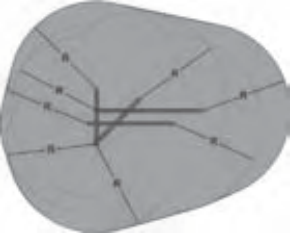
| Cat C | Cat C | Cat D | Cat D | |
|---|---|---|---|---|
| ICAO | TERPS | ICAO | TERPS | |
| ManeuveringSpeed | 180 kt | 140 kt | 205 kt | 165 kt |
| R | 4.20 nm | 2.83 nm | 5.28 nm | 3.7 nm |
| Minimum Visibility | 1 600 m | 2 400 m | 2 400 m | 3 200 m |
| Minimum HAA | 500 ft | 450 ft | 600 ft | 550 ft |
5.1. Approach Preparation:
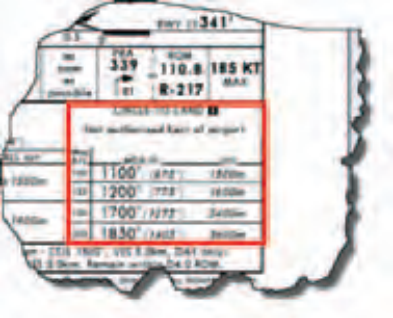
Section titled “5.1. Approach Preparation:”First of all, start with the chart, check the protected area and terrain and look for any special notes or restrictions. Check the MDA for circling (circling minima) for your category of aircraft and brief the approach configuration. Prepare the secondary flight plan (SEC F-PLN): copy active and change runway to actual landing runway. Ensure that the use of ND during the approach is fully briefed.
The Airbus Safety Magazine
5.2. Instrument Approach:
Section titled “5.2. Instrument Approach:”Airbus SOP is that the initial part of the normal circling approach is flown with gear down and CONF 3. We recommend that, for an ILS, pilots should use the Flight Directors (FD) in HD/VS mode, whereas, for a non-precision approach, the FD mode should be TRK/FPA.
5.3. At MdA for Circling:
Section titled “5.3. At MdA for Circling:”Level-off and fly not lower than MDA (Anticipate the level-off; this is a minimum descent altitude and the pilot must not descend below). Level-off using the VS knob (PUSH TO LEVEL OFF), or by pushing the ALT push-button, depending on your aircraft option and company SOP. If you are flying an ILS, select TRK/FPA and arm the 45 degree track turn, left or right, as appropriate.
q If visual reference is achieved (see diagram): commence the turn by pulling HDG knob for track.
q If not: Go Around.
Note: at this stage, the Go Around is still in the active F-PLN of the FMS, and may be flown automatically.
5.4. Timing for Circling:
Section titled “5.4. Timing for Circling:”The timing Airbus recommends is 30 seconds from wings level, adjusted for strong Head or Tail wind, by reference to the ND wind indicator.
However, this is a visual exercise: Timings are approximate only.
The pilot is abble to determine his aircraft’s position in relation to the runway with the aid of the external references.
IEM to Appendix 1 to JAR-OPS 1.430, 4.2 and 3.2
5.5. downwind:
Section titled “5.5. downwind:”Maintain visual reference with the runway environment. Monitor both lateral distance and track, with the aid of the ND, and adjust track for wind, as necessary. In particular if the aircraft is too close to the runway.
At an appropriate point, activate the SEC F-PLN ( Keep the DISCONTINUITY). Disconnect the AP and remove FD, at the latest before commencing any further descent.
5.6. downwind ABM:
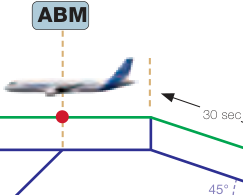
Section titled “5.6. downwind ABM:”Start timing when abeam the threshold (3 sec per 100 ft is a guide).
But what about airspeed and tail wind? Remember: this is a visual exercise and timings are approximate only! The ND may be used as an aid to initiating and judging the base turn.
Once again, all timings are approximate, and use the ND as a guide ONLY, for:
q 2.5 Nm offset?
-
q Position downwind?
-
q Track downwind?
-
q Abeam threshold?
-
q Tailwind for timing?
-
q Crosswind?
-
q Terrain?
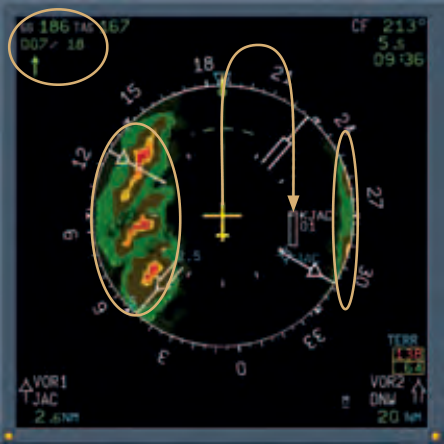
q 2.5 Nm offset? Remember the maximum for TERPS airfields and category C aircraft may be as little as 1.7 Nm. The small white marks of the range ring in this diagram represent 2.5 Nm. A normal circling approach at 150kts should result in a downwind offset of around 1.6 Nm and enable a rate 1 continuous base turn.
q Position downwind? The ND is a guide to the progress of the aircraft downwind but only a guide!
q Track downwind? The ND may be used as an immediate cross-check that the correct downwind track has been selected, and maintained.
q Abeam threshold? The threshold abeam point is best recognized visually but the ND may be used as a confirmation of the visual observation.
q Tailwind for timing? The ND wind arrow is a valuable and continuous measure of the wind situation during a circling approach. It enables the crew to observe, and react, to a changing wind situation including any…
q Crosswind?
Section titled “q Crosswind?”q Terrain? The ND is an excellent aid to situational awareness at all times.
The Airbus Safety Magazine
5.8. Final Turn:
Section titled “5.8. Final Turn:”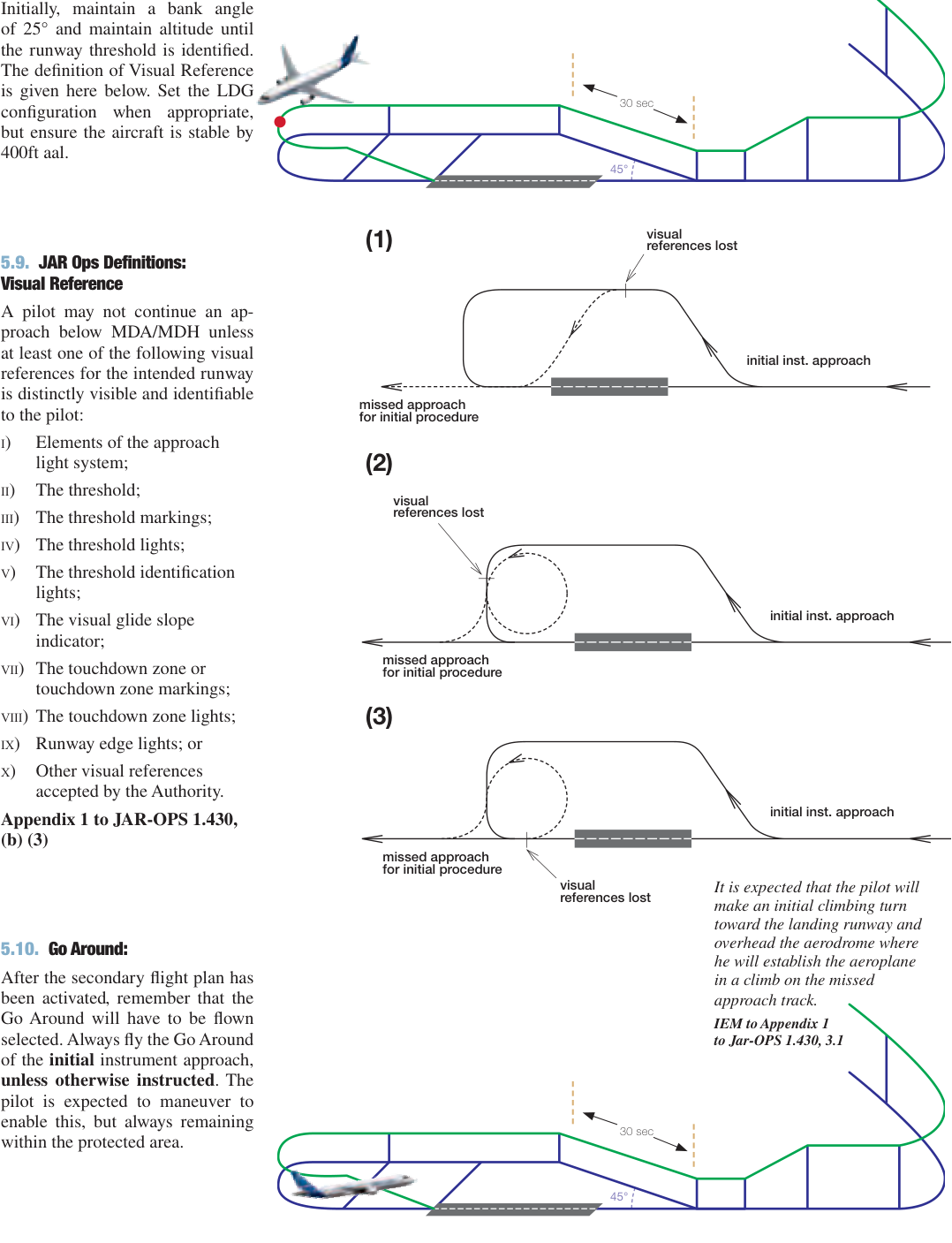
6. what about Engine Out?
Section titled “6. what about Engine Out?”In case of Engine Out, for all Airbus aircraft: Use the QRH, check the table for weight (A320/A330) and delay gear extension.
If the approach is flown at less than 750 ft RA, the “L/G NOT DOWN” warning will be triggered: This warning can be cancelled. NAV The “TOO LOW GEAR” warning will be triggered below 500 ft RA.
-
q Pilot WPTs (PBDs), or
-
q NAV mode, or
q AP below circling minima
8. Conclusion:
Section titled “8. Conclusion:”Airbus recommends that all operators examine their operations and the associated training regarding the circling approach…
What about other types of approach? RNP APCH or RNP AR APCH may replace a circling approach and create a lower minima.
来源:Airbus Safety First 网址:https://safetyfirst.airbus.com/the-circling-approach/ 发布日期:2011-07-25 类别:档案 PDF:原始 PDF
空客安全杂志
David OWENS
Section titled “David OWENS”训练政策高级总监
圆散场进近曾经是航空公司标准运营中的常见和正常组成部分。如今,它不再频繁实施,也不再是每位飞行人员的复训内容。然而,它仍然是一项具有挑战性的机动飞行。
2. 什么是圆散场进近?
Section titled “2. 什么是圆散场进近?”当着陆跑道与仪表进近跑道不同时。
JAR Ops 定义:
Section titled “JAR Ops 定义:”-
圆散(Circling):仪表进近的目视阶段,将飞机调至适合在不适合直接进近的跑道上着陆的位置。
-
目视进近:未完成全部或部分仪表进近程序,以对地形的目视参考执行的进近。
JAR-OPS 1 E 1.435 (1) 和 (8)
Section titled “JAR-OPS 1 E 1.435 (1) 和 (8)”3. 圆散场进近规则
Section titled “3. 圆散场进近规则”从水平飞行阶段开始,在或高于最低下降高度/高度(MDA/H)时,应保持由无线电导航设备确定的仪表进近航道,直至:
对于无下滑道的 ILS 程序(GP out 程序),应将相关的 MAPt(最低复飞点)纳入考虑。
飞行员应满足以下条件:
IEM to Appendix 1 to JAR-OPS 1.430, 4.2 and 3.2
- 飞行员估计在所有可能的情况下,在整个程序中能够保持对跑道或跑道环境的目视接触;
飞行机动应在圆散区域内进行,并以始终保持对跑道或跑道环境的目视接触的方式实施。
- 飞行员估计其飞机在开始圆散之前处于圆散区域内;且
相同的飞行机动应在不低于圆散 MDA/H 的高度/高度上实施。
- 飞行员能够借助外部参考点确定其飞机相对于跑道的位置。
在识别出使用跑道的入口点且飞机能够以正常下降率继续并降落在接地区内之前,不应开始低于 MDA/H 的下降。
如果在最低复飞点(MAPt)未满足上述条件,应按照仪表进近程序执行复飞。
IEM to Appendix 1 to JAR-OPS 1.430, 4.4, 4.5 and 4.6
如果借助以下方式执行仪表进近程序,则应考虑与无下滑道的 ILS 程序相关的 MAPt。
安全
4. 复飞怎么办?
Section titled “4. 复飞怎么办?”JAR Ops 定义:目视机动(圆散)
Section titled “JAR Ops 定义:目视机动(圆散)”如果在仪表进近圆散着陆过程中目视参考丢失,应按照该特定仪表进近规定的复飞程序执行。期望飞行员将进行初始爬升转弯,朝向着陆跑道并在机场上空建立沿复飞航道的爬升。由于圆散机动可能在一个以上的方向上完成,根据目视参考丢失时飞机所处位置,需要不同的模式来建立飞机沿规定复飞航线的位置,除非另有规定。
IEM to Appendix 1 to JAR-OPS 1.430, 3.1
| C 类 | C 类 | D 类 | D 类 | |
|---|---|---|---|---|
| ICAO | TERPS | ICAO | TERPS | |
| 机动速度 | 180 kt | 140 kt | 205 kt | 165 kt |
| 圆散半径 R | 4.20 nm | 2.83 nm | 5.28 nm | 3.7 nm |
| 最低能见度 | 1600 m | 2400 m | 2400 m | 3200 m |
| 最低 HAA | 500 ft | 450 ft | 600 ft | 550 ft |
5.1. 进近准备:
Section titled “5.1. 进近准备:”首先从航图开始,检查保护区域和地形,并查找任何特殊说明或限制。检查圆散类别的 MDA(圆散最低标准)以及您的飞机类别。简令进近构型。准备备用飞行计划(SEC F-PLN):复制现用计划并将跑道更改为实际着陆跑道。确保进近期间使用导航显示器(ND)的程序已充分简令。
空客安全杂志
5.2. 仪表进近:
Section titled “5.2. 仪表进近:”空客 SOP(标准操作程序)规定,常规圆散场进近的初始部分以起落架放下和形态 3(CONF 3)飞行。我们建议,对于 ILS,飞行员应在航向/垂直速度(HD/VS)模式下使用飞行指引仪(FD);对于非精密进近,FD 模式应为航迹/飞行航径角(TRK/FPA)。
5.3. 在圆散 MDA 处:
Section titled “5.3. 在圆散 MDA 处:”平飞并保持不低于 MDA 的高度(提前做平飞;这是最低下降高度,飞行员不得低于此高度下降)。使用垂直速度旋钮平飞(按下平飞),或根据您的飞机选装和公司 SOP 按下高度(HOLD)按钮平飞。如果正在飞 ILS,选择 TRK/FPA 并预位适当的 45 度航迹转弯(向左或向右)。
-
如果获得目视参考(见示意图):拉出航向旋钮以航迹方式开始转弯。
-
如果未获得目视参考:复飞。
注意:在此阶段,复飞仍在 FMS 的现用飞行计划(F-PLN)中,可以自动飞行。
5.4. 圆散场计时:
Section titled “5.4. 圆散场计时:”空客建议的计时为从翼展水平开始 30 秒,根据 ND 风向指示器针对强劲顺风或逆风进行调整。
然而,这是一个目视练习:计时仅为近似值。
飞行员能够借助外部参考点确定其飞机相对于跑道的位置。
IEM to Appendix 1 to JAR-OPS 1.430, 4.2 and 3.2
5.5. 下风边(Downwind):
Section titled “5.5. 下风边(Downwind):”保持对着陆环境的目视参考。借助 ND 监控横向距离和航迹,必要时调整航迹以修正风向。特别是在飞机离跑道太近的情况下。
在适当的时机激活备用飞行计划(保留不连续性)。断开自动驾驶仪并在最晚开始进一步下降前移除飞行指引仪。
5.6. 下风边正切跑道(Downwind ABM):
Section titled “5.6. 下风边正切跑道(Downwind ABM):”在正切跑道入口时开始计时(每 100 ft 3 秒作为参考)。
但是空速和顺风呢?记住:这是一项目视练习,计时仅作为近似参考!ND 可作为起始和判断最后一边转弯的辅助工具。
再次强调,所有计时均为近似值,仅将 ND 作为参考,用于:
q 2.5 Nm 偏置?
-
q 下风边位置?
-
q 下风边航迹?
-
q 正切跑道入口?
-
q 顺风计时?
-
q 侧风?
-
q 地形?
q 2.5 Nm 偏置? 记住 TERPS 机场 C 类飞机的最大偏置可能仅为 1.7 Nm。本图中距离圈的白色小刻度代表 2.5 Nm。正常盘旋进近以 150 节飞行,下风边偏置约为 1.6 Nm,可实现 Rate 1 连续最后一边转弯。
q 下风边位置? ND 是飞机下风边飞行进度的参考,仅供参考!
q 下风边航迹? ND 可作为即时交叉检查,确认已选择并保持正确的下风边航迹。
q 正切跑道入口? 正切跑道入口点最好通过目视识别,ND 可作为目视观察的确认。
q 顺风计时? ND 的风矢量为盘旋进近期间的风况提供了有价值的连续测量。它使机组能够观察并应对变化的风况,包括任何……
q 侧风?
q 地形? ND 在任何时候都是态势感知的优秀辅助工具。
The Airbus Safety Magazine
5.8. 最后转弯(Final Turn):
Section titled “5.8. 最后转弯(Final Turn):”
6. 单发失效怎么办?
Section titled “6. 单发失效怎么办?”对于所有空客飞机单发失效的情况:查阅 QRH,检查重量(A320/A330)并延迟起落架放下。
如果在低于 750 ft 无线电高度飞行进近,将触发”L/G NOT DOWN”警告:该警告可被取消。 NAV 在低于 500 ft 无线电高度将触发”TOO LOW GEAR”警告。
-
q 飞行员航路点(PBDs),或
-
q NAV 方式,或
q 自动驾驶仪低于盘旋最低高度
8. 结论:
Section titled “8. 结论:”空客建议所有运营人检查其运营活动及与盘旋进近相关的培训……
其他类型的进近呢?RNP APCH 或 RNP AR APCH 可以替代盘旋进近并创造更低的最低标准。