Inadvertent Autopilot Engagement during Takeoff on A220 Aircraft
Source: Airbus Safety First URL: https://safetyfirst.airbus.com/inadvertent-autopilot-engagement-during-takeoff-on-a220-aircraft/ Published: 2023-09-06 Category: Flight Ops PDF: Original PDF

Several in-service events were reported to Airbus where the flight crew inadvertently selected the autopilot while attempting to engage the autothrottle during the takeoff roll. Inadvertent autopilot engagement may result in early rotation that can lead to a tail strike, inability to climb, runway overrun, or even loss of control.
The of this article is to describe the circumstances purpose leading to this type of event with a case study and to provide details about the procedure updates and planned product enhancements that aim to prevent recurrence.
Check the latest version of this article on safetyfrst.airbus.com and on the Safety first app for iOS and Android devices.
CASE STUDY
Section titled “CASE STUDY”Event Description
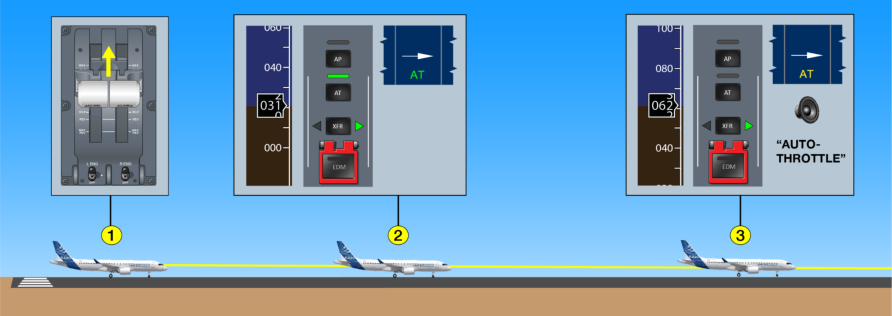
Section titled “Event Description”An A220 aircraft was aligned on the runway and ready for a flap 2 and TO-3 derated takeoff. The computed takeoff speeds were 135 kt for V1, 137 kt for VR, and 141 kt for V2. The autothrottle was armed (fig.1).
① The flight crew moved the thrust levers forward to initiate takeoff. ② The autothrottle engaged at approximately 31 kt and the takeoff thrust (81.5% N1) was reached at approximately 40 kt. ③ At 62 kt, the autothrottle unexpectedly disconnected, accompanied by the “ AUTOTHROTTLE ” aural alert.
(fig.1) illustration of the event - part 1
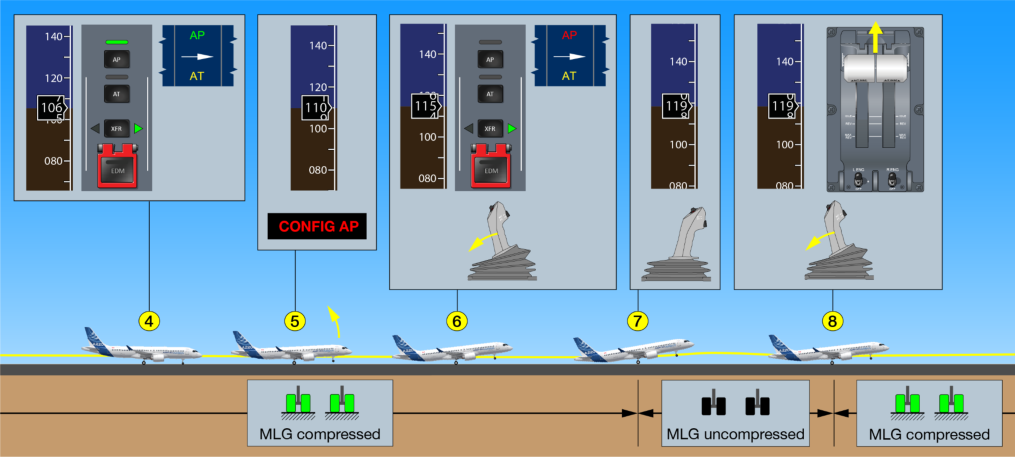
④ At 106 kt, the flight crew wanted to re-engage the autothrottle but they pressed the autopilot AP switch instead of the AT switch on the Flight Control Panel (FCP). ⑤ The CONFIG AP EICAS alert triggered at 110 kt (VR- 27 kt), but without the associated “ CONFIG AUTOPILOT ” aural alert as the “ AUTOTHROTTLE ” aural alert was still repeating. With the AP engaged, the aircraft started to rotate. ⑥ At 115 kt (VR-22 kt), the PF disconnected the autopilot and briefly applied 66% backstick input before releasing the sidestick to neutral. ⑦ At 119 kt (VR-18 kt), the aircraft pitch reached 10.7 ° and the strut of the main landing gear decompressed. ⑧ 1s later, the landing gear was compressed again and the aircraft pitch reduced slightly (fig.2) illustration of the event - part 2 to 7.5 °. The captain (PM) pushed the thrust levers to MAX and the first officer applied 50% backstick inputs.
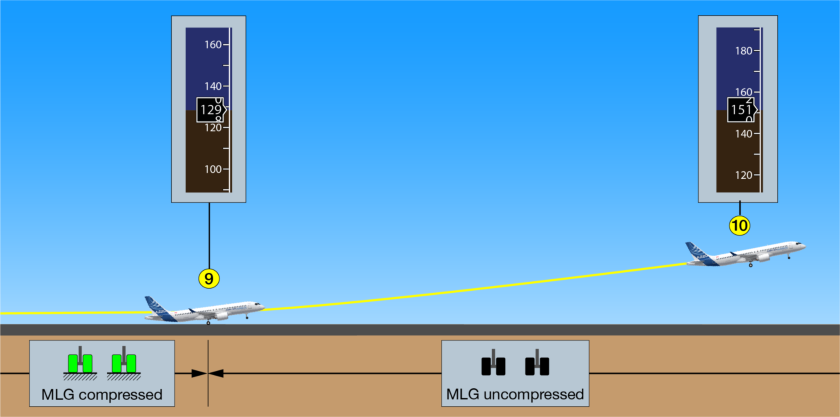
⑨ The landing gear decompressed again when the aircraft reached 129 kt (VR-8 kt) and began to climb. ⑩ The aircraft reached 151 kt (V2 + 10kt) at 100 ft RA. The flight crew deactivated the repetitive “ AUTOTHROTTLE ” aural alert and continued the flight.
(fig.3) Illustration of the event - part 3
Event Analysis
Section titled “Event Analysis”Inadvertent selection of the autopilot
Section titled “Inadvertent selection of the autopilot”When the autothrottle unexpectedly disconnected during the takeoff roll, the flight crew tried to manually reengage it using the autothrottle switch, but they inadvertently pressed the autopilot switch instead. This caused the autopilot to be engaged with the aircraft still on ground.
Autopilot commanded rotation The autopilot commanded a pitch-up when it was inadvertently activated on the ground to reach the flight guidance pitch target. This caused the aircraft to rotate too early when the aircraft was still 27 kt below VR. No “CONFIG AUTOPILOT” aural alert The ” CONFIG AUTOPILOT ” aural alert did not sound, because the repetitive “ AUTOTHROTTLE ” aural alert was still active when the CONFIG AP EICAS alert was triggered. Reduced Tailstrike Margin During the event, at step ⑦ , the aircraft pitch attitude was 10.7° when the aircraft was still on the ground, which corresponds to a tailstrike margin as low as 1 to 2 ft.
OPERATIONAL CONSIDERATIONS
Section titled “OPERATIONAL CONSIDERATIONS”The A220 FCOM and AFM were updated and the red OEB 001 was published to provide procedures and information to flight crews with the aim to raise awareness and prevent any unintentional selection and engagement of the autopilot during the takeoff roll if attempting to select and engage the autothrottle.
No autothrottle selection during takeoff roll
Section titled “No autothrottle selection during takeoff roll”The flight crew must not attempt to select and engage the autothrottle during the takeoff roll. This will reduce the risk of unintentional selection of the autopilot switch.
As a reminder, the autothrottle selection pushbutton on the FCP is inhibited above 60 kt when the HOLD Mode activates and remains inhibited until reaching 400 ft AGL.
Managing autothrottle disconnect during takeoff
Section titled “Managing autothrottle disconnect during takeoff”A220 FCOM 2 “Normal Procedures - Normal takeoff / High wind takeoff, Step (3) Autothrottle“ was updated to provide flight crews with a procedure if the autothrottle disconnects during the takeoff roll.
Autothrottle disconnect below 60kt
Section titled “Autothrottle disconnect below 60kt”If the autothrottle disconnects below 60 kt, the flight crew must abort takeoff.
Autothrottle disconnect above 60 kt
Section titled “Autothrottle disconnect above 60 kt”-
In the case of a TO or FLEX takeoff , the thrust levers must be set to MAX to continue the takeoff
-
In the case of a derated takeoff (TO-1, TO-2, or TO-3) : ○ If the N1 of both engines matches the N1 target, the flight crew can continue the takeoff
-
If the N1 of either or both engine(s) does not match the N1 target, the flight crew must abort the takeoff.
When stabilized in climb (not below 400 ft)
Section titled “When stabilized in climb (not below 400 ft)”After the aircraft is established on a stabilized climb above 400 ft, the flight crew can reengage the autothrottle as required. For derated thrust or FLEX takeoff, they must confirm that the autothrottle is selected on.
AFM update
Section titled “AFM update”The AFM was updated to add a warning in the limitations section for the autopilot. It states that “Autopilot engagement during takeoff roll can result in premature rotation, possibly leading to tail strike, inability to climb or loss of control. Immediate crew intervention is required.”
Training
Section titled “Training”-
The Operations Training Transmission A220-OTT-22-00-001 Rev 00 (dated 14-July-2023) recommends that Operators and Training Organizations: ● Reinforce flight crew knowledge on: ○ The importance of reviewing OEBs together during preflight
-
○ The content of the red OEB “INADVERTENT AUTOPILOT ENGAGEMENT DURING TAKEOFF”
-
○ The temporary AFM and FCOM 2 takeoff normal procedure “Autothrottle disconnect during takeoff”
-
● Highlight the importance of the role of Pilot Monitoring.
-
Further information can be found in the following documents:
-
FOT A220-FOT-22-00-001 dated 09-NOV-22 “ATA 22 – A220 Inadvertent Autopilot Engagement During Takeoff” available on the A220World portal
-
● TCCA Emergency AD CF-2022-64
-
FAA Emergency AD 2022-25-51
-
A220 Red OEB-001.01 Inadvertent Autopilot Engagement During Takeoff published on 28-March-2023
-
A220 AFM - Limitations, Autopilot
-
● A220 FCOM – Normal Procedures - Normal takeoff / High Wind Takeoff, Step (3) Autothrottle
-
● A220-OTT-22-00-001 Rev 00 dated 14-July-2023
PRODUCT ENHANCEMENTS
Section titled “PRODUCT ENHANCEMENTS”Airbus will introduce the following enhancements to prevent inadvertent engagement of the autopilot when the aircraft is still on the ground and improve flight crew awareness to prevent any errors.
Modification to inhibit autopilot
Section titled “Modification to inhibit autopilot”To prevent autopilot engagement during the takeoff roll, the Primary Flight Control Computer (PFCC) will be upgraded to inhibit AP engagement during takeoff and until 6 seconds after liftoff. This modification will be introduced in PFCC standard 009, planned for Q2 2024.
Enhancement of the autothrottle disconnection logic
Section titled “Enhancement of the autothrottle disconnection logic”The autothrottle disconnect logic is also being updated to address the issues that cause it to disconnect during the takeoff roll. A first set of improvements will be introduced with the next 8A3 avionics software and further improvements are currently being developed.
“CONFIG AUTOPILOT” priority over “AUTOTHROTTLE” aural alert
Section titled ““CONFIG AUTOPILOT” priority over “AUTOTHROTTLE” aural alert”EICAS software will be upgraded to give higher priority to takeoff configuration warning messages, such as “CONFIG AUTOPILOT”, or when other CONFIG takeoff alerts are posted, even if the AUTOTHROTTLE aural alert is not silenced. This improvement should also be available in the 8A3 avionics software.
Contributors: Ali FARHAT
Section titled “Contributors: Ali FARHAT”A220 Senior Engineering Specialist Autoflight Design Office
Sébastien FITTE
Section titled “Sébastien FITTE”A220 Engineering Specialist Design Office
Sebastien GUAY
Section titled “Sebastien GUAY”A220 Engineering Specialist Principal Design Office
Sunny GUPTA
Section titled “Sunny GUPTA”Accident/Incident Investigation
Product Safety
Flight crews should be aware of the consequences of inadvertent selection of the autopilot during the takeoff roll, which may lead to a risk of tail strike, inability to climb, runway overrun, and possible loss of control. A220 FCOM procedures were updated and AFM limitations were added to help flight crews learn from the experience of previously reported events and prevent this kind of event from recurring. This should be reinforced by all operators applying the applicable recommendations, including the need for the flight crew to review applicable OEBs together during preflight and the importance of the Pilot Monitoring role. Product enhancements, modifications, and updates will be implemented as additional safety features that will inhibit autopilot engagement during the takeoff roll, increase the robustness of the autothrottle monitoring, and improve the priority sequencing of aural alerts.
Matthias MAEDER
Section titled “Matthias MAEDER”A220 Chief Technical Pilot
Guillaume REIX
Section titled “Guillaume REIX”A220 Engineering Specialist - Indicating Design Office
With thanks to Josep BOADA-BAUXELL from A220 engineering, Adrien CHEN from A220 Product Safety, Jimmy AVGOUSTIS from A220 Flight Operations Support and Albert MAZZIA from Training and Flight Operations Support
Safety first, 2023. Safety first is published by Airbus S.A.S. 1, rond point Maurice Bellonte - 31707 Blagnac Cedex/France.
Editor: Yannick Malinge, Chief Product Safety Officer.
Editorial team: Guillaume Estragnat, Vanessa Sadi, Gwyneth Duggan, Javier Martinez Marina, Tim Roach.
- Reference: X00D16031905.
Photos by Airbus.
Source: Airbus Safety First URL: https://safetyfirst.airbus.com/inadvertent-autopilot-engagement-during-takeoff-on-a220-aircraft/ Published: 2023-09-06 Category: 飞行运营 PDF: 原始 PDF
空客收到多起在服事件报告,机组在起飞滑跑时尝试接通自动油门却意外选择了自动驾驶仪。意外接通自动驾驶仪可能导致提前抬头,从而引发尾撬擦地、无法爬升、跑道冲出甚至失控。
本文的目的是通过案例研究描述此类事件的发生情形,并详细介绍程序更新和计划中的产品改进,以防止再次发生。
请在 safetyfirst.airbus.com 和适用于 iOS 和 Android 设备的 Safety first 应用上查看本文的最新版本。
一架 A220 飞机在跑道上对齐,准备使用 2 形态和 TO-3 减推力起飞。计算得出的起飞速度为:V1 135 kt、VR 137 kt、V2 141 kt。自动油门已预位**(图 1)**。
① 机组向前推动推力手柄以开始起飞。② 自动油门在约 31 kt 时接通,起飞推力(81.5% N1)在约 40 kt 时达到。③ 在 62 kt 时,自动油门意外断开,并伴随” AUTOTHROTTLE “(自动油门)语音警告。
(图 1) 事件图示 - 第一部分
④ 在 106 kt 时,机组想要重新接通自动油门,但他们按下了飞行控制面板(FCP)上的自动驾驶仪 AP 开关而非 AT 开关。⑤ CONFIG AP EICAS 警告在 110 kt(VR-27 kt)时触发,但由于” AUTOTHROTTLE “语音警告仍在重复播放,因此未伴随” CONFIG AUTOPILOT “语音警告。自动驾驶仪接通后,飞机开始自动抬头。⑥ 在 115 kt(VR-22 kt)时 PF 断开了自动驾驶仪,并短暂施加了 66% 的侧杆后拉输入,然后松开侧杆至中立位。⑦ 在 119 kt(VR-18 kt)时,飞机俯仰角达到 10.7°,主起落架撑杆压缩解除。⑧ 1 秒后,起落架再次被压缩,飞机俯仰角略微减小至 7.5° (图 2) 事件图示 - 第二至第七步。机长(PM)将推力手柄推至最大位,副驾驶施加了 50% 的侧杆后拉输入。
⑨ 当飞机达到 129 kt(VR-8 kt)并开始爬升时,起落架再次压缩解除。⑩ 飞机在 100 ft RA 高度达到 151 kt(V2+10 kt)。机组关闭了重复播放的” AUTOTHROTTLE “语音警告并继续飞行。
(图 3) 事件图示 - 第三部分
误选自动驾驶仪
Section titled “误选自动驾驶仪”当自动油门在起飞滑跑期间意外断开时,机组试图使用自动油门开关手动重新接通,但错误地按下了自动驾驶仪开关。这导致自动驾驶仪在飞机仍在地面时就已接通。
自动驾驶仪指令的抬头 自动驾驶仪在地面意外接通后,指令俯仰向上以达到飞行指引的俯仰目标。这导致飞机在 VR 速度以下 27 kt 时就已提前抬头。未触发”CONFIG AUTOPILOT”语音警告 由于在 CONFIG AP EICAS 警告触发时重复播放的” AUTOTHROTTLE “语音警告仍在进行,因此” CONFIG AUTOPILOT “语音警告未响起。尾撬裕度减小 在事件过程中,第⑦步时飞机仍在地面上的俯仰姿态为 10.7°,对应的尾撬裕度仅为 1 至 2 ft。
运营注意事项
Section titled “运营注意事项”A220 FCOM 和 AFM 已更新,并发布了红色 OEB 001,旨在为机组提供程序和信息,以提高认识并防止在尝试选择和接通自动油门时在起飞滑跑期间意外选择和接通自动驾驶仪。
起飞滑跑期间不得选择自动油门
Section titled “起飞滑跑期间不得选择自动油门”飞行机组不得在起飞滑跑期间尝试选择并接通自动油门。这将降低意外选择自动驾驶仪开关的风险。
提醒:FCP上的自动油门选择按钮在60节以上且HOLD模式激活时被抑制,并在到达400英尺AGL之前保持抑制状态。
起飞期间自动油门断开的处置
Section titled “起飞期间自动油门断开的处置”A220 FCOM 2“正常程序—正常起飞/大侧风起飞,第(3)步自动油门”已更新,为飞行机组提供在起飞滑跑期间自动油门断开时的处置程序。
自动油门在60节以下断开
Section titled “自动油门在60节以下断开”如果自动油门在60节以下断开,飞行机组必须中断起飞。
自动油门在60节以上断开
Section titled “自动油门在60节以上断开”-
在TO或FLEX起飞情况下,必须将推力手柄设置为MAX以继续起飞
-
在减额定起飞(TO-1、TO-2或TO-3)情况下:
- 如果两台发动机的N1与目标N1相符,飞行机组可以继续起飞
- 如果任一或两台发动机的N1与目标N1不符,飞行机组必须中断起飞。
在爬升中建立稳定状态后(不低于400英尺)
Section titled “在爬升中建立稳定状态后(不低于400英尺)”在飞机建立稳定上升且高于400英尺后,飞行机组可根据需要重新接通自动油门。对于减额定推力或FLEX起飞,必须确认已选择接通自动油门。
AFM已更新,在自动驾驶的 limitations(限制)部分新增警告。内容为:“在起飞滑跑期间接通自动驾驶仪可能导致过早抬轮,可能导致尾蹭、无法爬升或失去控制。需要机组立即干预。”
-
运营培训通报 A220-OTT-22-00-001 Rev 00(日期:2023年7月14日)建议运营商和培训机构:
- 加强飞行机组对以下内容的了解:
- 在起飞前共同复习OEB的重要性
- 红色OEB“起飞期间意外自动驾驶仪接通”的内容
- 临时AFM和FCOM 2起飞正常程序“起飞期间自动油门断开”
- 强调监控飞行员角色的重要性。
- 加强飞行机组对以下内容的了解:
-
更多详细信息可在以下文件中查阅:
-
FOT A220-FOT-22-00-001 日期:2022年11月9日“ATA 22 – A220起飞期间意外自动驾驶仪接通”,可在A220World门户查阅
-
● TCCA紧急AD CF-2022-64
-
FAA紧急AD 2022-25-51
-
A220红色OEB-001.01起飞期间意外自动驾驶仪接通 发布于2023年3月28日
-
A220 AFM — 限制,自动驾驶仪
-
● A220 FCOM — 正常程序—正常起飞/大侧风起飞,第(3)步自动油门
-
● A220-OTT-22-00-001 Rev 00 日期:2023年7月14日
-
空客将引入以下改进,以防止在飞机仍处于地面状态时意外接通自动驾驶仪,并提高飞行机组的意识以防止任何错误。
抑制自动驾驶仪的改装
Section titled “抑制自动驾驶仪的改装”为防止在起飞滑跑期间接通自动驾驶仪,主飞行控制计算机(PFCC)将升级为在起飞时以及抬轮后6秒内抑制AP接通。此改装将在PFCC标准009中引入,计划于2024年第二季度完成。
自动油门断开逻辑的增强
Section titled “自动油门断开逻辑的增强”自动油门断开逻辑也在更新,以解决在起飞滑跑期间导致其断开的根本问题。第一套改进将在下一个8A3航电软件中引入,目前正在开发进一步的改进。
“CONFIG AUTOPILOT”优先于“AUTOTHROTTLE”音响告警
Section titled ““CONFIG AUTOPILOT”优先于“AUTOTHROTTLE”音响告警”EICAS软件将升级,使起飞构型警告信息(如“CONFIG AUTOPILOT”)或其他CONFIG起飞告警具有更高优先级,即使AUTOTHROTTLE音响告警未被静音。此项改进也将在8A3航电软件中提供。
Ali FARHAT A220自动飞行设计办公室高级工程专家
Sébastien FITTE A220设计办公室工程专家
Sebastien GUAY A220设计办公室首席工程专家
Sunny GUPTA 事故/事件调查 产品安全
飞行机组应了解在起飞滑跑期间意外选择自动驾驶仪的后果,可能导致尾蹭风险、无法爬升、跑道越线以及可能的失去控制。A220 FCOM程序已更新,AFM限制已添加,以帮助飞行机组从先前报告的事件中吸取经验,防止此类事件再次发生。所有运营商应通过适用建议加以强化,包括飞行机组在起飞前共同复习适用OEB的必要性,以及监控飞行员角色的重要性。将实施产品改进、改装和更新,作为额外安全功能,抑制起飞滑跑期间的自动驾驶仪接通,增强自动油门监控的稳健性,并改善音响告警的优先排序。
Matthias MAEDER A220首席技术飞行员
Guillaume REIX
Section titled “Guillaume REIX”A220 工程专家 - 显示设计室
特别感谢 A220 工程团队的 Josep BOADA-BAUXELL、A220 产品安全团队的 Adrien CHEN、A220 飞行运营支持团队的 Jimmy AVGOUSTIS,以及培训与飞行运营支持团队的 Albert MAZZIA
Safety first,2023。Safety first 由空中客车股份有限公司出版,地址:法国布朗格,31707 Blagnac Cedex,Maurice Bellonte 环路 1 号。
编辑:Yannick Malinge,首席产品安全官。
编辑团队:Guillaume Estragnat、Vanessa Sadi、Gwyneth Duggan、Javier Martinez Marina、Tim Roach。
20192534。参考编号:X00D16031905。
照片由空中客车提供。