Incorrect pitch trim setting at takeoff
Source: Airbus Safety First URL: https://safetyfirst.airbus.com/incorrect-pitch-trim-setting-at-takeoff/ Published: 2010-02-14 Magazine Issue: 2010-02 Category: Archive PDF: Original PDF
Catherine BONNET
Section titled “Catherine BONNET”Group Manager Weight and Balance Operational Performance Customer Services
1. Introduction
Section titled “1. Introduction”In 2008, an A330 flight crew was surprised by the rapid rate of rotation of the aircraft at takeoff.
Analysis of the flight revealed that the crew selected an erroneous takeoff pitch trim setting. This trim setting was based on a Takeoff Center of Gravity (TOCG) determined through a simplified load and trim sheet calculation method. This TOCG did not correspond with the aircraft’s CG at takeoff.
This event highlights three issues: q The AFTER START procedure, which calls for the setting of the pitch trim according to the CG indicated on the ECAM, was not properly applied.
q The pitch trim setting was set according to a load and trim sheet TOCG instead of the ECAM CG. q The TOCG on the load and trim sheet was erroneous, because of the simplified TOCG calculation method.
The aim of this article is to: q Explain why this simplified TOCG calculation method can lead to differences between the calculated TOCG and the real TOCG at brake release. q Propose an improved simplified TOCG calculation method. q Highlight the existing Standard Operating Procedures (SOP) relating to the TOCG.
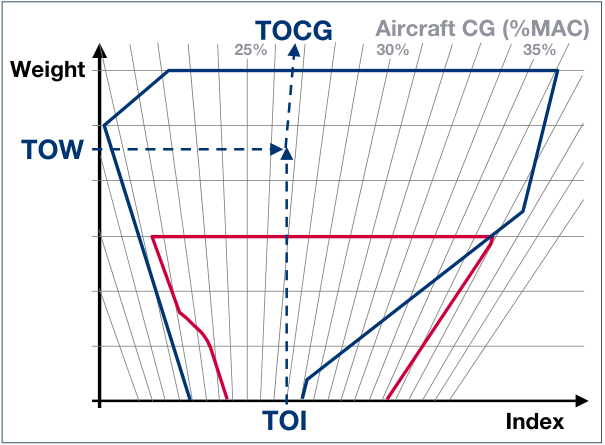
Figure 1 Determination of the TOCG
For TOW, airlines use a standard value for taxi fuel weight. This is an acceptable simplification. However for TOI, the determination of the Taxi Fuel Index is complex because it depends both on the amount and the location of the fuel consumed during taxi. Therefore airlines often prefer to use the simplified calculation method described here below.
2. TOCG calculation methods
Section titled “2. TOCG calculation methods”2.1. Complete calculation
Section titled “2.1. Complete calculation”To determine the TOCG (expressed in percent of the Mean Aerodynamic Chord, %MAC) it is necessary to determine the Takeoff Weight (TOW) and the Takeoff Index (TOI) (fig. 1).
The TOW and TOI are calculated with the following formulae:
2.2. Simplified TOCG calculation
Section titled “2.2. Simplified TOCG calculation”TOW = Zero Fuel Weight + Ramp Fuel weight – Taxi Fuel Weight
(As used during the 2008 A330 event.) The TOI is calculated with the following formula:
TOI = Zero Fuel Index + Ramp Fuel Index – Taxi Fuel Index
TOI = Zero Fuel Index + Takeoff Fuel Index
Safety
The Takeoff Fuel index is taken from the ramp fuel index table, which gives for each fuel weight the corresponding total fuel index. The table assumes a pre-determined tank refueling sequence, (fig. 2).
|---|---| |Fuel Weight|Index| |…|…| |37500|- 6| |38000|0| |38500|+ 5| |39000|+ 10| |…|…|
The utilization of the ramp fuel index table to calculate the takeoff weight index is possible as long as the taxi fuel burn sequence is the reverse of the tank refueling sequence, i.e. if the taxi fuel is consumed from the last refueled tank.
If the taxi fuel is not consumed from the last refueled tank, the distance between the CG after refueling and the aircraft’s CG at takeoff is:
• Negligible if the taxi fuel quantity is low or if the tank used for taxi is near the last refueled tank.
3. Improved simplified TOCG calculation
Section titled “3. Improved simplified TOCG calculation”To avoid any large CG discrepancy, Airbus recommends an improved Figure 2 Excerpt from an A330 simplified method where the TOI ramp fuel index table is calculated with the following formula:
TOI = Zero Fuel Index + Ramp Fuel Index
Section titled “TOI = Zero Fuel Index + Ramp Fuel Index”The Ramp Fuel Index replaces the Takeoff Fuel Index of the original simplified calculation because, on all Airbus aircraft, the taxi fuel is burnt in the tanks located near the aircraft’s CG position.
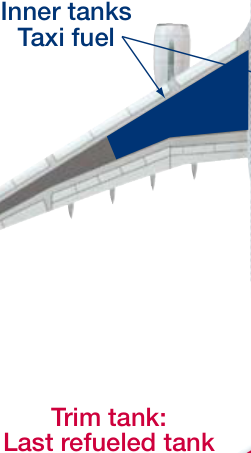
Figure 3 A330 fuel tank configuration
On Airbus aircraft the taxi fuel is consumed from:
q The inner/wing tanks on the A300/A310/A318/A319/A320/ A321/A330/A340. q The feed tanks on the A380.
As a consequence, the taxi fuel index can be considered to be negligible.
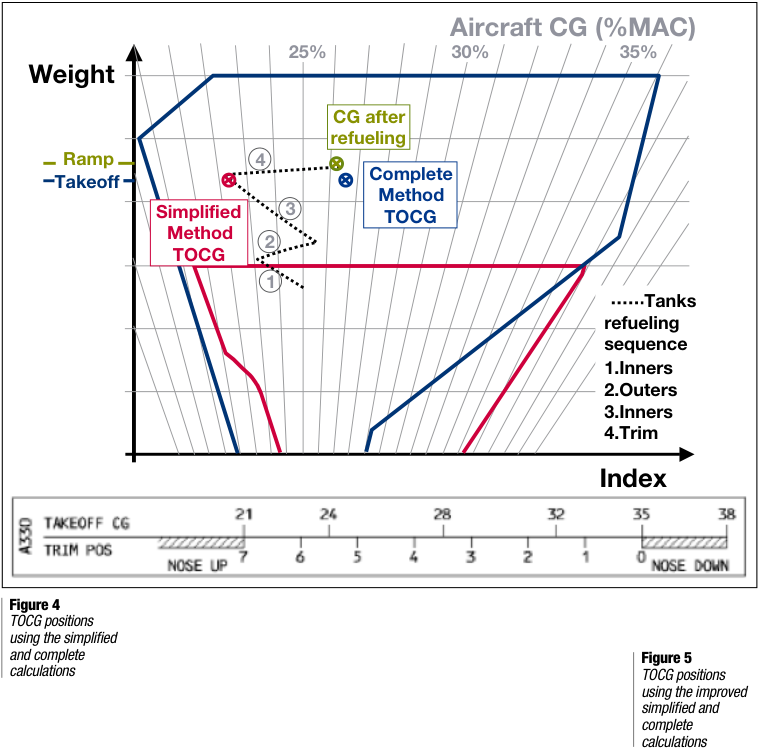
On the A330 used to illustrate our article, the calculation of the TOCG by means of the improved simplified calculation would have given a TOCG at 26,3% MAC, corresponding to a pitch trim setting of 4.3 degrees NOSE UP. This is very close to the TOCG at 26,7% MAC and the pitch trim setting of 4.1 degree NOSE UP that would have resulted from calculation using the complete calculation.
With the improved simplified TOCG calculation, the difference between the calculated TOCG and the real TOCG decreases from 4.5% MAC to 0.4% MAC.
The respective TOCG positions are shown in fig.5
• Large if the fuel used for taxi is high and if the tank used for taxi is far from the last refueled tank.
On the A330 example mentioned in the introduction, the Ramp Fuel was 39 tons and the Taxi Fuel was 2.6 tons. In this configuration, the last refueled tank is the trim tank, and the taxi fuel is burnt from the inner tanks, as shown in fig.3.
The simplified TOCG calculation gives a TOCG at 22.2%MAC, that corresponds to a pitch trim setting of 6.4 degrees NOSE UP. The complete calculation taking into account the taxi fuel burn gives a TOCG at 26.7%MAC, that corresponds to 4.1 degree NOSE UP.
The aircraft CG moves backward during the taxi-out, whereas the simplified method considers that the CG moves forward.
The respective TOCG positions are shown in fig.4.
4.1. BEFORE PUSHBACK OR START procedure
Section titled “4.1. BEFORE PUSHBACK OR START procedure”(FCOM 2.03.07 on A300-600/ A310, FCOM 3.03.07 on A318/ A319/A320/A321/A330/A340, FCOM > Procedure > Normal Procedure > Standard Operating Procedure > Before Pushback or Start on A380).
The loadsheet check in the BEFORE PUSHBACK procedure requires the Captain to :
q Ensure that the load and trim sheet is filled properly.
q Control that the ZFW/CG data is entered in the FMS correctly.
q Verify that the TOCG is within the load and trim sheet operational limits.
In addition, on the aircraft types where the ECAM displays the Gross Weight (GW) and CG (A300-600R/A310-300/A330/ A340/A380), the loadsheet check calls for the comparison of the load and trim sheet CG against the ECAM CG.
A significant difference may be due to:
q An error in the load and trim sheet q An erroneous ZFW/ZFWCG entry in the FMS.
q A non standard fuel distribution on board, which may be caused by an inoperative part of the fuel system.
q An erroneous TOCG on the load and trim sheet, calculated with the simplified TOCG calculation.
On these aircraft types, the pitch trim must bew set according to the ECAM CG:
q Manually on A300-600R/A310300/A330/A340.
q Automatically on A380, A340500/A340-600 and A330/A340 equipped with takeoff automatic pitch trim setting.
Safety
4.2. AFTER START procedure
Section titled “4.2. AFTER START procedure”The A300-600/A310-200 procedures (FCOM 2.03.09) are as follows:
PITCH TRIM …SET for T/O
The flight crew uses the TOCG from the load and trim sheet, which is close to the TOCG at brake release if the improved simplified TOCG calculation method is used.
The A300-600R/A310-300 procedures (FCOM 2.03.09) are as follows:
PITCH TRIM …SET for T/O
The flight crew uses the CG displayed on the ECAM, which is close to the TOCG at brake release.
The A320 family procedures (FCOM 3.03.09) are as follows:
PITCH TRIM …SET Set takeoff CG on pitch trim wheel.
The flight crew uses the TOCG from the load and trim sheet, which is close to the TOCG at brake release if the improved simplified TOCG calculation method is used.
The A330/A340 procedures (FCOM 3.03.09) are as follows:
5. Conclusion
Section titled “5. Conclusion”Caution must be exercised when determining the TOCG value on the load and trim sheet through a simplified calculation method. This may lead to erroneous results, particularly on aircraft equipped with trim tanks and/or Auxiliary Center Tanks (ACT).
Airbus therefore recommends the use of either the complete or improved simplified calculation for the TOCG value. This insures that the TOCG values always remain as close as possible to the real aircraft CG at takeoff.
The AFTER START Standard Operating Procedures call for the pitch trim to be set according to:
q The CG displayed on the ECAM on the A300-600R/ A310-300/A330/A340/A380. q The calculated TOCG value on the load and trim sheet on the A300-600/A310-200/A318/ A319/A320/A321.
PITCH TRIM …SET
Set CG on pitch trim wheel. For this purpose use CG indicated on ECAM.
The flight crew uses the CG displayed on the ECAM, which is close to the TOCG at brake release.
The A340-500/A340-600 and A330/A340 equipped with takeoff automatic pitch trim setting procedures (FCOM 3.03.09) are as follows:
PITCH TRIM … CHECK Check the takeoff CG on the pitch trim wheel using the ECAM’S CG indication.
The flight crew checks that the pitch trim is correctly set.
The FCOM 2.01.40 for A318/A319/ A320/A321/A330/A340 has been updated with the improved simplified TOCG calculation method in the revision released in SEPT09. The FCOM 2.06.40 for A300-600/ A310 will be updated at next revision in MAY10.
The subject was presented at the IATA Load Control and Aircraft Messaging Working Group in Geneva in SEPT09.
The A380 procedures (FCOM>Procedure>Normal Procedure>Standard Operating Procedure>After Start) are as follows:
PITCH TRIM … CHECK
Check that the pitch trim is at the takeoff target on the pitch trim position indication of the PFD.
The flight crew checks that the pitch trim is correctly set.
Safety
Catherine BONNET
Section titled “Catherine BONNET”重心与平衡运营性能客户服务部经理
2008年,一架空客A330飞行机组在起飞时对飞机快速的抬轮速率感到惊讶。
分析飞行数据后发现,机组选择了错误的起飞俯仰配平设置。该配平设置基于通过简化的载重与配平单计算方法得出的起飞重心(TOCG)。该TOCG与飞机起飞时的实际重心不符。
此事件突出以下三个问题:
- 起飞后(AFTER START)程序要求根据ECAM上显示的重心设置俯仰配平,但未被正确执行。
- 俯仰配平设置是根据载重与配平单上的TOCG设置的,而非ECAM上显示的重心。
- 由于简化的TOCG计算方法存在缺陷,载重与配平单上的TOCG是不准确的。
本文旨在:
- 解释为何简化的TOCG计算方法会导致计算得出的TOCG与实际刹车松开时的重心之间存在差异。
- 提出一种改进的简化TOCG计算方法。
- 强调与TOCG相关的现行标准操作程序(SOP)。
图1 TOCG的确定
对于起飞总重(TOW),航空公司使用标准的滑行燃油重量值。这是可接受的简化做法。然而对于起飞指数(TOI),滑行燃油指数的确定较为复杂,因为它取决于滑行期间消耗的燃油量和位置。因此,航空公司通常更倾向于使用下文所述的简化计算方法。
2. TOCG计算方法
Section titled “2. TOCG计算方法”2.1. 完整计算
Section titled “2.1. 完整计算”要确定TOCG(以平均气动弦的百分比表示,%MAC),必须确定起飞总重(TOW)和起飞指数(TOI)(图1)。
TOW和TOI的计算公式如下:
TOW = 零燃油重量 + 滑行重量 – 滑行燃油重量
TOI = 零燃油指数 + 滑行燃油指数
TOW = 零燃油重量 + 起飞燃油重量
(2008年A330事件中所用的方法。)TOI的计算公式如下:
TOI = 零燃油指数 + 起飞燃油指数
安全
起飞燃油指数取自滑行燃油指数表,该表为每个燃油重量提供对应的总燃油指数。该表假设了一个预设的油箱加油顺序**(图2)**。
| 燃油重量 | 指数 |
|---|---|
| … | … |
| 37500 | - 6 |
| 38000 | 0 |
| 38500 | + 5 |
| 39000 | + 10 |
| … | … |
使用滑行燃油指数表计算起飞重量指数的前提是:滑行燃油消耗顺序与油箱加油顺序相反,即滑行燃油从最后加油的油箱消耗。
如果滑行燃油不是从最后加油的油箱消耗,则加油后重心与起飞时飞机重心之间的距离为:
- 可忽略——如果滑行燃油量较低,或用于滑行的油箱接近最后加油的油箱。
- 较大——如果用于滑行的燃油量较高,且用于滑行的油箱远离最后加油的油箱。
在本文提到的A330示例中,滑行燃油为39吨,滑行燃油量为2.6吨。在这种情况下,最后加油的油箱是配平油箱,而滑行燃油从内侧油箱消耗(图3)。
简化TOCG计算得出的TOCG为22.2%MAC,对应6.4度机头向上的配平设置。完整计算(考虑滑行燃油消耗)得出的TOCG为26.7%MAC,对应4.1度机头向上。
飞机重心在滑行过程中向后移动,而简化方法则认为重心向前移动。
各自的TOCG位置如图4所示。
3. 改进的简化TOCG计算
Section titled “3. 改进的简化TOCG计算”为避免任何较大的重心偏差,空客建议采用改进的简化方法,其中TOI的计算公式如下:
TOI = 零燃油指数 + 滑行燃油指数
滑行燃油指数取代了原简化计算中的起飞燃油指数,因为在所有空客飞机上,滑行燃油是从位于飞机重心位置附近的油箱中消耗的。
图3 A330燃油箱配置
在空客飞机上,滑行燃油的消耗来源为:
- A300/A310/A318/A319/A320/A321/A330/A340:内侧/机翼油箱
- A380:供油油箱
因此,滑行燃油指数可视为可忽略不计。
在用于说明本文的A330上,通过改进的简化计算得出的TOCG为26.3%MAC,对应4.3度机头向上的配平设置。这与使用完整计算得出的TOCG 26.7%MAC和4.1度机头向上的配平设置非常接近。
使用改进的简化TOCG计算方法,计算得出的TOCG与实际TOCG之间的差异从4.5%MAC降至0.4%MAC。
各自的TOCG位置如图5所示。
4.1. 推出或启动前程序
Section titled “4.1. 推出或启动前程序”(A300-600/A310 参见 FCOM 2.03.07;A318/A319/A320/A321/A330/A340 参见 FCOM 3.03.07;A380 参见 FCOM > 程序 > 正常程序 > 标准操作程序 > 推出或启动前)。
推出或启动前程序中的载重表检查要求机长:
q 确保载重和配平表填写正确。
q 核查 FMS 中输入的 ZFW/CG 数据无误。
q 核实 TOCG 在载重和配平表操作限制范围内。
此外,在 ECAM 显示毛重(GW)和 CG 的机型上(A300-600R/A310-300/A330/A340/A380),载重表检查要求将载重和配平表 CG 与 ECAM CG 进行比对。
显著差异可能由以下原因造成:
q 载重和配平表中的错误
q FMS 中 ZFW/ZFWCG 输入错误。
q 机上燃油分布不符合标准,可能由燃油系统部件失效引起。
q 载重和配平表上的 TOCG 存在错误,采用简化 TOCG 计算方法计算得出。
在这些机型上,俯仰配平必须按照 ECAM CG 进行设置:
q 在 A300-600R/A310-300/A330/A340 上手动设置。
q 在 A380、A340-500/A340-600 以及配备起飞自动俯仰配平设置的 A330/A340 上自动设置。
安全提示
4.2. 启动后程序
Section titled “4.2. 启动后程序”A300-600/A310-200 程序(FCOM 2.03.09)如下:
俯仰配平 …起飞设置
飞行机组使用载重和配平表上的 TOCG,如果采用改进简化 TOCG 计算方法,该值与刹车松开时的 TOCG 接近。
A300-600R/A310-300 程序(FCOM 2.03.09)如下:
俯仰配平 …起飞设置
飞行机组使用 ECAM 上显示的 CG,该值与刹车松开时的 TOCG 接近。
A320 系列程序(FCOM 3.03.09)如下:
俯仰配平 …设置
在俯仰配平轮上设置起飞 CG。
飞行机组使用载重和配平表上的 TOCG,如果采用改进简化 TOCG 计算方法,该值与刹车松开时的 TOCG 接近。
A330/A340 程序(FCOM 3.03.09)如下:
俯仰配平 …设置
在俯仰配平轮上设置 CG。为此使用 ECAM 上显示的 CG。
飞行机组使用 ECAM 上显示的 CG,该值与刹车松开时的 TOCG 接近。
配备起飞自动俯仰配平设置的 A340-500/A340-600 及 A330/A340 程序(FCOM 3.03.09)如下:
俯仰配平 … 检查
使用 ECAM CG 指示检查俯仰配平轮上的起飞 CG。
飞行机组确认俯仰配平设置正确。
A380 程序(FCOM > 程序 > 正常程序 > 标准操作程序 > 启动后)如下:
俯仰配平 … 检查
检查 PFD 俯仰配平位置指示上的俯仰配平是否处于起飞目标位置。
飞行机组确认俯仰配平设置正确。
使用简化计算方法确定载重和配平表上的 TOCG 值时必须谨慎。这可能导致错误结果,尤其是在配备配平油箱和/或辅助中央油箱(ACT)的飞机上。
因此,空客建议使用完整或改进简化的 TOCG 计算方法来确定 TOCG 值。这确保 TOCG 值始终尽可能接近飞机起飞时的实际 CG。
启动后标准操作程序要求按以下方式设置俯仰配平:
q 在 A300-600R/A310-300/A330/A340/A380 上使用 ECAM 显示的 CG。
q 在 A300-600/A310-200/A318/A319/A320/A321 上使用载重和配平表上的计算 TOCG 值。
A318/A319/A320/A321/A330/A340 的 FCOM 2.01.40 已于 2009 年 9 月发布的修订版中更新了改进简化 TOCG 计算方法。A300-600/A310 的 FCOM 2.06.40 将于 2010 年 5 月的下一修订版中更新。
该议题已于 2009 年 9 月在日内瓦举行的 IATA 载重控制与飞机通信工作组会议上进行了介绍。
安全提示