Prevention of EGT Overlimit Events
Source: Airbus Safety First URL: https://safetyfirst.airbus.com/prevention-of-egt-overlimit-events/ Published: 2022-02-22 Category: Flight Ops, Maintenance, EGT, engine, high temperature, OAT, RTO, takeoff, temperature PDF: Original PDF

A number of engine Exhaust Gas Temperature (EGT) overlimit events at takeoff were reported to Airbus, including dual events to a increase in crew leading significant flight workload at low altitude.
This article recalls the importance of monitoring the EGT of each to detect in margin engine any degradation engine performance early, and provides recommendations to Maintenance, Flight Operations, and flight crews to prevent EGT overlimit events. It also reminds us of what to do in the case of an EGT overlimit indication at takeoff.
This article is also available on safetyfrst.airbus.com and on the Safety first app for iOS and Android devices.
Among the reported events of EGT overlimit, 10 occurred on both engines between May and September 2021. Even if EGT overlimit events are common, they can increase the flight crew workload in a critical phase of flight, especially when they happen on both engines simultaneously. They can create operational disruptions (e.g. rejected takeoff or in-flight turnback) and require maintenance actions.
CASE STUDY
Section titled “CASE STUDY”Event Description
Section titled “Event Description”An A321 aircraft, with a takeoff weight of 73 T (MTOW 98.7 T), was in CONF2 with packs ON and ready for takeoff on a relatively warm weather day (30°C OAT/ISA+15). The flight crew applied standard thrust stabilization and then TOGA thrust. The takeoff was uneventful until liftoff. At 90 ft RA, the ENG1 EGT OVER LIMIT and ENG2 EGT OVER LIMIT ECAM alerts triggered. The PF initially moved both thrust levers to MCT, then engaged the autopilot at 450 ft and moved the thrust levers to the CLB notch. At 890 ft, the PF set the ENG1 thrust lever to idle. The vertical speed began to decrease and the PF set the ENG2 thrust lever to MCT. The flight crew then set the ENG1 master switch to OFF when crossing 1 300 ft, leveled off at 1 500 ft, and decided to perform an in-flight turnback. The PF climbed to 4 000 ft. The flight crew started the APU and began descent to initiate the approach. The ENG1 master switch was set back to ON during the descent and Engine 1 successfully restarted at approximately 2 700 ft. The approach and landing were performed without any further events.
Event Analysis
Section titled “Event Analysis”The investigation confirmed that both engines had an EGT overlimit and compressor stall during the event. This was the combination of degraded performance on both engines, combined with a relatively high OAT (30°C), and the use of TOGA thrust with packs ON.
The inspection of both engines by the engine manufacturer stated, “ General dirty/eroded/corroded/worn condition of engine’s flow path. Deteriorated airfoil profile and tip & seals clearance identified as major contributors to both engines EGT overtemperature. ” It was also noted that an interruption of in-flight engine data transmission between the Operator and the engine manufacturer did not facilitate a timely assessment of the engine degradation.
THE EGT PARAMETER
Section titled “THE EGT PARAMETER”The EGT sensors are located either on the inlet or the outlet of the Low Pressure Turbine (LPT), depending on the engine type.
Parameters that Influence EGT
Section titled “Parameters that Influence EGT”An engine with degraded performance is less efficient and requires more fuel to produce the same thrust leading to an increase in EGT. A number of parameters can cause temporary performance degradation that will have an influence on EGT or there can be a progressive degradation of engine performance.
Temporary performance degradation
Section titled “Temporary performance degradation”Several parameters can cause temporary engine performance degradation and result in increased EGT values:
-
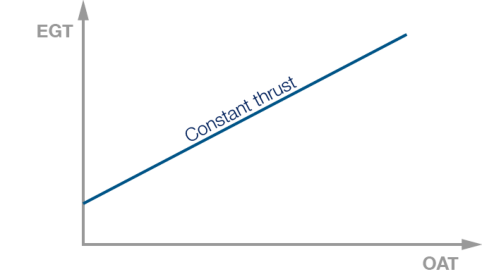
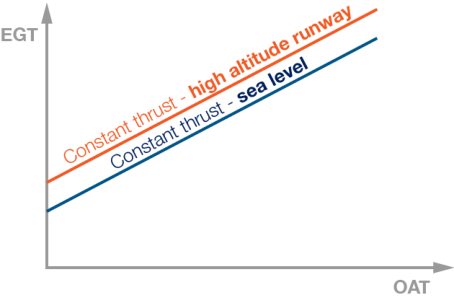
Environmental parameters such as Outside Air Temperature (OAT) (fig.1) and altitude (fig.2). For example, every increase of 1°C in OAT can lead to (fig.1) and (fig.2) Effect an EGT increase of approximately 3°C to produce the same thrust at takeoff, of OAT and altitude on the EGT for a constant
-
depending on the engine type. thrust
-
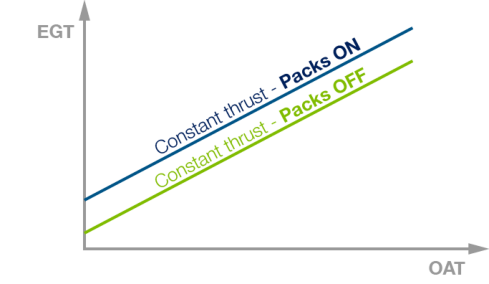
Bleed demand : Use of air conditioning packs and anti-ice increases the (fig.3) and (fig.4) Effect bleed demand on the engine and will result in a higher EGT to produce the of bleed demand (packs) same thrust (fig.3). and engine
-
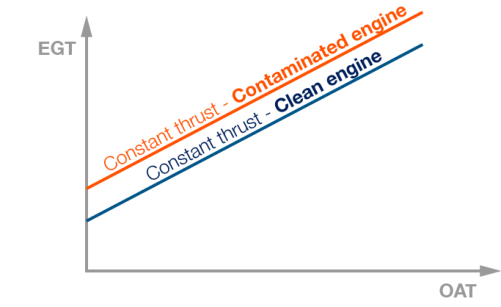
● Engine contamination (e.g. dust, pollution) can disturb the airflow through contamination on the the engine, which affects the overall performance of the engine and results EGT for a constant in higher EGT values (fig.4). thrust
- Engine temperature : An engine is “cold” when the EGT is almost the same as the OAT at engine start. This can lead to an increased peak in the EGT during takeoff if the engine does not have sufficient time to warm up after starting.
Progressive Performance Degradation: Engine Wear
Section titled “Progressive Performance Degradation: Engine Wear”The performance of any engine progressively degrades with time due to inevitable wear of its components. This is generally due to eroded or damaged compressor foils, worn seals, and the increased clearance between rotor/stator blade tips and the stator/rotor in the compressor and turbine sections due to erosion.
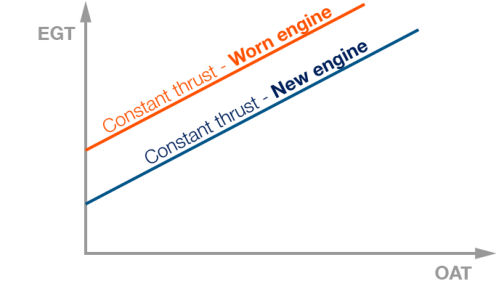
(fig.5) Effect of engine wear on the EGT
EGT Redline
Section titled “EGT Redline”The “EGT redline” is defined as the engine operational limit that prevents damage to the engine due to an excessively high temperature. EGT limits for each flight phase are provided in the “ AFM - LIMITATIONS - POWER PLANT - Engine Parameters” and “ FCOM - Limitation - Engines - Thrust Setting/EGT Limits”. The EGT redline corresponds to the EGT limit for takeoff and go-around.
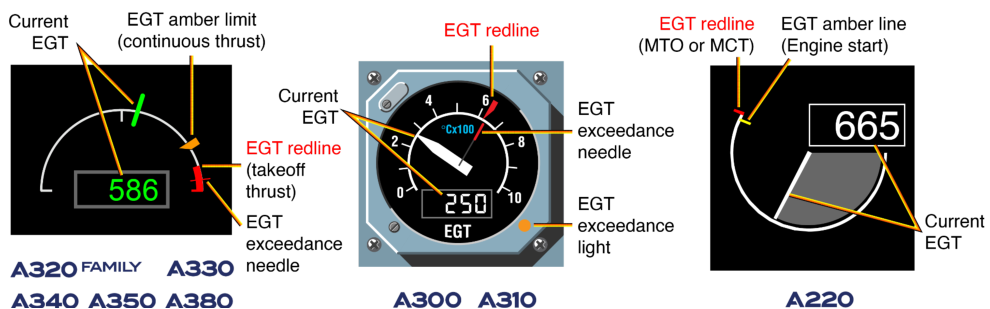
The EGT redline appears as a red line on the EGT indicator of A300/A310 aircraft and on the engine display of A220 aircraft. On A320 family, A330, A340, A350, and A380 aircraft, the EGT redline is the start of the red zone of the EGT arc on the engine display (fig.6). An EGT amber limit indicates the EGT limit for maximum continuous thrust or engine start provided in the FCOM on A320 family, A330, A340, A350, and A380 aircraft. This amber limit indication is hidden when takeoff power is applied. On A220 aircraft, an amber line indicates the EGT limit during engine start.
(fig.6) EGT indication
The EGT redline is not a “hard” limit
Section titled “The EGT redline is not a “hard” limit”In the absence of severe damage, an engine is capable of operating above the EGT redline without thrust loss, but at the cost of an accelerated engine wear. This was demonstrated during the engine certification tests. It is why an amber caution alert is used to inform the flight crew of an EGT overlimit rather than a red warning alert.
-
The ENG1(2) EGT OVER LIMIT ECAM alert is combined with an amber or red EGT indication for A320 family, A330, A340, A350, and A380 aircraft or an amber light on the EGT indicator for A300-600 and A310 aircraft. The alert is inhibited from 80 kt (70kt for A300-600/A310) during takeoff roll until liftoff to prevent a high-energy rejected takeoff and from touchdown down to 80 kt at landing to prevent the flight crew from stopping the use of thrust reversers.
-
The ENG EGT warning light on the Master Warning Panel is combined with an amber light on the EGT indicator for A300 aircraft
In the absence of severe damage, an engine is capable of operating above the EGT redline without thrust loss, but at the cost of an accelerated engine wear.
- The L(R) ENG EXCEEDANCE EICAS caution is combined with an AMBER or red EGT indication for A220. The caution is inhibited during the takeoff roll.
An EGT overlimit requires maintenance
Section titled “An EGT overlimit requires maintenance”After an EGT overlimit, inspection and troubleshooting are necessary to identify the root cause of the overlimit and assess the engine’s health.
EGT MARGIN INDICATES ENGINE HEALTH
Section titled “EGT MARGIN INDICATES ENGINE HEALTH”Engine manufacturers define the guaranteed maximum thrust of an engine based on its maximum limits (e.g. EGT, N1, N2) and up to a defined OAT. This OAT is called the flat rate temperature. It is also commonly called corner point temperature, breakpoint temperature, or kink point temperature. Above this OAT value, the engine control (FADEC) automatically manages the thrust to maintain a constant EGT. The maximum thrust and flat rate temperature are selected so that a new or overhauled engine has a sufficient EGT margin to the EGT redline (fig.7). This will enable the engine to sustain a certain amount of engine wear and still be capable of producing its maximum thrust rating without reaching the EGT redline. An OAT of 30°C at sea level (ISA +15°C) is usually defined at max take-off by engine manufacturers as a compromise for flat rate temperature because it enables maximum thrust in a wide range of conditions.
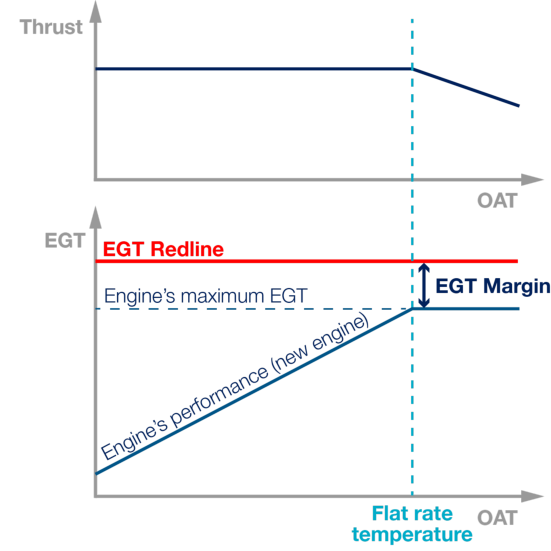
(fig.7) EGT margin
EGT monitoring
Section titled “EGT monitoring”The EGT margin gradually decreases with the progressive degradation in the performance of an engine. Use of the Engine Condition Monitoring (ECM) tool to measure the EGT margin of an engine provides a good indication of its health and can highlight if there is a need for maintenance. EGT margin trends can also provide a useful forecast of the average time on wing remaining for an engine.
Calculating the Current EGT Margin of an Engine
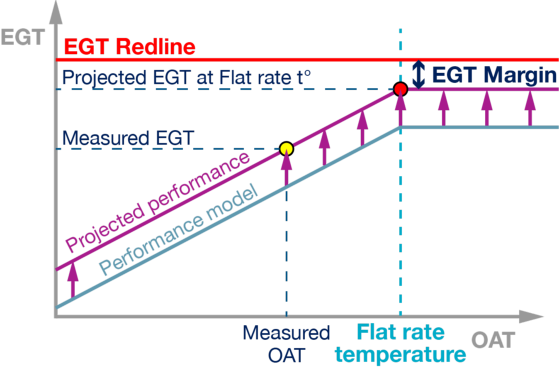
Section titled “Calculating the Current EGT Margin of an Engine”Each time a takeoff is performed with TOGA thrust, the ECM tool takes a snapshot of the engine parameters and of the external conditions (e.g. OAT, pressure). The tool then uses this measurement to calculate a delta vs the engine performance model and project it to the worst condition to determine the projected EGT of the engine (fig.8). The difference between this projected EGT and the EGT redline value is the current EGT margin of the engine.
The ECM also estimates the EGT margin when a FLEX or derated takeoff is performed, however, the computation is less accurate than when TOGA thrust is used. The need to perform a regular takeoff with TOGA thrust is therefore necessary to ensure efficient EGT monitoring. This is particularly important when the engine is near the EGT redline.
All parameters should be considered to prevent EGT overlimit
Section titled “All parameters should be considered to prevent EGT overlimit”Several parameters such as altitude, OAT, takeoff thrust used, and bleed demand can affect the peak EGT value at takeoff. Therefore, an engine with a slightly positive EGT margin may experience an EGT overlimit at takeoff but an engine with a slightly negative EGT margin may not necessarily experience EGT overlimit at takeoff.
(fig.8) Computation principle of the current EGT margin of an engine (altitude and mach corrections are not represented)
The need to perform a regular takeoff with TOGA thrust is necessary to ensure efficient EGT monitoring.
Maintenance, Flight Operations and flight crews can all play a role to prevent EGT overlimit events. Role of Maintenance Monitoring engine performance degradation The engine manufacturer Instructions for Continued Airworthiness (ICA) manual requests Operators to monitor the EGT Margin of their aircraft engines. This monitoring may be performed by the Operators or through a service provided by the engine manufacturer. The Operator should check the maximum thrust (TOGA) by performing full-rated takeoffs at regular intervals, in order to detect a reduced EGT margin, or maintaining an adequate engine monitoring program, in order to follow up on the engine parameters. Maintenance should inform Flight Operations and request that flight crews perform a takeoff with TOGA thrust when it is necessary to ensure an accurate computation of the EGT margin. Avoid fitting two performance limited engines to the same aircraft Operators should manage their fleet to ensure as much as possible that aircraft have no more than one engine with low EGT margin. An aircraft that has two performance-limited engines increases the probability of a dual EGT overlimit event. Regular engine washes Performing regular engine washes will remove particles from the compressor such as dirt, oil, sand, and salt that reduce the engine efficiency. The engine wash procedure is available in the AMM/MP. Operators can request additional or specific recommendations directly from the engine manufacturer. Sharing engine performance information It is important to ensure there is good communication between Maintenance and Flight Operations about the conditions and performance of engines fitted to an aircraft. Maintenance must inform the Flight Operations department when an aircraft is fitted with performance-limited engine(s). This will enable operations to be adapted according to the limitations of each aircraft.

Role of Flight Operations
Section titled “Role of Flight Operations”Adapting operations for aircraft with performance-limited engines Flight Operations should adapt operations to avoid using aircraft with performance-limited engines on performance-demanding routes such as into airports with hot weather or high-altitude runways. Operators should take particular care during the summer season when EGT events are more likely to occur. Informing flight crews Flight Operations should provide information to the flight crew before they fly an aircraft with performance-limited engines, so that they can adapt their procedures accordingly. Flight Operations also need to plan and pass on the request from Maintenance to perform a TOGA takeoff for an accurate computation of the EGT margin. Role of Flight Crew Engine warm-up time High EGT is often experienced when the engine is cold on the first takeoff of the day or after a long stay on the ground. When the EGT is almost the same as the OAT before engine start, the flight crew can extend the warm-up time to reduce the EGT peak during takeoff, especially at airports with hot weather and high-altitude runways, or if the aircraft engines have limited EGT margins. The usual warm-up time is between 2 and 5 minutes, however, a warm-up time of 10 minutes can reduce the takeoff EGT by approximately 10°C depending on the engine type. Some Operators have made it a policy to extend this warm-up time for each first flight of the day. Use reduced takeoff thrust If the flight crew uses reduced takeoff thrust, it can enable the engine to have an increased margin to the EGT redline. The use of “Flex” or “Derated” takeoff configuration can help to extend engine life and to save on maintenance costs. Take off with packs OFF If it is not possible for the flight crew to reduce the thrust takeoff, they can choose to take off with packs set to OFF, in order to reduce the bleed air demand on the engine (except on A380 aircraft). Take off with APU BLEED ON If the OAT is high and it does not enable the flight crew to take off with packs set to OFF, then they can perform the takeoff with APU BLEED ON to remove the bleed air demand from the engines and maintain passenger comfort.

WHAT TO DO IN THE CASE OF AN EGT OVERLIMIT DURING TAKEOFF
Section titled “WHAT TO DO IN THE CASE OF AN EGT OVERLIMIT DURING TAKEOFF”Despite applying all of the prevention measures, EGT overlimits can still happen and especially during hot weather. The EGT usually reaches a peak at the end of the takeoff roll, near rotation, or just after liftoff. If an EGT overlimit is combined with vibrations and happens shortly after the application of takeoff power, this can be an indication of more severe engine damage.
EGT overlimit between takeoff power application and 100 kt
Section titled “EGT overlimit between takeoff power application and 100 kt”If the EGT overlimit alert is triggered or if the flight crew notices that the EGT value becomes red on the engine display (on A220/A320/A330/A340/A350/A380 when the alert is inhibited) between takeoff power application and 100 kt, they should consider rejecting the takeoff.
EGT overlimit between 100 kt and V1
Section titled “EGT overlimit between 100 kt and V1”If the flight crew notices that the EGT value becomes red on the engine display (on A220/A320/A330/A340/A350/A380) or if the EGT overlimit warning light comes on (on A300/A310) between 100 kt and V1, they should continue the takeoff to establish the aircraft on the initial climb path. The flight crew should then wait to be above 400 ft before they apply the ECAM/FCOM procedure. However, the decision to perform a rejected takeoff is at the captain’s discretion and it depends on the situation, especially in the case of a dual EGT overlimit event or if the aircraft is in a mountainous area, for example.
EGT overlimit after V1 or after liftoff
Section titled “EGT overlimit after V1 or after liftoff”If the EGT overlimit happens after V1 or after liftoff, the flight crew must continue the takeoff. They should wait until the aircraft is safely established on its climb path above 400 ft before they apply the ECAM/FCOM procedure and gently reduce the thrust of the affected engine. If the temperature goes above a given threshold or if the overlimit situation persists after reduction of the thrust, the flight crew may shut down the affected engine as requested in the ECAM/FCOM procedure.
Reporting EGT overlimit events
Section titled “Reporting EGT overlimit events”Each time the flight crew experiences an EGT overlimit event, they must report it to maintenance, so that the necessary inspections and troubleshooting can be performed.
Contributors:
Section titled “Contributors:”Vincent BILLEROT Senior Expert Engine Performance Design Office
Cesar GARCIA CASTILLA
Section titled “Cesar GARCIA CASTILLA”Product Safety Enhancement Product Safety
David MONTASSIER
Section titled “David MONTASSIER”Powerplant Support Engineer Customer Engineering Support
Régis PERNET Flight Operation Support Engineer Customer Support
Martin SMITH
Section titled “Martin SMITH”Head of Propulsion System Airbus Canada
Jordane SOULA-OUDOT Accident/Incident Investigator Product Safety
With thanks to Tuong Vi ARNAU from the propulsion control integration team, Julien BARRY from the cockpit design team, and Thomas GOBEAUT, Maxime LANSONNEUR, Dirk De-WINTER and Emmanuel JANSSEN from the Flight Operations Support team.
Engine performance progressively degrades over time, which leads to an increase in EGT to produce the same thrust. Operators must monitor the performance of their aircraft engines and the evolution of the EGT margin. This will allow for maintenance or removal of an engine, if necessary, before engine performance degrades too much.
Maintenance, Flight Operations and flight crews all have a role to play to prevent EGT overlimit events on their aircraft in operations. In addition to monitoring the EGT margin, regular engine washes should be performed. Maintenance should avoid installing more than one engine with an EGT margin close to the EGT redline or a negative margin. Flight operations and flight crews should be informed when an aircraft is fitted with performance-limited engines. Maintenance should also request that Flight Operations plan for, and ask flight crews to perform, regular TOGA thrust takeoffs to ensure efficient monitoring of the EGT margin of the engines.
Flight Operations should avoid scheduling performance-limited aircraft on demanding routes and inform flight crews before they fly on a performance-limited aircraft, so that they can adapt their procedures accordingly. This can be done, for example, by extending the engine warm-up time before takeoff, using reduced-thrust takeoff, or performing the takeoff with packs set to OFF or APU bleed ON to gain extra EGT margin.
Flight crews should keep in mind that the EGT red line is not a hard limit. An engine can still produce thrust above the redline but with more wear on the engine components. As a result, if an EGT overlimit occurs during takeoff:
-
Before 100 kt , the takeoff should be aborted, because an EGT overlimit in the early stage of the takeoff roll can be a sign of engine damage, especially if associated with vibrations.
-
Between 100 kt and V1 , the flight crew should continue the takeoff, establish the aircraft on the initial climb path, and wait until the aircraft is above 400 ft before they apply the ECAM/FCOM procedure. However, the captain may decide to reject the takeoff depending on the situation.
-
After V1 or after liftoff , the flight crew must continue the takeoff and wait until the aircraft is above 400 ft before they apply the ECAM/FCOM procedure.
The flight crew must report any EGT overlimit to the Maintenance personnel and make a logbook entry so that appropriate troubleshooting and inspection are performed before the aircraft returns to service.
Safety first, 2022. Safety first is published by Airbus S.A.S. 1, rond point Maurice Bellonte - 31707 Blagnac Cedex/France.
Editor: Yannick Malinge, Chief Product Safety Officer.
Editorial team: Guillaume Estragnat, Vanessa Sadi, Gwyneth Duggan, Tim Roach.
- Reference: X00D16031905.
Photos by Airbus.
来源: Airbus Safety First 网址: https://safetyfirst.airbus.com/prevention-of-egt-overlimit-events/ 发布日期: 2022-02-22 类别: 飞行运营、维修、EGT、发动机、高温、OAT、中断起飞、起飞、温度 PDF: 原始PDF
空客收到多起关于起飞时发动机排气温度(EGT)超限事件的报告,包括双发同时超限事件,导致机组在低空工作负荷显著增加。
本文再次强调了监控每台发动机EGT以尽早发现发动机性能退化的重要性,并为维修人员、飞行运营部门和机组提供了预防EGT超限事件的建议。本文还提醒了起飞时出现EGT超限指示时的应对措施。
本文也可在 safetyfirst.airbus.com 以及 iOS 和 Android 版 Safety first 应用中获取。
在报告的EGT超限事件中,2021年5月至9月期间发生了10起双发同时超限事件。尽管EGT超限事件较为常见,但它们可能在飞行关键阶段增加机组工作负荷,尤其是在双发同时超限时。这些事件可能导致运营中断(例如中断起飞或返航),并需要维修措施。
一架A321飞机,起飞重量73吨(MTOW 98.7吨),使用CONF2形态,空调组件接通,在相对高温天气(30°C OAT/ISA+15)下准备起飞。机组执行了标准推力稳定程序,随后施加TOGA推力。起飞直到离地一切正常。在90英尺RA时,ENG1 EGT超限 和ENG2 EGT超限 ECAM警报触发。PF首先将两个推力手柄移至MCT,随后在450英尺接通自动驾驶仪,并将推力手柄移至CLB卡位。在890英尺,PF将ENG1推力手柄设置至慢车。垂直速度开始下降,PF将ENG2推力手柄设置至MCT。当穿越1300英尺时,机组将ENG1主电门设置至OFF,在1500英尺改平,随后决定执行空中返航。PF爬升至4000英尺。机组启动APU并开始下降以进入进近。在下降过程中,ENG1主电门重新设置至ON,发动机1在大约2700英尺处成功重新启动。进近和着陆顺利完成,未发生其他事件。
调查确认两台发动机在事件中均出现EGT超限和压气机喘振。这是两台发动机性能退化的叠加影响,加上相对较高的OAT(30°C),以及在组件接通情况下使用TOGA推力的组合结果。
发动机厂家对两台发动机的检查指出:“发动机流道整体脏污/侵蚀/腐蚀/磨损状态。恶化的翼型轮廓和叶尖及封严间隙被认定为两台发动机EGT超温的主要原因。”同时注意到,飞行中发动机数据传输在运营商与发动机厂家之间的中断,不利于及时评估发动机退化情况。
EGT传感器根据发动机类型的不同,位于低压涡轮(LPT)的进口或出口。
影响EGT的参数
Section titled “影响EGT的参数”性能退化的发动机效率较低,需要消耗更多燃油来产生相同的推力,从而导致EGT升高。多个参数可能导致暂时性性能退化从而影响EGT,也可能存在发动机性能逐渐退化的情况。
暂时性性能退化
Section titled “暂时性性能退化”以下参数可能导致发动机暂时性性能退化,并造成EGT值升高:
-
环境参数,如外界大气温度(OAT)(图1)和海拔高度(图2)。例如,OAT每升高1°C,起飞时为产生相同推力EGT约升高3°C,具体取决于发动机类型。
-
引气需求:空调组件和防冰的使用会增加发动机的引气需求,导致EGT升高以产生相同推力(图3)。
-
发动机污染(如灰尘、污染物)可能干扰通过发动机的气流,影响发动机整体性能,导致EGT值升高(图4)。
-
发动机温度:当EGT几乎与发动机启动时的OAT相同时,发动机处于“冷”状态。如果发动机启动后没有足够时间暖机,可能导致起飞时EGT峰值升高。
渐进性能退化:发动机磨损
Section titled “渐进性能退化:发动机磨损”任何发动机的性能都会随着时间的推移而逐步退化,这是由于其部件不可避免的磨损造成的。这通常是由于压气机叶片被侵蚀或损坏、密封件磨损,以及压气机和涡轮段中转子/静子叶片尖端与静子/转子之间的间隙因侵蚀而增大所致。
(图 5) 发动机磨损对 EGT 的影响
EGT 红线
Section titled “EGT 红线”“EGT 红线”定义为发动机运行限制,用于防止因温度过高而对发动机造成损坏。各飞行阶段的 EGT 限制值见《AFM - 限制条件 - 动力装置 - 发动机参数》和《FCOM - 限制条件 - 发动机 - 推力设定/EGT 限制》。EGT 红线对应于起飞和复飞的 EGT 限制。
EGT 红线在 A300/A310 飞机的 EGT 指示器上显示为一条红线,在 A220 飞机的发动机显示屏上也是如此。在 A320 系列、A330、A340、A350 和 A380 飞机上,EGT 红线是 EGT 弧形指示区红色区域起始位置**(图 6)**。EGT 琥珀色限制表示 A320 系列、A330、A340、A350 和 A380 飞机 FCOM 中规定的最大连续推力或发动机启动的 EGT 限制。应用起飞推力时,此琥珀色限制指示会隐藏。在 A220 飞机上,琥珀色线条表示发动机启动时的 EGT 限制。
(图 6) EGT 指示
EGT 红线并非“硬”限制
Section titled “EGT 红线并非“硬”限制”在未发生严重损坏的情况下,发动机能够在超过 EGT 红线的状态下运行而不会损失推力,但代价是发动机磨损加速。这在发动机取证测试中已得到验证。因此,使用琥珀色警戒提示来告知飞行机组 EGT 超限,而非红色警告提示。
-
ENG1(2) EGT OVER LIMIT ECAM 警戒在 A320 系列、A330、A340、A350 和 A380 飞机上与琥珀色或红色 EGT 指示关联,在 A300-600 和 A310 飞机上则与 EGT 指示器上的琥珀色灯光关联。该警戒在起飞滑跑阶段从 80 节(A300-600/A310 为 70 节)到起飞离地期间被抑制,以防止高能量中断起飞;着陆时从接地到 80 节期间被抑制,以防止飞行机组停止使用反推。
-
Master Warning Panel 上的 ENG EGT 警告灯在 A300 飞机上与 EGT 指示器上的琥珀色灯光关联
在未发生严重损坏的情况下,发动机能够在超过 EGT 红线的状态下运行而不会损失推力,但代价是发动机磨损加速。
- L(R) ENG EXCEEDANCE EICAS 警戒在 A220 飞机上与琥珀色或红色 EGT 指示关联。该警戒在起飞滑跑期间被抑制。
EGT 超限需要维护
Section titled “EGT 超限需要维护”EGT 超限后,必须进行检查和故障排除,以识别超限的根本原因并评估发动机状况。
EGT 余量表明发动机健康状况
Section titled “EGT 余量表明发动机健康状况”发动机厂家根据发动机的最大限制值(如 EGT、N1、N2)和最高外部大气温度(OAT)来定义发动机保证的最大推力。此 OAT 称为平直线温度。它通常也被称为拐点温度、断点温度或转折点温度。超过此 OAT 值时,发动机控制装置(FADEC)自动管理推力以保持恒定的 EGT。最大推力和平直线温度的选择原则是,使新发动机或大修后的发动机具有足够的 EGT 余量**(图 7)**。这将使发动机能够承受一定程度的磨损,同时仍能产生其最大推力额定值而不超过 EGT 红线。发动机厂家通常将海平面 30°C(ISA +15°C)的 OAT 设定为最大起飞时的平直线温度,因为这能够在广泛的条件范围内实现最大推力。
(图 7) EGT 余量
EGT 监控
Section titled “EGT 监控”随着发动机性能逐步退化,EGT 余量也会逐渐减小。使用发动机状态监控(ECM)工具测量发动机的 EGT 余量可以很好地反映其健康状况,并可显示是否需要维护。EGT 余量趋势还可用于预测发动机在翼平均剩余时间。
计算发动机当前 EGT 余量
Section titled “计算发动机当前 EGT 余量”每次使用 TOGA 推力起飞时,ECM 工具会采集发动机参数和外部条件(如 OAT、气压)的快照。然后,该工具利用此测量值计算与发动机性能模型的偏差,并投影到最差条件以确定发动机的投影 EGT**(图 8)**。该投影 EGT 与 EGT 红线值之间的差值即为发动机当前的 EGT 余量。
ECM 在执行 FLEX 或减推力起飞时也会估算 EGT 余量,但计算精度不如使用 TOGA 推力时高。因此,定期使用 TOGA 推力执行起飞对于确保有效的 EGT 监控是必要的。当发动机接近 EGT 红线时,这一点尤为重要。
应综合考虑所有参数以防止 EGT 超限
Section titled “应综合考虑所有参数以防止 EGT 超限”高度、外界温度(OAT)、使用的起飞推力以及引气需求等多个参数都会影响起飞时的峰值 EGT。因此,一台 EGT 余量略为正值的发动机可能在起飞时发生 EGT 超限,而一台 EGT 余量略为负值的发动机在起飞时却未必会发生 EGT 超限。
(图 8) 当前发动机 EGT 余量的计算原理(未表示高度和马赫数修正)
定期使用最大起飞推力(TOGA)执行起飞是确保有效 EGT 监控的必要条件。
维修、飞行运营和飞行机组均可发挥作用以防止 EGT 超限事件。 维修的职责——监控发动机性能衰减 发动机制造商的持续适航指令(ICA)手册要求运营商监控其飞机发动机的 EGT 余量。此项监控可由运营商执行,也可通过发动机制造商提供的服务完成。运营商应定期通过执行满额定起飞来检查最大推力(TOGA),以检测 EGT 余量的降低,或维护适当的发动机监控程序以跟踪发动机参数。维修部门应通知飞行运营部门,并请求飞行机组在必要时执行 TOGA 起飞以确保 EGT 余量的准确计算。 避免为同一架飞机安装两台性能受限的发动机 运营商应管理其机队,确保飞机至多只有一台发动机 EGT 余量较低。装有双发性能受限发动机的飞机会增加双发动机 EGT 超限事件的发生概率。 定期发动机清洗 定期进行发动机清洗可清除压气机中的灰尘、油污、沙粒和盐分等颗粒物,这些物质会降低发动机效率。发动机清洗程序见 AMM/MP。运营商可直接向发动机制造商请求额外或特定的建议。 共享发动机性能信息 确保维修部门与飞行运营部门之间就飞机所装发动机的状况和性能保持良好沟通非常重要。维修部门必须在飞机安装性能受限发动机时通知飞行运营部门,从而使运营工作能够根据每架飞机的限制条件进行调整。
飞行运营的职责
Section titled “飞行运营的职责”针对性能受限发动机的运营调整 飞行运营部门应调整运营,避免将性能受限发动机飞机投入性能需求高的航线运营,如飞往高温天气或高原跑道机场的航线。在夏季应特别谨慎,此时更易发生 EGT 事件。 通知飞行机组 飞行运营部门应在飞行机组驾驶性能受限发动机飞机前向其提供信息,以便其相应地调整程序。飞行运营部门还需要计划并传达维修部门关于执行 TOGA 起飞以准确计算 EGT 余量的请求。 飞行机组的职责——发动机暖机时间 发动机在当天首次起飞或长时间停场后处于冷态时,往往会出现高 EGT。当发动机起动前的 EGT 与外界温度(OAT)几乎相同时,飞行机组可延长暖机时间以降低起飞时的 EGT 峰值,特别是在高温天气和高高原机场,或者飞机发动机 EGT 余量有限的情况下。通常暖机时间为 2 至 5 分钟,但 10 分钟的暖机时间可将起飞 EGT 降低约 10°C(具体取决于发动机型号)。部分运营商已制定政策,将每天首次飞行的暖机时间延长。 使用减推力起飞 如果飞行机组使用减推力起飞,可使发动机增加至 EGT 红线的余量。使用”灵活温度(Flex)“或”减额定”起飞构型有助于延长发动机寿命并节省维护成本。 使用组件关闭起飞 如果飞行机组无法使用减推力起飞,可选择组件关闭起飞以减少发动机上的引气需求(A380 飞机除外)。 使用 APU 引气起飞 如果外界温度(OAT)较高且无法使用组件关闭起飞,则可在 APU 引气打开的状态下起飞,以消除发动机的引气需求并保持乘客舒适度。
起飞阶段排气温度超限的处置措施
Section titled “起飞阶段排气温度超限的处置措施”尽管采取了所有预防措施,排气温度超限仍可能发生,尤其是在高温天气条件下。排气温度通常在起飞滑跑结束时、接近抬轮时或刚刚离地后达到峰值。如果排气温度超限伴有振动,且发生在起飞推力施加后不久,则可能表明发动机损坏更为严重。
起飞推力施加后至 100 kt 之间发生排气温度超限
Section titled “起飞推力施加后至 100 kt 之间发生排气温度超限”如果在起飞推力施加后至 100 kt 之间触发了排气温度超限警戒,或飞行机组注意到发动机显示器上的排气温度值变为红色(A220/A320/A330/A340/A350/A380 在警戒抑制时除外),则应考虑中断起飞。
100 kt 至 V1 之间发生排气温度超限
Section titled “100 kt 至 V1 之间发生排气温度超限”如果飞行机组在 100 kt 至 V1 之间注意到发动机显示器上的排气温度值变为红色(A220/A320/A330/A340/A350/A380),或排气温度超限警告灯亮起(A300/A310),则应继续起飞,使飞机建立初始爬升轨迹。此后,飞行机组应等待飞机高度超过 400 ft 后再执行 ECAM/FCOM 程序。然而,是否执行中断起飞由机长酌情决定,取决于具体情况,尤其是在出现双发动机排气温度超限事件或飞机位于山区等情况下。
V1 后或离地后发生排气温度超限
Section titled “V1 后或离地后发生排气温度超限”如果排气温度超限发生在 V1 后或离地后,飞行机组必须继续起飞。他们应等待飞机安全建立爬升轨迹且高度超过 400 ft 后,再执行 ECAM/FCOM 程序,并轻柔地减小受影响发动机的推力。如果温度超过给定阈值,或在减小推力后超限情况仍然持续,飞行机组可按照 ECAM/FCOM 程序的要求关闭受影响的发动机。
排气温度超限事件的报告
Section titled “排气温度超限事件的报告”每当飞行机组遇到排气温度超限事件时,必须向维修部门报告,以便进行必要的检查和故障排除。
Vincent BILLEROT 发动机性能设计办公室高级专家
Cesar GARCIA CASTILLA
Section titled “Cesar GARCIA CASTILLA”产品安全改进 产品安全
David MONTASSIER
Section titled “David MONTASSIER”动力装置支援工程师 客户工程支援
Régis PERNET 飞行运营支援工程师 客户支援
Martin SMITH
Section titled “Martin SMITH”空客加拿大推进系统负责人
Jordane SOULA-OUDOT 事故/事故征候调查员 产品安全
感谢推进控制集成团队的 Tuong Vi ARNAU、驾驶舱设计团队的 Julien BARRY,以及飞行运营支援团队的 Thomas GOBEAUT、Maxime LANSONNEUR、Dirk DE-WINTER 和 Emmanuel JANSSEN。
发动机性能会随着时间逐渐退化,导致产生相同推力所需的排气温度升高。运营人必须监控其飞机发动机的性能以及排气温度裕度的变化。这样可以在发动机性能退化过多之前,必要时进行维修或拆换发动机。
维修、飞行运营和飞行机组在防止飞机运营中发生排气温度超限事件方面都发挥着重要作用。除监控排气温度裕度外,还应定期进行发动机清洗。维修部门应避免安装超过一台排气温度裕度接近排气温度红线或裕度为负值的发动机。飞行运营和飞行机组应在飞机安装了性能受限发动机时被告知。维修部门还应要求飞行运营计划安排,并要求飞行机组定期执行 TOGA 推力起飞,以确保有效监控发动机的排气温度裕度。
飞行运营应避免将性能受限的飞机安排在要求苛刻的航线上,并在飞行机组执飞性能受限飞机前告知他们,以便他们能够相应地调整程序。例如,可通过以下方式延长起飞前的发动机暖机时间、使用减推力起飞,或在组件设置为 OFF 或 APU 引气 ON 的状态下起飞以获得额外的排气温度裕度。
飞行机组应牢记,排气温度红线并非硬性限制。发动机在红线以上仍可产生推力,但会导致部件磨损加剧。因此,如果在起飞过程中发生排气温度超限:
-
100 kt 之前,应中断起飞,因为在起飞滑跑早期阶段发生排气温度超限可能是发动机损坏的征兆,尤其是在伴有振动的情况下。
-
100 kt 至 V1 之间,飞行机组应继续起飞,建立飞机初始爬升轨迹,并等待飞机超过 400 ft 后再执行 ECAM/FCOM 程序。但是,机长可根据情况决定是否中断起飞。
-
V1 后或离地后,飞行机组必须继续起飞,并等待飞机超过 400 ft 后再执行 ECAM/FCOM 程序。
飞行机组必须向维修人员报告任何排气温度超限情况,并填写飞行日志,以便在飞机恢复服役前进行适当的故障排除和检查。
Safety first,2022 年。Safety first 由空中客车股份有限公司(Airbus S.A.S.)出版。地址:1, rond point Maurice Bellonte - 31707 Blagnac Cedex/法国。
编辑:Yannick Malinge,产品安全首席负责人。
编辑团队:Guillaume Estragnat、Vanessa Sadi、Gwyneth Duggan、Tim Roach。
20192534。参考编号:X00D16031905。
照片由空中客车公司提供。