Unreliable airspeed at Takeoff
Source: Airbus Safety First URL: https://safetyfirst.airbus.com/unreliable-airspeed-at-takeoff/ Published: 2021-03-12 Category: Flight Ops, Maintenance, air speed, airspeed, IAS, rejected takeoff, RTO, speed, take off, takeoff PDF: Original PDF

Since the beginning of 2020, Airbus has received an increasing number of reports of unreliable airspeed events at takeoff due to Pitot probe obstruction. Despite the existing prevention means and the preflight exterior walkaround, takeoffs with obstructed air data probes may happen. This article highlights why it is so important for pilots to actively monitor the airspeed during the entire takeoff roll, to detect an airspeed discrepancy as early as possible, and safely reject the takeoff, if required to do so.
This article is also available on safetyfirst.airbus.com and on the Safety first app for iOS and Android devices.
MULTIPLE UNRELIABLE AIRSPEED EVENTS AT TAKEOFF
Section titled “MULTIPLE UNRELIABLE AIRSPEED EVENTS AT TAKEOFF”Preparing for a Safe Return to the Skies is a Safety first article published in June 2020 that already highlighted the increased risk of unreliable airspeed events after aircraft parking or storage. The number of reported occurrences since this article was published is still a reason for concern.
Between January 2020 and March 2021, 55 events of unreliable airspeed indication during takeoff were reported to Airbus.
Majority of events linked to Pitot obstruction
Section titled “Majority of events linked to Pitot obstruction”44 of the 55 reported cases of unreliable airspeed at takeoff were due obstruction of the Pitot tube. Obstructions can be caused by the presence of insects, sand, dirt, dust or any other foreign materials that could enter the Pitot when protective covers are not fitted to the aircraft when on the ground. In one reported case, the obstruction was because the protective covers were not removed before the flight.
Pitot contamination occurring during various types of parking conditions
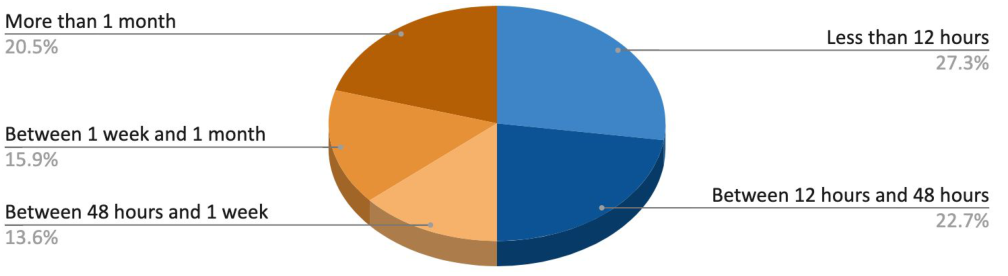
Section titled “Pitot contamination occurring during various types of parking conditions”The chart below (fig.1) shows the duration of time an aircraft spent on the ground before the flight when the unreliable airspeed event occurred.
(fig.1) Duration of time an aircraft spent on ground before reported unreliable airspeed event
Also beware during shorter ground stays
Section titled “Also beware during shorter ground stays”Contamination of Pitot probes by insects does not happen only during long periods of parking or storage. Half of all reported Pitot contamination related events occurs when the aircraft is parked for a time period of less than 48 hours. A significant number of reported occurrences of obstructed Pitots were on aircraft in transit and on the ground for less than two hours. Pitot probes are not always protected by covers during short duration transits.
Why Pitots are even more exposed to the risk of contamination during the pandemic
Section titled “Why Pitots are even more exposed to the risk of contamination during the pandemic”The COVID-19 pandemic had the effect of a significantly reduced number flights, which means aircraft spent more time on the ground between flights. cases where the air data probe protective covers are not fitted, the exposure the risk of Pitot contamination is greatly increased.
Prevention of air data probe obstruction
Section titled “Prevention of air data probe obstruction”Airbus published several documents to provide recommendations for the prevention and detection of obstructed air data probes on ground:
-
ISI(*) 34.11.00026 : A320FAM and A330/A340 Pitot probes - Description, evolutions and maintenance recommendations
-
OIT(*) 999.0019/20 (May 2020) - ATA 10 – Parking and Storage: Exceptional Procedures and Recommendations Related to COVID-19 Massive Grounding Situation
-
OIT(*) 999.0048/20 (July 2020) - Increasing number of events related to adverse effects on air data probes following a parking/storage period
-
Parking and Storage / Return to Service Summary Letter
-
● Safety first articles :
-
Pitot Probe Performance Covered On the Ground (July 2016)
-
Aircraft Parking and Storage (April 2020)
-
Preparing for a Safe Return to the Skies (June 2020)
-
News: Parking and Storage / Return to Service Summary Letter (December 2020)
-
WIN video: What about the exterior walkaround? (September 2020)
(*) ISI articles, OITs, and the Parking and Storage / Return to Service Summary Letter are available on the AirbusWorld portal
Several cases of late detection
Section titled “Several cases of late detection”In 36 of the 55 reported cases, the flight crew detected the speed discrepancy and rejected the takeoff. For many of the reported rejected takeoffs, the speed discrepancy could have been detected earlier during the takeoff roll, which would have incited the flight crew to reject the takeoff at a lower speed. The following case studies of three events of unreliable airspeed at takeoff highlight the importance of speed monitoring during the takeoff roll.
CASE STUDY 1
Section titled “CASE STUDY 1”Event description
Section titled “Event description”Flagged speed indications detected during the takeoff roll
Section titled “Flagged speed indications detected during the takeoff roll”An A330 aircraft was lined up for takeoff in night conditions. The first officer was the Pilot Flying (PF). The weather was clear with no wind. The recomputed takeoff decision speed was 150 kt and the rotation speed was 159 kt.
During aircraft acceleration, the speed indications were flagged on both PFDs.
A 100 kt callout and a rotation based on ground speed indication
Section titled “A 100 kt callout and a rotation based on ground speed indication”The Pilot Monitoring (PM) made the 100 kt callout when the ground speed reached 100 kt. The PF then initiated the rotation at 159 kt of ground speed.
Unreliable airspeed indication procedure application
Section titled “Unreliable airspeed indication procedure application”The flight crew applied the FCOM unreliable airspeed procedure when airborne and switched all three ADRs to OFF when the aircraft reached FL 110, activating the BackUp Speed Scale (BUSS) indication (as requested by the procedure when all ADRs are affected below FL 250).
In-flight turnback and overweight landing
Section titled “In-flight turnback and overweight landing”The flight crew decided to return to the departure airport and performed an overweight landing.
When the aircraft finally returned to the gate, it was noticed that the protective covers were not removed before the flight and they were still fitted on all three Pitot probes.
Event Analysis
Section titled “Event Analysis”Analysis of the recorder data confirmed that the Pitot covers, which were not removed before the flight, were the cause of the unreliable airspeed indication.
Three missed opportunities of detecting the covers
Section titled “Three missed opportunities of detecting the covers”Post event analysis shows that the Pitot protective covers were not seen by the maintenance engineer during the external aircraft inspection, and neither by the captain during the preflight exterior walkaround nor by ground personnel during pushback, as recorded on the airport surveillance videos.
Speed display during takeoff roll
Section titled “Speed display during takeoff roll”Recorder data also showed that the display of the SPD red flag on both PFDs from 50 kt of ground speed should have made the flight crew aware of the airspeed issue which would have enabled them to reject the takeoff .
-
From 0 kt to 50 kt of ground speed : The Indicated Air Speed (IAS)
-
was at the bottom of the speed scale on both PFDs and on the speed scale of the Integrated Standby Instrument System (ISIS). This was because the measured airspeed from all 3 ADRs was below 30 kt.
-
From 50 kt to approximately 140 kt of ground speed : The SPD red
-
flag was displayed on the speed scale of both PFDs and the IAS on the ISIS was still at the bottom of the speed scale.
-
From 140 kt of ground speed until rotation and liftoff: The IAS
-
was between 30 kt and 50 kt on at least one of the PFDs. The IAS of the ISIS remained at the bottom of the speed scale.
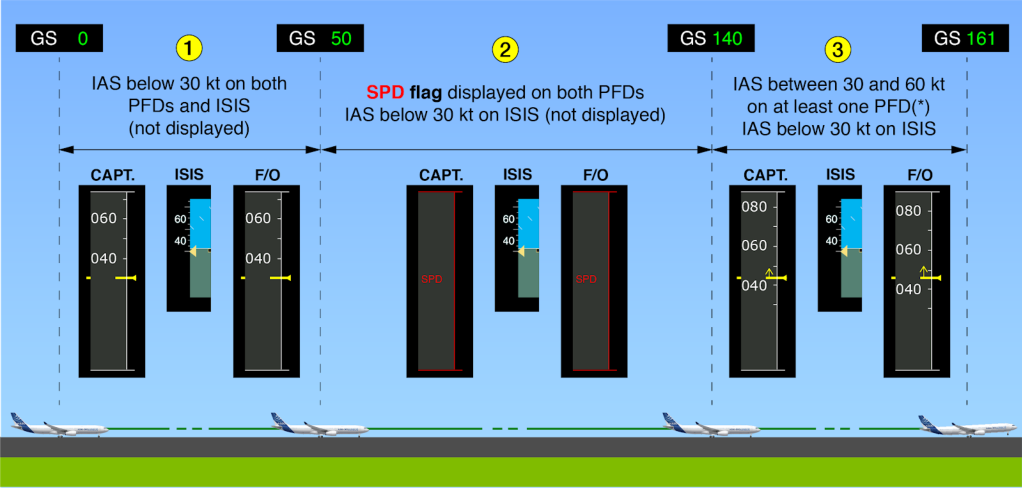
(*) This type of flight data recorder records only the airspeed value of the captain’s side, provided it is valid information. Otherwise, it will record the first officer’s IAS. The IAS may have been displayed on both PFDs at this stage. If it was only displayed on one PFD, the other PFD would still have displayed the SPD red flag.
This sequence is in accordance with the display logic of the IAS on the PFD:
- If the measured airspeed is below 30 kt and ground speed is below 50 kt, then the IAS remains at the bottom of the speed scale
(fig.2) PFD airspeed indication during the takeoff roll of the event
-
If the measured airspeed is below 30 kt and the ground speed is above 50 kt, the SPD red flag is displayed on the speed scale
-
When the measured airspeed is above 30 kt, it will be displayed on the PFD.
CASE STUDY 2
Section titled “CASE STUDY 2”Event Description
Section titled “Event Description”A speed discrepancy at the 100 kt callout
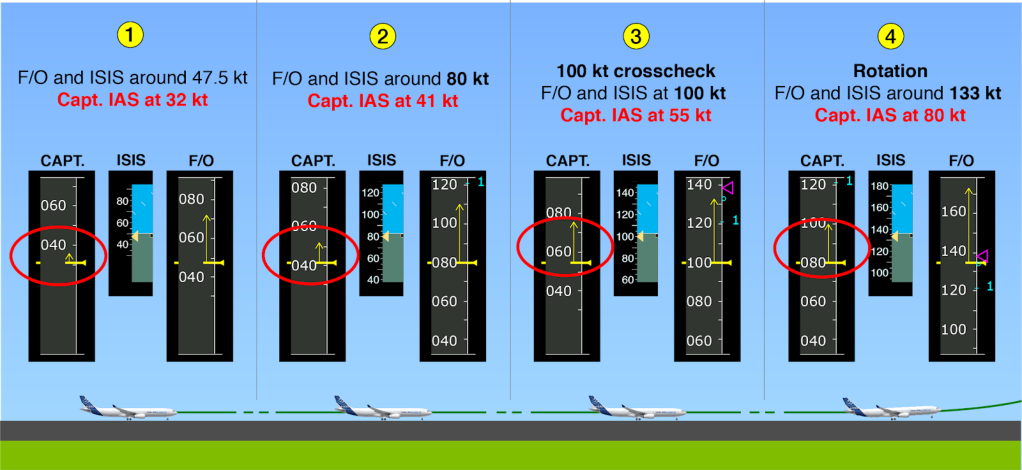
Section titled “A speed discrepancy at the 100 kt callout”An A330 aircraft was ready for takeoff. The captain, who was the PF, applied takeoff power and the aircraft started to accelerate. The flight crew noticed discrepancy between the PFD airspeeds at the 100 kt crosscheck. The flight crew continued the takeoff and performed the rotation at 133 kt.
ECAM cautions and level off for troubleshooting
Section titled “ECAM cautions and level off for troubleshooting”The NAV IAS DISCREPANCY ECAM caution triggered shortly after liftoff, followed by the NAV ADR1 FAULT. The flight crew levelled off the aircraft at 3000 ft to perform ECAM actions and troubleshooting. The flight crew set the AIR DATA rotary selector to “CAPT ON 3” and resumed the climb to cruise FL 340.
Overspeed warning while approaching cruise FL
Section titled “Overspeed warning while approaching cruise FL”An overspeed warning triggered while the aircraft was passing FL 334. The autopilot remained engaged and the aircraft leveled off at FL 340. The overspeed warning stopped a few seconds later.
In-flight turn back
Section titled “In-flight turn back”The flight crew performed an in-flight turnback and landed safely. Maintenance personnel inspected the Pitot on the captain’s side and found that it was obstructed by dust.
Event Analysis
Section titled “Event Analysis”Flight data recorder analysis confirmed the effects caused by the obstruction the captain’s Pitot probe.
A missed opportunity to reject the takeoff
Section titled “A missed opportunity to reject the takeoff”If the airspeed was monitored even more closely by the flight crew during the takeoff roll, they may have identified the speed discrepancy sooner, allowing them to reject the takeoff and bring the aircraft safely to a stop.
Airspeed display during the takeoff roll
Section titled “Airspeed display during the takeoff roll”-
The IAS remained at the bottom of the PFD speed scale on both
-
PFDs, and on the ISIS, at the start of the takeoff roll until the measured speed reached 30 kt (which is its normal behavior). The captain’s IAS went above 30 kt when the first officer and ISIS IAS both indicated approximately 47 kt.
-
When the first officer and ISIS IAS indicated approximately 80 kt, the
-
captain’s IAS was only displaying 41 kt.
-
When the first officer and ISIS IAS indicated 100 kt, the captain’s IAS
-
was only displaying approximately 55 kt.
-
The captain rotated the aircraft when 133 kt was indicated on the first
-
officer’s PFD and ISIS, but the captain’s IAS was only displaying 80 kt.
-
(fig.3) PFD airspeed indication during the takeoff roll of the event
CASE STUDY 3
Section titled “CASE STUDY 3”Event Description
Section titled “Event Description”Rolling takeoff
Section titled “Rolling takeoff”An A320 was cleared for takeoff and the PF, who was the captain, performed rolling takeoff. The captain performed the 1.05 EPR stabilization step and then applied takeoff thrust.
Rejected takeoff following an airspeed discrepancy at the 100 kt crosscheck
The aircraft accelerated nominally, but the captain identified a speed discrepancy when the PM did the 100 kt callout, and immediately rejected the takeoff.
Maintenance personnel performed troubleshooting when the aircraft returned the gate and they found small pieces of leaves in the captain’s Pitot probe and its pressure line.
Event Analysis
Section titled “Event Analysis”An early speed discrepancy on the captain’s side
Section titled “An early speed discrepancy on the captain’s side”-
Recorder data showed that obstruction of the captain’s Pitot probe
-
was providing an initial IAS of approximately 45 kt while the aircraft Ground Speed (GS) was 0 kt prior to the aircraft lining up on the runway.
-
At the application of takeoff thrust, the first officer and ISIS IAS
-
indicated 35 kt with nominal acceleration shown by the speed trend arrow on the first officer’s PFD. However, the IAS on the captain’s PFD was 49 kt with a very small speed trend arrow.
-
When 100 kt was reached on the first officer’s PFD and ISIS, the
-
captain’s IAS was only 58 kt.
-
When the aircraft safely came to a complete stop after the RTO, the
-
captain’s IAS was still at 55 kt.
-
(fig.4) PFD airspeed indication during the takeoff roll of the event
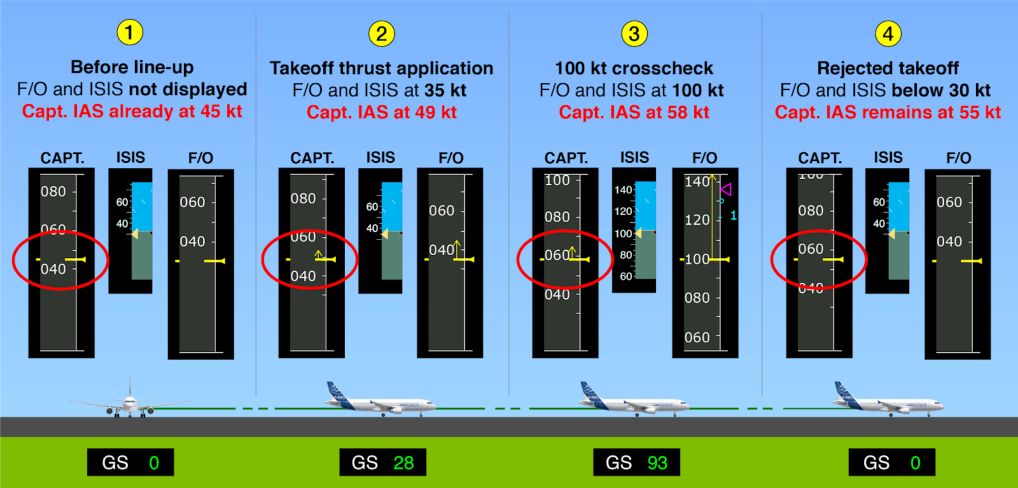
A useful 100 kt crosscheck!
Section titled “A useful 100 kt crosscheck!”During the entire takeoff roll, the captain’s IAS increased slightly but remained below 64 kt. The 100 kt crosscheck enabled the captain to identify the discrepancy and immediately reject the takeoff.
A possible earlier RTO
Section titled “A possible earlier RTO”The Standard Operating Procedure requests monitoring of the PFD speed scale during the entire takeoff roll. Following this recommendation may have made the flight crew aware of the airspeed discrepancy earlier than the 100 kt callout and enabled them to reject the takeoff at lower speed. The first opportunity to detect the speed discrepancy was before lining up for takeoff, when the captain’s airspeed indicated 45 kt while the aircraft was stationary with ground speed at 0 kt. The second opportunity was at the application of takeoff thrust when the IAS on the captain’s PFD was almost steady speed with a very small speed trend arrow.
MONITORING OF THE AIRSPEED DURING THE TAKEOFF ROLL
Section titled “MONITORING OF THE AIRSPEED DURING THE TAKEOFF ROLL”The three events described above illustrate the importance of closely monitoring the airspeed throughout the takeoff roll. Both the Pilot Flying (PF) and the Pilot Monitoring (PM) have a role to play.
While the PF maintains the aircraft on the centerline using external references, the PM must actively monitor the airspeeds from the start of the takeoff roll. This will allow for the PM to detect any inconsistent airspeed indications between instruments, an abnormal airspeed trend or absence of airspeed indications as early as possible.
The “ Role of the Pilot Monitoring during Takeoff ” video on the Airbus Worldwide Instructors News (WIN) website illustrates each of the various steps for the PM to perform during the takeoff.
The 100 kt crosscheck: the last line of defense
Section titled “The 100 kt crosscheck: the last line of defense”Case study 3 shows us the importance of the 100 kt crosscheck, which requested in the Standard Operating Procedure. It is the last line of defense preventing a takeoff with an unreliable airspeed indication. The flight crew should be prepared to reject the takeoff at the time of the 100 kt crosscheck if an airspeed discrepancy is observed.
Monitoring that must be done for every takeoff
Section titled “Monitoring that must be done for every takeoff”Takeoff with obstructed Pitot probes can happen for any flight as highlighted by the reported events described in this article. It is evidence of why it is essential to carefully monitor airspeed during every takeoff.
Contributors:
Section titled “Contributors:”Panxika CHARALAMBIDES
Section titled “Panxika CHARALAMBIDES”Incident/Accident Investigator Product Safety
Benoît DUQUESNE
Section titled “Benoît DUQUESNE”Air Data System Support Engineer Customer Support
Capt. Gilbert SAVARY
Section titled “Capt. Gilbert SAVARY”Head of Operational & Training Policy Flight Operations & Training Support
Domenico SPATARO
Section titled “Domenico SPATARO”Product Safety Enhancement Product Safety
With thanks to Etienne BETTINGER and Michel SIBADE from the Handling Qualities Department and to Frédéric JUPIN from the Accident/Incident Analysis Department.
Obstructed Pitots are the main cause of the reported unreliable airspeed events at takeoff. Contamination of aircraft Pitot probes can happen in less than two hours on the ground in certain cases. The risk of Pitot contamination has increased since the beginning of the COVID-19 pandemic because there are fewer flights and aircraft spend more time on the ground between flights.
Airbus has published several documents to provide recommendations for the prevention of obstructed air data probes on the ground. During transits or upon the return to service of a parked aircraft, it important to pay particular attention to the Pitot probes during the maintenance external aircraft inspection and the pilot’s preflight exterior walkaround. This will confirm that all protective covers are removed before flight.
Early detection of an unreliable airspeed event will enable the flight crew to reject the takeoff at a lower speed. From the start of the takeoff roll, the pilot monitoring must check for inconsistent airspeed indications, abnormal airspeed trends, or the absence of airspeed indications, and alert the pilot flying as early as possible if an issue is detected.
The 100 kt crosscheck is the last line of defense to prevent taking off with an unreliable airspeed indication. The flight crew should be prepared to reject the takeoff at the time of the 100 kt crosscheck an airspeed discrepancy is observed.
It is essential that flight crews carefully monitor the airspeed indications during every takeoff. Obstruction or contamination of the Pitot can occur before any flight.
Safety first , 2021. Safety first is published by Airbus S.A.S. 1, rond point Maurice Bellonte - 31707 Blagnac Cedex/France.
Editor: Yannick Malinge, Chief Product Safety Officer.
Editorial team: Guillaume Estragnat, Vanessa Sadi, Gwyneth Duggan, Tim Roach.
- Reference: X00D16031905.
Photos by Airbus.
© Airbus S.A.S. 2021 – All rights reserved. Proprietary documents.
Section titled “© Airbus S.A.S. 2021 – All rights reserved. Proprietary documents.”起飞时不可靠空速
Section titled “起飞时不可靠空速”自 2020 年初以来,空客收到的关于起飞时因皮托管堵塞导致的不可靠空速事件报告数量不断增加。尽管现有预防措施和起飞前外部绕机检查均已执行,皮托管受阻的飞机仍可能执行起飞。本文强调,飞行员在整个起飞滑跑过程中积极监控空速的重要性,以便尽早发现空速偏差,并在需要时安全中断起飞。
本文也可在 safetyfirst.airbus.com 及适用于 iOS 和 Android 设备的安全优先(Safety first)应用程序中查阅。
多起起飞时不可靠空速事件
Section titled “多起起飞时不可靠空速事件”空客于 2020 年 6 月发布的《为安全重返蓝天做准备》(Preparing for a Safe Return to the Skies)安全优先文章已指出,飞机停场或存放后不可靠空速事件风险增加。自该文章发布以来,报告的事件数量仍令人担忧。
2020 年 1 月至 2021 年 3 月期间,共向空客报告了 55 起起飞时不可靠空速事件。
大多数事件与皮托管堵塞有关
Section titled “大多数事件与皮托管堵塞有关”在 55 起起飞时不可靠空速报告案例中,44 起是由于皮托管堵塞所致。堵塞可能由昆虫、沙粒、污垢、灰尘或任何其他异物引起,这些异物在飞机停场时未安装保护罩的情况下会进入皮托管。在其中一起报告中,堵塞原因是飞行前未移除保护罩。
各种停场状态下均可能发生皮托管污染
Section titled “各种停场状态下均可能发生皮托管污染”下图 (图 1) 显示了发生不可靠空速事件时,飞机在起飞前的停场时间。
(图 1) 报告不可靠空速事件前飞机在地面停留的时间
短时间停场同样需注意
Section titled “短时间停场同样需注意”皮托管被昆虫污染并非仅发生在长时间停场或存放期间。报告的皮托管污染相关事件中,有一半发生在飞机停场时间少于 48 小时的情况下。相当数量的皮托管受阻报告发生在过站飞机上,其地面停留时间少于两小时。在短时间过站期间,皮托管探针并不总是受到保护罩的保护。
新冠疫情期间皮托管更易受到污染风险的原因
Section titled “新冠疫情期间皮托管更易受到污染风险的原因”新冠疫情导致航班数量大幅减少,这意味着飞机在航班之间的地面停留时间更长。在大气数据探头保护罩未安装的情况下,暴露于皮托管污染风险的时间大大增加。
大气数据探头堵塞的预防
Section titled “大气数据探头堵塞的预防”空客发布了多份文件,为地面大气数据探头堵塞的预防和检测提供建议:
-
ISI(*) 34.11.00026 : A320FAM 及 A330/A340 皮托管 - 说明、改进和维护建议
-
OIT(*) 999.0019/20(2020 年 5 月)- ATA 10 – 停场和存放:与新冠大规规模停场情况相关的特殊程序和建议
-
OIT(*) 999.0048/20(2020 年 7 月)- 停场/存放后大气数据探头不良影响相关事件增加
-
停场和存放/恢复运营总结函
-
安全优先文章:
-
地面停场时的皮托管性能(2016 年 7 月)
-
飞机停场和存放(2020 年 4 月)
-
为安全重返蓝天做准备(2020 年 6 月)
-
新闻:停场和存放/恢复运营总结函(2020 年 12 月)
-
WIN 视频: 外部绕机检查是怎么回事?(2020 年 9 月)
(*) ISI 文章、OIT 以及停场和存放/恢复运营总结函可在 AirbusWorld 门户网站上获取
多起延迟检测案例
Section titled “多起延迟检测案例”在 55 起报告案例中,有 36 起是机组检测到速度偏差后中断了起飞。对于许多报告的中断起飞,速度偏差本可以在起飞滑跑过程中更早被发现,这将促使机组在更低的速度下中断起飞。以下三起起飞时不可靠空速事件的案例分析凸显了在起飞滑跑过程中监控速度的重要性。
案例分析 1
Section titled “案例分析 1”起飞滑跑过程中检测到速度指示异常
Section titled “起飞滑跑过程中检测到速度指示异常”一架 A330 飞机在夜间条件下排队等待起飞。第一副驾驶为 PF(主飞飞行员)。天气晴朗,无风。重新计算的起飞决断速度为 150 节,抬轮速度为 159 节。
飞机加速过程中,两侧 PFD 上的速度指示均出现标记。
100 节通报及根据地速进行的抬轮
Section titled “100 节通报及根据地速进行的抬轮”监控飞行员(PM)在地速达到 100 节时进行了 100 节通报。PF 随后根据地速 159 节开始抬轮。
不可靠空速指示程序的应用
Section titled “不可靠空速指示程序的应用”飞行机组在飞机升空后应用了 FCOM 不可靠空速程序,当飞机到达 FL 110 时将三部 ADR 全部切换至 OFF,激活了备份速度刻度(BUSS)显示(根据程序要求,当所有 ADR 在 FL 250 以下受影响时需如此操作)。
飞行中返航与超重着陆
Section titled “飞行中返航与超重着陆”飞行机组决定返回起飞机场,并执行了超重着陆。
当飞机最终返回停机位时,发现飞行前未取下保护罩,三个皮托管探头仍套着保护罩。
记录器数据分析确认,飞行前未取下的皮托管罩是导致空速不可靠的原因。
三次发现保护罩的错失机会
Section titled “三次发现保护罩的错失机会”事后分析表明,维修工程师在外部飞机检查期间、机长在起飞前外部绕机检查期间以及地面人员在推飞机期间(根据机场监控视频记录)均未发现皮托管保护罩。
起飞滑跑期间的速度显示
Section titled “起飞滑跑期间的速度显示”记录器数据还显示,从地速 50 节起两部 PFD 上显示的 SPD 红色标志本应使飞行机组意识到空速问题,从而能够中断起飞。
-
从地速 0 节到 50 节:由于三部 ADR 测量的空速均低于 30 节,两部 PFD 和综合备用仪表系统(ISIS)的速度刻度上,指示空速(IAS)均显示在速度刻度最底端。
-
从地速 50 节到约 140 节:两部 PFD 的速度刻度上显示 SPD 红色标志,ISIS 上的 IAS 仍显示在速度刻度最底端。
-
从地速 140 节到抬头和起飞:至少有一部 PFD 上的 IAS 在 30 节到 50 节之间。ISIS 上的 IAS 仍显示在速度刻度最底端。
(*) 这类飞行数据记录器仅记录机长侧的空速值(前提是该信息有效)。否则将记录副驾驶的 IAS。在该阶段,IAS 可能显示在两部 PFD 上。如果仅显示在一 部 PFD 上,另一部 PFD 仍将显示 SPD 红色标志。
此序列符合 PFD 上 IAS 的显示逻辑:
- 若测量的空速低于 30 节且地速低于 50 节,则 IAS 保持在速度刻度最底端
(图 2) 事件中起飞滑跑期间的 PFD 空速指示
-
若测量的空速低于 30 节且地速高于 50 节,则速度刻度上显示 SPD 红色标志
-
当测量的空速高于 30 节时,将显示在 PFD 上
案例研究 2
Section titled “案例研究 2”100 节报数时的空速不一致
Section titled “100 节报数时的空速不一致”一架 A330 飞机准备起飞。担任 PF 的机长施加起飞推力,飞机开始加速。飞行机组在 100 节交叉检查时注意到 PFD 空速之间存在差异。飞行机组继续起飞并在 133 节执行抬头动作。
ECAM 警告和改平以进行故障排除
Section titled “ECAM 警告和改平以进行故障排除”起飞后不久触发 NAV IAS DISCREPANCY ECAM 警告,随后触发 NAV ADR1 FAULT。飞行机组在 3000 ft 高度改平以执行 ECAM 操作和故障排除。飞行机组将大气数据旋转选择器设置为”CAPT ON 3”,并恢复爬升至巡航高度 FL 340。
接近巡航高度时的超速警告
Section titled “接近巡航高度时的超速警告”飞机通过 FL 334 时触发了超速警告。自动驾驶仪保持接通,飞机在 FL 340 改平。超速警告在几秒后停止。
飞行机组执行了飞行中返航并安全着陆。维修人员检查了机长侧的皮托管,发现其被灰尘堵塞。
飞行数据记录器分析确认了机长侧皮托管堵塞造成的影响。
错过中断起飞的机会
Section titled “错过中断起飞的机会”如果在起飞滑跑过程中,机组能够更加密切地监控空速,他们或许能够更早地识别出速度差异,从而使他们能够中断起飞并安全地将飞机停下。
起飞滑跑期间的空速显示
Section titled “起飞滑跑期间的空速显示”-
在起飞滑跑开始时,IAS 保持在两侧 PFD 速度刻度的底部,
-
以及 ISIS 上,直到测量速度达到 30 kt(这是其正常行为)。当副驾驶和 ISIS 的 IAS 均显示约 47 kt 时,机长的 IAS 超过了 30 kt。
-
当副驾驶和 ISIS 的 IAS 指示约 80 kt 时,机长的 IAS 仅显示
-
41 kt。
-
当副驾驶和 ISIS 的 IAS 指示 100 kt 时,机长的 IAS 仅显示
-
约 55 kt。
-
当副驾驶的 PFD 和 ISIS 显示 133 kt 时,机长执行了抬轮,但机长的 IAS 仅显示 80 kt。
-
(图 3) 事件中起飞滑跑期间的 PFD 空速指示
案例研究 3
Section titled “案例研究 3”一架 A320 获得起飞许可,PF(操纵飞行员)机长执行了滑跑起飞。机长执行了 1.05 EPR 稳定步骤,然后施加了起飞推力。
在 100 kt 交叉检查时发现空速差异后中断起飞
飞机正常加速,但机长在 PM 进行 100 kt 报数时识别出速度差异,并立即中断了起飞。
飞机返回停机位后,维护人员进行了故障排查,发现机长的皮托管及其压力管路中有少量树叶。
机长侧早期速度差异
Section titled “机长侧早期速度差异”-
记录器数据显示,在飞机进入跑道之前,机长皮托管的堵塞导致
-
初始 IAS 约为 45 kt,而地速(GS)为 0 kt。
-
施加起飞推力时,副驾驶和 ISIS 的 IAS 指示 35 kt,副驾驶 PFD 上的速度趋势箭头显示正常加速。然而,机长 PFD 上的 IAS 为 49 kt,速度趋势箭头非常小。
-
当副驾驶的 PFD 和 ISIS 显示 100 kt 时,机长的 IAS 仅
-
为 58 kt。
-
飞机在中断起飞后安全完全停止时,机长的 IAS 仍为 55 kt。
-
(图 4) 事件中起飞滑跑期间的 PFD 空速指示
有用的 100 kt 交叉检查!
Section titled “有用的 100 kt 交叉检查!”在整个起飞滑跑期间,机长的 IAS 略有增加,但始终保持在 64 kt 以下。100 kt 交叉检查使机长能够识别出差异并立即中断起飞。
更早中断起飞的可能性
Section titled “更早中断起飞的可能性”标准操作程序要求在起飞滑跑期间全程监控 PFD 速度刻度。遵循此建议可使机组在 100 kt 报数之前更早地发现空速差异,从而使他们能够在更低的速度中断起飞。发现速度差异的第一个机会是在进入跑道之前,当时机长的空速显示为 45 kt,而飞机静止、地速为 0 kt。第二个机会是在施加起飞推力时,当时机长 PFD 上的 IAS 几乎保持稳定,速度趋势箭头非常小。
起飞滑跑期间空速的监控
Section titled “起飞滑跑期间空速的监控”上述三个事件说明在整个起飞滑跑期间密切监控空速的重要性。PF(操纵飞行员)和 PM(监控飞行员)都发挥着作用。
PF 使用外部参考保持飞机在中心线上,PM 必须从起飞滑跑开始就积极监控空速。这将使 PM 能够尽早检测到仪表之间不一致的空速指示、异常的空速趋势或空速指示的缺失。
空中客车全球教官新闻(WIN)网站上的”起飞期间监控飞行员的角色”视频说明了 PM 在起飞期间需要执行的各个步骤。
100 kt 交叉检查:最后一道防线
Section titled “100 kt 交叉检查:最后一道防线”案例研究 3 向我们展示了标准操作程序要求的 100 kt 交叉检查的重要性。它是防止在空速指示不可靠的情况下起飞的最后一道防线。如果在 100 kt 交叉检查时观察到空速差异,机组应准备在此时中断起飞。
每次起飞都必须进行的监控
Section titled “每次起飞都必须进行的监控”如本文所述的报告中事件所强调的那样,皮托管堵塞导致的起飞可能发生在任何航班上。这证明了在每次起飞时仔细监控空速的必要性。
Panxika CHARALAMBIDES
Section titled “Panxika CHARALAMBIDES”事故/事故调查员,产品安全部
Benoît DUQUESNE
Section titled “Benoît DUQUESNE”大气数据系统支持工程师,客户支持部
Capt. Gilbert SAVARY
Section titled “Capt. Gilbert SAVARY”运营与培训政策主管,飞行运营与培训支持部
Domenico SPATARO
Section titled “Domenico SPATARO”产品安全增强,产品安全部
特别感谢 Handling Qualities 部门的 Etienne BETTINGER 和 Michel SIBADE,以及 Accident/Incident Analysis 部门的 Frédéric JUPIN。
皮托管堵塞是报告的起飞阶段不可靠空速事件的主要原因。在某些情况下,飞机皮托管探头在地面停留不到两小时就可能发生污染。自新冠疫情爆发以来,皮托管污染的风险有所增加,因为航班数量减少,飞机在两次飞行之间在地面停留的时间更长。
空客已发布多份文件,为防止地面气动数据探头堵塞提供建议。在过站期间或恢复停放飞机的运行前,进行维护外部检查和飞行员起飞前外部检查时,应特别注意皮托管探头。这将确认所有保护盖在飞行前已移除。
尽早检测到不可靠空速事件可使机组在较低速度时中断起飞。从起飞滑跑开始,监控飞行员必须检查空速指示是否不一致、空速趋势是否异常,或空速指示是否缺失,如发现异常应尽早提醒操纵飞行员。
100 kt 交叉检查是防止在空速指示不可靠的情况下起飞的最后防线。如果在 100 kt 交叉检查时发现空速存在差异,机组应准备中断起飞。
机组必须在每次起飞期间仔细监控空速指示。皮托管的堵塞或污染可能在任何飞行前发生。
Safety first,2021 年。Safety first 由空中客车公司出版。1, rond point Maurice Bellonte - 31707 Blagnac Cedex/法国。
主编:Yannick Malinge,首席产品安全官。
编辑团队:Guillaume Estragnat、Vanessa Sadi、Gwyneth Duggan、Tim Roach。
20192534。参考号:X00D16031905。
照片由空客提供。