Safely Flying Non-Precision Instrument Approaches
Source: Airbus Safety First URL: https://safetyfirst.airbus.com/safely-flying-non-precision-instrument-approaches/ Published: 2017-01-29 Magazine Issue: 2017-01 Category: Flight Ops, approach, barometric, cdfa, chart, DME, FAF, FINAL APP, FLS, FMS, fpa, GBAS, GLS, GNSS, GPS, guidance, LNAV, LOC, LPV, managed, minima, minimum, MLS, NDB, non precision approach, NPA, RNAV, RNP, RNP-AR, selected, VNAV PDF: Original PDF
Safely Flying NonPrecision Instrument Approaches
Section titled “Safely Flying NonPrecision Instrument Approaches”Historically the distinction between fl ying ILS/MLS and non-precision approaches was very clear. However, many new kinds of instrument approaches are now available and this makes the distinction less obvious.
What remains true today for any approach is that disregarding basic fl ying techniques and procedures reduces safety margins. This article clarifi es which technologies are available to perform approaches using an Airbus aircraft. It also emphasises the safety messages that are important to remember whenever fl ying an approach.


THIERRY THOREAU Director Flight Safety
SHAUN WILDEY Experimental Test Pilot
MAXIME DE VILLEPIN Approach & Landing Project Leader
OVERVIEW OF NAVIGATION TECHNOLOGIES
Section titled “OVERVIEW OF NAVIGATION TECHNOLOGIES”Ground based navigation technologies
Section titled “Ground based navigation technologies”Development of the earliest radio navigation systems started in the 1920s and 1930s. Initially, only the lateral course was supported by a radio navigation aid through systems such as Localiser (LOC), Non-Directional Beacons (NDB), and VHF Omni-Range (VOR). These systems provided, and continue to provide, guidance data for non-precision approaches.
guidance, and therefore quickly became standard equipment at airports during the early 1970s. The inclusion of glide-slope guidance created what has become known as ‘precision approaches’. Later in that decade, the Microwave Landing System (MLS) was developed to reduce ILS -beam distortion and multi-path errors; but although it is in operation today, MLS has never gained a significant commercial aviation foothold and is only in limited service.
With the growth of the air-transport system in the 1970s, it became necessary to reduce the number of accidents occurring due to lack of vertical guidance in approach, as well as to enable more consistent operations in poor weather.
Historically, with the ground-based technologies described above providing the guidance, it was easy to differentiate between precision approaches and non-precision approaches simply on the basis of whether glide-slope guidance information was provided or not.
Instrument-based Landing Systems (ILS) satisfy the requirement to provide both lateral and vertical (glide-slope)
Historically, it was easy to differentiate between precision approaches and non-precision approaches on the basis of whether glide-slope guidance information was provided or not.
On-board technologies enhance Non Precision Approaches
Section titled “On-board technologies enhance Non Precision Approaches”With the increase in Flight Management System (FMS) capability through the 80’s and 90’s, and especially with the introduction of Global Positioning System (GPS) equipment into civil aviation, the simple distinction between precision and non-precision approaches used earlier is no longer possible. These on-board technologies have rapidly become very sophisticated and are progressively enabling vertical and lateral approach guidance at a similar level to that of an ILS precision approach.
The first enhancement of these nonILS/MLS instrument approaches came in the 1980s, with the replacement of the step-down technique (“dive & drive”) by Continuous Descent Final Approach (CDFA).
Today, the majority of non-ILS/ MLS[ approaches are flown using a ]
barometric vertical guidance, for which QNH setting and temperature are key factors and this must be taken into consideration by the crew. The most sophisticated instrument approaches use geometric vertical guidance based on an augmented GPS signal to create ‘ILS-like’ approaches.
In addition, various new GPS based techniques offer sufficient accuracy, even to the point of taking the industry beyond the traditional ‘straight-line’ approaches and enabled curved approaches.
As a result of all this development, some airports may have several approach charts available for a given runway as shown in (fig.1). In addition, each chart can present several minima. Therefore, pilots must be familiar with
Various new GPS based techniques offer sufficient accuracy, even to the point of taking the industry beyond the traditional ‘straightline’ approaches and enabled curved approaches’.
If the required visual references are not acquired by the applicable minima, or lost after it, a missed approach must be initiated.
the charting from their provider in order to ensure correct understanding of approach charts.
Whatever the type of technology, we can state that with the introduction of the CDFA technique, all approaches now share two common characteristics:
-
Descent profiles of instrument approaches have become similar: vertical guidance is provided and there is no level-off required at minima
-
If the required visual references are not acquired by the applicable minima, or indeed lost after, a missed approach must be initiated.
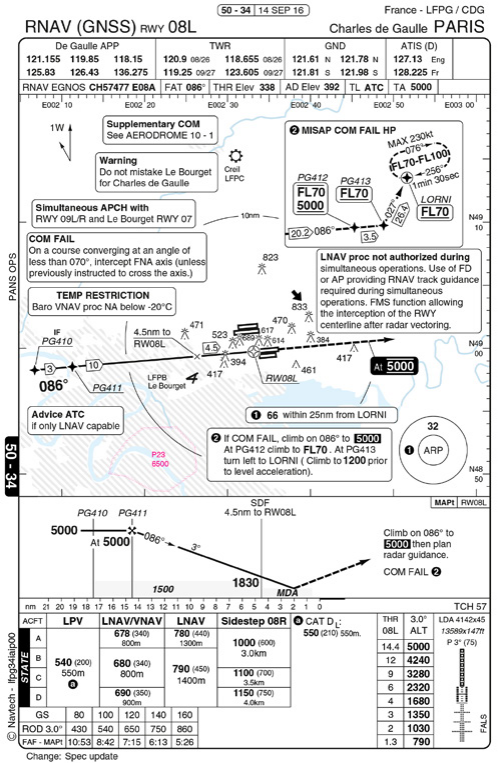
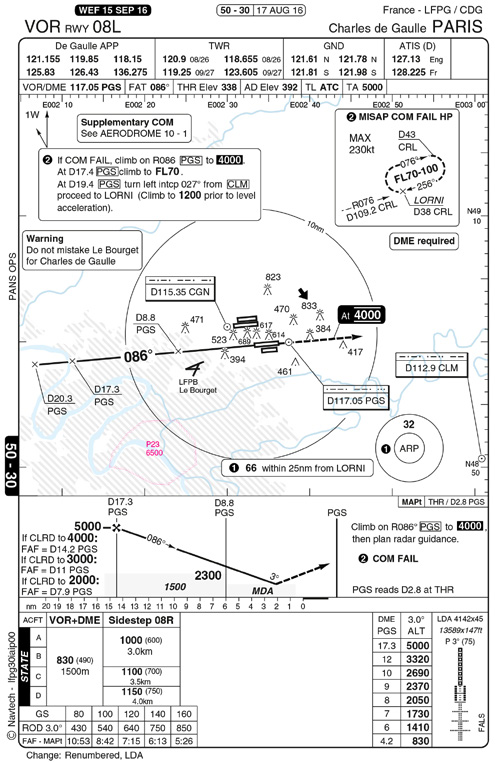
(fig.1)
Section titled “(fig.1)”VOR and RNAV (GNSS) approach charts for LFPG RWY 08L. Source: NAVBLUE
FLYING APPROACHES WITH AN AIRBUS
Section titled “FLYING APPROACHES WITH AN AIRBUS”The importance of vertical guidance
Section titled “The importance of vertical guidance”ICAO Controlled Flight Into Terrain As a consequence, a focus was placed (CFIT) studies have shown that once at Airbus in recent years to offer some some form of vertical guidance is guidance on the vertical path for all added to approaches, the safety instrument approaches. margin is increased by a factor of 8.
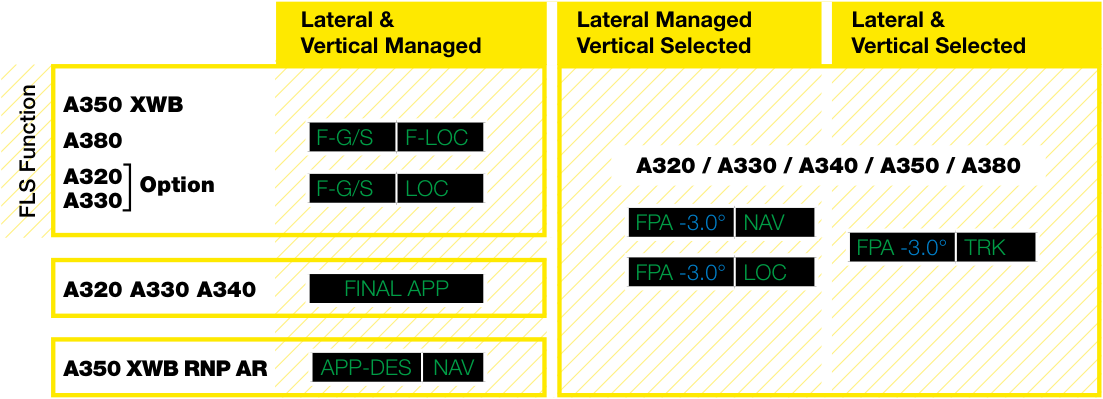
If we now discount ILS and MLS approaches, there are different guidance modes available on Airbus aircraft to fl y all types of instrument approaches, from TRK/FPA to managed modes offering guidance on both the lateral and vertical trajectory.
Depending on the approach type, the crew has to select the appropriate one (fig.2). Managed modes are recommended, but selected mode might be useful in case of system or equipment failures.
It is worth recalling that in selected mode, the Flight Path Angle (FPA) easily permits to follow the published descent gradient, but the pilot must still ensure that the vertical trajectory relative to the touchdown point is precisely followed.
The creation of new approach modes that have lateral and vertical profi les independent of navaids followed the introduction of the Flight Management System (FMS) in the 1980s and of the GPS in the 1990s. The objective was to standardize the way of fl ying all approaches down to the published approach minima, whatever the airport, and whatever the equipment on the ground. The FLS (FMS Landing System) is part of that concept and today, it is an Airbus option offering a solution to fl y 99% of approaches that are not ILS/MLS, with a barometric vertical profi le.
It offers lateral and vertical guidance for a straight-in instrument approach, referenced from the aircraft position, along a trajectory retrieved from the FMS navigation database.
FLS is an Airbus option offering a solution to fl y 99% of approaches that are not ILS/MLS, with barometric vertical profi le.
(fi g.2)
Section titled “(fi g.2)”Guidance modes available to fl y non-ILS/ approaches not based on augmented GPS signal
Ultimately, what is needed to safely fl y (or FLS anchor point position) an approach is a clear picture of what • Vertical profile (barometric and it represents in terms of: temperature considerations)
-
Vertical profile (barometric and temperature considerations)
-
The aircraft capabilities and crew qualifi cations (e.g. RNP-AR)
-
Applicable minima
-
Aircraft guidance mode
-
The approach type
-
The recovery scenario in case of system failures or deviations exceedance.
-
The approach lateral axis, including potential offset with the runway axis
THE FMS LANDING SYSTEM (FLS) GUIDANCE MODE
Section titled “THE FMS LANDING SYSTEM (FLS) GUIDANCE MODE”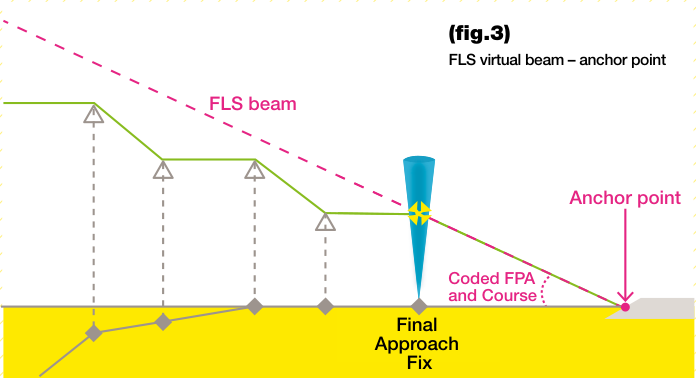
FLS allows a pilot to fl y an approach down to minima as an ‘ILS-alike approach’ thanks to the CDFA technique. In addition, the human / machine interface has been designed similar enough for the crew to capitalize on their current techniques but different enough for the
crew not to mistake a non-precision approach fl own with FLS for an ILS thanks to a distinctive symbology (fig.4). In the end, this concept makes these approaches more simple to fl y, thereby contributing to an increase in safety.
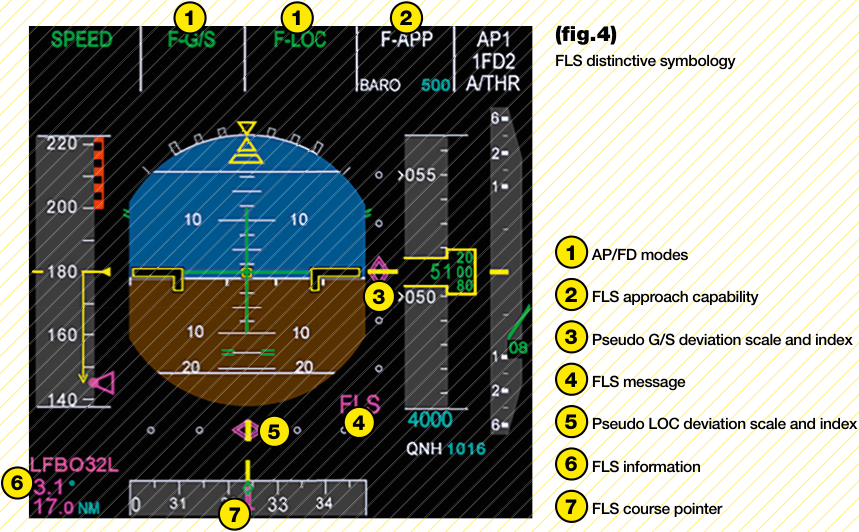
the FINAL APP (or APP-DES on A350 aircraft) mode. Nevertheless, Airbus is working towards co-existence of the two modes so that all non-ILS/MLS approaches are fl own in FLS and the FINAL APP mode remains available for RNP-AR.
INFORMATION
Section titled “INFORMATION”Not all aircraft are technically capable of ensuring F-G/S, F-LOC or FINAL APP guidance. FINAL APP and F-G/S or F-LOC guidance modes availability depends on the actual configuration of the aircraft and the airline approach options chosen in the catalogue (i.e FLS or FINAL APP).
The FLS mode is basic on A380 and A350 aircraft. It is available as an option on A320 and A330 families.
The coexistence of FINAL APP and FLS modes is already available for A330 aircraft with Honeywell FMS. It is expected by end 2018 for the remainder of the A330 fleet, as well as A320 family aircraft.
FLYING AN INSTRUMENT APPROACH SAFELY
Section titled “FLYING AN INSTRUMENT APPROACH SAFELY”A well trained and briefed crew: why preparation is key to a successful approach, whatever its type
Section titled “A well trained and briefed crew: why preparation is key to a successful approach, whatever its type”For a flight crew, after possibly long hours of flight or a busy day’s flying schedule, the objective is to perform the most appropriate approach available at the airport according to the weather, aircraft capability, crew knowledge and training.
require good preparation both on ground and in flight.
Before the flight commences, GPS coverage (Receiver Autonomous Integrity Monitoring (RAIM) / Autonomous Integrity Monitored Extrapolation (AIME)) at destination must be checked if approach requiring GPS only is expected.
To fly a non-ILS/MLS approach using managed guidance requires a valid FMS data base. If not, then selected guidance must be used.
When in flight, the crew should ensure that the status of the aircraft is compliant with the technical requirement to fly the approach. In accordance with SOP, the FMS waypoints have to be checked versus the applicable chart to ensure that the correct approach has been selected and that the aircraft will fly the charted trajectory. During the descent
The FMS data base is considered validated if the provider is compliant with Regulatory requirements and/or validated by the Operator (depending on FMS standards and approach types).
In addition, because instrument approaches that are not ILS/MLS may not be flown on a daily basis they
FLS allows a pilot to fly a nonILS approach down to minima as an ‘ILS-like approach’ thanks to the CDFA technique.
Managed guidance to fly a non-ILS/ MLS approach can be used only if the FMS database has been validated.
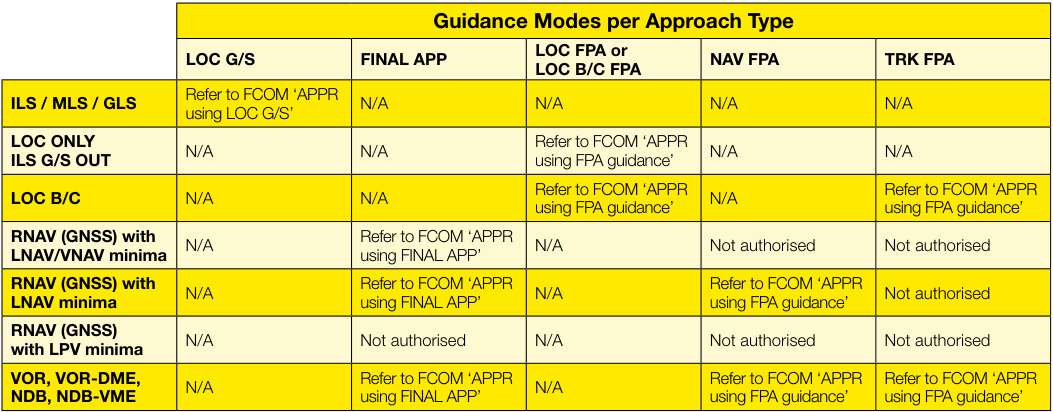
(fig.5)
Section titled “(fig.5)”Example of a cross-reference table, as available in A320 FCOM PRO-NOR-SOPAPPROACH-APPROACH GENERAL.
preparation, the crew must define and agree on the aircraft guidance mode depending on the approach type and applicable minima. For this purpose, the cross-reference table published in FCOM is helpful (fig.5).
The action plan to fly the approach must also consider threats and errors
management, e.g. vertical profile, visual segment after minima and offset.
During the descent, the flight crew should check that the navigation accuracy is compliant with the approach type and use the guidance mode that was intended to be flown, as per SOP.
Any “negotiation” with the visibility requirement from the minima and below for any approach is a drift into danger.
With the increasing precision of the navigation means used to fly any approach (e.g. GPS positioning) and the improved reliability of aircraft on-board systems, there is an observed tendency of crews to delay the go-around decision perhaps because of increased confidence in the aircraft automation to guide them below the published minima. This tendency translates into a significant reduction of the safety margins, especially with respect to flying without visual references below the minima.
Data has shown that if visual conditions were not achieved at the minima but
were still expected, some crews waited a little bit longer, hoping for visibility to improve before they made the decision to go-around. This means that they were now flying unsafely below minima with no visual references. Likewise, if visibility is good at minima but it then reduces, some crews may decide to continue the approach, hoping for an improvement in the visibility. This tendency could also be reinforced if pilots are not go-around minded.
In reality, any “negotiation” with the visibility requirement from the minima and below for any approach is a drift into danger.
GLOSSARY
Section titled “GLOSSARY”CDFA Continuous Descent Final Approach DME Distance Measuring Equipment FAF Final Approach Fix FLS FMS Landing System FMA Flight Mode Annunciator FPA Flight Path Angle GLS GBAS (Ground Based Augmentation System) Landing System GNSS Global Navigation Satellite System GPS Global Positioning System G/S Glideslope ILS Instrument Landing System
LNAV Lateral Navigation LOC Localizer LPV Localizer Performance with Vertical guidance NDB Non-Directional Radio Beacon RNAV Area Navigation RNP Required Navigation Performance RNP-AR Required Navigation Performance Authorization Required SLS Satellite Landing System VNAV Vertical Navigation VOR VHF Omnidirectional Range

The most important safety messages to keep in mind to fl y any kind of instrument approach are:
-
Know which procedure your company allows
-
Prepare the approach well in advance; on ground and in fl ight
-
Know which parameters and deviations or systems failures should trigger a go-around decision
-
Brief, share and understand the intended approach technique to be used
-
Fly as you are trained. Fly the brief
-
Respect the minima; from the minima and below, visual references are primary references. If they are not there or don’t remain there, go-around!
-
From the minima, ensure the aircraft can continue with a normal rate of descent and bank angle, to land within the touchdown zone.
Finally, the Pilot Monitoring (PM) has a vital role to play in all instrument approaches. The PM must understand what the Pilot Flying (PF) has planned to do, what the PF is doing right now and what the PF will do in the near future. The PM supports the PF in using the SOP callouts and ultimately ensuring that the minima are respected. He/she also assists the PF in monitoring the appropriate arming and engagement of guidance modes at the right time.
Safety first, #23 January, 2017. Safety first is published by Airbus S.A.S. - 1, rond point Maurice Bellonte - 31707 Blagnac Cedex/France. Publisher and Editor: Yannick Malinge, Chief Product Safety Officer. Concept Design by Airbus Multi Media Support 20162610. Reference: X00D16031905 Issue 23. Photos by Airbus, Lindner Fotografie, S. Ramadier, H. Goussé, P. Masclet, F. Lancelot, B. Lange, A, Doumenjou, C. Brinkmann, M. Lindner, E. Lafargue. Computer renderings by Fixion
安全实施非精密仪表进近
Section titled “安全实施非精密仪表进近”历史上,飞行 ILS/MLS 进近与非精密进近之间的区别非常明确。然而,如今可用的仪表进近类型越来越多,这使得两者之间的界限变得不那么清晰了。
如今,对于任何进近而言,有一点始终不变:不遵守基本的飞行技术和程序会降低安全裕度。本文阐明了使用空客飞机执行进近时可用的技术,并强调了飞行进近时需要牢记的安全提示。
蒂埃里·索罗 飞行安全总监
肖恩·威尔德 试飞员
马克西姆·德·维尔潘 进近与着陆项目负责人
导航技术概述
Section titled “导航技术概述”地基导航技术
Section titled “地基导航技术”最早的无线电导航系统始于 1920 年代和 1930 年代。最初,仅通过航向信标(LOC)、无方向性信标(NDB)和甚高频全向信标(VOR)等系统提供横向航迹引导。这些系统为非精密进近提供(并继续提供)引导数据。
仪表着陆系统(ILS)满足了同时提供横向和垂直(下滑道)引导的需求,因此很快成为 1970 年代初期机场的标准设备。下滑道引导的加入催生了所谓的”精密进近”。在随后的十年中,微波着陆系统(MLS)被开发出来以减少 ILS 波束畸变和多路径误差;但尽管该系统如今仍在运行,MLS 从未在商业航空领域获得显著的立足点,仅处于有限服务状态。
随着 1970 年代航空运输系统的增长,有必要减少因进近中缺乏垂直引导而导致的事故数量,同时也能在恶劣天气条件下实现更加一致的运行。
历史上,由于上述地基导航技术提供引导,精密进近与非精密进近之间的区分很容易,即根据是否提供下滑道引导信息来划分。
机载技术增强非精密进近
Section titled “机载技术增强非精密进近”随着 1980 年代和 1990 年代飞行管理系统(FMS)能力的提升,特别是全球定位系统(GPS)设备引入民用航空领域,之前那种简单的精密与非精密进近区分已不再适用。这些机载技术已迅速发展得非常精密,并逐步实现了与 ILS 精密进近相当水平的垂直和横向进近引导。
这些非 ILS/MLS 仪表进近的首次增强出现在 1980 年代,即用连续下降最后进近(CDFA)取代了阶梯式下降技术(“俯冲与平飞”)。
如今,大多数非 ILS/MLS 进近采用气压垂直引导飞行,其中 QNH 设置和温度是关键因素,机组必须予以考虑。最精密的仪表进近使用几何垂直引导,基于增强的 GPS 信号创建”类 ILS”进近。
此外,各种基于 GPS 的新技术提供了足够的精度,甚至使航空业突破了传统的”直线”进近限制,实现了曲线进近。
由于这些发展,某些机场的同一条跑道可能有多张进近图可用,如**(图 1)**所示。此外,每张图可能呈现多个最低运行标准。因此,飞行员必须熟悉其供应商的制图规范,以确保正确理解进近图。
各种基于 GPS 的新技术提供了足够的精度,甚至使航空业突破了传统的”直线”进近限制,实现了曲线进近。
如果在适用的最低天气标准时未获得所需目视参考,或在该标准之后失去目视参考,必须执行复飞。
无论采用何种技术,我们可以确认,随着 CDFA 技术的引入,所有进近现在有两个共同特征:
- 仪表进近的下降剖面已变得相似:提供垂直引导,且在最低点无需平飞
- 如果在适用的最低天气标准时未获得所需目视参考,或在该标准之后失去目视参考,必须执行复飞。
(fig.1)
Section titled “(fig.1)”LFPG 08L 跑道的 VOR 和 RNAV (GNSS) 进近图。资料来源:NAVBLUE
使用空客飞机执行进近
Section titled “使用空客飞机执行进近”垂直引导的重要性
Section titled “垂直引导的重要性”ICAO 可控飞行撞地(CFIT)研究表明,一旦在进近中增加了某种形式的垂直引导,安全边际将提高 8 倍。
如果不考虑 ILS 和 MLS 进近,空客飞机上有不同的引导模式可用于执行各类仪表进近,从 TRK/FPA 到同时提供水平与垂直轨迹引导的管理方式。
根据进近类型,机组需要选择合适的模式 (fig.2)。建议使用管理方式,但在系统或设备故障情况下,选择方式可能会有所帮助。
值得回顾的是,在选择方式下,飞行航径角(FPA)可以轻松地跟随公布的下降梯度,但飞行员仍需确保相对接地点的垂直轨迹得到精确跟随。
随着 20 世纪 80 年代飞行管理系统(FMS)和 90 年代 GPS 的引入,出现了独立于导航台的水平与垂直剖面进近新模式。其目标是标准化在所有机场、以所有地面设备执行进近的方式,使飞机能够下降至公布的进近最低标准。FLS(FMS 着陆系统)就是这一概念的组成部分,如今它作为空客选装功能,提供了一种解决方案,可执行 99% 的非 ILS/MLS 进近,并带有气压垂直剖面。
它为直线仪表进近提供水平与垂直引导,以从 FMS 导航数据库检索的轨迹为参考,基于飞机位置进行引导。
FLS 是空客选装功能,提供了一种解决方案,可执行 99% 的非 ILS/MLS 进近,并带有气压垂直剖面。
(fig.2)
Section titled “(fig.2)”用于飞非 ILS/MLS 进近(不基于增强型 GPS 信号)的引导模式
归根结底,安全飞进近(或 FLS 锚点位置)需要清楚地了解其在以下方面的含义:
-
垂直剖面(气压与温度考虑)
-
飞机能力与机组资质(例如 RNP-AR)
-
适用最低标准
-
飞机引导方式
-
进近类型
-
进近水平轴,包括与跑道轴可能的偏置
-
系统故障或偏差超出时的复飞场景
FMS 着陆系统(FLS)引导方式
Section titled “FMS 着陆系统(FLS)引导方式”
FLS 使飞行员能够通过 CDFA 技术以”ILS 类进近”方式将飞机下降至最低标准。此外,人机界面设计得足够相似,以便机组能够利用现有的操作技术,但又有所不同,确保机组不会将在 FLS 下执行的非精密进近误认为 ILS,这得益于独特的符号显示 (fig.4)。最终,这一概念使这些进近更易于操作,从而有助于提高安全性。
FINAL APP 模式(或 A350 飞机上的 APP-DES 模式)。尽管如此,空客正在努力实现两种模式的共存,使所有非 ILS/MLS 进近都使用 FLS 执行,而 FINAL APP 模式则保留供 RNP-AR 使用。
INFORMATION
Section titled “INFORMATION”并非所有飞机在技术上都能确保 F-G/S、F-LOC 或 FINAL APP 引导。FINAL APP 和 F-G/S 或 F-LOC 引导模式的可用性取决于飞机的实际构型以及航空公司随附选装的进近选项(即 FLS 或 FINAL APP)。
FLS 模式是 A380 和 A350 飞机的基本配置。在 A320 和 A330 系列飞机上作为选装提供。
FINAL APP 和 FLS 模式共存已适用于配备 Honeywell FMS 的 A330 飞机。预计2018年底将扩展至其余 A330 机队以及 A320 系列飞机。
FLYING AN INSTRUMENT APPROACH SAFELY
Section titled “FLYING AN INSTRUMENT APPROACH SAFELY”安全执行仪表进近
Section titled “安全执行仪表进近”经过充分训练和简报的机组:为何准备工作是成功进近(无论何种类型)的关键
Section titled “经过充分训练和简报的机组:为何准备工作是成功进近(无论何种类型)的关键”对于飞行机组而言,在可能经过长时间飞行或繁忙的飞行日程之后,目标是在机场执行根据天气、飞机性能、机组知识和培训可获得的最适当的进近。
需要在地面和空中都进行充分的准备。
在飞行开始前,如果预计需要仅使用 GPS 的进近,则必须检查目的地的 GPS 覆盖范围(接收机自主完好性监测(RAIM)/自主完好性监测外推(AIME))。
使用管理的引导来飞非 ILS/MLS 进近需要有效的 FMS 数据库。否则,必须使用选择的引导。
在飞行中,机组应确保飞机状态符合执行该进近的技术要求。根据 SOP,必须对照适用的航图检查 FMS 航路点,以确保选择了正确的进近并且飞机会沿着航图上标注的轨迹飞行。在下降期间
如果供应商符合法规要求和/或经运营人验证(取决于 FMS 标准和进近类型),则 FMS 数据库被视为已验证。
此外,由于非 ILS/MLS 的仪表进近可能不会每天都执行,它们
FLS 允许飞行员通过 CDFA 技术,以“类似 ILS 进近”的方式执行非 ILS 进近至最低标准。
只有当 FMS 数据库已验证时,才能使用管理的引导来飞非 ILS/MLS 进近。
交叉参照表示例,如 A320 FCOM PRO-NOR-SOP-APPROACH-APPROACH GENERAL 中所提供。
在准备阶段,机组必须根据进近类型和适用最低标准定义并确认飞机引导模式。为此目的,FCOM 中发布的交叉参照表很有帮助**(图5)**。
飞该进近的行动计划还必须考虑威胁和差错管理,例如垂直剖面、最低标准以下的目视航段和偏置。
在下降期间,飞行机组应检查导航精度是否符合进近类型的要求,并按照 SOP 使用原本计划飞行的引导模式。
在最低标准和以下与能见度要求进行任何“协商”都是危险的漂移。
随着用于飞任何进近的导航手段精度不断提高(如 GPS 定位)以及飞机机载系统可靠性的改善,观察到一种趋势:机组因对飞机自动化引导他们低于公布最低标准的信心增加,而延迟复飞决定。这种趋势转化为安全裕度的显著降低,特别是在最低标准以下无目视参考的情况下飞行。
数据表明,如果在最低标准时未达到目视条件但仍预期可获得,某些机组会多等一会儿,希望能见度在做出复飞决定前有所改善。这意味着他们现在正在低于最低标准且无目视参考的情况下不安全地飞行。同样,如果在最低标准时能见度良好但随后变差,某些机组可能会决定继续进近,希望能见度能够改善。如果飞行员没有复飞意识,这种趋势也可能被强化。
实际上,在最低标准和以下与任何进近的能见度要求进行任何“协商”都是危险的漂移。
CDFA 连续下降最终进近 DME 测距仪 FAF 最终进近定位点 FLS FMS着陆系统 FMA 飞行方式指示器 FPA 飞行轨迹角 GLS GBAS(地基增强系统)着陆系统 GNSS 全球导航卫星系统 GPS 全球定位系统 G/S 下滑道 ILS 仪表着陆系统
LNAV 横向导航 LOC 航向信标 LPV 航向信标性能垂直引导 NDB 无方向性信标 RNAV 区域导航 RNP 所需导航性能 RNP-AR 所需导航性能授权要求 SLS 卫星着陆系统 VNAV 垂直导航 VOR 甚高频全向信标
在任何类型的仪表进近中,需要牢记的最重要的安全信息包括:
-
了解公司允许使用何种程序
-
提前做好进近准备;在地面和飞行中均是如此
-
了解哪些参数和偏差或系统故障应触发复飞决策
-
简令、分享并理解拟使用的进近技术
-
按照训练的要求飞行。按照简令飞行
-
尊重最低标准;从最低标准及以下,目视参考是主要参考。如果目视参考不存在或不再存在,复飞!
-
从最低标准开始,确保飞机能够以正常的下降率和坡度角继续飞行,落在接地地带范围内。
最后,在所有仪表进近中,监控飞行员(PM)都发挥着至关重要的作用。PM必须了解主飞飞行员(PF)计划做什么、此刻正在做什么以及近期将要做什么。PM支持PF使用标准操作程序喊话,并在最终确保遵守最低标准。PM还协助PF在正确时机监控相应的引导方式预位和接通。
Safety first, #23 2017年1月。Safety first由空中客车公司出版发行 - 1, rond point Maurice Bellonte - 31707 Blagnac Cedex/France。出版人和编辑:Yannick Malinge,产品安全首席官。概念设计由空中客车多媒体支持 20162610。参考编号:X00D16031905 第23期。照片来源:空中客车、Lindner Fotografie、S. Ramadier、H. Goussé、P. Masclet、F. Lancelot、B. Lange、A、Doumenjou、C. Brinkmann、M. Lindner、E. Lafargue。计算机渲染:Fixion