High Load Event Reporting
Source: Airbus Safety First URL: https://safetyfirst.airbus.com/high-load-event-reporting/ Published: 2018-03-08 Magazine Issue: 2018-07 Category: Flight Ops, Maintenance, Hard landing PDF: Original PDF




All aircraft are designed, tested and certified to avoid the possibility of exceeding its structural strength. Operational thresholds or limits define the envelope for the load conditions in normal operations, and there are design margins to cope with abnormal or excessive loads on the aircraft if they are experienced in-flight or on the ground.
The Pilot’s report of a high load event in the logbook is the starting point to commence an evaluation of the event and determine if the abnormal load has affected the structure or systems of the aircraft. Early reporting enables efficient evaluation of the event by maintenance personnel and it can allow the aircraft to more rapidly return to service when the required maintenance tasks are completed.
WHAT IS A HIGH LOAD EVENT?
Section titled “WHAT IS A HIGH LOAD EVENT?”A high load event is any event that is outside of range of the load conditions an aircraft will experience in normal operations. The aircraft is designed to withstand a certain level of excessive loads in abnormal conditions or situations but this loading can have an effect on the components of the aircraft’s structure, engines, engine mounts, pylons and its systems. When such a high load event occurs, with forces that exceed these thresholds, action is required to ensure the aircraft remains in a state continued airworthiness.
… it’s the pilot’s ability to observe or sense a high load event, manage the event and then report it that is paramount.
High load events can occur when an aircraft is either in flight or on the ground. For instance, a flight load exceedance may occur if the aircraft encounters severe turbulence and crosswind conditions, or when flown above its operational speed limits. This includes events where the aircraft’s airspeed was above the allowable limits for extending or operating flaps, slats or the landing gear. A high load event on the ground is most commonly a hard landing or hard overweight landing, but it can also be caused by abnormal lateral loading when landing or taxing in severe crosswinds.
The Importance of the Pilot’s Report
Section titled “The Importance of the Pilot’s Report”The reporting of high load events relies on the pilot’s awareness and experience as the primary means of detection. It is the responsibility of every pilot to report high load events by making a logbook entry. This will initiate an evaluation of the event on the ground that will determine what maintenance actions are required. A timely pilot report (or PIREP) of any high load event enables efficient evaluation that allows the aircraft to more rapidly return to operations when the required maintenance tasks are complete. This will also reassure the pilot that the aircraft remains in a continuous airworthy condition.
What happens following a pilot’s report of a high load event?
Section titled “What happens following a pilot’s report of a high load event?”Evolution of aircraft technology has introduced sensors and more sophisticated means of generating high load event alerts, but it’s the pilot’s ability to observe or sense a high load event, manage the event and then report it that is paramount. The pilot’s report has remained the certification baseline for managing high load events on all Airbus aircraft families from the A300 / A310 and up to the latest A350 XWB. This is common practice across the industry for all aircraft.
There have been successive improvements in sensing and recording high load event data, including the LOAD <15> reports introduced on A320 and A330/ A340 aircraft families and the Smart Access Recorder (SAR) data available on the A380 and A350 XWB. This data is provided to support the airline’s maintenance control evaluation and classification of a pilot reported high load event. The event’s classification will allow the airline’s maintenance personnel to more precisely determine which maintenance actions are necessary to ensure the aircraft’s continued airworthiness.
On the latest Airbus aircraft families of the A380 and A350 XWB, there is the capability to transfer recorded data from the aircraft’s Smart Access Recorder (SAR) to dedicated diagnostic ground support tools. These software tools will analyse the event’s recorded data and provide an optimised list of the maintenance actions that will focus only on the areas of the aircraft that were most likely affected. This detailed information provides more autonomy to the airlines in managing their pilot reported high load events and it minimises the time the aircraft is required to be on the ground for maintenance.
TYPES OF HIGH LOAD EVENTS
Section titled “TYPES OF HIGH LOAD EVENTS”(fig.1)
Section titled “(fig.1)”High load events related to aircraft speed exceedance include:
The type of high load event will be described by the Pilot Report (PIREP). There are generally two categories of high load events; those related aircraft speed exceedance (fig.1) and others related to rapid vertical or lateral accelerations of the aircraft (fig.2).
VMO | MMO VLE | MLE VLO | MLO VFE Exceeding the maximum Exceeding the maximum Exceeding the maximum Exceeding the maximum operating speed of the speed/Mach at which the speed/Mach to operate speed** the aircraft can aircraft aircraft can fly with the (both extend and retract) fly with the Slats/Flaps landing gear extended the landing gear extended
**Note: There is a VFE value per flaps/slats configuration
(fig.2)
Section titled “(fig.2)”High load events related to rapid vertical or lateral accelerations of the aircraft include:
Vertical Turbulence
Lateral Hard Overweight Hard Turbulence Landing Landing
Avoidance of any high load event is often related to the pilot’s own awareness of the prevailing conditions and their effective management of the aircraft’s energy. In some cases, the conditions leading to a high load event are difficult to anticipate, such as inadvertently flying into pockets of severe clear air turbulence, or sudden crosswind gusts shifting the alignment of the aircraft moments before a touchdown. In the absence of these abrupt and unpredictable natural phenomena, a high load event is often the inevitable outcome for any flight crew who may not have effectively managed the aircraft’s energy, or if they have made a sudden and excessive control input inflight.
RECOGNISING AND RESPONDING TO HIGH LOAD EVENTS
Section titled “RECOGNISING AND RESPONDING TO HIGH LOAD EVENTS”Severe Turbulence High Load Events
Section titled “Severe Turbulence High Load Events”Severe turbulence causes large, abrupt changes in altitude or attitude of the aircraft, often associated with variations in airspeed. Characteristically, turbulence can be considered as excessive or severe if passengers and crew report that they were moved violently against their fastened seatbelts or untethered objects were moved around the cabin with force.
What to do in case of severe turbulence high load events?
Section titled “What to do in case of severe turbulence high load events?”After experiencing a severe turbulence event, the pilot should make a logbook entry to trigger the evaluation of the event and assess the relevant maintenance actions to carry out when the aircraft arrives at its destination. If the event is classified as severe turbulence, the AMM / MP maintenance procedure will recommend contacting Airbus for support. The analysis of the recorded flight data by Airbus will assist the airline in identifying the areas of the aircraft that were most likely affected by the event. Airbus will also advise which supplementary maintenance actions should be completed with a tailored list of items that focus on the areas of the aircraft that were affected.
For information on managing threats to the airspeed and avoiding speed excursions, refer to the “Control Your Speed in Cruise” article published in Safety first issue #21, which includes tips for “How to anticipate a speed excursion”.
VMO | MMO Speed Exceedance High Load Events
Section titled “VMO | MMO Speed Exceedance High Load Events”Although intentional VMO | MMO exceedance cases are uncommon, this speed value can typically be overshot when the aircraft is subject to unpredictable conditions such as sudden changes in outside air temperature or wind strength and direction. At lower altitudes, exceeding VMO | MMO can cause a significant high load event.
Whilst it is important to always respect VMO | MMO flight crew should keep in mind that a slight and temporary speed or Mach exceedance at high altitude will not lead the aircraft into an imminent hazardous situation. The aircraft is designed to fly safely at high altitude within a margin above VMO | MMO, as it must meet certification requirements to ensure that the aircraft remains safe to fly up to its design limit speed, or VD | MD.
What to do in case of VMO | MMO speed exceedance high load events?
Section titled “What to do in case of VMO | MMO speed exceedance high load events?”If VMO | MMO is exceeded, an over speed warning is triggered in the cockpit that alerts the crew. The FCOM, QRH and FCTM provides pilots with procedures and the guidelines to both prevent and to recover from a speed excursion and describes how to calmly manage unexpected variation of airspeed. Any type of over speed must be reported by the flight crew so that analysis of flight data can allow maintenance to tell whether or not there was a high load event, and if maintenance actions are required when the aircraft is on the ground.
Flaps or Slats Extended Speed Exceedance High Load Events
Section titled “Flaps or Slats Extended Speed Exceedance High Load Events”High loads event AMM tasks
Section titled “High loads event AMM tasks”AMM 05-51-11 Inspection after hard landing or hard overweight landing
Section titled “AMM 05-51-11 Inspection after hard landing or hard overweight landing”AMM 05-51-12 Inspection after landing gear speed exceedance
Section titled “AMM 05-51-12 Inspection after landing gear speed exceedance”AMM 05-51-13 Inspection after fl ap/slat speed exceedance
Section titled “AMM 05-51-13 Inspection after fl ap/slat speed exceedance”AMM 05-51-17 Inspection after turbulence or speed exceedance
Section titled “AMM 05-51-17 Inspection after turbulence or speed exceedance”AMM 05-51-44 Inspection after in-fl ight lateral loads
As a general rule, reported high load events requiring maintenance actions are referenced in any AMM/MP within chapter 05-51-xx
A modified LOAD<15> report triggering will introduce the means to detect high lateral loads on A320 family aircraft
In the case of take-off, where the auto thrust is not active, fl ying with slats and fl aps extended or extending slats and fl aps above VFE poses a risk of overloading the aircraft’s structure through the slats and fl aps track mechanisms. This could result in distortion of the fl aps and slats, the extension mechanisms or potentially the structural components they are attached to.
What to do in case of fl aps or slats extended speed exceedance high load events?
Section titled “What to do in case of fl aps or slats extended speed exceedance high load events?”If VFE is exceeded, an over speed warning is triggered in the cockpit that alerts the crew to take corrective action by reducing speed or retracting the fl ap and slats accordingly. The pilot should also report this high load event caused by VFE exceedance in the logbook in case specifi c maintenance actions and troubleshooting procedures need to be performed before the aircraft can continue operations.
Landing Gear Operated or Extended Speed Exceedance High Load Events
Section titled “Landing Gear Operated or Extended Speed Exceedance High Load Events”A high load event can occur if the landing gear is extended or retracted while the aircraft’s speed is more than the maximum speed limit for operating the landing gear (VLO / MLO), or when an aircraft with its landing gear down and locked increases its speed above the maximum limit that it can fl y with its landing gear extended (VLE / MLE).
What to do in case of landing gear operated or extended speed exceedance high load events?
Section titled “What to do in case of landing gear operated or extended speed exceedance high load events?”If landing gear is operated or extended when the aircraft’s speed is exceeding the allowable limit, an over speed warning is triggered in the cockpit that alerts the crew to take corrective action by reducing speed or retracting the gear. These abnormal events should be reported by the pilot as a logbook entry to be assessed maintenance personnel and determine which maintenance actions are requested by the AMM / MP.
In-fl ight Lateral High Load Event
Section titled “In-fl ight Lateral High Load Event”Typical examples of conditions that can cause high lateral loads infl ight include heavy turbulence in fl ight or large movements in yaw and roll, system failures such as rudder trim run-away with crew take-over. In all cases, the pilot report is the trigger for an assessment of the event’s severity.
What to do in case of in-fl ight high lateral load events?
Section titled “What to do in case of in-fl ight high lateral load events?”If a pilot senses that the aircraft experiences high lateral accelerations infl ight, which are abnormal or excessive, they should report the event as a logbook entry. It should be noted that currently on the A320 family, a LOAD<15> report will not be generated high lateral accelerations if the loads were only lateral and without associated vertical accelerations above the limits. If there are high vertical accelerations above the limits during the turbulence event, then an automatic LOAD<15> report is generated, and the recorded high lateral accelerations can be checked. If the pilot reports that the aircraft experienced high lateral acceleration on the ground, then this should be analysed in accordance with the AMM / MP hard landing inspection criteria.
Hard Landing or Hard Overweight Landing
Section titled “Hard Landing or Hard Overweight Landing”What differentiates a hard overweight landing from a hard landing? In the case of an in-fl ight turn back or diversion, a hard overweight landing may be unavoidable with the on-board fuel load. A hard landing can occur as a result of an unstable approach or if there are sudden lateral accelerations at the touchdown caused by severe crosswind gusts.
What to do in case of in-fl ight hard or overweight landing high load events?
Section titled “What to do in case of in-fl ight hard or overweight landing high load events?”In order to minimise the impact of unavoidable overweight landing events, it is recommended that the fl ight crew limit the vertical speed and ensure a symmetrical landing. After the fl ight crew report a hard or hard overweight landing, make an analysis of the landing’s parameters from the LOAD<15> report or the SAR fi le and check the applicable AMM / MP to determine what maintenance tasks are required.
More detailed operational and maintenance recommendations for managing hard landings are available in the article “Hard Landing, a Case Study for Crews and Maintenance Personnel” published in Safety fi rst issue #17.



Linton Foat
Section titled “Linton Foat”Flight Operations Governance, Compliance & Risk Manager Captain - Airbus Fleet Thomas Cook Airlines - Condor
Encouraging Exceedance Event Reporting
Section titled “Encouraging Exceedance Event Reporting”Thomas Cook Airlines (TCX) operates the A321 on a medium range sectors such as Dalaman, Turkey (LTBS) to Manchester in the United Kingdom (EGCC). A fully loaded aircraft is operated close to the A321’s Maximum Take-off Weight (MTOW), especially when flying out of warmer climate airports. With the combination of higher outside air temperatures and a heavy payload, ‘S’ speed (slat retraction speed) can be close to the flap-slat limiting speed or VFE. TCX pilots are reminded to ensure they have a clean configuration with the flaps fully retracted before accelerating on the climb and avoid the risk of an over speed with flaps extended.
On the occasion when there is an over speed, the Commander will make a logbook entry during the flight in the electronic technical log for maintenance action. TCX pilots are also requested to send an ACARS message to their operations control centre to alert maintenance that an over speed had occurred and that maintenance actions will be required at the destination airport. This is also the case when the flight crew experience severe turbulence during their flight or have a VMO | MMO exceedance in cruise.
This early contact via ACARS facilitates additional time for maintenance operations to arrange for the appropriately qualified technicians to meet the aircraft upon its arrival and commence the maintenance actions. Being alerted ahead of time means that the ground engineers will have the opportunity to review the aircraft maintenance manual prior to the aircraft landing. This proactive coordination ensures that all of the equipment is available and maintenance personnel are ready to complete the tasks upon the arrival of the aircraft at its destination, assuring a timely assessment of the aircraft’s continued airworthiness. Once the required maintenance activities are satisfactorily completed, and if there is no further rectification required, the aircraft is released back into line operations.
Thomas Cook Airlines encourages their pilots to report all defects or high load event with the confidence that their actions are putting safety at heart. We acknowledge that our pilot willingness to report events is essential and we fully encourage open and honest reporting to ensure our aircraft continue operating safely. “Safe at Heart” is the core philosophy of our company wide safety management system. The Safe at Heart message fosters a culture within the Thomas Cook family where we put safety at the heart of everything we do.
Picture courtesy of Thomas Cook Group

EVOLUTION OF THE HIGH LOAD REPORT & ANALYSIS
Section titled “EVOLUTION OF THE HIGH LOAD REPORT & ANALYSIS”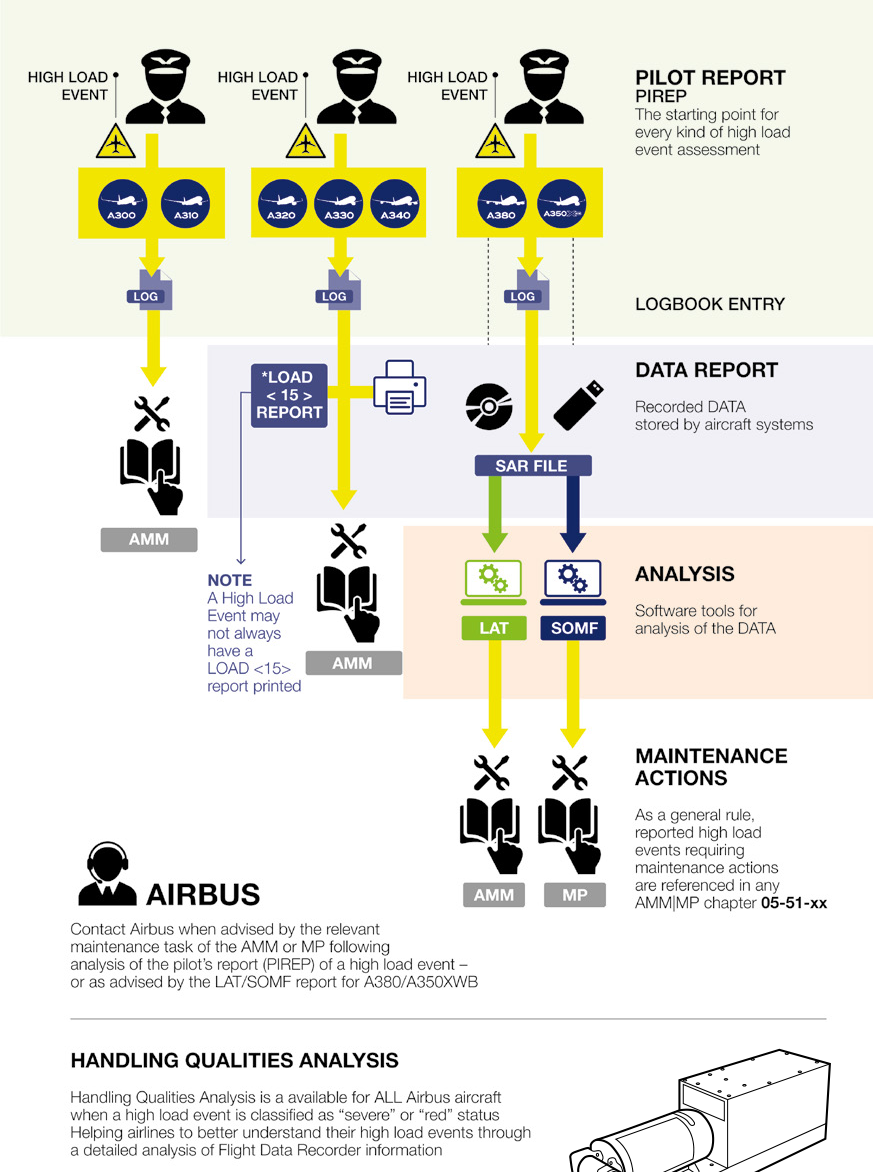
(fig.3)
Section titled “(fig.3)”Info-graphic showing the evolution of high load event reporting and analysis across the successive Airbus Aircraft families
Airbus
recommends that airlines check that their fleet has a consistent configuration to produce the LOAD<15> report at the required time…
For the A300/A310 aircraft, assessment of the maintenance actions required following a high load event relies completely on the pilot’s report of the event and their recorded observations. Through many years of in-service experience, the scope of the maintenance actions have been optimised as far as possible to reduce the time necessary to complete the associated tasks. The maintenance actions will focus on the critical components that could have been affected during the event. If there are no defects found, then the aircraft can return to service with a shorter amount of time required on the ground.
On all of the Airbus aircraft families since the A300 / A310, we still rely on pilot’s report and their recorded observations for managing high load events (fig.3). Using the available technology at the time of an aircraft’s design phase, increasingly sophisticated means of high load sensing and recording were implemented, for example, the LOAD<15> report for A320 and A330/A340 families. For A330 / A340 aircraft, certain flight load events are generating a LOAD<35> report, for example VMO | MMO exceedance.
On the latest A380 and A350 XWB aircraft, the post-event analysis is further assisted by ground-support software tools. These tools will use flight data from a Special Access Recorder (SAR) to assess which of the aircraft’s components were affected during the high load event. The resulting report provides an optimised list of targeted maintenance actions to perform that focuses on these areas.
A320 | A330 | A340 LOAD<15> Report
Section titled “A320 | A330 | A340 LOAD<15> Report”If the LOAD<15> report is not generated, this does not always mean that there was not a high load event …
A high load event printed report, or LOAD<15> report can be customised and configured according to the operator’s preferences. Airbus recommends that airlines check their fleet has a consistent configuration to produce the LOAD<15> report at the required time on all of their aircraft. The configurable settings include choosing if to print a report immediately after a high load event or only upon landing. The report’s triggering limits are set by default to the values in the Aircraft Maintenance Manuals (AMM). However, these can be adapted by the operators to lower the LOAD<15> report’s triggering thresholds, should more sensitive data monitoring be needed to pre-emptively identify any adverse operational trends. In practice, this generates more load reports and it could rapidly increase the number of operational load events to be analysed by the airline’s maintenance control.
When flight crew report a hard landing or hard overweight landing, the maintenance personnel will use AMM instructions to analyse the LOAD<15> report and determine if any maintenance actions are necessary. The purpose of this report is to assist the decision making regarding the AMM tasks that should be carried out. Any intentional inhibition of the LOAD<15> report could therefore be detrimental to the accuracy of the analysis and this may adversely affect the dispatch time. If the LOAD<15> report is not generated, this does not always mean that there was not a high load event that could have caused a load exceedance. In all cases, the pilot’s report remains the primary means for detecting a high load event and the LOAD<15> only supports the post flight analysis of the event.
If the assessment of the event in accordance with the maintenance manual requires maintenance actions and inspections, these are divided into four major zones to include fuselage, wings, nacelles-pylons and stabilizers. The inspection items are categorised into three phases (fig.4).
If no defects or damage is found during the inspection of the phase 1 items, then no further examination is necessary. If defects or damage is noted during the phase 1 inspections, then the phase 2 items must be completed. Depending on the severity of the event, it may be necessary to complete Phase 1 and Phase 2 inspections concurrently. Phase 3 inspection items must be accomplished only if defects or damage are noted during the phase 2 inspections. The AMM will advise if it is necessary to contact Airbus.
Phase 1 AMM Phase 2 AMM Inspection Items Inspection Items General inspection for primary Detailed inspection of internal areas damage to the airframe, engines and some component removal may and pylons and for any indication also be requested of internal damage
(Fig.4)
Section titled “(Fig.4)”Inspection items are categorised into 3 phases following a high load event report and LOAD<15> report analysis on A320 | A330 | A340.
Phase 3 AMM Inspection Items
Detailed inspections that may require component removal and strip down
The capability to transmit LOAD<15> reports by ACARS, combined with ground support tools for readout (e.g. AIRMAN), allows an airline to anticipate the maintenance actions required after a report is received. Maintenance personnel can prepare themselves and be ready to commence maintenance activity shortly after the aircraft arrives.
A380 Load Analysis Tool
Section titled “A380 Load Analysis Tool”Airbus developed software called Load Analysis Tool (LAT) for the entry into service of the A380. After a high load event is reported by an A380 crew, the LAT tool uses data from the aircraft’s Special Access Recorder (SAR) to calculate the magnitude of the loads that may have affected areas of the aircraft’s structure or systems during the event. If any of the aircraft’s components were excessively loaded or stressed, it automatically provides a load report with cross-references to the relevant AMM subtasks that focus on the most affected areas.
A350 Structural Overload Monitor Function
Section titled “A350 Structural Overload Monitor Function”The Structural Overload Monitor Function (SOMF) tool was developed for the A350 XWB. The SOMF tool uses the data recorded from a high load event on the Special Access Recorder SAR to produce a comprehensive load report. The detailed analysis in the report supports a more rapid return to service by listing the specifi c maintenance actions that are relevant to the event meaning that it describes the precise task to carry out for specifi c areas of the aircraft structure or systems that may have been exposed to any load exceedance.
Using Smart Access Recorder Data to Analyse High Load Events on A380 & A350 XWB
Section titled “Using Smart Access Recorder Data to Analyse High Load Events on A380 & A350 XWB”As for any other aircraft, the starting point is the pilot’s report (or PIREP) of the event describing the conditions of the event, the confi guration of the aircraft and the aircraft’s situation following the event.
Structural
Section titled “Structural”Assess the level of structural loads sustained by A/C.
Overload
Section titled “Overload”Determine if design envelop has been exceeded and which areas have been overloaded.
Monitoring
Section titled “Monitoring”Allow the operator to monitor abnormal events on its fl eet.
Function
Section titled “Function”
Final function
is to generate a report with focused inspection program.
To assess the event and determine if additional maintenance actions are necessary, additional assistance is available using software tools called LAT on A380 and SOMF for the A350 XWB aircraft by following these steps:
-
Use the fl owcharts published in AMM / MP 05-51 and follow the guidelines step by step after any high load event PIREP
-
The maintenance actions in the AMM / MP may request maintenance to download the SAR fi le from the aircraft onto a writable CD-ROM for A380, or transfer the fi le to a USB key for A350 XWB
-
The downloaded SAR fi le is then sent to the Airline’s maintenance centre responsible for assessing reported high load events
(fi g.5)
Section titled “(fi g.5)”Descriptions of which maintenance actions can be required from LAT or SOMF analysis and report
- The maintenance centre can then process the generated SAR fi le using LAT for an A380 event or SOMF for an A350 XWB event and produce a load report with descriptions of which maintenance actions are required and if it is advisable to contact Airbus for additional support (fi g.5).
Notify Airbus of the event and send event data for analysis A380 [LAT] “SEVERE LOADS” [A380] Inspect areas listed as Phase 1 A350 [SOMF] & Phase 2 by the LAT report “OVERLOAD [RED]” [A350 XWB] Perform RED ALL inspections & AMBER inspections listed in the SOMF report classifi ed RED & AMBER Inspect any additional areas as advised by Airbus following the analysis of the event A380 [LAT] [A380] Inspect areas listed “HIGH LOADS” as Phase 1 by the LAT report A350 [SOMF] “OVERLOAD [A350 XWB] perform AMBER [AMBER]” inspections listed in the SOMF report ALL inspections classifi ed AMBER Follow any supplementary instructions provided by Airbus A380 [LAT] “NORMAL LOADS” Only preliminary inspection A350 [SOMF] tasks are necessary that are listed in the AMM / MP “NO OVERLOAD”

Refer to ISI 05.51.00019 for SOMF and ISI 05.51.00001 for LAT
A380 LAT or A350 XWB SOMF Reports
Section titled “A380 LAT or A350 XWB SOMF Reports”The LAT or SOMF will display a Load Report that will list the details of the “Aircraft and Event Information”, an “Event Assessment – Summary”, which describes severity of the load exceedance or “overload”, the list the AMM / MP subtasks that are required and if it is advisable to contact Airbus before commencing the next fl ight.
LAT for the A380, and SOMF for A350 XWB, are free of charge software tools made available to operators of these aircraft at entry-into-service and via the Airbus World portal.
A350 XWB Optional Automatic Report Analysis
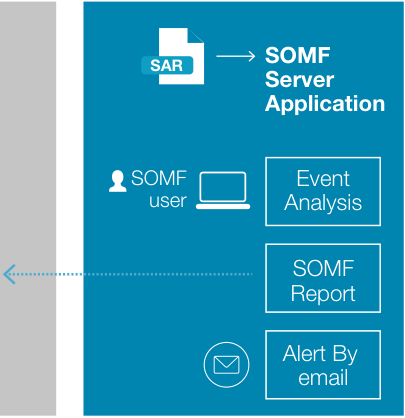
Section titled “A350 XWB Optional Automatic Report Analysis”The A350 XWB has a confi gurable option that can automatically transfer the relevant Smart Access Recorder (SAR) data of a high load event to the airline’s Maintenance Control Centre (MCC) via the IPCOM system. The SAR data fi le will be received in the ‘inbox’ of the data repository at the MCC and it is automatically analysed by SOMF application. An alert with the resulting the load report can be immediately sent by email to a distribution list defi ned by the airline (fi g.6).
This can help to prepare the maintenance teams who will be ready to perform the required maintenance actions as soon as the aircraft arrives at its destination. It reduces the risk of operational delays and allows the aircraft to be promptly returned to service if no defects or damage are found. The generated SOMF report will be stored in the data repository ‘outbox’ together with its associated SAR fi le. The archived load reports and SAR fi le can be easily recovered for data analysis to monitor trends or identify any common causes for a sharp increase of particular high load events observed across the fl eet.
(fi g.6)
Section titled “(fi g.6)”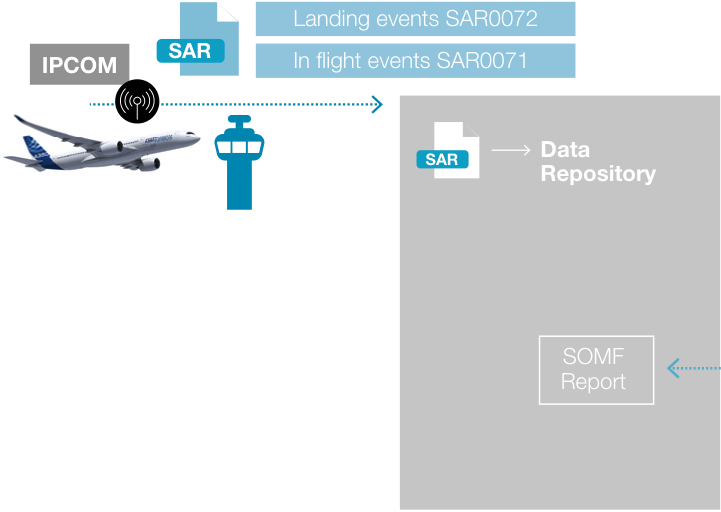
Main objectives of a HQA
Section titled “Main objectives of a HQA”-
Understand an event and its origin
-
Provide information to airlines on operationalbest practices to avoid a re-occurrence
-
Monitor the fleet and system design consistency
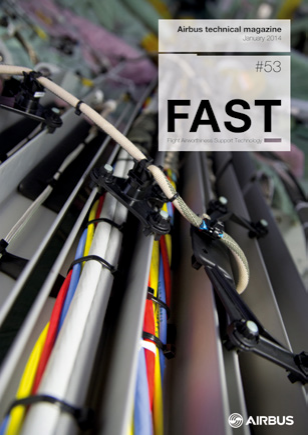
For more information about the Airbus Handling Qualities Analysis (HQA), refer to the article in Airbus Technical Magazine - FAST #53 Available on airbus.com
(fig.7)
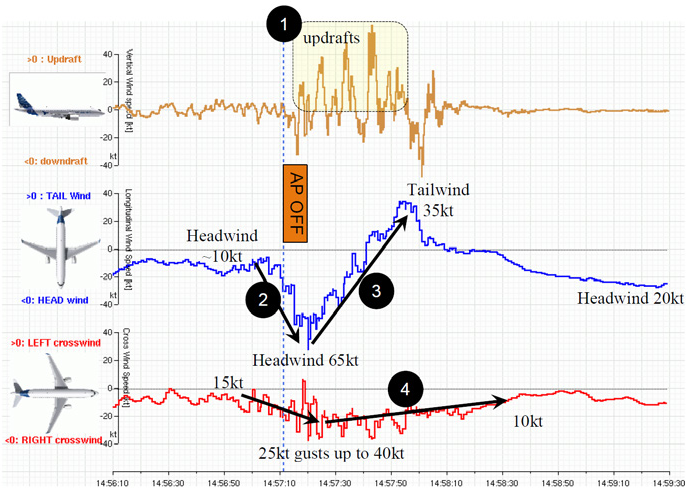
Section titled “(fig.7)”An example of a Handling Qualities Analysis of wind evolution using flight recorder data from an excessive turbulence event shoeing that the aircraft experienced several vertical gusts at 4kt/s, which were mainly updrafts (1). The headwind sharply increased from 10kt to 65kt at a rate of ~4kt/s (2) then changed to a 35kt tailwind, with a gradient of 100kt in 35sec at ~3kt/s and significant gusts (3). The right crosswind component was around 15kt before encountering the turbulence when it increased up to 25kt with several gusts of up to 40kt (4).
AIRBUS ASSISTANCE FOR HIGH LOAD EVENT ANALYSIS
Section titled “AIRBUS ASSISTANCE FOR HIGH LOAD EVENT ANALYSIS”If a high load event is classified as “severe” or “red” status following the analysis of the data from an in-flight speed exceedance, severe turbulence, strong crosswind lateral loads and overweight or hard landings, Airbus will assist airlines with their analysis of the reported event. Airline maintenance personnel should contact Airbus via AIRTAC following a reported event when it is requested by the AMM / MP maintenance actions in chapter 05-51.
Handling Qualities Analysis
Section titled “Handling Qualities Analysis”Beyond the technical assistance in response to the AMM / MP maintenance actions, Airbus offers to help airlines better understand their high load events through a detailed analysis, mainly based on raw data extracted from the Flight Data Recorder. This Airbus activity is called a “Handling Qualities Analysis” (HQA) for specific in-service events.
A HQA report from Airbus can be requested by Airlines for the high load events leading to additional maintenance actions, including load exceedance from significant over-speed, abnormal overweight or heavy landings, severe turbulence with excessive flight parameter deviations or for any incident where there were injuries caused to passengers and crew.
The HQA, based on the FDR raw data readout (fig.7) , is carried out in parallel with the load analysis generally required for structural inspections. The aircraft’s release back into to service is out of the scope of the HQA. The main objectives of the HQA are to understand an event and its origin and to provide information on operational best practices to the airline to avoid re-occurrence. Through the HQA activity Airbus proactively supports airlines in maximizing the efficiency of their operations as well as monitoring the fleet for system and design consistency, with enhancing safety as its primary objective.
CONTRIBUTORS:
Section titled “CONTRIBUTORS:”Sylvain DUBERTRAND HO Structure Transverse & Abnormal Events Customer Engineering Support
Erwin RIEDL
Section titled “Erwin RIEDL”HO Landing Gear Systems ATA 32 Customer Engineering Support
Jean-Victor NOEL BETEMPS Handling Qualities Product Leader Customer Engineering Support
Frederic SOLIVERES
Section titled “Frederic SOLIVERES”HO AFS/Nav/Com Systems Handling Qualities Analysis & Aircraft Environment Customer Engineering Support
Ian GOODWIN
Section titled “Ian GOODWIN”Director Product Safety Enhancement Product Safety
Airlines regularly train their pilots to avoid the conditions that can lead to high loads on the aircraft, but if a high load event occurs, it is important that pilots are also aware of the procedures to report these events. The pilot’s report in the logbook is the starting point triggering the evaluation of high load events for all of the Airbus aircraft families. Additionally, by providing training to maintenance personnel in the evaluation of pilot reported high load events, they will more efficiently identify and carry out the appropriate maintenance tasks called out by the aircraft maintenance manuals, maintenance procedures or from the dedicated load event analysis software tools.
Load reports and available recorded data give airlines more autonomy to manage their high load events on their Airbus aircraft, such as the LOAD<15> reports on A320, A330 and A340 aircraft families, or post event analysis using software tools such as LAT for A380, and SOMF tool for the A350XWB. However, even if the information available is evolving to further enhance and optimize the management of reported high load events, the trigger for assessing any event has always, and will always rely on the pilot’s report.
There are both safety and operational incentives for pilots to report high load events, most importantly ensuring that the aircraft can continuously operate in an airworthy condition. An airline that encourages a reporting mind-set and safety culture within its flight crews can benefit from their pilot’s willingness to send early alerts to ground operations following an abnormal event in flight. This enables faster decision making by maintenance personnel who will then then carry out the necessary maintenance actions, allowing the aircraft to safely return to line operations sooner.
Safety fi rst
Section titled “Safety fi rst”Safety fi rst, #26 July, 2018. Safety fi rst is published by Airbus S.A.S. - 1, rond point Maurice Bellonte - 31707 Blagnac Cedex/France. Publisher and Editor: Yannick Malinge, Chief Product Safety Offi cer. Concept Design by Airbus Multi Media Support 20180451. Reference: X00D16031905 Issue 26. Photos by Airbus, P. Pigeyre, g-stockstudio, H. Goussé, I. Howarth, F. Lancelot. Cover: J. Darcy.
来源:Airbus Safety First 网址:https://safetyfirst.airbus.com/high-load-event-reporting/ 发布日期:2018-03-08 期刊期号:2018-07 类别:飞行运营、维修、硬着陆 PDF:原始 PDF
所有飞机在设计、试验和认证时都需确保其结构强度不可能被超过。运行阈值或限制定义了正常运营中载荷条件包线范围,同时留有设计裕度以应对飞行中或地面上的异常或过大载荷。
飞行员在飞行记录本中报告高载荷事件是启动事件评估并确定异常载荷是否影响飞机结构或系统的起点。尽早报告可使维修人员高效评估事件,也能在完成所需维修工作后让飞机更快恢复运营。
什么是高载荷事件?
Section titled “什么是高载荷事件?”高载荷事件是指超出飞机在正常运营中将经历的载荷条件范围的任何事件。飞机设计能够承受异常条件或情况下的一定程度的过大载荷,但这种载荷可能影响飞机结构、发动机、发动机安装架、吊架及其系统的部件。当发生此类高载荷事件且作用力超过这些阈值时,需要采取行动确保飞机保持持续适航状态。
……飞行员能够观察或感知高载荷事件、管理事件并随后报告事件的能力是至关重要的。
高载荷事件可能发生在飞机飞行中或地面上。例如,如果飞机遭遇严重颠簸和侧风条件,或超过运行速度限制飞行,则可能发生飞行载荷超限。这包括飞机空速超过可收放或操作襟翼、缝翼或起落架的允许限制的情况。地面高载荷事件最常见的是硬着陆或超重硬着陆,但也可能是着陆或滑行时在严重侧风条件下产生异常侧向载荷所致。
飞行员报告的重要性
Section titled “飞行员报告的重要性”高载荷事件的报告依赖于飞行员的意识和经验作为主要检测手段。报告高载荷事件是每位飞行员的职责,需在飞行记录本中作相应记录。这将启动地面事件评估,以确定需要采取哪些维修措施。及时飞行员报告(或 PIREP)可使维修控制评估和分类工作更加高效,当所需维修工作完成后让飞机更快恢复运营。这也将使飞行员确信飞机仍处于持续适航状态。
飞行员报告高载荷事件后会发生什么?
Section titled “飞行员报告高载荷事件后会发生什么?”飞机技术的演进引入了传感器和更复杂的高载荷事件告警生成手段,但飞行员能够观察或感知高载荷事件、管理事件并随后报告事件的能力仍是至关重要的。飞行员报告一直是管理从 A300/A310 到最新 A350 XWB 所有空客机型系列高载荷事件的认证基线。这是整个行业的通用做法。
在感知和记录高载荷事件数据方面已有持续改进,包括在 A320 和 A330/A340 机型系列上引入的 LOAD 报告,以及在 A380 和 A350 XWB 上可用的 Smart Access Recorder (SAR) 数据。这些数据用于支持航空公司维修控制的评估和飞行员报告的高载荷事件分类。事件分类将使航空公司维修人员能够更精确地确定需要采取哪些维修措施以确保飞机的持续适航。
在最新的空客机型系列 A380 和 A350 XWB 上,能够将 Smart Access Recorder (SAR) 记录的飞行数据传输至专用诊断地面支持工具。这些软件工具将分析事件记录数据,并提供一份优化后的维修工作清单,仅聚焦于飞机最可能受影响的区域。这些详细信息为航空公司管理飞行员报告的高载荷事件提供了更大的自主性,并将飞机在地面上进行维修的时间降至最短。
高负载事件类型
Section titled “高负载事件类型”与飞机速度超限相关的高负载事件包括:
高负载事件的类型将通过飞行员报告(PIREP)进行描述。高负载事件通常分为两类:与飞机速度超限相关的高负载事件**(图1)以及与飞机快速垂直或侧向加速度相关的高负载事件(图2)**。
| VMO | MMO | VLE | MLE | VLO | MLO | VFE |
|---|---|---|---|
| 最大操作速度/马赫数 | 使用缝翼/襟翼时飞机可以飞行的最大速度/马赫数 | 使用起落架(伸展和收上)的最大速度/马赫数 | 使用起落架伸展的最大速度/马赫数 |
| 超出最大操作速度 | 超出可以飞行的最大速度/马赫数 | 超出最大操作速度 | 超出最大操作速度 |
注:每个缝翼/襟翼形态都有一个对应的 VFE 值。
与飞机快速垂直或侧向加速度相关的高负载事件包括:
| 垂直颠簸 | 侧向颠簸 | 重着陆 | 硬着陆 |
|---|
避免任何高负载事件通常与飞行员对当时条件的自身警觉性及其对飞机能量状态的有效管理有关。在某些情况下,导致高负载事件的条件难以预测,例如无意中飞入严重的晴空颠簸区域,或在接地前瞬间突然的侧风阵风改变飞机对齐状态。在不存在这些突然且不可预测的自然现象的情况下,高负载事件往往是飞行机组未能有效管理飞机能量状态,或者在飞行中做出突然且过度的控制输入的必然结果。
高负载事件的识别与响应
Section titled “高负载事件的识别与响应”严重颠簸高负载事件
Section titled “严重颠簸高负载事件”严重颠簸会导致飞机高度或姿态发生剧烈变化,通常与空速变化相关。从特征上看,如果乘客和机组人员报告他们被剧烈地甩向已系紧的安全带上,或松散的物体在客舱内被大力移动,则可认为颠簸属于过度或严重等级。
遇到严重颠簸高负载事件该怎么办?
Section titled “遇到严重颠簸高负载事件该怎么办?”经历严重颠簸事件后,飞行员应在飞行日志中做记录,以触发对该事件的评估,并在飞机抵达目的地时评估应执行的相应维修措施。如果事件被判定为严重颠簸,AMM/MP 维修程序将建议联系空客获取支持。空客对记录飞行数据的分析将协助航空公司识别飞机最可能受到事件影响的区域。空客还将建议应完成哪些补充维修措施,并提供一份针对受影响区域的定制化项目清单。
有关管理空速威胁和避免速度偏差的信息,请参阅“安全优先”第21期刊登的“巡航中控制您的速度”一文,其中包含“如何预判速度偏差”的提示。
VMO | MMO 速度超限高负载事件
Section titled “VMO | MMO 速度超限高负载事件”虽然故意超出 VMO | MMO 的情况并不常见,但当飞机受到不可预测条件影响时,例如外界温度或风强度及方向的突然变化,这一速度值通常会被超越。在较低高度,超出 VMO | MMO 可能导致严重的高负载事件。
虽然始终遵守 VMO | MMO 很重要,但飞行员应记住,在高空轻微且临时的速度或马赫数超限不会使飞机陷入迫在眉睫的危险状况。飞机设计可在高于 VMO | MMO 的余量范围内安全高空飞行,因为它必须满足认证要求,确保飞机在设计限制速度或 VD | MD 范围内保持安全飞行。
遇到 VMO | MMO 速度超限高负载事件该怎么办?
Section titled “遇到 VMO | MMO 速度超限高负载事件该怎么办?”如果超出 VMO | MMO,驾驶舱将触发超速警告以提醒机组。FCOM、QRH 和 FCTM 为飞行员提供了预防和从速度偏差中改出的程序及指南,并描述了如何冷静地管理意外的空速变化。任何类型的超速都必须由飞行机组报告,以便飞行数据分析后,维修人员能够判断是否发生了高负载事件,以及飞机在地面时是否需要执行维修措施。
缝翼或襟翼伸出时速 exceedance 高载荷事件
Section titled “缝翼或襟翼伸出时速 exceedance 高载荷事件”高载荷事件 AMM 任务
Section titled “高载荷事件 AMM 任务”AMM 05-51-11 硬着陆或硬超重着陆后的检查
Section titled “AMM 05-51-11 硬着陆或硬超重着陆后的检查”AMM 05-51-12 起落架速 exceedance 后的检查
Section titled “AMM 05-51-12 起落架速 exceedance 后的检查”AMM 05-51-13 襟翼/缝翼速 exceedance 后的检查
Section titled “AMM 05-51-13 襟翼/缝翼速 exceedance 后的检查”AMM 05-51-17 颠簸或速 exceedance 后的检查
Section titled “AMM 05-51-17 颠簸或速 exceedance 后的检查”AMM 05-51-44 飞行中横向载荷检查
一般规则:需要维护措施的高载荷事件请参阅 AMM/MP 第 05-51-xx 章中的相关条目
修改后的 LOAD<15> 报告触发逻辑将引入在 A320 系列飞机上检测高横向载荷的手段
在起飞时,如果自动推力未接通,以缝翼和襟翼伸出或正在伸出缝翼和襟翼的状态飞行,且速度超过 VFE,则存在通过缝翼和襟翼轨道机构使飞机结构过载的风险。这可能导致襟翼和缝翼、伸机构或与其相连的结构部件发生变形。
发生缝翼或襟翼伸出时速 exceedance 高载荷事件时应该怎么做?
Section titled “发生缝翼或襟翼伸出时速 exceedance 高载荷事件时应该怎么做?”如果超过 VFE,驾驶舱内会触发超速警告,提醒机组采取纠正措施,即降低速度或相应收回襟翼和缝翼。飞行员还应在飞行记录本中报告此次因超过 VFE 导致的高载荷事件,以便在飞机继续运营前执行特定的维护措施和故障排除程序。
起落架操作或伸出时速 Exceedance 高载荷事件
Section titled “起落架操作或伸出时速 Exceedance 高载荷事件”如果起落架在飞机速度超过起落架操作最大限制速度(VLO/MLO)时伸出或收回,或者起落架放下并锁定的飞机增速超过允许的最大起落架伸出飞行速度限制(VLE/MLE),都可能发生高载荷事件。
发生起落架操作或伸出时速 Exceedance 高载荷事件时应该怎么做?
Section titled “发生起落架操作或伸出时速 Exceedance 高载荷事件时应该怎么做?”如果起落架在飞机速度超过允许限制时被操作或伸出,驾驶舱内会触发超速警告,提醒机组采取纠正措施,即降低速度或收回起落架。这些异常事件应由飞行员作为飞行记录本条目进行报告,由维修人员评估并确定需要执行哪些 AMM/MP 规定的维护措施。
飞行中横向高载荷事件
Section titled “飞行中横向高载荷事件”可能导致飞行中高横向载荷的典型情况包括飞行中遇到重度颠簸、大的偏航和滚转运动,以及系统故障(如方向舵配平失控并由机组接管)。在所有情况下,飞行员报告都是触发事件严重程度评估的依据。
发生飞行中高横向载荷事件时应该怎么做?
Section titled “发生飞行中高横向载荷事件时应该怎么做?”如果飞行员感觉到飞机在飞行中经历了异常或过大的横向加速度,应将其作为飞行记录本条目进行报告。需要注意的是,目前在 A320 系列飞机上,如果载荷仅为横向载荷且没有伴随超过限制的垂直加速度,则不会生成 LOAD<15> 报告。如果颠簸事件期间存在超过限制的高垂直加速度,则会自动生成 LOAD<15> 报告,并且可以检查记录的横向加速度数据。如果飞行员报告称飞机在地面经历了高横向加速度,则应按照 AMM/MP 硬着陆检查标准进行分析。
硬着陆或硬超重着陆
Section titled “硬着陆或硬超重着陆”硬超重着陆与硬着陆的区别是什么?在空中返航或改航的情况下,硬超重着陆可能是机上燃油载荷不可避免的结果。硬着陆可能由不稳定进近导致,或者由严重侧风阵风引起的接地瞬间大横向加速度造成。
发生飞行中硬着陆或超重着陆高载荷事件时该怎么做?
Section titled “发生飞行中硬着陆或超重着陆高载荷事件时该怎么做?”为降低不可避免的超重着陆事件的影响,建议飞行机组限制垂直速度并确保对称着陆。飞行机组报告硬着陆或超重硬着陆后,需根据 LOAD<15> 报告或 SAR 文件对着陆参数进行分析,并查阅相应的 AMM/MP 以确定所需的维护任务。
有关管理硬着陆的更详细运营和维护建议,请参阅《Safety First》第 17 期发布的文章《硬着陆:面向机组和维护人员的案例研究》。
Linton Foat
Section titled “Linton Foat”飞行运营管理、合规与风险经理 机长——空客机队 Thomas Cook Airlines - Condor
鼓励超限事件报告
Section titled “鼓励超限事件报告”Thomas Cook Airlines(TCX)使用 A321 执行中等航程航线,例如从土耳其达拉曼(LTBS)飞往英国曼彻斯特(EGCC)。当从气候较温暖的机场起飞时,满载飞机在接近 A321 最大起飞重量(MTOW)状态下运行。在较高外界气温与大载量的组合情况下,“S”速度(缝翼收上速度)可能接近缝翼限制速度或 VFE。提醒 TCX 飞行员在爬升加速前确认构型干净、缝翼完全收上,以避免缝翼伸出时超速的风险。
一旦发生超速,机长将在飞行中于电子技术记录本中作记录以便维护处理。TCX 飞行员还需向运行控制中心发送 ACARS 报文,以提醒维护人员发生了超速,需在目的地机场进行维护工作。在飞行机组遭遇严重颠簸或巡航中发生 VMO/MMO 超限时亦然。
通过 ACARS 提前联系可为维护工作争取额外时间,便于安排具备适当资质的维修技术人员在飞机落地时迎接并开始维护工作。提前获知信息意味着地面工程师将有机会在飞机着陆前查阅飞机维护手册。这种主动协调确保所有设备就位、维护人员就绪,可在飞机抵达目的地后立即完成任务,确保对飞机持续适航性进行及时评估。完成所需的维护活动并确认无需进一步修复后,飞机即可恢复航线运营。
Thomas Cook Airlines 鼓励飞行员报告所有缺陷或高载荷事件,并相信这些行为是以安全为核心。我们深知飞行员报告事件的意愿至关重要,我们全力鼓励开放、诚实的报告文化,以确保飞机持续安全运行。**“Safe at Heart(安全在心)”**是我们公司级安全管理体系的核心价值观。Safe at Heart 理念在 Thomas Cook 大家庭中培育了一种将安全置于一切核心的文化。
图片由 Thomas Cook Group 提供
高载荷报告与分析的演进
Section titled “高载荷报告与分析的演进”
信息图展示了空客各机型系列中高载荷事件报告与分析的演进历程
空客
建议各航空公司检查其机队是否具有一致配置,以便在需要时生成 LOAD<15> 报告……
对于 A300/A310 飞机,高载荷事件后所需维护工作的评估完全依赖飞行员对事件的报告及其记录的观察结果。通过多年的服役经验,维护工作的范围已尽可能优化,以减少完成相关任务所需的时间。维护工作将重点关注事件中可能受到影响的关键部件。如未发现缺陷,则飞机可在较短的地面停场时间后恢复运行。
自 A300/A310 以来,所有空客机型系列在高载荷事件管理中仍依赖飞行员的报告及其记录的观察结果(图 3)。利用飞机设计阶段可用的技术,逐渐实现了更先进的高载荷探测和记录手段,例如 A320 和 A330/A340 系列飞机的 LOAD<15> 报告。对于 A330/A340 飞机,某些飞行载荷事件会产生 LOAD<35> 报告,例如 VMO/MMO 超限。
在最新的 A380 和 A350 XWB 飞机上,事件后分析进一步由地面支持软件工具辅助完成。这些工具将使用特殊访问记录器(SAR)的飞行数据来评估高载荷事件中飞机哪些部件受到影响。最终报告提供一份优化的目标维护工作清单,聚焦于这些受影响区域。
A320 | A330 | A340 LOAD<15> 报告
Section titled “A320 | A330 | A340 LOAD<15> 报告”如果未生成 LOAD<15> 报告,这并不总是意味着未发生高载荷事件……
高载荷事件打印报告或 LOAD<15> 报告可根据运营商的偏好进行定制和配置。空客建议航空公司检查其机队的配置是否一致,以便在所有飞机的所需时间生成 LOAD<15> 报告。可配置设置包括选择是在高载荷事件后立即打印报告,还是仅在着陆时打印。报告的触发限值默认为《 Aircraft Maintenance Manuals》(AMM)中的数值。然而,如果需要更敏感的数据监控以提前识别任何不良运营趋势,运营商可以调整这些限值以降低 LOAD<15> 报告的触发阈值。在实际应用中,这会产生更多的载荷报告,并可能迅速增加航空公司维护控制部门需要分析的高载荷事件数量。
当飞行机组报告硬着陆或硬超重着陆时,维护人员将使用 AMM 说明来分析 LOAD<15> 报告,并确定是否需要采取任何维护措施。本报告的目的是协助决策确定应执行的 AMM 任务。因此,任何故意抑制 LOAD<15> 报告的行为都可能对分析的准确性产生不利影响,并可能对放行时间产生不利影响。如果未生成 LOAD<15> 报告,这并不总是意味着未发生可能导致载荷超限的高载荷事件。在所有情况下,飞行员的报告仍然是检测高载荷事件的主要手段,而 LOAD<15> 报告仅支持事件的后飞行分析。
如果根据维护手册对事件的评估需要维护措施和检查,这些措施和检查分为四个主要区域:机身、机翼、发动机短舱/挂架和安定面。检查项目分为三个阶段**(图 4)**。
如果在第 1 阶段项目的检查过程中未发现缺陷或损坏,则无需进一步检查。如果在第 1 阶段检查中发现了缺陷或损坏,则必须完成第 2 阶段项目。根据事件的严重程度,可能需要同时完成第 1 阶段和第 2 阶段检查。第 3 阶段检查项目只有在第 2 阶段检查中发现缺陷或损坏时才必须执行。AMM 将告知是否有必要联系空客。
第 1 阶段 AMM 检查项目 第 2 阶段 AMM 检查项目 机体、发动机和挂架的主要损坏的全面检查,以及任何内部损坏迹象的检查 内部区域的详细检查,可能还需要拆卸某些部件
在 A320 | A330 | A340 高载荷事件报告和 LOAD<15> 报告分析后,检查项目分为三个阶段。
第 3 阶段 AMM 检查项目
可能需要拆卸部件和分解的详细检查
通过 ACARS 传输 LOAD<15> 报告的能力,加上用于读取的地面支持工具(如 AIRMAN),使航空公司能够预判收到报告后所需的维护措施。维护人员可以做好准备,在飞机抵达后不久即可开始维护工作。
A380 载荷分析工具
Section titled “A380 载荷分析工具”空客为 A380 的投入运营开发了一款名为载荷分析工具(LAT)的软件。在 A380 机组报告高载荷事件后,LAT 工具使用飞机特殊存取记录器(SAR)的数据来计算可能影响飞机结构或系统区域载荷的大小。如果任何飞机部件被过度加载或受力,它会自动生成一份载荷报告,其中交叉引用了相关的 AMM 子任务,重点关注受影响的区域。
A350 结构过载监控功能
Section titled “A350 结构过载监控功能”结构过载监控功能(SOMF)工具是为 A350 XWB 开发的。SOMF 工具使用从特殊存取记录器 SAR 记录的高载荷事件数据,生成一份全面的载荷报告。报告中详细的分析通过列出与该事件相关的具体维护措施来支持更快速地恢复运营,这意味着它描述了针对可能暴露于任何载荷超限的飞机结构或系统特定区域应执行的精确任务。
利用 Smart Access Recorder 数据分析 A380 和 A350 XWB 高载荷事件
Section titled “利用 Smart Access Recorder 数据分析 A380 和 A350 XWB 高载荷事件”与其他机型一样,起点是飞行员提交的事件报告(即 PIREP),其中描述事件条件、飞机构型以及事件发生后飞机所处状态。
评估飞机承受的结构载荷等级。
确定是否超出设计包线,以及哪些区域发生超载。
使运营人能够监控其机队中的异常事件。
最终功能
是生成包含针对性检查程序的报告。
为评估事件并确定是否需要额外的维修措施,可使用以下软件工具获取额外帮助:A380 使用 LAT,A350 XWB 使用 SOMF,具体步骤如下:
- 使用 AMM/MP 05-51 中发布的流程图,在任何高载荷事件 PIREP 后按步骤遵循指南
- AMM/MP 中的维修措施可能要求维修人员从飞机上下载 SAR 文件:A380 写入 CD-ROM,A350 XWB 传输至 USB 密钥
- 下载的 SAR 文件随后发送至航空公司负责评估高载荷事件的维修中心
LAT 或 SOMF 分析和报告所需维修措施的说明
- 维修中心随后使用 LAT 处理 A380 事件的 SAR 文件,或使用 SOMF 处理 A350 XWB 事件的 SAR 文件,生成载荷报告,说明所需维修措施,并建议是否需要联系空客获取额外支持**(图 5)**。
通知空客 事件发生并发送事件数据进行分析 A380 [LAT] “严重载荷” [A380] 检查 LAT 报告中列为第一阶段的区域 A350 [SOMF] 及第二阶段 “超载 [红色]” [A350 XWB] 执行所有红色检查及 SOMF 报告中列为红色和琥珀色的琥珀色检查 根据空客对事件分析后的建议检查任何额外区域 A380 [LAT] [A380] 检查 LAT 报告中列为 “高载荷” 第一阶段的区域 A350 [SOMF] “超载 [A350 XWB] 执行 SOMF 报告中列为琥珀色的所有琥珀色检查 [琥珀色]” 遵循空客提供的任何补充说明 A380 [LAT] “正常载荷” 仅需执行 AMM/MP 中列出的初步检查任务 A350 [SOMF] “无超载”
SOMF 相关信息参见 ISI 05.51.00019,LAT 相关信息参见 ISI 05.51.00001
A380 LAT 或 A350 XWB SOMF 报告
Section titled “A380 LAT 或 A350 XWB SOMF 报告”LAT 或 SOMF 将显示载荷报告,其中列出”飞机和事件信息”的详情、“事件评估摘要”(描述载荷超限或”超载”的严重程度)、所需 AMM/MP 子任务清单,以及是否建议在执行下一次飞行前联系空客。
A380 的 LAT 和 A350 XWB 的 SOMF 是免费软件工具,在这些机型投入运营时即向运营人提供,也可通过空客 World 门户获取。
A350 XWB 可选自动报告分析
Section titled “A350 XWB 可选自动报告分析”A350 XWB 提供可配置选项,可自动将通过 IPCOM 系统将高载荷事件的相关 Smart Access Recorder(SAR)数据传输至航空公司维护控制中心(MCC)。SAR 数据文件将接收至 MCC 的数据仓库”收件箱”,并由 SOMF 应用自动分析。生成的载荷报告警报可立即通过电子邮件发送至航空公司定义的通讯组**(图 6)**。
此功能有助于维修团队做好准备,在飞机抵达目的地后即可立即执行所需维修措施。这降低了航班延误风险,若未发现缺陷或损伤,可使飞机迅速恢复运行。生成的 SOMF 报告将连同相关 SAR 文件一起存储在数据仓库的”发件箱”中。归档的载荷报告和 SAR 文件可轻松检索,用于数据分析,以监测趋势或识别机队中特定高载荷事件急剧增加的共同原因。
HQA 的主要目标
Section titled “HQA 的主要目标”-
了解事件及其成因
-
为航空公司提供避免再次发生的最佳运营实践信息
-
监控机队和系统设计的一致性
如需了解更多关于空客操控品质分析 (HQA) 的信息,请参阅空客技术杂志 - FAST #53 文章,可在 airbus.com 获取
以下为使用过度颠簸事件飞行记录器数据进行操控品质分析的风场演变示例,显示飞机经历了多次 4kt/s 的垂直阵风,主要为上升气流 (1)。顶风从 10kt 急剧增加到 65kt,变化率约为 4kt/s (2),随后转为 35kt 的顺风,梯度在 35 秒内达到 100kt,约为 3kt/s,并伴有显著阵风 (3)。右侧侧风分量在遭遇颠簸前约为 15kt,随后增加至 25kt,期间多次出现高达 40kt 的阵风 (4)。
空客高载荷事件分析协助
Section titled “空客高载荷事件分析协助”如果在超速、严重颠簸、强侧风横向载荷以及超重或硬着陆的飞行数据进行分析后,高载荷事件被评定为“严重”或“红色”状态,空客将协助航空公司对报告的事件进行分析。航空公司维修人员应在报告事件后按照 AMM/MP 维修手册第 05-51 章中维修措施的要求,通过 AIRTAC 联系空客。
操控品质分析
Section titled “操控品质分析”除了响应 AMM/MP 维修措施的的技术协助外,空客还通过对基于从飞行数据记录器提取的原始数据进行详细分析,帮助航空公司更好地理解其高载荷事件。此空客活动被称为特定在役事件的“操控品质分析”(HQA)。
对于导致额外维修措施的高载荷事件,航空公司可向空客申请 HQA 报告,包括因严重超速造成的载荷超限、异常超重或重着陆、伴有过度飞行参数偏差的严重颠簸,或任何造成乘客和机组人员受伤的事件。
基于 FDR 原始数据读取 (图 7) 进行的 HQA,与结构检查通常所需的载荷分析并行开展。飞机返回服役不在 HQA 范围内。HQA 的主要目标是了解事件及其成因,并向航空公司提供运营最佳实践信息以避免再次发生。通过 HQA 活动,空客积极支持航空公司最大限度地提高运营效率,同时监控机队的系统和设计一致性,以提升安全性为首要目标。
Sylvain DUBERTRAND 结构横向及异常事件主管 客户工程支援
Erwin RIEDL 起落架系统 ATA 32 主管 客户工程支援
Jean-Victor NOEL BETEMPS 操控品质产品负责人 客户工程支援
Frederic SOLIVERES AFS/Nav/Com 系统操控品质分析及飞机环境主管 客户工程支援
Ian GOODWIN 产品安全增强总监 产品安全
航空公司定期对飞行员进行培训以避免可能导致高载荷的条件,但如果发生高载荷事件,飞行员同样重要的是了解报告这些事件的程序。飞行日志中的飞行员报告是触发所有空客机型高载荷事件评估的起点。此外,通过对维修人员进行飞行员报告的高载荷事件评估培训,他们将能够更高效地识别并执行航空维修手册、维修程序或专用载荷事件分析软件工具所要求的适当维修任务。
载荷报告和可用记录数据使航空公司能够更好地自主管理其空客飞机的高载荷事件,如 A320、A330 和 A340 机型的 LOAD<15> 报告,或使用 A380 的 LAT 工具和 A350XWB 的 SOMF 工具进行的事后分析。然而,即使可用信息在不断改进以进一步增强和优化报告高载荷事件的管理,但评估任何事件的触发条件始终且永远依赖于飞行员的报告。
飞行员报告高载荷事件既有安全方面的动因,也有运营方面的动因,最重要的是确保飞机能够持续以适航状态运营。航空公司如果在飞行机组中鼓励报告意识和安全文化,将能够从飞行员在飞行中发生异常事件后向地面运营部门发送早期预警的意愿中受益。这使维修人员能够更快地做出决策,从而执行必要的维修措施,使飞机能够更快地安全恢复航线运营。
安全优先,第 26 期 2018 年 7 月。安全优先由空客 S.A.S. 出版 - 1, rond point Maurice Bellonte - 31707 法国布拉尼亚克 Cedex。出版人和编辑:Yannick Malinge,产品安全首席官。概念设计:空客多媒体支援 20180451。参考编号:X00D16031905 第 26 期。照片由空客、P. Pigeyre、g-stockstudio、H. Goussé、I. Howarth、F. Lancelot 提供。封面:J. Darcy。