Do you know your ATC-TCAS panel ?
Source: Airbus Safety First URL: https://safetyfirst.airbus.com/do-you-know-your-atc-tcas-panel/ Published: 2007-06-29 Magazine Issue: 2017-06 Category: Archive PDF: Original PDF
Do you know your ATC/TCAS panel ?
Section titled “Do you know your ATC/TCAS panel ?”By: Bernard VIGNAULT
Section titled “By: Bernard VIGNAULT”Flight Operations Safety Enhancement Engineer
1 TCAS Fault leads to AIRPROX
Section titled “1 TCAS Fault leads to AIRPROX”Shortly after takeoff from London Heathrow, the ECAM alert TCAS FAULT was triggered in an Airbus A340-600. The ECAM procedure consists in setting the TCAS mode to standby. Unfortunately, the effects of the action were not the expected ones: the crew inadvertently switched off both transponder and TCAS instead of selecting the TCAS standby mode as per ECAM procedure. The Air Traffic Control secondary radar information was temporarily lost and prevented the automatic update of the flight data. In other words, the aircraft disappeared from the ATC radar screen and was not able to respond to other aircraft TCAS interrogation. During this time the Tower Traffic Controller tried to contact the approach centre. Although several attempts were made the calls were not answered. Unknown to the approach controller, the aircraft was climbing in conflict with another departing aircraft. As the aircraft transponder was not responding, no TCAS alerts nor Short Term Conflict Alert (in Air Traffic Control) triggered and the minimum separation reduced to 3.7 NM and 0 ft.
2 TCAS controls
Section titled “2 TCAS controls”Let us have a closer look to the ECAM procedure and to the TCAS controls, to understand this scenario.
When the TCAS fails, the ECAM procedure indicates (on A340/330): TCAS MODE………..STBY (See fig 1).
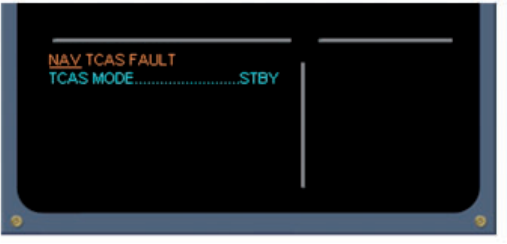
Fig 1: CAS FAULT ECAM procedure on A330/340
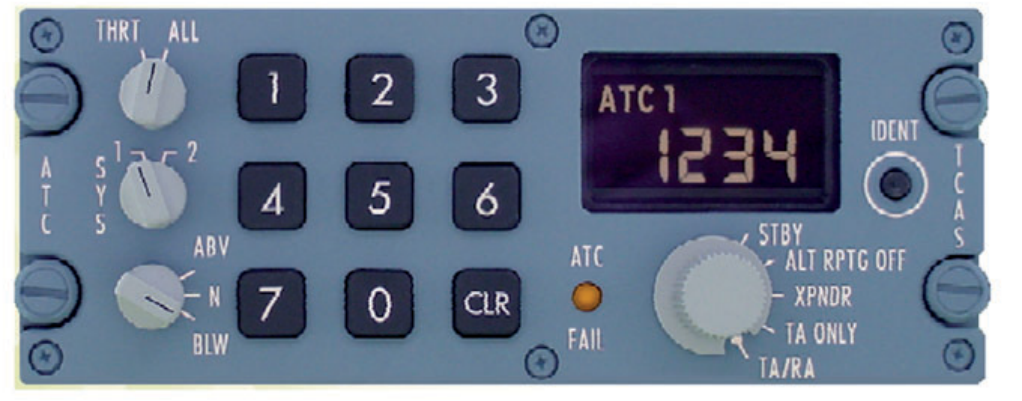
Fig 2: Gables 40 ATC/TCAS control panel
transponder operate. But if the selector is placed in one of the three other positions (XPNDR, ALT RPTG OFF, STBY), then the TCAS is on standby mode. In their intention to set the TCAS only on standby mode, as requested by the ECAM, the crew turned the selector until it reached the STBY position. They did not immediately realize that this position set both the TCAS and the ATC transponder on standby mode.
The crew is expected to set the faulty system on standby.
In the above event, the airline had chosen for its fleet the TCAS panel, which is shown in figure 2.
On this panel, a single rotating selector enables the crew to switch between several modes, linked to ATC transponder and/or TCAS. When the selector is placed in TA/RA or TA ONLY positions, both TCAS and ATC
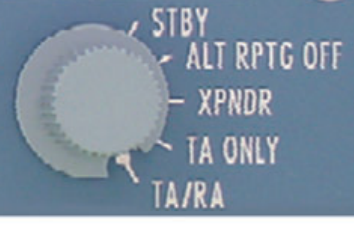
TCAS + Transponder in standby
TCAS standby / Transponder On
TCAS + Transponder ON
3 Other TCAS Control Panels
Section titled “3 Other TCAS Control Panels”Several types of panels are available to customers, and pilots have to pay attention to the switches layout when operating them, as functions may differ from a panel to an other.
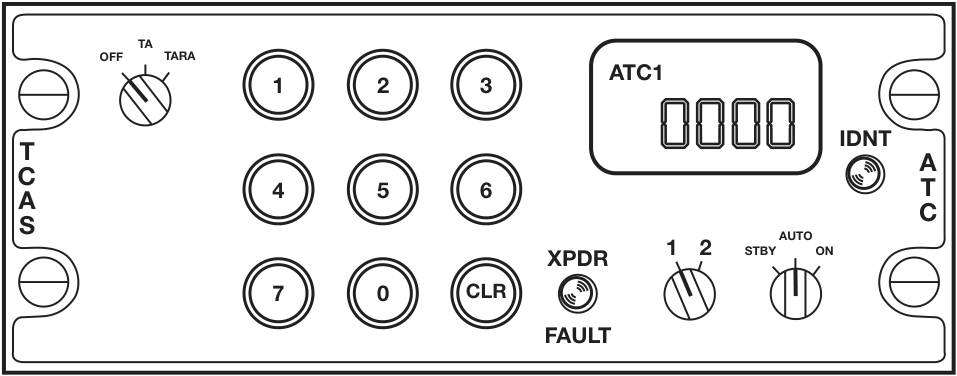
On Airbus basic TCAS panel, the controls are split into two parts:
l one side of the panel is dedicated to ATC transponder controls
l the other side is dedicated to TCAS control.
Fig 3: Basic ATC/TCAS control panel
Setting the TCAS mode to standby is done by setting the appropriate switch to the STBY position. The switch is easily identified, as it is located with other TCAS controls, and separated from ATC transponder controls (see fig 3).
When the TCAS switch is placed on the STBY position, the TCAS is electrically supplied but is inoperative, and the ATC transponder still operates normally. As a result, there will be no TCAS TA or RA on board the aircraft whose TCAS has been set to stand-by. However, the ATC transponder will be able to continue responding to potential intruder interrogation, and TA/RA information will continue to operate on-board the intruder.
Other designs exist for ATC/TCAS panel, on which TCAS setting on standby is achieved by setting the selector to XPNDR, STBY, ON or OFF, depending on which TCAS control panel is installed. On Gables 10 panel, for example, the selector should be turned from the normal TA/RA position to the ON position to set the TCAS on standby (see Figure 4). The ON legend is related to the ATC Transponder only. This is indicated by the fact that the ON legend is out of the settings related to the TCAS, that are gathered by a line associated to a TCAS label.
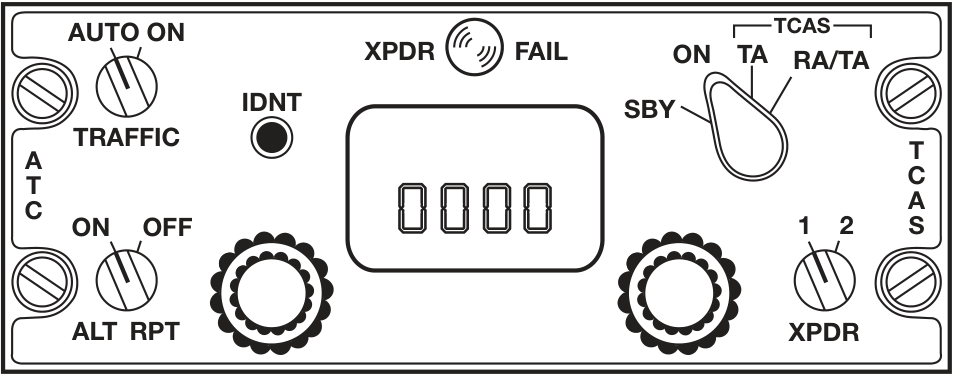
On Gables 20 panel, ATC transponder and TCAS have dedicated controls. TCAS is set on standby by placing the TCAS selector to the OFF position (see Figure 5).
4 New ECAM procedure
Section titled “4 New ECAM procedure”Setting the TCAS to standby mode can be achieved by setting the selector to XPNDR, STBY, ON or OFF, depending on which TCAS control panel is installed.
The Flight Warning Computer that generates the ECAM procedure in case of a TCAS fault has no means of determining what type of ATC/TCAS control panel is installed. It is therefore not possible to provide the crew with a customized ECAM procedure indicating the setting to be reached for each panel.
This is why the TCAS FAULT ECAM procedure is generic and provides the objective of the action to be performed: TCAS MODE……STBY. It is then up to the crew to place the right selector in the right position.
ECAM Change
Section titled “ECAM Change”Setting the TCAS on stand-by when it is faulty enables to remove the TCAS FAULT flags on PFD and ND.
But the related in-service event highlighted the difficulty for the crew to use the right setting when the word “STBY” is displayed on the ECAM with a panel that differs from the AIRBUS standard one. Airbus then decided to remove the action line TCAS MODE…..STBY from the ECAM procedure and to accept the drawback of the flags remaining on PFD and ND after the failure. This modification will be effective upon fitting with new FWC standards. This modification is only applicable to Long Range aircraft, as the TCAS FAULT procedure is crew awareness only (no action line) on Single Aisle and A380 aircraft, and there is no ECAM warning for TCAS failure on A300/A310 family.
In the interim period before FWC standards are installed, AIRBUS published an OEB to inform crews not to apply the action line TCAS MODE…..STBY, in the case of a TCAS FAULT ECAM caution. The TCAS FAULT ECAM caution should be considered as a “crew awareness”.
This information was dispatched to airlines through FOT 999.0138/06 on 11[th] December 2006. The crews are informed of the deviation from ECAM procedure by:
-
l OEB 68/1 for A330 aircraft (cancelled by FWC STD 2)
-
l OEB 82/1 for A340 aircraft (cancelled by FWC STD L11 for A340-200/300 aircraft and FWC STD T2 for A340-500/600 aircraft)
您了解您的 ATC/TCAS 控制面板吗?
作者:Bernard VIGNAULT
飞行操作安全增强工程师
1 TCAS 故障导致空中接近(AIRPROX)
Section titled “1 TCAS 故障导致空中接近(AIRPROX)”一架空客 A340-600 从伦敦希思罗机场起飞后不久,触发了 ECAM 警戒 TCAS FAULT(TCAS 故障)。ECAM 程序要求将 TCAS 模式设置为 STBY(待机)。然而,这一操作的效果并未如预期:机组人员错误地将应答机和 TCAS 都关闭了,而非按照 ECAM 程序选择 TCAS 待命模式。空中交通管制二次雷达信息暂时丢失,导致飞行数据无法自动更新。换言之,该飞机从 ATC 雷达屏幕上消失,且无法响应其他飞机的 TCAS 询问。在此期间,塔台管制员尝试联系进近中心。尽管多次尝试,但呼叫均未得到回应。进近管制员不知道的是,该飞机正在与另一架离场飞机发生冲突上升。由于应答机未响应,TCAS 告警和短期冲突告警(STCA)(空中交通管制)均未触发,两机间隔缩减至 3.7 海里和 0 英尺。
2 TCAS 控制
Section titled “2 TCAS 控制”让我们仔细查看 ECAM 程序和 TCAS 控制,以理解这一事件。
当 TCAS 故障时,ECAM 程序(A340/330)指示:TCAS MODE……….STBY(参见图 1)。
图 1:A330/340 上的 TCAS FAULT ECAM 程序
图 2:Gables 40 ATC/TCAS 控制面板
当选择器置于 TA/RA 或 TA ONLY 位置时,TCAS 和 ATC 应答机均工作。但如果选择器置于其他三个位置之一(XPNDR、ALT RPTG OFF、STBY),则 TCAS 处于待机模式。为了按 ECAM 要求将 TCAS 仅设置为待机模式,机组人员将选择器旋转至 STBY 位置。他们没有立即意识到,该位置同时将 TCAS 和 ATC 应答机都设置为待机模式。
机组应将故障系统设置为待机。
在上述事件中,该航空公司为其机队选择了图 2 所示的 TCAS 面板。
在此面板上,单个旋转选择器使机组能够在与 ATC 应答机和/或 TCAS 相关的多种模式之间切换。当选择器置于 TA/RA 或 TA ONLY 位置时,TCAS 和 ATC
TCAS + 应答机待机
TCAS 待机/应答机接通
TCAS + 应答机接通
3 其他 TCAS 控制面板
Section titled “3 其他 TCAS 控制面板”客户可选用多种类型面板,飞行员在操作时需注意开关布局,因为不同面板的功能可能不同。
在空客基本 TCAS 面板上,控制分为两部分:
l 面板一侧用于 ATC 应答机控制
l 另一侧用于 TCAS 控制。
图 3:基本 ATC/TCAS 控制面板
将 TCAS 模式设置为待机,需将相应开关置于 STBY 位置。该开关易于识别,因为它与其他 TCAS 控制相邻,并与 ATC 应答机控制分开(参见图 3)。
当 TCAS 开关置于 STBY 位置时,TCAS 有电力供应但不工作,ATC 应答机仍正常工作。因此,TCAS 已设置为待机的飞机上将不会出现 TCAS TA 或 RA。然而,ATC 应答机将继续能够响应潜在入侵者的询问,且 TA/RA 信息将在入侵者机上继续工作。
其他设计的 ATC/TCAS 面板上,将 TCAS 设置为待机是通过将选择器置于 XPNDR、STBY、ON 或 OFF 来实现的,具体取决于所安装的 TCAS 控制面板。例如,在 Gables 10 面板上,需将选择器从正常 TA/RA 位置旋转至 ON 位置,以将 TCAS 设置为待机(参见图 4)。ON 指示仅与 ATC 应答机相关。这可以从 ON 指示位于与 TCAS 相关的设置之外这一事实看出,与 TCAS 相关的设置由一条线和一个 TCAS 标签聚集在一起。
在 Gables 20 面板上,ATC 应答机和 TCAS 有各自独立的控制。TCAS 通过将 TCAS 选择器置于 OFF 位置设置为待机(参见图 5)。
4 新的 ECAM 程序
Section titled “4 新的 ECAM 程序”将 TCAS 设置为待机模式可以通过将选择器设置为 XPNDR、STBY、ON 或 OFF 来实现,具体取决于安装的是哪种 TCAS 控制面板。
飞行警告计算机在 TCAS 发生故障时生成 ECAM 程序,但它无法确定安装的是哪种类型的 ATC/TCAS 控制面板。因此,不可能为机组提供定制化的 ECAM 程序,指示每种面板应设置的对应位置。
这就是为什么 TCAS FAULT(TCAS 故障)ECAM 程序是通用性的,它提供的是需要执行的操作目标:TCAS MODE……STBY。然后由机组将相应的选择器置于正确位置。
ECAM 更改
Section titled “ECAM 更改”当 TCAS 故障时将其设置为待机可以消除 PFD 和 ND 上的 TCAS FAULT(TCAS 故障)标志。
但相关服务事件表明,当 ECAM 上显示“STBY”,而面板与 AIRBUS 标准面板不同时,机组很难使用正确的设置。空客随后决定从 ECAM 程序中删除操作行 TCAS MODE…..STBY,并接受故障后标志仍保留在 PFD 和 ND 上的缺点。此修改将在安装新的 FWC 标准后生效。此修改仅适用于远程飞机,因为单通道和 A380 飞机上的 TCAS FAULT 程序仅为机组认知(无操作行),而 A300/A310 系列飞机上没有 TCAS 故障的 ECAM 警告。
在安装 FWC 标准之前的过渡期间,空客发布了 OEB,以通知机组在遇到 TCAS FAULT ECAM 警戒时不要执行操作行 TCAS MODE…..STBY。TCAS FAULT ECAM 警戒应被视为“机组认知”。
此信息通过 FOT 999.0138/06 于 2006 年 12 月 11 日分发至各航空公司。机组通过以下方式获知与 ECAM 程序的偏差:
- A330 飞机的 OEB 68/1(被 FWC STD 2 取消)
- A340 飞机的 OEB 82/1(被 A340-200/300 飞机的 FWC STD L11 和 A340-500/600 飞机的 FWC STD T2 取消)