Safety, Our Shared Destination
Source: Airbus Safety First URL: https://safetyfirst.airbus.com/safety-our-shared-destination/ Published: 2017-01-29 Magazine Issue: 2017-01 Category: D10X PDF: Original PDF
GENERAL TOPIC
Section titled “GENERAL TOPIC”As professionals, working in an industry with annual growth rates between 5 & 6%, we must ask ourselves the question ‘what could be the impact on Safety of a doubling of air traffi c?’.
Without industry-wide action to lower the accident rate, by 2030 we will be experiencing accidents more frequently.
This article looks at an Airbus initiative called Air Transport Safety Destination 10X Together, which is a platform upon which Airbus and our operators can collaborate to propose pragmatic solutions to key identifi ed safety issues.
YANNICK VANHECKE
Section titled “YANNICK VANHECKE”Head Of Safety Enhancement
COMMERCIAL AVIATION’S RECORD ON SAFETY
Section titled “COMMERCIAL AVIATION’S RECORD ON SAFETY”Our industry can be very proud of its record on safety. Our combined efforts have reduced the fatal accident rate to about only 1 fatal accident per 10 million departures on the fourth generation of airplanes (fig.1).
Even if these abstracted statistics show a low and stable accident rate, we at Airbus believe we must still address the real-world meaning of fatal accidents and their impact on people, since any accident is an unacceptable tragedy.
Yet despite this success, the fatal accident rate for 4[th] generation jets has been consistent for the last 10 years, barely decreasingly.
The fatal accident rate of 1 per 10 million departures for 4[th] generation jets has been consistent for the last 10 years, barely decreasingly.
(fig.1)
Section titled “(fig.1)”Accident rate per million by aircraft generation (ten year moving average). The accident rate for 4th generation jets is very low but has barely decreased over the last 10 years.
Fatal accident rate 1996-2015
Section titled “Fatal accident rate 1996-2015”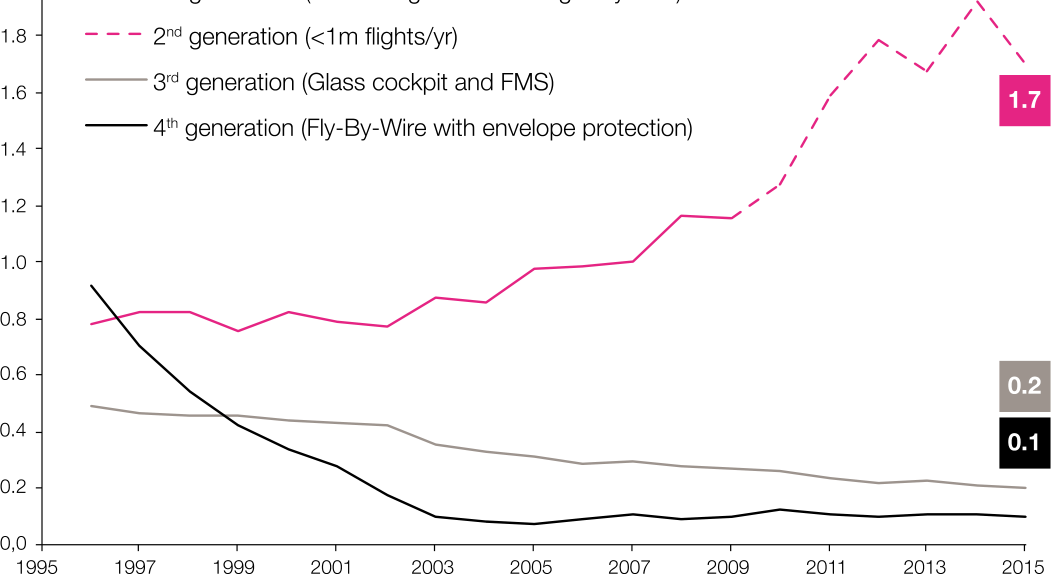
GENERAL TOPIC
Section titled “GENERAL TOPIC”SAFETY IN THE FUTURE
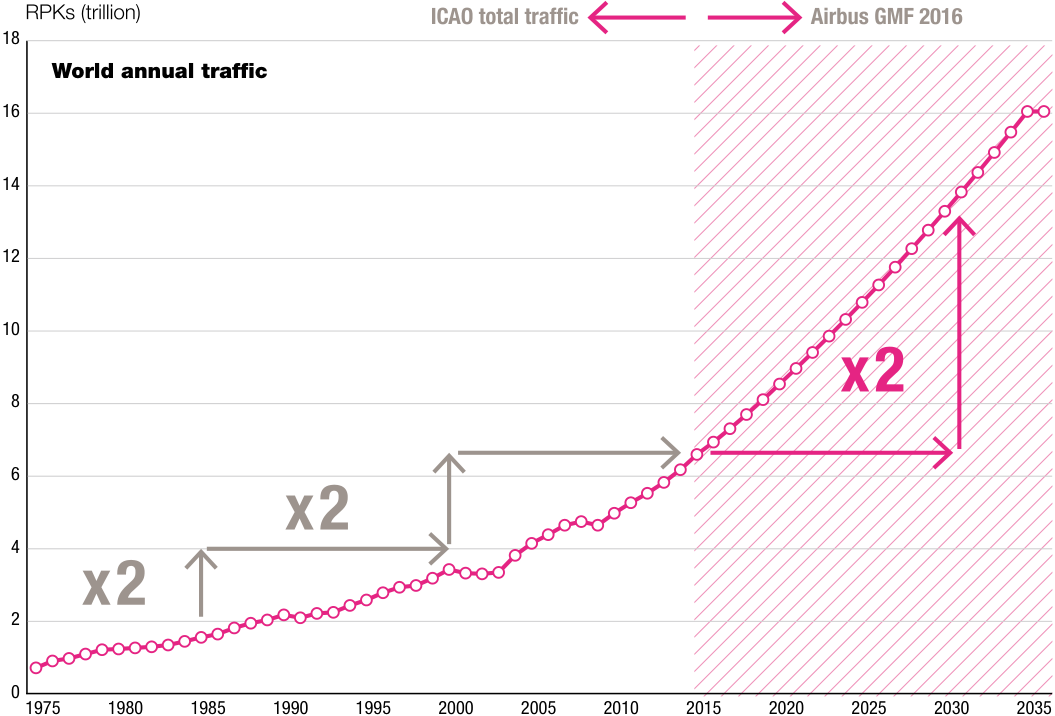
Section titled “SAFETY IN THE FUTURE”If the fatal accident rate remains at today’s level, the doubling of fl ights forecast to occur by 2030 will inevitably lead to double the number of accidents in numerical terms.
(fi g.2)
Section titled “(fi g.2)”Airbus Global Market Forecast for annual traffi c (trillion RPKs per year). Air traffi c is resilient to external shocks, and is forecast to double over the next 15 years.
What do we know about the future of our industry?
Section titled “What do we know about the future of our industry?”In terms of the volume of activity we need to manage, we know that our industry’s output (RPKs) continues to grow at a global rate of between 5 & 6% per year. We also have the proof from history which shows that this growth is resilient to external shocks over the longterm. We can therefore be reasonably confi dent in the consensus of forecasts which anticipate a doubling of air traffi c over the next 15 years (fi g.2).
the number of accidents in numerical terms. This must surely be something which we all fi nd unacceptable.
Furthermore, rapid global development of the industry may generate increased operational pressures at all areas of the air transport system. It will also require a signifi cant expansion of the number of newly certifi ed personnel, potentially causing a decrease in the overall level of experience and causing new threats to emerge.
As professionals, we must ask ourselves the question, ‘what could be the impact on Safety of a doubling of air traffi c?’
The conclusion from these considerations seems clear: we need to launch co-ordinated actions with all actors of air transport system to address upcoming threats and drive the rate of accidents lower than it has ever been.
If we assume a scenario where our fatal accident rate remains at today’s level, the doubling of fl ights forecast to occur by 2030 will inevitably lead to double
DESTINATION 10X
Section titled “DESTINATION 10X”With this in mind, Airbus has launched a project called ‘Air Transport Safety Destination 10X Together’, or Destination 10X for short. The objective of the Destination 10X project is to identify and implement different initiatives to enhance Air Transport Safety, in cooperation with our operators.
By sharing information and exchanging ideas, the project aims to identify ‘quick-wins’ for Safety enhancement and then move quickly into pragmatic implementation.
The Destination 10X project is integrated into Airbus’ strategy for continuous Safety Enhancement. The annual Airbus Flight Safety Conference (FSC) is a key component in this activity, since it offers Airbus and airlines a unique opportunity to share information and ideas. In 2016 the FSC was attended by 267 airline delegates from 117 different operators, and it was with this community that Airbus launched the first wave of activity on the project.
The airlines were surveyed in order to identify the areas in which they believed the industry needed to focus attention in order to improve Safety.
Based on this survey, as well as from the existing safety plans from EASA, ICAO and FAA, four key areas were identified as the top priorities; Training, Weather, Safety Data, and Safety Enhancement Promotion.
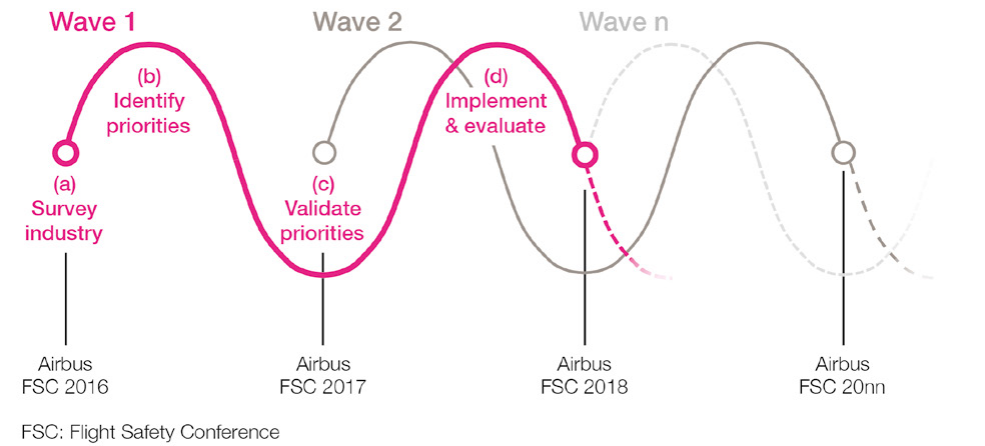
At this point in the project, Airbus is running workshops with some operators on these key priority areas, to identify quick-win enhancement projects, and has chosen the top two priorities of Weather and Training as the key themes of this year’s Airbus Safety Conference in Santiago. Airlines at this conference will have the opportunity to collaborate with Airbus by participating in workshops to propose priorities to be launched for implementation in Wave 1, as well as to identify priority areas for Wave 2 (fig.3).
Similar waves will be run at every FSC, with a second wave already scheduled for the 2017 event in order to identify the next areas of focus for the project.
In addition, in order to promote a continually collaborative working mode for the project, Airbus will release a Destination 10X app and website in Q1 2017. Users will be able to receive project updates, as well as be able to vote on project priorities.
By sharing information and exchanging ideas, the project aims to identify ‘quick-wins’ for Safety enhancement and then move quickly into pragmatic implementation.
(fig.3)
Section titled “(fig.3)”Destination 10X Timeline.
Project waves are integrated into Airbus’ strategy for continuous Safety Enhancement. Each wave involves four key phases of (a) surveying industry, (b) Identifying priorities for action, (c) Validating priorities, and finally (d) Implementing solutions and evaluating the result.
GENERAL TOPIC
Section titled “GENERAL TOPIC”DESTINATION 10X TOGETHER
Section titled “DESTINATION 10X TOGETHER”Airbus and our airline customers are already in co-operation on the Destination 10X project. We encourage more airlines to join us.
The Destination 10X project is a platform upon which Airbus and its operators can collaborate to propose pragmatic solutions to key identified safety issues.
As mentioned, Airbus and our airline customers are already in co-operation in the current first wave of the project. We certainly encourage more airlines to join us as we progress into the selection of solutions, whether at the Airbus Flight Safety Conference (see pages 4-5), or through the app / website.
As we identify together quick win initiatives, we aim at sharing them across industry. The concept is to create initial momentum amongst those whose businesses are most immediately impacted by Safety, and then to continue to build momentum across other industry actors in a ‘snowball effect’.
This is a pragmatic approach to building consensus from the ground up, with a focus on action.
INFORMATION
Section titled “INFORMATION”
From the beginning of March 2017, scan the QR code in order to download your copy of the Destination 10X app. This is will be your way to engage in the Destination 10X project, to make sure your ideas are captured and priorities are implemented for finding the most effective ways to enhance Safety.
Despite our industry’s success on preventing accidents, the fatal accident rate of 1 accident per 10 million flights for 4[th] generation jets has been consistent for the last 10 years, barely decreasingly.
When we combine increased operational pressures arising from the forecast doubling of flights over the next 15 years, with the rapid intake of newly certified personnel which is needed to achieve growth, it is likely that we will experience accidents more frequently. This is clearly unacceptable.
The goal of Airbus’ Destination 10X project is to quickly identify and implement different initiatives to enhance Air Transport Safety and share them at industry level.
Airbus and our airline customers are already in co-operation together, and we encourage all our operators to get involved.
Safety first, #23 January, 2017. Safety first is published by Airbus S.A.S. - 1, rond point Maurice Bellonte - 31707 Blagnac Cedex/France. Publisher and Editor: Yannick Malinge, Chief Product Safety Officer. Concept Design by Airbus Multi Media Support 20162610. Reference: X00D16031905 Issue 23. Photos by Airbus, Lindner Fotografie, S. Ramadier, H. Goussé, P. Masclet, F. Lancelot, B. Lange, A, Doumenjou, C. Brinkmann, M. Lindner, E. Lafargue. Computer renderings by Fixion
Source: Airbus Safety First URL: https://safetyfirst.airbus.com/safety-our-shared-destination/ Published: 2017-01-29 Magazine Issue: 2017-01 Category: D10X PDF: Original PDF
作为专业人士,在一个年增长率为5%至6%的行业中,我们必须问自己一个问题:“航空流量翻倍将对安全产生什么影响?”
如果不采取全行业行动来降低事故率,到2030年,我们将更频繁地遭遇事故。
本文介绍了空客发起的一项名为”航空运输安全Destination 10X Together”的倡议,这是一个平台,空客和运营商可以在此合作,为已识别的关键安全问题提出务实的解决方案。
YANNICK VANHECKE
Section titled “YANNICK VANHECKE”安全改进主管
商业航空的安全记录
Section titled “商业航空的安全记录”我们的行业完全有理由为自身的安全记录感到自豪。我们的共同努力已将致命事故率降低到第四代飞机大约每1000万次起飞仅发生1起致命事故的水平 (图1)。
尽管这些抽象的统计数据表明事故率低且稳定,但我们空客认为,我们必须认真对待致命事故的现实意义及其对人们的影响,因为任何事故都是不可接受的悲剧。
然而,尽管取得了这一成功,过去10年来第四代喷气飞机的致命事故率基本保持不变,几乎没有下降。
过去10年来,第四代喷气飞机每1000万次起飞1起致命事故的事故率基本保持不变,几乎没有下降。
各代飞机每百万架次的事故率(十年移动平均值)。第四代喷气飞机的事故率非常低,但在过去10年中几乎没有下降。
1996-2015年致命事故率
Section titled “1996-2015年致命事故率”
如果致命事故率保持在今天的水平,那么预计到2030年航班数量翻倍将不可避免地导致事故数量翻倍。
空客全球市场预测:年度流量(每年万亿收入客公里)。航空流量对外部冲击具有韧性,预计在未来15年将翻倍。
我们对行业的未来了解多少?
Section titled “我们对行业的未来了解多少?”就我们需要管理的活动量而言,我们知道我们行业的产出(RPKs)继续以全球5%至6%的年增长率增长。我们也有历史证明,表明这种增长在长期内对外部冲击具有韧性。因此,我们可以合理地对预测共识充满信心,该共识预计航空流量在未来15年将翻倍 (图2)。
事故数量翻倍。这无疑是我们所有人都无法接受的。
此外,行业的快速全球发展可能会在航空运输系统的各个领域产生更大的运营压力。这还需要大量增加新认证人员的数量,可能导致整体经验水平下降,并引发新的威胁。
作为专业人士,我们必须问自己:“航空流量翻倍将对安全产生什么影响?”
这些考虑得出的结论似乎很清楚:我们需要与航空运输系统的所有参与者共同发起协调行动,以应对即将到来的威胁,并将事故率降低到历史最低水平。
如果我们假设一种致命事故率保持在今天水平的情景,那么预计到2030年航班数量翻倍将不可避免地导致事故数量翻倍。
目标 10X
Section titled “目标 10X”鉴于此,空客启动了一个名为“航空运输安全目标 10X 协作项目”(Air Transport Safety Destination 10X Together),简称“目标 10X”。目标 10X 项目的目标是与运营商合作,识别并实施各项举措以提升航空运输安全。
通过分享信息和交流想法,该项目旨在识别安全提升的“快速收效措施”,然后迅速付诸务实的实施。
目标 10X 项目已纳入空客持续安全提升战略体系。一年一度的空客飞行安全大会(FSC)是该活动的重要组成部分,因为它为空客和航空公司提供了分享信息和想法的独特机会。2016 年 FSC 共有来自 117 家不同运营商的 267 名航空公司代表参加,正是在这一群体中,空客启动了项目的第一批活动。
已对航空公司进行调研,以识别业内认为需要重点关注的安全改进领域。
基于此项调研以及 EASA、ICAO 和 FAA 的现有安全计划,确定了四个关键领域为最高优先级:培训、天气、安全数据和安全提升推广。
在项目的这一阶段,空客正在与部分运营商就这些关键优先领域举办研讨会,以识别快速收效的提升项目,并已选择天气和培训作为今年空客圣地亚哥安全大会的重点主题。与会航空公司将有机会通过参加研讨会与空客合作,提出将在第一批次中启动实施的重点议题,并识别第二批次(Wave 2)的优先领域。
每届 FSC 都将开展类似的活动批次,第二批次已计划在 2017 年活动期间进行,以确定项目的下一重点领域。
此外,为促进项目持续协作的工作模式,空客将于 2017 年第一季度发布目标 10X 应用程序和网站。用户将能够接收项目最新动态,并对项目优先级进行投票。
通过分享信息和交流想法,该项目旨在识别安全提升的“快速收效措施”,然后迅速付诸务实的实施。
(fig.3)
Section titled “(fig.3)”目标 10X 时间表。
项目批次已纳入空客持续安全提升战略。每个批次包含四个关键阶段:(a) 行业调研,(b) 识别行动优先领域,(c) 验证优先级,最后 (d) 实施解决方案并评估结果。
目标 10X 协作
Section titled “目标 10X 协作”空客与航空公司客户已在目标 10X 项目上开展合作。我们鼓励更多航空公司加入我们。
目标 10X 项目是一个平台,空客及其运营商可在此平台上协作,为已识别的关键安全问题提出务实的解决方案。
如前所述,空客与航空公司客户已在当前项目的第一批中开展合作。我们诚挚鼓励更多航空公司加入我们,在解决方案的选择阶段参与进来,可通过空客飞行安全大会(见第 4-5 页)或通过应用程序/网站参与。
当我们共同识别快速收效举措时,我们的目标是在全行业范围内分享这些成果。理念是在受安全影响最直接的企业中首先形成初步动力,然后以“滚雪球效应”在其他行业参与者中持续扩大影响力。
这是一种从基层建立共识的务实方法,注重行动。
从 2017 年 3 月初起,扫描二维码下载目标 10X 应用程序。这是您参与目标 10X 项目的方式,确保您的主张被采纳,优先级得到实施,以寻找增强安全的最有效方法。
尽管本行业在预防事故方面取得了成功,但第四代喷气客机每千万飞行架次 1 起致命事故的致命事故率在过去 10 年保持一致,几乎没有下降。
当我们将未来 15 年航班数量预计翻倍所带来的运营压力增加,与实现增长所需的新认证人员快速补充相结合时,我们可能会更频繁地遭遇事故。这显然是不可接受的。
空客目标 10X 项目的目标是快速识别并实施提升航空运输安全的不同举措,并在行业层面进行分享。
空客与航空公司客户已在合作中,我们鼓励所有运营商参与进来。
Safety first, #23 January, 2017. Safety first is published by Airbus S.A.S. - 1, rond point Maurice Bellonte - 31707 Blagnac Cedex/France. Publisher and Editor: Yannick Malinge, Chief Product Safety Officer. Concept Design by Airbus Multi Media Support 20162610. Reference: X00D16031905 Issue 23. Photos by Airbus, Lindner Fotografie, S. Ramadier, H. Goussé, P. Masclet, F. Lancelot, B. Lange, A, Doumenjou, C. Brinkmann, M. Lindner, E. Lafargue. Computer renderings by Fixion