Landing on contaminated runways
Source: Airbus Safety First URL: https://safetyfirst.airbus.com/landing-on-contaminated-runways/ Published: 2015-01-29 Magazine Issue: 2015-01 Category: Flight Ops, airport, brake, Brakes, Braking, contaminants, contaminated, crosswind, damp, esf, friction, frost, ice, landing, matrix,, perfo, performance, pirep, RCAM, runway, slush, snow, water, wet PDF: Original PDF
12 Safety First #19 | January 2015 OPERATIONS
Section titled “12 Safety First #19 | January 2015 OPERATIONS”THE QUESTION OF PERFORMANCE
Section titled “THE QUESTION OF PERFORMANCE”Landing performance is a function of the exact landing runway conditions at the time of landing. A simple statement for a more complex reality. Indeed, knowing what exact contamination is or remains on the runway at a given point in time is often challenging.


ROBERT LIGNEE
Section titled “ROBERT LIGNEE”Experimental Flight Test Engineer
LARS KORNSTAEDT
Section titled “LARS KORNSTAEDT”Performance expert – Flight Operations Support

Landing on a contaminated runway may be an almost daily experience for some pilots or a more exceptional one for others. In any case, doing it safely requires some background understanding and thinking on a variety of questions, especially: What does the term “contaminated runway” actually mean? How are contaminated runway conditions reported to pilots? How to translate the reported runway condition terminology into a safe assessment of the aircraft landing performance? How to prepare for a safe landing and then perform it?
CONTAMINATED RUNWAY: WHAT DOES IT MEAN IN REALITY?
Section titled “CONTAMINATED RUNWAY: WHAT DOES IT MEAN IN REALITY?”If weather can to some extent be anticipated, the runway surface conditions with natural contamination may be more difficult to forecast. Indeed, runway surface conditions depend on a variety of factors including state changes due to surface temperature effects, chemical treatment, or run-off and removal.
A variety of contaminants
Section titled “A variety of contaminants”-
The most common and natural con• ice (solid contaminant, its depth is taminants are limited in number: irrelevant).
-
compacted snow (solid contamiThey are the ones for which sufficient nant, its depth is irrelevant), historical data has been gathered
-
• dry or wet snow, depth at or more and safe performance levels defined than 3 mm - 1/8 inch (*) by EASA, assuming a homogeneous
-
• water, slush, depth at or more than condition of the contaminant along 3 mm - 1/8 inch (*) runway length.
(*) DRY and WET normal runway conditions, without abnormal contamination by rubber or other pollution, are by aeronautical language convention classed as “non-contaminated”.
Dry or wet snow, water and slush of a depth less than 3 mm - 1/8 inch or frost are considered equivalent to a wet runway (non-contaminated).
A wet runway excessively contaminated by rubber, reported by NOTAM as “Slippery when Wet” as defined by ICAO, is a contaminated runway. It is considered to have the same performance as snow (MEDIUM).
The
most common contaminants for which aircraft performance level can be defined have been synthetized into the Runway Condition Assessment Matrix that permits deterministic classification of the expected landing performance.
In some situations though, the contaminant reported to be present on the runway may not make it possible to identify the corresponding performance level just by considering the contaminant type and depth. It is the case particularly when the contaminant is:
-
too variable as to its impact on aircraft performance: e.g. volcanic ash, hydraulic fluid spillage. Operations cannot, in general, be supported with specific performance information;
-
a common natural one, but outside of the temperature conditions where its characteristics are well known: e.g. compacted snow if the outside air temperature subsequently raises above -15°C. Indeed, compacted snow is a specially prepared winter runway when temperature is very low, at or below -15°C. Above that, there is a risk that some
of the contaminant be no longer true compacted snow. A downgrade of performance should then be considered as risk mitigation to support safe operations.
- a piling up of layers of different contaminants: the few cases documented water on top of compacted snow, water on top of ice (or wet ice), or dry/wet snow over ice, have shown unacceptable impact on aircraft performance and operations cannot be supported, even adoption of the most conservative contaminant, i.e. ice, for snow over ice condition might be unsafe.
Eventually, the most common contaminants for which aircraft performance level can be defined have been synthetized into the Runway Condition Assessment Matrix that permits deterministic classification of the expected Landing Performance.
A dynamic weather
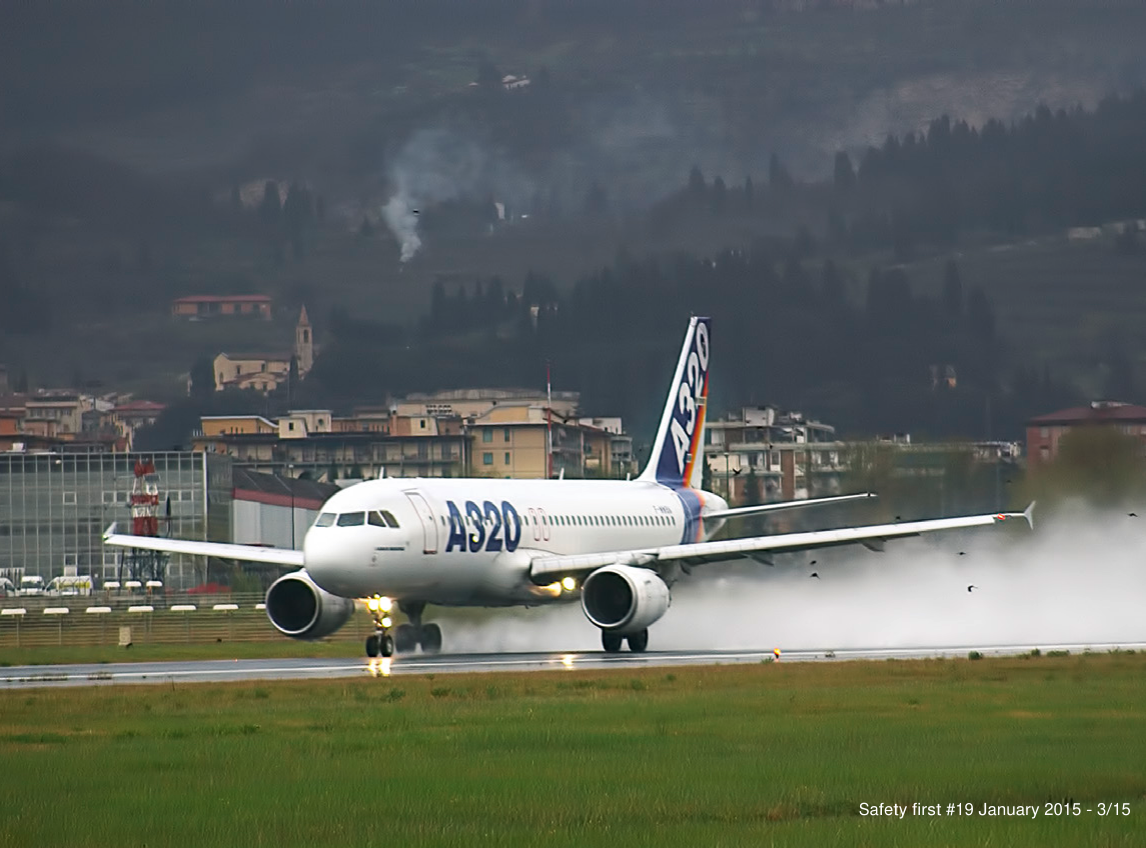
Section titled “A dynamic weather”Weather conditions evolve quickly and elude a forecast accurate enough to be compatible with the sensitivity of landing performance. As an example, Landing performance is defined as GOOD when the runway is normally wet (runways quickly drain water during showers with normal precipitation rates). It might drop to MEDIUM TO POOR with standing water accumulation (the 3 mm water depth criterion is a necessary simplification to represent this phenomenon). Likewise, the estimated runway condition and resulting landing performance may be sensitive to temperature. It is the case especially when
the temperature leads to a change of state of the contaminant: landing performance is poor on dry ice, but can become non-existent if ice surface is melting (here again, the -3°C temperature criterion is a necessary simplification).
Determining precisely when the precipitation accumulation will become critical or when the ice will start melting in significant proportion is already a challenge when nothing interferes with it. Yet in reality, a number of other factors do interfere with this weather dimension and make it even more difficult to determine the actual runway condition, not to mention an anticipation of it.
A large runway surface area
Section titled “A large runway surface area”Although runways vary in size, 3 km long and 45 m wide give a representative indication of the surface area of a runway. On such a surface, the exact contamination may vary from one place to another. As an illustration, “patchy snow and ice” may be reported in some airports as representing less
than 25% of runway coverage. Whatever the actual state of the runway and its variability, it needs to be simplified to make a landing performance computation. Indeed, landing performance models can only consider a single contaminant evenly distributed on the runway.
Airport operations
Section titled “Airport operations”Beyond these intrinsic difficulties of having an accurate representation of the runway condition, operations taking place on the runway modify the runway condition at least in some places of the runway. An aircraft landing on a runway may change the depth of a contaminant if not its nature. Indeed, it can for example induce a change of state at the touchdown point or along its deceleration path. The contamination will remain unchanged though on the un-trafficked last part of the runway or further away
laterally from the landing gear.
An aircraft taking off might also induce changes in the runway contamination along its take-off roll, thereby increasing as well the heterogeneity of the contamination throughout the runway surface.
A more obvious case of impact of airport operations on runway contamination is any runway management action such as cleaning or de-icing. In many cases, de-icing fluids are applied only to a limited width along the runway axis.
HOW ARE RUNWAY CONDITIONS REPORTED TO PILOTS?
Section titled “HOW ARE RUNWAY CONDITIONS REPORTED TO PILOTS?”For pilots, the main reason why runway contamination needs to be considered is because of its impact on the performance of the landing.
Although this sounds obvious, it means that what pilots need to know is not the very physical details of the runway conditions but rather how the performance of the aircraft might be affected, thus what they will need to do to still perform a safe landing. In other words, what pilots really need is a translation of the runway condition into its practical effects on the aircraft.
Yet today, the information provided to pilots on runway condition is not directly a level of performance. One of the main challenges for pilots is to translate from their vantage point in the cockpit of an approaching aircraft the sometimes complex information provided to them on runway surface condition into a single classification of the runway condition landing performance level.
This translation is done by means of the Runway Condition Assessment Matrix (RCAM) introduced earlier. The RCAM includes, beyond DRY, WET and thin contaminants that are equivalent to WET, 4 discrete levels of contamination, each of which is associated with a landing performance level.
The information provided to pilots of runway condition may vary from one country to another and from one airport to another. Let’s review the three categories of possible information pilots may get on runway condition before discussing how they can be integrated to come up with a single, representative, performance level.
What pilots need is a translation of the runway condition into its practical effects onto the aircraft.
Contaminant type & depth
Section titled “Contaminant type & depth”In accordance with ICAO standards, all airports around the world should provide this information to pilots prior to landing. It is the primary information about runway contamination (this reporting is even more essential for take-off).
Currently, the description of contaminants in SNOWTAMs is done through a combination of codes and free text/ plain-language remarks. There is no clear distinction between performance relevant contaminants and other runway surface conditions provided for situational awareness. The ICAO SNOWTAM codes correspond to a set of generic contaminants, thus are different from the RCAM landing performance codes
agreed by the Takeoff and Landing Performance Assessment Aviation Rulemaking Committee (TALPA ARC, see article Safety First 10).
Providing the contaminant type & depth to pilots relies on measurements, especially that of contaminant depth. Performing these measures in a way that provides a representative view of the real depth is a challenge to airports. More generally, measuring runway contamination, whether it is to determine contaminant depth or to estimate the surface friction coefficient (see next section), can become challenging for a variety of reasons (see insert The challenge of providing measures on runway contamination ).
Estimated surface friction (ESF)
Section titled “Estimated surface friction (ESF)”There is no established meaningful correlation on most contaminants between estimated surface friction established by ground measurement devices and aircraft performance.
ICAO and national authorities have progressively shied away from reporting measured friction to pilots. In fact, there is no established meaningful correlation on most contaminants between estimated surface friction established by ground measurement devices and aircraft performance. Therefore, reporting ESF is strongly discouraged by ICAO on contaminants for which it is now known that it may be dangerously biased (fluid winter contaminants as snow or slush, i.e. dry or wet snow or slush). (see insert The challenge of providing measures on runway contamination ). Yet, it is a secondary information pilots may get in some areas of the world.
ESF can be reported in different formats. Either under the terminology: GOOD / GOOD TO MEDIUM / MEDIUM / MEDIUM TO POOR / POOR by third of runway length, or through a figure e.g. 26μ. When the surface friction is expressed through a figure, it may give the illusion that it is an accurate measurement although it still remains of limited practical use in characterizing winter runway conditions for aircraft operations. Indeed, no related landing performance level can reasonably be derived from the sole figure.
Pilot Reports of Braking Action (PiRep of BA)
Section titled “Pilot Reports of Braking Action (PiRep of BA)”The last secondary information pilots may get on runway conditions, although its use largely varies regionally, is through the air traffic controller in the form of a Pilot Report or PiRep of Braking Action. PiRep of BA are encouraged in some countries. These reports are individual perceptions that may be influenced by a number of factors: whether the pilot is familiar with contaminated runways and this particular type of conditions or with the type of aircraft or the use of deceleration devices. It is also easy for a pilot to mistake aerodynamic and reverse thrust deceleration forces for braking forces. However, the usefulness of such subjective reports should not be underestimated, as they often (but not always) provide the most recent information available under dynamic weather, and resulting runway surface
conditions. PiReps should always be communicated to the approaching pilots with a time and emitter of the report including the airline and the aircraft type.
PiReps of Braking Actions are also reported using the terminology: GOOD / GOOD TO MEDIUM / MEDIUM / MEDIUM TO POOR / POOR, and can also be reported by third of runway length.
In countries where PiReps of Braking Action are transmitted to following traffic, it is the sole responsibility of the pilot performing the In-Flight landing performance assessment to determine whether the transmitted information can be considered reliable or not.
Integrating the various types of information on runway surface condition
Section titled “Integrating the various types of information on runway surface condition”Eventually, pilots need to integrate all the pieces of information they receive in relation to runway contamination to come up with a single level of landing performance. They can receive up to three different information types, coming from different sources:
-
Runway contaminant type and depth: mandatory as primary information;
-
Estimated Surface Friction (ESF): not systematic as secondary information;
-
Pilot Report of Braking Action (PiRep of BA): not systematic as secondary information.
used to determine the Related Landing Performance Level for in-flight landing performance assessment (downgrade). When ESF is higher than the performance associated to contaminated type and depth in the RCAM, its use to determine the Related Landing Performance Level is not supported (no upgrade).
Some rules do exist for pilots to integrate these various types of information.
As a general rule, the Related Landing Performance level derived from the primary information (contaminant type & depth) prevails if considering other sources of information would lead to being less conservative than EASA regulation.
When ESF is lower than the performance associated to contaminant type and depth in the RCAM, it should be
When PiRep of BA is lower than the performance associated to contaminant type and depth in the RCAM, it should be used to determine the Related Landing Performance Level for in-flight landing performance assessment (downgrade). When PiRep of BA is higher than the performance associated to contaminated type and depth in the RCAM, its use to determine the Related Landing Performance Level is not supported (no upgrade) by EASA, but under pilot responsibility in USA.
THE CHALLENGE OF PROVIDING MEASURES ON RUNWAY CONTAMINATION
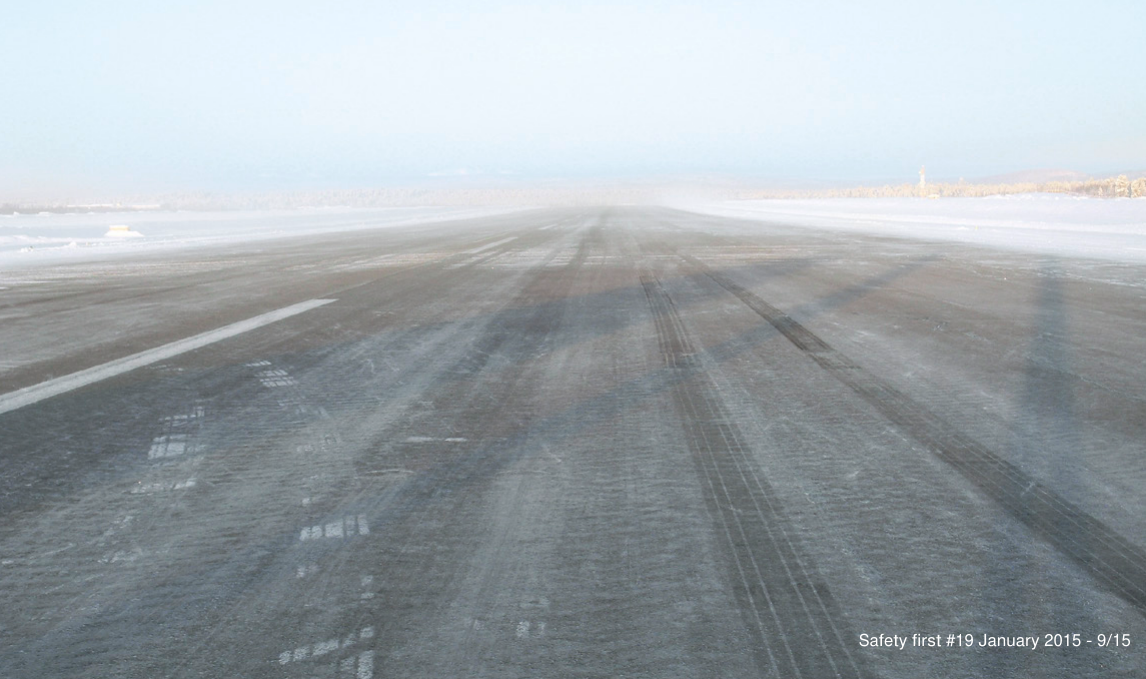
Section titled “THE CHALLENGE OF PROVIDING MEASURES ON RUNWAY CONTAMINATION”Providing quantitative information on runway contamination combines two major challenges. The first one is to perform accurate and representative measures. As for the second one, it relates to the validity of the measurement with time.
Interfering with operations on an active runway
Section titled “Interfering with operations on an active runway”Performing measures on a runway requires sending a measurement vehicle on the runway (except for few airports equipped with contaminant depth automatic measurement devices). For any airport, this could induce a risk for active runways.
The time needed to perform the measures
Section titled “The time needed to perform the measures”Even if the number of measurements performed to assess the runway condition must remain limited despite the runway surface area, it takes some time to perform them. On an airport that has infrequent winter weather events and thus has limited equipment and personnel available, the time for a runway condition assessment and runway cleaning may be very similar. Yet, when weather “piles up”, both are needed. The measurements then allow for validating the success of the cleaning operations.
The limitation of measurement tools
Section titled “The limitation of measurement tools”Contaminant depth
Section titled “Contaminant depth”Measuring the contaminant depth is done by means of tripods put on the ground, or lasers, or FOD cameras or in very few airports so far, sensors built into the runway surface. Whatever the tool, very dynamic weather conditions make it difficult to perform an accurate measure. Heavy rainfalls are among these conditions,
except for the few airports in the world equipped with above mentioned automatic measurement devices for real-time water depth.
Runway friction
Section titled “Runway friction”Airport runway friction assessment can be performed using a variety of devices and vehicles that are based on an equally wide palette of measurement principles and ways of implementing these. They are all subject to limitations that affect the accuracy and reproducibility of measurements. The correlation of data produced with them with aircraft performance is challenged by factors such as test wheel size and inflation pressure, load on the test wheel, and last but not least testing speed, which are all at least an order of magnitude different from those of the aircraft. Airport runway friction assessment should thus at best be considered as a way to monitor trends rather than determine absolute values. It can in no way be used as primary information to directly derive landing performance from.
The sustainability of the values measured
Section titled “The sustainability of the values measured”Measures are performed on a discrete basis not only space wise but also time wise. In other words, a measure is representative of whatever it measures at the time of the measure. Yet, actual conditions may quickly drift from a measurement performed at a given point in time.
PERFORMING A SAFE LANDING ON A CONTAMINATED RUNWAY
Section titled “PERFORMING A SAFE LANDING ON A CONTAMINATED RUNWAY”Performing a safe landing on a contaminated runway involves a number of dimensions, including lateral control, max X-wind… However, for simplification purposes, this section will put the emphasis on aircraft performance. Beyond the dispatch calculation of the landing performance, preparing to land on a contaminated runway also relies on a number of activities in-flight.
Reevaluating landing performance calculation in-flight
Section titled “Reevaluating landing performance calculation in-flight”Even if under EASA regulation, landing performance is calculated based on the probable contamination before dispatch, it is necessary to re-evaluate the landing performance prior to landing. Dispatch considerations will most probably no longer apply to the actual conditions at the time of landing. In addition, should the conditions be exactly the ones anticipated, the most recent in-flight landing performance models can lead to longer distances. Indeed, the in-flight landing performance models used today rely on more realistic assumptions thus allow for deriving more realistic, though often more conservative, landing distances.
The model used for all Airbus aircraft for In-Flight Landing Distance assessment is based on the comprehensive work of the TALPA-ARC group. This work relies itself on the contaminants
characteristics described in EASA CS25.1591 (see SAFETY FIRST n° 10 August 2010 P8-11). Airbus concurs with the FAA in recommending a minimum margin of 15% on these distances, achievable in line operations when no unexpected variations occur from reported outside conditions and assumed pilot technique.
The improvements brought by the RCAM are so widely recognized that they allowed EASA, in combination with a minimum margin of 15%, to accept a new still safe but more realistic (better) performance level for POOR. This level is consistent with ICE (COLD & DRY) rather than with WET ICE (as previously), for which the RCAM prohibits operations. These new computation options have started to appear at the end of 2014 on the Airbus fleet and will continue progressively.
Anticipate all the realistic degradation or aggravating factors and determining the thresholds below which a safe landing can still be performed
Assessing realistic worst conditions in which landing is still safe
Section titled “Assessing realistic worst conditions in which landing is still safe”While performing the in-flight check on landing performance, anticipating all the realistic degradation or aggravating factors and determining the thresholds below which a safe landing can still be performed is a way to cope with the uncertainty of the information available in approach, hence remove a potential element of surprise should one or more parameters evolve by the time you actually land. For example, if it is snowing and the latest airport report states less than 3
mm (1/8 inch) of snow, asking yourself: “is it going to exceed the critical depth of 3 mm (1/8 inch)? If it does, am I still safe?” is a way to proactively get prepared to a safe landing. Likewise if it is raining, “what is the maximum cross-wind under which I can still perform a safe landing” is the kind of question that contributes to a good preparation to a safe landing.
Understanding the margins
Section titled “Understanding the margins”As mentioned earlier and illustrated in SAFETY FIRST n°10 fig.5, a 15% margin is to be integrated in the calculations of In-Flight Landing performance, on DRY, WET and on contaminated runways (Factored In-Flight Landing performance), except in case of failure. This margin is meant to cover some uncertainty related to a variety of aspects:
-
Pilot achievement of the assumed touch-down location and touchdown ground speed
-
Pilot timely activation of deceleration devices assumed (brakes if no Auto-Brake, reversers)
-
Lower performance than expected (even if friction models of CS25.1591 are generally conservative)
If the 15% margin is fully “eaten” by the sole effect of runway conditions worse than expected, there is no margin left for any other deviation as a slightly long flare or slight pilot lag in applying deceleration means.

BEST PRACTICE
Section titled “BEST PRACTICE”MANAGEMENT OF FINAL APPROACH, TOUCH-DOWN AND DECELERATION
Section titled “MANAGEMENT OF FINAL APPROACH, TOUCH-DOWN AND DECELERATION”With the rationale for the recommended 15% safety margin in mind, the management of final approach, touch-down and deceleration appear as key factors that deserve special attention upon landing on a contaminated runway. The following tips are worth keeping in mind:
-
Consider diversion to an uncontaminated runway when a failure affecting landing performance is present
-
Land in CONF FULL without speed additives except if required by the conditions and accounted for by appropriate in-flight landing performance assessment, with the auto-brake mode recommended per SOPs
-
Monitor late wind changes and GA if unexpected tailwind (planning to land on contaminated runway with tailwind should be avoided)
-
Perform early and firm touchdown (early as runway behind you is no use, firm to ensure no delay in ground spoiler extension, brake physical onset, and reverse extension by sluggish wheel spin-up and/or delayed flight to ground transition of the gear squat switches)
-
Decelerate as much as you can as soon as you can: aerodynamic drag and reverse thrust are most effective at high speed, then moderate braking only at low taxi speed after a safe stop on the runway is assured
-
Do not delay lowering the nose wheel onto the runway (it increases weight on braked wheels and may activate aircraft systems, such as auto-brake)
-
Throttles should be changed smoothly from Reverse max to Reverse idle at the usual procedure speed: be ready to maintain Reverse max longer than normal in case of perceived overrun risk
-
Do not try to expedite runway vacating at a speed that might lead to lateral control difficulty (Airport taxiway condition assessment might be less accurate than for the runway)
12 Safety First #19 | 2015年1月 运营
Section titled “12 Safety First #19 | 2015年1月 运营”着陆性能是特定着陆时刻跑道实际条件的函数。这句话看似简单,实则反映了一个更为复杂的现实。事实上,准确了解在某一时刻跑道上存在何种污染或残留物往往具有相当大的挑战性。
罗伯特·利尼(ROBERT LIGNEE)
Section titled “罗伯特·利尼(ROBERT LIGNEE)”实验飞行试验工程师
拉斯·科恩斯塔特(LARS KORNSTAEDT)
Section titled “拉斯·科恩斯塔特(LARS KORNSTAEDT)”性能专家 – 飞行运营支援
对于某些飞行员来说,在污染跑道上着陆可能是近乎日常的经历,而对另一些人则可能较为罕见。无论如何,要安全完成这一操作,需要对多方面问题有基本的了解和思考,尤其是:术语“污染跑道”的实际含义是什么?污染跑道条件是如何向飞行员报告的?如何将报告的跑道条件术语转化为对飞机着陆性能的安全评估?如何为安全着陆做好准备,然后执行着陆?
污染跑道:现实中的含义是什么?
Section titled “污染跑道:现实中的含义是什么?”虽然天气在一定程度上可以预测,但带有自然污染物的跑道表面条件可能更难预报。事实上,跑道表面条件取决于多种因素,包括表面温度效应引起的物态变化、化学处理,以及径流和清除。
-
最常见且自然的污染物数量有限:它们是已收集到足够历史数据、EASA 据此定义了安全性能水平的污染物,假设污染物沿跑道长度呈均匀分布。
-
冰(固体污染物,其深度无关紧要)。
-
压实雪(固体污染物,其深度无关紧要)。
-
干雪或湿雪,深度等于或大于3毫米(1/8英寸)(*)。
-
水、泥浆,深度等于或大于3毫米(1/8英寸)(*)。
(*)根据航空惯例,干湿正常跑道条件(无橡胶或其他污染物的异常污染)归类为“非污染”。
深度小于3毫米(1/8英寸)的干雪、湿雪、水和泥浆,或霜冻,被视为与湿跑道等效(非污染)。
因橡胶过度污染而潮湿的跑道,通过 NOTAM 报告为“湿滑”(ICAO 定义的“Slippery when Wet”),属于污染跑道。其性能被认为与雪(中等)相同。
最常见的污染物——可用于定义飞机性能水平——已被综合纳入跑道条件评估矩阵(Runway Condition Assessment Matrix),该矩阵可对预期着陆性能进行确定性分类。
然而在某些情况下,报告中显示的跑道污染物可能无法仅根据污染物类型和深度来确定相应的性能水平。这种情况尤其包括:
-
对飞机性能的影响过于多变:例如火山灰、液压油泄漏。通常无法提供支持运营的具体性能信息;
-
是一种常见的自然污染物,但超出了其特性已充分了解的温度条件:例如压实雪在外部空气温度随后升至-15°C以上时。事实上,压实雪是在温度极低、即等于或低于-15°C 时经过特殊准备的冬季跑道。超过该温度,存在污染物可能不再是真正压实雪的风险。应在此时考虑降低性能等级作为风险缓解措施,以支持安全运营。
-
不同污染物的层叠堆积:为数不多的有记录案例——例如冰上覆水、压实雪上覆水(或湿冰上覆水),或干/湿雪覆冰——表明对飞机性能的影响不可接受,甚至采用最保守的污染物(冰)来处理雪覆冰条件也可能不安全。
最终,最常见的可用于定义飞机性能水平的污染物已被综合纳入跑道条件评估矩阵,该矩阵可对预期着陆性能进行确定性分类。
动态气象条件
Section titled “动态气象条件”气象条件变化迅速,难以准确预测,无法满足着陆性能计算所需的精度要求。例如,当跑道处于正常湿润状态时(降水强度正常时,跑道能快速排水),着陆性能被定义为”良好”。但若出现积水(3毫米水深标准是表征该现象的必要简化),着陆性能可能降至”中等到差”。同样,估计的跑道状况及相应的着陆性能可能对温度敏感。尤其在以下情况下:
温度导致污染物状态发生变化时:干冰上的着陆性能较差,但若冰面融化则可能完全无法着陆(此处-3°C的温度标准同样是必要的简化)。
准确判断降水何时会累积至临界状态,或冰面何时开始大量融化,即便在没有其他干扰因素的情况下本身已是难题。然而在现实中,许多其他因素会影响这一气象维度,使得准确判断实际跑道状况变得更加困难,更不用说对其进行预判了。
广阔的跑道表面面积
Section titled “广阔的跑道表面面积”尽管跑道尺寸各异,但3公里长、45米宽可作为跑道表面的代表性指标。在这样的表面上,污染物的确切分布可能因地而异。例如,“片状积雪和结冰”在某些机场报告中可能仅表示跑道覆盖面积不足25%。无论跑道的实际状态及其变异性如何,都需要进行简化处理才能进行着陆性能计算。事实上,着陆性能模型只能考虑均匀分布在跑道上的单一污染物。
机场运营活动
Section titled “机场运营活动”除了准确描述跑道状况本身存在的困难外,在跑道上进行的各种操作也会至少在跑道的某些区域改变跑道状况。飞机在跑道上着陆可能会改变污染物的深度,虽然不一定改变其性质。实际上,例如可以引发接触点的状态变化或沿减速路径的变化。然而,在未经使用的跑道末端部分或主起落架横向更远处,污染物将保持不变。
飞机起飞也可能沿其起飞滑跑路线导致跑道污染物发生变化,从而进一步加剧整个跑道表面污染的非均质性。
机场运营对跑道污染影响更明显的例子是任何跑道管理措施,如清洁或除冰。在许多情况下,除冰液仅沿跑道轴线施加有限宽度。
如何向飞行员报告跑道状况?
Section titled “如何向飞行员报告跑道状况?”对于飞行员来说,考虑跑道污染的主要原因在于其对着陆性能的影响。
尽管这一点显而易见,但这意味着飞行员需要了解的并非跑道状况的精确物理细节,而是飞机性能可能受到何种影响,以及他们需要采取什么措施才能完成安全着陆。换言之,飞行员真正需要的是将跑道状况转化为对飞机的实际影响。
然而目前,提供给飞行员的跑道状况信息并非直接的性能等级。飞行员面临的主要挑战之一是从接近飞机驾驶舱的有利位置,将提供给他们的关于跑道表面状况的复杂信息转化为一单一的跑道状况着陆性能等级。
这一转化通过前文介绍的跑道状况评估矩阵(RCAM)完成。RCAM除干燥、湿滑及等同于湿滑的薄污染物外,还包含4个离散的污染等级,每个等级均对应一个着陆性能水平。
提供给飞行员的跑道状况信息可能因国家和地区以及机场而异。让我们回顾飞行员可能获得的关于跑道状况信息的三个类别,然后再讨论如何将其整合为一个单一的、具有代表性的性能水平。
飞行员需要的是将跑道状况转化为对飞机的实际影响。
污染物类型与深度
Section titled “污染物类型与深度”根据ICAO标准,全球所有机场应在着陆前向飞行员提供此信息。这是关于跑道污染的基本信息(此报告对着飞更为重要)。
目前,雪情通告(SNOWTAM)中对污染物的描述通过代码和自由文本/纯文本说明的组合完成。提供的跑道表面状况信息在性能相关污染物与其他状况之间没有明确区分。ICAO雪情通告代码对应一套通用污染物,因此与着陆和起飞性能评估航空规则制定委员会(TALPA ARC,见《Safety First》第10期)商定的RCAM着陆性能代码不同。
向飞行员提供污染物类型和深度信息依赖于测量,尤其是污染物深度的测量。以能够代表实际深度的方式进行这些测量对机场来说是一项挑战。更一般来说,无论是为了确定污染物深度还是为了估算表面摩擦系数(见下一节),测量跑道污染都可能因各种原因变得困难(见插入内容_提供跑道污染测量的挑战_)。
预估表面摩擦系数 (ESF)
Section titled “预估表面摩擦系数 (ESF)”在大多数污染物条件下,地面测量设备确定的预估表面摩擦系数与飞机性能之间不存在已建立的有意义的关联。
国际民航组织(ICAO)和国家主管部门已逐步避免向飞行员报告测量的摩擦系数。事实上,在大多数污染物条件下,地面测量设备确定的预估表面摩擦系数与飞机性能之间不存在已建立的有意义的关联。因此,ICAO强烈不建议对已知可能存在危险偏差的污染物(液态冬季污染物,如雪或泥浆,即干雪、湿雪或泥浆)报告预估表面摩擦系数。(参见插文提供跑道污染测量值所面临的挑战)。然而,这是飞行员在世界某些地区可能获得的次要信息。
预估表面摩擦系数可以采用不同的格式报告。一种方式是使用术语:好/好至中/中/中至差/差,按跑道三分之一段报告;另一种方式是通过数值报告,例如 26μ。当表面摩擦系数以数值表示时,可能会给人一种精确测量的错觉,尽管其在表征冬季跑道条件对飞机运行的影响方面仍然只有有限的实际用途。事实上,仅凭单一数值无法合理推导出相关的着陆性能水平。
刹车效应飞行员报告 (PiRep of BA)
Section titled “刹车效应飞行员报告 (PiRep of BA)”飞行员获取跑道状况的最后一个次要信息来源,尽管其使用因地区而差异很大,是通过空中交通管制员以飞行员报告或刹车效应飞行员报告(PiRep of BA)的形式提供。某些国家鼓励提交此类报告。这些报告是个人的主观感受,可能受到多种因素影响:飞行员是否熟悉受污染跑道和此类特定条件,或是否熟悉该机型或减速装置的使用。飞行员也容易将气动减速和反推减速的力量误认为是刹车制动力。然而,不应低估此类主观报告的用处,因为在动态天气条件下,以及由此产生的跑道表面状况下,它们往往(但并非总是)提供最新可获得的信息。飞行员报告应始终附带报告时间和发布者信息(包括航空公司和机型)传达给进场飞机。
刹车效应飞行员报告也使用以下术语报告:好/好至中/中/中至差/差,也可按跑道三分之一段报告。
在将刹车效应飞行员报告传输给后续航空器的国家中,执行飞行中着陆性能评估的飞行员需自行判断所传输的信息是否可靠。
综合跑道表面状况各类信息
Section titled “综合跑道表面状况各类信息”最终,飞行员需要将收到的与跑道污染相关的所有信息整合起来,得出单一水平的着陆性能。他们可能收到来自不同来源的最多三种不同类型的信息:
-
跑道污染物类型和深度:作为主要信息,是强制性的;
-
预估表面摩擦系数 (ESF):作为次要信息,非系统性提供;
-
刹车效应飞行员报告 (PiRep of BA):作为次要信息,非系统性提供。
当预估表面摩擦系数低于跑道状况评估矩阵(RCAM)中污染物类型和深度所对应的性能时,应使用该信息确定相关的着陆性能水平,用于飞行中着陆性能评估(降级)。当预估表面摩擦系数高于跑道状况评估矩阵(RCAM)中污染物类型和深度所对应的性能时,不支持使用该信息确定相关的着陆性能水平(不升级)。
飞行员整合这些不同类型信息确实存在一些规则。
作为一般规则,如果考虑其他信息来源会导致不如欧洲航空安全局(EASA)法规保守,则以主要信息(污染物类型和深度)确定的相关着陆性能水平为准。
当预估表面摩擦系数低于跑道状况评估矩阵(RCAM)中污染物类型和深度所对应的性能时,应使用该信息确定相关的着陆性能水平用于飞行中着陆性能评估(降级)。当预估表面摩擦系数高于跑道状况评估矩阵(RCAM)中污染物类型和深度所对应的性能时,不支持使用该信息确定相关的着陆性能水平(不升级)。
当刹车效应飞行员报告低于跑道状况评估矩阵(RCAM)中污染物类型和深度所对应的性能时,应使用该信息确定相关的着陆性能水平,用于飞行中着陆性能评估(降级)。当刹车效应飞行员报告高于跑道状况评估矩阵(RCAM)中污染物类型和深度所对应的性能时,欧洲航空安全局(EASA)不支持使用该信息确定相关的着陆性能水平(不升级),但在美国可由飞行员自行决定。
提供跑道污染测量的挑战
Section titled “提供跑道污染测量的挑战”提供跑道污染的定量信息面临两大挑战。第一个是执行准确且具代表性的测量。第二个则涉及测量值随时间的有效性。
对运行中跑道作业的干扰
Section titled “对运行中跑道作业的干扰”在跑道上进行测量需要将测量车辆驶入跑道(少数配备污染物深度自动测量装置的机场除外)。对于任何机场而言,这都可能对运行中的跑道产生风险。
执行测量所需的时间
Section titled “执行测量所需的时间”尽管为评估跑道状况而执行的测量数量必须受到限制,但执行这些测量需要一定时间。对于冬季天气事件不频繁的机场而言,设备与人员有限,跑道状况评估与跑道清理所需的时间可能非常接近。然而,当天气状况”叠加”时,两者都不可或缺。测量结果随后可用于验证清理作业是否成功。
测量工具的局限性
Section titled “测量工具的局限性”污染物深度的测量通过放置在地面的三脚架、激光、FOD 摄像头,或者截至目前极少数配备跑道表面嵌入式传感器的机场来实现。无论使用何种工具,多变的天气条件都会使准确测量变得困难。暴雨便是其中之一,
世界范围内仅有少数配备上述自动测量装置的机场能够实时测量水深。
机场跑道摩擦力评估可使用多种基于不同测量原理和实施方式的设备与车辆。这些方法均存在影响测量准确性和可重复性的局限性。测量数据与飞机性能之间的关联性受到多种因素挑战,例如测试轮尺寸与充气压力、测试轮载荷,以及最后但同样重要的是测试速度,这些参数与飞机参数相比至少存在一个数量级的差异。因此,机场跑道摩擦力评估至多应被视为监测趋势的方法,而非确定绝对值的方法。它绝不能作为主要信息直接用于推导着陆性能。
测量值的时效性
Section titled “测量值的时效性”测量不仅在空间上而且在时间上都是离散执行的。换言之,某项测量仅代表该测量时刻的实际状况。然而,实际条件可能迅速偏离某一特定时刻的测量结果。
在污染跑道上执行安全着陆
Section titled “在污染跑道上执行安全着陆”在污染跑道上执行安全着陆涉及多个维度,包括横向控制、最大侧风等。然而,为简化起见,本节将重点关注飞机性能。除着陆性能的签派计算外,在污染跑道上准备着陆还依赖于飞行中的多项活动。
在飞行中重新评估着陆性能计算
Section titled “在飞行中重新评估着陆性能计算”即使根据 EASA 规定,着陆性能在签派前基于可能的污染情况进行计算,着陆前仍有必要重新评估着陆性能。签派时的考虑因素很可能不再适用于着陆时的实际条件。此外,如果条件与预期完全一致,最新的飞行中着陆性能模型也可能得出更长的距离。事实上,当今使用的飞行中着陆性能模型基于更切合实际的假设,因此能够推导出更真实的着陆距离,虽然通常更为保守。
所有 Airbus 飞机用于飞行中着陆距离评估的模型均基于 TALPA-ARC 工作组的全面研究。该研究本身依赖于 EASA CS-25.1591 中描述的污染物特性(参见 SAFETY FIRST 第 10 期 2010 年 8 月 P8-11)。Airbus 与 FAA 一致,建议在这些距离上增加 15% 的最小余量,在没有意外偏离报告外部条件及假定飞行员技术的情况下,航线上运营可实现该余量。
RCAM 带来的改进获得了广泛认可,使得 EASA 在结合 15% 最小余量的条件下,接受了 POOR 等级下新的仍属安全但更现实(更好)的性能水平。该等级与 ICE(寒冷干燥)条件下的性能相一致,而非此前使用的 WET ICE(湿冰)——RCAM 对湿冰条件禁止运行。这些新的计算选项已于 2014 年底开始在 Airbus 机队上逐步推出,并将继续推广。
预测所有现实可能的性能下降或不利因素,确定能够安全执行着陆的阈值
评估实际最不利条件下仍可安全着陆的条件
Section titled “评估实际最不利条件下仍可安全着陆的条件”在执行飞行中着陆性能检查时,预判所有现实的性能下降或不利因素,并确定仍可完成安全着陆的阈值,这是一种应对进近阶段可用信息不确定性的方法,从而消除实际着陆时一个或多个参数发生变化时可能带来的意外风险。例如,若正在下雪且最新机场报告指出积雪厚度不足 3 mm(1/8 英寸),则可以自问:“积雪是否会超过 3 mm(1/8 英寸)的临界厚度?如果超过,我还能安全着陆吗?”这种主动自问的方式有助于为安全着陆做好充分准备。同样,若正在下雨,“在何种最大侧风条件下我仍能完成安全着陆”这类问题也是为安全着陆做好准备的良好方式。
理解安全裕度
Section titled “理解安全裕度”如前所述,并在《Safety First》第 10 期图 5 中所示,在计算飞行中着陆性能时,应在干跑道、湿跑道和污染跑道上均纳入 15% 的裕度(计及系数的飞行中着陆性能),故障情况除外。该裕度旨在覆盖多方面的不确定性:
-
飞行员能否实现设定的接地点位置及接地地速
-
飞行员能否及时启动假定的减速装置(若未启用自动刹车,则为刹车;若未使用反推)
-
实际性能低于预期(即使 CS25.1591 的摩擦模型通常已较为保守)
若 15% 的裕度完全被跑道状况低于预期的单一因素所消耗,则对于任何其他偏差都将没有任何裕度余量,例如轻微的长拉平或飞行员在施加减速手段时的轻微延迟。
最终进近、接地与减速管理
Section titled “最终进近、接地与减速管理”牢记推荐 15% 安全裕度的理论依据,最终进近、接地与减速的管理成为在污染跑道上着陆时值得特别关注的关键因素。以下要点值得牢记:
-
当存在影响着陆性能的故障时,考虑改航至未污染跑道
-
使用 CONF FULL 着陆,不增加速度增量,除非条件要求且已通过适当的飞行中着陆性能评估加以考虑,并按 SOP 建议的自动刹车模式
-
监控后期风向变化,若出现意外顺风则复飞(应避免计划在有顺风的情况下于污染跑道上着陆)
-
尽早且坚定接地(尽早:跑道在身后毫无用处;坚定:确保地面扰流板展开、刹车物理作用启动以及反推展开不会因轮速较慢和/或起落架支柱压缩传感器从飞行到地面的转换延迟而延迟)
-
尽早尽多减速:气动阻力与反推在高速时效率最高,然后在确保已在跑道上安全停稳后,仅在低滑行速度时适度刹车
-
不得延迟将前轮放下接触跑道(这会增加制动轮上的重量,并可激活自动刹车等飞机系统)
-
油门应按正常程序速度从最大反推平滑收至反推慢车位:若感觉到超限风险,应做好比正常更长时间保持最大反推的准备
-
不得以可能导致侧向控制困难的速度急于脱离跑道(机场滑行道状况评估可能不如跑道准确)