The Golden Rules for Pilots
Source: Airbus Safety First URL: https://safetyfirst.airbus.com/the-golden-rules-for-pilots/ Published: 2013-01-14 Magazine Issue: 2013-02 Category: Archive PDF: Original PDF
david OWENS
Section titled “david OWENS”Senior Director Training Policy
The Golden Rules for Pilots Moving from PNF to PM
Section titled “The Golden Rules for Pilots Moving from PNF to PM”1. Introduction
Section titled “1. Introduction”On the 4[th] of November 2010 Qantas flight QF32 experienced an uncontained engine failure shortly after takeoff from Singapore Changi Airport.
This type of incident is so rare and unpredictable that it does not have an allocated procedure attached to it. The crew of the A380 was able to cope with this event by applying a set of simple basic rules, which are referred to as the Golden Rules for Pilots.
2. QANTAS QF32
Section titled “2. QANTAS QF32”Australian Transport Safety Bureau (ATSB) Preliminary Report Released 3 December 2010 :
On 4 November 2010, at 0157 Universal Coordinated Time (UTC), an Airbus A380 aircraft, registered VH-OQA (OQA), being operated as Qantas flight 32, departed from runway 20 centre (20C) at Changi Airport, Singapore for Sydney, New South Wales. On board the aircraft were five flight crew, 24 cabin crew and 440 passengers (a total of 469 persons on board).
Following a normal takeoff, the crew retracted the landing gear and flaps. The crew reported that, while maintaining 250 kts in the climb and passing 7,000 ft above mean sea level, they heard two almost coincident ‘loud bangs’, followed shortly after by indications of a failure of the No 2 engine. The crew advised Singapore Air Traffic Control of the situation and were provided with radar vectors to a holding pattern. The crew undertook a series of actions before returning the aircraft to land at Singapore. There were no reported injuries to the crew or passengers on the aircraft. A subsequent examination of the aircraft indicated that the No 2 engine had sustained an uncontained failure of the Intermediate Pressure (IP) turbine disc. Sections of the liberated disc penetrated the left wing and the left wing-to-fuselage fairing, resulting in structural and systems damage to the aircraft.
Safety
In various interviews and statements the crew recognise that Crew Resource Management (CRM) gave them the ability to manage this challenging event. They have spoken of “Synergy in Action”, the goal of CRM, and effective teamwork. They had plenty of fuel and therefore time and options. They acknowledge the impressive performance of the aircraft and their training and knowledge.
3. The Golden Rules
Section titled “3. The Golden Rules”On the flight deck of QF32 that day Captain David Evans:
“From a training point of view it doesn’t matter what aeroplane you are flying, airmanship has to take over. In fact, Airbus has some Golden Rules which we all adhered to on the day – aviate, navigate and communicate – in that order.”
Royal Aeronautical Society, 6 December 2010
So, what are the Golden Rules? When should they be used and why?
The following four Golden Rules for Pilots are applicable to all normal operations and any abnormal or emergency situations:
-
q Fly, navigate and communicate
-
q Use the appropriate level of automation at all times
-
q Understand the FMA at all times
-
q Take action if things do not go as expected.
3.1 Fly, navigate and communicate
Section titled “3.1 Fly, navigate and communicate”In this order and with appropriate tasksharing.
Just as the crew of QF 32 stated, the number one priority in any event and at all times is to fly the aircraft; this is the first Golden Rule.
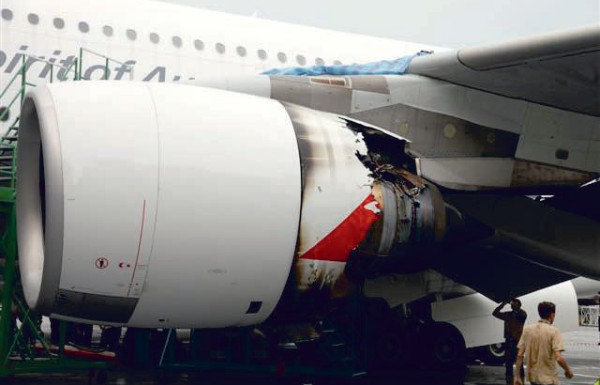
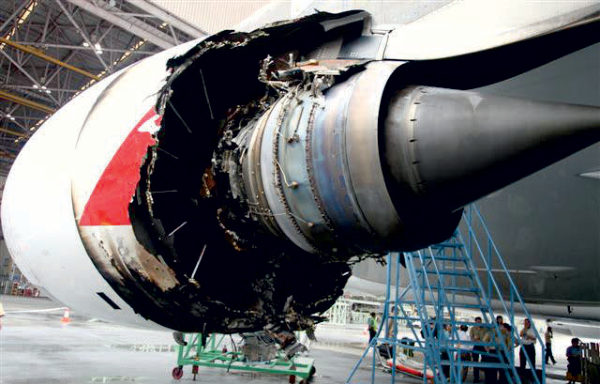
Figure 2 QF32 n°2 engine after it sustained an uncontained failure of the Intermediate Pressure (IP) turbine disc
Tasksharing should be adapted to the prevailing situation (i.e. tasksharing for hand flying or with the Auto Pilot engaged, task sharing for normal operation or for abnormal / emergency conditions) and tasks should be accomplished in accordance with the following priorities:
MONITORING role, which is why Airbus will be changing its documentation over the next year to fully reflect and highlight the importance of Pilot Monitoring (PM). Wherever you see PNF, think PM!
Both pilots must remain focused on their task as PF or PM, not allow anything to distract them. This is what we mean by appropriate tasksharing.
3.1.1 Fly
Section titled “3.1.1 Fly”The Pilot Flying (PF) must focus on flying the aircraft by controlling and / or monitoring the pitch attitude, bank angle, airspeed, thrust, sideslip, heading etc. to capture and maintain the desired vertical and lateral flight path.
Both pilots must maintain their Situational Awareness and immediately resolve any uncertainty as a crew.
3.1.2 Navigate
Section titled “3.1.2 Navigate”Navigate can be summarized by the following three statements of situational awareness:
The Pilot Not Flying (PNF) must assist the Pilot Flying (PF) by actively monitoring all flight parameters and actively directing the attention of the PF to any excessive deviation. Actively monitoring is a key message, we want to emphasize the
-
q Know where you are
-
q Know where you should be
-
q Know where the weather, terrain and obstacles are.
3.1.3 Communicate
Section titled “3.1.3 Communicate”Effective crew communication includes communication between:
-
q The PF and the PM
-
q The flight crew and air traffic control
-
q The flight crew and the cabin crew or any other crew on-board
q The flight crew and ground crew. Effective communication enables the sharing of goals and intentions and enhances situational awareness. To ensure positive communication, the flight crew must use standard phraseology and applicable callouts.
3.2 use the appropriate level of automation at all times
Section titled “3.2 use the appropriate level of automation at all times”To fly the aircraft the crew must comply with `Golden Rule number 2. On highly automated and integrated aircraft, several levels of automation are available to perform a given task. The appropriate level of automation depends on the situation and task; taking into account the forecast or actual weather, any malfunction or crew incapacitation. Pilot judgment prevails for the choice of automation level, including the choice to fly manually.
-
q Understand the implication of the intended level of automation
-
q Select the intended level
-
q Confirm the aircraft responds as expected.
-
q By PM taking action, again we want to emphasize the PM function and its essential role in flight safety:
To sum up:
-
q Monitor your FMA
-
q Announce your FMA
-
q Confirm your FMA
-
Questioning, and if that is not enough
-
q Understand your FMA.
-
Challenging, and if that is still not enough
Finally, if any problems occur, refer to the Golden Gule number 4.
- Taking-over.
3.4 Take action if things do not go as expected
Section titled “3.4 Take action if things do not go as expected”Never assume that any crewmember is aware of a particular threat, error or deviation and remember that incapacitation may be subtle; act before it is too late.
If the aircraft does not follow the desired vertical or lateral flight path or the selected target, the crew should react without delay:
-
q By PF changing the level of automation:
-
From managed guidance to selected guidance, or
-
From selected guidance to manual flying; or
4. Conclusion
Section titled “4. Conclusion”-
Fly, navigate and communicate:
-
1 In this order and with appropriate tasksharing
-
2 Use the appropriate level of automation at all times
This leads us to Golden Rule number 3.
- 3 Understand the FMA at all times
3.3 understand the FMA at all times
Section titled “3.3 understand the FMA at all times”Any action on the FCU, or on the MCDU/KCCU, should be confirmed by crosschecking the corresponding annunciation or data on the PFD or ND.
At all times, the PF and PM should be aware of:
-
q The armed or engaged modes
-
q The guidance targets set
-
4 Take action if things do not go as expected
Apply these Golden Rules, use them always and support each other. The rules have been proven to make a difference. Just like the crew of Qantas QF 32, remember to always…
Fly the Aircraft …….. Fly the Aircraft…… Fly the Aircraft
-
q The aircraft response in terms of attitude, speed and trajectory, etc
-
q Any mode transitions or reversions.
Safety
大卫·欧文斯
Section titled “大卫·欧文斯”培训政策高级总监
从 PNF 到 PM 飞行员的黄金法则
Section titled “从 PNF 到 PM 飞行员的黄金法则”2010年11月4日,澳航QF32航班在从新加坡樟宜机场起飞后不久遭遇了非包容性发动机故障。
此类事件极为罕见且不可预测,因此没有相应的程序可供执行。A380 机组人员通过应用一套简单的基本规则成功应对了这一事件,这些规则被称为”飞行员黄金法则”。
2. 澳航 QF32 航班
Section titled “2. 澳航 QF32 航班”澳大利亚运输安全局(ATSB)初步报告,2010年12月3日发布:
2010年11月4日,协调世界时(UTC)01:57,一架空中客车 A380 飞机(注册号 VH-OQA,即 OQA)作为澳航32号航班从新加坡樟宜机场20号跑道中线(20C)起飞,飞往澳大利亚新南威尔士州悉尼。机上共有5名飞行机组、24名客舱乘务员和440名乘客(机上人员总计469人)。
起飞正常后,机组收上了起落架和襟翼。机组报告称,在爬升过程中保持250节空速、通过7000英尺平均海平面高度时,他们听到了两声几乎同时发生的”巨响”,随后不久便出现了2号发动机失效的指示。机组向新加坡空中交通管制通报了情况,并获得雷达引导进入等待航线。机组在返航新加坡着陆前执行了一系列动作。机上机组和乘客均无报告受伤。随后对飞机的检查表明,2号发动机发生了中压(IP)涡轮盘的非包容性故障。脱落的涡轮盘碎片穿透了左机翼和左翼身整流罩,造成了飞机的结构损坏和系统损伤。
安全
在多次采访和声明中,机组人员认为驾驶舱资源管理(CRM)使他们能够有效应对这一挑战性事件。他们提到了”行动中的协同”,这是 CRM 的目标,以及有效的团队协作。他们有充足的燃油,因此有足够的时间和选择。他们认可飞机卓越的性能以及他们的培训和知识。
3. 黄金法则
Section titled “3. 黄金法则”当天 QF32 航班驾驶舱,机长戴维·埃文斯说:
“从培训的角度来看,无论你驾驶的是什么飞机,飞行技能必须占据主导。事实上,空客有一些黄金法则,我们在那天都遵守了——飞行、导航、通信——按此顺序。”
皇家航空学会,2010年12月6日
那么,黄金法则是什么?何时使用?为什么?
以下四项飞行员黄金法则适用于所有正常操作以及任何非正常或紧急情况:
-
q 飞行、导航和通信
-
q 始终使用适当的自动化等级
-
q 始终理解 FMA(飞行方式指示器)
-
q 如果情况不如预期,采取行动。
3.1 飞行、导航和通信
Section titled “3.1 飞行、导航和通信”按此顺序并配合适当的任务分工。
正如 QF32 航班机组所述,在任何事件中和任何时候,首要任务都是飞行——这是第一条黄金法则。
图2 QF32 二号发动机中压涡轮盘非包容性故障后的状态
任务分工应根据当前情况调整(即手动飞行的任务分工或自动驾驶仪接通时的任务分工,正常操作的任务分工或非正常/紧急情况的任务分工),并应按以下优先级完成任务:
监控角色,这就是为什么空客将在未来一年内更改其文档,全面反映并强调监控飞行员(PM)的重要性。无论你在哪里看到 PNF,都要想到 PM!
两名飞行员必须专注于各自作为 PF 或 PM 的任务,不允许任何事物分散他们的注意力。这就是我们所说的适当任务分工。
3.1.1 飞行
Section titled “3.1.1 飞行”操纵飞行员(PF)必须专注于飞行,通过控制或监控俯仰姿态、坡度角、空速、推力、侧滑、航向等来获取并保持所需的垂直和水平飞行轨迹。
两名飞行员都必须保持情景意识,并立即作为机组解决任何不确定性。
3.1.2 导航
Section titled “3.1.2 导航”导航可归纳为以下三条情景意识声明:
不操纵飞行员(PNF)必须通过积极监控所有飞行参数并主动将操纵飞行员(PF)的注意力引导到任何过度偏差上来协助 PF。 积极监控是一个关键信息,我们强调这一点,这就是为什么空客将改变其文档,在未来一年内全面反映并突出监控飞行员(PM)的重要性。无论你在哪里看到 PNF,都要想到 PM!
-
q 知道你在哪里
-
q 知道你应该在哪里
-
q 知道天气、地形和障碍物在哪里。
3.1.3 通信
Section titled “3.1.3 通信”有效的机组通信包括以下各方之间的通信:
-
q PF 与 PM 之间
-
q 飞行机组与空中交通管制之间
-
q 飞行机组与客舱乘务组或机上任何其他机组之间
-
q 飞行机组与地面机务之间
有效的通信能够实现目标和意图的共享,并增强情景意识。为确保积极有效的沟通,飞行机组必须使用标准术语和适当的喊话。
3.2 根据实际情况选择适当的自动化等级
Section titled “3.2 根据实际情况选择适当的自动化等级”机组必须遵守黄金规则第 2 条。在高度自动化和综合化的飞机上,可使用多个自动化等级来执行特定任务。自动化等级的选取取决于当时的情况和任务,同时需要考虑预报或实际的天气状况、任何故障或机组失能情况。自动化等级的选择权归属于飞行员判断,包括选择手动飞行。
-
q 理解所选自动化等级的影响
-
q 选择预期的自动化等级
-
q 确认飞机响应符合预期
-
q PM 采取行动,我们再次强调 PM 职能及其在飞行安全中的关键作用:
总结:
-
q 监控 FMA
-
q 宣布 FMA
-
q 确认 FMA
-
质疑,若质疑不够
-
q 理解 FMA
-
挑战,若挑战仍不够
最后,若发生任何问题,请参阅黄金规则第 4 条。
- 接管
3.4 如情况未按预期发展,应采取行动
Section titled “3.4 如情况未按预期发展,应采取行动”切勿假设任何机组员已意识到特定的威胁、错误或偏差,并记住失能可能表现隐匿;应及早行动,以免为时已晚。
若飞机未按预期的垂直或侧向航径飞行,或未达所选目标,机组应及时做出反应:
-
q PF 更改自动化等级:
-
从管理引导转为选择引导,或
-
从选择引导转为手动飞行;或
-
飞行、导航和通讯:
-
1 按此顺序并合理分工
-
2 在任何时候使用适当的自动化等级
这就引出了我们的黄金规则第 3 条
- 3 始终理解 FMA
3.3 始终理解 FMA
Section titled “3.3 始终理解 FMA”对 FCU 或 MCDU/KCCU 进行任何操作后,均应通过交叉检查 PFD 或 ND 上相应的显示或数据来进行确认。
在任何时候,PF 和 PM 都应了解:
-
q 已预位或已接通的方式
-
q 已设置的引导目标
-
4 如情况未按预期发展,应采取行动
运用这些黄金规则,始终遵守,并相互支持。这些规则已被证明能够起到关键作用。正如澳航 QF 32 航班机组一样,请始终记住……
飞好飞机 …….. 飞好飞机…… 飞好飞机
-
q 飞机的响应,包括姿态、速度和航迹等
-
q 任何方式的转换或回复
Safety