A340 Thrust Reverser Unlocked
Source: Airbus Safety First URL: https://safetyfirst.airbus.com/a340-thrust-reverser-unlocked/ Published: 2006-12-14 Magazine Issue: 2006-12 Category: Archive PDF: Original PDF
By:Vincent SWIDERSKI A340 Propulsion System Engineer CFM56-5C Per-Oliver GUENZEL
A330/A340 Flight Safety Coordinator
1 Introduction
Section titled “1 Introduction”The CFM56-5C engine (fitted on A340-200 and 300) has a Thrust Reverser with 4 pivoting doors. As soon as one incorrectly locked thrust reverser door is detected, an “ENG X REV UNLOCKED” warning comes up on the ECAM warning display.
In the past, most “ENG X REV UNLOCKED” warnings were spurious. This is not the case any more, as this phenomenon has been understood and cured.
Today, most of the events are actual ones and the repetitive occurrences are due to a lack of troubleshooting as detailed hereafter.
2 Histor y
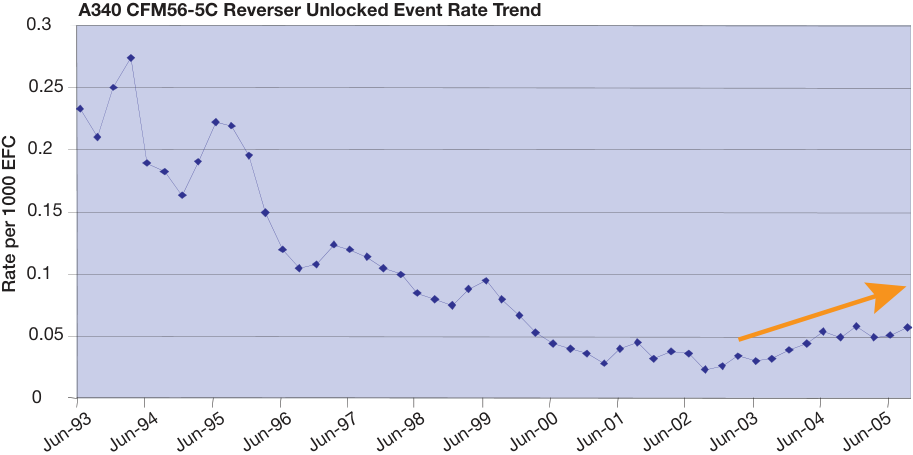
Section titled “2 Histor y”Since Entry Into Service, various operators are impacted by Rev Unlocked warnings. Airbus, CFM, Goodrich and Aircelle are carrying out a continuous improvement of the system. It began in August 1996 with issuance of the “ATO package” Service Bulletin (Ref A). This SB provided a first answer to the Rev Unlock phenomenon knowledge at that time. It has been followed by several other SB and led to decrease the Rev Unlock rate to under 0.05 events per 1000 Engine Flight Cycles.
However, this rate has been rising again in the last 2 years, as highlighted on Figure 1.
3 Thrust Reverser
Section titled “3 Thrust Reverser”system description
Section titled “system description”The CFM56-5C Thrust Reverser is hydraulically commanded. Each pivoting door is motioned by an actuator and secured in closed position by a locking system.
The selection of the Thrust Reverse mode sends hydraulic pressure, which opens the locking system and deploys the pivoting doors actuators.
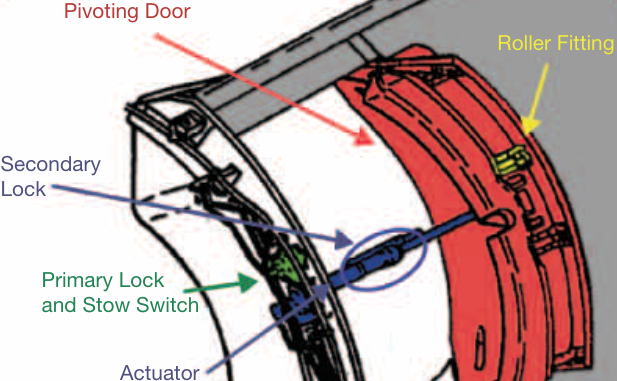
The primary lock
Section titled “The primary lock”It is the main locking element. It consists of a rotating cam located on the Thrust Reverser’s forward frame, which hooks on a roller fitting fixed on the pivoting door.
The secondary lock
Section titled “The secondary lock”It ensures that the door stays closed in case the primary lock fails.
It is composed of 4 integrated “locking fingers” located in the pivoting door actuator body.
The locking system is composed of 2 mechanical retention means (Fig 2):
4 “ ENG X Rev Unlocked ” root causes
Section titled “4 “ ENG X Rev Unlocked ” root causes”The continuous feedback from the operators allowed identifying that the primary lock rotating cam can fail to hook the roller-fitting due to:
G An insufficient actuator stroke;
- G An incorrect rigging of the roller fitting;
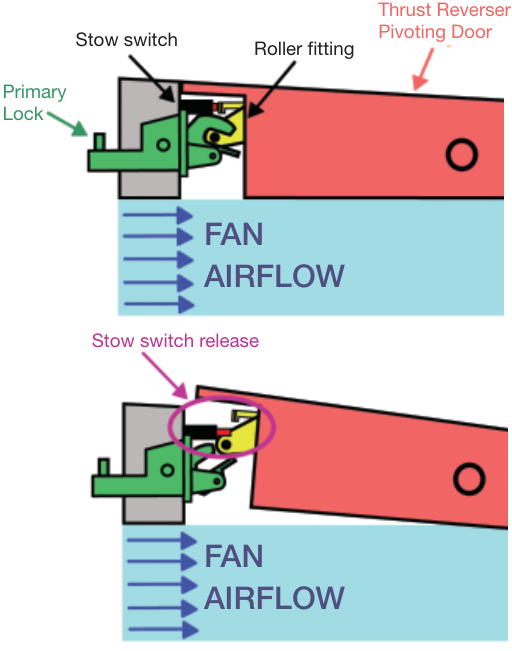
When the locking system is not pressurized, the secondary lock is engaged, ready to retain the actuator in its almost full-retracted position. If the primary lock fails, the door will extend slightly above the flush position before the secondary lock engages. In that case, the stow switch sensor is released (Fig 3), which leads to the generation of an “ENG X REV UNLOCKED” warning on the ECAM.
- G An undesirable hydraulic pressure spike in the actuation system, which can prevent the primary lock from hooking completely.
5 O erational im act p p and maintenance actions
The above-described root causes usually lead to an unstable position of the primary lock between open and closed position. This unstable position switches to the open position (secondary lock activated) during the following flight due to engine acceleration/vibration. In most cases this happens during the takeoff run. An “ENG X REV UNLOCKED” warning is triggered and the crew performs a Rejected Take Off.
Maintenance will find a pivoting door ajar on the affected engine. Pushing the door back in its closed position will engage the primary lock and clear the issue for the next takeoff. But as the root cause has not been addressed it is likely that an “ENG X REV UNLOCKED” will appear after some thrust reverser actuations.
This is why troubleshooting has to be done in accordance with Ref. D or E in order to find the root cause and to apply the appropriate corrective action.
Fig 3: Release of the stow switch with Primary lock open
If the need to operate the aircraft does not allow any troubleshooting, the Thrust Reverser should be deactivated as per the MEL (Ref F).
6 Preventive maintenance and permanent solution
Section titled “6 Preventive maintenance and permanent solution”The various investigations emphasized the importance of adhering to several maintenance practices in order to prevent the “Rev Unlocked” events.
CFM/Goodrich have released the Best Practices Manual (BPM) in January 2005.
It has proven to be very effective when applied at every C-check, but it was only applied by 25% of the operators.
To ensure a fleet-wide application, the BPM has been included in a Service Bulletin (Ref C) that is referenced as a scheduled maintenance task at each ‘C’ in the MPD (ref. H).
In addition to those practices, a final solution will introduce a set of improvements to the locking system by addressing the above root causes. See also ref. G for further information.
7 Conclusion
Section titled “7 Conclusion”Airbus permanent effort on the “Rev Unlocked” warning has eliminated the spurious triggering known from the early days of the A340-300.
-
Today, the majority of the events are due to actual Thrust Reverser door unlocks. Therefore: G Adhere strictly to the ECAM procedure, which instructs to select idle on the affected engine, even if that engine has already been automatically reduced to idle by the FADEC;
-
G Apply proper troubleshooting before the next flight to avoid re-occurrence, or deactivate the Thrust Reverser if you can not complete the troubleshooting;
-
G Perform preventive maintenance, in the form of a MPD task every ‘C’ check, to minimize the operational interruptions due to “Rev Unlocked” events.
REFERENCES
Section titled “REFERENCES”A) SB RA34078-27 B) SB RA340A78-56 C) SB RA34078-88 D) TSM tasks 78-31-00-810967/968/969/970
- E) Goodrich AOL A340/CFM56-04-047 REVISION 1
F) MEL 78-30-01 G) TFU 78.30.00.052 H) MPD task 783241-C4-1
A340 Thrust Reverser Unlocked
Section titled “A340 Thrust Reverser Unlocked”作者:Vincent SWIDERSKI A340 CFM56-5C 推进系统工程师 Per-Oliver GUENZEL
A330/A340 飞行安全协调员
CFM56-5C 发动机(装配于 A340-200 和 300)配备有 4 个旋转门的反推装置。一旦检测到一个未正确锁定的反推门,ECAM 警告显示器上会出现”ENG X REV UNLOCKED”(X 号发动机反推未锁定)警告。
过去,大多数”ENG X REV UNLOCKED”警告为虚警。情况现已改变,该现象的机理已被阐明并得到解决。
如今,大多数事件为真实故障,重复发生的原因在于缺乏如后文详述的故障排除工作。
自投入服役以来,多家运营商受到反推未锁定警告的影响。空客、CFM、Goodrich 和 Aircelle 正在对系统进行持续改进。1996 年 8 月首次发布”ATO 方案”服务通告(参考文献 A)。该服务通告在当时为反推未锁定现象提供了首个解决方案。此后又发布多项服务通告,将反推未锁定率降低至每 1000 发动机飞行循环 0.05 次事件以下。
然而,过去两年该比率再次上升,如图 1 所示。
3 反推系统说明
Section titled “3 反推系统说明”CFM56-5C 反推系统由液压控制。每个旋转门由一个作动筒驱动,并通过锁定系统固定在关闭位置。
选择反推模式后,液压压力打开锁定系统并展开旋转门作动筒。
主锁
主锁是主要的锁定元件,由安装在反推前框架上的旋转凸轮组成,凸轮钩住固定在旋转门上的滚轮配件。
副锁
副锁确保在主锁失效时门保持关闭状态。
它由安装在旋转门作动筒体内的 4 个集成”锁止指”组成。
锁定系统由 2 种机械保持装置组成(图 2):
4 “ENG X REV UNLOCKED”根本原因
Section titled “4 “ENG X REV UNLOCKED”根本原因”根据运营商的持续反馈,已确认主锁旋转凸轮可能因以下原因未能钩住滚轮配件:
- 作动筒行程不足;
- 滚轮配件调节不正确;
当锁定系统未加压时,副锁啮合,准备将作动筒保持在其几乎完全收回的位置。如果主锁失效,门将在副锁啮合之前略微伸展超过齐平位置。在这种情况下,收纳开关传感器释放(图 3),导致 ECAM 上产生”ENG X REV UNLOCKED”警告。
- 作动系统中不良的液压压力峰值,可能阻止主锁完全钩住。
5 运行影响及维护措施
Section titled “5 运行影响及维护措施”上述根本原因通常导致主锁在打开和关闭位置之间处于不稳定状态。由于发动机加速/振动,该不稳定状态在后续飞行中切换至打开位置(副锁激活)。大多数情况发生在起飞滑跑期间。触发”ENG X REV UNLOCKED”警告后,机组执行中断起飞。
维护人员将发现受影响发动机上的旋转门半开。将门推回关闭位置将使主锁啮合,并清除下一批次起飞时的故障。但由于根本原因未被处理,在若干次反推作动后很可能再次出现”ENG X REV UNLOCKED”。
因此,必须按照参考文献 D 或 E 进行故障排除,以找出根本原因并采取适当的纠正措施。
图 3:主锁打开时收纳开关的释放
如果飞机需要继续运行而不允许进行故障排除,应按照最低设备清单(MEL)(参考文献 F)停用反推装置。
6 预防性维护和永久解决方案
Section titled “6 预防性维护和永久解决方案”各项调查强调了遵守若干维护规范以防止”反推未锁定”事件的重要性。
CFM/Goodrich 于 2005 年 1 月发布了最佳实践手册(BPM)。
实践证明,在每次 C 检时执行该手册效果显著,但仅有 25% 的运营商采纳。
为确保机队全面应用,BPM 已纳入服务通告(参考文献 C),并作为 MPD(参考文献 H)中每次”C 检”的计划维护任务被引用。
除上述措施外,最终解决方案将通过解决上述根本原因,引入锁定系统的一系列改进。更多信息请参阅参考文献 G。
空客对”反推未锁定”警告的持续努力已消除了 A340-300 早期出现的虚警触发现象。
- 如今,大多数事件是由于实际反推门未锁定所致。因此:
- 严格遵守 ECAM 程序,该程序指示在受影响发动机上选择慢车,即使该发动机已被 FADEC 自动降至慢车;
- 在下一飞行前进行适当故障排除以避免再次发生,或在无法完成故障排除时停用反推装置;
- 按照 MPD 任务在每次”C 检”时执行预防性维护,以最大程度减少”反推未锁定”事件造成的运行中断。
A) SB RA34078-27 B) SB RA340A78-56 C) SB RA34078-88 D) TSM 任务 78-31-00-810-967/968/969/970
- E) Goodrich AOL A340/CFM56-04-047 修订版 1
F) MEL 78-30-01 G) TFU 78.30.00.052 H) MPD 任务 783241-C4-1